





What is the plywood import duty EU from Vietnam?
The EVFTA preferential customs duty can be 0% for qualifying Vietnamese plywood supplied by HCPLY, but the applicable rate must be checked against the exact EU tariff code and import date. The European Commission’s 2026 Access2Markets guidance says that preferential treatment requires both qualifying origin and the prescribed proof. A Vietnamese shipping address alone does not establish that origin.
For HCPLY orders, the practical sequence is to identify the face and construction, classify the finished panel, verify the manufacturing record, and obtain the correct origin document. The rate in the EU–Vietnam Free Trade Agreement (EVFTA) is separate from import VAT and any trade-remedy measure applicable to the specific product and origin. A wrong declaration can lead to duty recovery, customs queries, storage charges, or a delayed release.
Use the broader plywood import duty by country reference when comparing destinations. For a binding import decision, the EU importer should match the actual ten-digit TARIC classification, entry date, origin and applicable measures with its customs representative.
Which EVFTA tariff line applies to each plywood group?
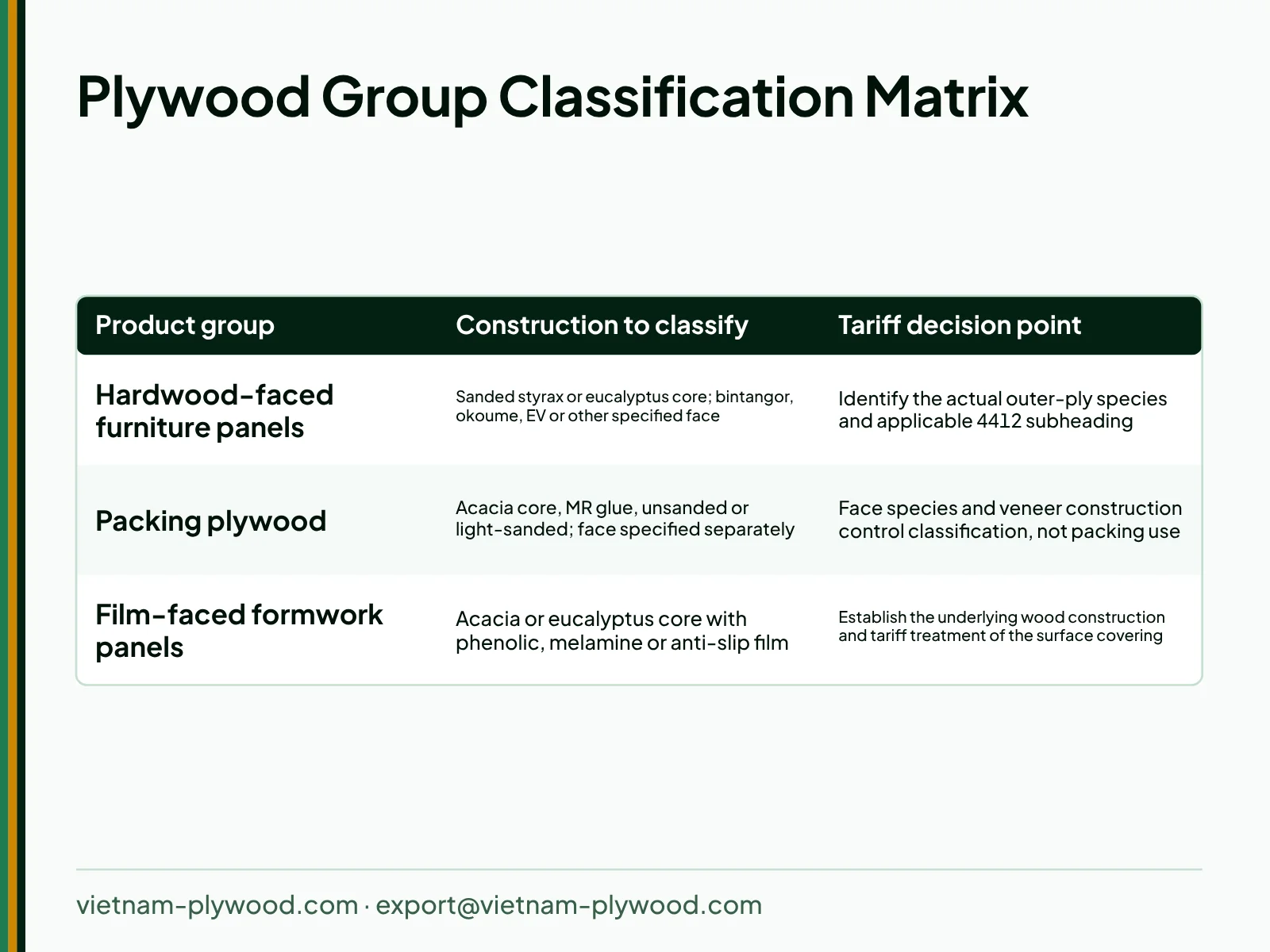
The tariff line follows the panel’s customs characteristics, especially the outer veneer species and whether the product meets the plywood definition. A furniture, packing or film-faced sales label does not independently determine the tariff heading. HS 4412 covers plywood, veneered panels and similar laminated wood; the EU’s tariff schedule then subdivides that heading.
| HCPLY product group | Construction to classify | Tariff decision point | Manufacturing line |
|---|---|---|---|
| Hardwood-faced furniture panels | Sanded styrax or eucalyptus core; bintangor, okoume, EV or other specified face | Identify the actual outer-ply species and applicable 4412 subheading | Our furniture line |
| Packing plywood | Acacia core, MR glue, unsanded or light-sanded; face specified separately | Face species and veneer construction control classification, not packing use | Our commercial and packing line |
| Film-faced formwork panels | Acacia or eucalyptus core with phenolic, melamine or anti-slip film | Establish the underlying wood construction and tariff treatment of the surface covering | Our construction line |
The European Commission’s EVFTA agreement-text index lists the Union’s tariff schedule in Appendix 2-A-1. Historical subheadings are not a current declaration template; check the import-date Combined Nomenclature and TARIC classification.
An okoume face, an engineered veneer face and a film surface call for different classification evidence. Send a species declaration, cross-section photograph and product specification before asking the importer to settle the current tariff line. The furniture plywood specification page gives the product context.
Does an imported face veneer on a Vietnamese core qualify?
An imported face veneer can be used in plywood that qualifies for EVFTA preference if the completed panel satisfies the applicable product-specific origin rule and other protocol conditions. The face’s foreign origin is a material fact to document, not an automatic disqualification. Equally, pressing a foreign face onto a finished imported plywood panel is a different manufacturing case from building plywood from separate veneers.
The European Commission’s 2026 Access2Markets explanation distinguishes products made from originating materials from products made using non-originating inputs after sufficient working or processing. For our furniture line, the producing factory can document the received face veneer, core veneers, lay-up and pressing stages. Those records allow an importer to assess the rule against the actual materials and manufacturing steps.
For example, a separately imported veneer sheet is classified differently from completed plywood. Its conversion into a pressed multilayer panel must be tested against the EVFTA Annex II rule for the final heading. A purchase invoice that merely says ‘Vietnam plywood’ cannot substitute for input classification and production evidence.
What origin rule does plywood under HS 4412 have to meet?
Plywood under HS 4412 must meet the product-specific rule in the EVFTA origin protocol’s current Annex II, alongside the protocol’s insufficient-processing and non-alteration conditions. Check the rule for the precise heading and the version applicable on the import date. A change in tariff classification is a different test from a minimum local-content percentage.
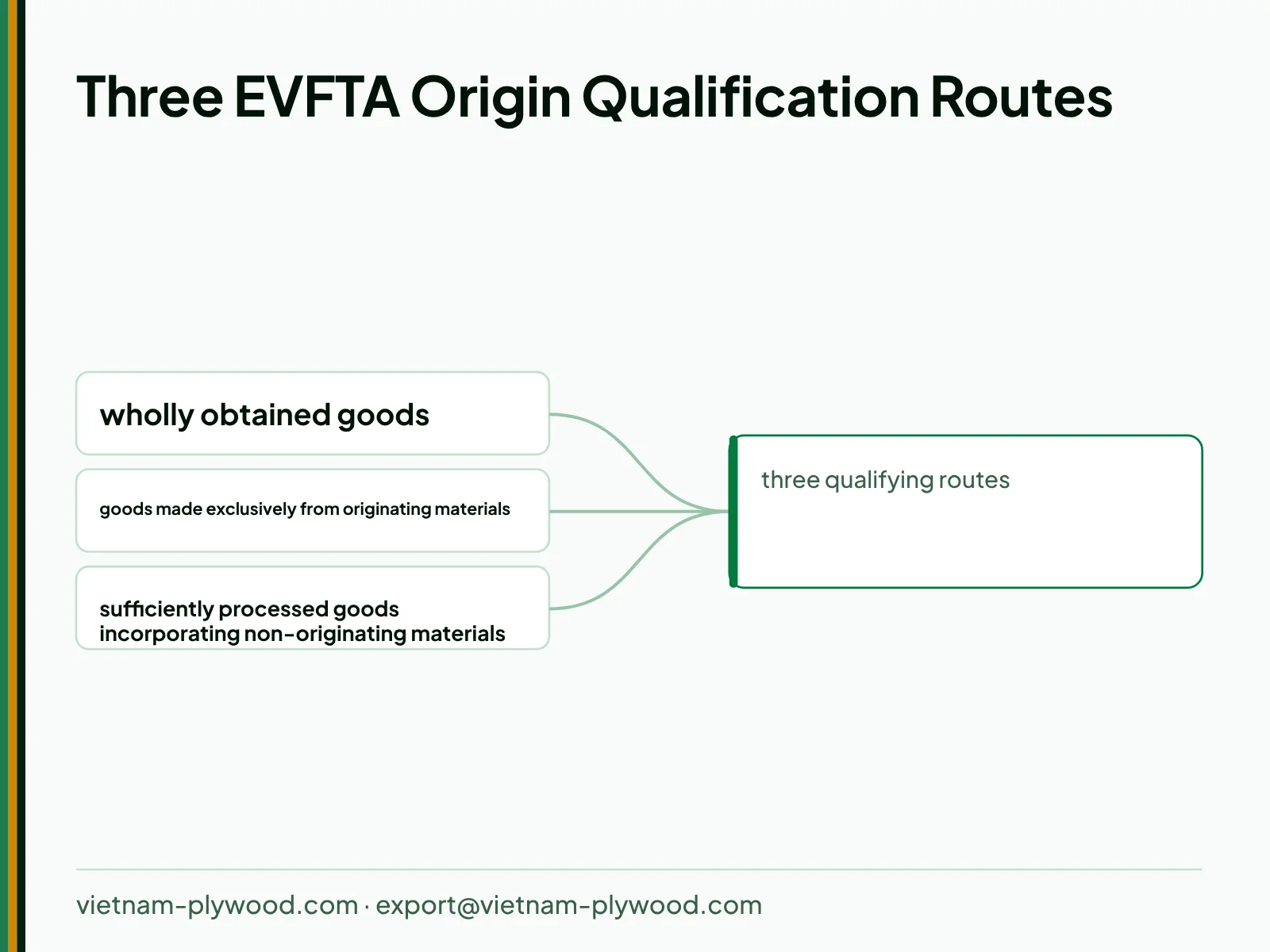
The European Commission’s 2026 Access2Markets guidance points to Decision No 2/2024, which updated the product-specific rules to the 2022 Harmonized System. It also identifies three qualifying routes: wholly obtained goods, goods made exclusively from originating materials, and sufficiently processed goods incorporating non-originating materials. For plywood made with imported veneer, the third route is the one to investigate.
Our factory evidence pack should identify the supplier and origin of each imported veneer, its input tariff classification, the final panel classification, and the work performed. Core-origin records and a press log are useful corroboration. A buyer should not infer that the Vietnamese core alone determines the finished panel’s preferential origin.
The exact wording of the current 4412 list rule should be checked directly in the operative Annex II before an origin claim is signed. An importer should also check whether any claimed cumulation is actually available for those inputs; ordinary third-country veneer does not become Vietnamese merely through purchase.
Is a REX statement the proof for a Vietnam-to-EU shipment?
A Registered Exporter (REX) statement is the established EVFTA route for qualifying EU-origin exports to Vietnam, not the default proof for commercial Vietnamese plywood entering the EU. The European Commission’s September 2026 Registered Exporter System guidance identifies EU exporters to Vietnam as users of REX. Confusing the export direction can leave an EU import entry without acceptable evidence.
For products originating in Vietnam, the Commission’s 2026 Access2Markets page identifies a certificate of origin and an origin declaration for qualifying small consignments. Its guidance describes a EUR.1 movement certificate issued by the competent Vietnamese authority, while an exporter declaration is available within the stated value threshold. It does not state that Vietnam has activated a general REX route for its exports to the EU.
For a normal commercial container, request the EUR.1 process early. The importer claims preference in the EU customs declaration using the applicable origin proof and its reference. A REX number on an unrelated invoice does not replace the correct Vietnamese export proof.
What does the producing factory need to show?
The producing factory should show a traceable link between imported veneer receipts, domestic core material, panel manufacture and the export lot. An inspector can witness the veneer lay-up and check press and packing records against the agreed product specification. This matters most when the face species changes between orders.
For a furniture build, our furniture line uses a full stitched, sanded styrax or eucalyptus core. Our commercial and packing line instead makes acacia-core MR panels, while our construction line presses film-faced panels using acacia or eucalyptus. Each line therefore has a distinct material record and finished appearance that an inspector can compare.
Ask to see the face species on the veneer purchase document, the core selection, the press batch and the finished bundle marks. The buyer can inspect goods at the producing factory and meet at the factory office. Factory-member certificates, including FSC, CARB P2, ISO 9001 and CE, are shown with factory details masked, on request; they do not replace preferential-origin evidence.
Which export papers support the EVFTA claim?
The EUR.1 certificate of origin is the shipment document that supports the preferential-origin claim for a qualifying Vietnam-to-EU commercial lot. It should match the invoice description, exporter, shipment and declared goods. HCPLY manages specification, on-site QC, export documents and loading, with shipment directly from the producing factory.
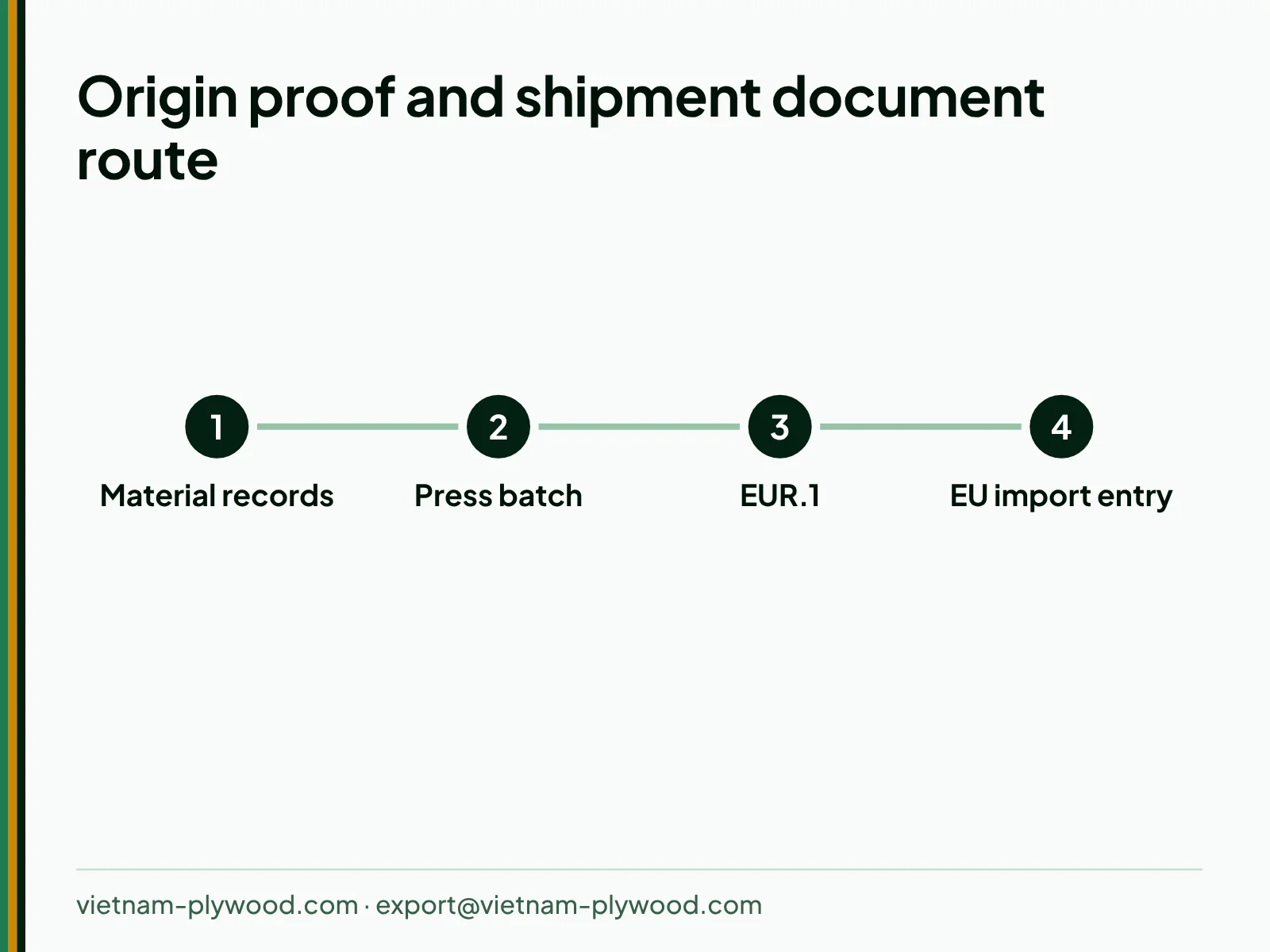
The export document set includes the commercial invoice, packing list, bill of lading, certificate of origin, phytosanitary and fumigation papers, and the EUTR/EUDR file set for EU lots. Insurance is included under CIF; order-specific FSC claims, emission certificates and agreed test reports accompany the shipment as applicable. After loading, the draft shipping documents come to you for approval.
The European Commission’s 2026 guidance also discusses the non-alteration requirement. If cargo is stored or split during transit, retain transport and customs-supervision evidence. That paper trail supports the origin claim independently of the plywood’s visual quality.
How do the face, glue and emission fields affect an order?
The face determines the product name and contributes to customs classification; the core determines the stated panel density. Glue and emission are separate specification fields. For our furniture line, styrax is 500 kg/m³ and eucalyptus is 650 kg/m³; our commercial and packing line uses acacia at 580 kg/m³.
Furniture panels use E0 or E1 emission classes, with the sanded thickness tolerance ordered as ±0.2 or ±0.3 mm. Commercial panels have ±0.5 mm tolerance and packing panels ±0.5–1.0 mm. The construction line offers 120 g/m² standard film, 135 g/m² premium film and 220 g/m² anti-slip film.
MR melamine glue has a 12-hour boil specification and WBP phenolic glue a 72-hour boil specification. These technical labels do not themselves establish tariff preference or EU regulatory compliance. Specify the actual face species, core and glue system separately so the customs and purchasing records describe the same goods.
Can different plywood groups share a trial container?
Different specifications can share one 40HC container within the 28.5 t payload limit. The number of sheets changes with core density, thickness and pallet count, so the customs invoice must still identify each product group distinctly. See mixed container loads and the container packing reference for loading details.
At 18 mm and 1220 × 2440 mm, a full styrax load is 990 sheets and 26.52 t, while a full acacia load is 880 sheets and 27.35 t. A full eucalyptus load is 795 sheets and 27.69 t. These figures exclude film weight and describe separate full-container examples, not an additive mixed load.
For a mixed order, calculate the tonnes for each selected pallet group and sum them before loading. Keep the face, core, glue and country-of-origin records attached to each invoice line. Our distributor supply programmes page covers repeat purchasing arrangements.
What changes the landed cost beyond the tariff?
Landed cost changes with the classified customs duty, product specification, freight, VAT and any applicable trade-remedy measure. A preferential rate only changes the eligible customs-duty component. It does not remove destination taxes, port charges or documentary requirements.
Within the product itself, a higher-grade decorative face and full stitched sanded core cost more to make than a basic packing build. Tighter thickness tolerance adds processing work. Film type, core density, glue and pallet configuration affect the delivered calculation; request a written quotation for the selected construction.
Our commercial plywood starts from US$250/m³ FOB Hai Phong (October 2026), and furniture plywood starts from US$350/m³ FOB Hai Phong (October 2026). These are indicative starting points, not a landed-cost comparison. We ship FOB Hai Phong, or CFR (CNF) or CIF to your port. For film-faced plywood, ask for a quotation against the complete specification.
What should an EU importer check before release?
Before release, the importer should reconcile the final tariff code, origin proof, product description and shipping records. The EU customs entry must reflect the real panel, including its outer veneer and construction. A mismatch can trigger a request for evidence even when the panels were physically manufactured in Vietnam.
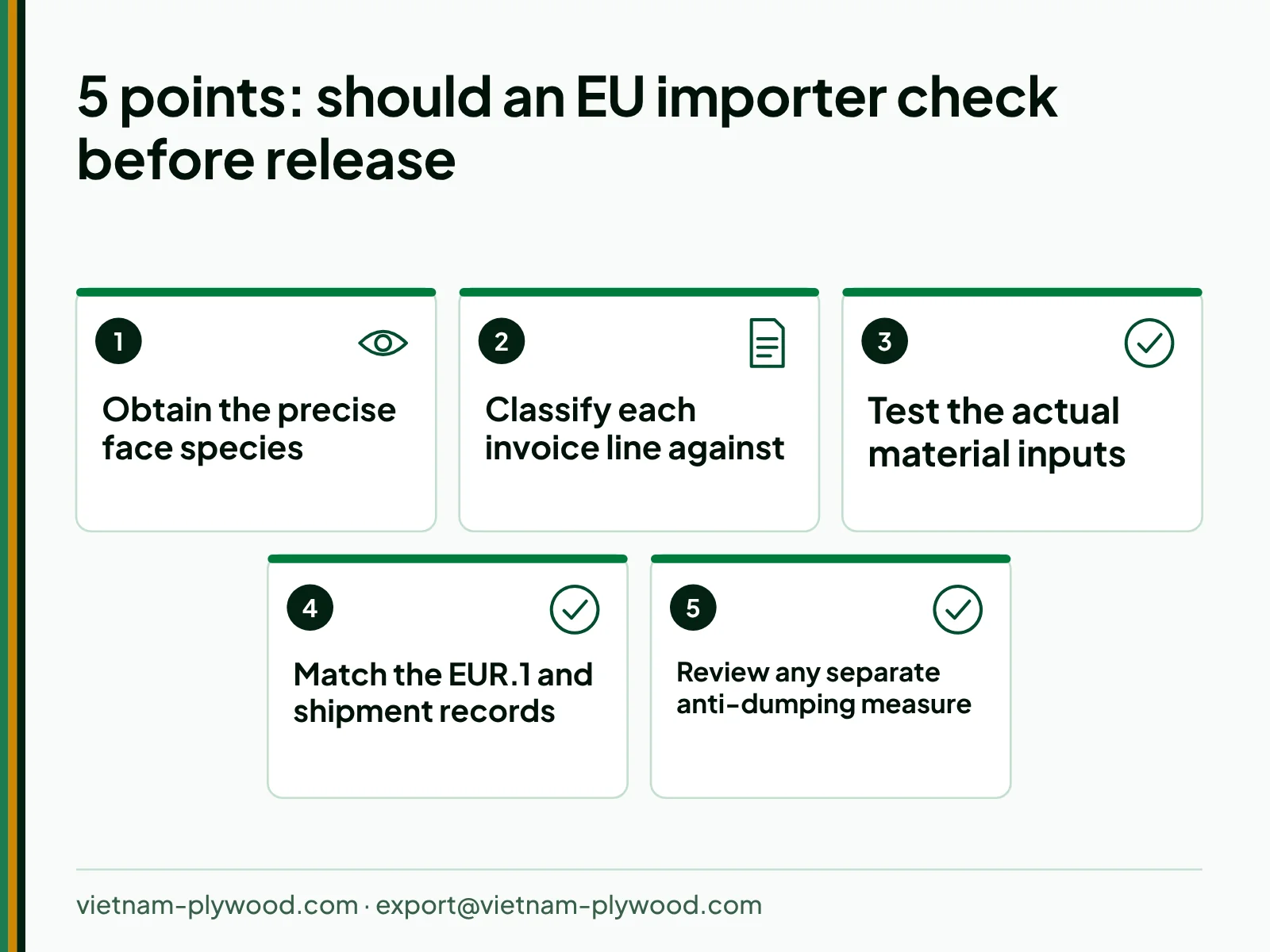
- Obtain the precise face species, core construction, thickness, surface treatment and manufacturing location.
- Classify each invoice line against the current EU Combined Nomenclature and TARIC measures.
- Test the actual material inputs and production steps against the current EVFTA Annex II origin rule.
- Match the EUR.1 and shipment records, including transit evidence where needed.
- Review any separate anti-dumping measure, VAT and product-compliance obligations before entry.
The European Commission’s 2026 Access2Markets page directs importers to its tariff assistant and rules-of-origin assessment tool. That is a better final check than treating an old HS code table or a general market comparison as an import ruling.
How should a buyer specify the first EU order?
A first EU order should describe the panel precisely enough for both production and customs classification. HCPLY’s three factories serve furniture, commercial packing and construction builds, with the selected order made at the appropriate site. Minimum order is one 40HC, and specifications can be mixed within the payload limit.
Factory lead time runs 15–45 days from receipt of the 30% deposit; the exact figure depends on order size, line loading and what the contract fixes. The remaining 70% is paid on the scan of the bill of lading, by T/T, or by irrevocable sight L/C. Samples cost nothing: a first-time buyer pays the courier, and that charge comes off the first confirmed order.
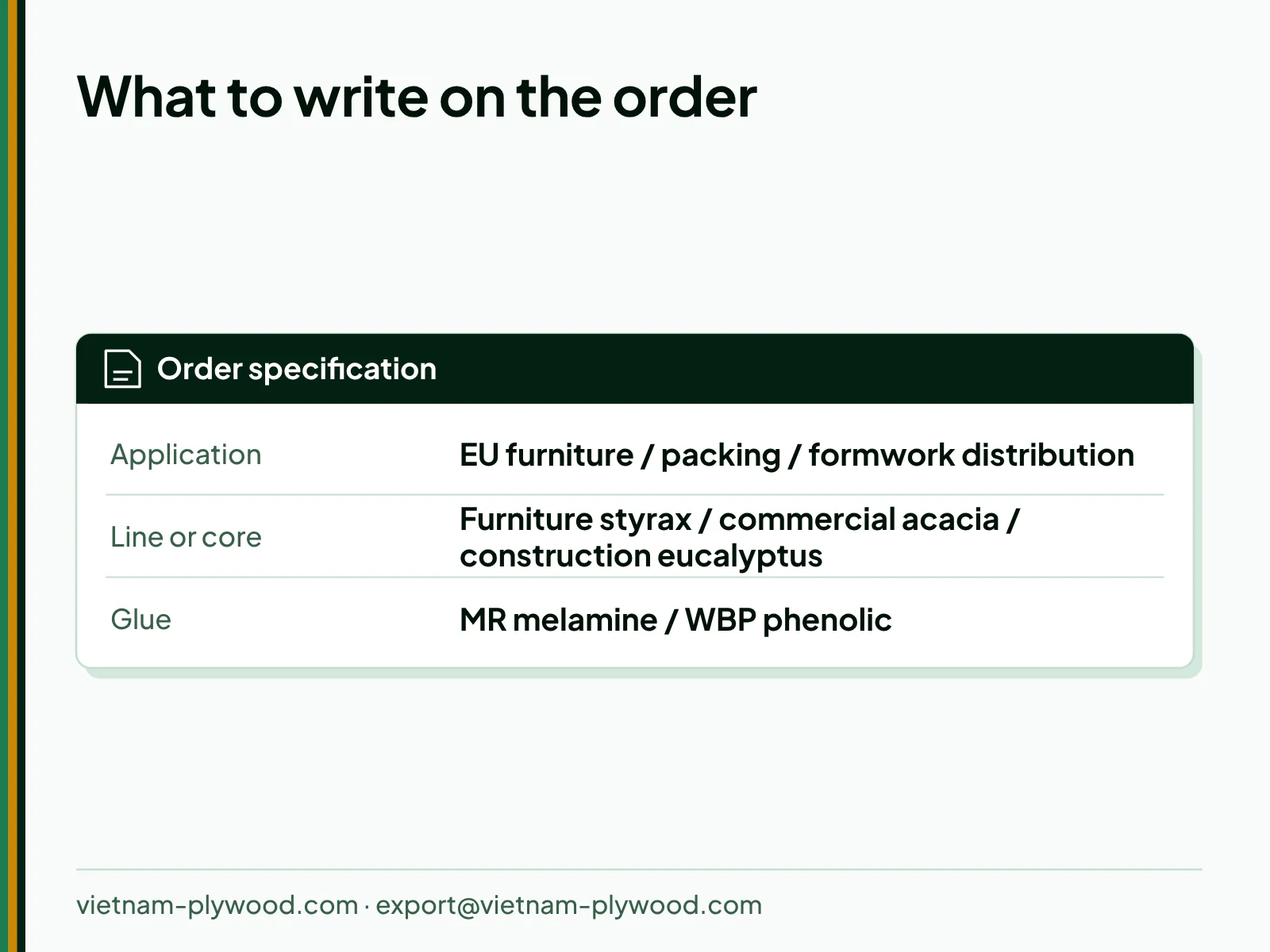
Send the following details to Lucy at export@vietnam-plywood.com, or use contact. Include the imported face’s source country if known, and ask for the production and origin-document plan alongside the quotation.
Application: EU furniture / packing / formwork distribution
Line or core: furniture styrax / commercial acacia / construction eucalyptus
Glue: MR melamine / WBP phenolic
Emission: E0 / E1 / E2 as specified
Face and grade: species, imported-face origin, A/B or applicable grade
Thickness and tolerance: mm and agreed tolerance
Size: length × width in mm
Quantity: sheets and container mix
Destination port: EU port and requested delivery term
Next step: plan a trial container with the selected line, face-species evidence and EUR.1 documentation requirements.