






HCPLY builds 4x8 plywood across furniture, commercial and construction lines, with different specifications and factory costs. Choosing a retail lookalike instead of an equivalent factory build can waste money or produce rejected panels. For US and Canadian importers, the useful 4x8 plywood price comparison converts a dated cubic-metre starting rate into a sheet value, then accounts for delivered costs.
What is the 4x8 plywood price from our factory lines?
HCPLY’s October 2026 starting references are from US$250/m³ FOB Hai Phong (October 2026) for commercial plywood and from US$350/m³ FOB Hai Phong (October 2026) for furniture plywood. A 4x8 sheet has no single factory price: thickness, face, core construction and bond determine the quoted build. Convert the cubic-metre rate using the ordered dimensions before comparing a local sheet price.
The broader Vietnam plywood export cost breakdown explains the other components of an import budget.
How do I convert a cubic-metre quote into a 4x8 sheet cost?
Multiply the rate in US dollars per cubic metre by length, width and thickness in metres. Our standard 4x8 format is 1220 × 2440 mm, giving an area of 2.9768 m². At 18 mm, its volume is 1.22 × 2.44 × 0.018 = 0.0535824 m³.
For a like-for-like arithmetic example, holding the commercial starting rate constant gives 0.0535824 × 250 = US$13.3956 of FOB value per 18 mm sheet. Holding the furniture starting rate constant gives US$18.75384. These calculations convert the dated starting rates; an actual thickness-specific quote also prices the requested construction. Do not read either calculation as a current retail or delivered sheet offer.
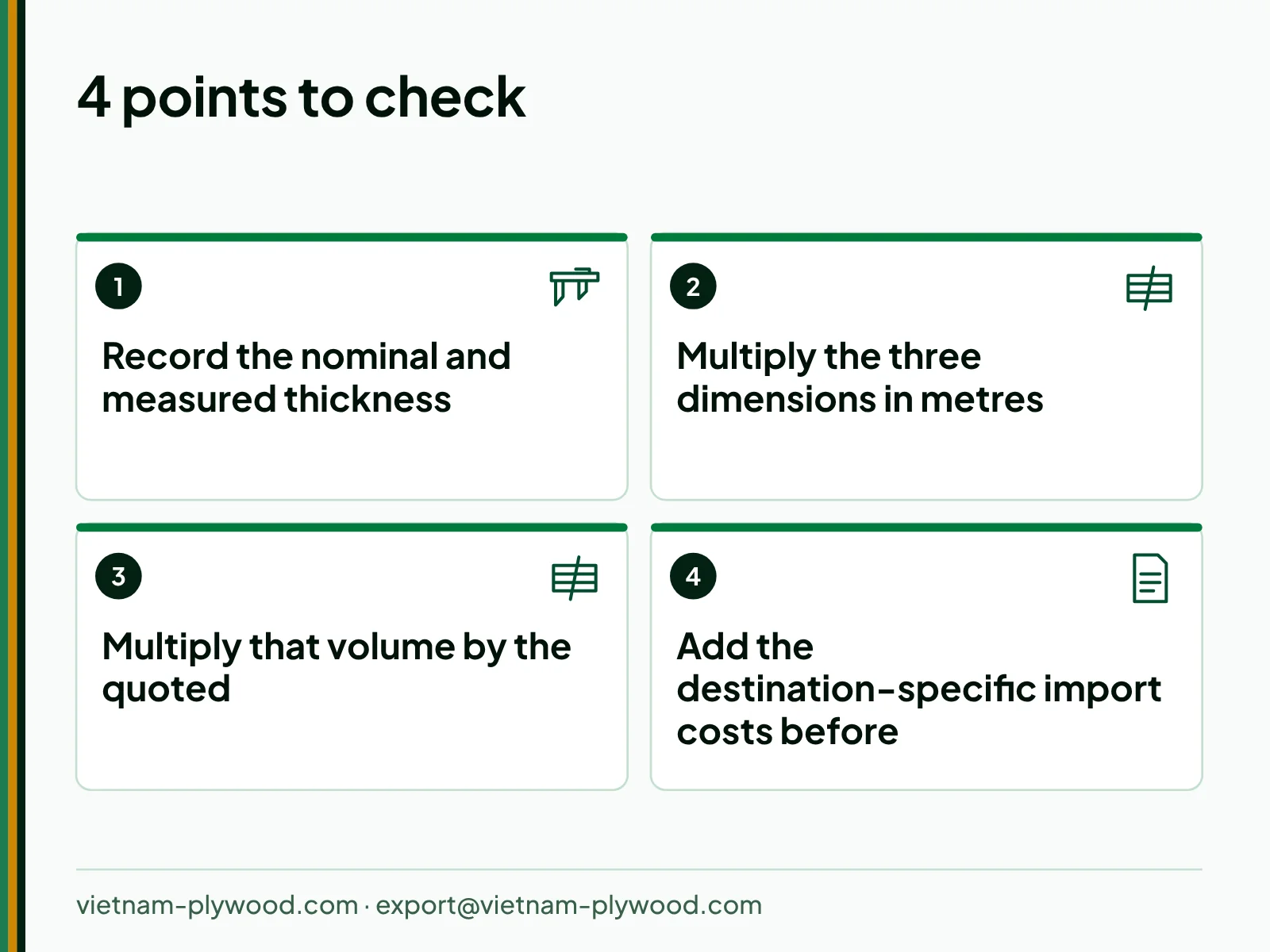
- Record the nominal and measured thickness in millimetres.
- Multiply the three dimensions in metres to find cubic metres per sheet.
- Multiply that volume by the quoted US$/m³ for the exact build.
- Add the destination-specific import costs before comparing with a local wholesale offer.
How does sheet cost change from 1/4 inch to 3/4 inch?
At a constant cubic-metre rate, sheet cost rises in direct proportion to thickness. North American inch labels should be reconciled with the metric thickness written on the purchase order. A nominal 1/4-inch sheet is about 6.35 mm, while 3/4 inch is 19.05 mm; those conversions do not specify which metric board is being ordered.
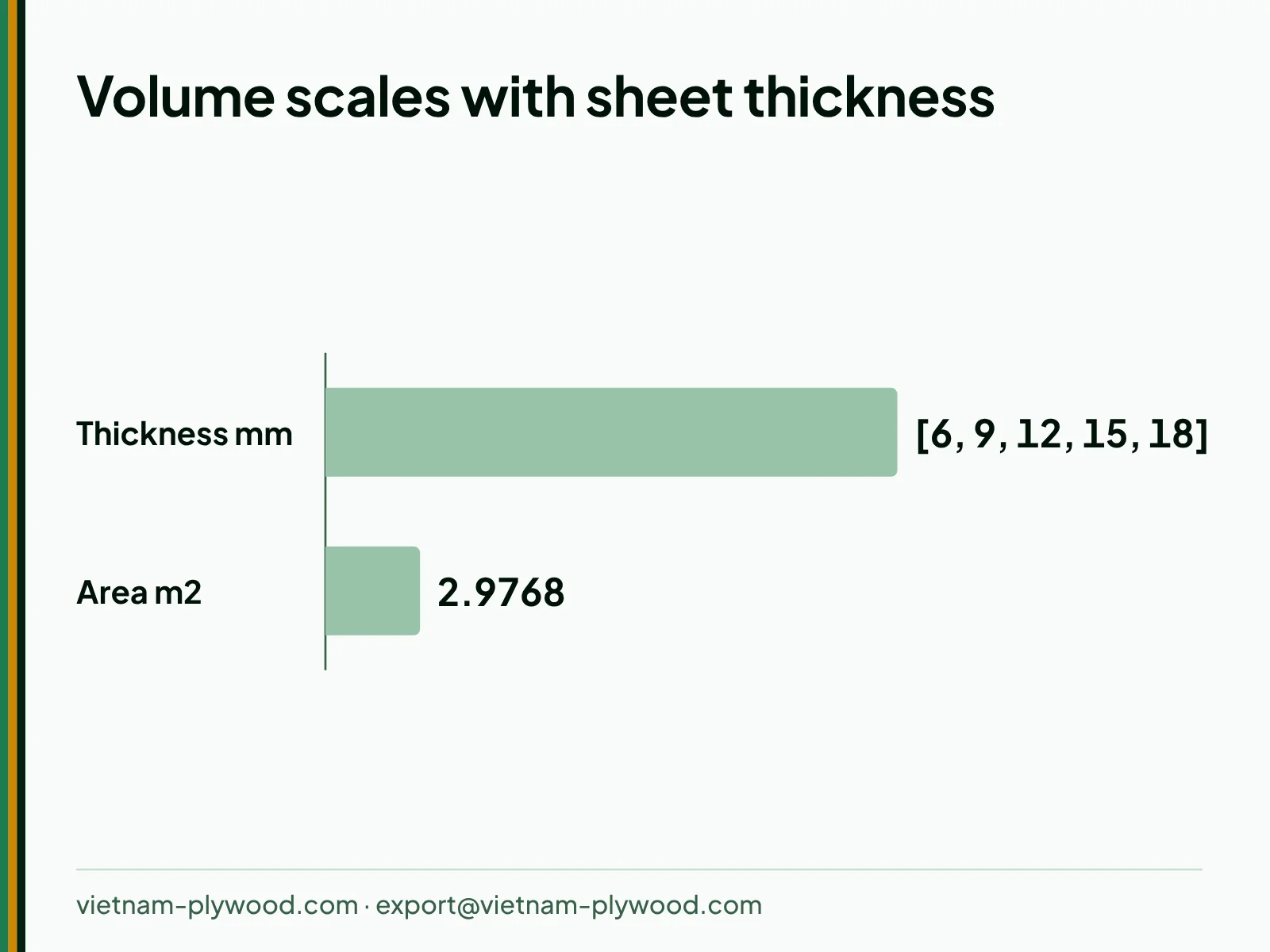
| Comparison label | Metric thickness used for illustration | Volume per 1220 × 2440 sheet | At constant commercial starting rate | At constant furniture starting rate |
|---|---|---|---|---|
| About 1/4 inch | 6 mm | 0.0178608 m³ | US$4.4652 | US$6.25128 |
| About 3/8 inch | 9 mm | 0.0267912 m³ | US$6.6978 | US$9.37692 |
| About 1/2 inch | 12 mm | 0.0357216 m³ | US$8.9304 | US$12.50256 |
| About 5/8 inch | 15 mm | 0.044652 m³ | US$11.163 | US$15.6282 |
| About 3/4 inch | 18 mm | 0.0535824 m³ | US$13.3956 | US$18.75384 |
Illustrative unit conversions of the two October 2026 FOB starting rates, held constant across thicknesses; these are not thickness-specific quotations. A buyer specifying a true 19.05 mm board must calculate with 0.01905 m, rather than quietly substituting 18 mm. HCPLY offers thicknesses from 3–40 mm, with the ordered tolerance recorded separately.
Which of our three lines builds a 4x8 sheet?
The application determines the producing factory and the bill of materials. A 4x8 size alone says little about surface acceptance, glue or finished thickness.
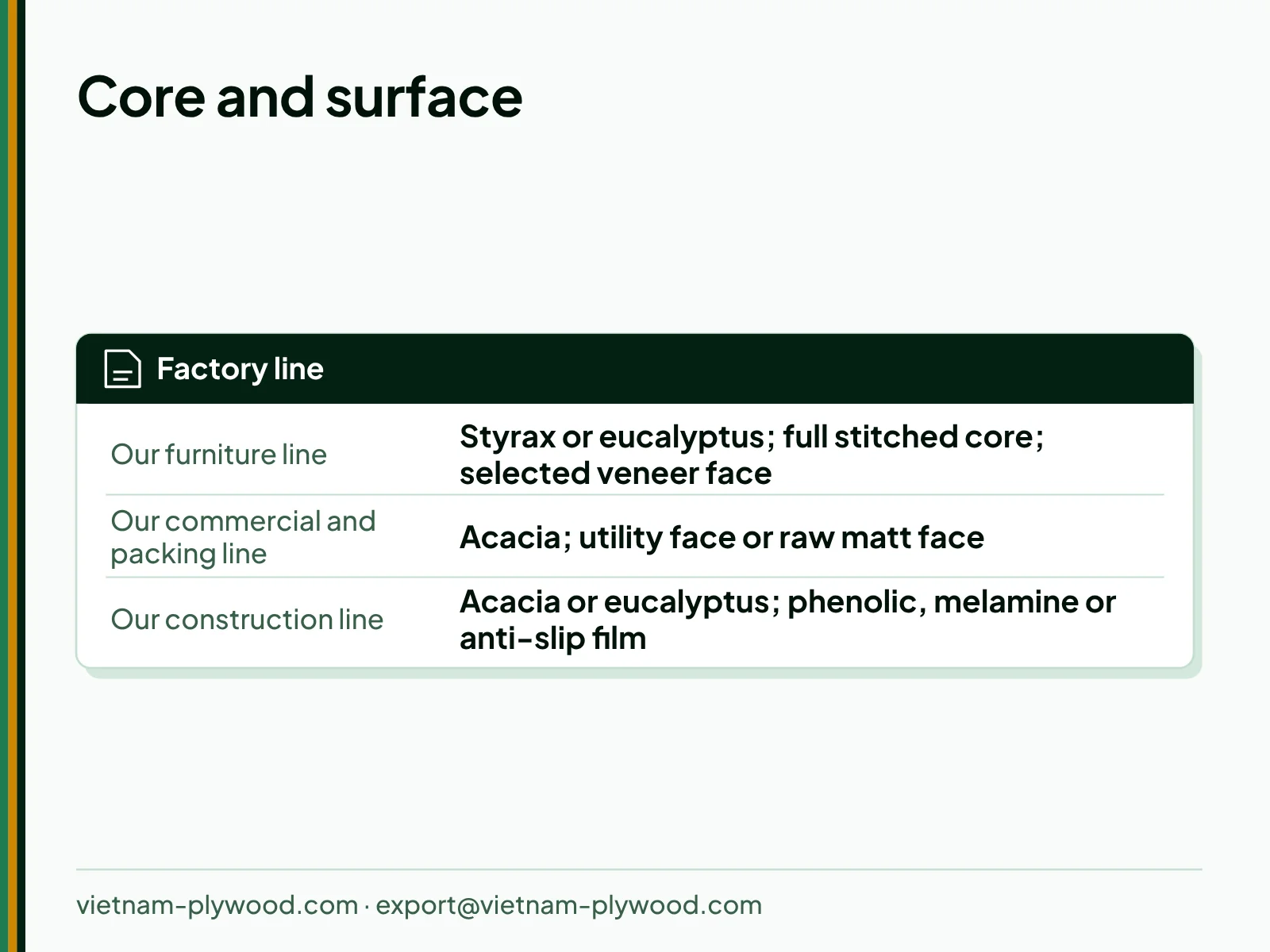
| Factory line | Core and surface | Bond and finish | Buying verdict |
|---|---|---|---|
| Our furniture line | Styrax or eucalyptus; full stitched core; selected veneer face | Sanded; E0/E1 emission class | Cabinet components and visible furniture panels |
| Our commercial and packing line | Acacia; utility face or raw matt face | MR glue; unsanded or light-sanded | Packing and utility applications where appearance is secondary |
| Our construction line | Acacia or eucalyptus; phenolic, melamine or anti-slip film | Unsanded film-faced panel | Concrete formwork and site handling |
A furniture-faced sheet uses the furniture plywood specification, while a utility build follows different face and core acceptance rules. We do not press oriented strand board, medium-density fibreboard or particleboard. A structural grade or marine designation requires a test report the buyer accepts; a construction appearance alone does not establish such a grade.
Which specification choices move the price most?
Core construction and face acceptance often separate a utility sheet from a cabinet sheet before freight enters the comparison. Full-stitched cores cost more to prepare than loose-laid cores; selected faces and sanding add processing. Bond requirements and tight dimensional tolerance further change the production route.
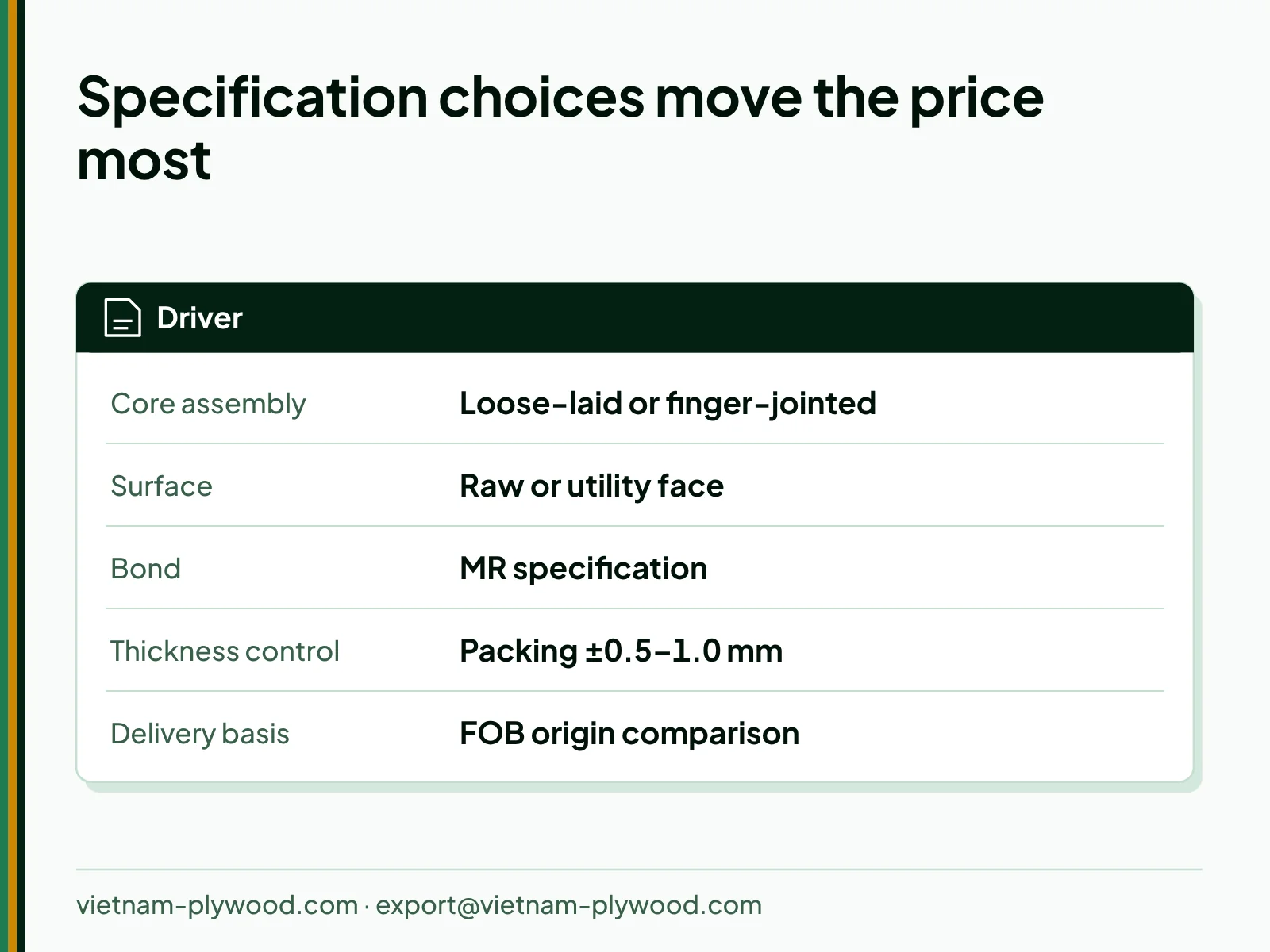
| Driver | Lower-cost direction | Higher-cost direction | Purchase decision |
|---|---|---|---|
| Core assembly | Loose-laid or finger-jointed | Full stitched | Choose by void and machining acceptance |
| Surface | Raw or utility face | Selected veneer and sanded finish | Match visible-face requirements |
| Bond | MR specification | Phenolic weather-and-boil-proof specification | Match exposure and agreed testing |
| Thickness control | Packing ±0.5–1.0 mm | Furniture sanded ±0.2 or ±0.3 mm | Match machine setup and reject limits |
| Delivery basis | FOB origin comparison | CFR or CIF destination quote | Compare costs at the same point |
For context, our commercial and packing line uses acacia core and MR glue, whereas our furniture line builds full-stitched sanded boards. Emission class and glue are separate purchase-order fields. For other grade differences, see furniture-grade plywood cost and value-grade plywood.
How does a store sheet price compare with a factory container quote?
A store ticket is a local sale price for an available SKU; an FOB factory quote values the specified goods at the origin port. They become comparable only after matching panel construction, size, currency, destination and the buyer’s actual delivery point. A US or Canadian importer should obtain a written destination freight quotation, customs classification and applicable duty assessment, clearance costs, terminal charges, domestic delivery and financing costs. Divide the complete landed shipment cost by accepted sheets, allowing separately for inspection rejects and machining yield. Compare that figure with the delivered local wholesale price for a genuinely equivalent board.
The US International Trade Administration’s Incoterms 2020 explanation distinguishes Free on Board (FOB), Cost and Freight (CFR), and Cost, Insurance and Freight (CIF) as sea-shipping terms; it says they allocate shipment tasks, costs and risks. See its official Incoterms explanation. Incoterms do not themselves fix import duty or the final sales price.
What does a 3/4-inch comparison look like for an importer?
An 18 mm metric board is a common purchasing comparison for a nominal 3/4-inch category, but the specification must say 18 mm explicitly. The commercial and furniture conversions above differ because their October 2026 starting rates and builds differ. Neither starting value substitutes for a quote for an actual 19.05 mm panel.
Use a spreadsheet with separate columns for the supplier’s actual quoted rate, volume per sheet, ocean freight, cargo insurance, duty and other import charges. Add the inland warehouse cost and divide by accepted sheets. For distribution orders, align specifications with plywood supply programmes for distributors.
Can a mixed load make a 4x8 order more useful?
A minimum order is one 40HC container, and specifications can be mixed within the 28.5 t payload limit. For 18 mm, 1220 × 2440 mm panels, the computed full-container references are 990 styrax sheets at 26.52 t, 880 acacia sheets at 27.35 t, or 795 eucalyptus sheets at 27.69 t. These are separate single-core loading references, not an additive mixed-load allowance.
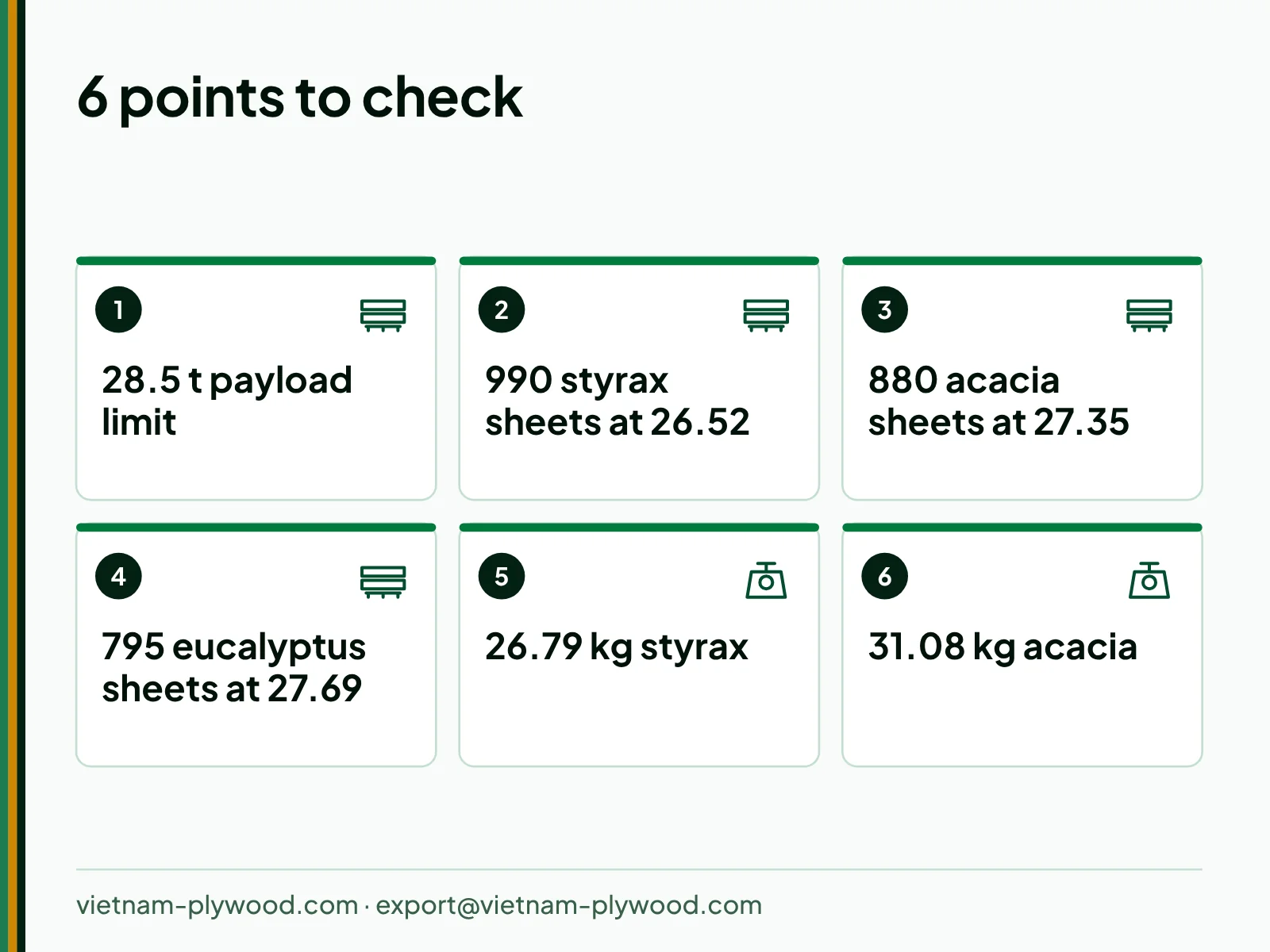
A distributor could combine cabinet-facing specifications with utility sheets when the producing factories and loading plan support the order. For any proposed mix, sum each component’s sheet weight times its quantity, then check pallet space and payload. The corresponding 18 mm sheet weights are 26.79 kg styrax, 31.08 kg acacia, and 34.83 kg eucalyptus, before film weight. The mixed-container loading process covers specification coordination; the container-load reference covers pallet quantities.
What can the buyer inspect before loading?
The inspector can measure thickness, examine face and back grade, check edge gaps and review the marked bundle specification at the producing factory. For a cabinet sheet, compare the ordered sanded tolerance with measurements across the panel; for a packing sheet, inspect the allowed core construction and surface acceptance. Record any nonconformity against the approved sample and purchase-order limits.
For an 18 mm full-stitched build, the reference ply count is 11–13, according to veneer thickness. Our on-site quality-control team coordinates checks and loading, while buyers can visit the factory office and inspect goods where their order is produced.
Factory-member certificates such as FSC, CARB P2, ISO 9001 or CE are shown with factory details masked, on request. Match certificate scope to the ordered product.
Which paperwork lets a buyer reconcile sheet cost?
The commercial invoice establishes the invoiced product value, while the packing list establishes the declared sheet and package quantities. The bill of lading records shipment details. The order’s agreed certificate and test documents support its specified product claims, and after loading, the draft shipping documents come to you for approval.
Shipment paperwork includes the certificate of origin, phytosanitary and fumigation papers, and insurance under CIF. EU lots additionally use EUR.1 where applicable and the EUTR/EUDR file set. For US and Canadian imports, the buyer’s customs team should separately determine the correct entry classification and current border charges.
HCPLY handles specification, on-site QC, shipping documents and loading. This gives the purchasing team a consistent basis for comparing invoice quantities with the landed-cost calculation.
How should wholesale buyers request a comparable quotation?
Send one written specification to each prospective supplier and request the same destination and Incoterms basis. Specify whether the commercial reference or furniture reference actually fits the application. For cabinet work, describe the face grade and machining acceptance; for packing, identify permitted core gaps and surface defects.
Our production window is 15–45 days after the 30% deposit, depending on quantity, production conditions and agreement. The 70% balance is against the scanned bill of lading, by T/T or irrevocable L/C at sight. Samples are free; new buyers book their courier, and that cost can be credited against a real order. Freight terms available are FOB Hai Phong, CFR (CNF) and CIF.
Use this compact request to prevent an attractive sheet conversion from hiding a different product:
Application: cabinet components / distribution / packing / formwork
Line or core: furniture styrax/eucalyptus / commercial acacia / construction acacia/eucalyptus
Glue: MR / melamine / phenolic; required bond test
Emission: E0 / E1 / E2 or applicable third-party US documentation
Face and grade: species, front/back grade, finish
Thickness and tolerance: ___ mm; ___ mm tolerance
Size: 1220 x 2440 mm or specified cut size
Quantity: ___ sheets / pallets / 40HC mix
Destination port: ___; quotation basis FOB / CFR / CIF
Request the 4x8 specification sheet from Lucy at export@vietnam-plywood.com.