





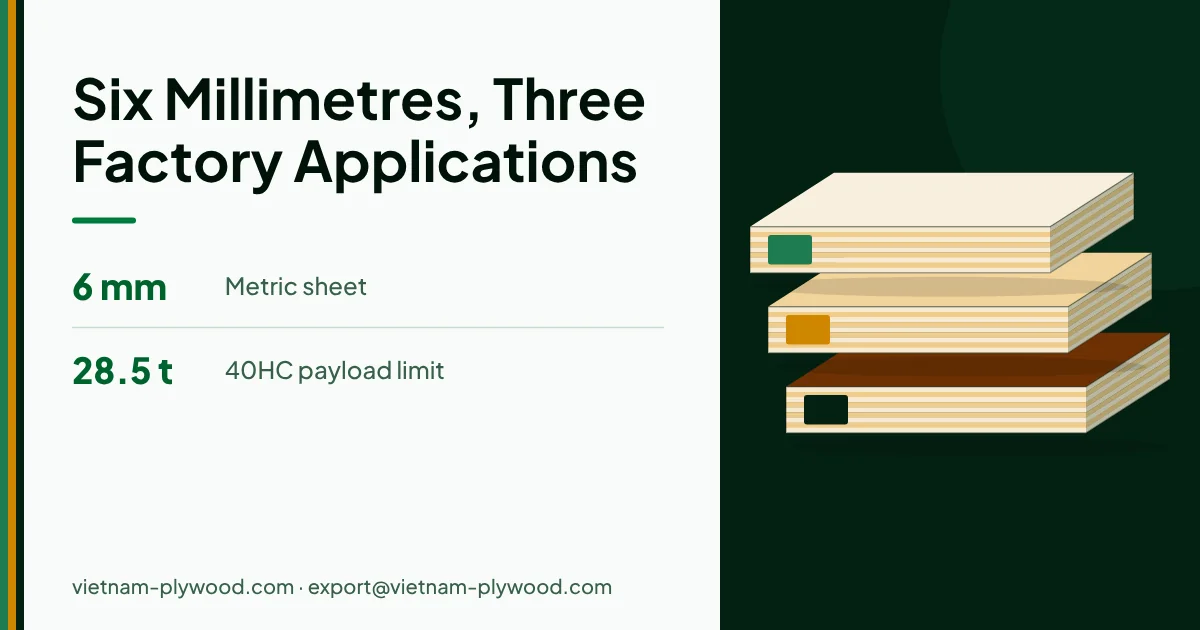
1/4 inch plywood is specified at HCPLY as a 6 mm metric sheet, with the face and packing selected for its end use. A wrong nominal-to-metric assumption can mean rejected cabinet grooves, delayed assembly and damaged incoming stock. We build decorative thin panels for furniture components and utility sheets for packing applications, with distinct tolerances and inspection points.
What is 1/4 inch plywood in mm?
1/4 inch plywood is exactly 6.35 mm by unit conversion, while 6 mm is the practical metric sheet HCPLY offers for this order. A nominal quarter-inch designation does not establish a finished-panel tolerance. Specify 6 mm explicitly, with the ordered tolerance, before cutting cabinet grooves or approving an import specification. The US National Institute of Standards and Technology (NIST), in its SI Units—Length explanation of the 1959 definition, states that one inch is exactly 25.4 mm: NIST conversion reference.
A 6 mm order is 0.35 mm below the mathematical inch conversion. Some markets also use a nominal quarter-inch label for panels thinner than 6.35 mm. That convention must never replace a measured thickness requirement. For fit-sensitive components, define the slot and panel together and refer to our thickness-tolerance specification.
Which sheet sizes and lines answer a quarter-inch order?
A 6 mm panel can be specified on our furniture line for finished components or our commercial and packing line for utility parts. Our construction line instead makes film-faced panels for formwork applications; its finish is unsuitable as a substitute for a decorative cabinet face.
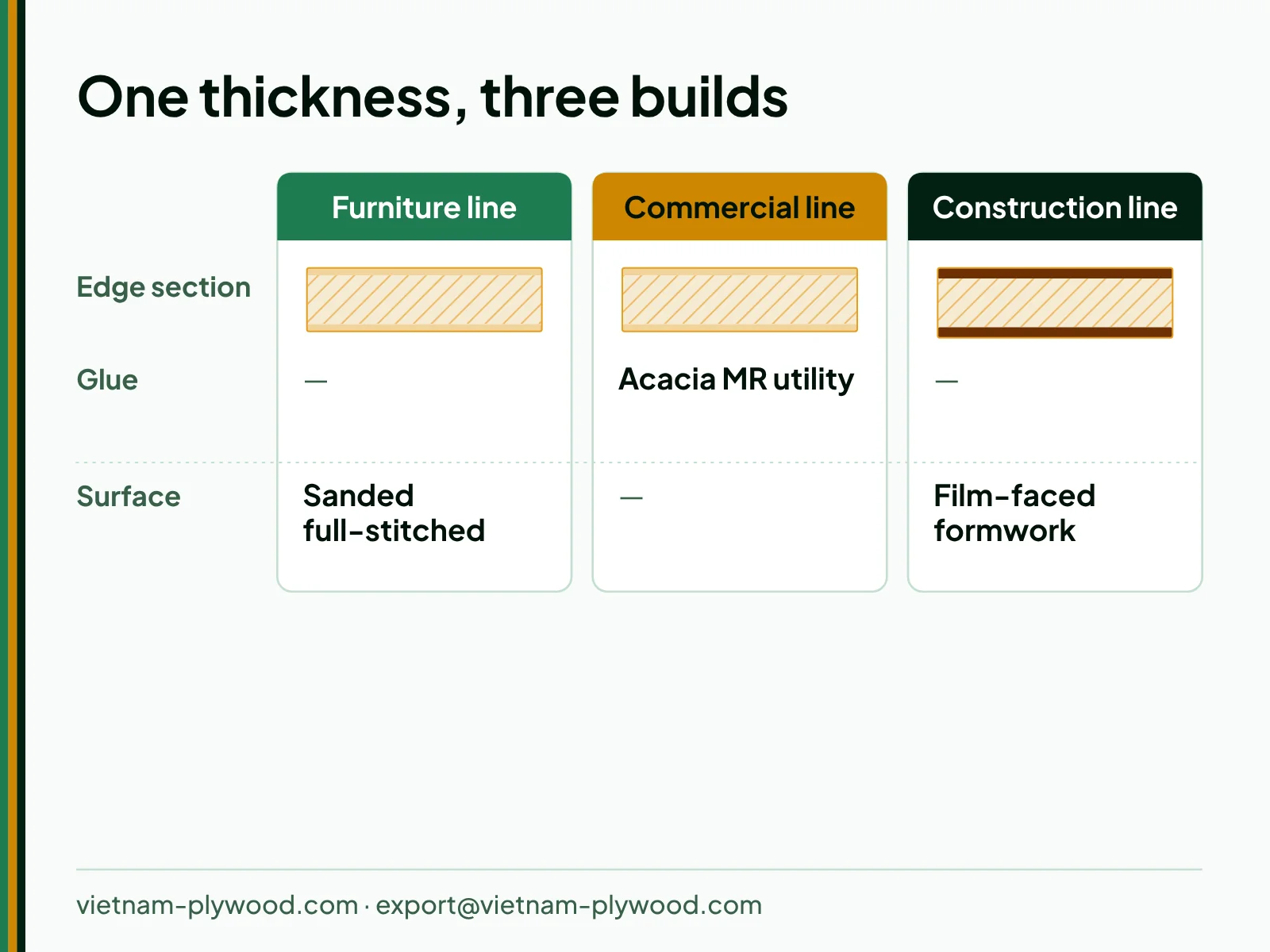
| Producing line | 6 mm build to discuss | Thickness tolerance | Surface and decision |
|---|---|---|---|
| Furniture | Styrax or eucalyptus core, full stitched | Sanded ±0.2 or ±0.3 mm as ordered | Sanded decorative face for cabinet backs and skins |
| Commercial and packing | Acacia core, MR glue | Commercial ±0.5 mm; packing ±0.5–1.0 mm | Unsanded or light-sanded utility panel |
| Construction | Acacia or eucalyptus core, phenolic or melamine film | Film-faced ±0.5 mm | Formwork-facing specification, rather than cabinet finish |
Standard sheet formats are 1220×2440, 1250×2500, 1220×2135, 1220×1830, 915×2440, 915×2135 and 915×1830 mm. Custom cutting is available; length and width tolerance is ±2 mm. The common 1220×2440 mm format is a metric commercial alternative to 4×8 feet, not an exact dimensional match. See the sizes and thickness specification guide and thin plywood supply for adjacent specifications.
What is 6 mm plywood used for?
The strongest fit for a 6 mm furniture sheet is a supported cabinet back, drawer base or non-load-bearing decorative skin. Furniture and fit-out manufacturers also specify thin panels as interior lining and partition facing when the supporting frame carries the load. A drawer base needs its groove, support span and expected contents defined; thickness alone cannot establish load capacity.
Commercial 6 mm sheets can serve as utility separators, protective packing skins and non-decorative backing where appearance is secondary. For floor underlayment, the installation system and local specification must independently accept the chosen panel. A thin skin should never be substituted for structural floor decking, exterior shear sheathing or a load-bearing shelf. If a project needs thicker panels, compare 20 mm plywood and 25 mm plywood instead.
For laminated plywood 1/4 requests, distinguish a veneer-faced plywood substrate from a factory-applied melamine, high-pressure laminate or other finished laminate. HCPLY describes those surface systems for specification comparison; we do not offer them as a separate pressed product line.
Which line presses 1/4 inch hardwood plywood?
Our furniture line presses the 6 mm decorative plywood order with a full-stitched styrax or eucalyptus core and a sanded surface. The term “hardwood plywood” in a buyer’s order can refer to a decorative hardwood face, not necessarily an all-hardwood core. The face names the product; the core controls the density and much of the handling weight.
For a packing separator, our commercial and packing line builds acacia-core material with MR adhesive and a utility surface. Our construction line builds film-faced plywood for concrete-forming work, rather than an alternative decorative hardwood sheet. The same nominal thickness therefore leads to different pressing, finishing and inspection criteria.
We direct each order to the producing factory in Phu Tho or Hai Phong. Buyers can visit the factory office and inspect the actual goods where they are made.
Which faces should a cabinet buyer specify?
Face choice follows the exposed surface and finishing method. Available veneer names include bintangor, okoume, engineered veneer (EV), gurjan, pine, poplar, eucalyptus, birch and sapele. A common face-veneer thickness is 0.2–0.4 mm. Furniture face grades are A/B, while birch face grades use D/E/F; these grading systems should not be treated as interchangeable.
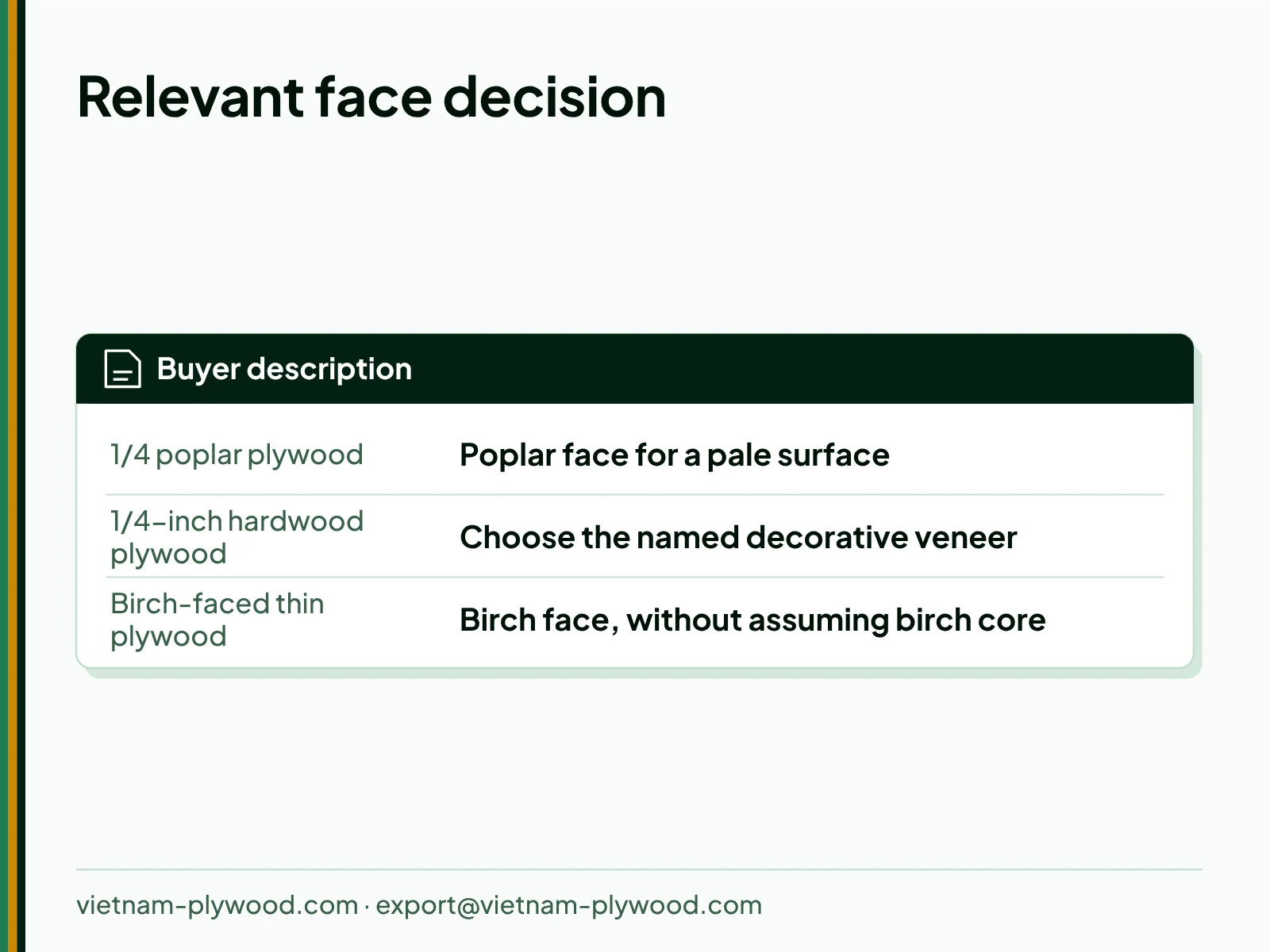
| Buyer description | Relevant face decision | What to write on the order |
|---|---|---|
| 1/4 poplar plywood | Poplar face for a pale surface | Poplar face, core and grade separately |
| 1/4-inch hardwood plywood | Choose the named decorative veneer | Actual face species, visible-side grade |
| Birch-faced thin plywood | Birch face, without assuming birch core | Birch face D/E/F, styrax or eucalyptus core |
| White oak plywood 1/4 or 1/4 red oak plywood | Oak appearance requested | Request an alternative face selection; oak is outside the listed faces |
| Maple or Baltic birch-core panel | Different market construction | We do not press maple-faced or birch-core plywood |
A birch face on eucalyptus core is a different product from birch-core plywood. A buyer comparing oak, maple and birch appearances should approve a physical veneer sample before authorizing production.
How do glue and emission specifications differ?
Glue defines the bonding system, while emission is a separate specification field. Furniture orders can specify E0 or E1 emission classes; the adhesive requirement must be written independently. The two adhesive systems described for the group are melamine (MR, 12-hour boil) and phenolic (WBP, weather and boil proof, 72-hour boil).
A boiling description identifies an adhesive-system test condition, not a marine or structural grade. Any request using “marine” or BS 1088 requires a test report the buyer accepts. CARB P2 and TSCA Title VI concern US emissions limits with third-party certification, not the veneer species. Factory certificates and related documents are shown with factory details masked, on request. For testing decisions see moisture-content standards and testing.
How flat does a 6 mm sheet stay?
A 6 mm sheet needs a written flatness acceptance method because no universal bow limit follows from its thickness. Thin sheets respond visibly to uneven moisture exposure, unsupported storage and unequal face conditions. A nominal thickness tolerance controls thickness variation; it does not measure bow, twist or cup.
For a cabinet-back programme, agree on a flat support surface, measurement positions, conditioning environment and maximum acceptable deviation before the run. The inspector can lay sampled sheets on a reference table, check corners and edges, measure the gap under the panel and record the result. Repeat after unpacking at the destination under the agreed conditioning procedure.
Full-stitched core construction and sanding help make a controlled furniture specification possible, but they do not replace the flatness acceptance check. Ask for the face, back and core construction to be recorded together, since asymmetric surfaces and storage exposure can change panel behavior.
How are thin sheets packed to arrive flat?
Thin panels should be stacked on level, continuous pallet support, with aligned edges and protective top and bottom boards. Secure the bundle without concentrated strap pressure on exposed veneer edges. Keep packs dry during storage, loading and transfer; protect cut edges and avoid long unsupported overhangs.
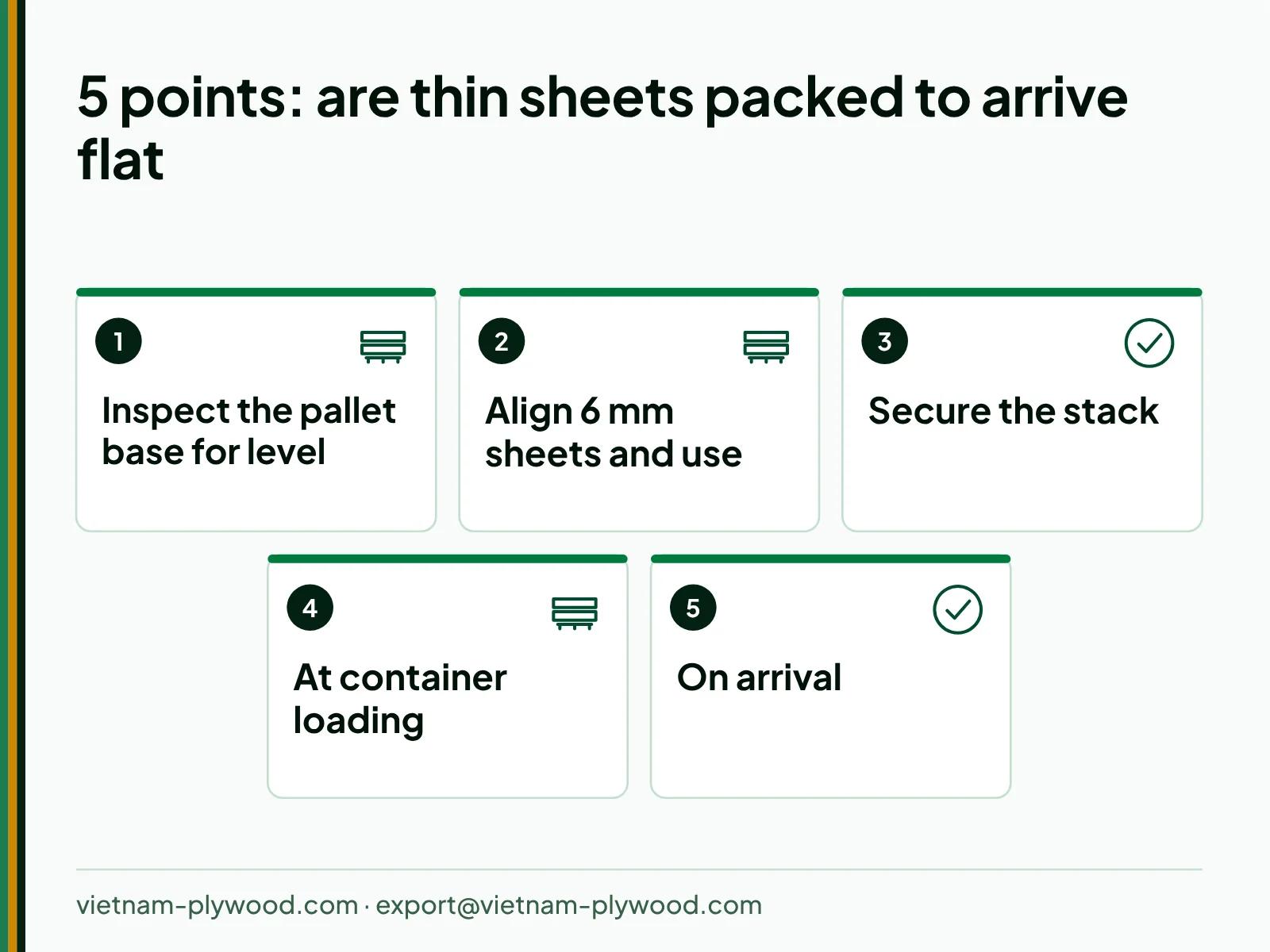
- Inspect the pallet base for level support and damage before stacking.
- Align 6 mm sheets and use a protective cover board to spread restraint pressure.
- Secure the stack, check its corners and record the pallet identification.
- At container loading, verify dry conditions, stable pallet placement and restraint against shifting.
- On arrival, photograph the pack before breaking straps and inspect representative sheets for bow and edge damage.
The factory visit can include a witness check of sheet alignment, pallet support and the loading photographs. This matters as much as face appearance for importers supplying precision cabinet production.
What does a 6 mm container load weigh?
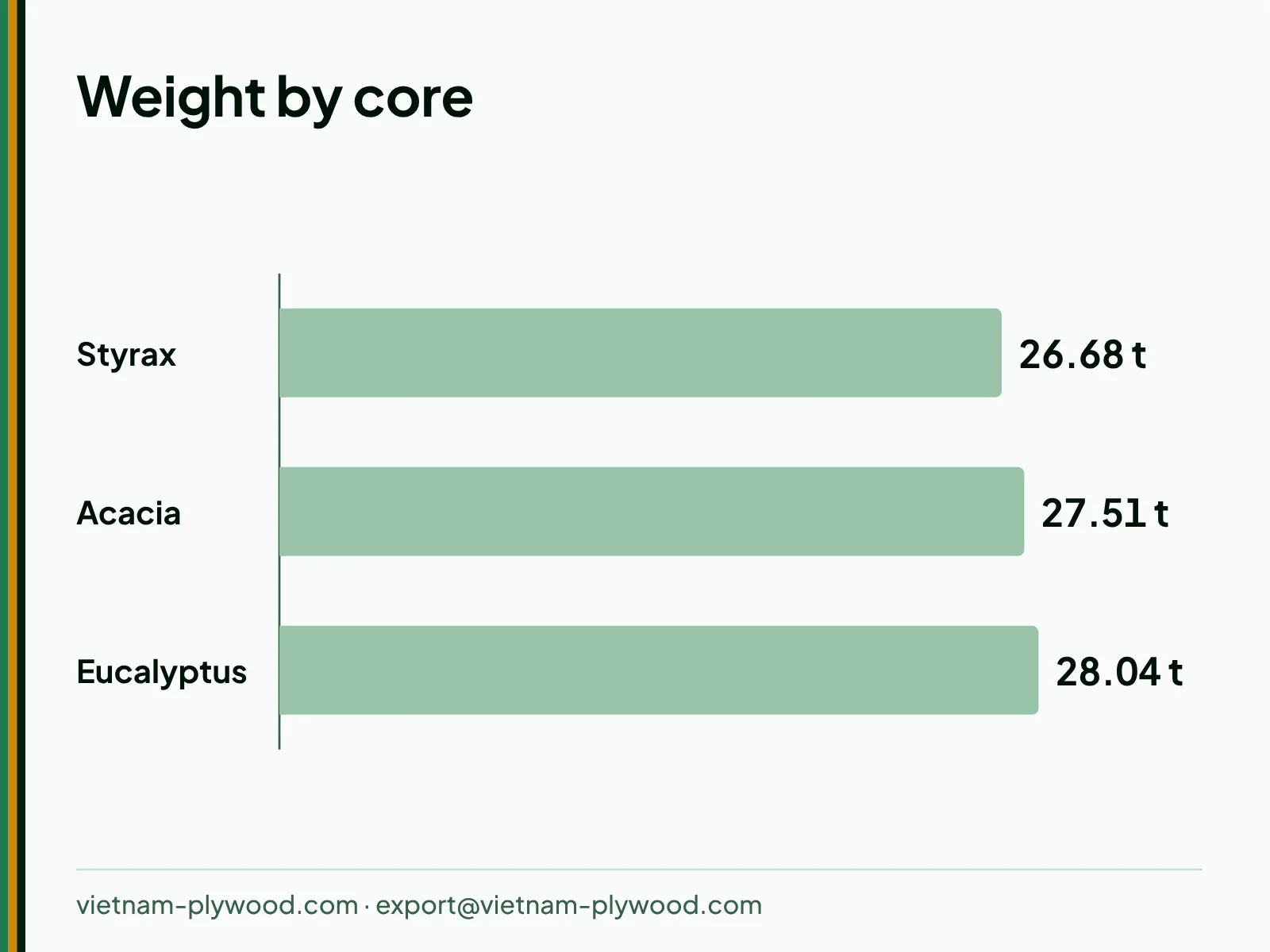
For 1220×2440 mm, 6 mm sheets, the core choice changes both sheet weight and full-container quantities. The figures below use the stated core densities and pallet stack limits; film weight is excluded.
| Core | Sheet weight | Sheets per pallet | Full 40HC sheets | Volume | Weight |
|---|---|---|---|---|---|
| Styrax | 8.93 kg | 166 | 2,988 | 53.37 m³ | 26.68 t |
| Acacia | 10.36 kg | 166 | 2,656 | 47.44 m³ | 27.51 t |
| Eucalyptus | 11.61 kg | 161 | 2,415 | 43.13 m³ | 28.04 t |
The 40HC payload limit is 28.5 t. The pallet count is 18 for styrax, 16 for acacia and 15 for eucalyptus. Different specifications can share a container within that payload limit, but a mixed load needs a fresh pallet-by-pallet weight plan rather than simply adding two full-load totals. The container-loading reference covers load planning.
What can an inspector verify before shipment?
A buyer’s inspector can witness the measured 6 mm thickness, face identity, surface grade, edge construction and the agreed flatness method at the producing factory. The sample selection and acceptance thresholds belong in the purchase specification before production starts.
Check the caliper against the ordered tolerance and compare sampled panels across a pallet, rather than measuring only a showroom piece. Look for veneer laps, open joints, local sanding-through and edge damage; document findings against the accepted sample. For moisture-sensitive applications, add the agreed moisture measurement method and acceptance range.
HCPLY coordinates on-site quality control, export paperwork and loading. The commercial invoice and packing list identify the ordered goods and quantities; the bill of lading records carriage. After loading, the draft shipping documents come to you for approval, together with applicable certificate and test documents for the agreed build.
How should an importer order 6 mm plywood?
Write the intended use first, then specify the producing line, core, veneer, bond, emission, thickness tolerance and sheet dimensions. A decorative A/B face with a sanded furniture tolerance is a different quotation from an unsanded acacia packing sheet.
Furniture plywood starts from US$350/m³ FOB Hai Phong (October 2026); commercial plywood starts from US$250/m³ FOB Hai Phong (October 2026). For the actual 6 mm build, veneer choice, stitched-core construction, sanding and tighter tolerance are major cost drivers. A decorative full-stitched sanded panel costs more to make than a utility unsanded panel because of veneer selection and finishing work.
The minimum order is one 40HC, with mixed specifications permitted within the payload limit. Production takes 15–45 days from the 30% deposit, set by order size, line loading and the contract. The remaining 70% is paid on the scan of the bill of lading, by T/T, or by irrevocable sight L/C. We ship FOB Hai Phong, or CFR (CNF) or CIF to your port. Free samples are available; new buyers book their courier, and courier cost can be credited against a real order. See distributor supply programmes for repeat-order planning.
What specification should the buyer send?
A written request should identify where the sheet will be used and how its fit and flatness will be judged. For an order that calls for quarter inch plywood, write 6 mm as the target metric thickness and specify the allowed deviation explicitly.
Application: Cabinet backs / drawer bases / interior skins
Line or core: Furniture / styrax core
Glue: MR melamine (12-hour boil)
Emission: E1
Face and grade: Poplar face, A/B
Thickness and tolerance: 6 mm, sanded ±0.2 mm
Size: 1220 × 2440 mm
Quantity: One 40HC, sheet count per approved loading plan
Destination port: [buyer to specify]
Book a factory visit with Lucy at export@vietnam-plywood.com through contact to inspect the producing line and sample packs.