





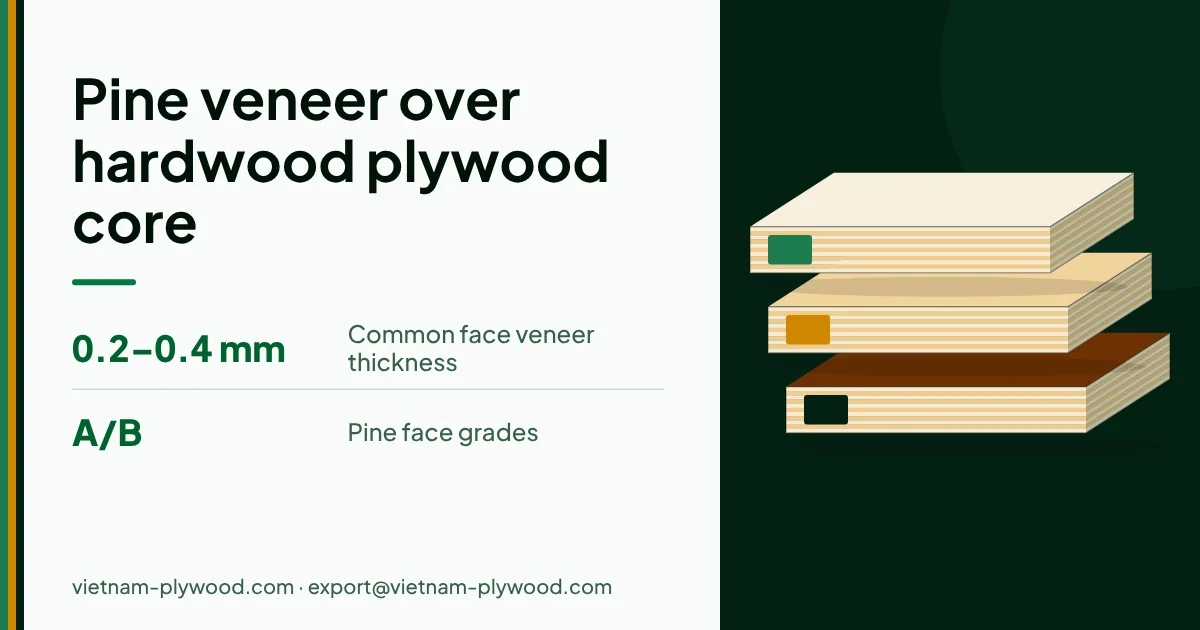
Pine wood gives a plywood face a pale, recognisable grain and the option of visible knots over a hardwood core. Choosing the wrong knot allowance or finish can turn an otherwise usable furniture shipment into rejected visible parts and extra sorting costs. At HCPLY, pine is a face veneer option on our furniture line, rather than a pine-core construction claim.
Is pine wood a hardwood or a softwood?
Pine wood is a softwood from coniferous trees of the genus Pinus, although individual pine species differ in hardness, resin and growth pattern. The term describes botanical origin; it does not certify that a finished panel is weak. For plywood procurement, distinguish the thin pine face from the hardwood veneers that carry most of the panel’s thickness and influence its weight.
The plywood types overview separates faces and cores. The common question “is pine a hardwood?” has a clear answer: no. In the timber trade, softwood and hardwood identify tree groups, rather than a universal ranking of dent resistance. Pine can be useful for exposed furniture surfaces when the designer accepts its characteristic grain and local variation.
Is pine wood strong enough for plywood furniture?
Pine-faced plywood can serve cabinet and fit-out parts when the core, thickness, bond and expected loading are specified together. The face species alone cannot establish a shelf’s allowable span, screw-holding performance or structural rating. For a load-bearing design, the buyer needs an accepted test report for the actual build and loading arrangement.
The USDA Forest Service’s Mechanical properties of wood (2021) discusses how knots and slope of grain affect wood properties. That observation matters especially when a buyer compares pine lumber strength figures with the appearance of a thin plywood face. A clear-looking face is useful visually, but it does not replace assessment of the assembled panel.
What properties of pine wood matter on a face?
The main properties of pine wood for a visible plywood face are pale colour, growth-ring contrast, knots, resin-related finishing behaviour and a comparatively soft surface. Those characteristics influence visual matching, machining and finishing more directly than the strength of the full panel.
Unlike MDF or plywood comparisons, the pine face here is veneer over a hardwood core. A pine face can show earlywood and latewood bands prominently. Boards cut from the same production lot can still differ in grain spacing and knot placement. For adjacent cabinet fronts, agree a photographic reference and a permitted variation range before pressing begins.
Pine’s softer surface can pick up handling dents on exposed parts. Resinous patches can also affect the appearance of some coatings, so finish trials should use representative faces from the intended order. Veneer is commonly 0.2–0.4 mm; heavy sanding can remove valuable face material rather than correct a deep mark.
What is pine wood used for in plywood?
Pine-faced plywood is used for visible furniture and interior fit-out components where a natural softwood appearance is part of the specification. Typical buyer applications include cabinet fronts, shelving with an engineered load design, decorative panels and interior display fittings.
The useful distinction is between decorative service and demanding exposed service. A pine face chosen for visible knots can be appropriate on rustic furniture; the same knots may be unacceptable on a smooth, uniform cabinet front. See UV-coated plywood for another finishing route. For parts that will receive an opaque finish, buyers should judge whether the pine appearance adds any value.
Which knot grades can a buyer order?
Our pine face is ordered under A/B face grades, with the permitted knots written into the appearance specification. A/B alone is too broad to settle whether small sound knots, dark knots, repaired knots or open knot holes are acceptable on a visible part.
A practical purchase schedule separates the visible face from the reverse face. It records knot type, maximum accepted size, frequency, location near edges, colour contrast and repair policy. Where matched cabinet fronts are required, also specify how sheets are to be grouped by tone and grain.
Where does pine fall short of birch or poplar?
Pine is less suitable when a buyer wants an even, low-knot face or a surface that resists visible dents during handling. Birch and poplar faces offer different appearance options, although no face species alone determines the performance of the hardwood core.
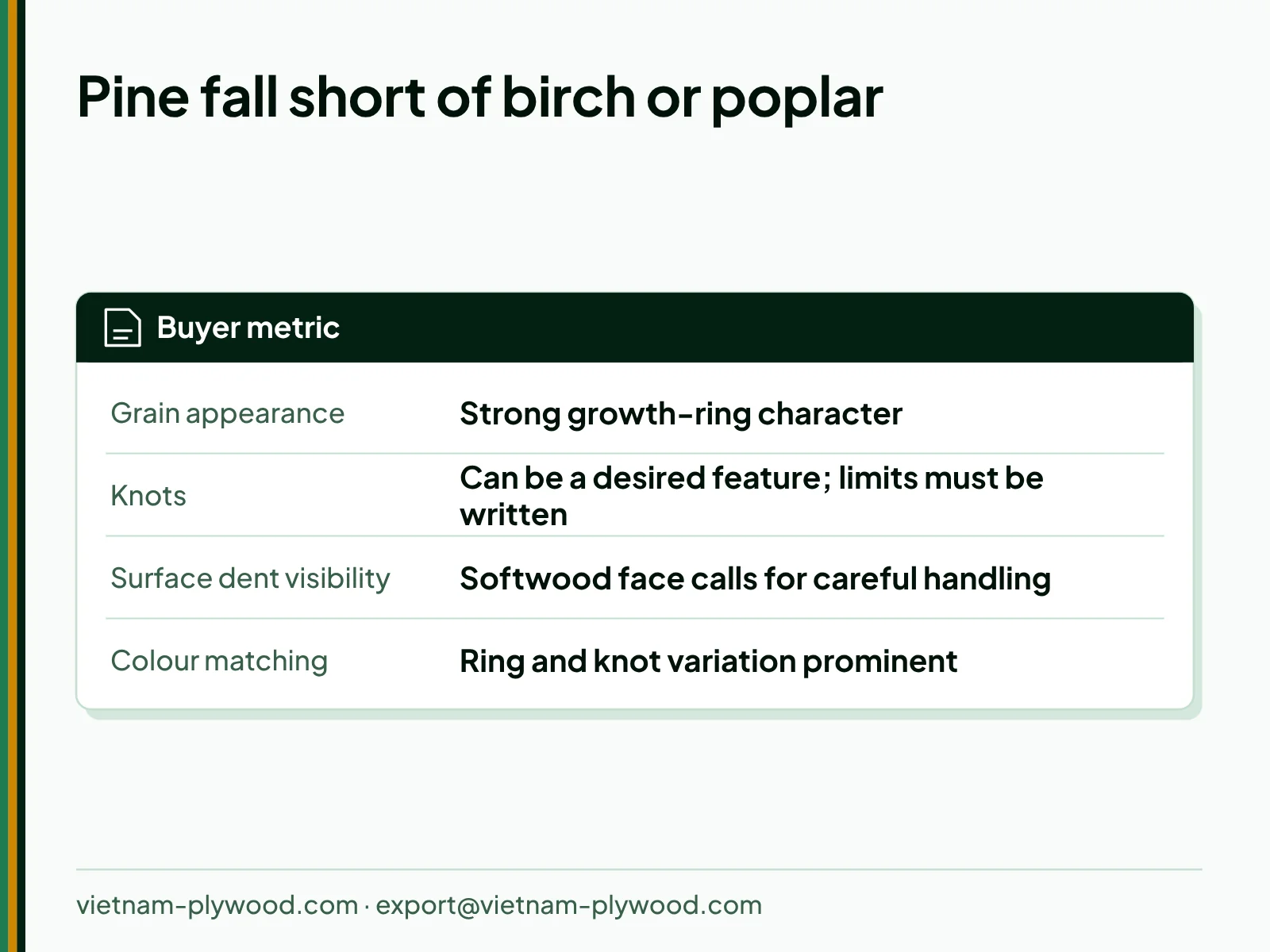
| Buyer metric | Pine face | Birch face | Poplar face | Verdict by use |
|---|---|---|---|---|
| Grain appearance | Strong growth-ring character | Finer, more uniform-looking figure | Usually quieter visual figure | Pine for pronounced natural grain; alternatives for restrained fronts |
| Knots | Can be a desired feature; limits must be written | Different visible defect pattern; HCPLY birch uses D/E/F grades | Visual defects still need a grade reference | Specify a sample for continuous cabinet runs |
| Surface dent visibility | Softwood face calls for careful handling | Different surface response | Different surface response | Test the chosen finish on sample panels |
| Colour matching | Ring and knot variation prominent | More restrained visual matching option | Pale appearance option | Compare full sheets under final lighting |
| Core density | Set by styrax or eucalyptus | Set by styrax or eucalyptus | Set by styrax or eucalyptus | Face choice does not set shipping weight |
Which factory line builds a pine-faced panel?
The cross-line grade comparison explains other builds. Our furniture line presses pine veneer over full-stitched, sanded styrax or eucalyptus core for furniture and cabinet applications. Our commercial and packing line instead builds acacia-core, MR-glue panels with unsanded or light-sanded faces. Our construction line presses phenolic or melamine film over acacia or eucalyptus core for formwork uses.
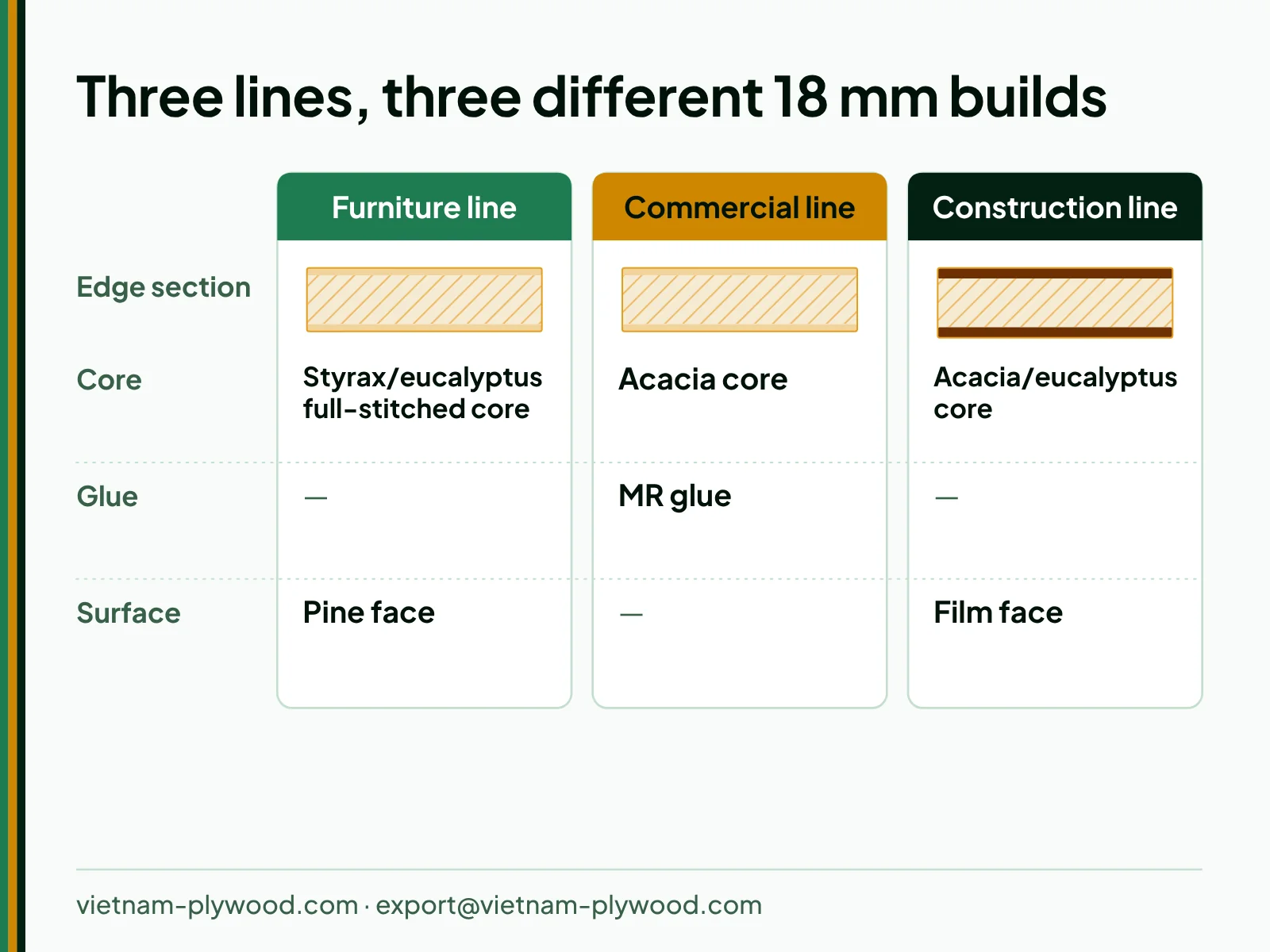
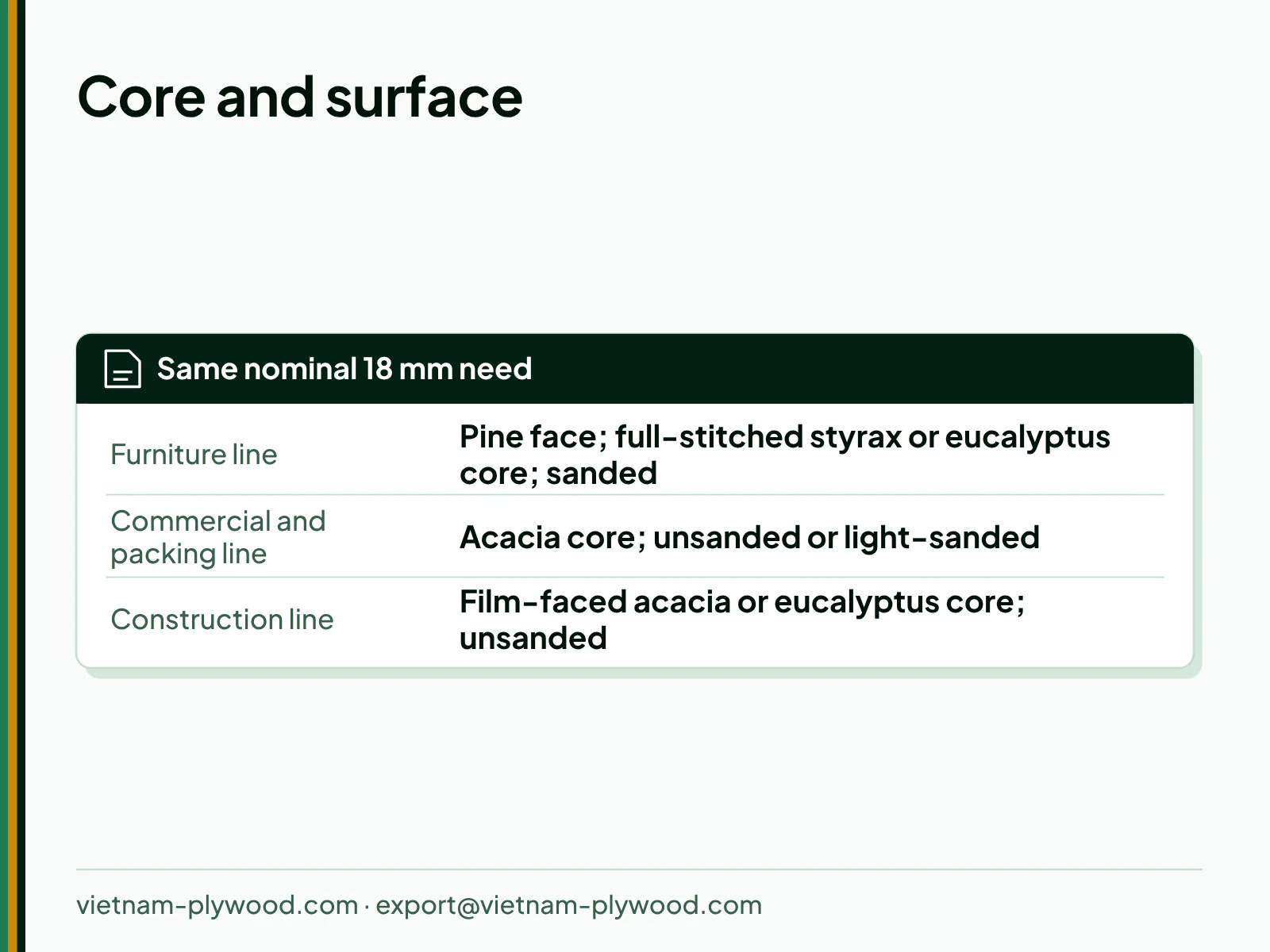
| Same nominal 18 mm need | Core and surface | Thickness tolerance | Appropriate purchasing use |
|---|---|---|---|
| Furniture line | Pine face; full-stitched styrax or eucalyptus core; sanded | ±0.2 or ±0.3 mm as ordered | Visible cabinet or furniture component |
| Commercial and packing line | Acacia core; unsanded or light-sanded | ±0.5 mm commercial; ±0.5–1.0 mm packing | Utility panel or packing application |
| Construction line | Film-faced acacia or eucalyptus core; unsanded | ±0.5 mm | Concrete formwork |
How should thickness, core and bond be specified?
A pine-faced order should identify the face grade, hardwood core, finished thickness tolerance, glue and emission class separately. Our furniture line offers styrax or eucalyptus core with full-stitched construction and E0 or E1 emission options. Glue and emission are different fields: MR describes a moisture-resistant melamine glue option, while E0 and E1 describe emission classes.
Panel thickness runs from 3–40 mm, with 3, 5, 9, 12, 15, 18, 21 and 25 mm common. Available formats include 1220×2440 and 1250×2500 mm, plus other specified sizes and custom cutting. Length and width tolerance is ±2 mm.
See types of plywood for broader classification. For an 18 mm panel, the core construction is typically 11–13 plies because individual core veneers are 1.4–2.0 mm thick. The written order should also fix face orientation and the appearance standard for both sides. For buyers placing recurring orders, a plywood supply programme can organize those agreed specifications.
What can an inspector check at the factory?
At the producing factory, an inspector can witness face grading, measure thickness and check the finished edge against the agreed core construction. The most useful inspection starts with a signed reference face and a written defect schedule, rather than a grade letter alone.
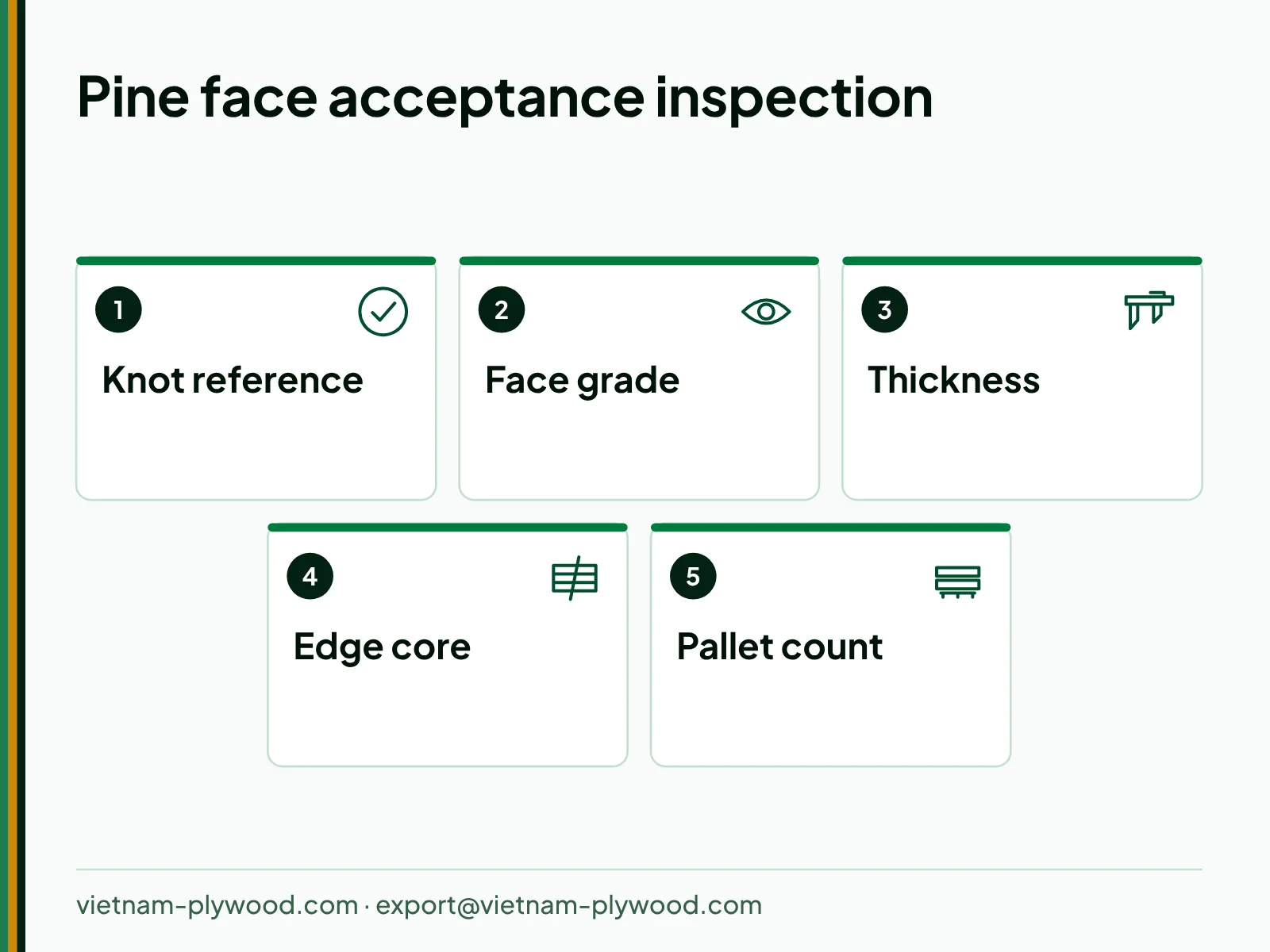
- Select sheets from more than one pallet and compare colour, grain and knot pattern with the approved sample.
- Measure finished thickness at agreed positions and compare it with the ordered furniture tolerance.
- Inspect cut edges for core continuity, gaps and the expected full-stitched construction.
- Examine both faces under consistent light for open knots, repairs, sanding marks and handling dents.
- Match pallet identification and sheet count with the packing list before loading.
HCPLY coordinates on-site quality control and the export process. Buyers visit the factory office and inspect goods where their order is produced. A coating trial remains useful when the final furniture finish has strict colour or gloss requirements.
How does a pine-faced order load for export?
For 18 mm sheets at 1220×2440 mm, a full 40HC styrax-core loading reference is 990 sheets, 53.05 m³ and 26.52 t. The eucalyptus-core reference is 795 sheets, 42.60 m³ and 27.69 t. Those figures follow the styrax density of 500 kg/m³ and eucalyptus density of 650 kg/m³ and pallet patterns; the pine face does not turn either load into pine-core plywood.
The payload ceiling is 28.5 t. Specifications can be mixed within one container while remaining within that limit, but a mixed load requires its own pallet and weight schedule. The container loading reference covers the broader loading question.
Minimum order is one 40HC. Factory lead time runs 15–45 days from receipt of the 30% deposit; the exact figure depends on order size, line loading and what the contract fixes. The remaining 70% is paid on the scan of the bill of lading, by T/T, or by irrevocable sight L/C.
What paperwork follows the order?
The export document set links the agreed pine face and core specification to the shipment’s packing and commercial records. It includes a commercial invoice, packing list, bill of lading, certificate of origin, phytosanitary and fumigation papers, plus the order’s agreed certificate documents. EUR.1 and the EUTR/EUDR file set apply to EU lots; CIF shipments also include insurance.
Factory-held FSC, CARB P2, ISO 9001 and CE documents, where relevant to the agreed order, are shown with factory details masked, on request. Emission certificates and test reports should correspond to the build being purchased. After loading, the draft shipping documents come to you for approval.
HCPLY ships FOB Hai Phong, CFR (CNF) or CIF.
What should the trial-container specification say?
A trial-container request should state the finished application and the visible-face acceptance rules before discussing volume. Pine is worth testing where its grain is desirable, while birch or poplar should be sampled alongside it when matching and surface appearance drive rejection risk.
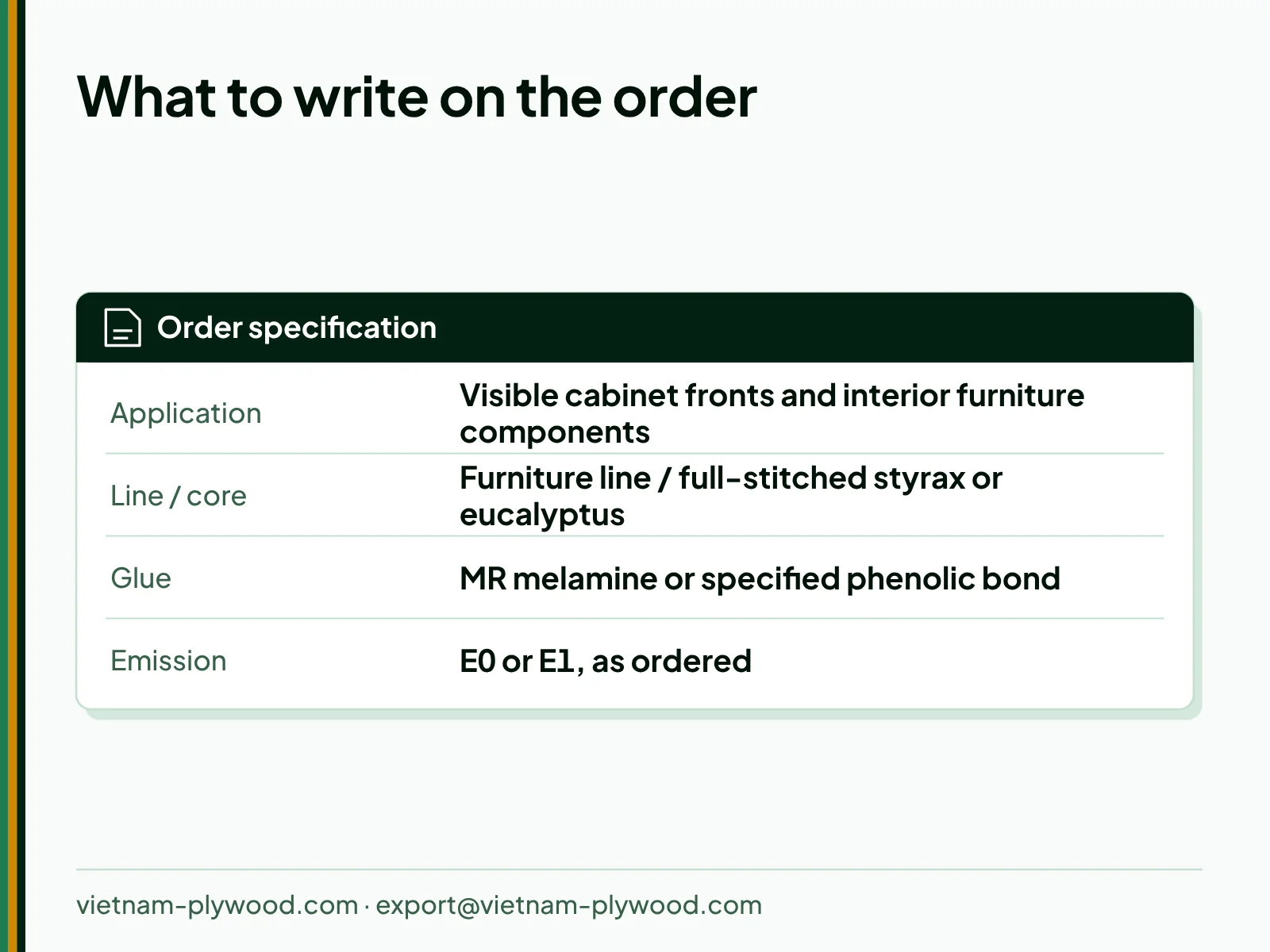
Send Lucy a concise specification with the knot reference photographs and any finish-trial requirements. Ask for a quotation against that build; price is driven by face selection and grade, core species, sanding standard, thickness, size and order mix. Our furniture plywood has an indicative starting price from US$350/m³ FOB Hai Phong (October 2026); the pine-faced build needs its own written quotation.
Application: Visible cabinet fronts and interior furniture components
Line / core: Furniture line / full-stitched styrax or eucalyptus
Glue: MR melamine or specified phenolic bond
Emission: E0 or E1, as ordered
Face and grade: Pine A/B; agreed knot limits and reference photographs
Thickness and tolerance: 18 mm; ±0.2 or ±0.3 mm as ordered
Size: 1220 × 2440 mm
Quantity: One 40HC trial container; sheet and pallet mix to be agreed
Destination port: [name the destination port]
Plan a trial container with Lucy at export@vietnam-plywood.com via the contact page.