






HCPLY supplies plywood for either a sacrificial pour or repeated stripping, while permanent formwork systems can eliminate plywood altogether. Choosing the wrong route adds unrecovered sheet cost, stripping labour or a rejected forming detail. The correct decision starts with whether the form stays, repeats or contributes to the finished structure.
What is permanent formwork?
Permanent formwork is a concrete mould that remains in the finished work after the concrete gains strength. It is also called stay in place formwork, sacrificial formwork or lost formwork. Some systems merely contain fresh concrete; others are engineered to contribute to the completed structure. The distinction changes both the purchase specification and who must approve the design.
For HCPLY, the practical choice is between plywood deliberately left behind, film-faced plywood recovered for further pours, and a specialist permanent system that requires no plywood. Start with the broader formwork explanation before selecting a contact face.
How does permanent vs temporary formwork compare?
Temporary formwork is removed after the concrete reaches the specified strength; permanent formwork stays in place. The table compares three procurement routes rather than treating every left-in form as the same product.
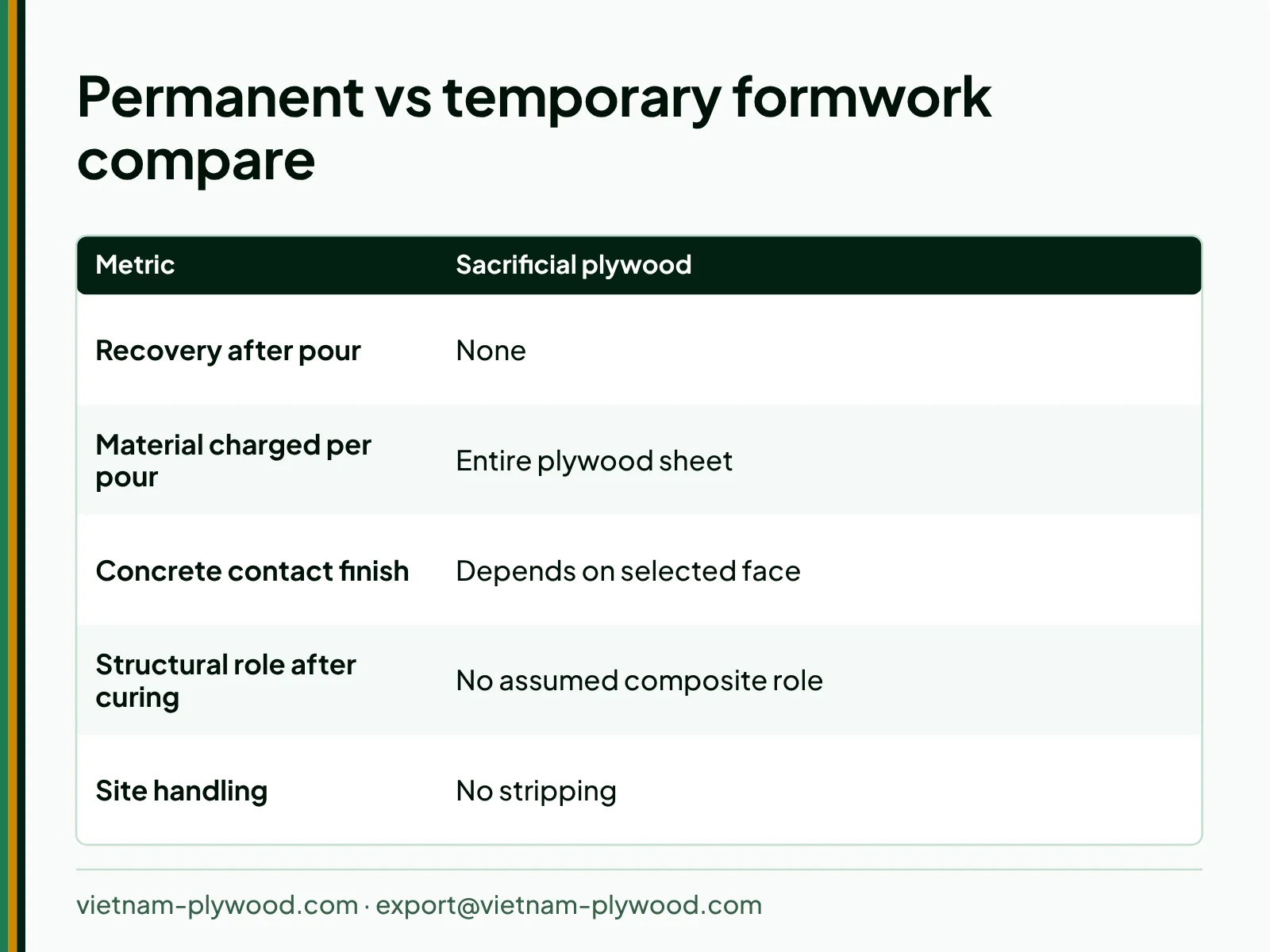
| Metric | Sacrificial plywood | Reusable film-faced plywood | Engineered stay-in-place system | Verdict by use |
|---|---|---|---|---|
| Recovery after pour | None | Strip, clean and cycle | None | Restricted access favours a left-in form |
| Material charged per pour | Entire plywood sheet | Sheet cost divided across actual pours | Entire system material | Repeated geometry favours reusable panels |
| Concrete contact finish | Depends on selected face | Film face selected for finish | Depends on system surface | Exposed repeat walls favour film-faced plywood |
| Structural role after curing | No assumed composite role | None after removal | Some systems are participating | Structural composite design favours engineered systems |
| Site handling | No stripping | Stripping and storage | No stripping | Congested sites favour permanent systems |
| Procurement | Sheet dimensions and support design | Panel specification and cycle plan | Proprietary system and engineering details | Buy by intended function |
The US Occupational Safety and Health Administration’s 1996 rule, 29 CFR 1926.703, requires formwork to resist anticipated vertical and lateral loads. For removable forms, it also ties striking to specified conditions or concrete strength testing. Project engineers must apply the governing local rules.
When does stay-in-place formwork beat reusable plywood?
Stay-in-place formwork earns its cost when recovery is difficult, unsafe or impossible. Buried pile caps, ground beams against excavations, inaccessible soffit pockets and tightly congested service areas are common candidates. Labour saved from striking must be compared with the entire single-use material cost.
A participating system has a different purpose. Profiled steel decking can serve as a casting platform and part of an engineered composite floor; ribbed metal stop-ends can create a specified construction joint. Expanded polystyrene forms can incorporate insulation, while mesh forms can suit irregular groundworks. Those functions cannot be reproduced simply by leaving a plywood sheet behind.
Review access for removal, geometry repetition, specified surface, pour pressure, joints and retained-material compatibility before issuing a purchase order. An inaccessible face can justify a lost former even when the same project uses reusable panels on its exposed walls.
Can plywood be left in as sacrificial formwork?
Plywood can be left in a pour where the approved design permits a non-participating lost former. Choose its thickness from the actual wet-concrete pressure, span and support spacing; a nominal thickness alone cannot establish safe capacity. Detail retained edges, moisture exposure, interfaces and any future inspection access in the drawings.
Our construction line presses film-faced panels on acacia or eucalyptus cores. A shorter-duty melamine-glue build can be the more economical sacrificial option than phenolic glue when the design accepts it and the sheet will never be recovered. A raw or lightly sanded commercial sheet should be considered only where its specified bond, face and support design suit the exposure and finish. Our construction plywood range covers the reusable casting-face choice.
Do not specify a premium film solely because the panel will remain buried. Equally, do not assume a low-cost sheet is adequate for high hydrostatic pressure or a permanently exposed interface. The engineer approves the application, while the factory builds to the written sheet specification.
Which HCPLY line builds each option?
Our construction line makes the film-faced plywood used for repeated pours and possible sacrificial applications. Our commercial and packing line makes acacia-core, MR-glue, unsanded or light-sanded plywood for suitable non-finish applications. Our furniture line makes sanded, full-stitched styrax- or eucalyptus-core panels for furniture uses rather than concrete casting.
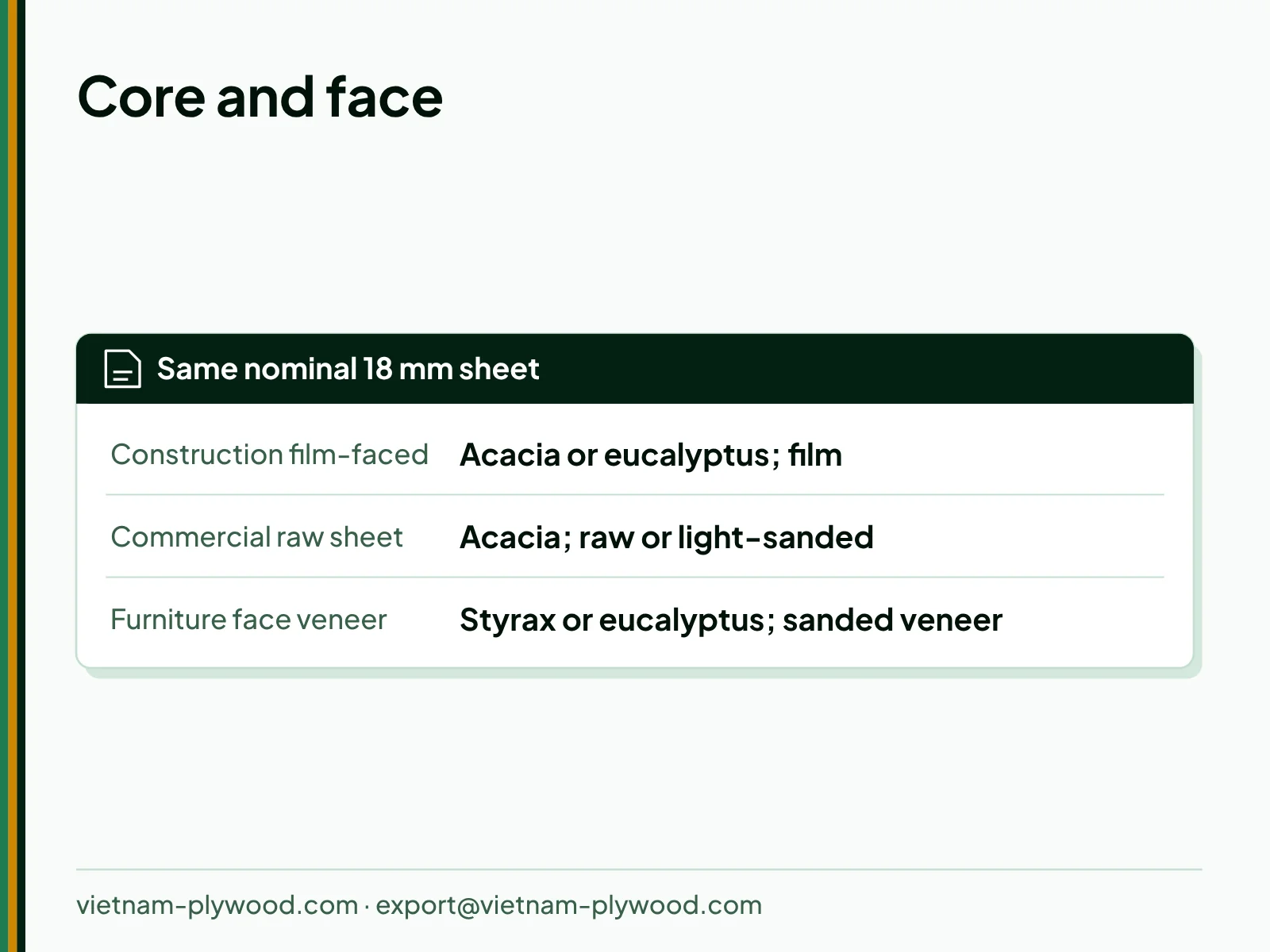
| Same nominal 18 mm sheet | Core and face | Factory route | Formwork decision |
|---|---|---|---|
| Construction film-faced | Acacia or eucalyptus; film | Construction | Specify for concrete contact and planned recovery |
| Commercial raw sheet | Acacia; raw or light-sanded | Commercial and packing | Assess only for an approved single-use application |
| Furniture face veneer | Styrax or eucalyptus; sanded veneer | Furniture | Choose for cabinet or furniture production, not formwork |
HCPLY operates three member factories in Phu Tho and Hai Phong. Each order is made at the producing factory that fits its specification, with export coordination through loading and FOB Hai Phong. Buyers can visit the factory office and inspect goods at the producing factory.
How does cost per pour change the decision?
Cost per pour falls as a reusable panel survives more successful cycles, but the crossover is calculated from site costs. A single-use sheet charges its full purchase cost to one pour. A reusable sheet spreads purchase cost across actual pours and adds stripping, cleaning, release agent, repair, storage and handling for each cycle.
Use single-use cost = sheet purchase + installation + disposal or retained-material treatment. For reusable plywood, use cost per pour = sheet purchase ÷ achieved pours + handling and consumables per pour + allocated damage or loss. Compare both on the same formed area, including supports and freight.
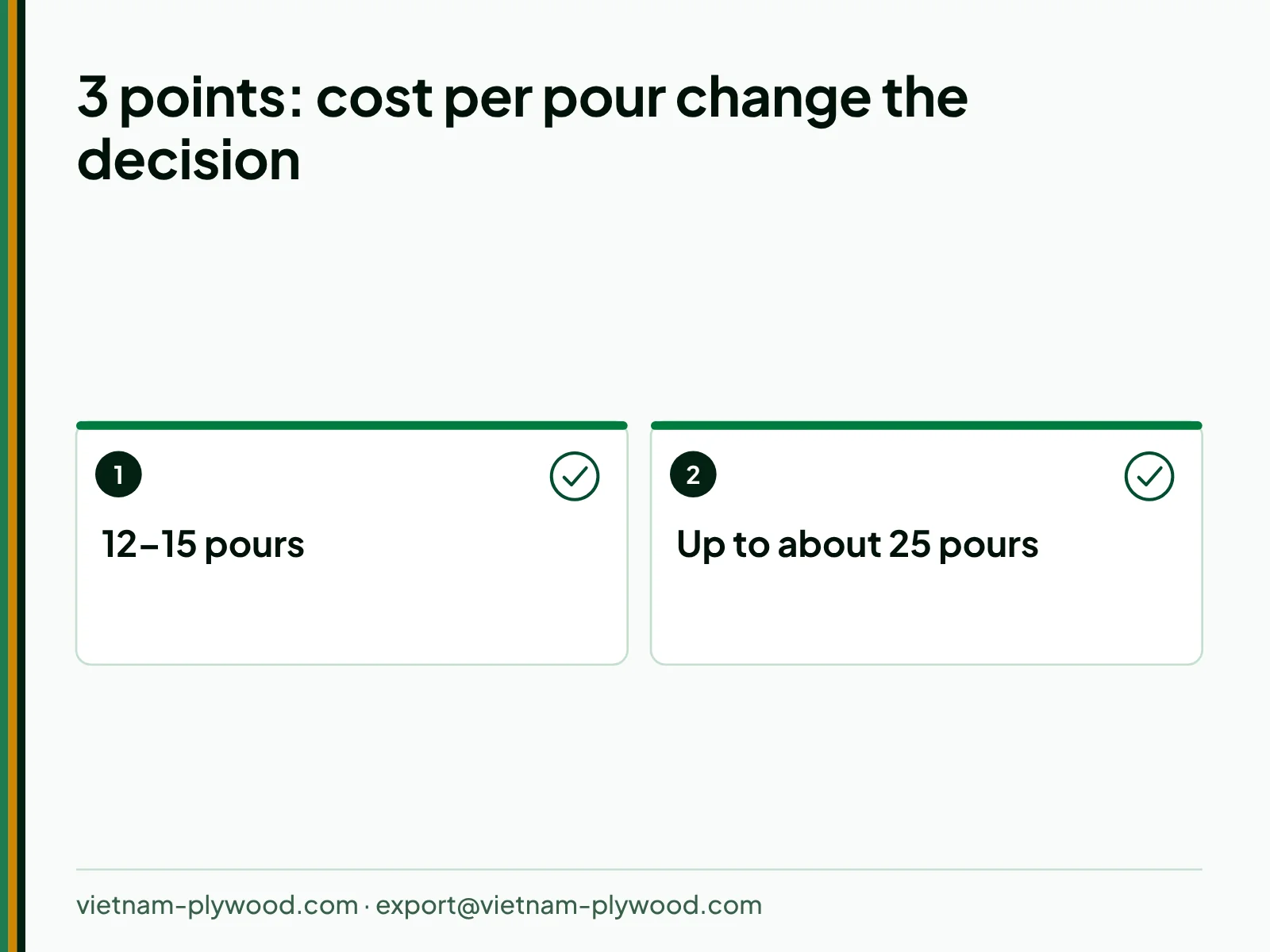
With proper handling, a release agent on every pour and sealed edges, including cut edges, melamine-glue film-faced plywood gives about 12–15 pours; phenolic-glue film-faced plywood reaches up to about 25 pours. Those are conditional planning figures rather than a project-specific result. Phenolic glue usually costs more than melamine glue because its bonding specification is more demanding; a higher film weight also raises material cost. Obtain the actual sheet quotation before calculating a crossover. For alternatives, see aluminium versus plywood formwork and timber formwork options.
What specification separates short-duty and repeat-duty film?
Film weight describes the surface layer, while glue describes the core bond. Our construction line offers 120 g/m² standard film, 135 g/m² premium film and 220 g/m² anti-slip film only. The anti-slip face addresses traction in its intended application and is not a default smooth concrete-contact face.
Melamine glue is the MR option with a 12-hour boil specification. Phenolic glue is the weather-and-boil-proof option with a 72-hour boil specification. Glue and emission class are separate specification fields; neither a film weight nor a glue name substitutes for a structural design calculation.
Construction plywood is unsanded, with an ordered thickness tolerance of ±0.5 mm and length and width tolerance of ±2 mm. Common thicknesses include 12, 15, 18, 21 and 25 mm. Confirm tie-hole layout, bracing and sealing details against the pour drawings rather than selecting a panel on film weight alone.
Can the order share a container with other plywood?
A 40HC has a 28.5 t payload limit, and mixed specifications can share a container within that limit. At 18 mm and 1220 × 2440 mm, the acacia-core lookup is 31.08 kg per sheet, 880 sheets and 27.35 t for a full acacia load; eucalyptus is 34.83 kg per sheet, 795 sheets and 27.69 t. These figures exclude film weight.
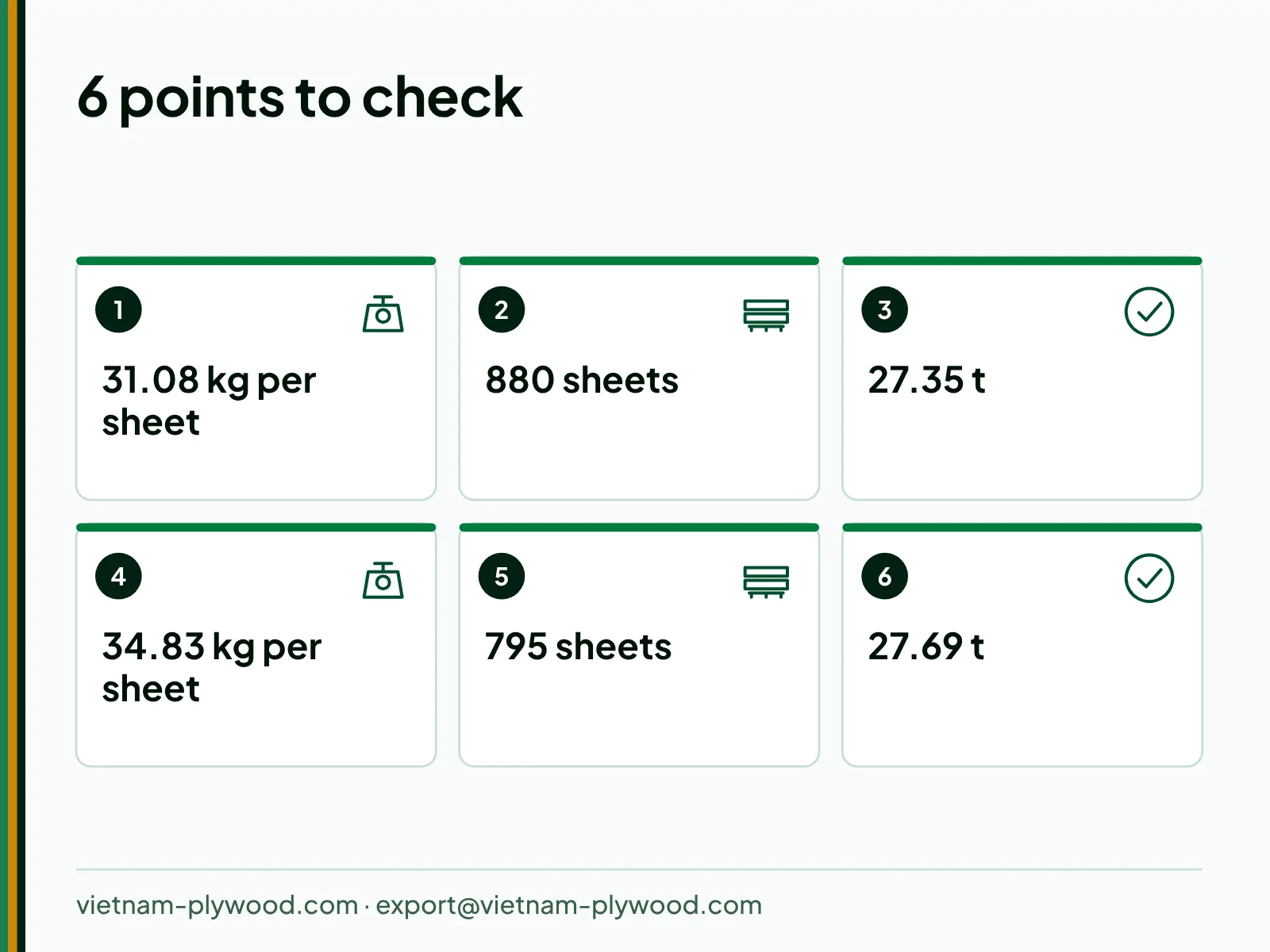
A mixed construction and commercial order needs a pallet-by-pallet weight plan because core density changes the load. The container loading reference covers sheet-count calculations; plywood supply programmes for distributors covers repeat purchasing.
What should an inspector witness at the producing factory?
An inspector should compare the approved purchase specification with physical panels before loading. Witness thickness measurement across representative sheets, size checks, face inspection, edge condition, pallet labels and separation of the specified film and core builds. Record the actual inspected lot and the agreed acceptance criteria.
For a sacrificial application, the inspection should also check that the ordered face and glue match the engineer-approved drawing. A factory thickness check cannot replace verification of wet-concrete pressure, bracing, connections or retained-material compatibility. Those remain design and site controls.
The shipment’s packing list identifies quantities and packing; the agreed test reports cover the specified build where required. HCPLY sends draft shipping documents for buyer approval after loading. Factory certificates or related documents, where applicable, are shown with factory details masked, on request.
When does a permanent formwork system mean no plywood order?
No plywood order is appropriate when the design requires a proprietary retained system that performs a function plywood cannot provide. Examples include engineered composite decking, insulation-integrated forming and specified ribbed joint formers. Their purchase criteria are system geometry, connection design, approvals and installation sequence.
Our construction line does not press steel decking, expanded-polystyrene forms or specialist mesh joint systems. It also does not press medium-density fibreboard, oriented strand board, chipboard, blockboard, bamboo panels, medium-density overlay, high-density overlay or three-ply spruce panels. Source those systems through their relevant manufacturers and preserve the engineer’s product-specific requirements.
On a mixed project, reserve plywood for the repeatable walls and columns while specifying permanent systems only where their distinct function justifies them. This avoids paying for film-faced plywood where the structural detail has already eliminated the plywood casting face.
What should the buyer send before ordering?
Send the pour drawings, planned reuse count, support layout and contact-finish requirements alongside the sheet specification. Separate permanently retained locations from panels intended for stripping, so the quotation reflects the correct material and quantity.
For plywood, the minimum order is one 40HC. Factory lead time runs 15–45 days from receipt of the 30% deposit; the exact figure depends on order size, line loading and what the contract fixes; the 70% balance is against the scanned bill of lading, by telegraphic transfer or irrevocable letter of credit at sight. We ship FOB Hai Phong, or CFR (CNF) or CIF to your port. Lucy at export@vietnam-plywood.com can review the written specification and arrange the visit.
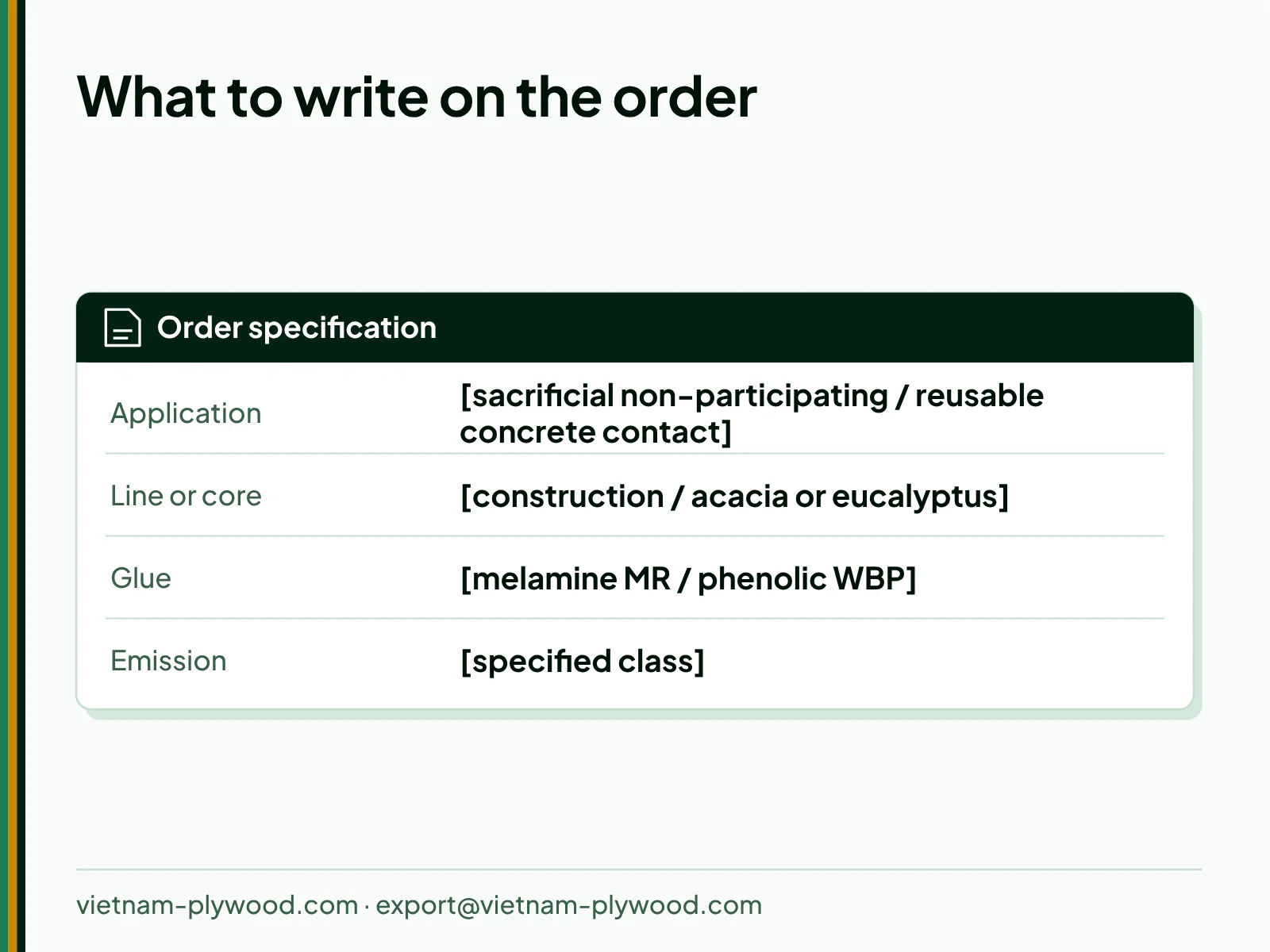
Application: [sacrificial non-participating / reusable concrete contact]
Line or core: [construction / acacia or eucalyptus]
Glue: [melamine MR / phenolic WBP]
Emission: [specified class]
Face and grade: [film weight and required face specification]
Thickness and tolerance: [mm; ordered tolerance]
Size: [length × width, mm]
Quantity: [sheets / pallets / containers]
Destination port: [port, country]
Next step: book a factory visit to inspect the proposed build at the producing factory.