





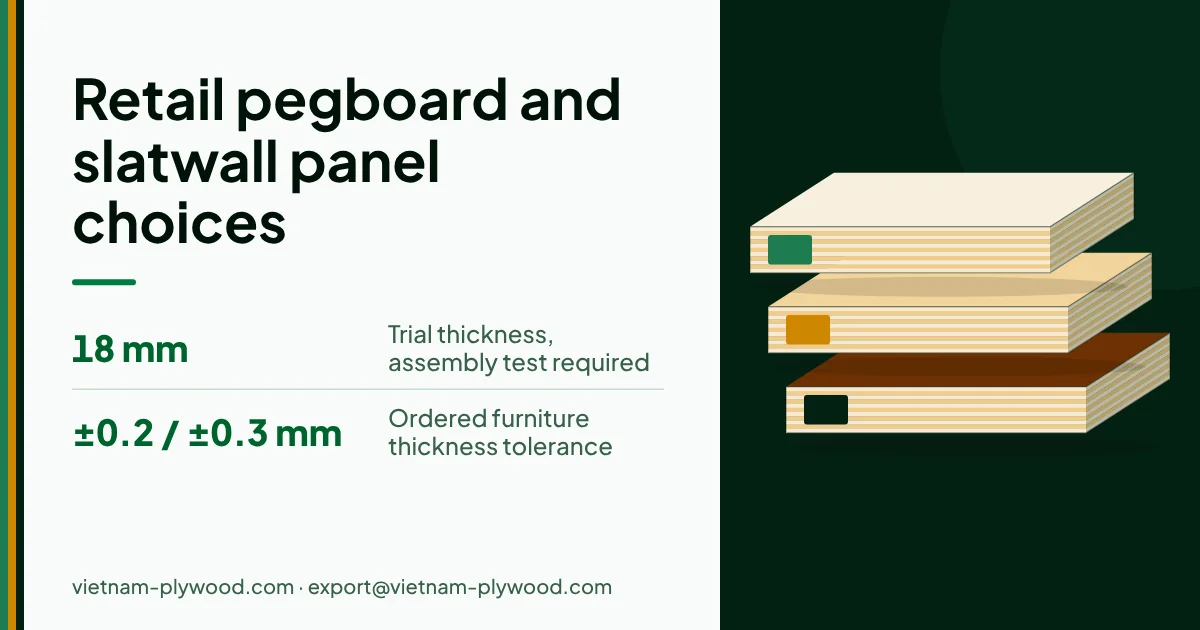
Plywood pegboard and slatwall create configurable retail walls when their panels, fittings and fixings are specified as one system. A mismatched hook grid or groove can mean rejected panels, remachining costs and delayed store openings. HCPLY produces decorative plywood substrates through its furniture line and coordinates pre-cut requirements against the approved wall drawing.
What is plywood pegboard for retail walls?
Plywood pegboard is a perforated plywood panel designed to accept removable hooks, brackets and merchandising fittings. For retail fit-outs, the specification must coordinate hole geometry, panel thickness, rear clearance and the supporting frame. A plywood face gives the designer a veneer appearance while the hole pattern provides flexible product placement. The hook supplier’s geometry controls the drilling pattern; a nominal hole diameter alone does not establish compatibility.
HCPLY’s furniture line is the relevant starting point for a decorative plywood pegboard. It uses full-stitched styrax or eucalyptus cores, sanded faces and E0 or E1 emission classes. Specify the intended finish before choosing face grade, since an exposed display wall receives more scrutiny than concealed cabinet backing. This application belongs in our applications library alongside other fabricated panel uses.
Slatwall vs pegboard: which should a fit-out maker specify?
Pegboard suits frequent repositioning of individual hooks; slatwall suits horizontal accessories designed for continuous grooves. Neither system has a universal load rating. The fixing method and accessory engagement matter as much as panel thickness.
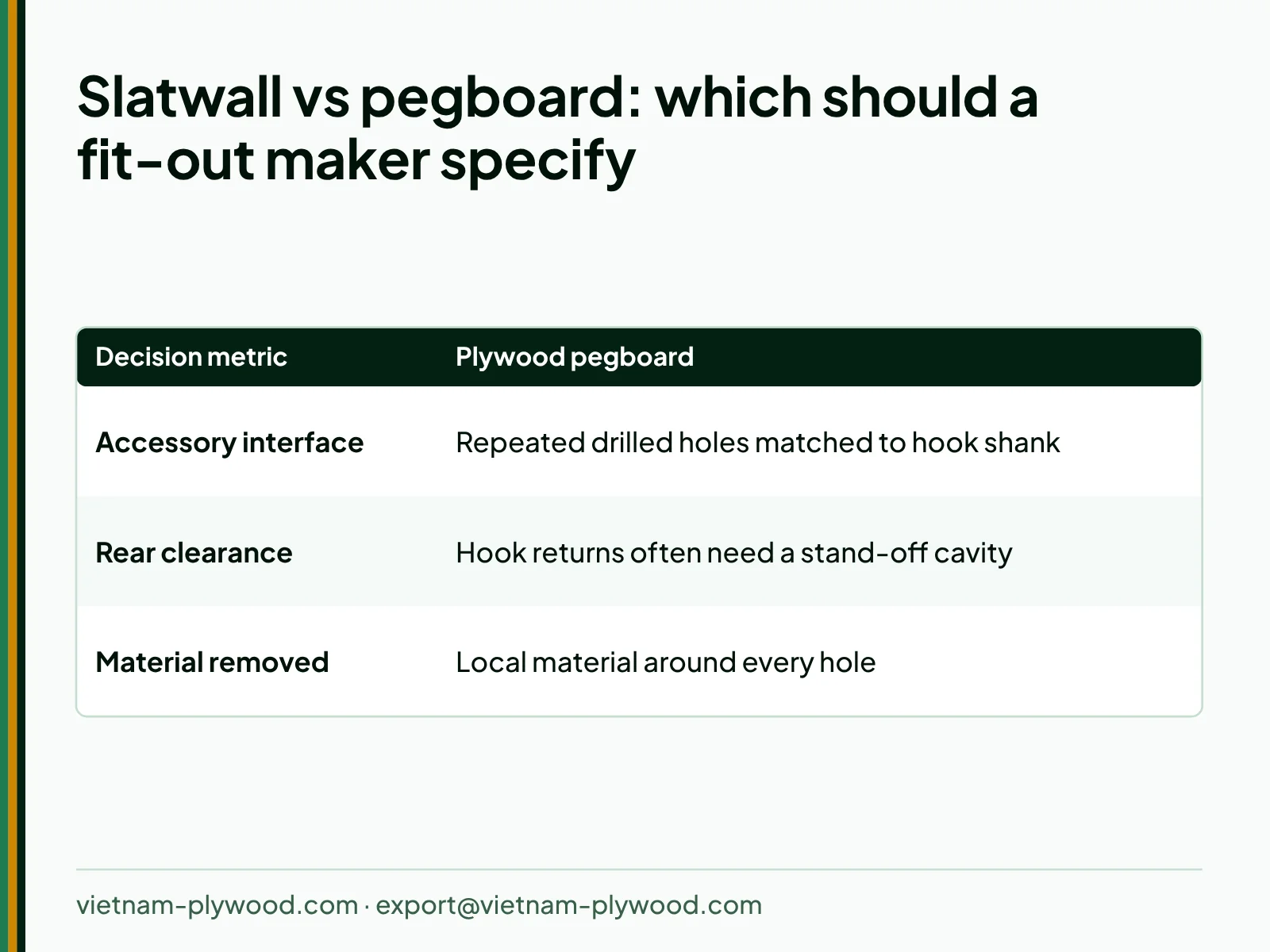
| Decision metric | Plywood pegboard | Grooved plywood slatwall | Verdict by use |
|---|---|---|---|
| Accessory interface | Repeated drilled holes matched to hook shank | Routed horizontal grooves matched to bracket profile | Pegboard for isolated hooks; slatwall for rail accessories |
| Rear clearance | Hook returns often need a stand-off cavity | Bracket engagement needs a groove profile and sufficient remaining material | Match hardware drawings before machining |
| Material removed | Local material around every hole | Continuous material along each groove | Test the weakest loaded region for either system |
| Merchandising changes | Individual hook positions can change across a grid | Fittings move along selected horizontal tracks | Choose by reset frequency and display layout |
| Visible finish | Exposed veneer between holes | Veneer interrupted by routed grooves | Approve a machined and finished sample |
| Load evidence | Test hook, panel and fixing assembly | Test bracket, groove and fixing assembly | Neither is rated by board thickness alone |
Grooved slatwall requires a groove cross-section agreed with the hardware supplier. A decorative tongue-and-groove wall panel is a different assembly and should not be substituted for a load-bearing merchandising groove. Likewise, a face laminate specification cannot replace a hook-fit drawing. Melamine, high-pressure laminate and other laminate finishes are separate finishing topics, not HCPLY product lines.
How much weight can plywood pegboard hold?
There is no defensible universal kilogram rating for plywood pegboard. The allowable load follows the tested combination of hole spacing, hook geometry, residual plywood, support spacing, fasteners and installation substrate. A thicker sheet can provide more material around a hole, but an unsupported panel or poorly seated hook can still fail. Ask the display engineer to approve a load per hook and a total load per mounted panel.
Test the intended worst case rather than an isolated straight pull. Include a cantilevered product load, repeated hook insertion, adjacent occupied holes and the chosen mounting frame. Observe hole elongation, veneer splitting, local bending, fastener withdrawal and permanent deformation after unloading. Record the load position and duration with the result so a purchasing team can compare identical assemblies.
A retail aisle also needs a projection check. The 2010 ADA Standards, published by the U.S. Access Board, state in section 307.2 that objects with leading edges above 27 inches (685 mm) and no higher than 80 inches (2030 mm) may project at most 4 inches (100 mm) into a circulation path. See the official accessibility standard. This is a circulation-path rule, not a plywood hook-capacity rating; review the complete installed display against applicable project requirements.
Which thickness, core and face should the drawing call for?
Start with the hardware and span drawing, then select a thickness from the available 3–40 mm range. Common order thicknesses include 9, 12, 15, 18 and 21 mm. For a trial display, 18 mm is a practical specification candidate, but it is not a published load classification. A routed groove removes material, so check the remaining web behind the deepest cut before approving a slatwall section.
The furniture line offers styrax or eucalyptus cores with full-stitched construction. At 18 mm, the core build has 11–13 plies, with the actual count tied to veneer thickness. Styrax density is 500 kg/m³ and eucalyptus is 650 kg/m³. Density follows the core rather than the visible face; a birch-faced sheet is not necessarily birch-core plywood, which we do not press.
Choose bintangor, okoume, engineered veneer, gurjan, pine, poplar, eucalyptus, birch or sapele faces against the finish sample. Face veneers commonly measure 0.2–0.4 mm. Specify A/B face grades where applicable; birch face grades are D/E/F. An exposed retail wall usually merits a cleaner visible face than a painted backing panel. Our furniture plywood page covers the base panel family.
How do our three factory lines differ for the same wall thickness?
Our furniture line makes the sanded decorative substrate for pegboard or routed slatwall fabrication. The commercial and packing line instead builds acacia-core MR-glue sheets, unsanded or light-sanded, for functional backing and packing uses. Our construction line presses acacia- or eucalyptus-core film-faced panels for formwork rather than a decorative merchandising face.
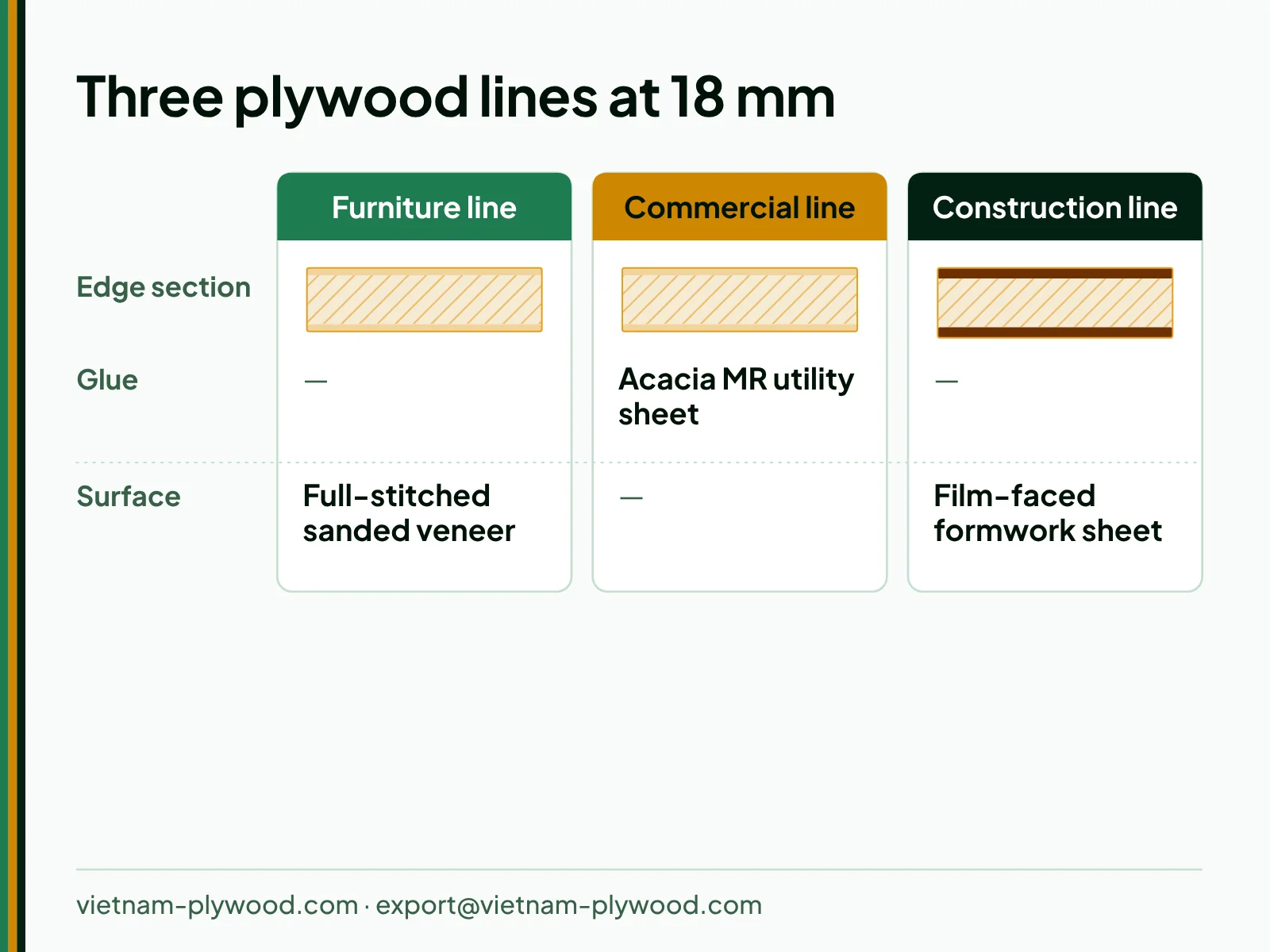
| Same nominal thickness | Core and surface | Relevant production purpose | Fit for this wall system |
|---|---|---|---|
| Furniture line, 18 mm | Full-stitched styrax/eucalyptus, sanded veneer | Visible retail wall substrate | Preferred starting specification |
| Commercial and packing line, 18 mm | Acacia, MR, unsanded or light-sanded | Concealed utility backing | Consider only where appearance is secondary |
| Construction line, 18 mm | Acacia/eucalyptus, phenolic or melamine film, unsanded core | Concrete formwork | Different application; not the decorative choice |
The producing factory is selected for the agreed build. HCPLY coordinates the written specification, on-site quality control, export paperwork and loading. A buyer can inspect the producing factory and examine the actual order before dispatch.
What must be fixed before factory pre-cutting?
Pre-cutting succeeds when the fabricator sends one controlled drawing that matches the site framing and accessory system. Panel dimensions alone cannot define a usable hole grid or slat profile. Provide a CAD drawing with the datum edge, machining face, hole centres, drill diameter, groove section, edge offsets, cut-outs and permitted defects.
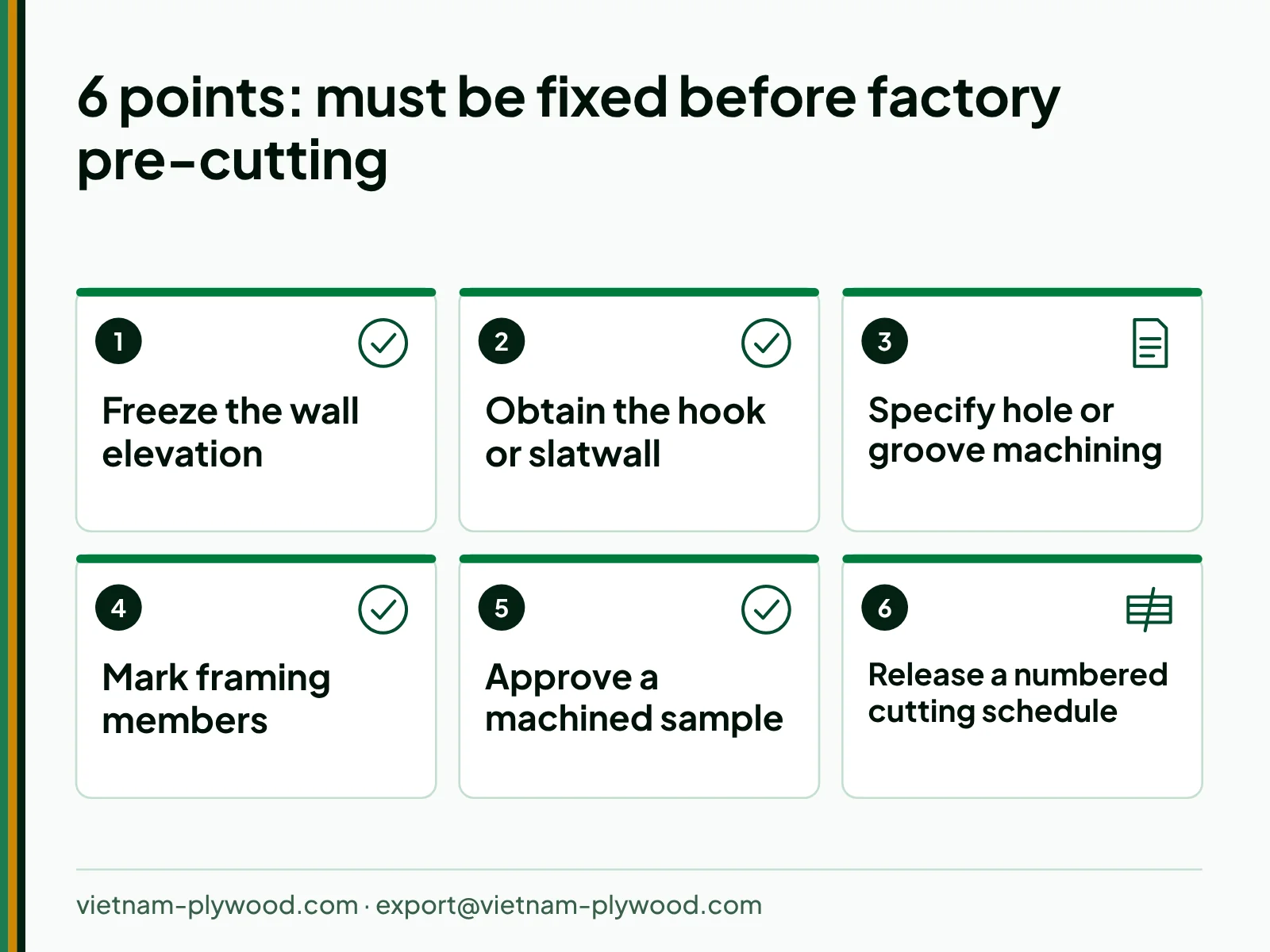
- Freeze the wall elevation and label every panel position, orientation and exposed edge.
- Obtain the hook or slatwall fitting manufacturer’s drawing and define its engagement clearance.
- Specify hole or groove machining tolerances separately from overall panel tolerances.
- Mark framing members, mounting points and the rear cavity required for hook returns.
- Approve a machined sample with the actual hook, bracket, finish and fastener set.
- Release a numbered cutting schedule and pack labels that follow the installation sequence.
Available sheet formats include 1220×2440, 1250×2500 and narrower formats, with custom cutting available. Standard length and width tolerance is ±2 mm; furniture sanded thickness tolerance is ±0.2 or ±0.3 mm as ordered. The CNC or drilling shop must agree separate feature tolerances, since sheet-size tolerance does not establish hole-to-hole accuracy. For toolpath and edge quality considerations, see laser-cutting plywood settings as a separate process reference.
What glue and emission fields belong on the purchase order?
Glue performance and formaldehyde emission classification are separate fields on the purchase order. The furniture line uses E0 or E1 emission classes; specify the required class and the test document accepted for the destination market. Melamine MR glue has a 12-hour boil description, while phenolic WBP glue has a 72-hour boil description in the available production specification. Those descriptions do not establish a retail hook load rating.
For a U.S. project, a buyer might request CARB Phase 2 or TSCA Title VI documentation for the agreed panel. Member-factory certificates, including FSC, CARB P2, ISO 9001 and CE, are shown with factory details masked, on request. Match the certificate scope to the producing factory and the ordered build. Where surface treatment is part of the fit-out, review anti-termite and anti-mold treatments separately instead of assuming a decorative panel includes treatment.
What can an inspector witness at the producing factory?
The inspection should compare a signed reference sample against panels selected from the actual lot. A witness can measure thickness, overall size, visible veneer grade, hole centres, groove profile, edge condition and pack labels. Inspect both faces and the rear cavity clearance with the intended fitting; a clean front face alone does not prove accessory engagement.
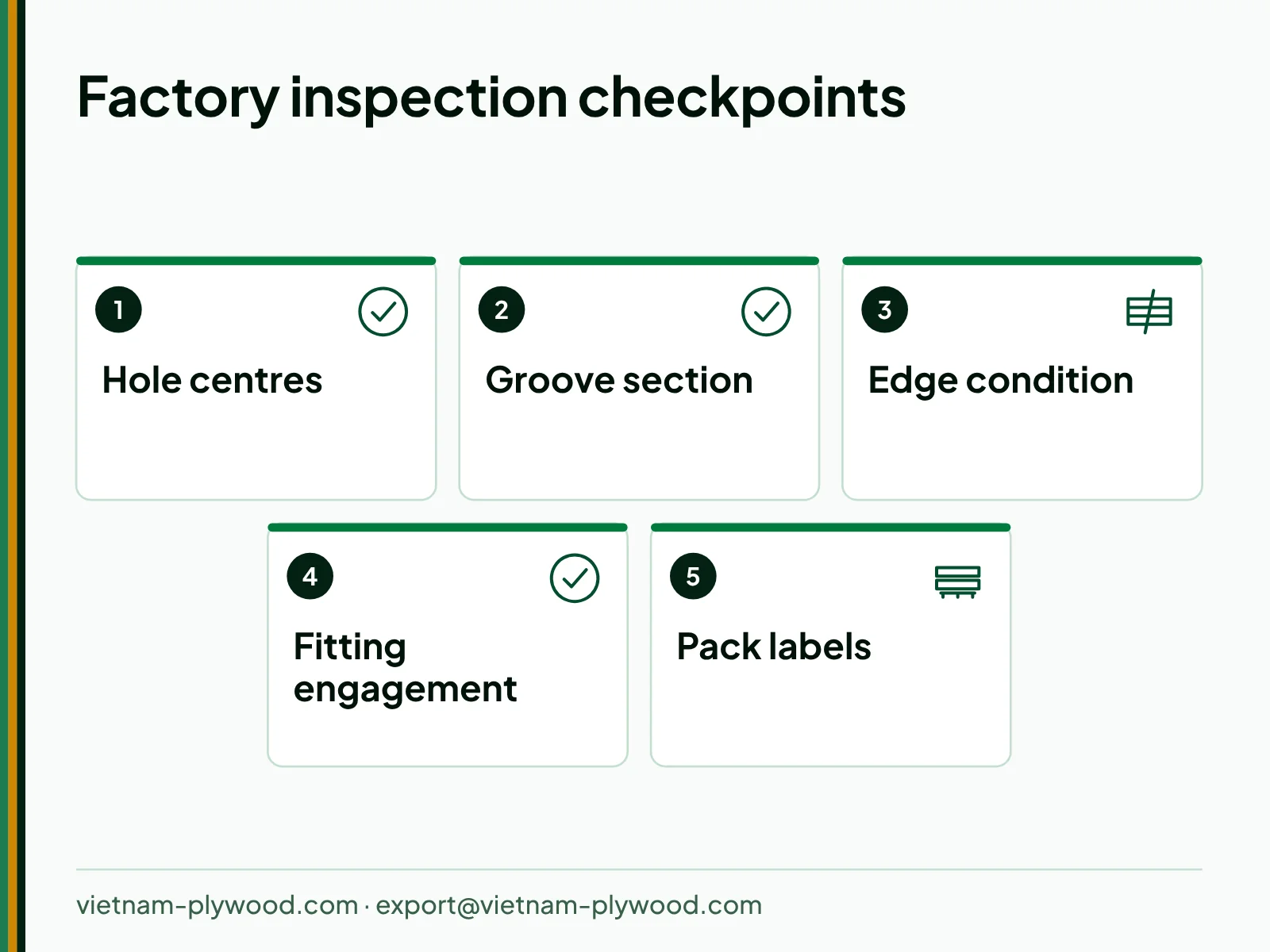
Use a go/no-go hook or bracket sample and record which panel position was checked. Examine the cut edge for core gaps and splits, especially beside holes or thin groove webs. A witness can check flatness against the buyer’s agreed method and inspect any edge-sealing requirement before packing. Load testing belongs to a documented assembly test with the intended mounting hardware, not a casual demonstration using a single loose sheet.
Keep the signed drawing revision, approved sample photographs, inspection measurements and any agreed test report together. The commercial invoice and packing list identify the shipped goods; order-specific test reports or emission documents accompany the export document set where agreed.
Can pegboard panels share a container with other plywood?
Mixed specifications can share one 40HC within the 28.5-tonne payload limit. For 18 mm, 1220×2440 mm sheets, the planning lookup gives 990 styrax sheets at 26.52 tonnes, 880 acacia sheets at 27.35 tonnes or 795 eucalyptus sheets at 27.69 tonnes when each core fills its own standard pallet plan. These are base-panel figures before machining losses, hardware, packaging adjustments or any added facing mass.
A mixed order must be recalculated from its actual pallet counts and panel weights rather than adding two full-container quantities. At the sheet level, the corresponding 18 mm weights are 26.79 kg for styrax, 31.08 kg for acacia and 34.83 kg for eucalyptus. For example, allocating 100 styrax sheets and 100 acacia sheets contributes 2,679 kg plus 3,108 kg, or 5,787 kg of base plywood toward the payload. The remaining allocation depends on pallet geometry and the rest of the cargo.
Use the container-load reference for the full packing question. Mark pre-cut panels by wall location and protect exposed machined edges from transit damage. A fit-out distributor may coordinate this order through plywood supply programmes when multiple store layouts are involved.
What drives the quotation and export documents?
Machining complexity and the chosen veneer face usually change the quote before small differences in nominal sheet size. A full-stitched sanded furniture panel costs more to build than a utility acacia backing because core preparation and surface selection differ. Dense drilling, tight groove tolerances, individually numbered cut parts and edge finishing add fabrication work. Request a written quotation against the final drawing and sample; there is no published pegboard or slatwall price here.
The minimum order is one 40HC, with mixed specifications allowed inside the payload limit. Factory lead time runs 15–45 days from receipt of the 30% deposit; the exact figure depends on order size, line loading and what the contract fixes. The remaining 70% is paid on the scan of the bill of lading, by T/T, or by irrevocable sight L/C. We ship FOB Hai Phong, or CFR (CNF) or CIF to your port.
Shipment papers include the commercial invoice, packing list, bill of lading, certificate of origin, phytosanitary and fumigation papers, and applicable order certificate documents. EU lots include EUR.1 and the EUTR/EUDR file set; CIF shipments include insurance. After loading, the draft shipping documents come to you for approval. For large fit-out contracts, construction-project plywood supply explains a separate procurement context.
What should the final specification and sample request contain?
The final request should identify the actual hardware system and the producing line before quantity is negotiated. A sample set should include the chosen face, the intended hole or groove section and a finished edge so the fit-out maker can evaluate the installed appearance. Free samples are available; a first-time buyer pays the courier, and that charge comes off the first confirmed order.
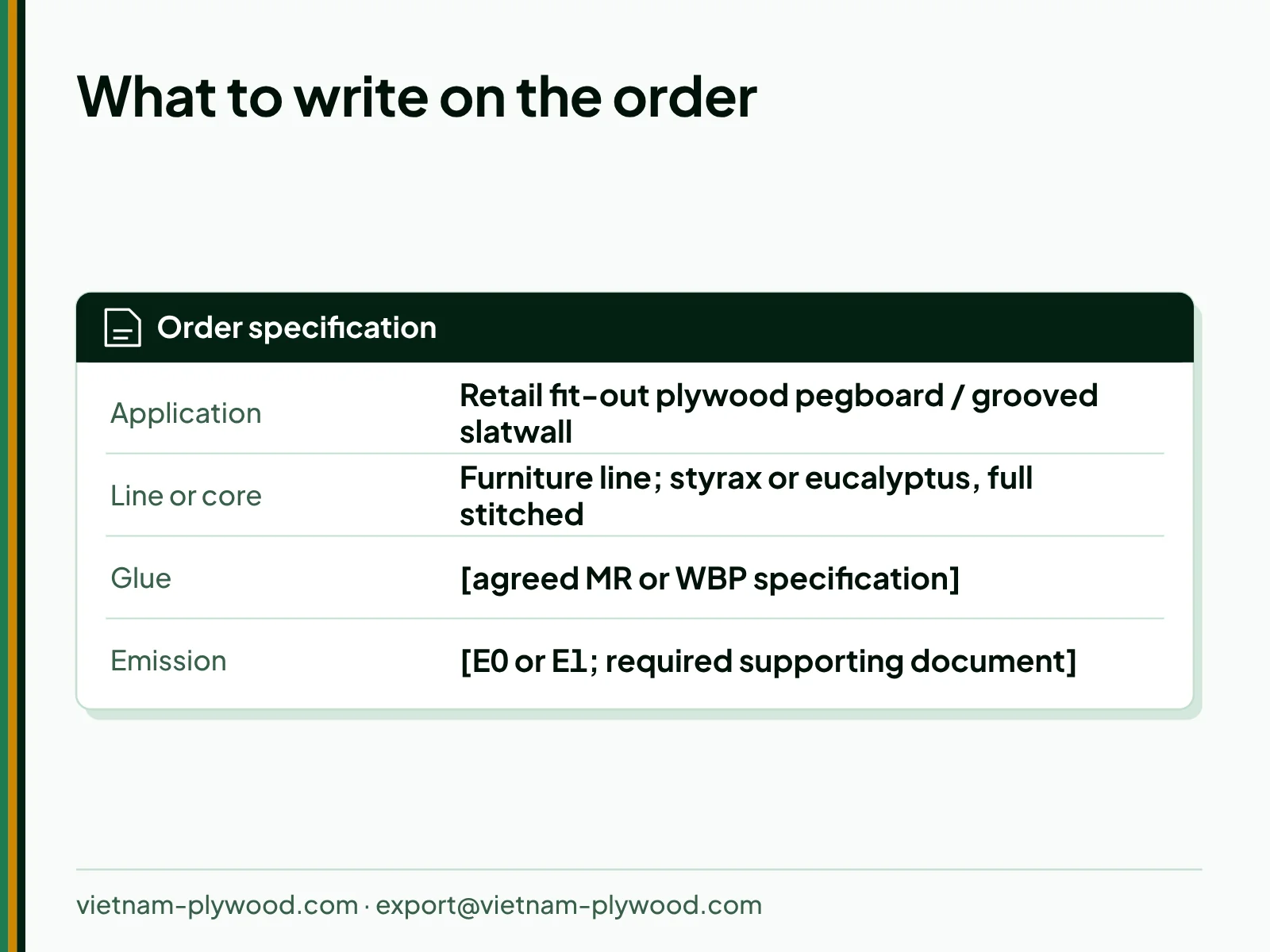
Send Lucy at export@vietnam-plywood.com the drawing revision and destination port with this specification:
Application: Retail fit-out plywood pegboard / grooved slatwall
Line or core: Furniture line; styrax or eucalyptus, full stitched
Glue: [agreed MR or WBP specification]
Emission: [E0 or E1; required supporting document]
Face and grade: [veneer species, applicable grade, finish reference]
Thickness and tolerance: [mm; ±0.2 or ±0.3 mm as ordered]
Size: [mm; panel cutting schedule and machining drawing revision]
Quantity: [sheets and mixed 40HC allocation]
Destination port: [port and country]
Ask for a sample set through contact before releasing the production drawing.