





PEFC is the Programme for the Endorsement of Forest Certification, a framework for national forest certification systems. A wrong certificate claim can cost an importer a rejected tender, delayed release, or replacement paperwork. HCPLY’s member factories hold Forest Stewardship Council (FSC) certificates and ship eligible FSC claims. The buyer’s specification must say whether FSC is accepted.
What is PEFC certification?
PEFC is an international framework that endorses national forest certification systems and provides chain-of-custody rules for forest-based products. Forest management certification concerns the source forest; chain-of-custody certification tracks qualifying material through purchasing, processing, and sale. A plywood invoice needs the applicable chain-of-custody claim when the purchaser has specified certified material. A PEFC logo alone is not a substitute for transaction evidence.
PEFC International’s 2024 claim guidance describes declarations on sales and delivery documents. Its 2020 chain-of-custody standard distinguishes certified content from controlled sources. A distributor buying PEFC timber should therefore check the certificate holder, product scope, current certificate status, and the actual sales claim. The term pefc certified wood should refer to material supported by that chain, rather than a supplier’s general statement about forest sourcing.
PEFC international recognition is useful when a purchasing policy names an endorsed national system. However, a national forest certificate and a product’s chain-of-custody declaration answer different questions. For plywood procurement, request the exact claim wording before the purchase order is signed.
What is the difference between PEFC and FSC?
PEFC and FSC are separate certification systems with distinct chain-of-custody claims, even though both address forest management and traceability. Neither name can be substituted for the other on an invoice. The correct selection follows the buyer’s contractual acceptance criteria.
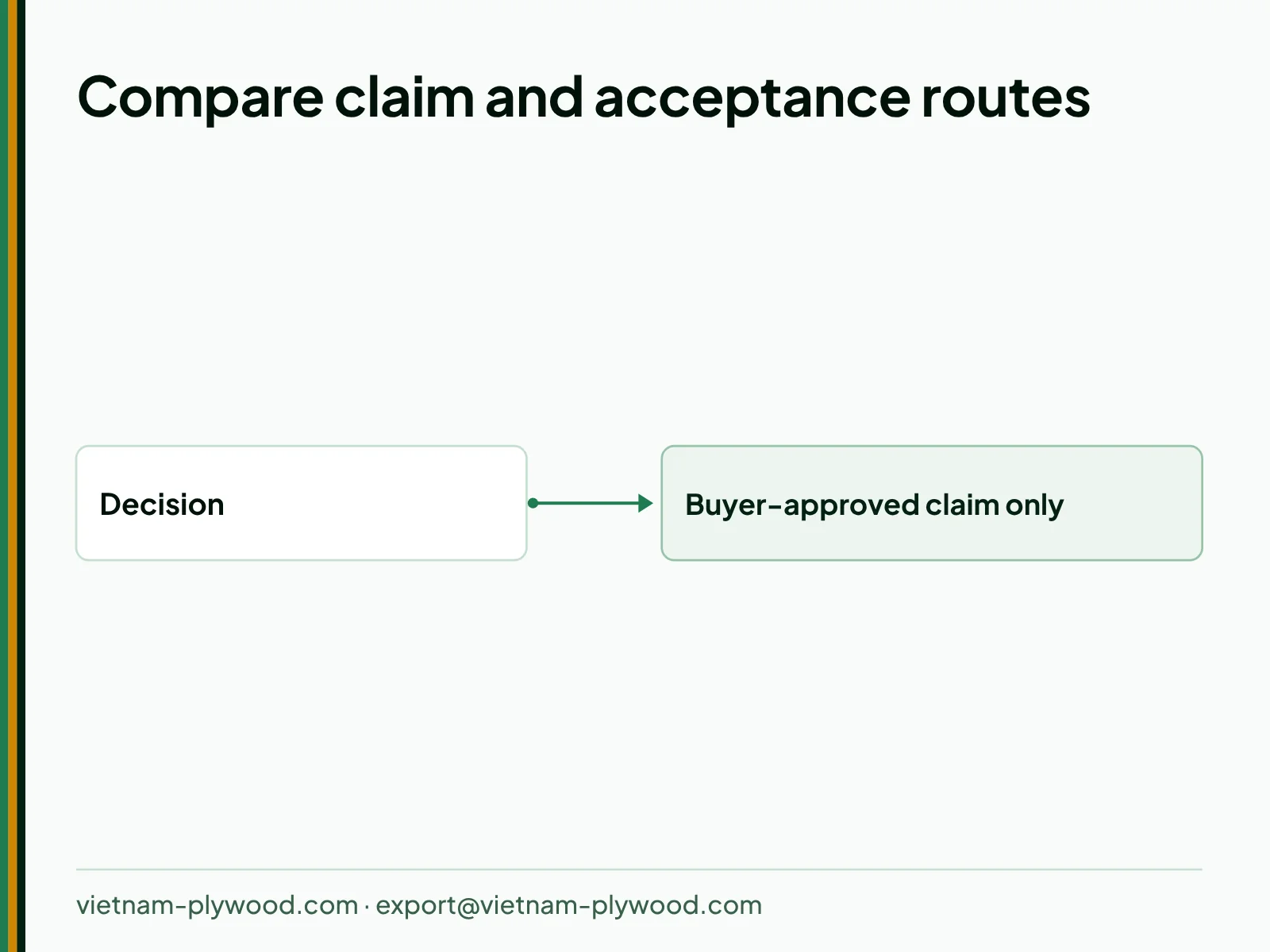
| Buying test | PEFC | FSC | Verdict by use |
|---|---|---|---|
| Certification framework | Endorses national forest schemes | Operates FSC forest-management and chain-of-custody requirements | Use the named scheme in the tender |
| Plywood transaction evidence | PEFC claim on sales or delivery records | FSC claim on eligible sales documents | Match the required claim exactly |
| Verification | Check PEFC certificate holder and scope | Check FSC certificate holder and scope | Validate before ordering |
| Buyer asks for either scheme | PEFC route can qualify | FSC route can qualify | FSC is an option if expressly accepted |
| Buyer asks only for PEFC | PEFC documentation required | FSC alone does not satisfy that wording | Seek written equivalence approval first |
The Forest Stewardship Council’s chain-of-custody guidance explains that product tracking continues through the stages of processing and sale. Its published guidance also limits sales with FSC claims to eligible certificate holders. These rules make fsc pefc certification a procurement decision about specific transaction records, rather than a choice between two interchangeable logos.
Which forest claim can buyers request from our factories?
Our member factories hold FSC certificates, and an eligible order can carry an FSC claim under the producing factory’s certificate scope. Certificates are shown with factory details masked, on request.
Our quality and certifications page explains the wider document categories. For an FSC order, specify the required claim in writing and identify the finished plywood build. The production and sales records must support the same description and quantity.
An importer whose purchasing rule names that scheme alone should obtain written approval for FSC as an alternative before contracting for our plywood. An informal assurance that FSC and PEFC are similar cannot change a tender’s mandatory evidence field.
Can an FSC claim answer a PEFC requirement in a European tender?
An FSC claim can answer a European tender’s PEFC requirement only when the tender authority or downstream buyer expressly accepts FSC as an alternative. If the specification requires PEFC exclusively, an FSC claim does not become a PEFC claim. Ask the decision-maker to approve the alternative in writing before the order is placed.
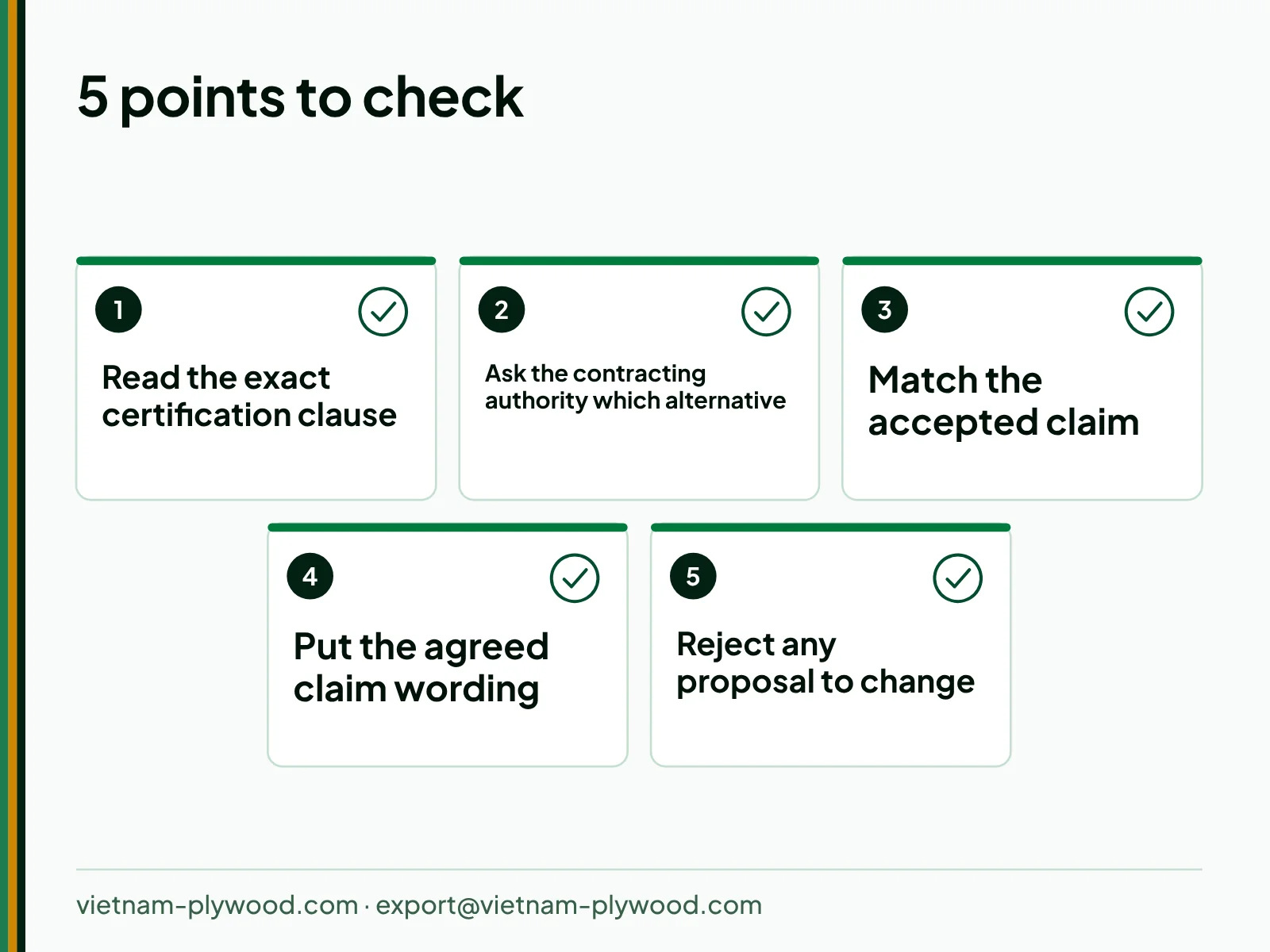
- Read the exact certification clause, including whether it says “PEFC or equivalent,” “FSC or PEFC,” or “PEFC only.”
- Ask the contracting authority which alternative evidence it accepts, and keep the written reply with the procurement file.
- Match the accepted claim to the producing factory’s FSC scope and the ordered plywood category.
- Put the agreed claim wording on the purchase specification and review the sales-document draft.
- Reject any proposal to change the certificate name while leaving the underlying chain-of-custody evidence unchanged.
A European importer’s own due-diligence obligations are separate from a voluntary certification preference. The order’s EUTR/EUDR file set addresses the EU timber documentation workflow, while the FSC claim on sales documents addresses the certified-material requirement. See our technical datasheet and sample standards for the product fields that should travel alongside the certification request.
What is Responsible Wood in Australia?
Responsible Wood is the Australian and New Zealand representative for PEFC and works with PEFC-endorsed forest-management standards. Responsible Wood’s 2023 explanation identifies its role in national standards and chain of custody. This is why an Australian purchaser can encounter both Responsible Wood and PEFC terminology in procurement documents.
A Responsible Wood requirement must be read at the level of the specified scheme and claim. Its connection to PEFC does not transform an FSC-certified shipment into a Responsible Wood shipment. Australian importers should ask whether their customer’s policy accepts FSC separately, then record that decision on the order.
The Australian term responsible wood can also appear descriptively in purchasing policies. Treat descriptive sourcing language differently from a named certification requirement. If a specification asks for a logo, claim, or certificate from a particular system, its documentary requirements control the purchase.
Which forest certificates do our member factories hold?
Our three factories hold FSC certificates at member-factory level; certificates are shown with factory details masked, on request. Other member-factory certificates include CARB P2, ISO 9001, and CE, but these address different product or management questions. An FSC claim belongs in the agreed sales documents for the eligible build.
The production route follows the product specification. A cabinet panel goes to our furniture line, commercial and packing plywood to our commercial and packing line, and film-faced panels to our construction line. A forest claim does not establish bonding performance, emission class, thickness tolerance, or structural suitability.
The ISO 9001 plywood mills page addresses quality-management documentation. For construction declarations, consult EN 13986 plywood CE and DoP and CE-marked plywood supply. These records must not be substituted for a forest chain-of-custody claim.
How does the same plywood thickness differ across our lines?
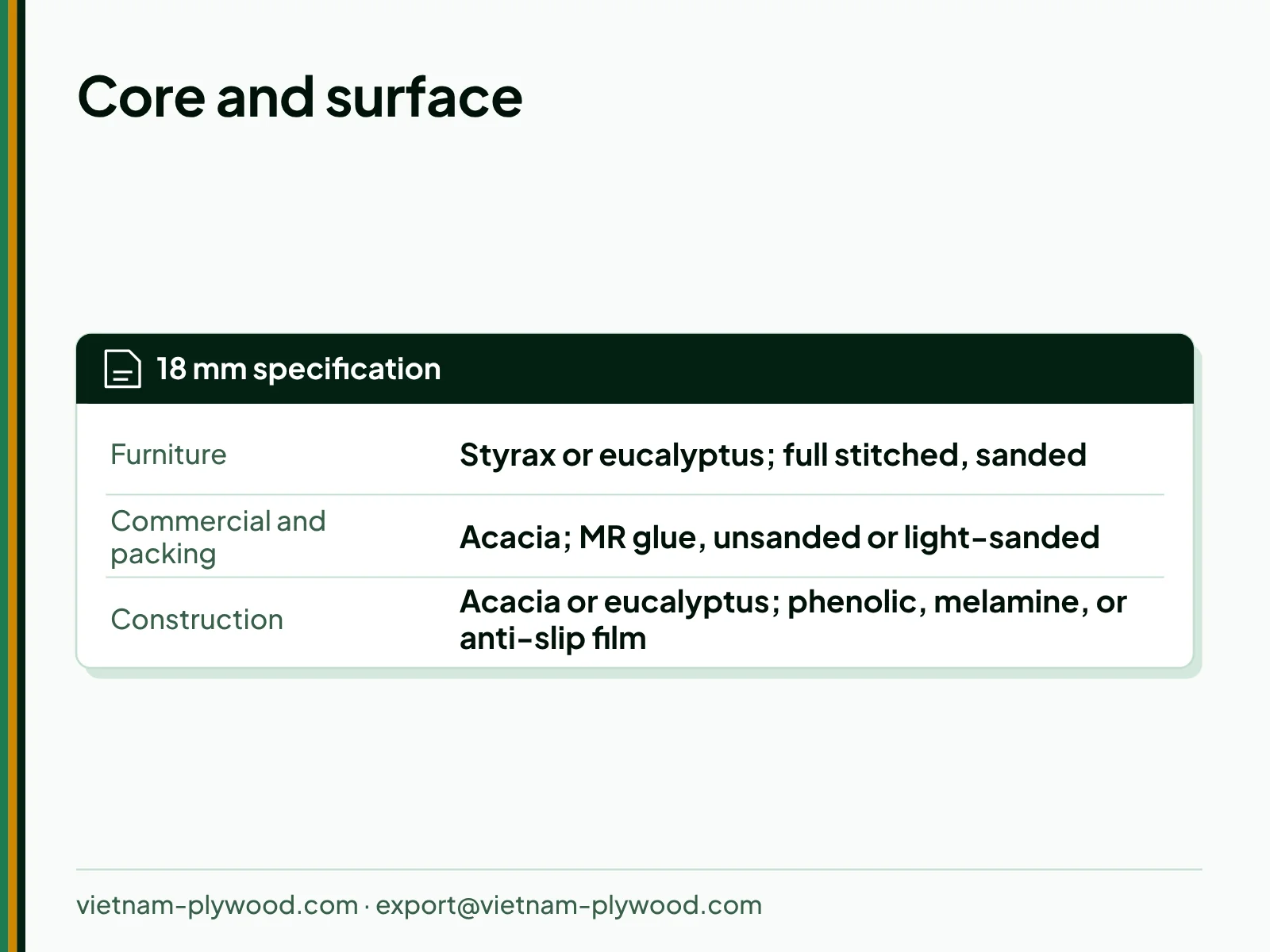
An 18 mm plywood order can be built differently on each line, with a different core, finish, and tolerance. The requested application determines the producing factory and the evidence the buyer should inspect.
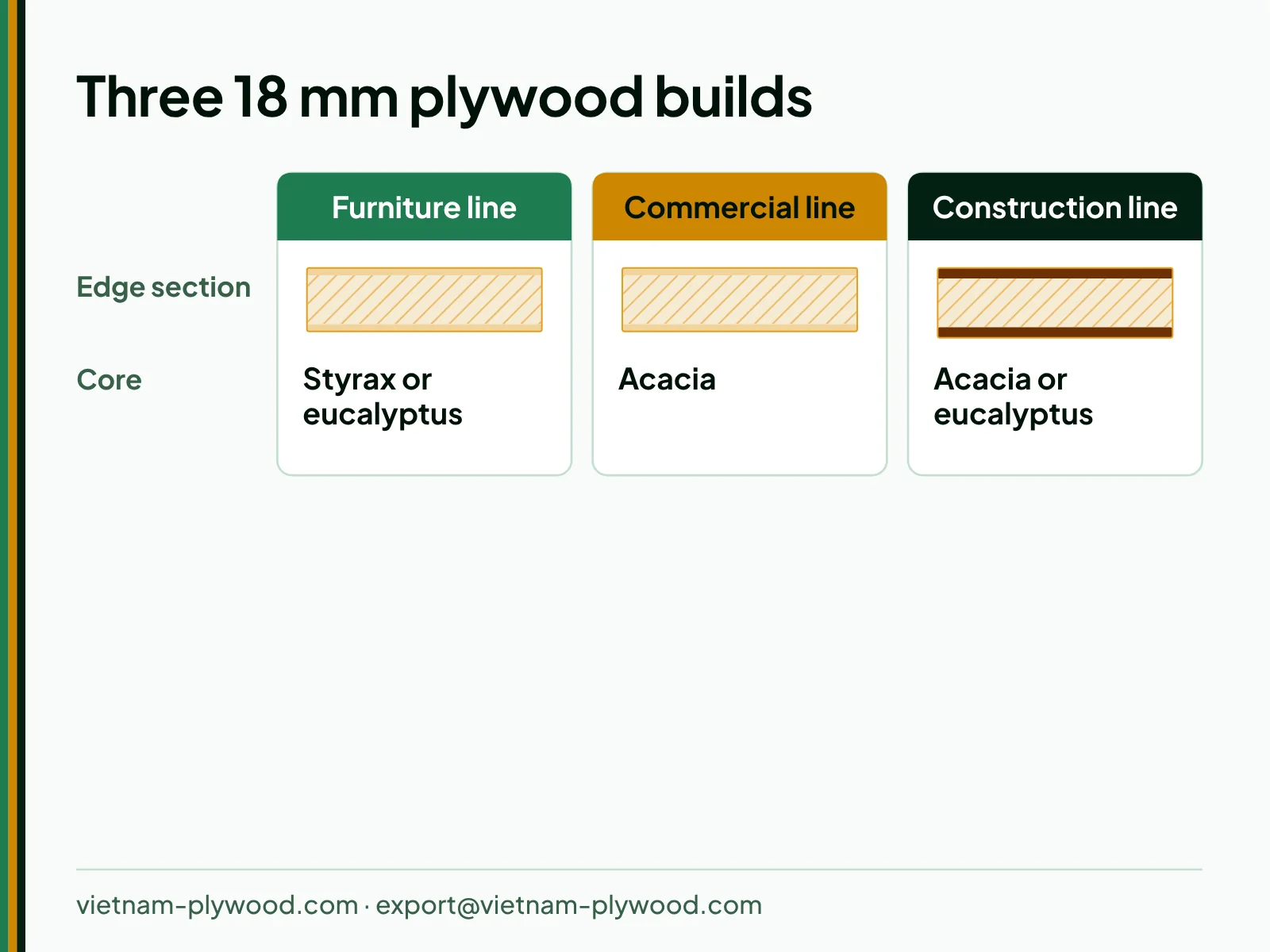
| 18 mm specification | Core and surface | Thickness tolerance | Appropriate buyer use |
|---|---|---|---|
| Furniture | Styrax or eucalyptus; full stitched, sanded | ±0.2 or ±0.3 mm as ordered | Cabinet and furniture components |
| Commercial and packing | Acacia; MR glue, unsanded or light-sanded | ±0.5 mm commercial; ±0.5–1.0 mm packing | General panels and export packing |
| Construction | Acacia or eucalyptus; phenolic, melamine, or anti-slip film | ±0.5 mm | Formwork and site applications |
An FSC requirement must be checked for the chosen producing factory and product scope, independently of the thickness. The furniture plywood specification is useful for cabinet orders, while construction buyers should state the film and glue system. Face species names describe the face, not the density of the core.
What can an inspector check at the producing factory?
An inspector can witness the panel build, batch identification, and quantity records that connect a specified order to its production. The factory office is the visit point; goods are inspected at the producing factory. This lets the buyer compare physical panels with the written specification before loading.
For furniture panels, inspect the sanded surface, core stitching, face grade, and thickness against the order. For packing panels, check the acacia core, finish, and agreed dimensional tolerance. For construction panels, check film type, edges, core, and the recorded glue specification. None of these physical observations replaces a valid FSC transaction claim.
The certificate and its scope should be reviewed alongside the production and sales records. The FSC’s chain-of-custody explanation describes identification, separation, and traceability of qualifying materials. An inspection request should name the certificate claim as a documentary checkpoint rather than asking the inspector to infer certification from panel appearance.
Can an FSC plywood order share a container with other specifications?
Specifications can be mixed within one 40HC container, within the 28.5 t payload limit. Certification eligibility must be recorded for each qualifying product line; a mixed load does not give every panel the same claim. Our mixed-container plywood loads page covers the ordering approach.
At 18 mm and 1220 × 2440 mm, the reference full-container quantities are 990 styrax sheets at 26.52 t, 880 acacia sheets at 27.35 t, or 795 eucalyptus sheets at 27.69 t. Those figures follow the respective core densities and do not include film weight. For mixed loads, check the producing factory’s pallet-by-pallet weight plan before finalising the load.
For a mixed load, request a pallet-by-pallet loading plan listing each core, thickness, sheet count and total gross weight. Check the planned gross weight against the payload limit before approving loading. See container loads and packing for full-load reference quantities.
Which shipping document carries the FSC claim?
The FSC claim belongs on the applicable sales documentation for the agreed certified product, supported by the producing factory’s certificate scope. The commercial invoice is therefore a key document for the buyer’s claim review. The packing list connects item quantities and packing marks to the shipment.
The shipment documentation also includes the bill of lading, certificate of origin, phytosanitary and fumigation papers, and the order’s applicable certificate documents. EU lots include EUR.1 and the EUTR/EUDR file set; CIF shipments include insurance. After loading, the draft shipping documents come to you for approval.
Use the FSC claim wording supported by the producing factory’s certificate scope on the order’s invoice. A buyer who needs FSC documentation should agree the exact claim and product coverage before production. The production lead-time page explains scheduling, while document wording remains a separate acceptance point.
How should an importer write the certification requirement?
Write the acceptable certification system, claim type, product build, and document evidence as separate purchase-order fields. This prevents an otherwise acceptable plywood specification from failing because the certificate wording differs from the downstream contract.
For a tender accepting FSC or PEFC, write that alternative explicitly and attach the tender authority’s approval when applicable. For a contract limited to that scheme, obtain written acceptance of an FSC alternative before placing the order. For a buyer accepting FSC, request the producing factory’s FSC scope and eligible claim documentation.
HCPLY coordinates the specification, on-site quality control, documents, and loading, with shipment directly from the producing factory. Lucy can discuss the written claim requirement at export@vietnam-plywood.com. Use the following fields to send a clear request:
Application: Import distribution / cabinet production / packing / formwork
Line or core: Furniture—styrax or eucalyptus / commercial—acacia / construction—acacia or eucalyptus
Glue: MR melamine or WBP phenolic, as applicable
Emission: E0 / E1 / E2, as ordered
Face and grade: [species or film] / [applicable grade]
Thickness and tolerance: [mm] / [± mm]
Size: [length × width, mm]
Quantity: [sheets and 40HC allocation]
Destination port: [port and country]
Certification requirement: FSC claim accepted / PEFC-only / either, with written tender acceptance
Next step: book a factory visit to review the producing factory’s build and claim documentation.