






EN 13986 applies to wood-based panels marketed for construction use; furniture-only plywood is treated differently. Misclassifying the application can mean replacement documents, delayed sale or a rejected load. HCPLY asks buyers to state the intended use before choosing a build or requesting CE documentation.
What is EN 13986?
EN 13986 is the European harmonised standard describing essential characteristics of wood-based panels intended for construction. It connects a panel’s stated use to performance declarations and the applicable assessment route. It covers structural and non-structural construction applications; it does not turn every plywood sheet sold in Europe into a construction product.
The European Commission’s 2011 Construction Products Regulation framework links harmonised specifications to the manufacturer’s declaration of performance (DoP). Its construction products standards register explains how references published in the Official Journal are tracked, including later amendments. For a purchase order, the applicable cited edition matters more than an isolated standard number printed on a brochure.
EN 636 addresses plywood specifications for dry, humid and exterior conditions; EN 314 addresses bonding quality. These are supporting product standards, whereas EN 13986 provides the construction-use declaration framework. A glue description alone cannot substitute for a tested declared performance. The quality and certifications overview places those checks alongside export documentation.
Does plywood need CE marking?
Plywood needs CE marking under the relevant EU construction-product rules when it is placed on the market for a covered construction use and the applicable harmonised specification requires the declaration route. A sheet destined only for a cabinet component is different. Determine the use in the sale documents before asking whether a CE label belongs on the bundle.
The European Commission’s 2026 CE marking and declaration explanation states that the mark follows the required declaration and technical documentation. CE marking communicates declared regulatory performance; it is not a blanket promise about suitability for every building detail.
An importer should distinguish the older Construction Products Regulation 2011 DoP terminology from the revised 2024 framework’s declaration of performance and conformity. The Commission explains that the transition brings new assessment terminology and future product-passport provisions.
Which plywood uses fall inside the scope?
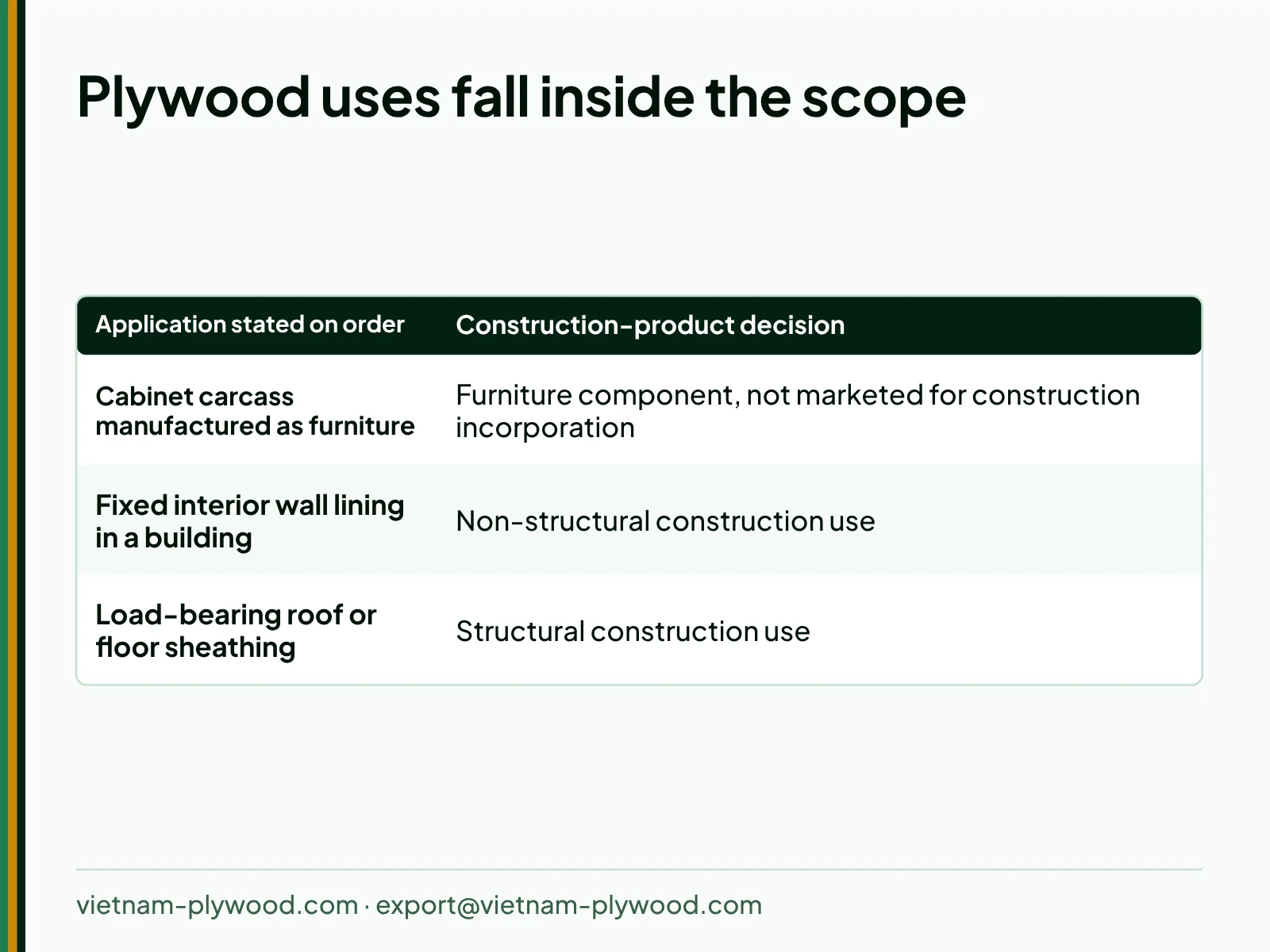
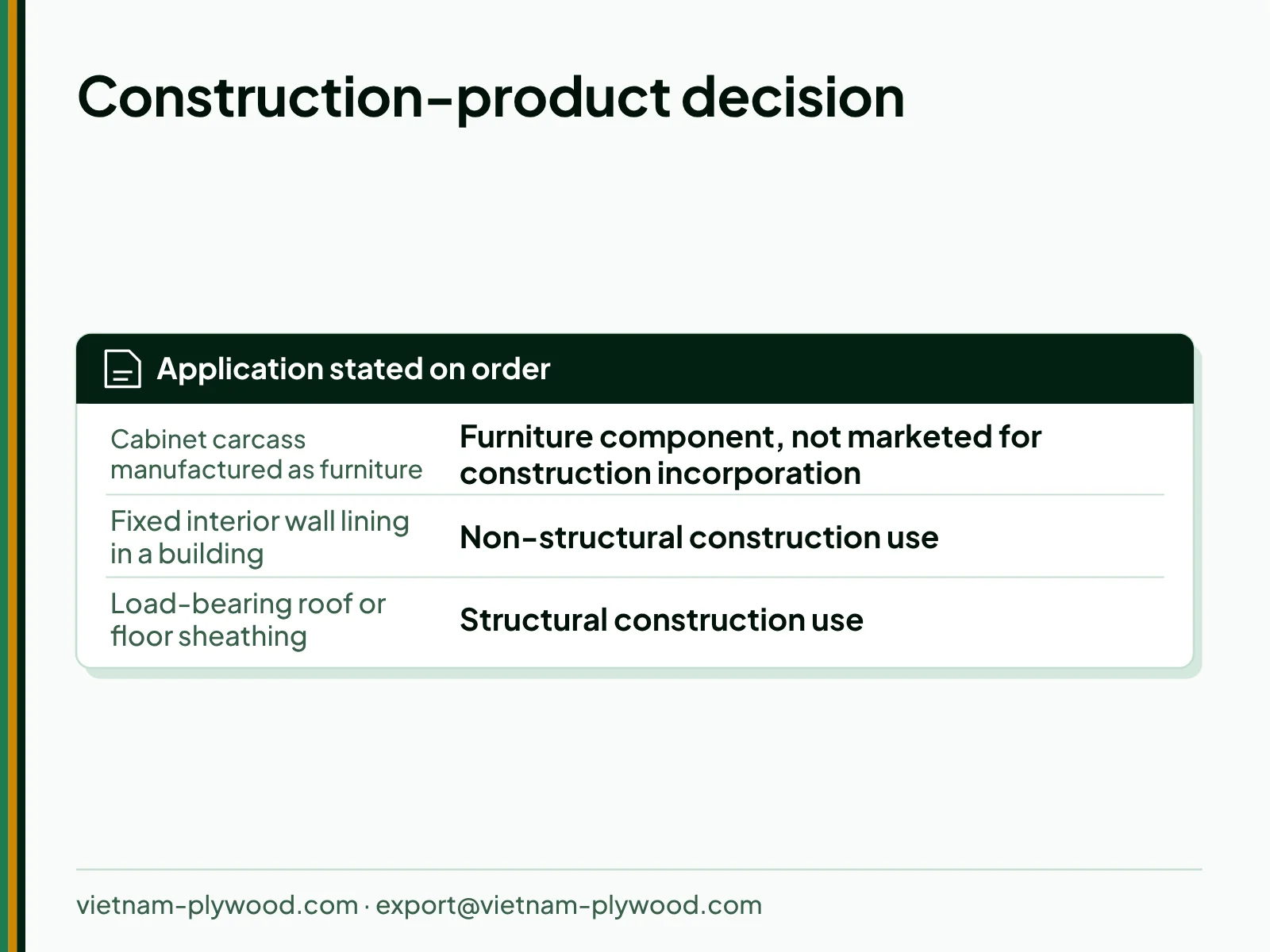
The decisive distinction is the intended use as a construction product, including non-load-bearing uses incorporated in works. Surface appearance, face species and thickness cannot decide the legal category by themselves. The buyer’s purchase specification should describe what the panel will actually do.
| Application stated on order | Construction-product decision | Document direction | Buyer verdict |
|---|---|---|---|
| Cabinet carcass manufactured as furniture | Furniture component, not marketed for construction incorporation | Furniture specification and applicable non-CPR obligations | No EN 13986 DoP for furniture-only use |
| Fixed interior wall lining in a building | Non-structural construction use | Check EN 13986 intended-use declarations and applicable AVCP | Assess CE/DoP route |
| Load-bearing roof or floor sheathing | Structural construction use | Check load-bearing classification, relevant performance and AVCP | Assess system 2+ requirements |
| Film-faced panel used only as removable concrete formwork | Temporary construction equipment rather than a permanently incorporated panel | Clarify exact marketed purpose and any separate applicable rules | Do not assume EN 13986 CE marking |
| Panel sold for permanent incorporation in a construction assembly | Construction use, even with a decorative face | Evaluate intended-use category and declarations | Assess CE/DoP route |
Film-faced formwork and permanent structural sheathing can both be found on a construction site, but their functions differ. The removable forming surface should be specified for the pour cycle and handling requirements without automatically applying the permanent-panel classification. See construction-project plywood supply for the product-selection context.
How do our plywood lines differ for the same 18 mm order?
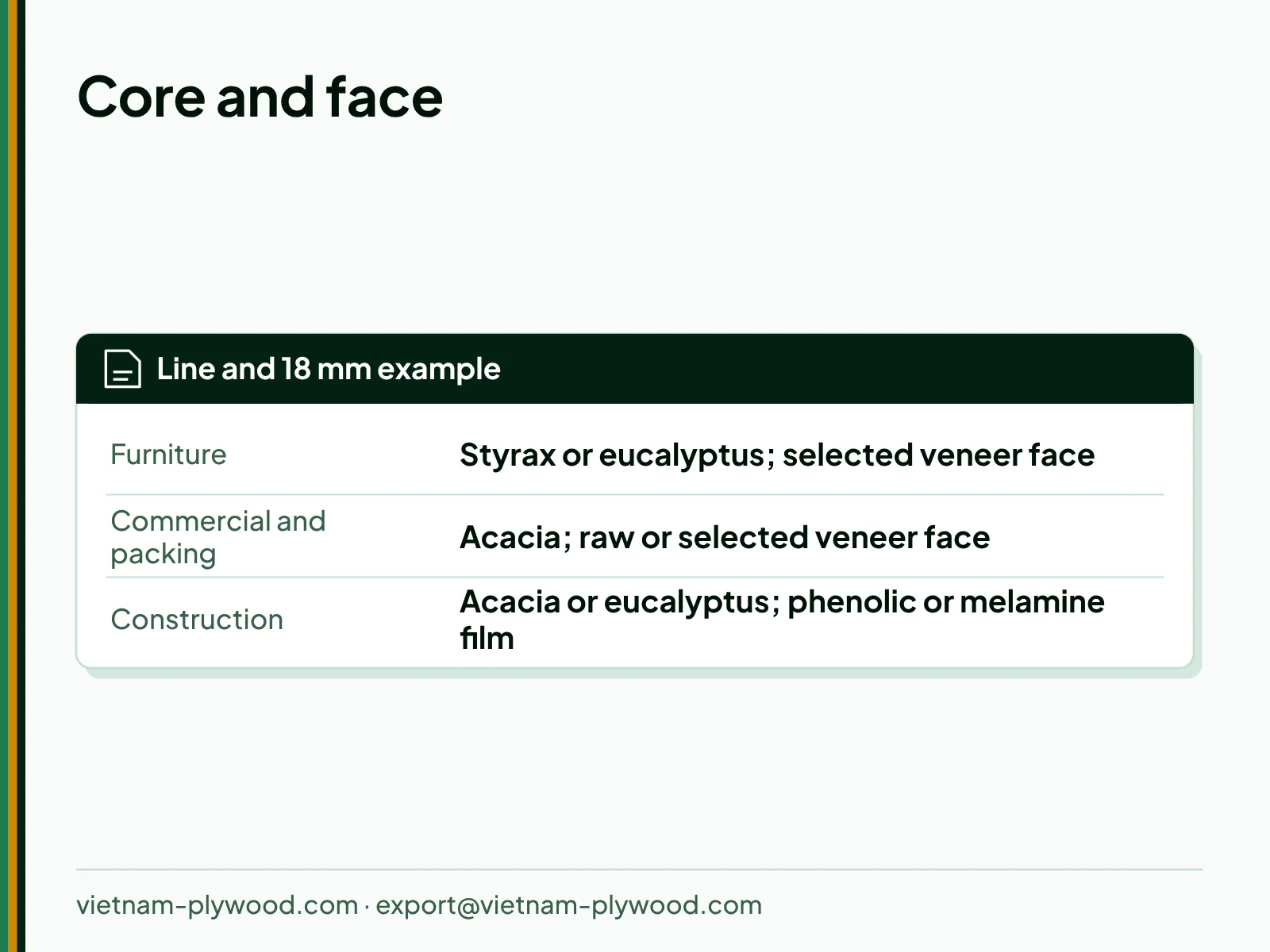
An 18 mm thickness alone does not identify the line or the CE documentation needed. Our furniture line builds sanded panels for cabinet and furniture components; our commercial and packing line builds acacia-core utility panels; our construction line presses film-faced panels for formwork specifications.
| Line and 18 mm example | Core and face | Surface and tolerance | Typical purchasing use |
|---|---|---|---|
| Furniture | Styrax or eucalyptus; selected veneer face | Sanded; ±0.2 or ±0.3 mm as ordered | Cabinet and furniture components |
| Commercial and packing | Acacia; raw or selected veneer face | Unsanded or light-sanded; commercial ±0.5 mm, packing ±0.5–1.0 mm | Packing or commercial panel |
| Construction | Acacia or eucalyptus; phenolic or melamine film | Unsanded core; ±0.5 mm | Removable formwork panel |
The same 18 mm sheet can have different declared purposes. Neither a sanded surface nor a phenolic film establishes a structural performance class. If a buyer requests a construction use beyond the line’s ordinary product specification, the test report and declared intended use must support it before sale. For film-faced build options, see exterior plywood supply.
What do AVCP systems 2+ and 4 mean?
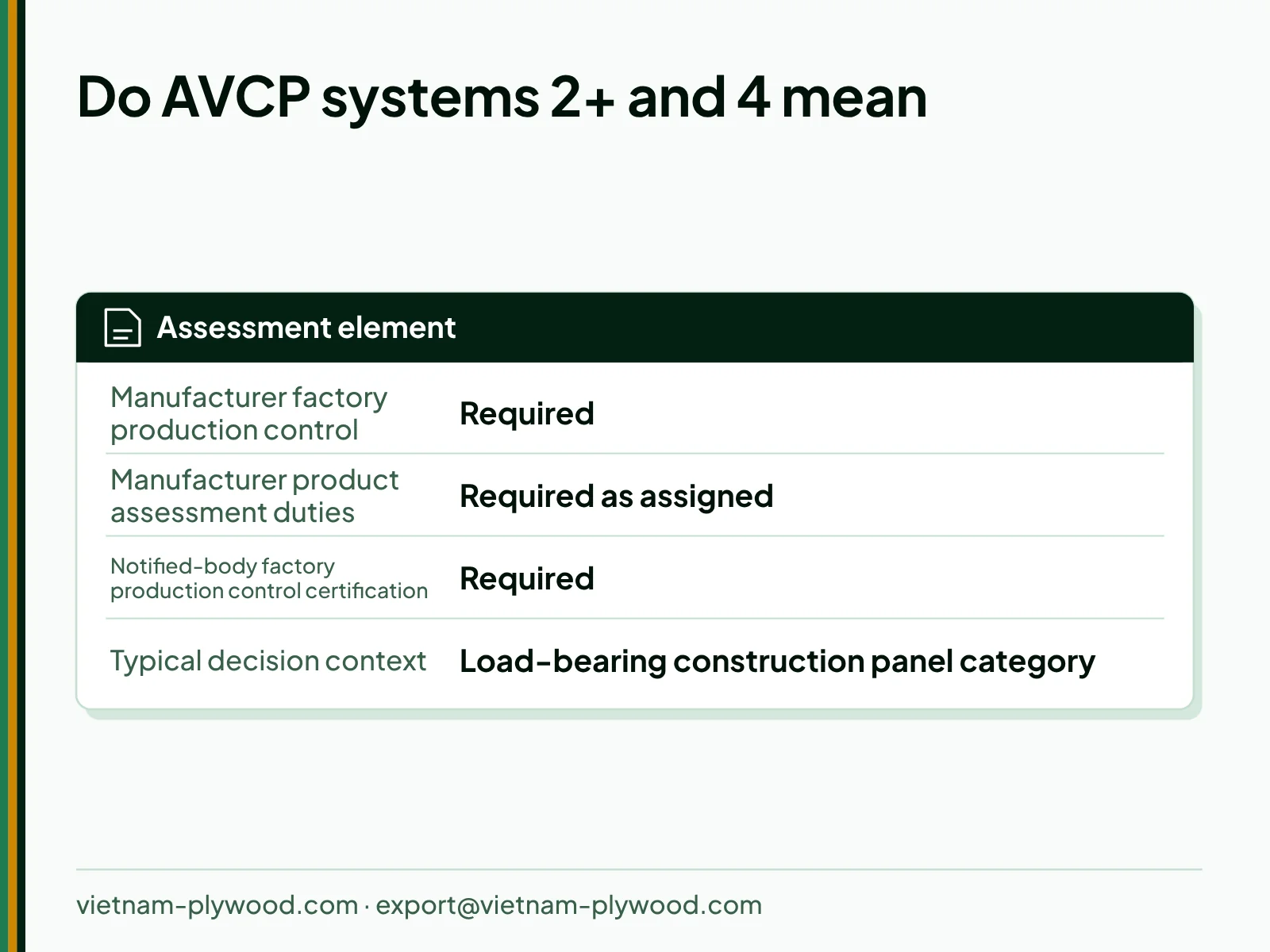
Assessment and verification of constancy of performance (AVCP) determines who assesses the product and who checks ongoing factory production control. System 2+ adds notified-body certification of factory production control; system 4 relies on manufacturer tasks without that third-party certification step. The applicable system follows the product’s intended use and characteristics, rather than the buyer choosing the easier option.
| Assessment element | System 2+ | System 4 |
|---|---|---|
| Manufacturer factory production control | Required | Required |
| Manufacturer product assessment duties | Required as assigned | Required as assigned |
| Notified-body factory production control certification | Required | Not required |
| Typical decision context | Load-bearing construction panel category | Certain non-load-bearing panel categories |
| Buyer action | Match certificate scope to producing factory and product | Examine manufacturer declaration and supporting control evidence |
The European Commission’s 2011 CPR overview describes the common technical language for construction-product performance. Under the applicable 2011 AVCP framework, a system 2+ certificate concerns factory production control, not universal approval of every plywood build. Other systems can apply to particular characteristics, including reaction-to-fire assessment, so the exact declaration must be checked.
Do not infer system 4 from the word “non-structural” alone. Check the harmonised standard’s assessment annex and the declared essential characteristics for the actual product. For the related market distinction, see CE 2+ plywood and UK requirements.
What should a plywood declaration of performance contain?
A plywood DoP should identify the product and intended use, specify the applicable technical basis and AVCP system, and declare the essential characteristics relevant to that use. The importer needs a document that can be matched to the physical lot and its CE marking information.
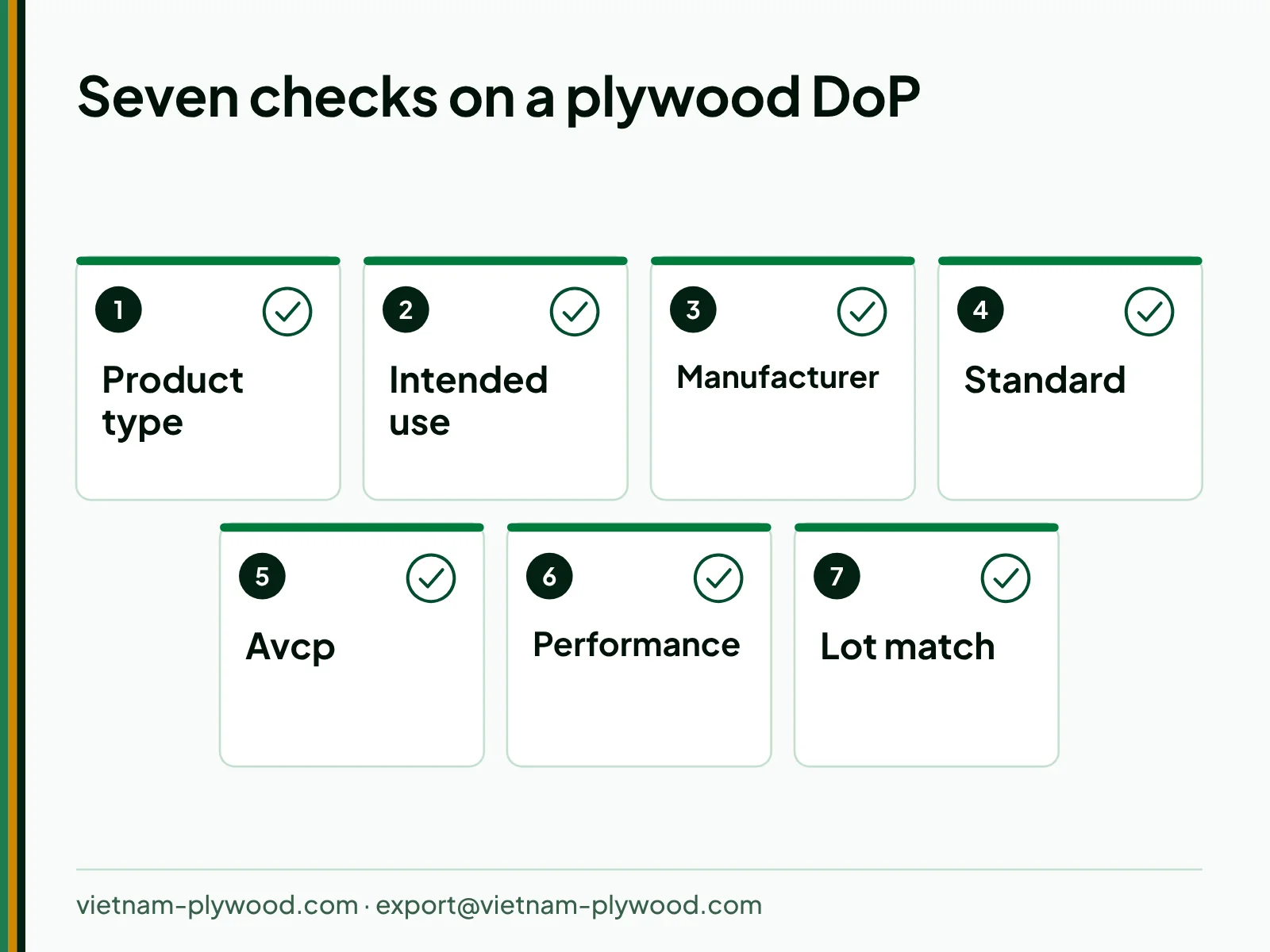
- Match the unique product-type identification to the order, packaging and technical description.
- Read the intended use, including structural status and dry, humid or exterior exposure.
- Check the manufacturer’s identity and the applicable harmonised standard reference and date.
- Identify the stated AVCP system and any notified body required for that system.
- Read the essential-characteristic table, including declared levels, classes and any “NPD” entries.
- Compare the declared performances with the project specification and the supporting test reports.
- Check that the CE information, DoP reference and producing factory evidence point to the same product type.
“NPD” means no performance determined for a characteristic; it is not a measured pass. An importer must decide whether an undeclared characteristic is acceptable for the intended building use. A CE mark cannot fill a missing project-required performance value.
The 2011 CPR’s Article 6 and Annex III describe the DoP fields. The Commission’s current declaration and CE marking guidance distinguishes the older DoP from the revised framework’s declaration of performance and conformity. Check the applicable transition rules before accepting a template for a new lot.
Does a furniture panel need a DoP?
A panel sold exclusively as a furniture component does not need an EN 13986 construction-product DoP merely because it is plywood. Its furniture application should be explicit on the specification and invoice. If the buyer instead markets it as a permanently installed building lining, the intended-use analysis changes.
Our furniture line uses styrax or eucalyptus cores, full stitched construction, sanded faces and E0/E1 emission classes. Glue and emission are separate fields: an MR or WBP adhesive description does not declare an emission class. CARB P2 or TSCA Title VI addresses a separate US emission regime, explained in the US plywood emission documentation guide.
A furniture maker can ask for an emission document and the agreed dimensional tolerance without requesting a construction DoP. A distributor supplying both furniture factories and building contractors should split those intended uses on the order. This avoids carrying a single ambiguous description into different sales channels.
What can an inspector check at the producing factory?
An inspector can compare the ordered build with the physical plywood, production records and the documents for the specific intended use. HCPLY coordinates on-site quality control at the producing factory, where buyers can inspect goods and review the factory’s relevant documentation.
For an 18 mm furniture order, the inspector can check sanded thickness against the ordered ±0.2 or ±0.3 mm tolerance. For an 18 mm commercial panel, the check uses ±0.5 mm; for packing it uses ±0.5–1.0 mm. The inspector can also check the face, core construction, size and bundle identification against the order.
For a construction-use DoP, the key desk check is whether the product type, declared use and supporting factory production control records correspond to the goods being loaded. Certificates held by member factories, including CE-related records, are shown with factory details masked, on request. That inspection does not replace a notified-body task where the applicable AVCP system requires one.
Which documents should travel with the shipment?
The shipment document package should connect the order’s intended-use statement to the agreed certificate and test-report documents. HCPLY manages the export process from specification through loading and draft shipping documents, which go to the buyer for approval after loading.
A shipment includes commercial invoice, packing list, bill of lading, certificate of origin, phytosanitary and fumigation papers, and the order’s agreed certificate documents. EU lots include EUR.1 where applicable and the EUTR/EUDR file set. Insurance documentation accompanies CIF shipments. The export certification document checklist explains how to request and reconcile the documents.
The DoP is product-performance evidence, whereas the certificate of origin addresses origin and the packing list identifies quantities. A buyer should request the applicable DoP and CE marking information before the order is released for sale, then match them to the shipping identifiers.
Can different specifications share a 40HC container?
Specifications can be mixed in a 40HC container within the 28.5 t payload limit. The legal classification still follows each product’s intended use, so mixing furniture and construction goods does not make their documentation interchangeable.
At 18 mm and 1220 × 2440 mm, a full styrax-core load is 990 sheets, 53.05 m³ and 26.52 t. A full acacia-core load is 880 sheets, 47.15 m³ and 27.35 t; a full eucalyptus-core load is 795 sheets, 42.60 m³ and 27.69 t. Those figures exclude film weight.
For a mixed order, check the pallet allocation and sum the weights for the selected core and thickness before confirming the load plan. Keep separate product-type identification for each specification and declaration route. The mixed-container ordering guide covers combining specifications; container loading calculations cover pallet quantities.
How should an importer approve the specification?
Approve the intended use before the face, glue or thickness becomes the sole description of the product. Then check the required performance evidence, factory scope and shipment documentation against that use.
Start with the destination market and whether the panel will remain in construction works. Specify structural or non-structural function, exposure conditions and the characteristics the project needs. Next request the matching DoP and AVCP evidence where required, and compare them with the physical product at inspection.
For a CE-marked construction lot, ask which harmonised edition and regulatory route the declaration follows. For furniture-only lots, state that purpose and request the relevant furniture and emission documents instead. The CE-marked plywood supply overview provides the adjacent purchasing workflow.
What specification should the buyer send?
A written specification should make the application unambiguous and keep construction-product documentation attached to the correct product type. Send the fields below to Lucy at export@vietnam-plywood.com, then contact HCPLY to review the intended-use and evidence requirements.
Application: [furniture component / permanent construction use / removable formwork]
Line or core: [furniture styrax or eucalyptus / commercial acacia / construction acacia or eucalyptus]
Glue: [melamine MR / phenolic WBP, as specified]
Emission: [E0 / E1 / E2, as required]
Face and grade: [face species and applicable grade / film weight]
Thickness and tolerance: [mm and ordered tolerance]
Size: [mm × mm]
Quantity: [sheets or containers; identify each build separately]
Destination port: [port and country]
Construction documentation: [intended use, required characteristics, applicable DoP and AVCP]
The next step is to plan a trial container against the written specification and the correct document route.