





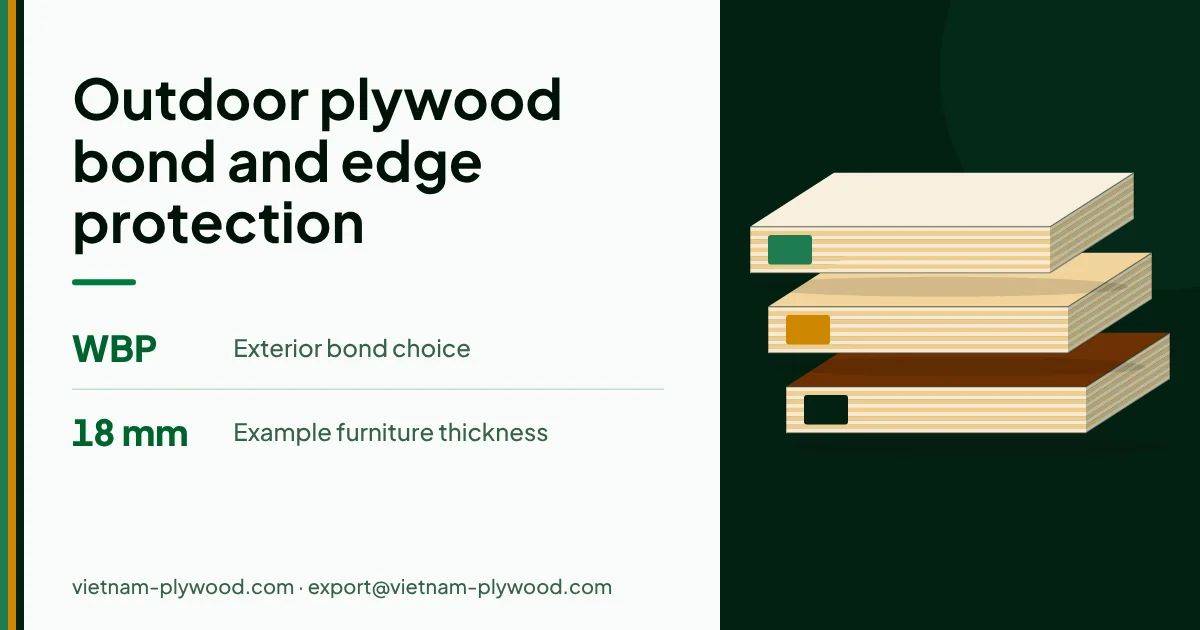
For outdoor furniture plywood, a phenolic WBP bond matters more than the decorative face because wetting challenges the glue lines. Choosing MR glue for repeatedly wetted garden furniture can mean rejected panels, rework and delayed deliveries. HCPLY helps furniture makers specify the bond, veneer and inspection evidence separately, while the maker controls coating and cut-edge sealing.
Is plywood for outdoor furniture a sound choice?
Plywood for outdoor furniture is a workable choice when the panel has a suitable exterior bond, the furniture sheds water, and the maker protects every exposed surface. For patio chairs, garden tables and outdoor cabinets, select the bond before choosing the decorative veneer. HCPLY separates these decisions in the written build specification.
The application matters as much as the board. A covered restaurant terrace exposes panels to occasional wind-driven rain; a poolside lounger encounters splash water and stronger sunlight. A horizontal tabletop retains water longer than a vertical cabinet side. Specify the expected wetting, drainage, fastening and maintenance conditions before choosing the finish.
Plywood offers broad, machinable surfaces and consistent sheet dimensions for repeat furniture production. Its cross-laminated veneer construction helps control movement, yet exposed end grain at cut edges still takes up moisture. The maker must design joints and drainage around that behavior. See our applications articles and end-use engineering guide for related selection questions.
Which glue class belongs in garden furniture?
For repeated outdoor wetting, specify a phenolic weather and boil proof (WBP) bond and an agreed bond-performance test. Moisture-resistant (MR) melamine glue belongs to a different exposure decision. The glue class is more consequential than whether the visible face is okoume, bintangor or birch.
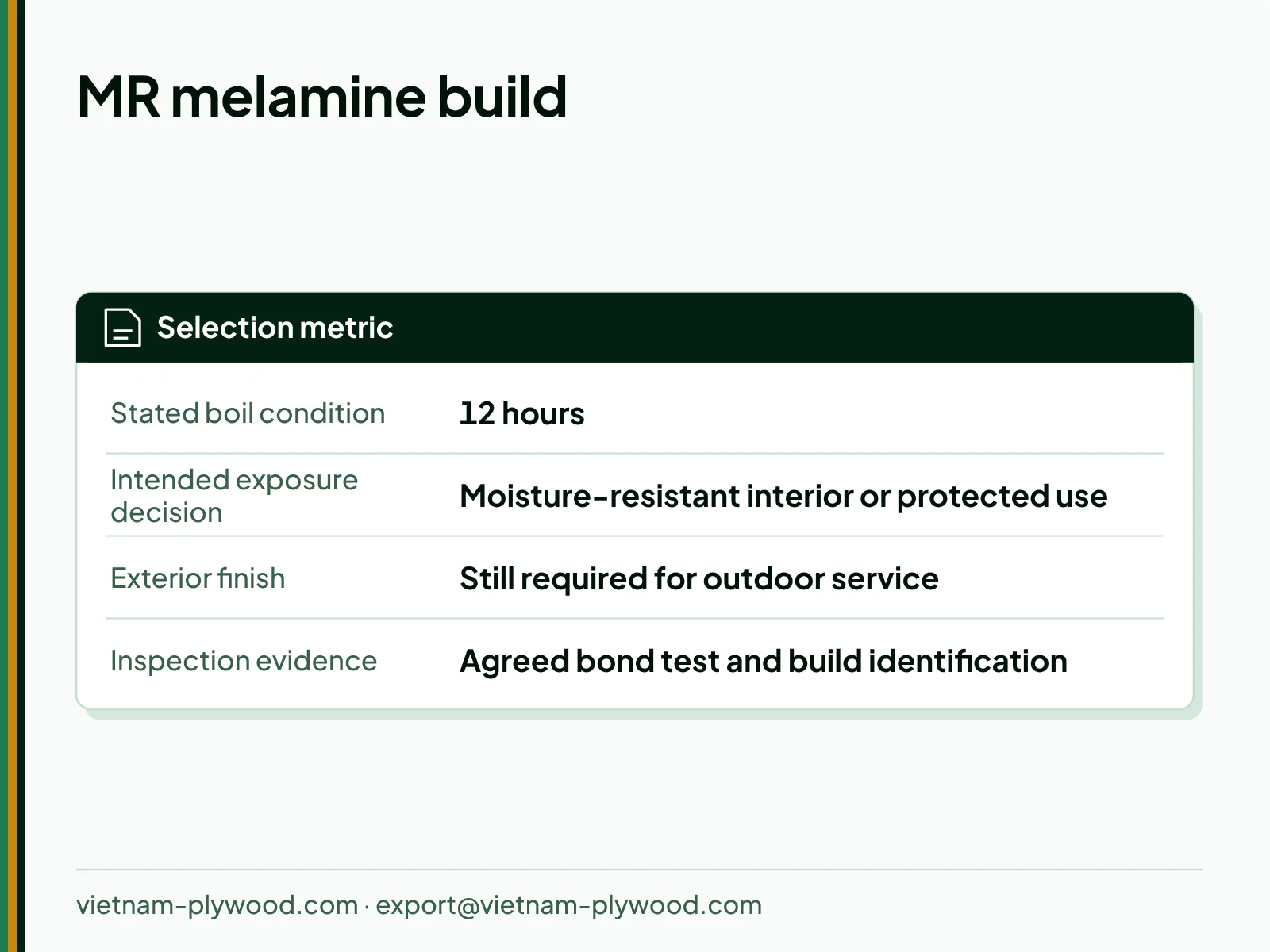
HCPLY describes MR melamine glue with a 12-hour boil condition and phenolic WBP glue with a 72-hour boil condition. Those are build descriptors; ask for the test method, acceptance criteria and report for the ordered panel. A boiling-duration label alone cannot describe the finished furniture’s weather resistance.
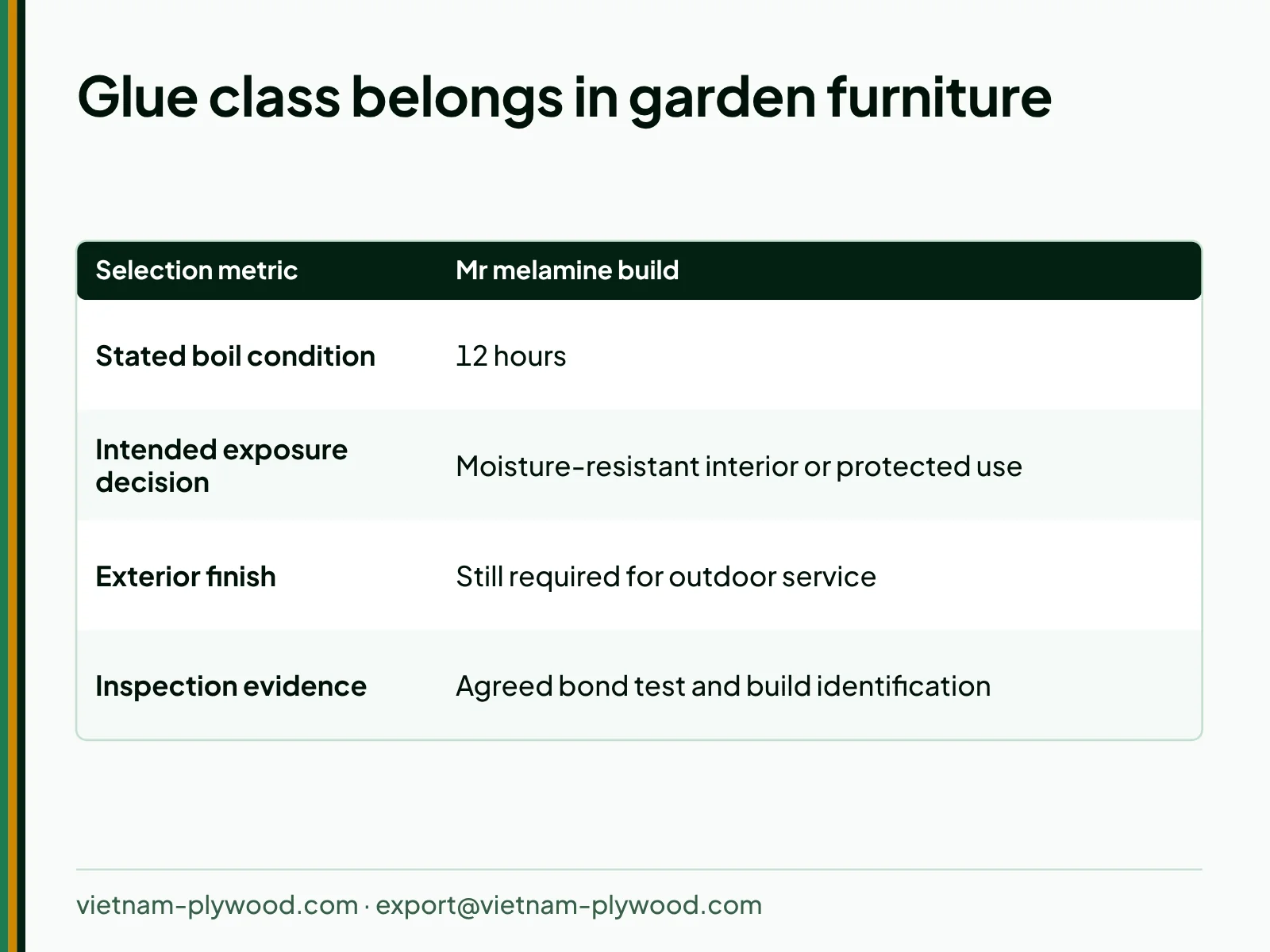
| Selection metric | MR melamine build | Phenolic WBP build | Verdict by use |
|---|---|---|---|
| Stated boil condition | 12 hours | 72 hours | WBP for repeatedly wetted patio components |
| Intended exposure decision | Moisture-resistant interior or protected use | More demanding moisture exposure | WBP for exposed garden furniture |
| Exterior finish | Still required for outdoor service | Still required for outdoor service | Neither replaces coating and edge sealing |
| Inspection evidence | Agreed bond test and build identification | Agreed bond test and build identification | Accept the documented result for the order |
The distinction also prevents a common purchasing mistake: E0 and E1 are emission classes, while MR and WBP describe adhesive performance. Specify emission and glue separately. An attractive A-grade veneer cannot compensate for a bond selected for the wrong exposure.
What is the best plywood for outdoor furniture?
The preferred specification is a phenolic WBP-bonded panel with sound core assembly, a face compatible with the selected exterior coating, and a documented acceptance test. There is no universal face species that overrides the furniture design and exposure.
For visible garden tables and chairs, start with a sanded furniture-quality face and inspect repairs, veneer joins and surface consistency. For painted parts, a uniform, well-prepared face often matters more than dramatic grain. For clear-coated components, select the veneer sample alongside the actual finishing system; sunlight changes the appearance of exposed wood.
Specify full stitched core construction where machined edges, fastener locations and visible profiles make internal gaps particularly undesirable. The furniture line uses full stitched, sanded styrax or eucalyptus core as its normal construction. The WBP bond must be explicitly agreed for an outdoor-oriented order rather than inferred from the line name. Exterior plywood supply gives the related product context.
How do our three lines compare for the same thickness?
Our furniture line is the starting point for a finished, visible furniture component; the other lines are built for different surface and handling requirements. For an 18 mm order, compare the construction and intended finish before comparing quotations.
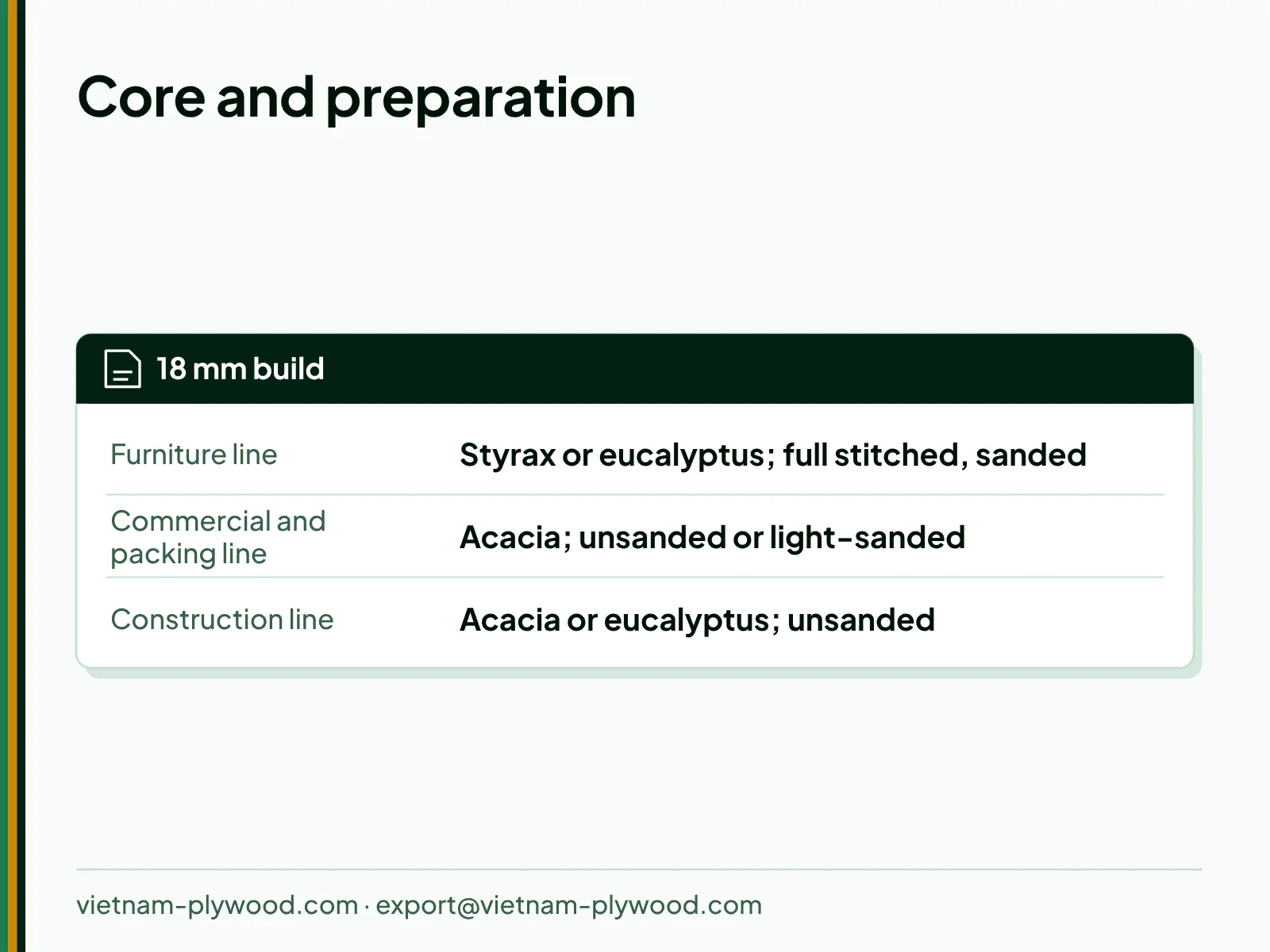
| 18 mm build | Core and preparation | Surface or bond direction | Intended use |
|---|---|---|---|
| Furniture line | Styrax or eucalyptus; full stitched, sanded | Decorative veneer; E0/E1 emission option; specify exterior bond separately | Machined furniture components requiring an exterior finish |
| Commercial and packing line | Acacia; unsanded or light-sanded | MR glue | Protected commercial components and packing |
| Construction line | Acacia or eucalyptus; unsanded | Phenolic or melamine film, including anti-slip film | Concrete formwork and site-facing panels |
A construction panel’s film surface does not make it a substitute for a visible furniture veneer. Likewise, a furniture-quality face does not automatically establish an exterior bond. Our three factories in Phu Tho and Hai Phong produce orders on the line that matches the agreed specification; the buyer inspects at the producing factory. Compare construction supply when the intended use is formwork.
Which plywood faces accept an exterior finish?
Bintangor, okoume, eucalyptus, pine, poplar, sapele and engineered veneer (EV) are face choices to evaluate with the furniture maker’s coating system. Birch is also a face option, with D/E/F face grades in our range; the name of the face does not identify the core.
Face veneer is commonly 0.2–0.4 mm. Decorative A/B face grades describe appearance, while the chosen coating, preparation and maintenance determine the surface’s protection in service. Do a finishing trial on the actual ordered face, including sanding and any stain or primer, before approving a production appearance standard.
Clear coatings expose natural color variation and demand attention to sunlight and water. Pigmented exterior systems can conceal more face variation while offering a different maintenance profile. The USDA Forest Service’s 2010 Wood Handbook, Chapter 16, explains that outdoor finishes protect wood surfaces against weathering: USDA Forest Service, 2010. Agree the finish system with the coating supplier using the intended climate and furniture geometry.
Does outdoor furniture need marine plywood?
Outdoor furniture does not automatically require a marine label. It requires a panel build and test evidence suitable for the exposure, plus proper furniture detailing and finishing. For an order described as marine or BS 1088, evaluate it against a test report the buyer accepts.
A marine designation should trigger a written discussion of veneer quality, voids, adhesive bond, test method and acceptance criteria. It should never stand in for those fields. A covered outdoor dining cabinet and a boat component face different wetting patterns, even if both are marketed with the same adjective.
The exterior bond also does not confer fungal-decay resistance. The APA plywood overview describes plywood as cross-laminated veneers bonded under heat and pressure; its exposure classifications distinguish long-term exterior conditions from temporary construction wetting. Design water run-off and ventilation, avoid moisture traps, and plan a realistic recoating schedule. For purchasers, the decision is the specified performance and supporting report rather than a product nickname.
Who seals the edges and coats the finished furniture?
The furniture maker seals all cut edges, machined openings, fastener penetrations and faces after fabrication, using a coating system approved for the intended exposure. HCPLY supplies the specified plywood panel; machining and the final exterior finishing sequence belong to the maker’s production process.
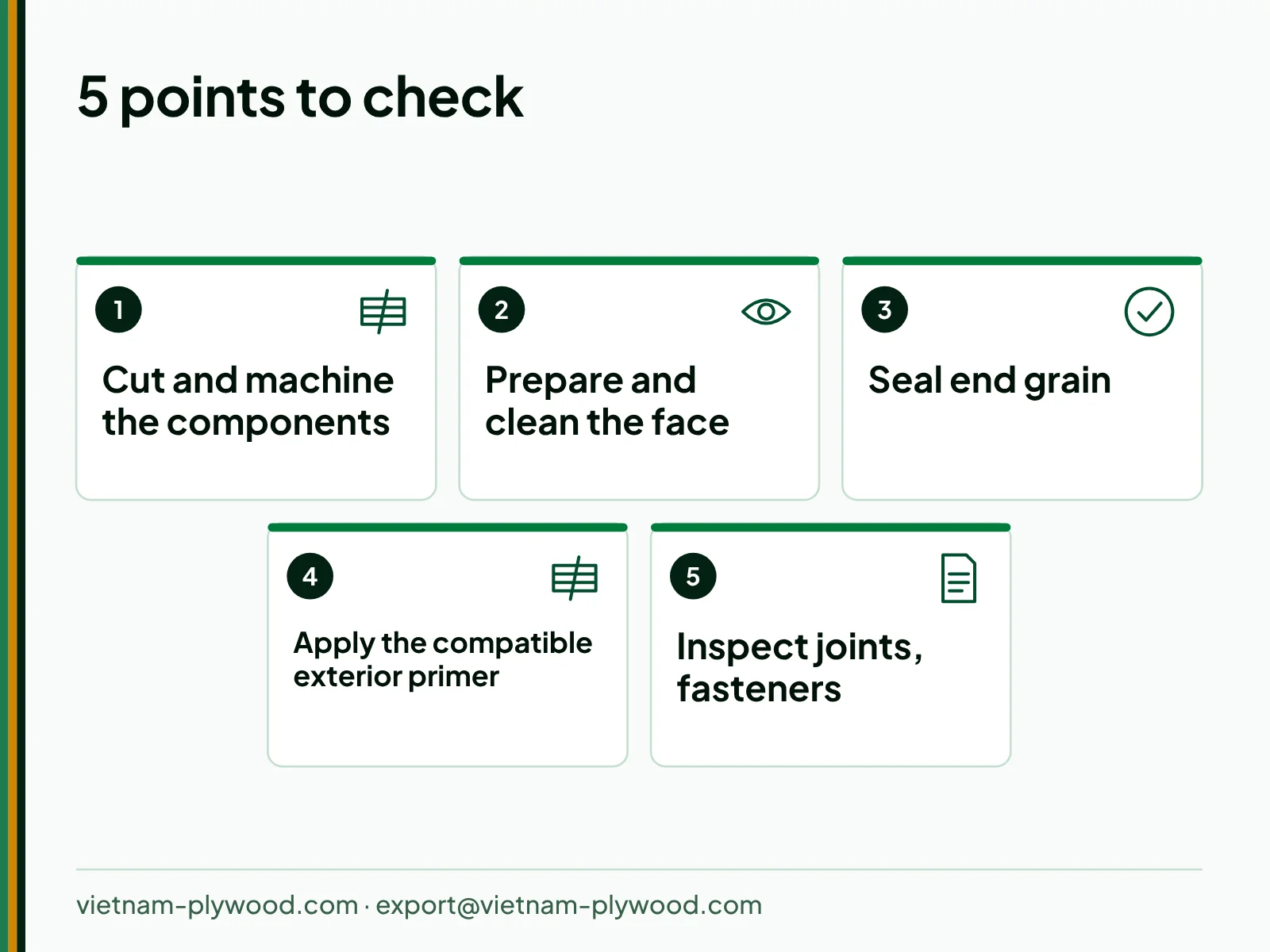
- Cut and machine the components to the approved drawing, avoiding unnecessary water traps.
- Prepare and clean the face and every newly exposed edge according to the coating supplier’s instructions.
- Seal end grain, drilled holes and exposed veneer layers before final assembly closes access.
- Apply the compatible exterior primer or finish to the specified film build, including hidden faces where required.
- Inspect joints, fasteners, drainage gaps and coating coverage before packing finished furniture.
The USDA Forest Service identifies protection as the primary technical purpose of outdoor wood finishing. That is why a WBP bond and a carefully selected face still require an exterior coating. Include recoating access in the furniture design; sealed edges can be damaged by later drilling, cutting or installation.
What dimensions and core details should buyers specify?
Write thickness, tolerance, size and core assembly as separate purchase-order fields. HCPLY panels cover 3–40 mm thickness, including common 9, 12, 15, 18, 21 and 25 mm selections for different component designs.
Furniture sanded thickness tolerance is ±0.2 or ±0.3 mm as ordered, and length and width tolerance is ±2 mm. Common sheet sizes include 1220 × 2440 mm and 1250 × 2500 mm; custom cutting is available. An 18 mm panel contains 11–13 plies according to the veneer thickness, so ply count should be agreed as a range tied to the build.
Core density follows the core species rather than the face: styrax 500 kg/m³, acacia 580 kg/m³ and eucalyptus 650 kg/m³. For furniture machining, agree the core, edge appearance, face grade and finishing trial together. For visible exposed edges, specify how the furniture maker will cover or finish the veneer stack.
What should an inspector witness before shipment?
An inspector should compare the actual producing-factory panels with the approved written specification and agreed test evidence. The most useful checks for this application are bond identity, face condition, thickness, core assembly and finishing suitability.
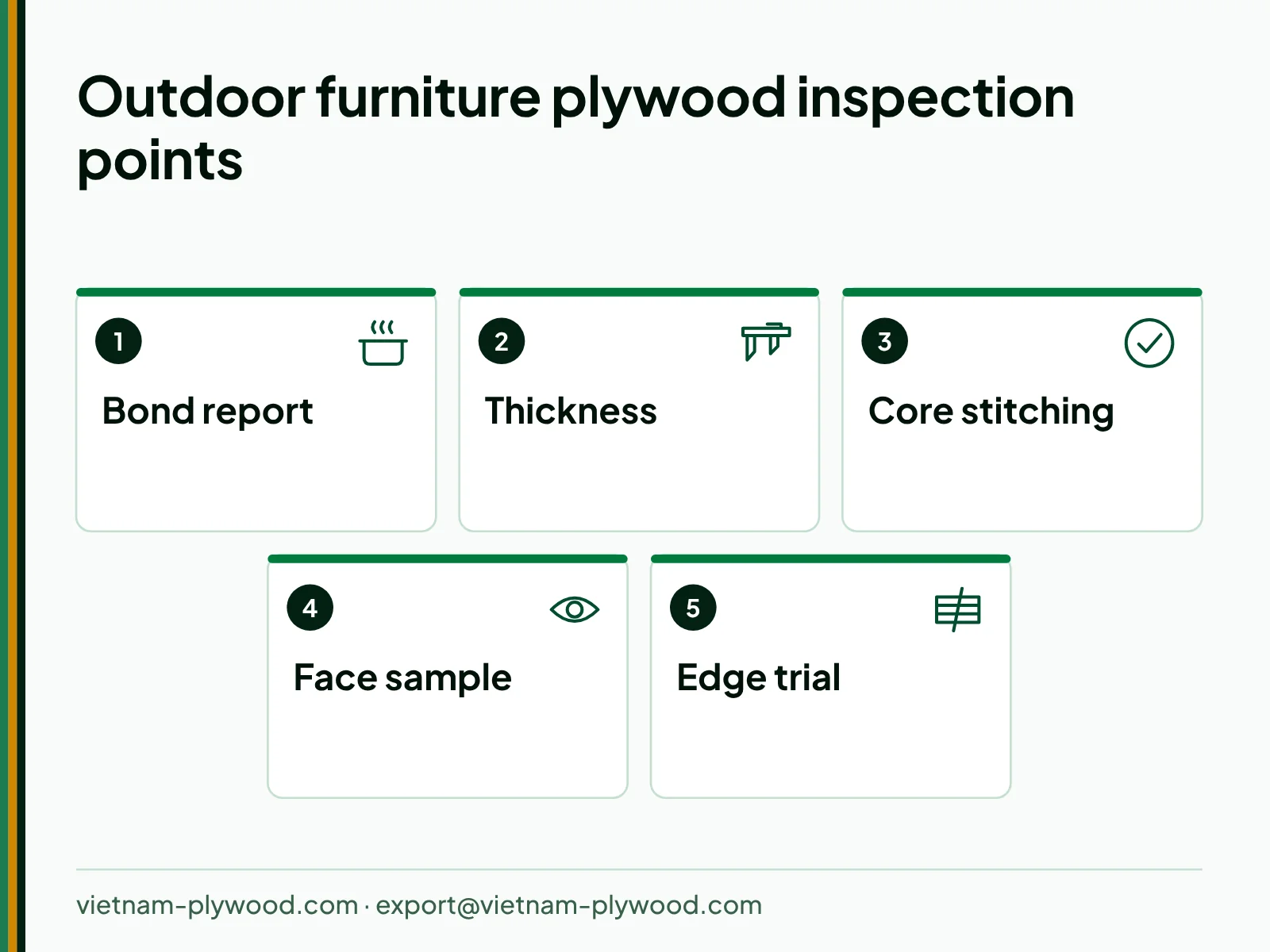
At the producing factory, sample panels across the lot and record thickness readings against the ordered ±0.2 or ±0.3 mm furniture tolerance. Inspect face repairs, sanded quality, edge voids and stitched core continuity on representative cut samples. Match labels and production records to the phenolic WBP requirement, and review the agreed bond test report rather than relying on the face species name.
A factory visit also allows a buyer to inspect sample machining and coating-trial panels prepared by the furniture maker. Keep the approved veneer sample and finish trial as the visual reference. Member-factory FSC, CARB P2, ISO 9001 or CE documents, where relevant to the order, are shown with factory details masked, on request.
How should outdoor furniture panels be ordered and shipped?
Order a minimum of one 40HC, with mixed specifications permitted within the 28.5 t payload limit. The chosen core affects both the sheet weight and the number of sheets that fit a full container.
For 18 mm, 1220 × 2440 mm sheets, the lookup is 990 styrax sheets at 26.52 t, 880 acacia sheets at 27.35 t or 795 eucalyptus sheets at 27.69 t for a full 40HC. These figures exclude film weight. Mixing thicknesses or cores requires a separate pallet and payload plan; see container loading for that calculation.
Factory lead time runs 15–45 days from receipt of the 30% deposit; the exact figure depends on order size, line loading and what the contract fixes. The remaining 70% is paid on the scan of the bill of lading, by T/T, or by irrevocable sight L/C. We ship FOB Hai Phong, or CFR (CNF) or CIF to your port. Our export team coordinates specifications, on-site quality control, shipping documents and loading. Distributor supply programmes cover broader repeat-order planning.
Which price drivers matter for an exterior build?
Phenolic WBP bonding, the required core construction and face selection should be costed before cosmetic refinements. A WBP-oriented furniture specification normally requires a more demanding bond choice than a standard MR commercial build; full stitched, sanded construction adds work compared with unsanded packing construction.
Within furniture specifications, selected decorative faces, tighter sanding tolerance, core selection, thickness and custom cutting change the quotation. An exterior finishing trial is a separate furniture-maker cost. Ask for a written quotation against the complete specification rather than treating the face species as a price category.
For reference, furniture plywood starts from US$350/m³ FOB Hai Phong (October 2026). That starting figure is for furniture plywood, not a quoted exterior WBP build. Compare the resulting offer on identical glue, core, face, test and delivery terms.
What should the purchase specification include?
A complete request identifies the outdoor exposure, the phenolic bond, the finishing responsibility and the acceptance evidence. That makes it possible to compare panels with the same intended performance rather than similar-looking veneer.
The shipment’s commercial invoice and packing list identify the agreed goods; the bill of lading records shipment, while order-specific test reports document the agreed build. Certificate of origin, phytosanitary and fumigation papers, and applicable destination documents form the export paperwork. After loading, the draft shipping documents come to you for approval.
For design-specific use questions, compare the applications engineering guide with the proposed furniture drawing. Send the following lines to Lucy at export@vietnam-plywood.com:
Application: Outdoor patio / garden furniture; exposure and drainage details
Line or core: Furniture line; styrax or eucalyptus; full stitched
Glue: Phenolic WBP; agreed bond test and acceptance criteria
Emission: E0 or E1 as ordered
Face and grade: Selected veneer and approved appearance sample
Thickness and tolerance: ___ mm; ±0.2 or ±0.3 mm as ordered
Size: ___ × ___ mm
Quantity: ___ sheets / pallets; minimum one 40HC
Destination port: ___
Finishing responsibility: Furniture maker; exterior coating and all cut-edge sealing
Request the outdoor furniture plywood specification sheet with your drawings and exposure conditions.