





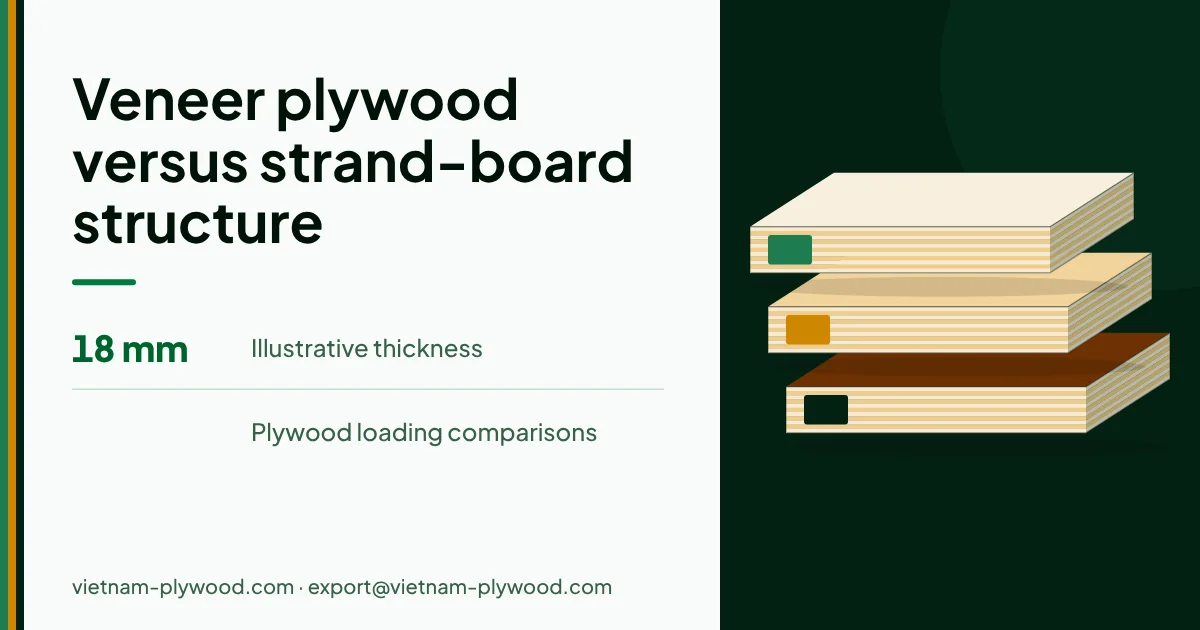
Plywood vs OSB is a choice between veneer-layer performance and lower-cost strand-board coverage; hardwood-core plywood earns its premium where edge condition, handling and repeated site use matter. The wrong selection can mean swollen flooring joints, replacement sheets or a rejected shipment. HCPLY makes plywood in Vietnam, including construction and packing builds, but does not manufacture oriented strand board (OSB).
What is the difference between plywood and OSB?
Plywood vs OSB starts with construction: plywood bonds cross-oriented wood veneers, while OSB presses oriented wood strands with resin. Both can serve structural sheathing when the actual panel is qualified for the required application. Veneer faces also give plywood a different surface for finishing, cutting and inspection. Neither material name establishes a structural rating by itself.
See plywood types and hardwood plywood for related materials. OSB is also called strand board or sterling board in some purchasing discussions. Those names do not describe a plywood core. A buyer comparing strandboard vs plywood should request the panel standard, declared performance and exposure classification, rather than treating the terms as interchangeable grades.
The 2016 technical topic Plywood or OSB? Used as Intended, the Two Products are Interchangeable, published by APA – The Engineered Wood Association, explains that qualified panels can perform similarly in intended applications. Its qualification argument applies to products manufactured and evaluated under the relevant standards, rather than every sheet described as plywood or OSB. See APA’s technical topic.
Which material wins by application and metric?
The use case decides the verdict: qualified OSB can be the economical choice for protected wall coverage, while a specified plywood build offers different advantages in cutting, wet handling and reusable site panels. Compare equivalent thickness, documented exposure category and tested properties before drawing a strength conclusion.
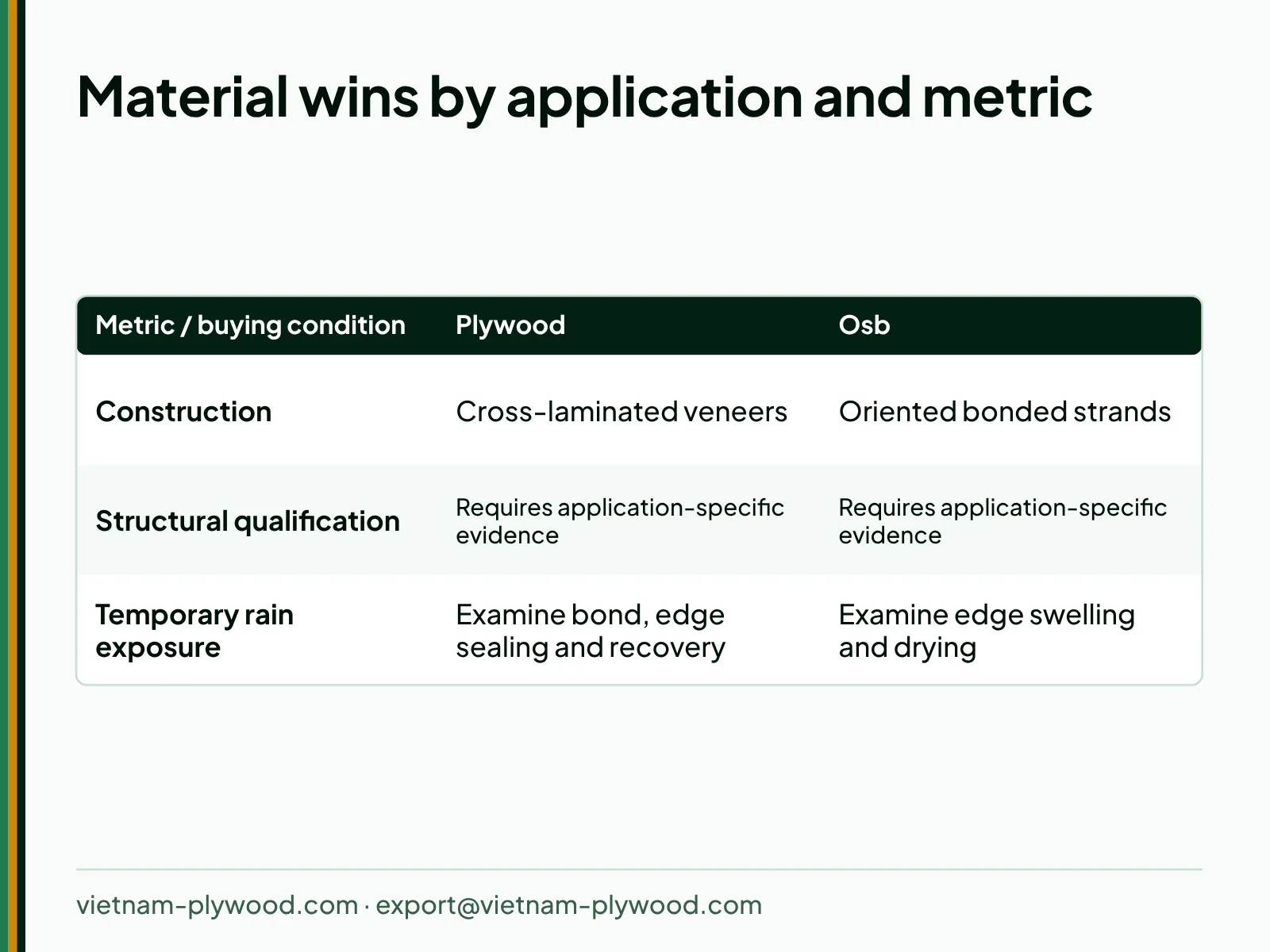
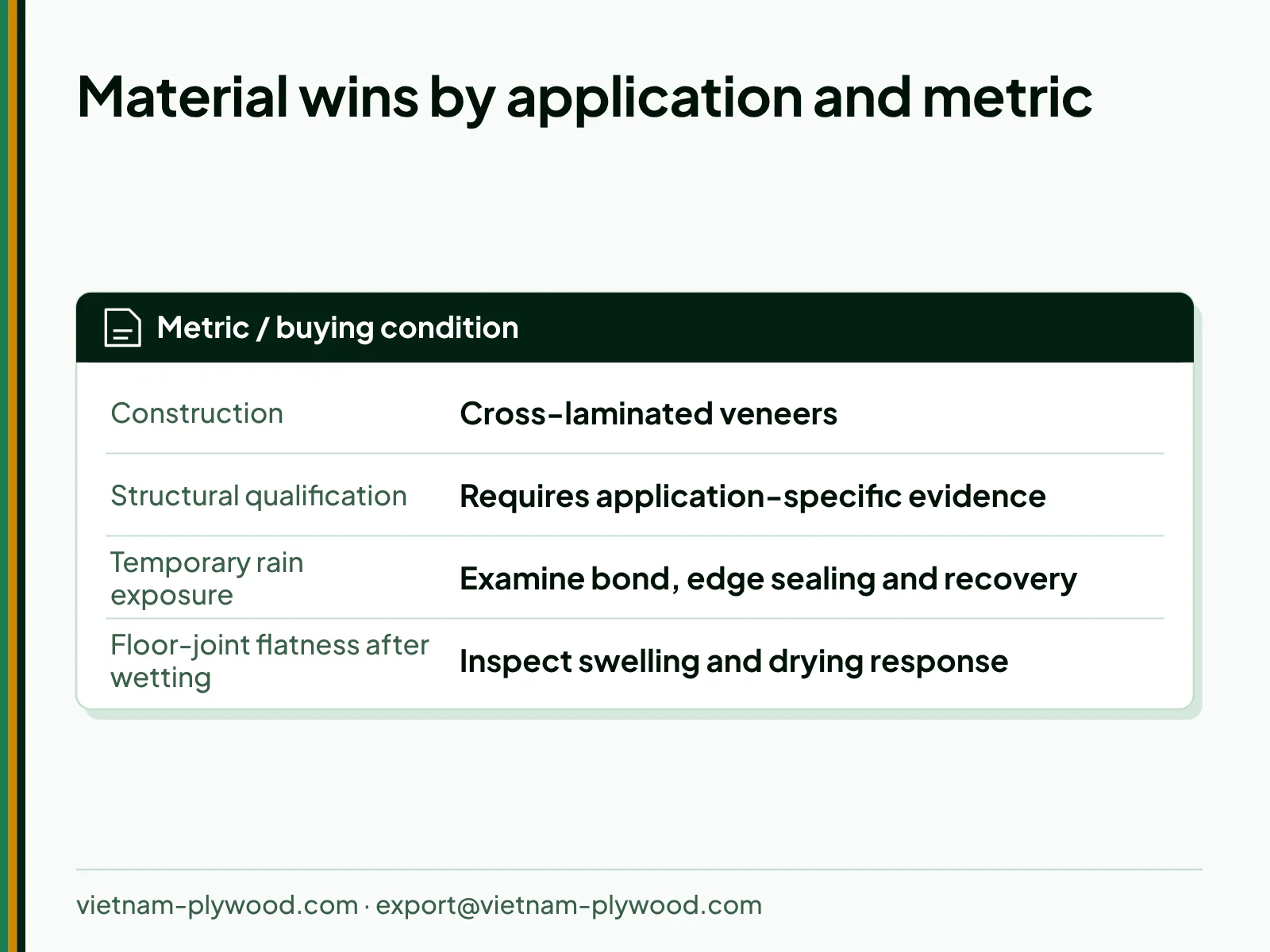
| Metric / buying condition | Plywood | OSB | Verdict by use |
|---|---|---|---|
| Construction | Cross-laminated veneers | Oriented bonded strands | Plywood for a visible veneer face; OSB for concealed coverage |
| Structural qualification | Requires application-specific evidence | Requires application-specific evidence | Tie when both meet the same design requirement |
| Temporary rain exposure | Examine bond, edge sealing and recovery | Examine edge swelling and drying | Select the tested panel for the exposure period |
| Floor-joint flatness after wetting | Inspect swelling and drying response | Inspect persistent edge ridges | Plywood often preferred where joint finish is sensitive |
| Wall sheathing area cost | Usually higher purchase cost | Often lower purchase cost | OSB for dry, quickly enclosed wall programs |
| Roof-deck fastening | Test withdrawal and edge distances | Test withdrawal and edge distances | No universal winner without tested fastener values |
| Repeated concrete forming | Film face and sealed edges can suit repeat use | Ordinary sheathing OSB is not the same forming specification | Film-faced plywood for the specified forming cycle |
| Visible cut edges and face finish | Veneer layers and selectable faces | Strand texture | Plywood for exposed fabricated parts |
| Packing and crating | Commercial acacia-core build available | OSB can suit dry protective packaging | Compare damage risk, handling and delivered cost |
| Container weight planning | Known core-density calculations available | Obtain actual OSB density from its seller | Compare tonnes per usable sheet, not just sheet price |
Is plywood stronger than OSB?
Neither plywood nor OSB is universally stronger: bending, shear, stiffness, fastener withdrawal and wet-condition performance are separate measurements. A panel can outperform another in one test and trail it in another.
Ask for bending strength and stiffness in both principal directions, shear performance where relevant, and fastener results at the intended edge distance. Compare results at the specified thickness and conditioning.
The APA’s 2016 comparison addresses performance-qualified interchangeability for designated uses. For HCPLY, any structural grade must be assessed against a test report the buyer accepts; our plywood is not offered with an APA or PS 1 stamp.
How do moisture and edge swelling change the decision?
Moisture changes the decision when exposed edges, delayed enclosure or a sensitive floor covering make swelling costly. Both wood-panel families respond to water, and neither should be specified for persistent wet service solely by name. The amount and duration of exposure, edge treatment and panel qualification govern the outcome.
APA’s 2021 Moisture-Related Dimensional Stability technical topic describes moisture-related linear expansion and thickness swell in both plywood and OSB. It identifies the need to assess wetting cycles and the resulting dimensional movement; see APA’s moisture technical topic.
For a subfloor, ask whether edge swelling could leave ridges beneath vinyl or another thin finish. For a roof, assess how long the deck remains exposed before covering. For a wall, assess the enclosure schedule and the sheathing’s bracing requirements.
See MDF or plywood for another panel comparison. Our construction line can press phenolic-glue plywood with film faces for site applications. That differs from specifying a certified roof-deck or subfloor product. A buyer requiring a structural classification should agree the test evidence before ordering, and seal all cut edges where the application calls for it.
Is plywood vs OSB price enough to decide?
OSB commonly wins on initial area cost for standard concealed sheathing, but a delivered-price comparison needs a matched performance specification. Hardwood-core plywood can earn its higher purchase price where better face selection, fabrication yield or repeat handling reduces replacements.
For HCPLY’s commercial plywood, the indicative starting price is from US$250/m³ FOB Hai Phong (October 2026). This is a commercial plywood starting point, not a price for structural sheathing or film-faced plywood. For furniture plywood, the indicative starting price is from US$350/m³ FOB Hai Phong (October 2026).
The strongest cost drivers are the required performance and glue system first, then core construction and face specification, followed by thickness, tolerances and shipment mix. A phenolic-glue film-faced build costs more to produce than a basic MR-glue commercial packing panel because the bonding and surface requirements differ. A full-stitched, sanded furniture core requires more preparation than a loose-laid packing core.
Calculate cost per accepted sheet after cutting and inspection, then add freight, handling and expected site losses. Request a quotation against a written build rather than using the commercial starting price as a roof or floor quote. Our plywood manufacturer overview describes the available plywood routes.
What would each HCPLY factory line build at 18 mm?
At 18 mm, the three HCPLY lines address different buyers: finished components, commercial packing and construction-site panels. We press no OSB on any line.
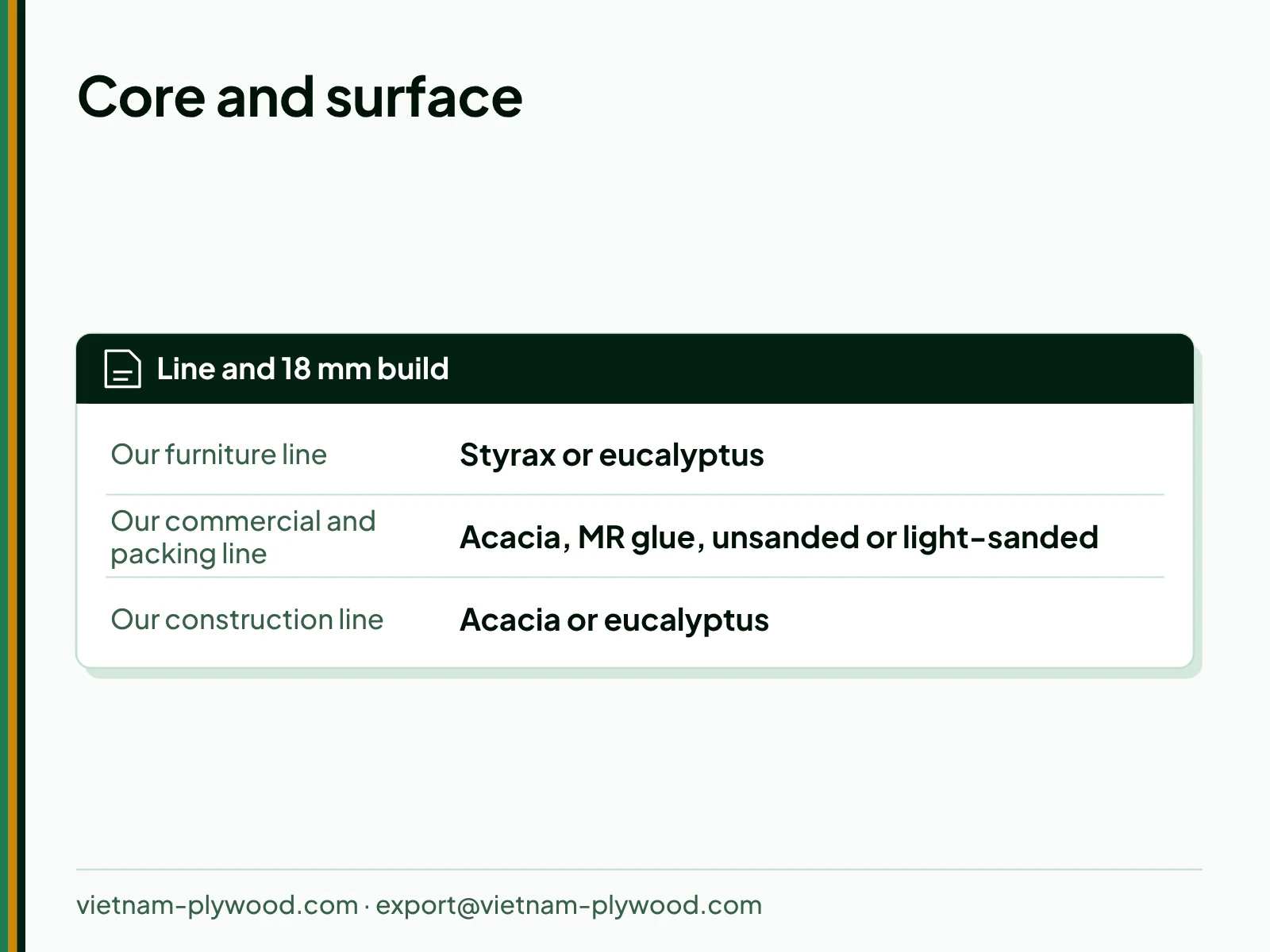
| Line and 18 mm build | Core and surface | Thickness tolerance | Appropriate purchasing comparison |
|---|---|---|---|
| Our furniture line | Styrax or eucalyptus, full stitched, sanded veneer face, E0/E1 emission class | ±0.2 or ±0.3 mm as ordered | Furniture components and precise fit-out cutting |
| Our commercial and packing line | Acacia, MR glue, unsanded or light-sanded | Commercial ±0.5 mm; packing ±0.5–1.0 mm | Crates, protective panels and non-structural packing |
| Our construction line | Acacia or eucalyptus, phenolic or melamine film, unsanded | ±0.5 mm | Formwork and specified site panels |
An 18 mm core commonly contains 11–13 plies. Core veneer thickness, assembly and face choice explain why two panels of identical outside dimensions can have different edges and different handling behaviour. Review the cross-line grade comparison before treating a packing panel as construction material.
Is plywood or OSB better for floors, roofs and walls?
For floors, roofs and walls, choose the panel with accepted evidence for that assembly; OSB often suits enclosed, cost-driven sheathing. Plywood becomes attractive when the buyer values veneer faces, cut-edge inspection or a specified response to intermittent site moisture.
Floors: compare span, deflection, edge support, joint gaps, fastening and compatibility with the final covering. A tile or stone finish needs an assembly-level stiffness and underlayment assessment; changing OSB to plywood alone does not establish tile suitability. Inspect edge swell after any site wetting before laying thin resilient finishes.
Roofs: compare roof-deck loading, fastening schedules, exposure category and the time until weatherproofing. Both materials need suitable detailing and moisture management. The purchaser should separate the material selection from claims about complete roof performance.
Walls: OSB is often the right commercial answer for concealed sheathing installed under prompt weather protection. A specified plywood panel can be selected for particular fabrication or attachment needs, provided its tested bracing and load properties meet the design. Film-faced formwork plywood should not be substituted for wall sheathing without appropriate evidence.
When is OSB the right choice instead?
OSB is the right choice when qualified strand-board sheathing meets the design and lower installed area cost is the deciding factor. It is particularly persuasive for large, concealed wall areas with controlled weather exposure. Buyers should obtain its rating, thickness, span data and installation instructions from the OSB producer.
OSB can also suit protected roof decks and dry floor assemblies when the relevant grade, support layout and finish system accept it. Specify a moisture-resistant grade where the project demands one, rather than assuming all strand boards behave alike. We do not offer OSB as a product.
When does imported hardwood-core plywood earn its premium?
Imported hardwood-core plywood earns its premium when the specification rewards controllable core construction, inspectable edges and a surface suited to its intended use. For crates, that may mean reliable cutting and fastening; for formwork, a suitable film and glue system matter. A plywood name alone is insufficient evidence of either outcome.
Our commercial and packing line uses acacia core at 580 kg/m³; the furniture line can use styrax at 500 kg/m³ or eucalyptus at 650 kg/m³. Density follows the core rather than the decorative face.
For film-faced work, our construction line offers 120 g/m² standard film, 135 g/m² premium film and 220 g/m² anti-slip film. With proper handling, a release agent on every pour and sealed edges including cut edges, melamine-glue film-faced plywood gives about 12–15 pours; phenolic-glue film-faced plywood gives up to about 25 pours. Those conditions are part of the comparison with single-use site boards.
How does an 18 mm container comparison work?
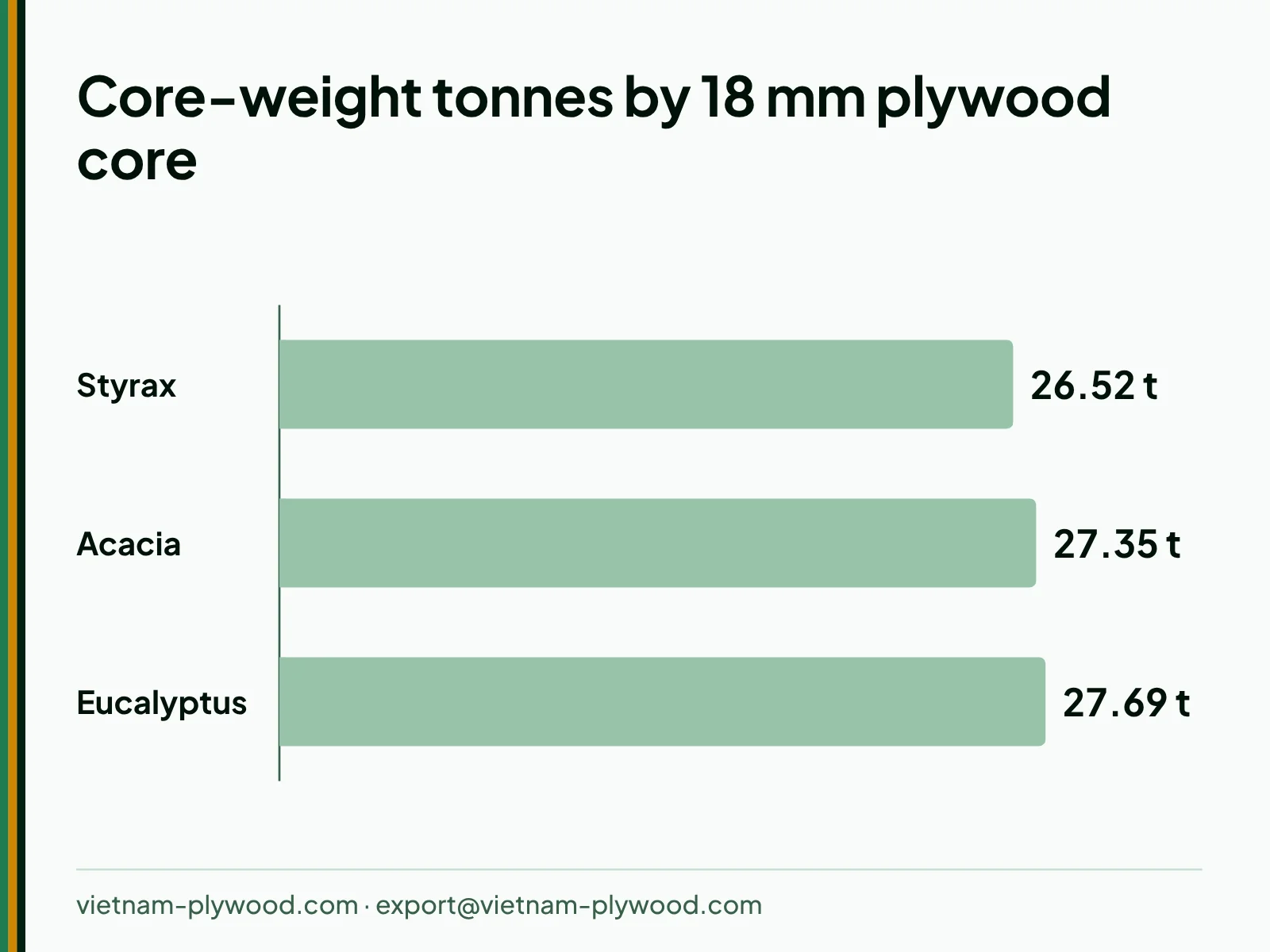
An 18 mm, 1220 × 2440 mm plywood shipment illustrates why density changes freight planning before any OSB quotation is compared. The 40HC payload limit is 28.5 t, and a full container count changes with core type. The figures below exclude film weight.
| 18 mm plywood core | Sheet weight | Sheets per pallet | Full 40HC | Volume | Core-weight tonnes |
|---|---|---|---|---|---|
| Styrax | 26.79 kg | 55 | 990 sheets | 53.05 m³ | 26.52 t |
| Acacia | 31.08 kg | 55 | 880 sheets | 47.15 m³ | 27.35 t |
| Eucalyptus | 34.83 kg | 53 | 795 sheets | 42.60 m³ | 27.69 t |
Specifications can be mixed in a container within the payload limit; see container packing. Compare the number of usable sheets delivered to the receiving port, rather than comparing cubic metres without accounting for density. Obtain the actual OSB sheet weight and packaging dimensions before calculating a competing load.
What can the buyer inspect at the producing factory?
At the producing factory, the buyer can inspect the panel build against the approved specification before loading. HCPLY coordinates specification, on-site quality control, documents and loading across our three factories. Buyers visit the factory office and inspect goods where their order is produced.
Inspectors can measure thickness at agreed points, examine the exposed veneer edges for gaps and core construction, check face and back grades, and review the specified glue and emission fields separately. For film-faced work, check film identity and cut-edge sealing against the order. Agree the sampling method and acceptance criteria before production.
Factory documents for FSC, CARB P2, ISO 9001, CE and EUDR/EUTR are shown with factory details masked, on request. Availability and relevance must be matched to the actual producing member factory and order. For a structural or marine claim, use a test report the buyer accepts.
The export document package includes the commercial invoice, packing list, bill of lading, certificate of origin, relevant phytosanitary and fumigation papers, and agreed certificate documents. EU lots include EUR.1 and the EUTR/EUDR file set; CIF shipments include insurance. After loading, the draft shipping documents come to you for approval.
What specification should an importer send?
Send the intended application and acceptance requirements first, then state the panel construction and shipment details. A comparison of plywood versus OSB becomes actionable only when both quotations describe the same service conditions. Use a separate OSB supplier’s performance documents for any strand-board alternative.
HCPLY offers FOB Hai Phong, CFR (CNF) or CIF. The minimum order is one 40HC. Free samples are available; new buyers book their courier, credited against a real order. Factory lead time runs 15–45 days from receipt of the 30% deposit; the exact figure depends on order size, line loading and what the contract fixes; The remaining 70% is paid on the scan of the bill of lading, by T/T, or by irrevocable sight L/C.
Application: [wall sheathing / roof deck / floor / crate / formwork]
Line or core: [furniture / commercial and packing / construction; styrax / acacia / eucalyptus]
Glue: [melamine MR / phenolic WBP]
Emission: [E0 / E1 / E2 or required documented limit]
Face and grade: [species or film type; face/back grade]
Thickness and tolerance: [mm; allowed variation]
Size: [length × width, mm]
Quantity: [sheets or m³; proposed 40HC mix]
Destination port: [port and country]
Ask Lucy for a sample set matched to the intended application and inspection checklist.