





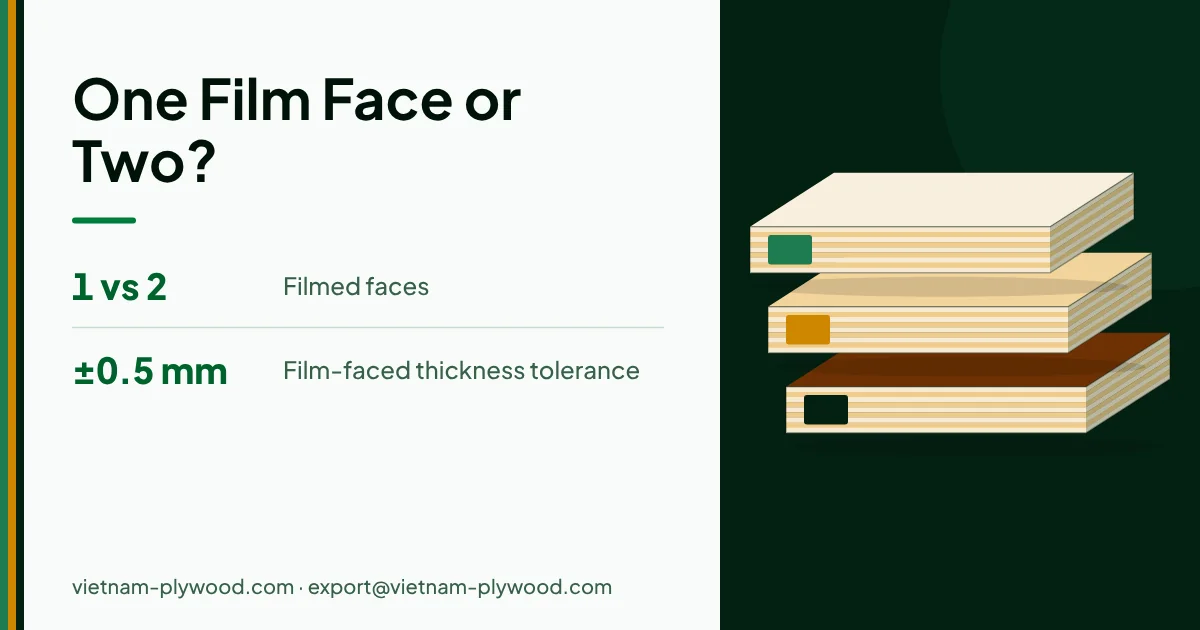
What is single sided film faced plywood?
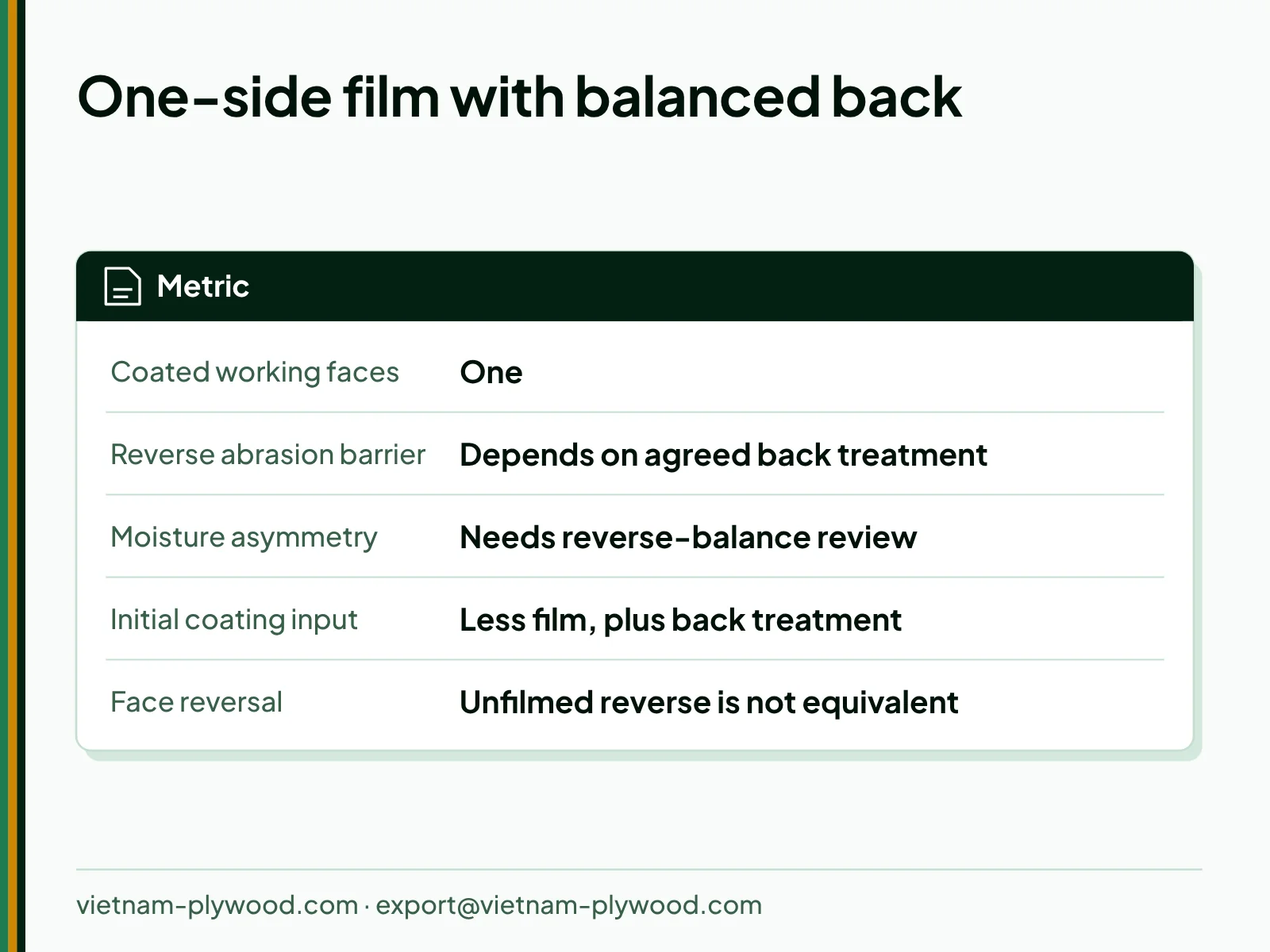
Single sided film faced plywood has a film-coated working face and a separately specified reverse face. For HCPLY construction orders, the reverse must be designed to balance the panel and match its exposure, rather than being left as an unspecified surface. A double-film sheet coats both faces and is the simpler choice when both faces face repeated moisture or handling.
The distinction matters because the film is a surface treatment; the core, glue, reverse construction and edge treatment still determine how the complete sheet behaves. See our film-faced plywood range for the broader product family. A one-side build should be identified on the purchase specification and sample, including which face meets the concrete or cargo.
What goes on the back of a one-side film sheet?
The back needs an agreed balancing treatment, with its material, application and acceptance criteria written into the order. A bare veneer reverse is a possible market description, but it offers less surface protection than a filmed reverse and does not establish a balanced construction by itself.
For a proposed single-film build, our construction line would review a reverse treatment matched to the face and intended exposure. The buyer should approve a physical sample showing the front film, reverse treatment, edges and cross-section before volume production. An agreed back coating should be described accurately; it must never be called a second film when it is not one.
Does filming one side make plywood warp?
A one-face construction can be more vulnerable to differential moisture movement when the two surfaces exchange moisture differently. It does not follow that every single-film panel will warp: veneer symmetry, core moisture, glue, reverse treatment, storage and wetting history all matter.
WoodWorks, in its Mass Timber Moisture Management for Construction guidance (accessed 2026), explains that moisture fluctuations can cause dimensional changes and warping in wood panels. Its discussion concerns mass timber, so it supports the moisture mechanism rather than a measured warp rate for HCPLY film-faced plywood. WoodWorks moisture guidance is useful context for specifying a practical comparison.
Ask for paired one-side and double-film samples with the same core, thickness and glue. Record initial flatness, store them on level supports, expose them to the same conditions, then check for bow, twist and edge swelling. Specify the acceptable outcome in writing before ordering; an appearance check alone cannot establish long-term stability.
Single film vs double film: which construction fits?
Double-film construction is the safer default for repeated wet formwork, while a specified one-film build can suit protected backs and limited-use applications. The comparison below assumes the same core, glue, nominal thickness and front-film specification.
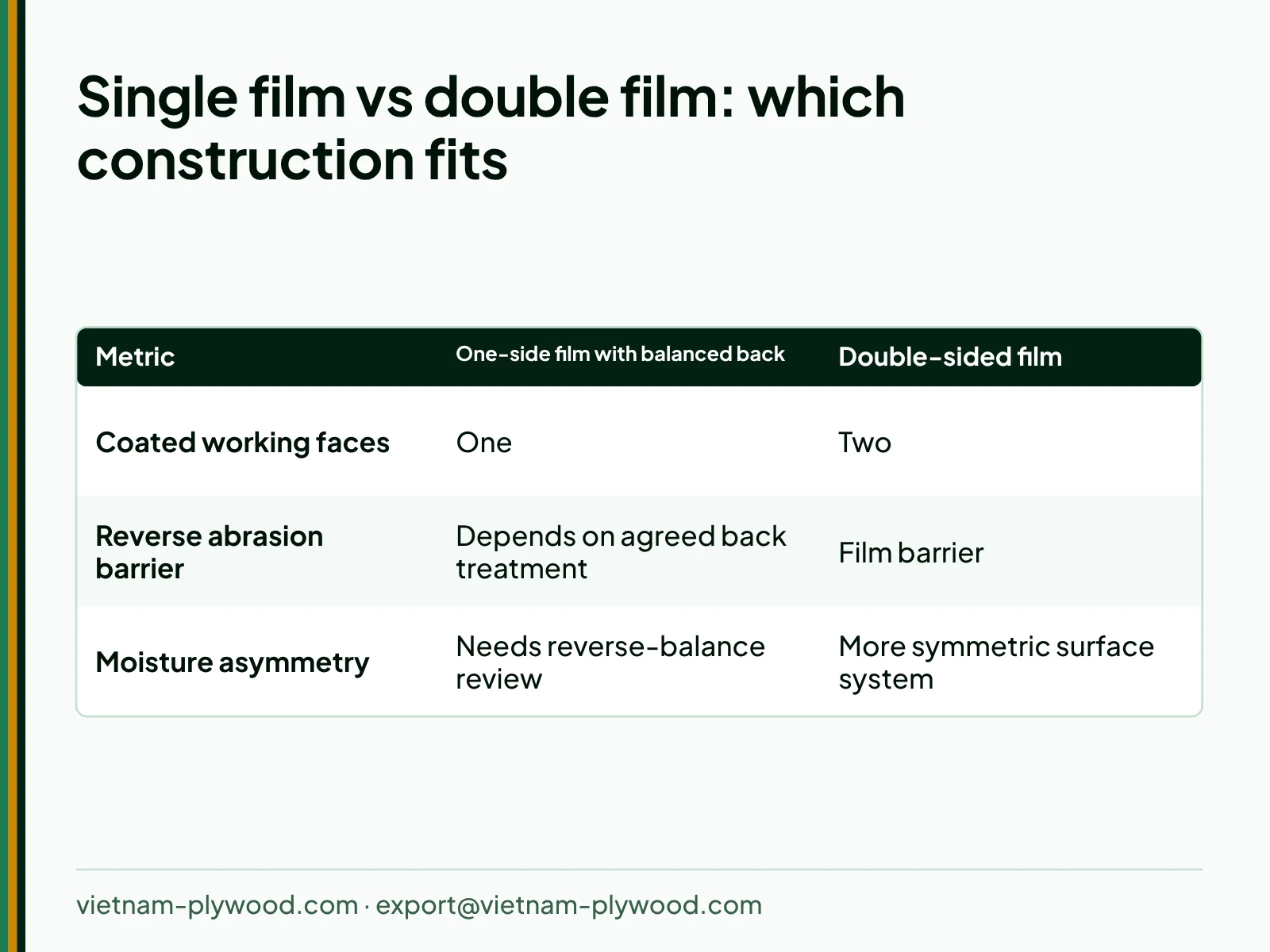
| Metric | One-side film with balanced back | Double-sided film | Verdict by use |
|---|---|---|---|
| Coated working faces | One | Two | One-sided liners: single; reversible forms: double |
| Reverse abrasion barrier | Depends on agreed back treatment | Film barrier | Rough handling: double |
| Moisture asymmetry | Needs reverse-balance review | More symmetric surface system | Repeated wet cycles: double |
| Initial coating input | Less film, plus back treatment | Film on both faces | Protected one-face use: compare quotations |
| Face reversal | Unfilmed reverse is not equivalent | Either film face can work | Reversible decks: double |
| Inspection focus | Film, back treatment, flatness | Both films, flatness | Both require edge checks |
This table is a selection framework, not a laboratory ranking. The reverse treatment and actual handling conditions can change the outcome. For film-faced plywood technical specifications, define the surfaces separately rather than ordering by a generic grade name.
What is single-sided film-faced plywood used for?
Single-face sheets are candidates for liners, protected vehicle-body interiors and limited-use formwork where only one face performs the exposed task. A liner facing cargo or a wall can need a cleanable front while its reverse stays supported and sheltered. Vehicle-body applications need separate checks for fixing, impact, water entry and whether the back contacts damp metal.
For one-off concrete forms, the filmed side faces the pour; the reverse needs protection from standing water and careless stacking. Repeated wall and slab pours place greater demands on both faces, especially during cleaning, stripping and storage. A single-film specification should identify which side will face concrete and which side will face the supporting structure.
Where traction matters for vehicle floors or access surfaces, a smooth single-film sheet is not an automatic substitute for an anti-slip design. Our construction line also makes 220 g/m² anti-slip film; its intended working surface and support requirements must be specified separately. The construction plywood page covers the broader formwork family.
Is double-sided film needed for slab decks?
For slab decks that see repeated pours, wash-down and face reversal, choose double-sided film unless the formwork design and trial support a single-film back. A slab panel can receive moisture from concrete on top and from rain or site cleaning below. The supporting frame also abrades the reverse during stripping and repositioning.
For reuse planning, HCPLY’s film-faced reference is about 12–15 pours for melamine-glue sheets and up to about 25 for phenolic-glue sheets, with proper handling, a release agent on every pour and sealed edges, including cut edges. These figures are conditional product guidance, not a separate single-film performance result. See melamine film-faced plywood for the glue distinction.
Is one-side film plywood less expensive?
A single-film construction normally uses less face-film material than a comparable double-film construction, but a balancing back treatment and added handling offset part of that saving. The strongest price drivers are the core and construction quality, glue system, front-film specification, reverse treatment, thickness and order configuration.
For the same core and glue, a straightforward double-film sheet carries a second film application; a one-film sheet substitutes an agreed reverse treatment. Which finished quotation is lower must be checked against matched specifications. There is no fixed percentage saving or published single-film price to apply across orders.
Ask for two quotations with the same dimensions, core and front-film weight. Compare total landed-use economics as well as the first purchase: an inexpensive back that wears quickly can increase replacements and labor. For definitions of film weights and grades, see film-faced plywood meaning and grades.
How does an unfilmed back wear?
An unfilmed or lightly treated reverse is more exposed to scraping, staining and moisture pickup than an intact film-coated back. Its actual wear depends on the back treatment, the support contact, wetting and how sheets are moved between pours.
Edge sealing deserves its own inspection because cut edges expose the plywood layup regardless of face selection. Record whether cutouts, drilled holes and field cuts will be resealed. If a reverse must tolerate repeated wet cleaning, specify a filmed back rather than treating a cosmetic coating as equivalent.
Which HCPLY line makes the build?
Our construction line presses film-faced sheets with acacia or eucalyptus cores; the other lines address different panel uses. HCPLY runs three factories in Phu Tho and Hai Phong, and each order is made at the producing factory matched to its specification.
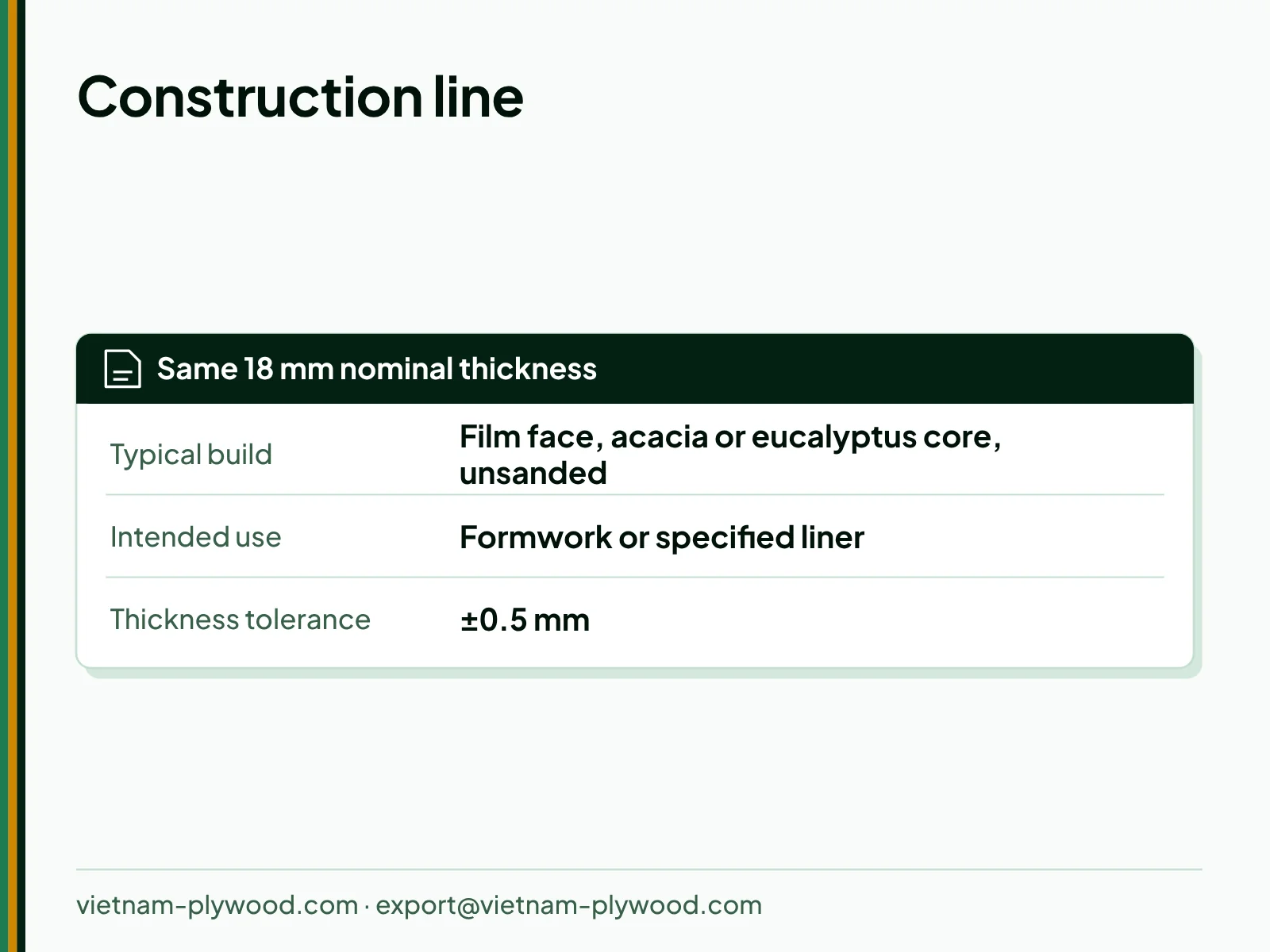
| Same 18 mm nominal thickness | Construction line | Commercial and packing line | Furniture line |
|---|---|---|---|
| Typical build | Film face, acacia or eucalyptus core, unsanded | Acacia core, MR glue, unsanded or light-sanded | Styrax or eucalyptus core, full stitched and sanded |
| Intended use | Formwork or specified liner | Packing and commercial panels | Furniture and cabinets |
| Thickness tolerance | ±0.5 mm | Commercial ±0.5 mm; packing ±0.5–1.0 mm | ±0.2 or ±0.3 mm as ordered |
Film-faced orders use 120 g/m² standard or 135 g/m² premium film; 220 g/m² is reserved for anti-slip film. Film weight describes the face, not the reverse treatment. See comparison across factory lines when a buyer needs the same nominal thickness for different jobs.
What can an inspector check before loading?
An inspector can witness the front/back identification, film continuity, reverse treatment, flatness, edges and thickness at the producing factory. The purchase order should make the acceptance method explicit before production starts.
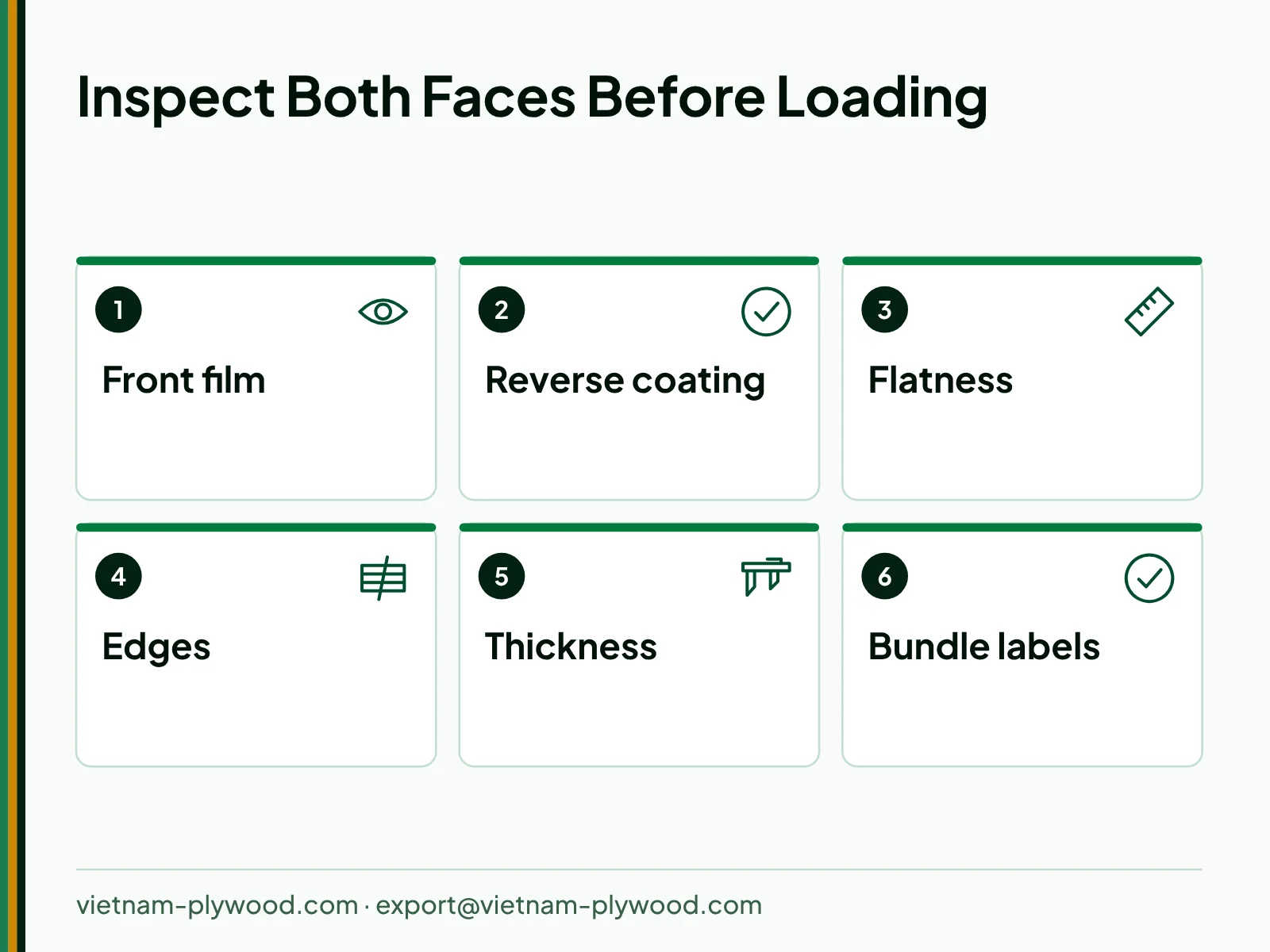
- Compare the approved sample and production panels under consistent lighting, with both faces visible.
- Measure thickness against the film-faced ±0.5 mm tolerance and length/width against ±2 mm.
- Examine reverse coating coverage, edge sealing, exposed cuts, veneer gaps and visible distortion.
- Check packaging labels distinguish single-film from double-film bundles, then record quantities at loading.
HCPLY coordinates on-site quality control and export documents. Buyers can visit the factory office and inspect goods at the producing factory. A shipment’s packing list identifies the ordered build and quantity; after loading, the draft shipping documents come to you for approval.
Can single-film and double-film sheets ship together?
Specifications can be mixed in one 40HC container within its 28.5 t payload limit. The mix needs separate bundle marks and packing-list lines so the receiving yard can identify which face construction was ordered.
For a 1220 × 2440 × 18 mm acacia-core reference, one sheet weighs 31.08 kg before film weight. The full acacia reference is 880 sheets, 47.15 m³ and 27.35 t; the film contribution is excluded from those figures. For a mixed shipment, count both constructions and check the final actual load against the payload limit rather than treating the reference as a finished film-faced loading promise.
The mixed-container loading page explains combining specifications; container packing covers sheet counts. A buyer should list the single-film and double-film quantities separately on the order.
What should the purchase specification say?
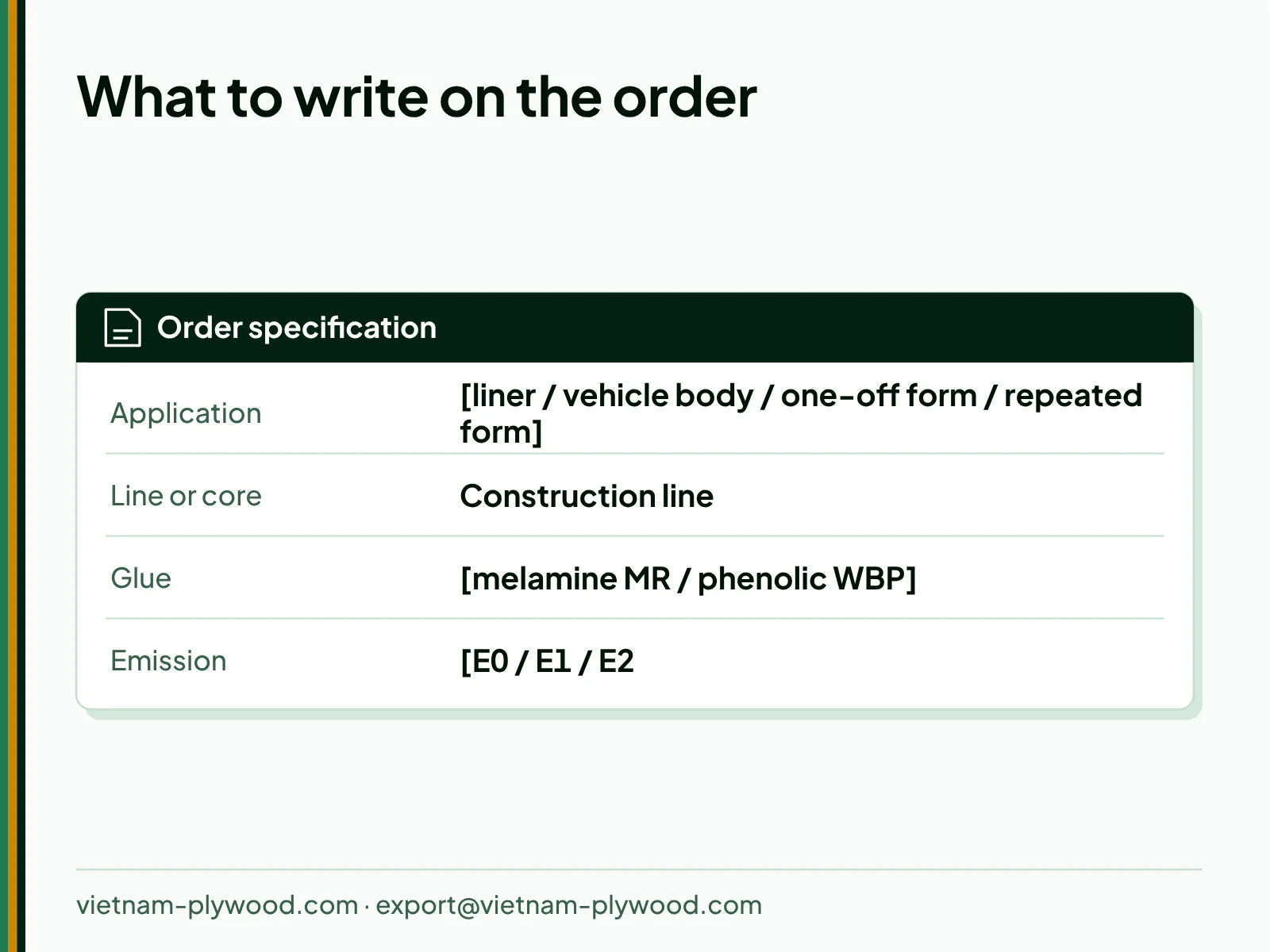
A workable order identifies the front film, reverse treatment and end use separately. This lets our construction line assess the build and lets the inspector compare the shipment with an approved sample.
HCPLY offers FOB Hai Phong, CFR (CNF) or CIF. The minimum order is one 40HC; production is 15–45 days from the 30% deposit, set by order size, line loading and the contract. The remaining 70% is paid on the scan of the bill of lading, by T/T, or by irrevocable sight L/C.
Free samples are available; a first-time buyer pays the courier, and that charge comes off the first confirmed order. Send Lucy at export@vietnam-plywood.com the following specification, then ask for a sample set.
Application: [liner / vehicle body / one-off form / repeated form]
Line or core: construction line; [acacia / eucalyptus]
Glue: [melamine MR / phenolic WBP]
Emission: [E0 / E1 / E2, as agreed]
Face and grade: one 120 or 135 g/m² film face; reverse balancing treatment [describe and approve sample]
Thickness and tolerance: [mm]; ±0.5 mm
Size: [mm × mm]
Quantity: [sheets and single-/double-film split]
Destination port: [port, country]
Ask for a sample set through contact before approving the production build.