





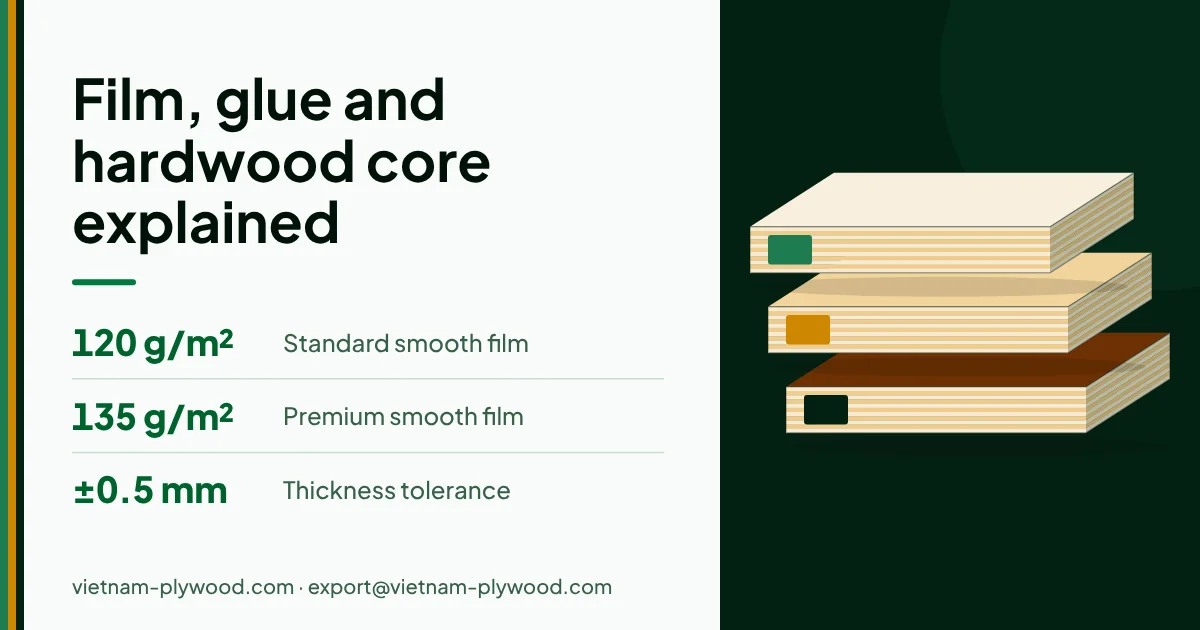
Film-faced plywood is a veneer-core panel with a resin-treated surface for repeated concrete forming. A wrong film, bond or core choice can mean damaged concrete faces, replacement sheets and lost site days. At HCPLY, our construction line presses film-faced panels around the specified surface, adhesive and hardwood core; these are separate decisions on a purchase order. For the broader range, see film-faced plywood from Vietnam.
What is film faced plywood?
Film-faced plywood is cross-laminated veneer plywood covered with a resin-treated film that limits surface wetting and gives concrete a comparatively smooth contact face. The film protects the broad faces, the adhesive holds veneers together, and the core carries bending loads between form supports. These functions must be specified separately.
A film face is the working skin that touches fresh concrete. A smooth skin can aid stripping and reduce surface marking, while a damaged skin can transfer defects to the next pour. Film does not seal a newly sawn edge; cutting exposes veneers and bond lines to water.
Our film-faced plywood range includes smooth film builds for formwork and a separate anti-slip film option. The anti-slip texture is intended for traction-related applications; a patterned surface can imprint wet concrete and should not be substituted for a smooth forming face.
What do the film, glue line and core do on site?
The film controls the concrete-contact surface, the glue line controls veneer bonding under wet exposure, and the core contributes stiffness and sheet weight. A thicker film cannot correct a poorly assembled core, while a stronger bond cannot protect an unsealed cut edge.
| Layer or decision | Construction-line specification | What the buyer checks on site |
|---|---|---|
| Working film | 120 g/m² standard or 135 g/m² premium | Surface scratches, coating continuity and release after stripping |
| Textured film | 220 g/m² anti-slip only | Texture matches the intended platform or flooring application |
| Adhesive | Melamine MR or phenolic WBP | Agreed bond test and signs of veneer separation |
| Hardwood core | Acacia 580 kg/m³ or eucalyptus 650 kg/m³ | Edge gaps, veneer arrangement, handling weight and deflection |
| Panel geometry | Thickness tolerance ±0.5 mm; length and width ±2 mm | Fit against form framing and panel joints |
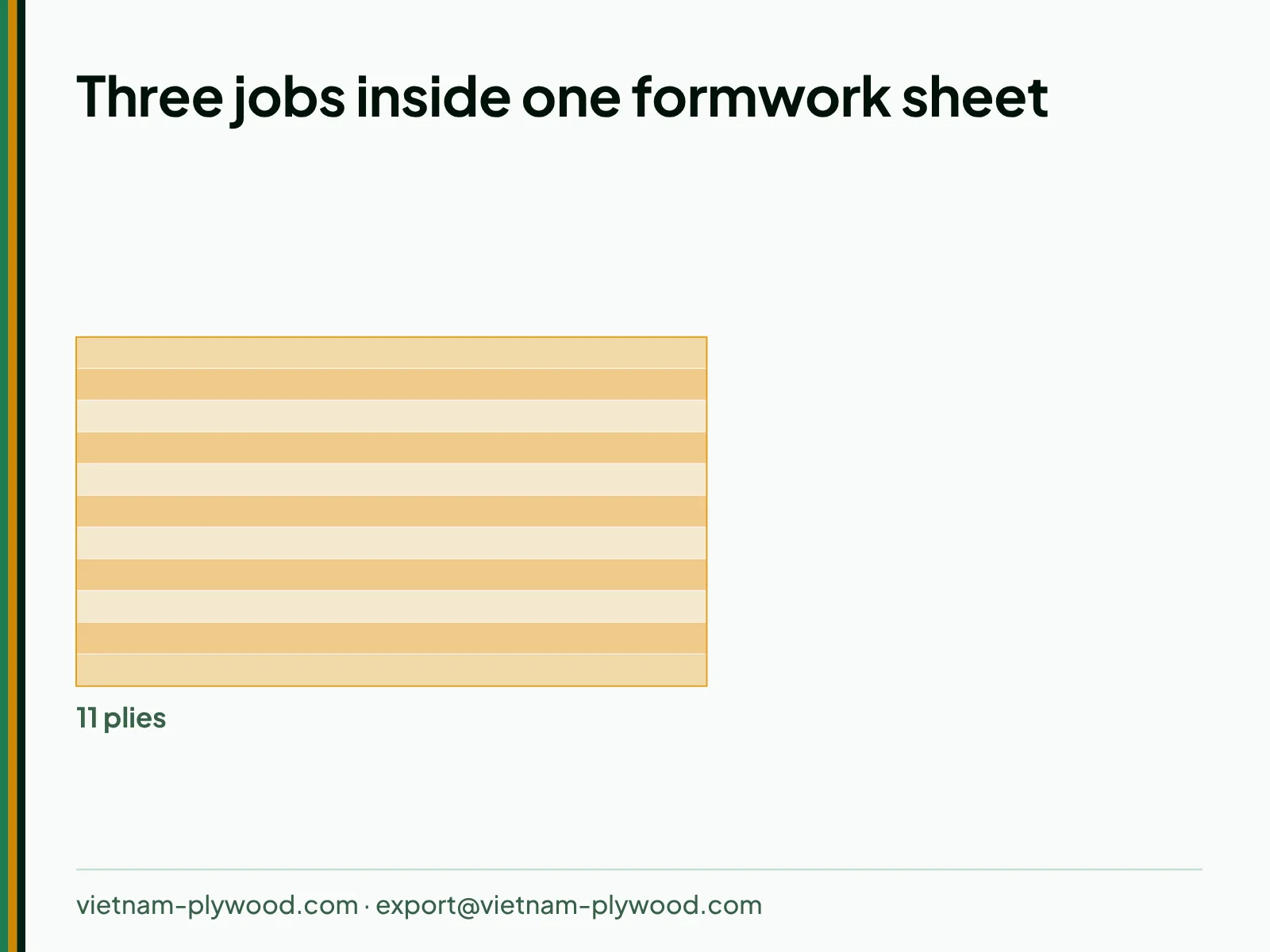
Our construction line uses unsanded cores beneath the film. Veneer thickness is 1.4–2.0 mm, so ply count changes with the layup; an 18 mm panel has 11–13 plies. Inspecting the cut edge gives more information about internal assembly than film colour alone.
How do phenolic and melamine film-faced builds differ?
Phenolic-glue construction is the higher wet-exposure build, while melamine-glue construction serves formwork with a different bond specification. The surface film and the internal glue must each appear on the quote; a seller’s phrase “phenolic film” does not identify every adhesive line inside the panel.
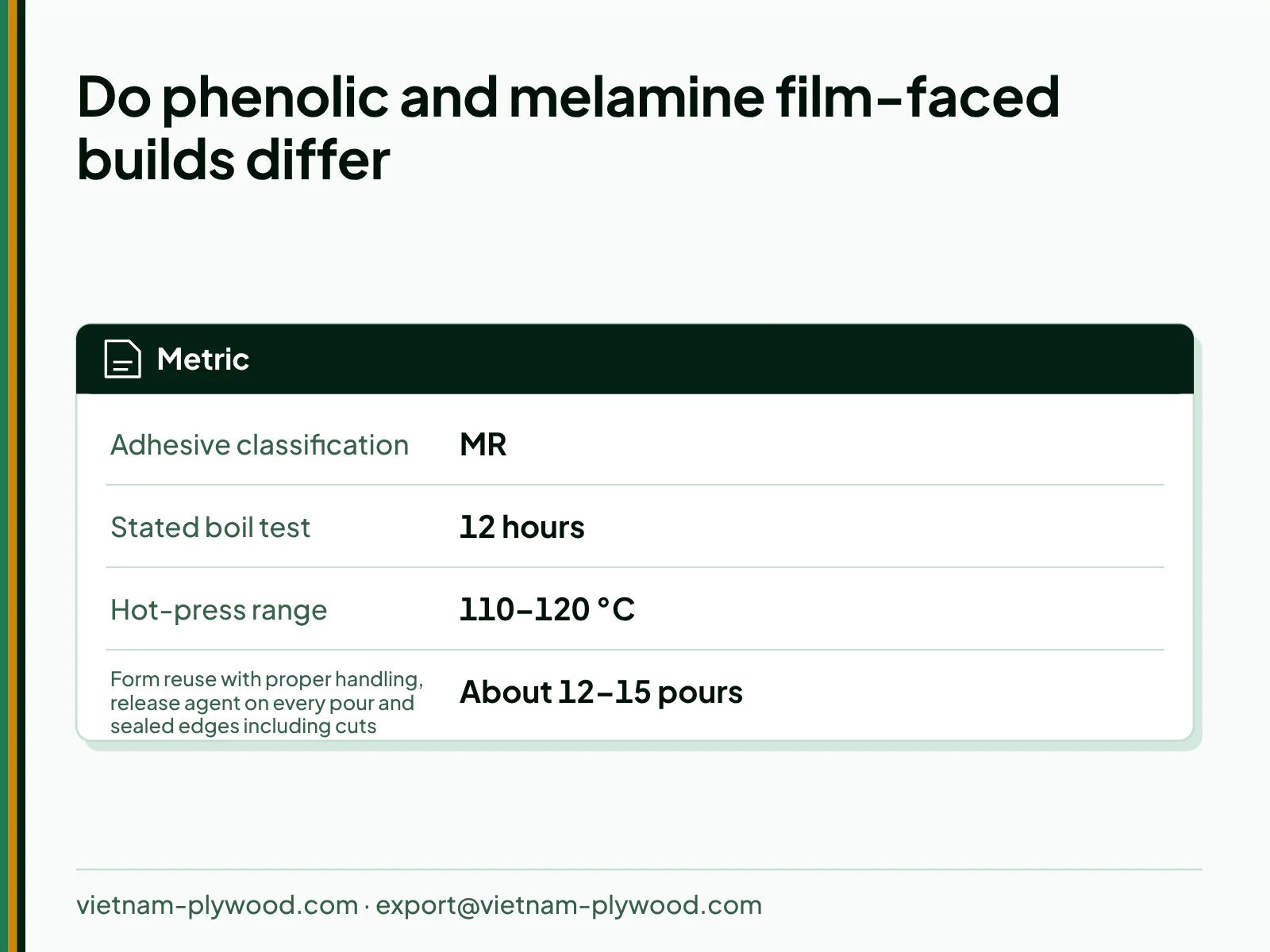
| Metric | Melamine-glue build | Phenolic-glue build | Buying verdict |
|---|---|---|---|
| Adhesive classification | MR | WBP | Specify WBP for the more demanding repeated wetting schedule |
| Stated boil test | 12 hours | 72 hours | Ask for a report matching the agreed build |
| Hot-press range | 110–120 °C | 130–145 °C | Press settings identify the production route, not site load capacity |
| Form reuse with proper handling, release agent on every pour and sealed edges including cuts | About 12–15 pours | Up to about 25 pours | Compare cost per usable pour under the same site practices |
| Surface film | Specify 120 or 135 g/m² independently | Specify 120 or 135 g/m² independently | Compare the same film weight before judging glue |
The melamine film-faced build and phenolic film-faced build have their own product specifications. Release agent on every pour, careful stripping and prompt edge sealing matter for either adhesive. Reuse counts describe those handling conditions, rather than a fixed result for every contractor.
Which film-faced plywood grades appear on quotations?
Film-faced plywood grades on quotations often mix film weight, adhesive, core construction and visual descriptions into a single label. A grade such as “premium,” “AA” or “black film” is incomplete without a written specification and an agreed acceptance method.
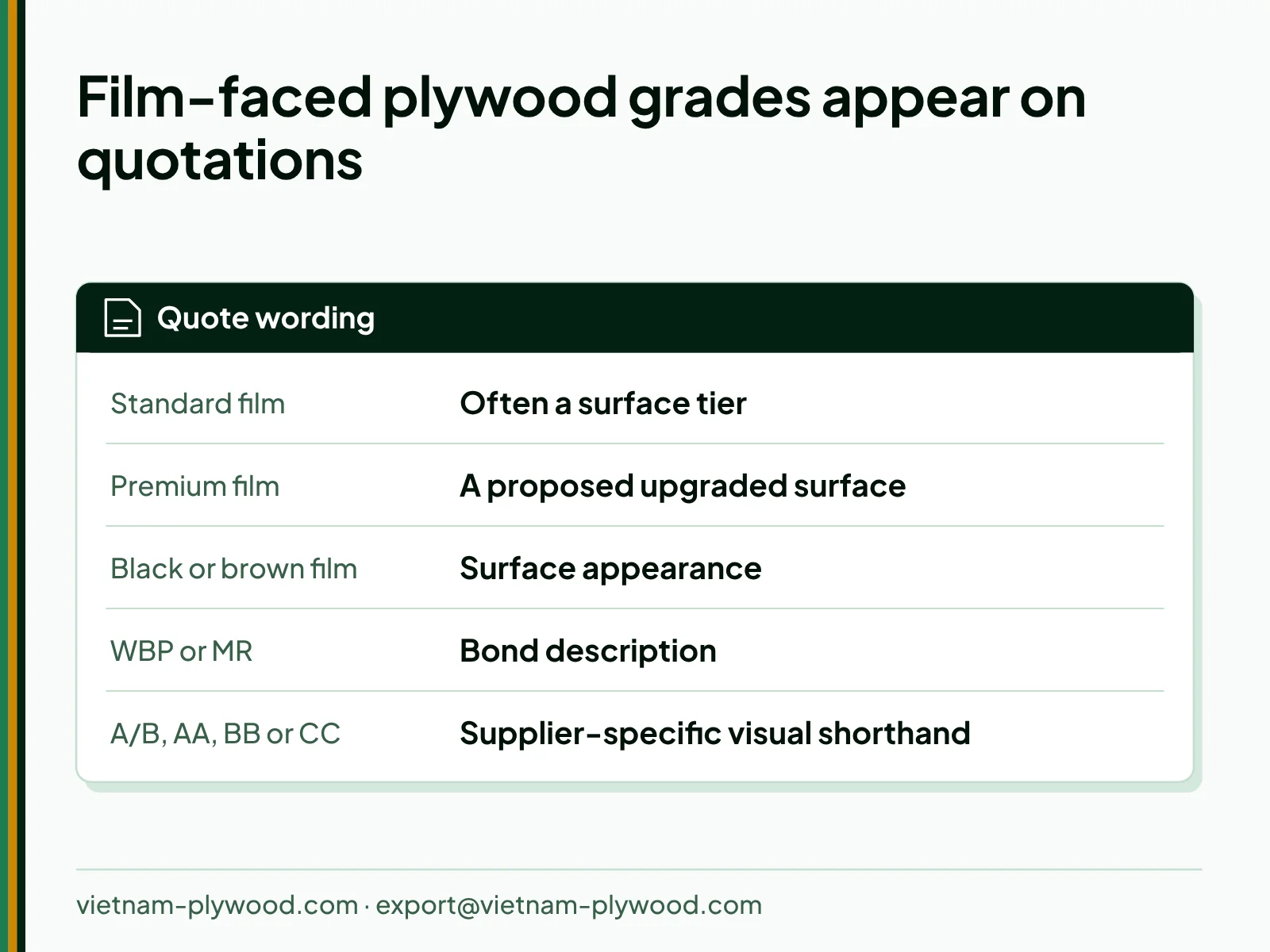
| Quote wording | What it can identify | What remains to be written |
|---|---|---|
| Standard film | Often a surface tier | Film weight in g/m², glue, core and tolerance |
| Premium film | A proposed upgraded surface | Whether it is 135 g/m² and which bond is used |
| Black or brown film | Surface appearance | Film weight and performance criteria; colour alone is insufficient |
| WBP or MR | Bond description | Film, hardwood core and test conditions |
| A/B, AA, BB or CC | Supplier-specific visual shorthand | Defined acceptance samples and actual veneer/core criteria |
| Structural or formwork grade | Intended engineering use | Load design, span data and accepted test report |
For HCPLY quotations, 120 g/m² is standard film, 135 g/m² is premium film, and 220 g/m² applies only to anti-slip film. These weights describe the coating, not a complete performance grade. An importer should compare equal thickness, equal film weight and equal adhesive before comparing quoted prices.
Is film-faced plywood structural?
Film-faced plywood can act as a load-bearing form sheathing component, but the film face alone does not establish a structural grade. Wet concrete pressure, support spacing, panel orientation, deflection and fixing details belong in the engineer’s formwork design.
APA – The Engineered Wood Association describes Plyform classes and pressure-related selection in its Concrete Plyforms guidance (accessed 2026). APA’s published grade terminology is specific to products covered by its system; a similar-looking imported film-faced sheet does not inherit that classification.
For a project that requires a named structural grade, request the specified grade against a test report the buyer accepts. Ask the engineer to approve the intended span, wet-concrete pressure and support arrangement using the actual panel data. Do not treat an attractive film surface, a boil-test duration or a thickness label as a substitute for load verification.
Which HCPLY line makes this panel?
Our construction line presses film-faced plywood with acacia or eucalyptus cores and phenolic or melamine film. Our furniture line and our commercial and packing line make different products even when the buyer requests the same nominal thickness.
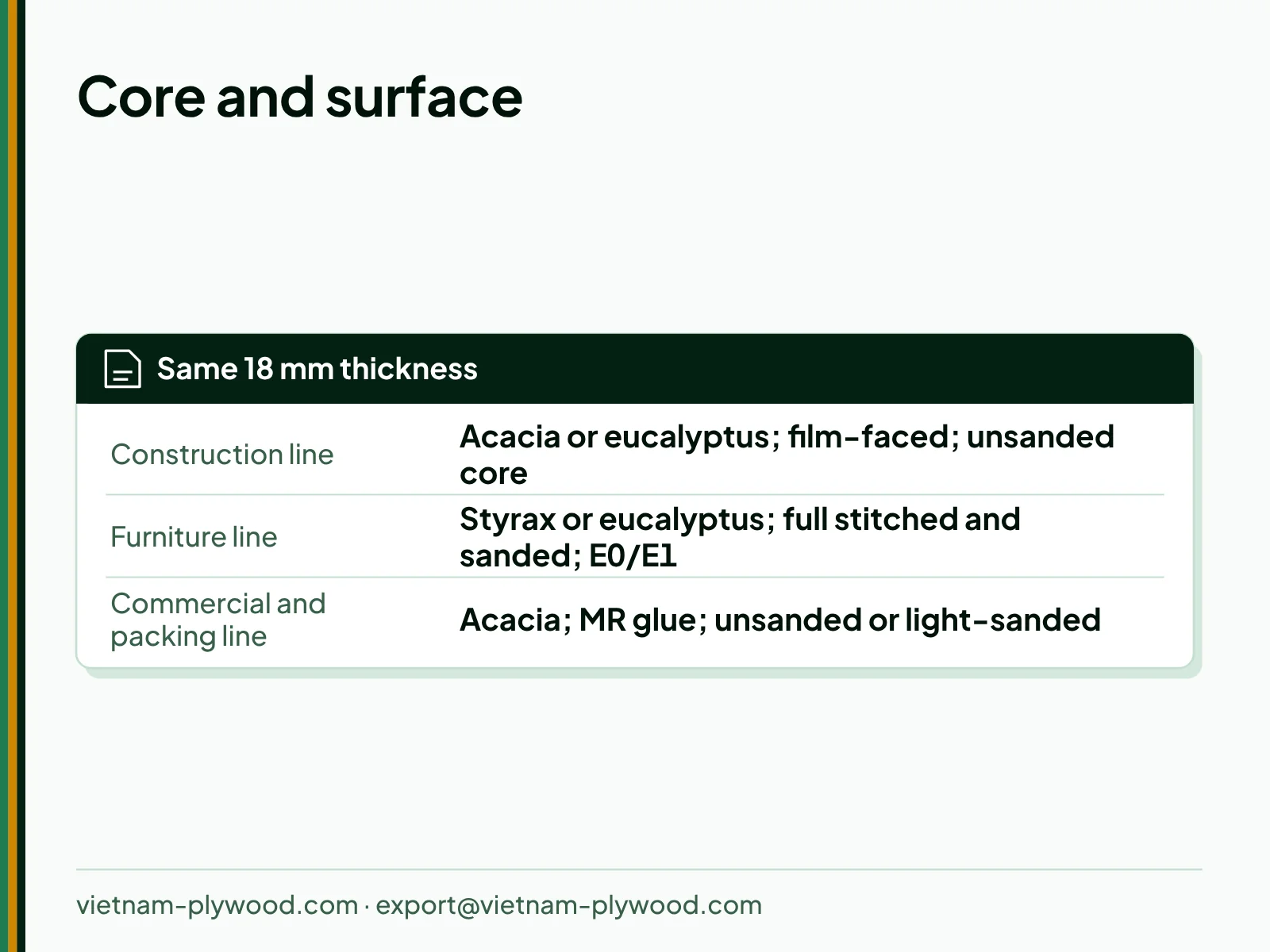
| Same 18 mm thickness | Core and surface | Production purpose |
|---|---|---|
| Construction line | Acacia or eucalyptus; film-faced; unsanded core | Concrete-contact formwork |
| Furniture line | Styrax or eucalyptus; full stitched and sanded; E0/E1 | Furniture and cabinet components |
| Commercial and packing line | Acacia; MR glue; unsanded or light-sanded | General commercial panels and packaging |
This comparison prevents a common procurement mistake: matching only 18 mm and overlooking the manufacturing route. The producing factory can show the relevant layup, film surface and thickness measurements during an inspection. Buyers visit the factory office and inspect goods where their order is made.
Our three factories are in Phu Tho and Hai Phong. The construction plywood line has capacity up to 140 containers a month; furniture and commercial plywood up to 100 containers a month. Each order ships directly from the producing factory, with HCPLY coordinating specification, on-site quality control, documentation and loading.
How do dimensions and container weights affect the order?
Dimensions affect form layout, joints, pallet counts and transport weight. Available sheet sizes include 1220 × 2440, 1250 × 2500, 1220 × 2135, 1220 × 1830, 915 × 2440, 915 × 2135 and 915 × 1830 mm; custom cutting is available.
Thicknesses span 3–40 mm, with 3, 5, 9, 12, 15, 18, 21 and 25 mm common. Select thickness against the project’s framing design and inspect its ±0.5 mm construction-line tolerance. For dimensional selection, see film-faced plywood thickness and sizes.
At 18 mm and 1220 × 2440 mm, an acacia-core sheet weighs 31.08 kg before film weight. The lookup for a full 40HC acacia load is 880 sheets, 47.15 m³ and 27.35 t, within the 28.5 t payload limit. The comparable eucalyptus-core sheet weighs 34.83 kg; its full load is 795 sheets, 42.60 m³ and 27.69 t. Film weight is excluded from these figures.
Specifications can be mixed in one 40HC within the payload limit. A buyer combining film-faced panels with other plywood should use the actual pallet plan and the mixed-container loading options. The detailed sheet-count method belongs to container packing, rather than a grade label.
How is film-faced plywood produced and checked?
Film-faced plywood is made by preparing veneers, assembling the hardwood core, bonding and pressing the layup, applying the specified film, then trimming and protecting the edges. Each stage creates a different inspection opportunity.
- Veneer preparation: check veneer condition and consistent layup before the stack closes.
- Core assembly: inspect alignment, open gaps and edge construction on sample cut edges.
- Glue and pressing: match the recorded adhesive type and pressing route to the written order.
- Film application: compare the working face against the approved film weight and finish sample.
- Trimming and edge treatment: measure length, width and thickness; check continuous edge protection.
- Pre-loading inspection: sample panels across pallets, record defects and verify package labels against the packing list.
A first-time buyer or appointed inspector can witness thickness readings and inspect cut edges at the producing factory. A test report should identify the actual glue and panel build being ordered. Photographs of an undamaged top sheet cannot reveal gaps deeper inside a pallet.
The commercial invoice and packing list record the shipped specification and quantities. Order-specific test reports belong with the certificate documents, while after loading, the draft shipping documents come to you for approval. This gives the importer a practical route from the approved sample to the shipped lot.
What should a first-time formwork buyer check before ordering?
A first-time formwork buyer should approve the entire panel build and an inspection method before comparing prices. Start with the actual pour and framing arrangement, then translate that application into measurable purchase-order fields.
- Application: smooth concrete-contact form, exposed finish, or a separate traction surface.
- Working surface: film type, 120 or 135 g/m² smooth film, and an agreed appearance sample.
- Bond and core: MR melamine or WBP phenolic; acacia or eucalyptus; visible core acceptance criteria.
- Geometry: thickness, ±0.5 mm tolerance, size and joint requirements.
- Evidence: approved sample, thickness checks, edge photographs and a relevant bond test report.
- Handling: edge sealing after every cut, release agent on each pour and suitable stripping practice.
Compare quotations line by line. A lower initial panel cost can become a higher cost per usable pour if the core opens or the surface wears early. The purchase order should also identify the destination port, pallet marking and inspection stage.
For quotation planning, film weight, adhesive system, core species, core assembly, thickness, size and order mix are the price drivers. Phenolic-glue construction costs more than a comparable melamine-glue build because of its bond system; premium film costs more than standard film when the other specifications match. Request a quotation against the written specification rather than an unqualified grade name.
What are the limits of film-faced plywood on site?
Film-faced plywood resists routine formwork exposure through its coated faces, but cuts, drilled holes and impact damage expose vulnerable material. Moisture can reach the veneer edges, and repeated stripping can scratch the film or break corners.
Store panels off wet ground and protect their faces during transport. Clean concrete residue without gouging the film, recoat cut edges and use release agent on every pour. Inspect panel edges and working faces before each reuse rather than assuming the original grade label describes the panel’s present condition.
What documents and next steps complete the purchase?
A complete first order ties the approved build to its inspection record and shipping paperwork. HCPLY offers FOB Hai Phong, CFR (CNF) or CIF, with a minimum order of one 40HC and mixed specifications permitted within the payload limit.
Factory lead time runs 15–45 days from receipt of the 30% deposit; the exact figure depends on order size, line loading and what the contract fixes. The remaining 70% is paid on the scan of the bill of lading, by T/T, or by irrevocable sight L/C. Samples cost nothing: a first-time buyer pays the courier, and that charge comes off the first confirmed order.
Shipment paperwork includes the commercial invoice, packing list, bill of lading, certificate of origin, phytosanitary and fumigation papers, and insurance under CIF. For EU lots, the certificate of origin is EUR.1 and the EUTR/EUDR file set is included. The order’s certificate documents can include an FSC claim on sales documents, emission certificate and test reports for the agreed build; member-factory certificates are shown with factory details masked, on request.
Use the following specification request to compare offers on the same basis:
Application: Concrete formwork; pour type and framing arrangement
Line or core: Construction line; acacia or eucalyptus core
Glue: Melamine MR or phenolic WBP; agreed test report
Emission: E0 / E1 / E2 as specified separately from glue
Face and grade: Smooth film 120 or 135 g/m²; agreed visual acceptance
Thickness and tolerance: 18 mm; ±0.5 mm
Size: 1220 × 2440 mm; length and width ±2 mm
Quantity: One 40HC or specified mixed load within payload limit
Destination port: [port name]
Request the film-faced plywood specification sheet from Lucy at export@vietnam-plywood.com.