





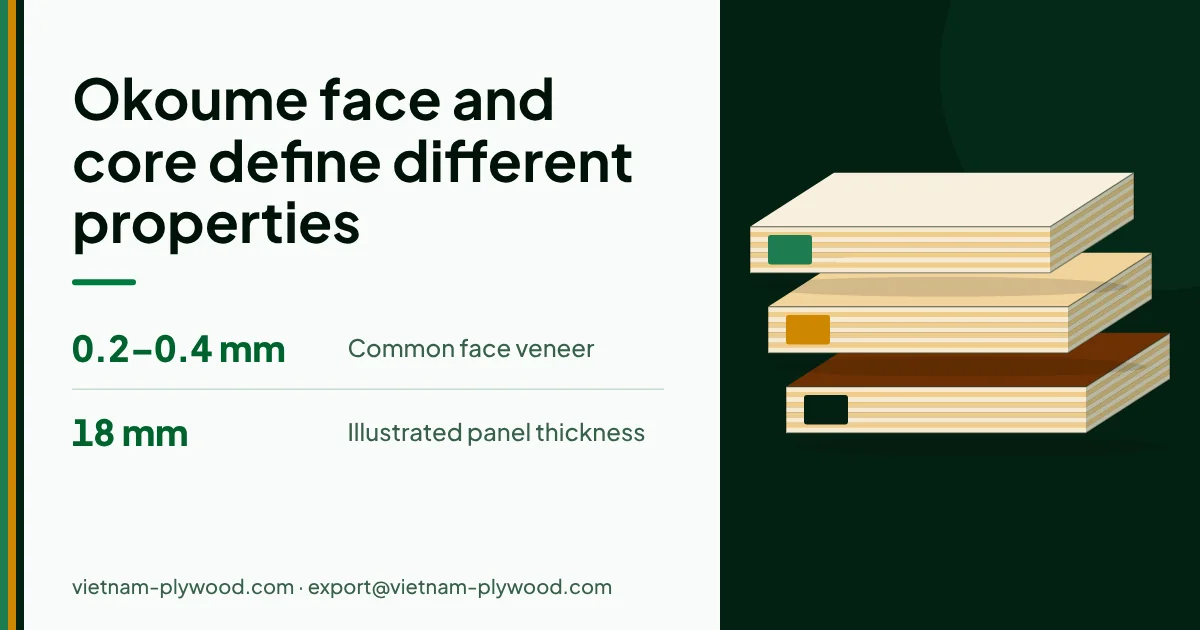
Okoumé veneer determines a plywood panel’s visible colour and grain, while its core determines most of the weight and strength. Choosing by face name alone can mean rejected cabinet finishes, heavier shipments or a costly wrong build. HCPLY makes okoume-faced furniture plywood with the face, core and finish requirements written separately.
What is okoumé wood?
Okoumé is the timber of Aucoumea klaineana, an African hardwood valued for its pale pink to reddish-brown appearance and fine, relatively even texture. In plywood purchasing, the practical question is usually whether a thin peeled okoume veneer will give the required finished face over a specified core. The species name identifies the face; it does not identify the whole panel construction.
A rotary-peeled okoume face can show straight or slightly interlocked grain, a gentle sheen and occasional colour movement between sheets. Buyers who need consistent cabinet doors should approve a representative face sample and agree how visible colour differences and repairs will be judged. A clear finish exposes differences that an opaque coating conceals.
The trade also uses the spelling okoume, and some catalogues say okume veneer. Those spellings do not change the purchase specification. For HCPLY, the order should name okoume face veneer, its grade and the underlying core separately. Our okoume plywood product page gives the related panel family.
What is okoume plywood used for?
Okoume-faced plywood fits furniture carcasses, cabinet fronts, interior fit-out panels, door components and decorative joinery when its face appearance and the chosen core match the job. A sanded panel gives a practical base for a clear coating, stain trial or opaque finish. Buyers should test their intended coating on an actual production-representative face.
For furniture and cabinet makers, the useful distinction is between exposed and concealed components. An exposed cabinet end needs a controlled face grade and finish; an internal partition may put greater emphasis on thickness, fastening and core integrity. A distributor serving both applications can write separate face requirements while keeping dimensions consistent.
Boat builders also use okoume plywood because suitable constructions can offer useful weight and bending characteristics. That application requires its own bond, core and exposure specification. The difference between okoume marine and okoume-faced plywood deserves a separate decision before any marine purchase.
How strong is okoume plywood?
The strength of an okoume-faced panel is governed mainly by its core, veneer lay-up, bond and thickness, rather than the species of its thin decorative face. A 0.2–0.4 mm face veneer contributes appearance and surface characteristics, but it cannot establish a structural design value for the whole sheet. A buyer asking how strong is okoume plywood must therefore specify the actual construction and test method.
For our furniture line, full-stitched styrax or eucalyptus cores offer a defined construction for furniture applications. At 18 mm, the ply count is 11–13, depending on the 1.4–2.0 mm core veneers. That ply count is a construction description, not a bending-strength certificate.
Compare samples for visible core gaps, thickness consistency, screw-holding in the intended edge detail and the behaviour of finished parts during machining. For a load-bearing or regulated use, commission testing against the buyer’s accepted report and design requirements. Neither the word okoume nor a smooth face substitutes for measured strength.
What colour and weight does an okoume face give a panel?
Okoume veneer typically brings a light pink, salmon or reddish-brown face with a fine, fairly uniform grain. The colour is a visible characteristic of the surface, while shipment weight follows the core density. An okoume-faced styrax panel and an okoume-faced eucalyptus panel can look similar but load very differently.
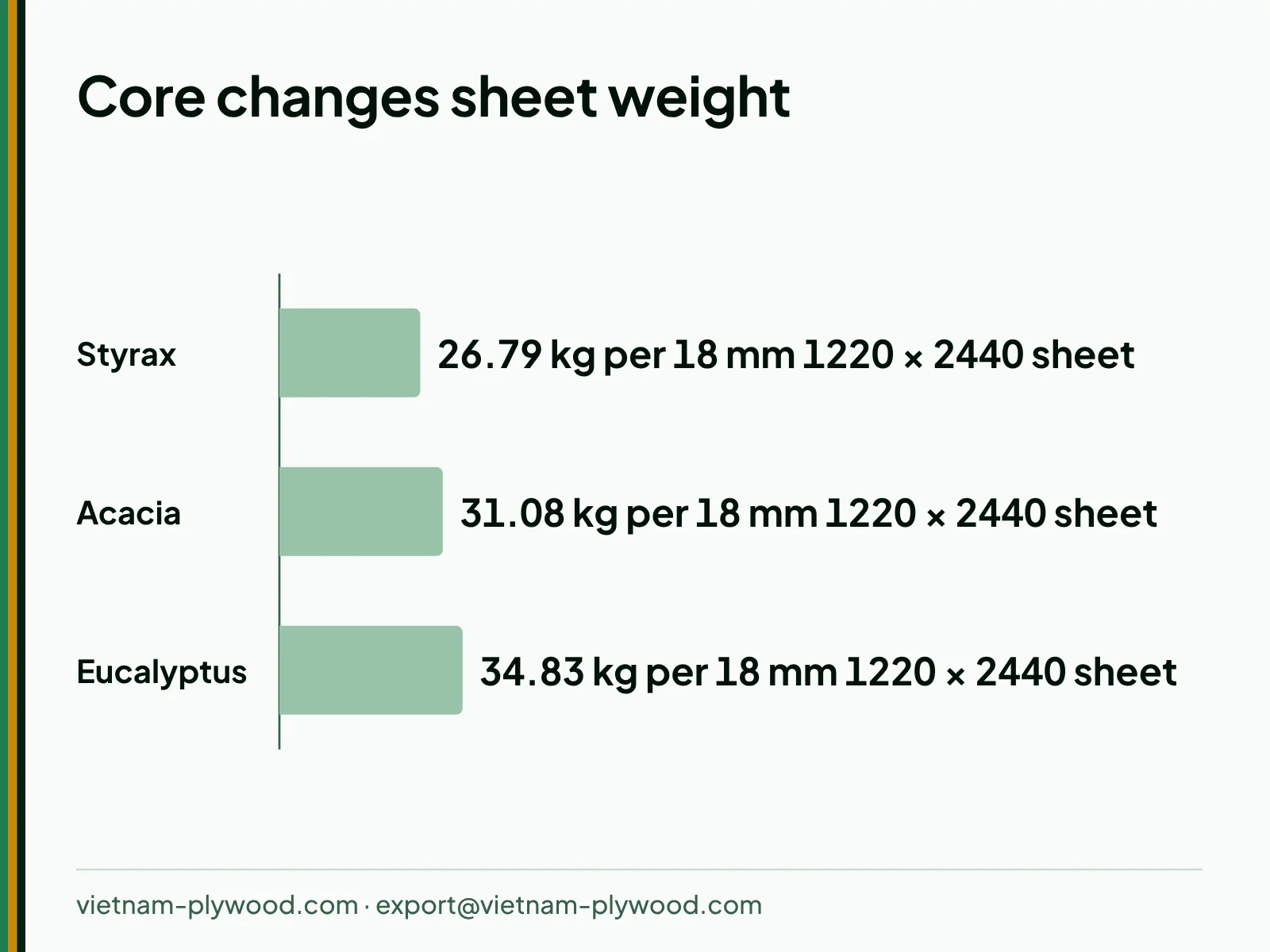
For a 1220 × 2440 × 18 mm sheet, the core-based lookup gives 26.79 kg with styrax, 31.08 kg with acacia and 34.83 kg with eucalyptus. These are panel estimates based on the named core densities; they do not include a separate face-weight adjustment. The corresponding core densities are 500, 580 and 650 kg/m³.
That difference matters to cabinet handling, container planning and freight documentation. A face-name-only purchase order leaves the heavier or lighter core unspecified. For a consistent series of finished cabinets, approve both the face colour range and the core species before production.
How does okoume compare with bintangor and birch faces?
Okoume is the choice for a warm, fine-textured pinkish face; bintangor offers a different reddish decorative look, while birch is selected when a lighter visual direction suits the finish. The comparison is meaningful only when all three faces are placed over the same core and thickness. Changing the core while comparing face species confuses weight and construction with appearance.
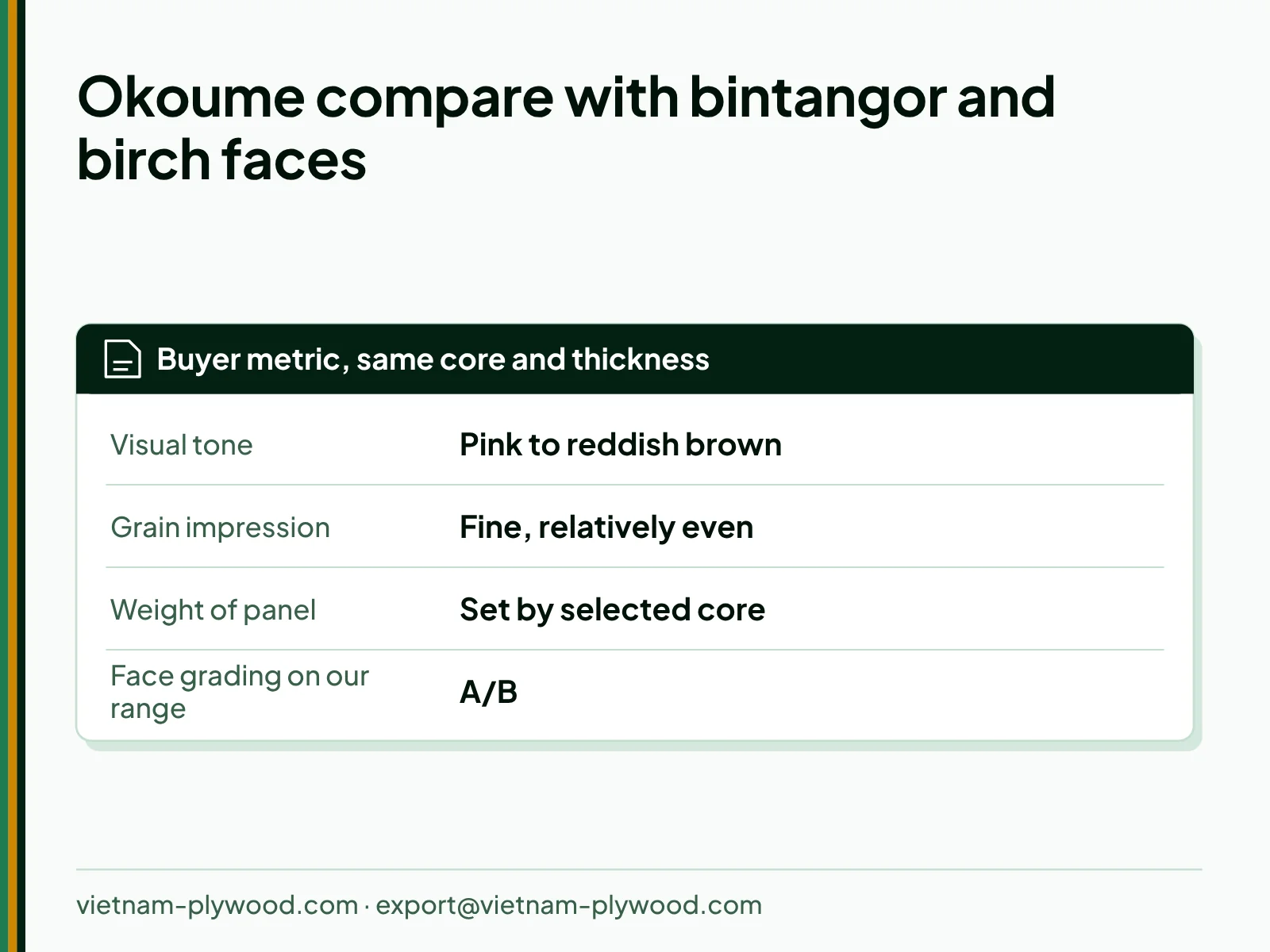
| Buyer metric, same core and thickness | Okoume face | Bintangor face | Birch face | Verdict by use |
|---|---|---|---|---|
| Visual tone | Pink to reddish brown | Reddish decorative tone | Light, pale tone | Okoume for warm joinery; birch for light interiors |
| Grain impression | Fine, relatively even | More pronounced decorative variation | Typically subtle, pale grain | Sample all three for clear-coated runs |
| Weight of panel | Set by selected core | Same core-based estimate | Same core-based estimate | No weight winner from face name alone |
| Face grading on our range | A/B | A/B | D/E/F | Write the correct grading system on the order |
| Main buying check | Colour and veneer continuity | Colour and pattern match | Pale-face defects and grading | Approve a face reference for the intended finish |
The veneer is commonly 0.2–0.4 mm. At that scale, a surface change does not turn a furniture panel into a different core product. If the job requires repeated matching across doors, request a sample set from the same agreed face grade and check it under the finish used by the cabinet maker.
How does okoume compare with mahogany?
Okoume is sometimes marketed as “okoume mahogany,” but Aucoumea klaineana is not true mahogany. The nickname points toward its warm appearance; it is not a botanical equivalence or a promise of the same machining, durability or strength. Specify the actual species when matching a design schedule.
An importer replacing a mahogany-look face with okoume should first compare approved samples under the intended coating. Grain, colour and pore appearance can shift after finishing, especially when a stain is used to imitate a darker timber. Ask the finishing shop to assess the final coating system rather than approving raw veneer alone.
The comparison also affects documentation. A generic label such as “African mahogany face” is inadequate when the order and applicable wood-traceability records require a species identity. Use the common and scientific names in the specification where the destination’s rules call for them.
Does an okoume face make a panel marine plywood?
No. An okoume face identifies the visible veneer; marine suitability requires the agreed complete panel construction and evidence against the test report the buyer accepts. The core, bonding, veneer quality and treatment of exposed edges all matter. A furniture-faced panel should not be ordered for prolonged wet exposure on the strength of its name.
The market uses okoume in boat panels because certain complete builds are comparatively light and workable. However, an attractive face alone says nothing about a particular panel’s boil resistance, void requirements or service environment. A marine or BS 1088 claim for an HCPLY order must be tied to a test report the buyer accepts.
For moisture-exposed assemblies, the buyer’s fabricator should specify sealing of faces and all cut edges, coating compatibility and maintenance. For ordinary interior cabinets, avoid paying for a marine specification that the actual application does not need. Compare the intended use against the marine-versus-faced decision.
Which producing line makes the specified face?
Our furniture line makes the okoume-faced furniture construction, with a full-stitched, sanded styrax or eucalyptus core and an ordered E0 or E1 emission class. The commercial and packing line is built around acacia-core, MR-glue utility sheets; our construction line makes film-faced panels for formwork. The three constructions answer different purchase intents.
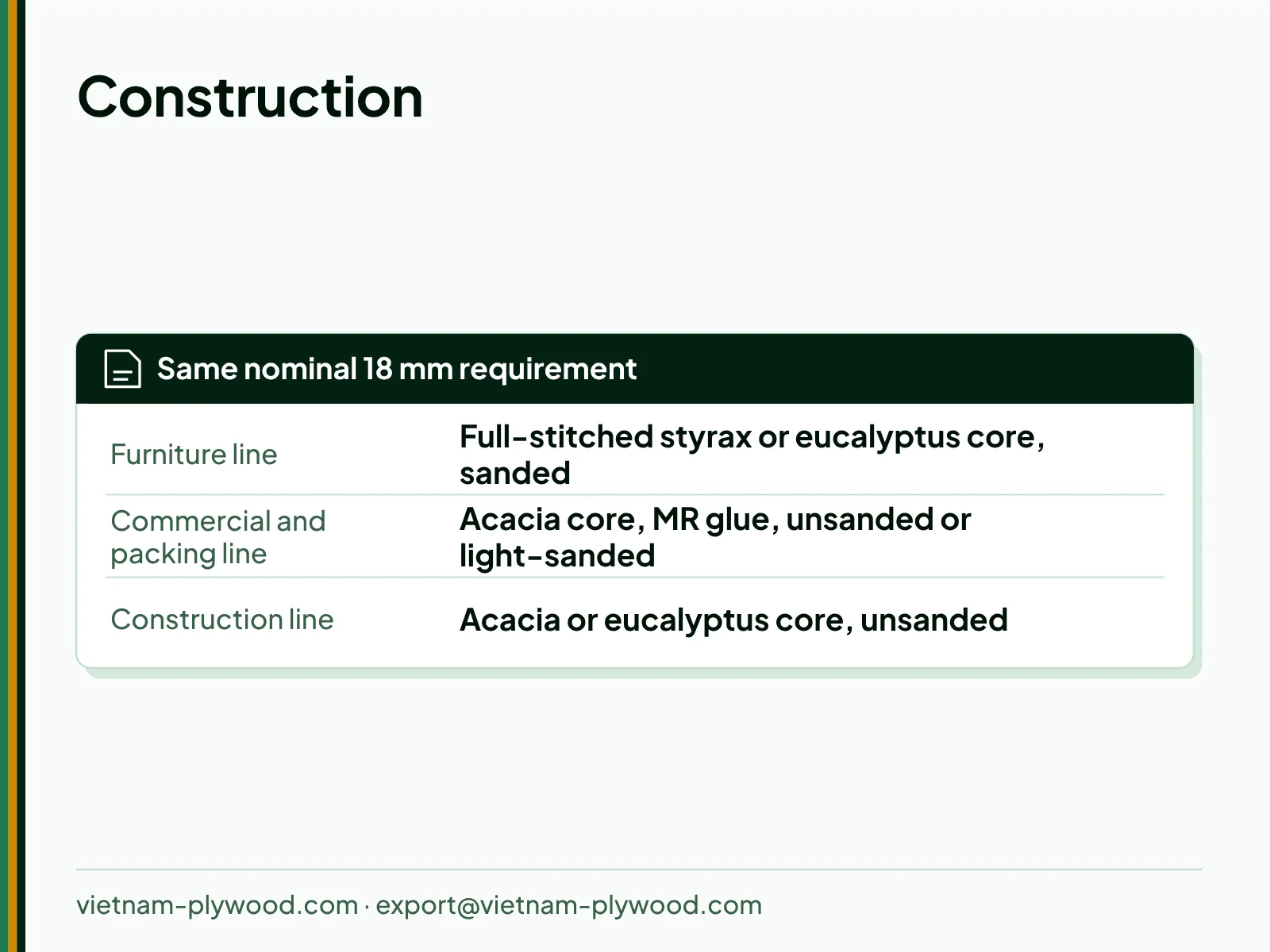
| Same nominal 18 mm requirement | Construction | Face or surface | Typical buyer decision |
|---|---|---|---|
| Furniture line | Full-stitched styrax or eucalyptus core, sanded | Okoume A/B face | Visible cabinet or fit-out work |
| Commercial and packing line | Acacia core, MR glue, unsanded or light-sanded | Utility surface | Packing or concealed commercial work |
| Construction line | Acacia or eucalyptus core, unsanded | Phenolic or melamine film | Formwork surface and site handling |
A 12 mm or 18 mm callout therefore needs an application beside it. The factory office can show buyers the intended order details, while inspection takes place at the producing factory. Buyers planning multiple product categories can review several plywood types and distributor supply programmes without mixing up their individual specifications.
What should an inspector check at the factory?
An inspector should compare the order’s approved okoume face sample with the actual pressed and sanded sheets, then check core construction, dimensions and marking. This is a practical way to catch a wrong face or a changed core before the load leaves the factory. Inspection should sample the goods that will be packed, rather than relying on a showroom panel.
Start by viewing several sheets under consistent light for face colour, repairs, splits and veneer continuity. Examine exposed edges for the agreed full-stitched core and any visible gaps. Measure thickness across the sheet and length and width against the written order.
Our furniture line can be ordered at ±0.2 or ±0.3 mm sanded thickness tolerance; length and width tolerance is ±2 mm. Record which thickness tolerance the purchase order selects. An A/B face grade should also have an approved acceptance reference, because the letters alone cannot describe every visual defect.
Finally, match the pallet labels and packing count with the approved build. Buyers can visit the factory office and witness these checks at the producing factory. HCPLY handles on-site quality control and the export paperwork through shipment.
How should an importer plan mixed specifications?
A 40HC can carry mixed specifications within the 28.5 t payload limit, but the different core weights must be counted separately. For 18 mm sheets at 1220 × 2440 mm, the full-container lookup is 990 styrax sheets at 26.52 t, 880 acacia sheets at 27.35 t or 795 eucalyptus sheets at 27.69 t. These are separate full-load examples, not quantities to add together.
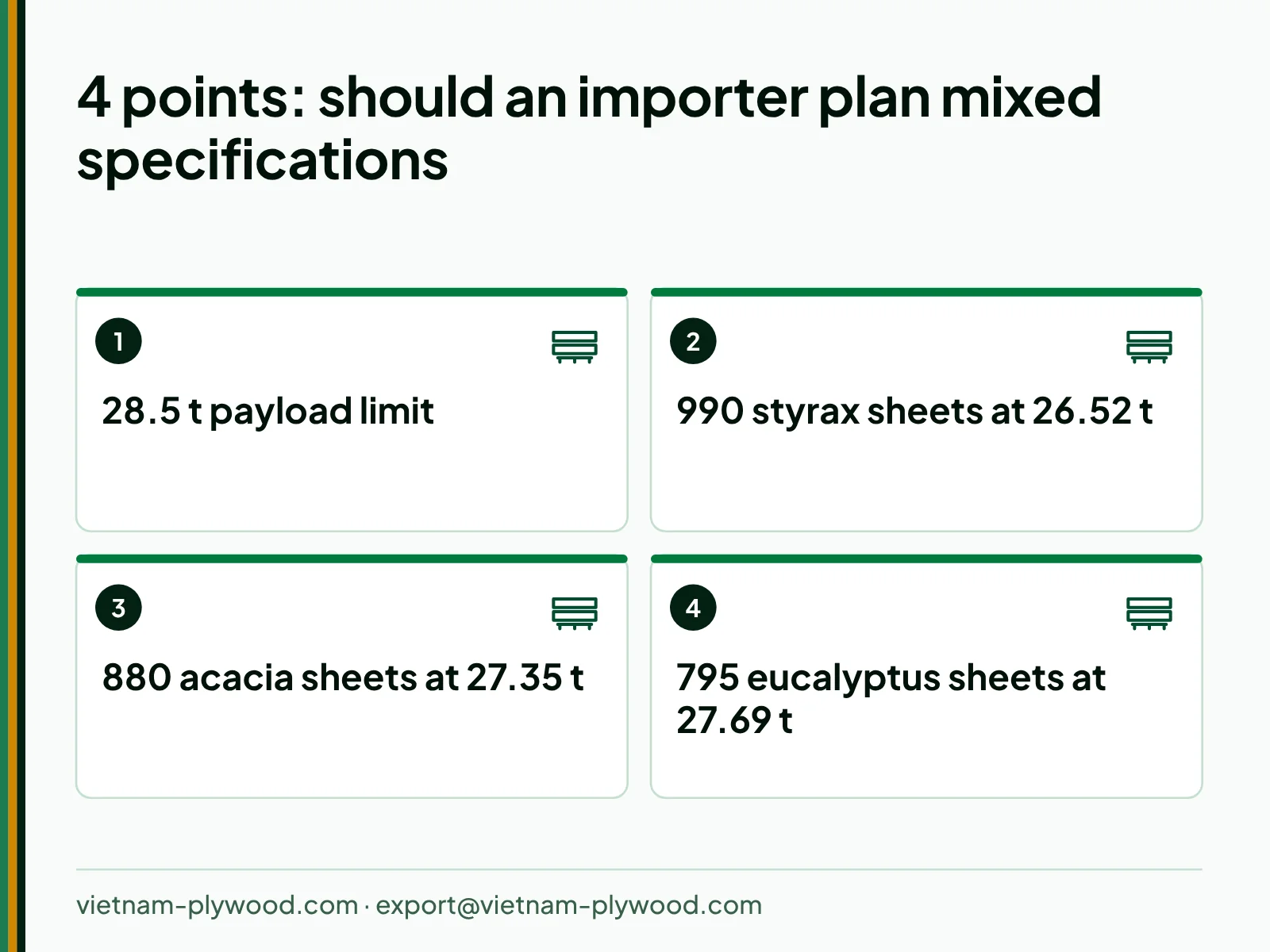
For a mixed furniture order, count each pallet by its core, thickness and dimensions, then sum its weight. A lighter styrax-core okoume-faced cabinet sheet can share a container with another approved furniture specification; mixed loads still need a packing plan that respects payload and pallet space. The container loading reference covers detailed quantities.
The minimum order is one 40HC. Specifications can be mixed in that container within the payload limit. For a distributor, that permits a written programme with distinct face grades or thicknesses while preserving clear pallet identification.
Which export documents identify the wood and build?
The commercial invoice and packing list identify the ordered panel and shipment quantities; the order’s agreed test or emission documents support the specified construction. For EU lots, the EUTR/EUDR file set also matters because face and core wood need traceability information. After loading, the draft shipping documents come to you for approval.
The European Union’s Regulation (EU) 2023/1115, in its 2025 consolidated text, Article 9, calls for the common name and full scientific name of wood used in relevant products. This makes the difference between an okoume face and a styrax or eucalyptus core a documentation question as well as a factory question. See the EUR-Lex regulation text.
The shipment document set includes the commercial invoice, packing list, bill of lading, certificate of origin (EUR.1 for EU lots), phytosanitary and fumigation papers, and insurance under CIF. Order-specific certificate documents can include an FSC claim on sales documents, an emission certificate or an agreed test report. Member-factory FSC, CARB P2, ISO 9001 and CE documents, plus EUDR/EUTR records, are shown with factory details masked, on request.
How do you specify an okoume-faced order?
Write the application, core and face grade together so the factory can build the panel that the finished product needs. Start with the finish requirement, then select core construction, adhesive, emission class, size and inspection criteria. Avoid a purchase description that says only “okoume plywood.”
For furniture plywood, the indicative starting price is from US$350/m³ FOB Hai Phong (October 2026). A full-stitched core and more demanding face selection cost more than a utility-grade construction because they require tighter material selection and finishing. Thickness, sheet size, ordered tolerance, grade, volume and destination terms also affect the quotation.
For context, commercial plywood starts from US$250/m³ FOB Hai Phong (October 2026); it serves a different specification. We ship FOB Hai Phong, or CFR (CNF) or CIF to your port. Factory lead time runs 15–45 days from receipt of the 30% deposit; the exact figure depends on order size, line loading and what the contract fixes; The remaining 70% is paid on the scan of the bill of lading, by T/T, or by irrevocable sight L/C.
Free samples are available; a first-time buyer pays the courier, and that charge comes off the first confirmed order. Lucy at export@vietnam-plywood.com can work from a written specification and a representative face sample. Use the contact page for the order discussion.
What specification should the buyer send?
Send one complete build description, including the intended use and receiving port. The following example is a furniture specification; replace each selection with the actual approved requirement. For a cabinet programme, attach the face sample and the coating acceptance reference to the same request.
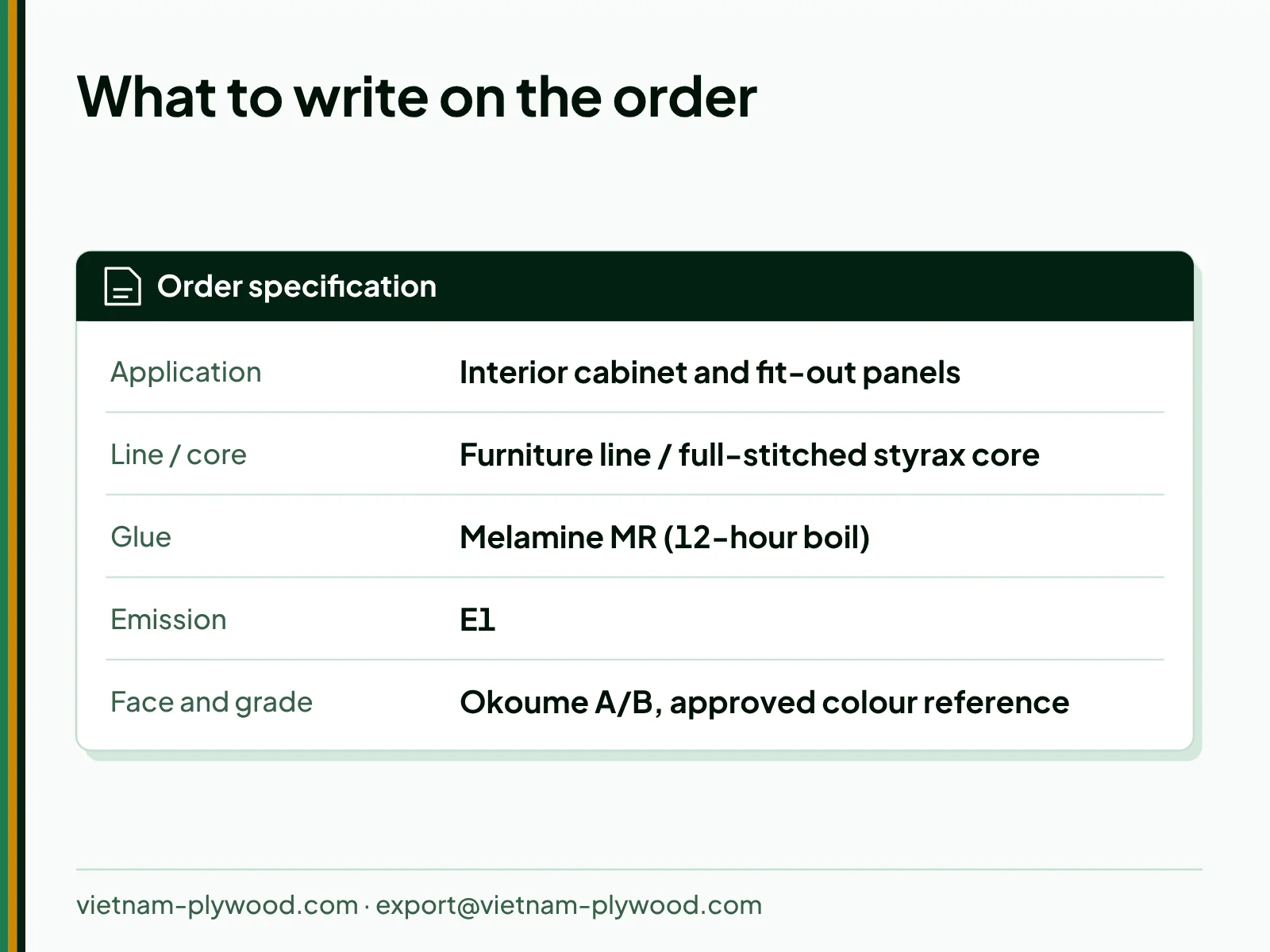
Application: interior cabinet and fit-out panels
Line / core: furniture line / full-stitched styrax core
Glue: melamine MR (12-hour boil)
Emission: E1
Face and grade: okoume A/B, approved colour reference
Thickness and tolerance: 18 mm, sanded ±0.2 mm
Size: 1220 × 2440 mm
Quantity: one 40HC, final pallet mix in packing plan
Destination port: [buyer to insert]
The next step is to book a factory visit to review the approved face and inspect the intended build.