





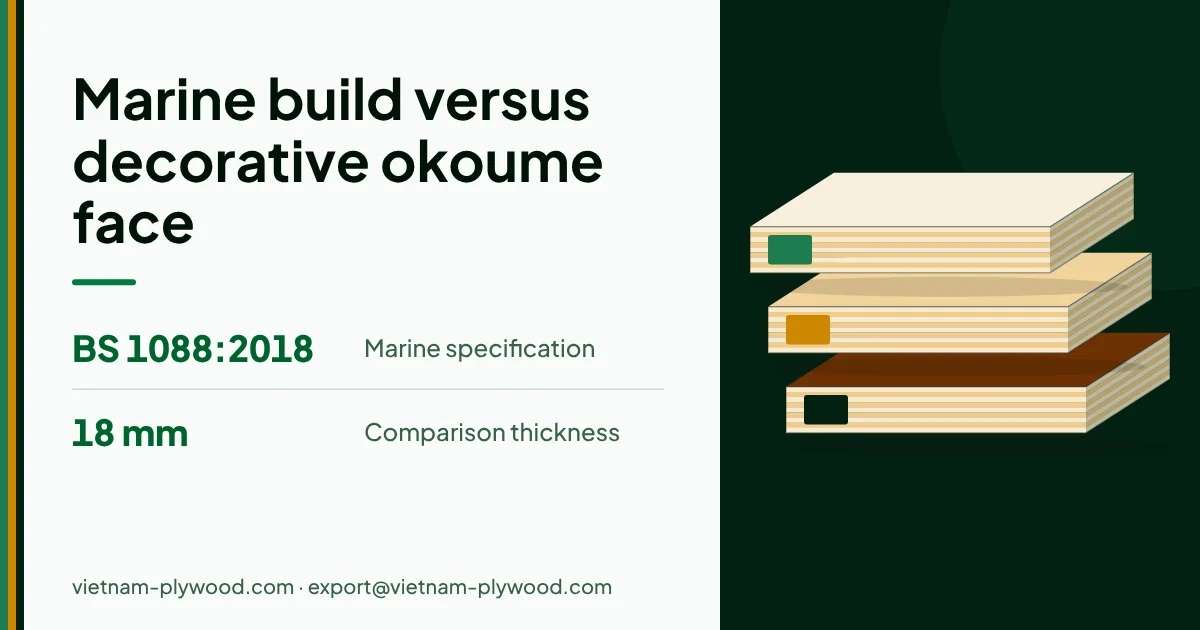
Marine okoume plywood requires a documented marine build, while an okoume face describes only the outer veneer. Confusing them can mean rejected panels, replacement costs and delayed fit-out work. HCPLY makes okoume-faced plywood for furniture applications and reviews any marine claim against a test report the buyer accepts.
What separates marine okoume plywood from an okoume face?
Marine okoume plywood is specified through its veneer construction, bond and performance evidence; okoume-faced plywood identifies the decorative outer veneer. The name on the face cannot establish the species of the inner plies, adhesive durability or conformity with a marine standard. An importer should ask for the complete panel construction before accepting a marine description.
An okoume face can be a practical choice for cabinets, fitted furniture and protected interior joinery. Our furniture line uses a sanded, full-stitched styrax or eucalyptus core with an okoume veneer face. An acacia-core construction belongs to our commercial and packing line, rather than the furniture line. These cores are different from an all-okoume marine construction.
For a broader account of veneer appearance and applications, see okoume plywood from Vietnam and okoume wood properties.
Which panel belongs in which application?
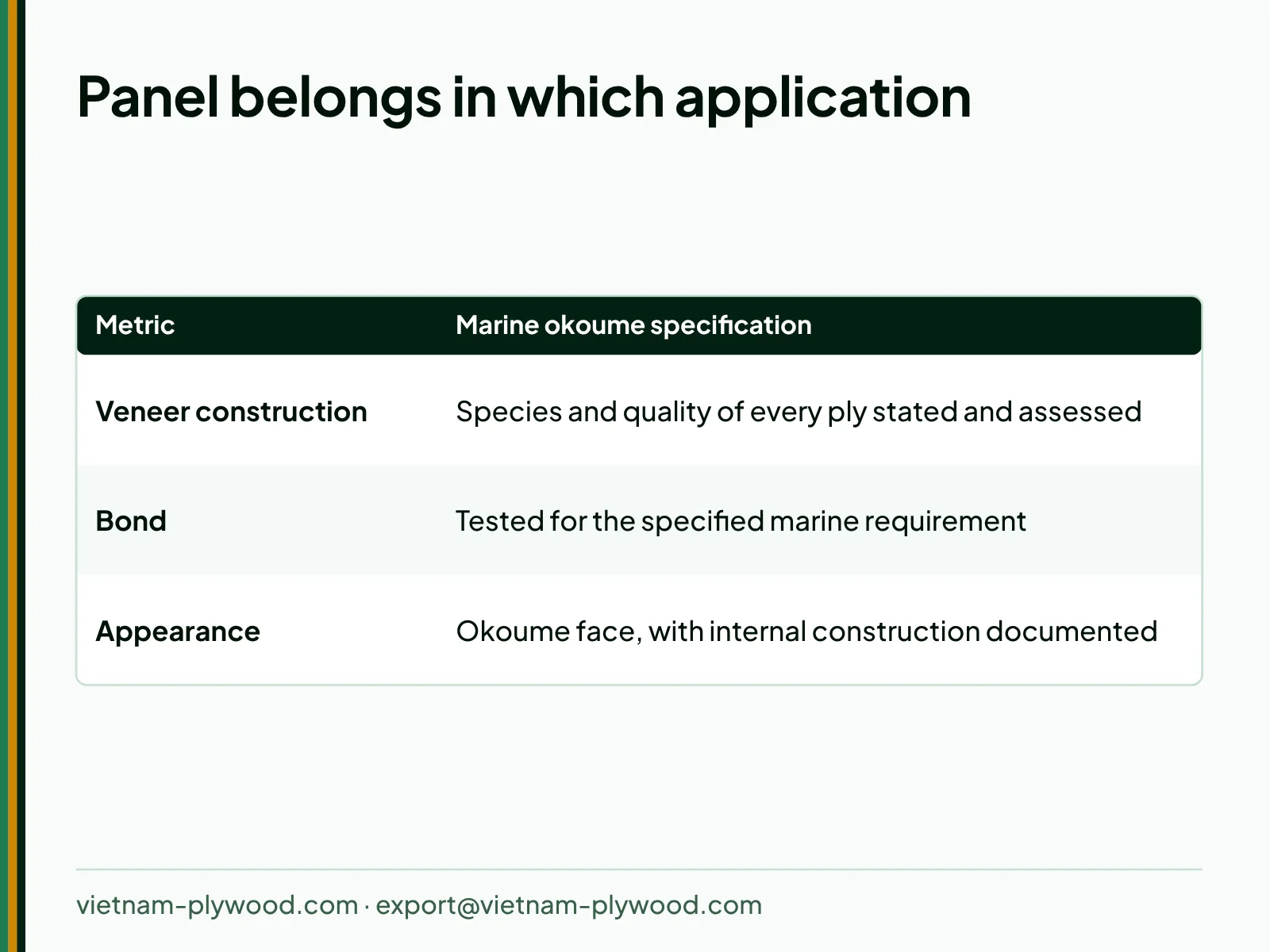
The decision starts with service exposure, required documentation and whether the panel carries a structural function. A marine label is a performance specification that needs evidence; a face description is an appearance specification.
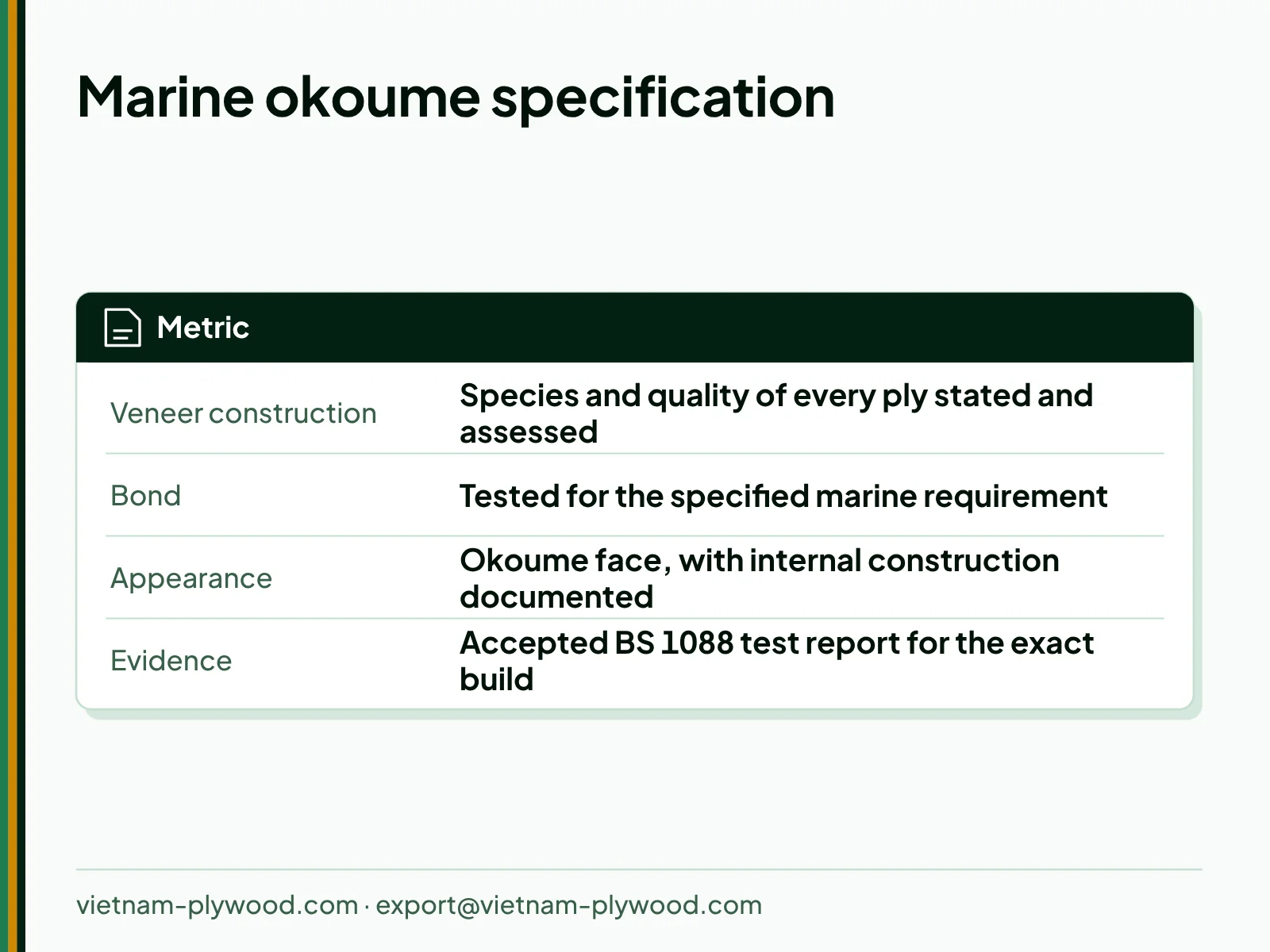
| Metric | Marine okoume specification | Okoume-faced furniture panel | Buying verdict |
|---|---|---|---|
| Veneer construction | Species and quality of every ply stated and assessed | Okoume outer face over specified styrax or eucalyptus core | Protected cabinetry: faced panel |
| Bond | Tested for the specified marine requirement | MR or specified WBP bond, separately identified | Persistent wet exposure: tested marine build |
| Appearance | Okoume face, with internal construction documented | Okoume face in A/B face grades | Decorative interior: faced panel |
| Evidence | Accepted BS 1088 test report for the exact build | Approved face, core, glue and emission specification | Marine contractual requirement: tested build |
| Moisture exposure | Designed against a marine specification, with edge protection still needed | Protected or intermittently damp service only after application review | Boat hull or continuously wet location: marine specification |
| Structural duty | Separate design properties and approval needed | No structural marine claim | Structural work: engineering review |
For building-site sheet goods rather than decorative faces, compare plywood supply for construction projects. The same nominal thickness can describe very different panels.
Is okoume face plywood suitable for marine applications?
Okoume-faced plywood can suit protected marine interiors when the buyer specifies the exposure, core, adhesive and finish. It should not replace a panel contractually required to meet BS 1088. Cabinet fronts in a sheltered cabin and exposed hull components impose different demands.
For marine fit-outs, identify where condensation, splashing, cleaning water and trapped moisture can reach the board. Specify sealing of faces, machined openings and cut edges as part of the assembly design. Ask the fabricator to document attachment methods and maintenance access, particularly near wet compartments.
If the project drawing calls for a marine standard, order against that requirement and an accepted test report. A decorative face alone cannot close the gap between a fit-out specification and a marine construction requirement.
Is okoume plywood waterproof?
Okoume wood itself is not waterproof. Water resistance comes from the complete panel build, the adhesive bond, edge treatment and the installed assembly. A water-resistant glue line does not prevent the wood from absorbing moisture through exposed surfaces and edges.
For HCPLY specifications, melamine MR glue has a 12-hour boil description; phenolic weather-and-boil-proof (WBP) glue has a 72-hour boil description. These are glue descriptions in the offered construction, rather than proof that the complete panel meets BS 1088. The emission class is recorded separately: E0, E1 or E2 is not an adhesive type.
Ask for a finished-panel bond test matched to the intended service. Seal freshly cut edges and avoid standing water against unprotected plywood. The British Standards Institution’s 2018 BS 1088 scope specifically addresses loss of bond strength with time and biological deterioration, while warning about rapid water ingress at panel edges. BSI’s standard overview explains that distinction.
What does BS 1088 require of a marine okoume panel?
BS 1088:2018 defines requirements for standard and lightweight marine plywood, including manufacturing and finished-panel requirements. It addresses veneer quality and defects, bond durability, biological deterioration, dimensions, marking and documentation. A supplier must substantiate the specified class and finished construction through evidence acceptable to the buyer.
The British Standards Institution published BS 1088:2018 in 2018. Its official scope states that it covers marine craft and other waterway applications, with building uses also considered. It does not replace every additional end-use regulation or engineering requirement.
Request the test-report scope, product identification, sample traceability, standard edition and class. Check that the report covers the same species configuration, glue and thickness family as the quoted material. An unrelated report or a glue-only boiling description cannot establish compliance for a different build.
HCPLY discusses a marine specification only against a test report the buyer accepts. We do not attach a marine claim to a decorative okoume face merely because the glue is WBP.
When is an okoume-faced WBP panel enough?
An okoume-faced panel with WBP glue is a reasonable specification for some protected joinery where the contract does not require BS 1088. It offers a decorative okoume surface with a more water-resistant bond choice, while the core and edge details still control suitability.
Consider enclosed furniture, removable access panels and non-structural fit-out pieces that receive occasional moisture. Require a finish system appropriate to the installation and an inspection plan for wet joints. Where water remains trapped, the finished assembly needs a different material decision or an explicitly tested marine build.
WBP describes the adhesive category, not the durability of every veneer or the panel’s fitness for a hull. Compare the actual build against the job drawing rather than treating WBP as a substitute for the marine standard.
How do our three production lines differ?
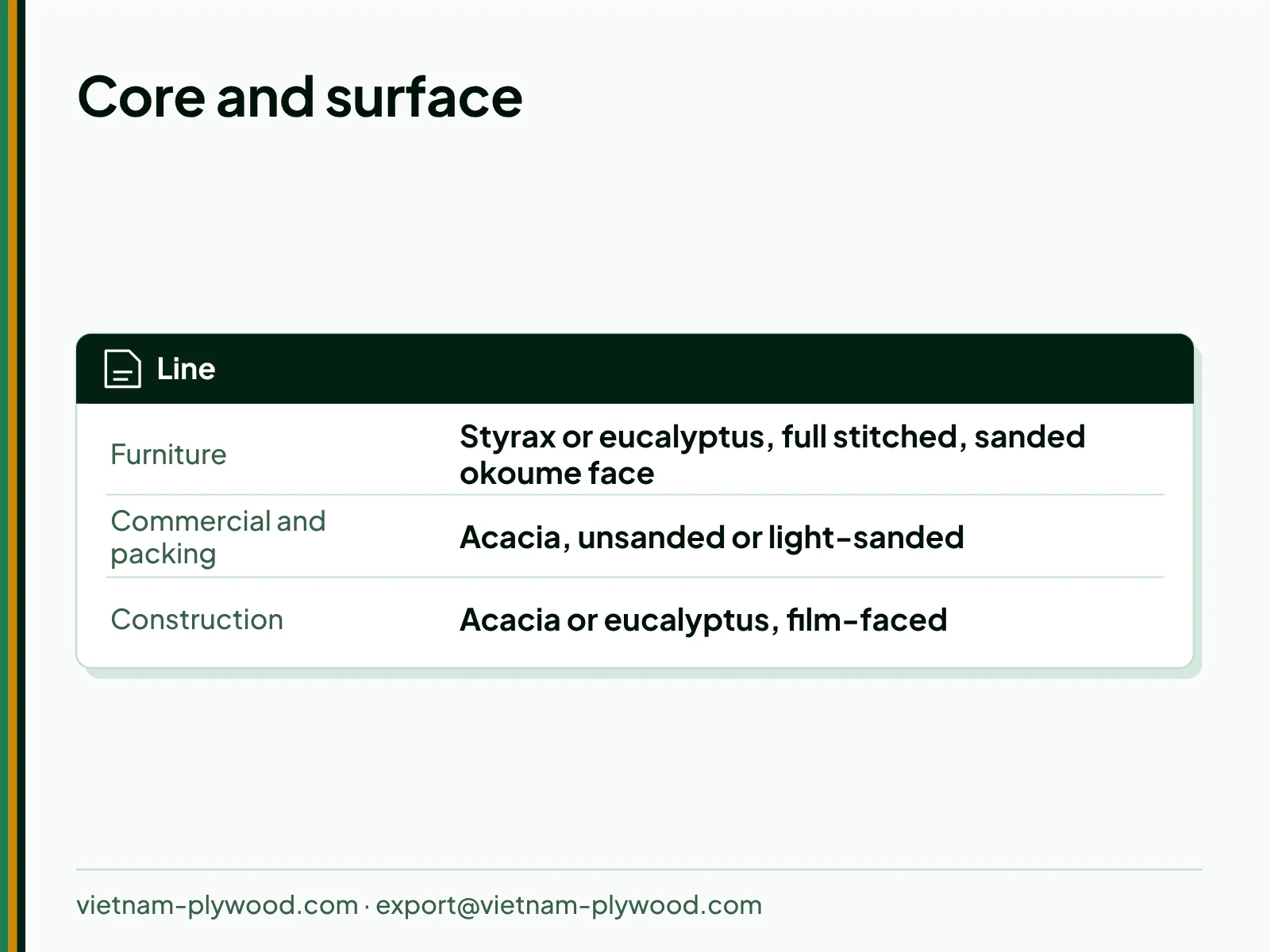
Our furniture line presses the sanded, full-stitched okoume-faced panel for interior joinery. Our commercial and packing line uses an acacia core with MR glue and unsanded or light-sanded faces. Our construction line builds film-faced sheets with acacia or eucalyptus cores for formwork, rather than okoume-faced decorative joinery.
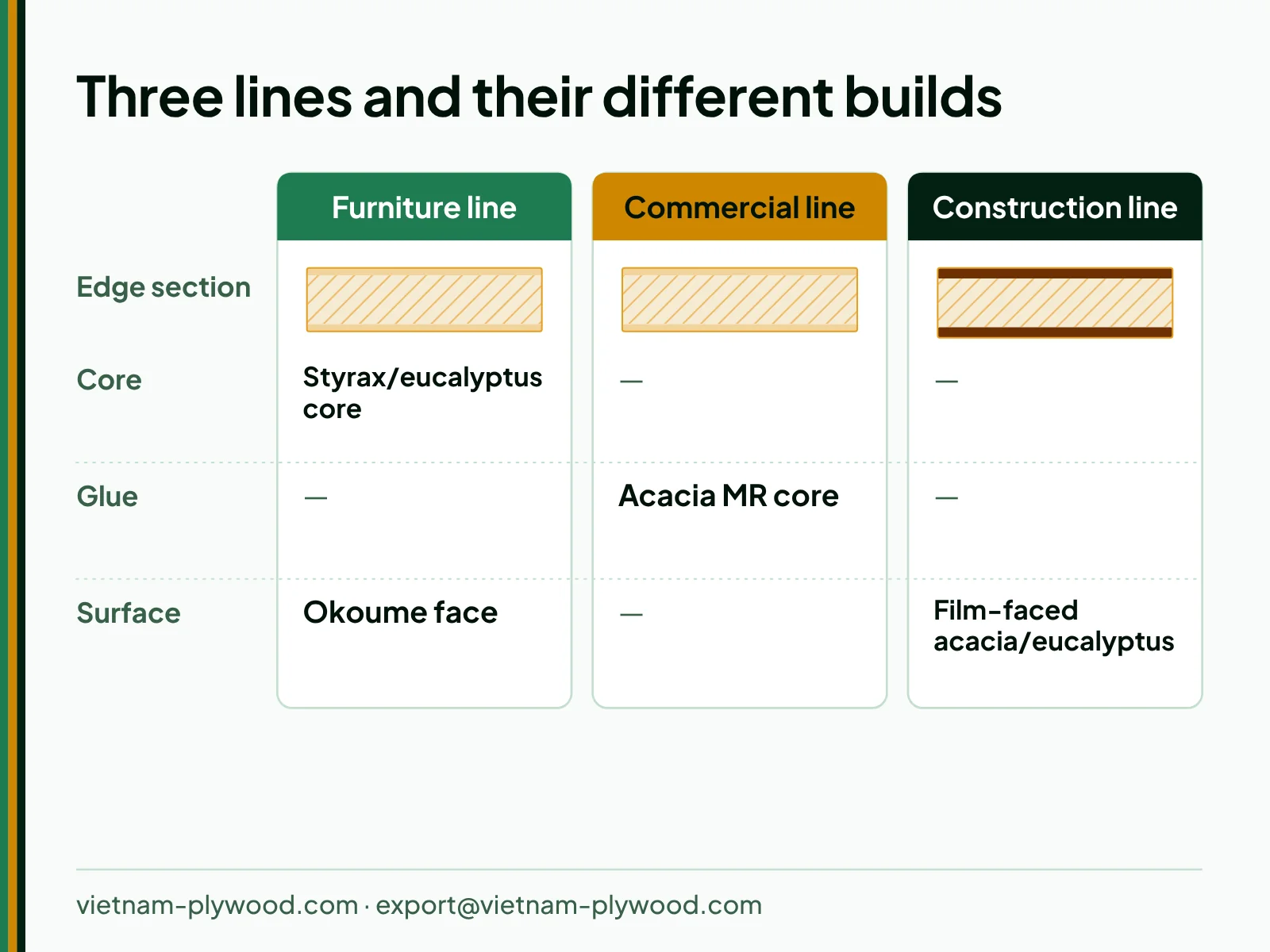
| Line | Core and surface | Typical glue or finish | What to inspect |
|---|---|---|---|
| Furniture | Styrax or eucalyptus, full stitched, sanded okoume face | E0/E1 emission specification; MR or ordered WBP bond | Face continuity, sanding and stitched core |
| Commercial and packing | Acacia, unsanded or light-sanded | MR glue | Core gaps and packing suitability |
| Construction | Acacia or eucalyptus, film-faced | Phenolic or melamine film | Film coverage, edge sealing and thickness |
The producing factory can show an inspector a cut cross-section, face grading and measured thickness against the approved specification. For a 18 mm furniture panel, the ply count is normally 11–13 because core veneers are 1.4–2.0 mm thick. A cross-section makes the difference between face species and core species visible.
See commercial and packing plywood for the alternative build and Vietnam plywood manufacturing for the wider production context.
How can I identify a misleading marine quote?
A marine quote must identify the complete construction and the evidence behind its claimed standard. Ask the seller to replace vague descriptions with measurable specifications before comparing unit prices.
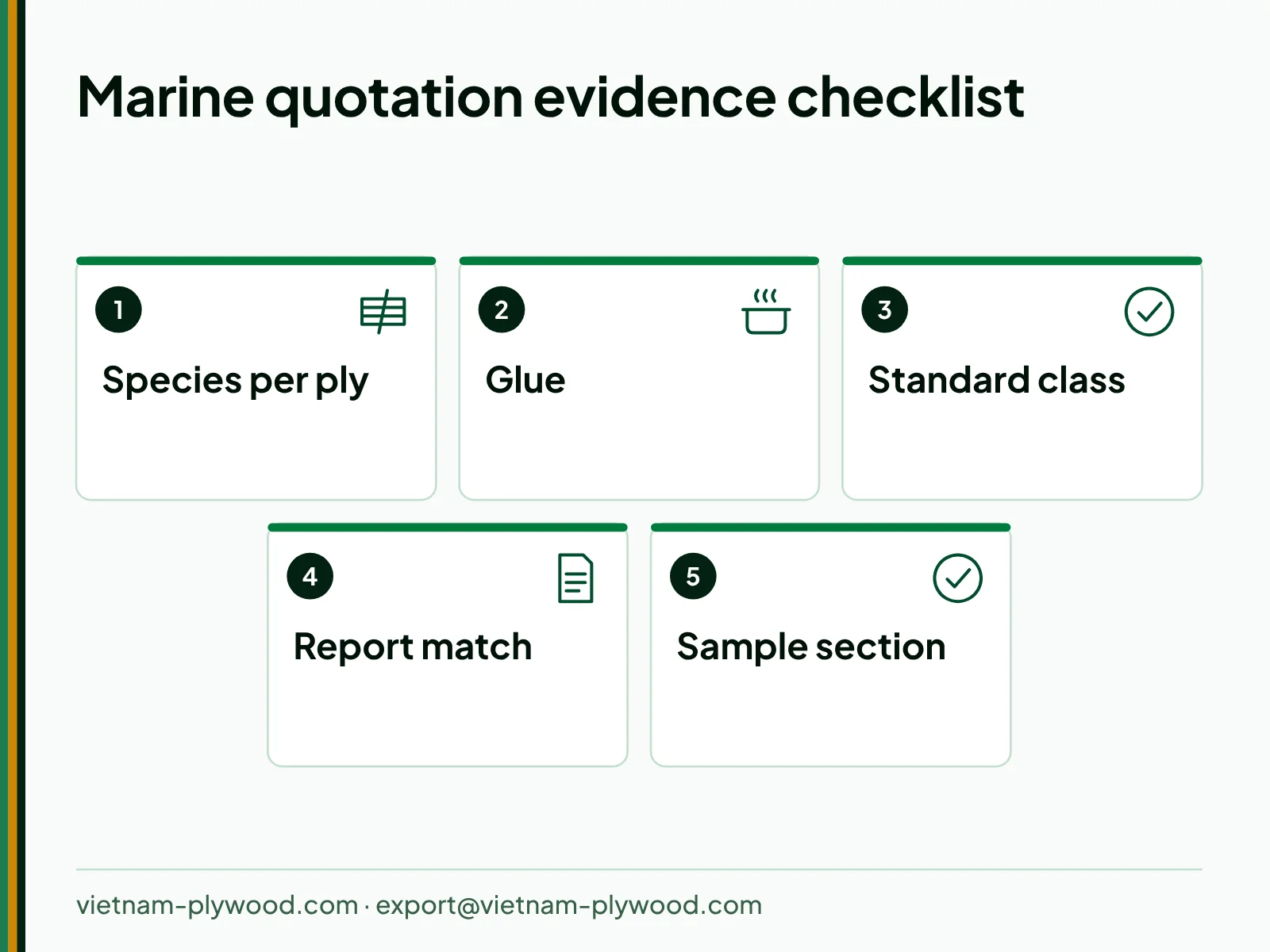
- Read the face description separately from the core species and lay-up.
- Record adhesive type and the finished-panel bond test requirement.
- State the BS 1088 edition and class only when the job requires them.
- Match the test report to the actual proposed build and shipment identification.
- Check thickness, face grade, dimensions and permitted tolerances in writing.
- Review sample cross-sections and edge details before the production lot is accepted.
The quote should state whether it offers all-okoume marine construction or an okoume face over a different core. A report covering another product cannot answer that question. For an HCPLY order, Lucy can arrange an inspection of the producing factory and its proposed build.
What changes in weight and container planning?
Core density, rather than the okoume face name, drives the shipping-weight estimate. HCPLY uses styrax at 500 kg/m³, acacia at 580 kg/m³ and eucalyptus at 650 kg/m³ for its respective core calculations.
At 18 mm and 1220 × 2440 mm, the lookup gives 26.79 kg per styrax-core sheet, 31.08 kg per acacia-core sheet and 34.83 kg per eucalyptus-core sheet. The corresponding full 40HC counts are 990, 880 and 795 sheets, with loads of 26.52 t, 27.35 t and 27.69 t respectively. The container payload limit is 28.5 t; film weight is excluded from these figures.
Specifications can be mixed in one container within the payload limit, so a buyer can combine an okoume-faced furniture order with suitable other sheets after checking pallet and weight allocation. The container-loading reference covers load planning in detail. These figures describe the named core calculations, not a tested all-okoume marine panel.
Which details control the purchase specification?
A useful order specification states face, core, adhesive, emission class and permitted dimensions separately. HCPLY offers 3–40 mm thicknesses, with common options of 3, 5, 9, 12, 15, 18, 21 and 25 mm. Common sheet sizes include 1220 × 2440 and 1250 × 2500 mm, with custom cutting available.
For sanded furniture panels, order a thickness tolerance of ±0.2 or ±0.3 mm; the length and width tolerance is ±2 mm. The common face veneer range is 0.2–0.4 mm, and okoume face grades are A/B. State the visible-face grade and whether both sides need the same appearance.
Ask the inspector to compare the sample with the finished stack, measure panels and examine cut edges for internal gaps. Where a marine claim is required, include the exact report and acceptance criteria in the purchase documents before pressing begins.
What should the export quotation and documents show?
The quotation should identify the producing line, the written panel build and the shipping term. HCPLY ships from the matching factory under FOB Hai Phong, CFR (CNF) or CIF arrangements. The minimum order is one 40HC, with mixed specifications possible within its payload limit.
Factory lead time runs 15–45 days from receipt of the 30% deposit; the exact figure depends on order size, line loading and what the contract fixes. The 70% balance is against the scanned bill of lading, by T/T or irrevocable L/C at sight. Free samples are available; new buyers book their courier, and that courier cost can be credited against a real order.
The shipment paperwork includes a commercial invoice, packing list, bill of lading, certificate of origin, phytosanitary and fumigation papers, and insurance under CIF. EU lots add EUR.1 where applicable and the EUTR/EUDR file set; the agreed build can also carry its relevant emission certificate, test reports or FSC claim on sales documents. Member-factory certificates are shown with factory details masked, on request. After loading, the draft shipping documents come to you for approval.
A decorative okoume-faced furniture panel has an indicative starting price of from US$350/m³ FOB Hai Phong (October 2026). A marine-tested construction requires a separate quotation based on the veneer build, bond specification, inspection scope and accepted report; a full marine build will typically cost more than a decorative face over a different core because its material selection and testing obligations are tighter.
What should the buyer send for a sample set?
Send a written specification that makes the intended use and the panel construction explicit. For protected furniture, identify the decorative face and required WBP bond; for a contractual marine requirement, name the accepted report and applicable standard class. The contact page connects the specification with Lucy at export@vietnam-plywood.com.
Application: protected cabin furniture / specified marine duty
Line or core: furniture; styrax or eucalyptus / marine build for report review
Glue: MR or phenolic WBP; required finished-panel test
Emission: E0 or E1, stated separately
Face and grade: okoume, A/B; reverse face requirement
Thickness and tolerance: 18 mm; ±0.2 or ±0.3 mm as ordered
Size: 1220 × 2440 mm; length/width ±2 mm
Quantity: one 40HC minimum; list any mixed specifications
Destination port: [port and country]
Marine requirement if applicable: BS 1088:2018 class and accepted report
Ask Lucy for a sample set matched to that specification.