





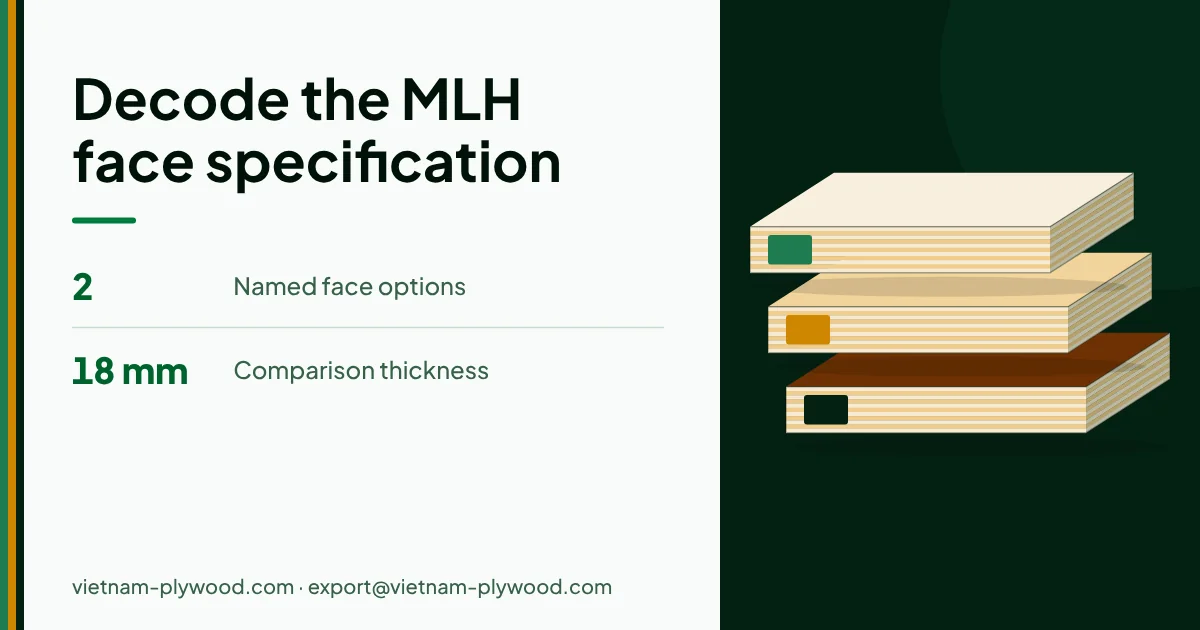
MLH plywood describes mixed light hardwood commercial panels whose face species needs to be named in the purchase specification. Choosing by red color alone can lead to rejected face appearance, rework and costly order delays. HCPLY quotes bintangor or okoume faces on an acacia-core commercial build so importers can compare actual specifications.
What is MLH plywood?
MLH plywood is a commercial plywood description using “mixed light hardwood” to identify a broad material category rather than a single botanical face species. In an import quotation, the abbreviation alone does not settle the face veneer, core species, bond, emission class or surface finish. Buyers should convert that shorthand into a written panel build before comparing offers.
A reddish face sample can look acceptable at quotation stage while concealing differences in core construction, grading or adhesive. For a wider overview of plywood types, begin with the intended use and then specify each layer.
What does mixed light hardwood mean in a quote?
“Mixed light hardwood” usually functions as a broad commercial description, not a species certificate or a fixed density grade. Ask the seller to identify the face and back separately from the core, because a mixed-species description can conceal changes that matter to finishing and machining.
A useful quotation names the visible veneer, its grade, the core species, the core lay-up and the glue system. It also distinguishes nominal thickness from the finished thickness tolerance. In our range, core density follows the core species rather than the decorative face: acacia is 580 kg/m³, styrax 500 kg/m³ and eucalyptus 650 kg/m³.
See the Vietnam plywood classification and hardwood plywood guide.
What is red face plywood?
Red face plywood is a visual trade description for panels with reddish-looking face veneers. The color does not identify a single species, glue class, grade or end use. Bintangor and okoume are named face choices that can be compared against a buyer’s red-face reference.
For a repeatable order, specify whether the approved sample controls hue, grain, repairs and visible patches. Natural veneer color can differ across logs, so a written acceptance sample is more useful than the word “red” alone.
Is MLH plywood the same as meranti?
MLH plywood and meranti are not interchangeable species descriptions. MLH is a broad trade label, whereas meranti identifies a timber grouping used in veneer trade. A red appearance by itself cannot establish that a sheet has a meranti face.
For import classification, the actual species and outer ply matter. The U.S. International Trade Commission’s 2026 investigation notice defines face and back veneers as the outermost wood veneers and distinguishes them from the core (USITC, 2026). Request the species description used on the commercial documents instead of translating a color nickname into a customs declaration.
How does MLH compare with bintangor-faced plywood?
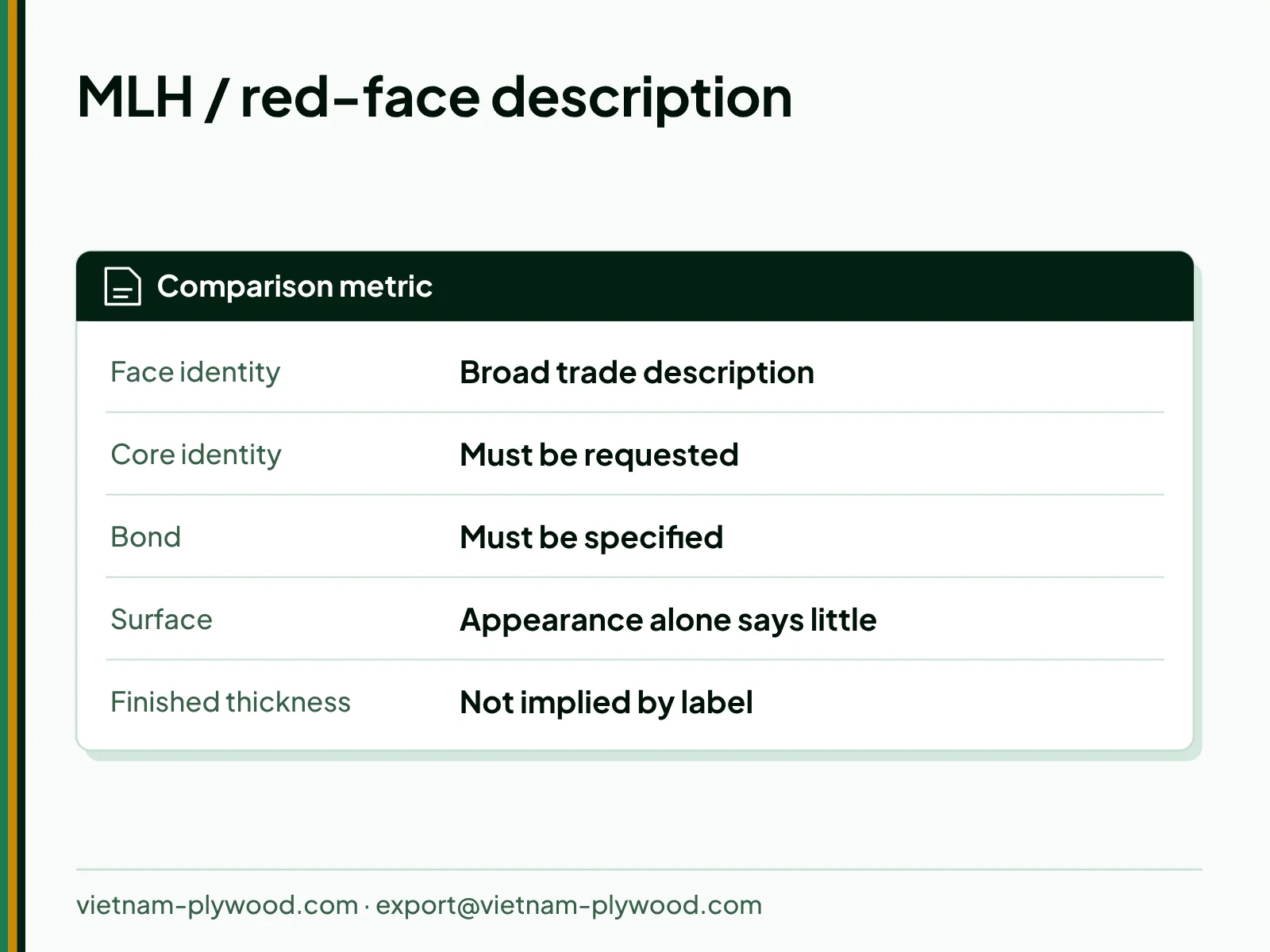
A bintangor-faced quote gives the buyer a named visible veneer, while “MLH” alone leaves that field open. Compare both offers at the same thickness, core, glue and grading before judging their fit for a cabinet back, shop fitting or distributor stock.
| Comparison metric | MLH / red-face description | Named bintangor-face build | Buying verdict |
|---|---|---|---|
| Face identity | Broad trade description | Bintangor stated | Named face for repeat appearance |
| Core identity | Must be requested | Acacia core stated on commercial build | Match core before comparing weight |
| Bond | Must be specified | MR glue on commercial line | Match glue to exposure |
| Surface | Appearance alone says little | Unsanded or light-sanded commercial finish | Review a physical sample for visible fit-out work |
| Finished thickness | Not implied by label | Commercial tolerance ±0.5 mm | Specify finished tolerance for assembly |
For higher-visibility cabinet faces, the furniture plywood manufacturing range offers a different core construction and sanding route.
Which face and production line do we quote?
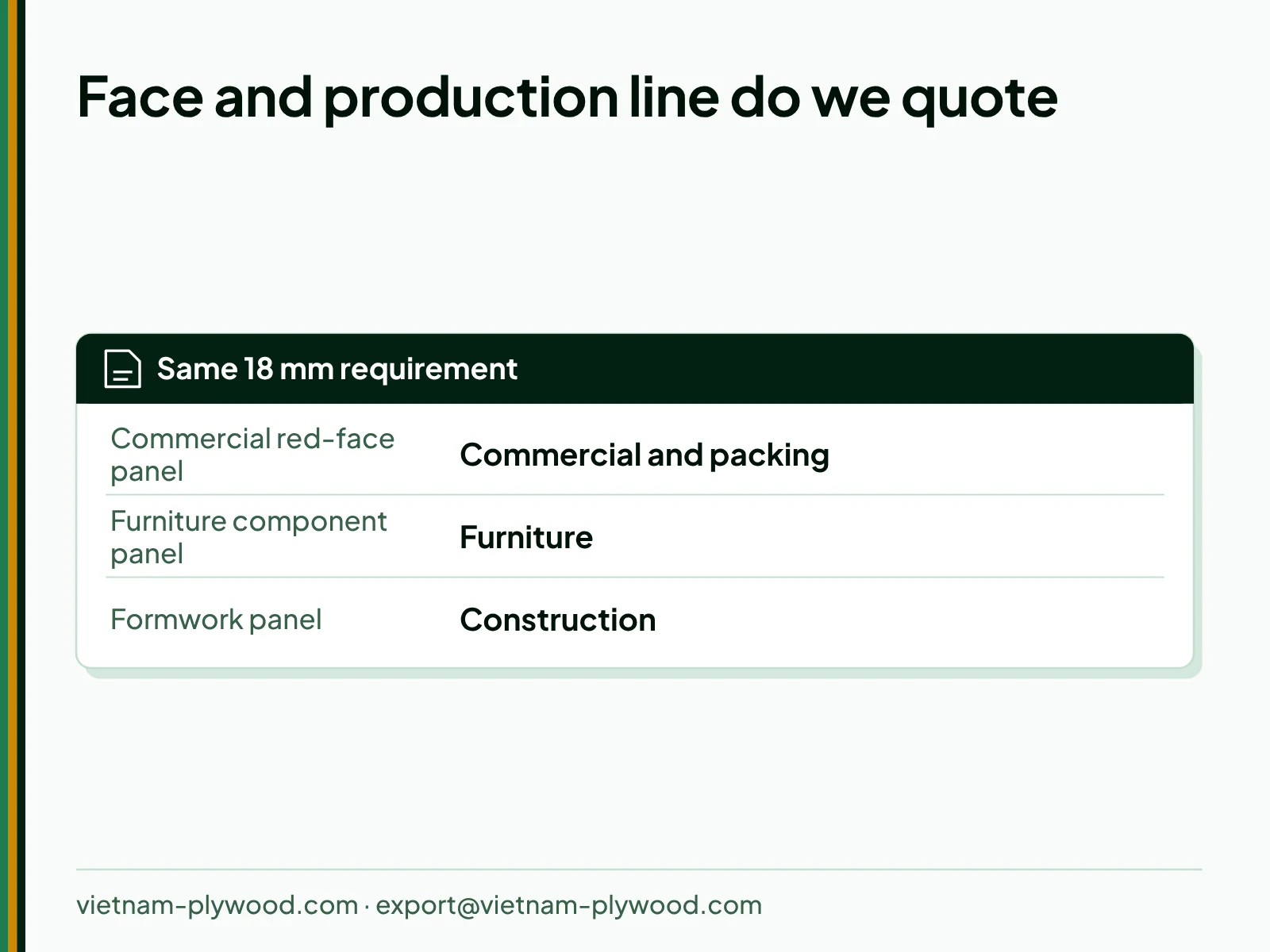
Our commercial and packing line quotes bintangor or okoume against an MLH-type red-face enquiry, with an acacia core, moisture-resistant (MR) glue and an unsanded or light-sanded surface. Our furniture line instead builds a full-stitched, sanded styrax- or eucalyptus-core panel with E0 or E1 emission specification. Our construction line presses film-faced acacia- or eucalyptus-core panels for formwork uses.
| Same 18 mm requirement | Producing line | Core and face route | Thickness tolerance | Appropriate use |
|---|---|---|---|---|
| Commercial red-face panel | Commercial and packing | Acacia, bintangor or okoume face | ±0.5 mm | Distributor commercial stock |
| Furniture component panel | Furniture | Styrax or eucalyptus, selected veneer face, sanded | ±0.2 or ±0.3 mm as ordered | Cabinet and furniture fabrication |
| Formwork panel | Construction | Acacia or eucalyptus, film surface | ±0.5 mm | Concrete formwork |
We allocate production to the producing factory according to the agreed specification. Read the several plywood types supply approach for orders covering distinct applications.
Which construction details should a buyer lock?
Core construction controls internal continuity even when two faces look similar. The available build hierarchy runs from full stitched, to stitched outer layers with edge-trimmed inner veneers, to finger-jointed, then loose-laid. A buyer seeking predictable cut edges should state the accepted lay-up rather than rely on a face grade.
The commercial line uses acacia core and MR glue. Glue and emission class belong in separate quotation fields: MR describes the bonding system, while E0, E1 and E2 describe emission classes. Melamine MR glue has a 12-hour boil designation in the available specification; phenolic weather-and-boil-proof (WBP) glue has a 72-hour boil designation. Neither wording substitutes for an agreed test report.
Face veneer commonly measures 0.2–0.4 mm; face grades A/B are available. Specify which face is the show side and which defects are acceptable on the reverse. A 18 mm panel normally contains 11–13 plies because core veneer thickness is 1.4–2.0 mm.
Which sizes and tolerances belong on the purchase order?
State the finished thickness, size, tolerance and application on the same line of the order. We offer thicknesses from 3–40 mm, with common choices of 3, 5, 9, 12, 15, 18, 21 and 25 mm. Standard formats include 1220×2440, 1250×2500 and 1220×2135 mm; custom cutting is available.
Commercial panels use ±0.5 mm thickness tolerance and ±2 mm length and width tolerance. Packing panels have a different thickness allowance of ±0.5–1.0 mm. That distinction matters if a red-face commercial sheet and packing sheet are quoted together: do not copy the packing tolerance onto cabinet components.
For a finished decorative surface, compare the finishing route with UV-coated plywood applications. UV coating is a separate topic from the raw or light-sanded MLH-style commercial face.
Can commercial, packing and film-faced panels share a container?
Yes. Specifications can be mixed in one 40HC container within its 28.5 t payload limit. The practical calculation starts with each panel’s core density, sheet dimensions and pallet count, then adds the planned tonnes across products.
At 18 mm and 1220×2440 mm, an acacia sheet weighs 31.08 kg. A full acacia-only load is 880 sheets, 47.15 m³ and 27.35 t. The same-size eucalyptus-core sheet weighs 34.83 kg, and its full-load reference is 795 sheets, 42.60 m³ and 27.69 t. These reference weights exclude film weight.
For a mixed load, list commercial, packing and film-faced pallets separately, then obtain the actual gross weights including film, pallets and protection. Compare the combined loading plan against the 28.5 t payload limit before confirming the container mix. The container packing calculation covers complete sheet counts and loading rules.
We can coordinate commercial, packing and film-faced specifications for a combined shipment. The distributor supply programme explains how to organize repeat stock requirements.
What can the buyer inspect at the producing factory?
The inspector can compare the approved red-face reference against the actual face veneer and check core construction at a cut edge. At the producing factory, the buyer can witness thickness measurements, panel dimensions, visible veneer defects and the pallet labels against the purchase order.
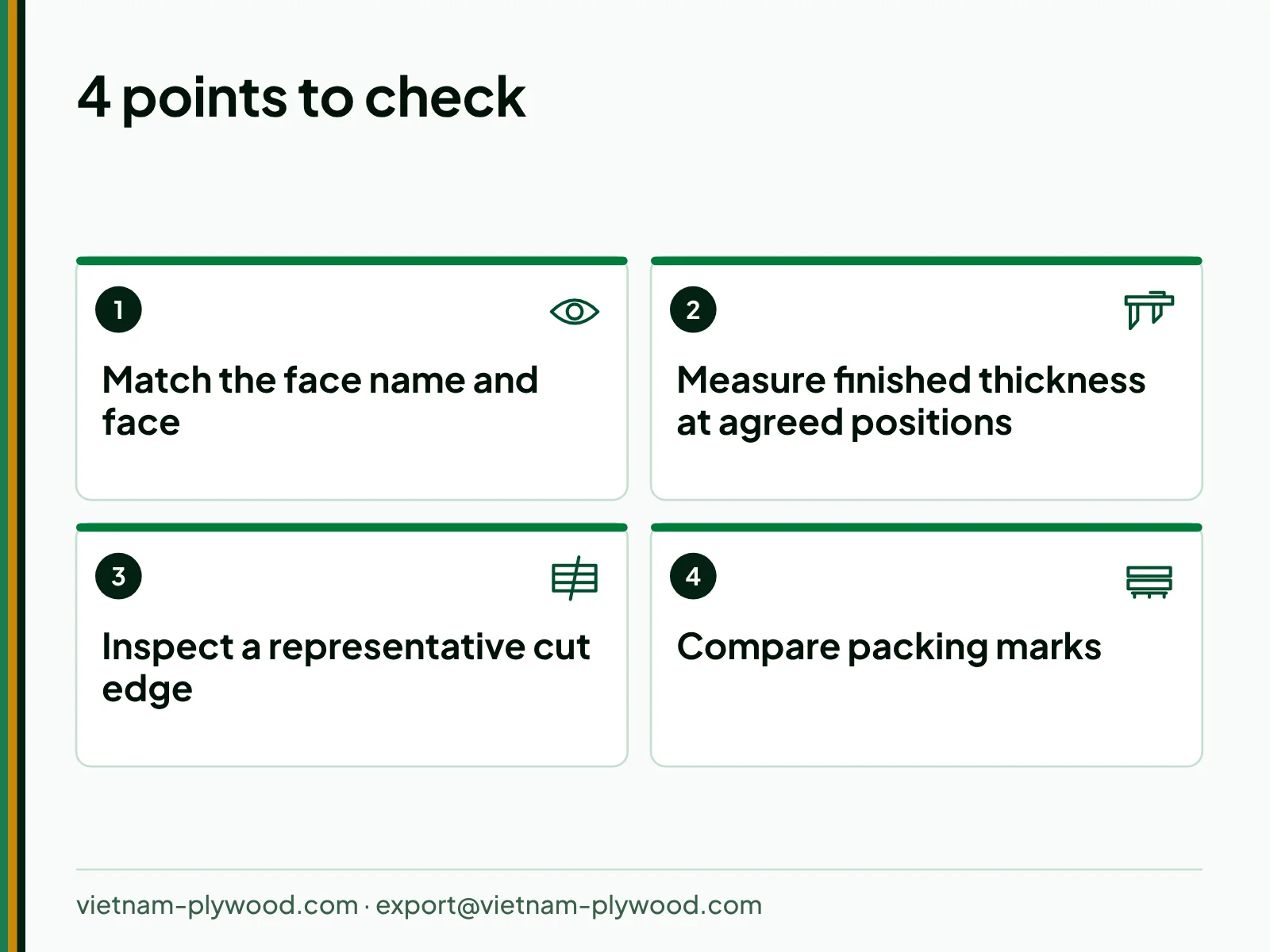
- Match the face name and face grade to the approved sample under consistent lighting.
- Measure finished thickness at agreed positions and compare with the commercial tolerance.
- Inspect a representative cut edge for gaps, overlaps and the specified core lay-up.
- Compare packing marks, pallet counts and order identification before loading.
Buyers visit the factory office and inspect goods where the panels are produced. We coordinate on-site quality control and loading, with draft shipping documents sent for buyer approval after loading.
How should the export quote and documents describe MLH?
The invoice and packing list should name the agreed face, core, glue, thickness and quantities. The shipment document set also includes the bill of lading and certificate of origin; other papers follow the destination and order specification.
We offer FOB Hai Phong, CFR (CNF) or CIF terms. The minimum order is one 40HC, with mixed specifications allowed inside the payload limit. Commercial plywood starts from US$250/m³ FOB Hai Phong (October 2026); actual quotations reflect face choice, core lay-up, thickness, surface finish, quantity and agreed documentation. A more selective face grade and tighter construction cost more than a simpler commercial build because they require greater veneer selection and processing.
Factory lead time runs 15–45 days from receipt of the 30% deposit; the exact figure depends on order size, line loading and what the contract fixes. The remaining 70% is paid on the scan of the bill of lading, by T/T, or by irrevocable sight L/C. Factory-held FSC, CARB P2, ISO 9001, CE and EUDR/EUTR documents are shown with factory details masked, on request; their applicability follows the producing factory and agreed order.
What specification should you send for a sample?
Include a reference sample or photographs showing the acceptable color range and repairs. State the intended market, especially when a Gulf, Indian or Philippine distributor needs consistent product naming across purchase orders.
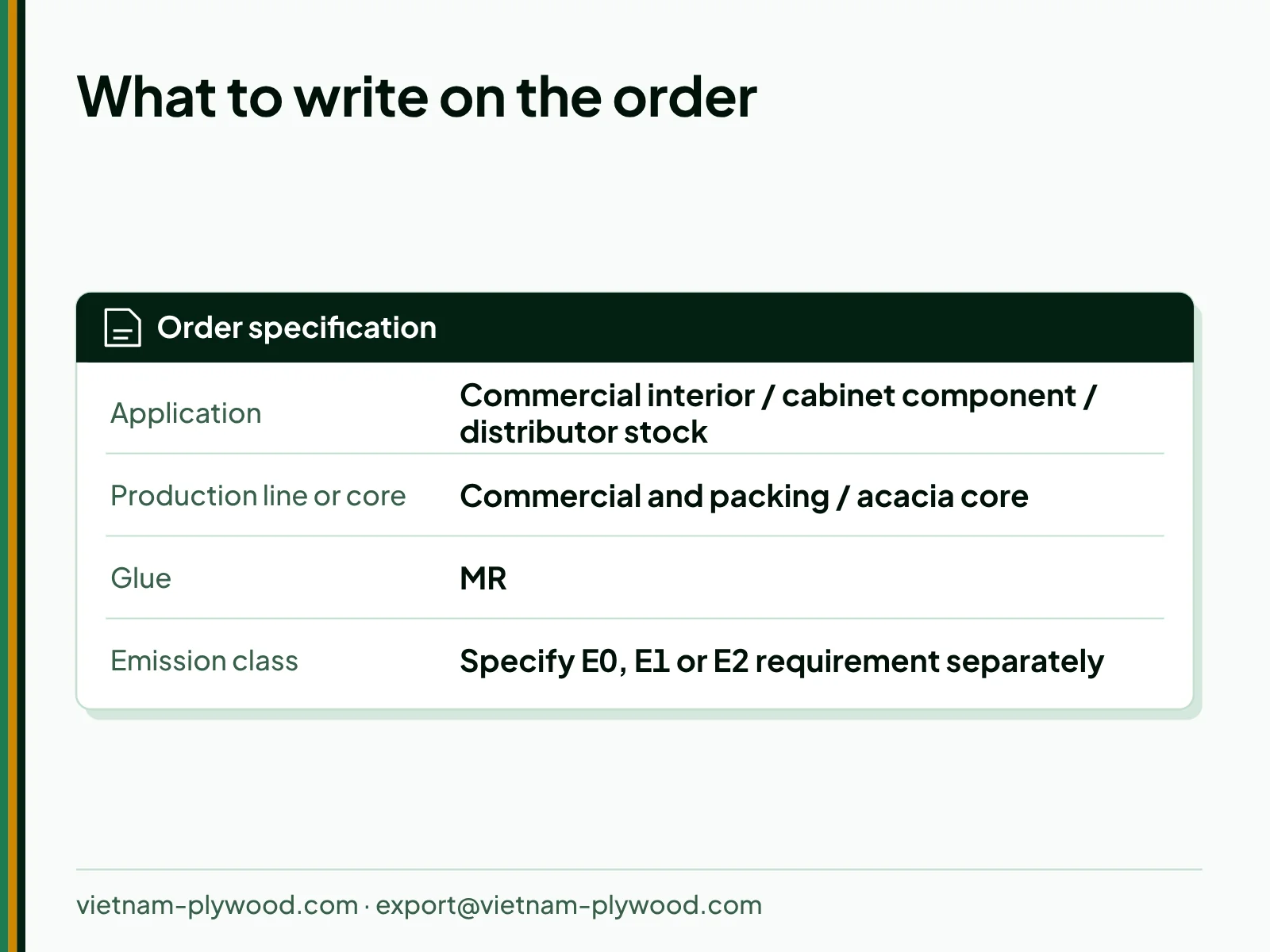
Use the contact page to send the following fields to Lucy at export@vietnam-plywood.com. Free samples are available; a first-time buyer pays the courier, and that charge comes off the first confirmed order.
Application: commercial interior / cabinet component / distributor stock
Production line or core: commercial and packing / acacia core
Glue: MR
Emission class: specify E0, E1 or E2 requirement separately
Face and grade: bintangor or okoume; A/B; approved red-face sample
Thickness and tolerance: 18 mm; ±0.5 mm
Sheet size: 1220 × 2440 mm; length/width ±2 mm
Quantity: sheets and 40HC mix by specification
Destination port: [named discharge port]
Ask for a sample set of bintangor- and okoume-faced commercial panels against this specification.