





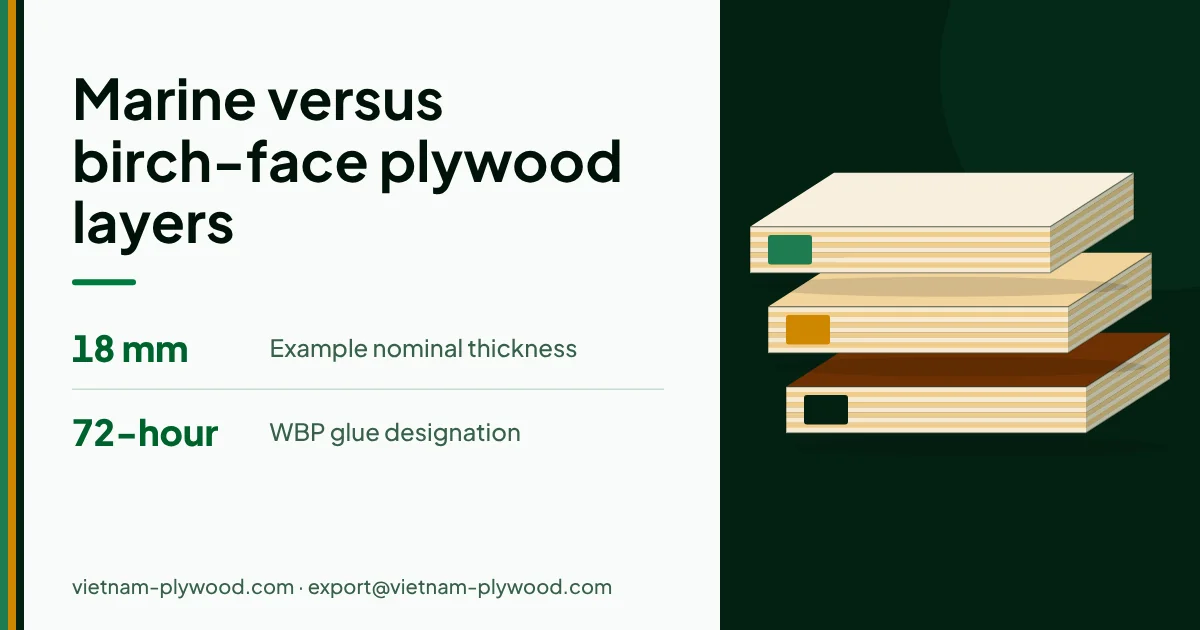
HCPLY’s WBP birch-face plywood is a furniture-line panel; a marine designation requires an accepted test report for the specified construction and marine requirements. Choosing by face appearance or glue label alone can mean rejected goods, replacement panels and delayed installation. The marine plywood vs birch plywood decision starts with exposure, core species and documentary evidence.
Marine plywood vs birch plywood: what is the difference?
Marine plywood names a construction evaluated against marine requirements and an accepted test report; birch plywood names a wood veneer or visible face. Either category can overlap, but neither label establishes the other. Compare the full veneer stack, bond, core gaps and accepted testing before choosing a panel.
The British Standards Institution’s BS 1088:2018 describes standard and lightweight classes of marine plywood for marine craft and waterways. Its scope addresses biological deterioration and bond-strength loss over time; it does not establish every end-use property. See the BSI marine plywood requirements.
How do the three builds compare by metric and use?
The deciding metrics are core composition, bond, wet exposure and the evidence attached to the order. This comparison distinguishes an all-birch panel evaluated against an accepted marine test report from the birch-face furniture panels our furniture line presses.
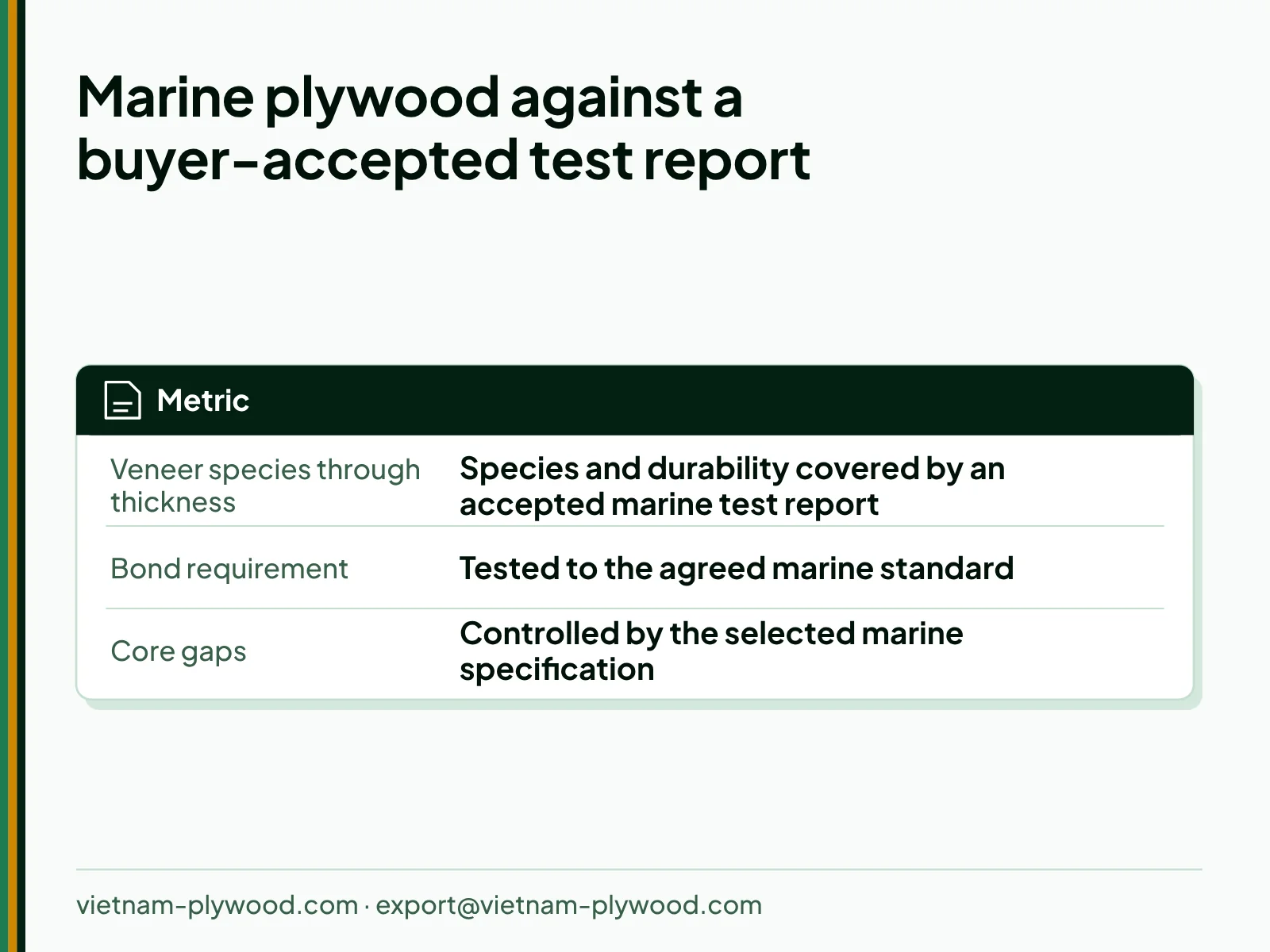
| Metric | Marine plywood against a buyer-accepted test report | All-birch / Baltic birch panel | HCPLY WBP birch-face furniture panel (marine claim only against a buyer-accepted test report) | Verdict by use |
|---|---|---|---|---|
| Veneer species through thickness | Species and durability covered by an accepted marine test report | Birch throughout when genuinely all-birch | Birch face; styrax or eucalyptus core | Boat work: marine build with accepted test report; visible interiors: our furniture build |
| Bond requirement | Tested to the agreed marine standard | Interior or exterior bond must be specified | Phenolic WBP, 72-hour boil process designation | WBP helps protected humid interiors; marine needs additional evidence |
| Core gaps | Controlled by the selected marine specification | Examine internal gaps and repairs | Full stitched furniture core | Inspect sections for either procurement route |
| Face appearance | Face grade set by marine specification | Pale, consistent birch veneer | Birch face grades D/E/F | Furniture-face appearance: select to approved sample |
| Moisture exposure | Wet service within design and coating requirements | Bond and finish govern suitability | Protected interiors with suitable sealing | Exposed marine service: procure tested marine build |
| Thickness tolerance | Per marine purchase specification and accepted test report | Per supplier’s documented schedule | Sanded ±0.2 or ±0.3 mm as ordered | Precision interior joinery: our furniture line |
| Structural values | Obtain design values and test evidence | Obtain relevant design values | No structural grade offered | Load-bearing marine parts: engineered, documented panel |
| Procurement evidence | Accepted marine report and traceable specification | Species schedule and bond report | Written core, face, glue and QC record | Do not accept a trade name alone |
Is birch plywood a marine plywood?
Birch plywood becomes a marine candidate only when its entire construction and documented performance satisfy the buyer’s marine requirement. Birch veneer can be used on a furniture panel without turning that panel into a marine product. Likewise, an exterior bond alone does not establish the durability of the timber layers.
The birch plywood Vietnam product overview explains the face-led product name. For an all-birch request, ask the seller for a ply-by-ply species schedule, permitted core defects, bond classification and the actual report covering the specified build.
What is marine birch plywood, including Baltic birch marine plywood?
Marine birch plywood is a birch-veneer construction assessed for marine service, rather than a decorative birch face with an unspecified core.
The phrase baltic birch marine plywood combines a geographic or commercial material description with a performance claim. Ask whether every ply is birch, what the adhesive classification is, and which marine standard the actual panel has been tested against.
Our factories do not press birch-core plywood. Buyers comparing alternative constructions can use birch or Baltic birch plywood and the Vietnam alternative to Russian birch for adjacent sourcing decisions.
Can WBP-glued birch-face plywood be sold as marine plywood?
Our WBP birch-face panel should be described as birch-face, phenolic WBP, styrax- or eucalyptus-core furniture plywood. A marine claim, including BS 1088, requires a test report the buyer accepts for that exact build.
In our production vocabulary, WBP means weather and boil proof with a 72-hour boil designation; MR is melamine glue with a 12-hour boil designation. Emission class is separate: E0 or E1 is specified independently of glue. A WBP panel can therefore be ordered with an emission class without confusing emissions with moisture performance.
Which factory line presses which construction?
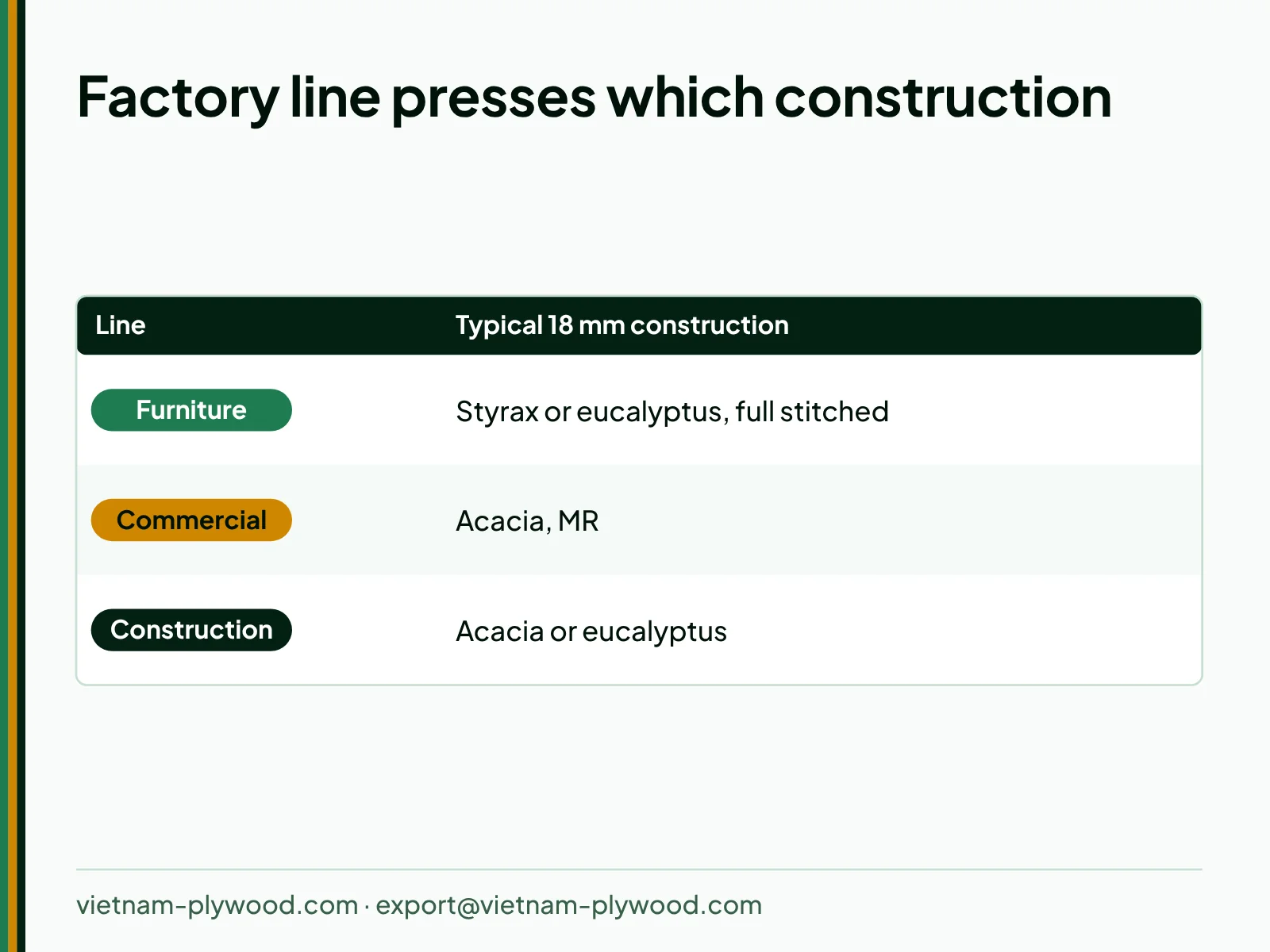
Our furniture line presses birch-face panels with styrax or eucalyptus cores, full stitched construction and sanded faces. The commercial and packing line instead presses acacia-core MR panels, while our construction line presses film-faced acacia- or eucalyptus-core panels.
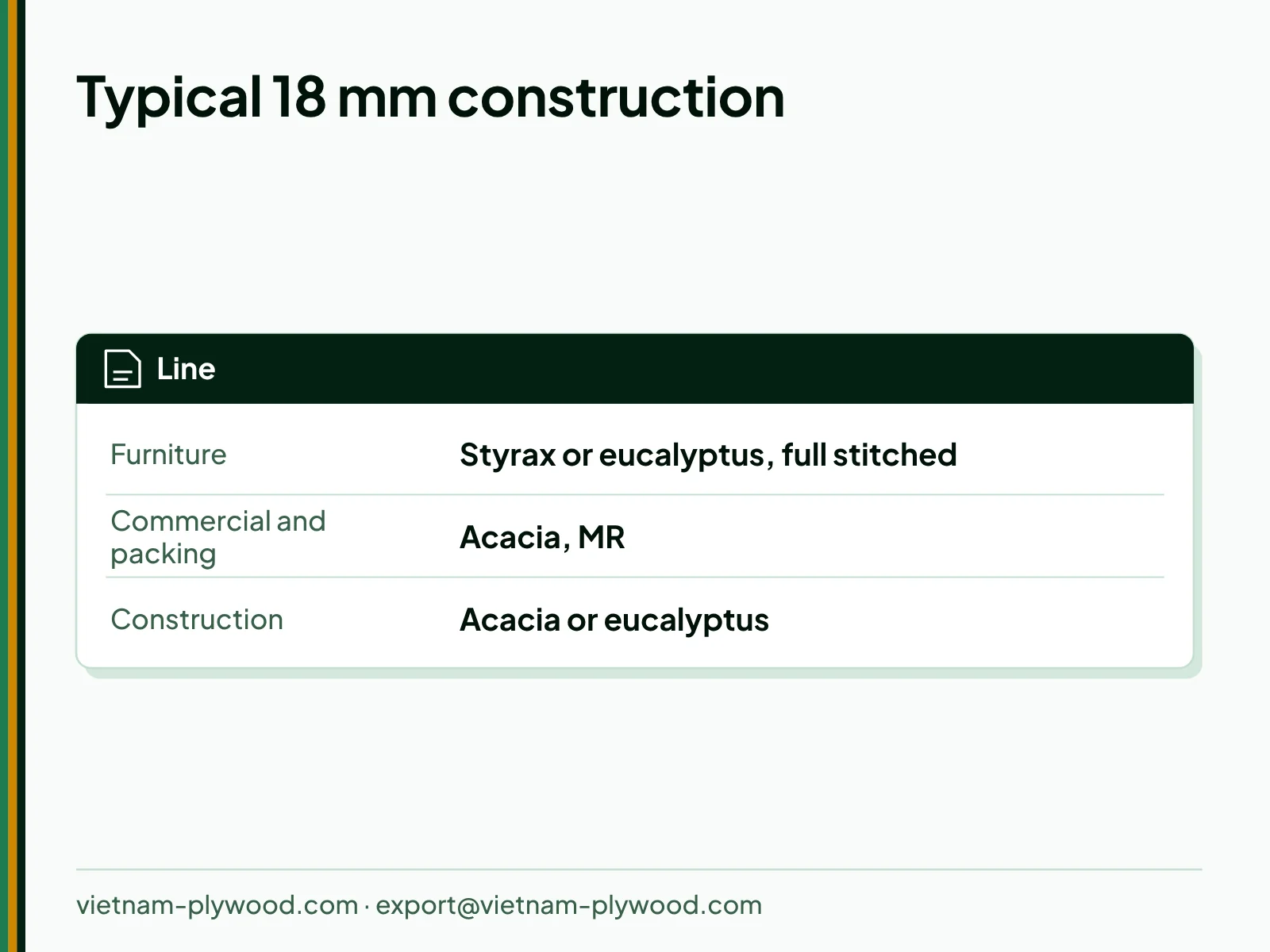
| Line | Typical 18 mm construction | Face and finish | Appropriate purchase purpose |
|---|---|---|---|
| Furniture | Styrax or eucalyptus, full stitched | Birch face, sanded | Cabinets, drawer fronts, protected fit-out |
| Commercial and packing | Acacia, MR | Unfaced or commercial veneer, unsanded or light-sanded | Packaging and general commercial parts |
| Construction | Acacia or eucalyptus | Phenolic or melamine film, unsanded | Formwork and jobsite panels |
See grades across factory lines for specification language used when comparing those builds.
What can an inspector witness at the producing factory?
An inspector can compare the approved face sample, measured thickness and exposed panel section with the order. At the producing factory, the buyer can inspect a representative cut edge for veneer continuity and core construction, then match the glue and emission records to the written specification.
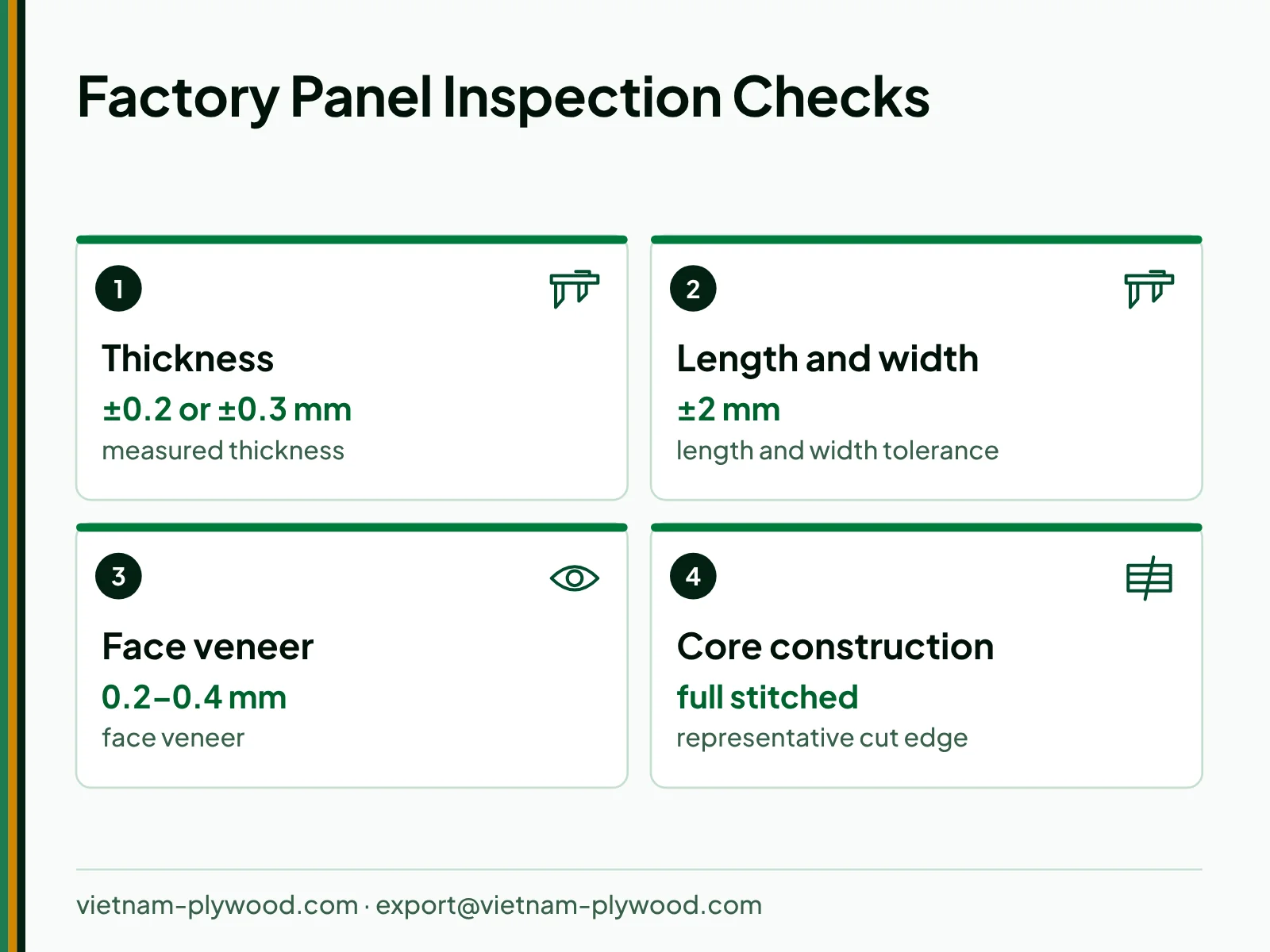
For a sanded furniture panel, order ±0.2 or ±0.3 mm thickness tolerance; length and width tolerance is ±2 mm. Our furniture core is full stitched, and the face veneer commonly measures 0.2–0.4 mm.
Buyers visit the factory office and inspect goods at the producing factory. HCPLY handles the specification, on-site QC, shipping documents and loading. The relevant order test report and emission certificate belong in the shipment’s document package; member-factory FSC, CARB P2, ISO 9001 and CE documents are shown with factory details masked, on request.
Can a birch-face order share a container with other builds?
A birch-face furniture order can share a 40HC with other specifications within the 28.5 t payload limit. The core species drives the weight calculation, even where both orders show a birch face. For 18 mm, 1220 × 2440 mm sheets, the computed full-container references are 990 styrax-core sheets at 26.52 t, 880 acacia-core sheets at 27.35 t, and 795 eucalyptus-core sheets at 27.69 t.
The mixed-container specification covers compatible purchase lines; the container loading reference owns the detailed sheet-count calculation.
Which jobs require marine plywood and which accept WBP birch face?
Choose tested marine plywood where the design or purchase specification demands marine performance. A WBP birch-face furniture build is an option for protected interiors where appearance, machining and a documented phenolic bond matter more than marine classification.
| Application and exposure | Buying verdict | Inspection priority |
|---|---|---|
| Boat hull or wet marine component | Marine plywood against accepted test report | Marine standard, bond, species and design properties |
| Open-air dock or exposed cabinet | Specify tested outdoor/marine build for the actual exposure | Edges, finish system and durability evidence |
| Interior coastal cabinet away from direct wetting | Consider WBP birch-face furniture plywood | Sealed edges, finish and approved sample |
| Dry interior drawer or fit-out | Birch-face furniture panel; MR or WBP as ordered | Flatness, face appearance and emission class |
| Structural platform | Obtain independently supported structural specification | Design values and accepted testing |
Specify the coating and edge-sealing procedure, including drilled holes and field cuts, for the actual exposure.
What changes the price and the procurement decision?
Full birch plies, stricter veneer selection, defect limits and marine test documentation add cost to the marine specification.
HCPLY quotes the birch-face build against a written specification, without a marine-grade price figure. Furniture plywood has an indicative starting price from US$350/m³ FOB Hai Phong (October 2026); that is the category starting point, not a price for this particular WBP birch-face grade. A commercial plywood alternative starts from US$250/m³ FOB Hai Phong (October 2026), with a different core and intended use.
Minimum order is one 40HC, with specifications mixed within the payload limit. Factory lead time runs 15–45 days from receipt of the 30% deposit; the exact figure depends on order size, line loading and what the contract fixes. The remaining 70% is paid on the scan of the bill of lading, by T/T, or by irrevocable sight L/C; delivery can be FOB Hai Phong, CFR (CNF) or CIF. Free samples are available; new buyers book their courier, and that cost can be credited against a real order.
Which shipping documents establish what was ordered?
The shipment document set identifies the sold build and supports the agreed compliance checks. It includes commercial invoice, packing list, bill of lading and certificate of origin; EU lots use EUR.1 and an EUTR/EUDR file set. Phytosanitary and fumigation papers, CIF insurance and the order’s relevant certificate documents or test reports are included as applicable.
After loading, the draft shipping documents come to you for approval. For European furniture purchasing context, see birch plywood for European furniture factories.
What specification should the buyer send?
Send the actual exposure and performance requirement before selecting a face grade.
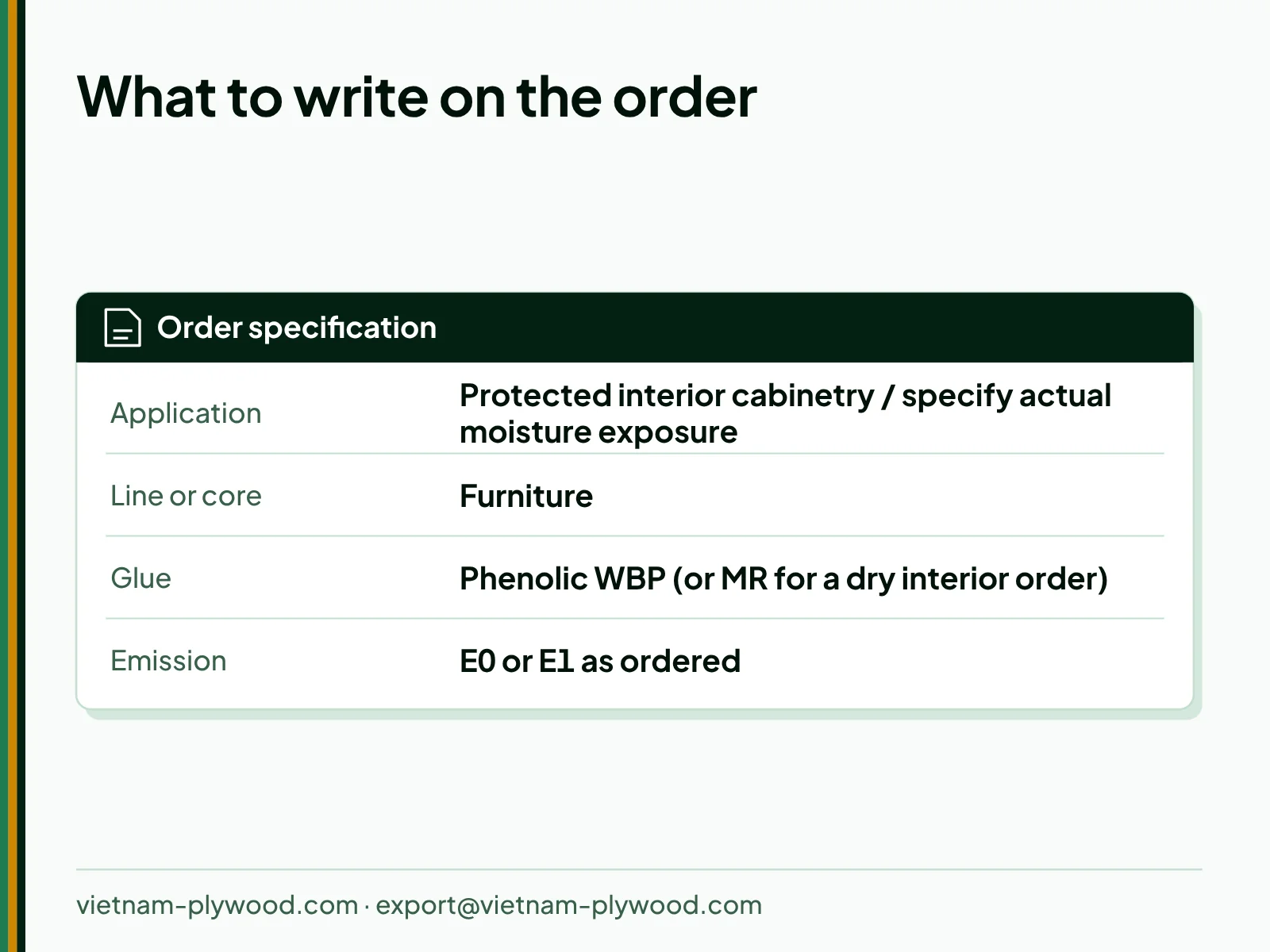
Application: protected interior cabinetry / specify actual moisture exposure
Line or core: furniture; styrax or eucalyptus core
Glue: phenolic WBP (or MR for a dry interior order)
Emission: E0 or E1 as ordered
Face and grade: birch face; D / E / F as approved sample
Thickness and tolerance: 18 mm; sanded ±0.2 or ±0.3 mm as ordered
Size: 1220 × 2440 mm
Quantity: one 40HC or mixed-container allocation
Destination port: [buyer to enter]
Marine requirement, if applicable: standard, edition and accepted test report
Request the birch-face specification sheet from Lucy at export@vietnam-plywood.com.