






LVL sizes for industrial orders start with the finished section—thickness × width—and the cut length required by the application. A wrong section can waste machining time, reduce packing efficiency or lead to a rejected load. HCPLY discusses bed slats, door stock, packing runners and formwork bearers as separate specification decisions.
What are the standard LVL sizes in mm?
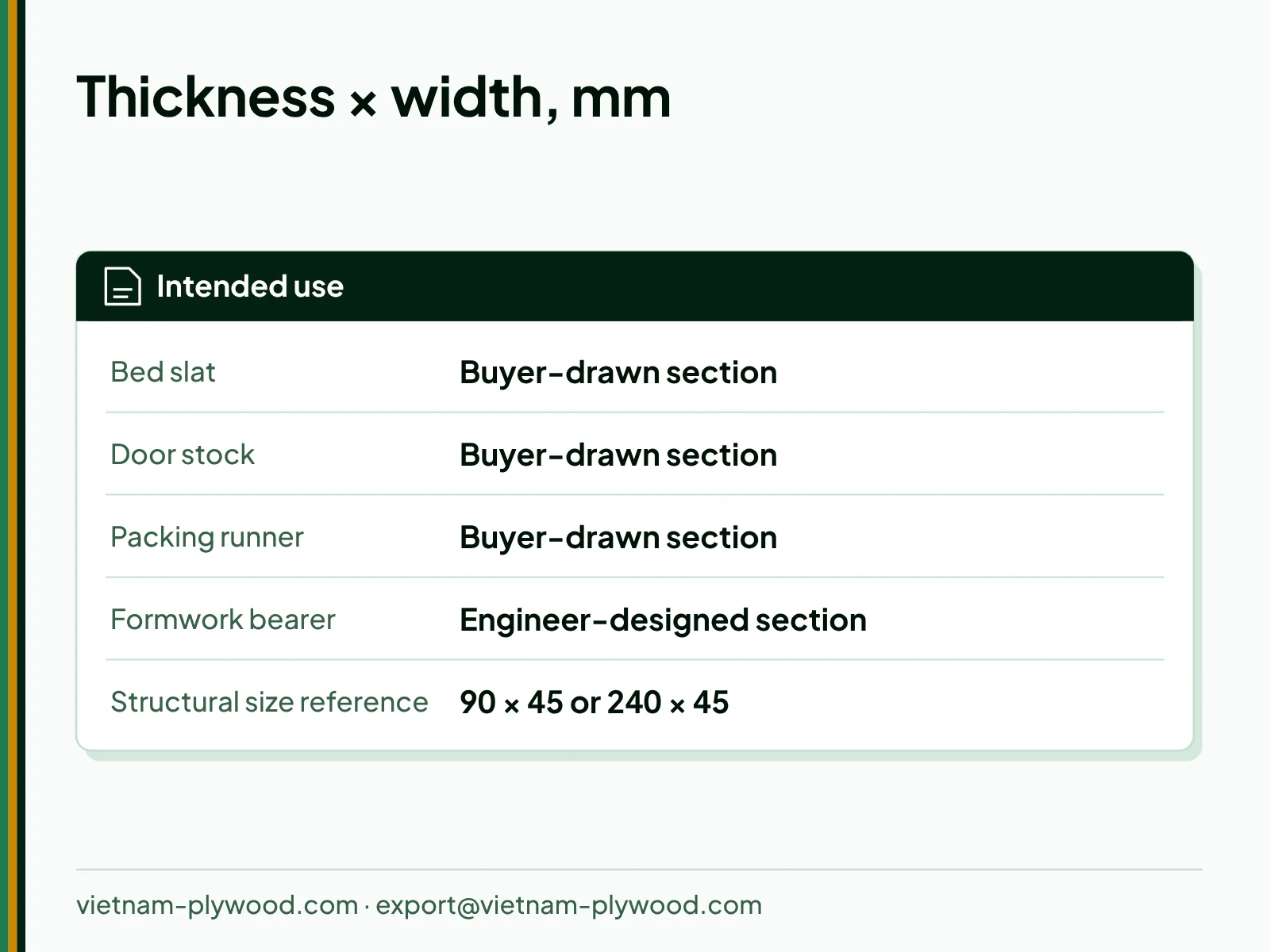
There is no single worldwide chart of standard LVL sizes that covers furniture parts, packaging members and engineered bearers. Dimensions such as 90 × 45 mm and 240 × 45 mm appear in structural LVL discussions, while industrial cut stock follows the buyer’s drawing. Use the table as a specification worksheet, not a list of stocked HCPLY sections.
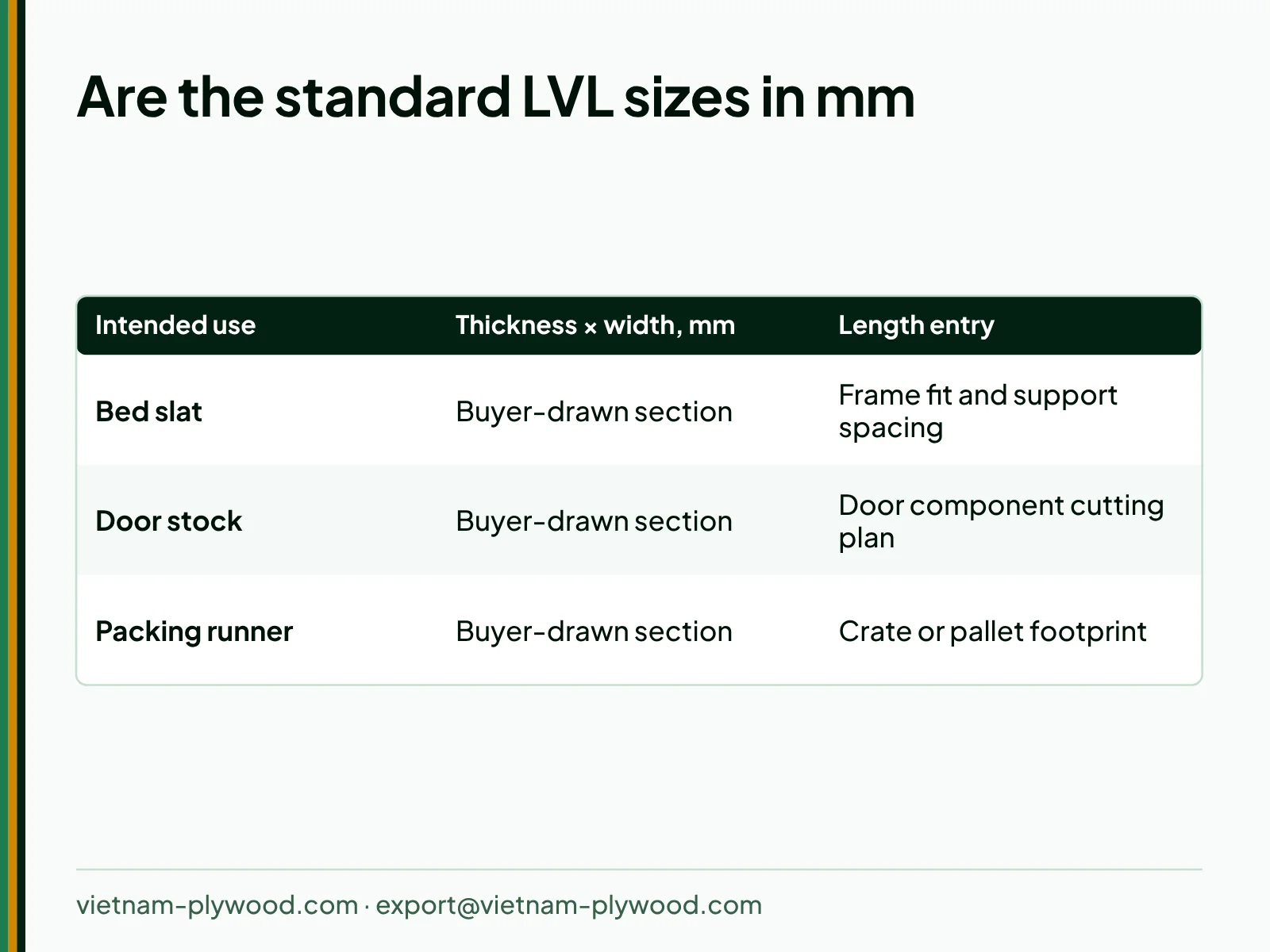
| Intended use | Thickness × width, mm | Length entry | Acceptance priority |
|---|---|---|---|
| Bed slat | Buyer-drawn section | Frame fit and support spacing | Thickness consistency and straightness |
| Door stock | Buyer-drawn section | Door component cutting plan | Squareness and machining allowance |
| Packing runner | Buyer-drawn section | Crate or pallet footprint | Contact area and fastening locations |
| Formwork bearer | Engineer-designed section | Approved span and support layout | Verified load capacity and deflection |
| Structural size reference | 90 × 45 or 240 × 45 | Project-specific | Design report and grade identification |
A section labelled 90 × 45 means 90 mm by 45 mm; the drawing must identify which dimension is depth and which is thickness. The same applies to 240 × 45 LVL. Neither dimension alone states a strength grade, span capacity or suitable end use.
How should LVL thickness, width and length be written?
Write laminated veneer lumber dimensions as thickness × width × finished length, in mm, followed by a drawing reference. Mark the veneer direction and the intended loaded orientation when the part carries bending loads. This prevents a 45 × 90 callout from being interpreted differently at cutting and inspection.
For slats, measure the opening and support arrangement before setting the cut length. For door stock, allow for downstream trimming and machining in the purchasing drawing. Packing runners need a length tied to the package footprint, while bearer lengths follow the engineered support plan.
A nominal dimension is an order label; the actual measured size must meet a separately written acceptance band. If a cut piece is to be machined after arrival, distinguish incoming dimensions from finished component dimensions.
Which factory line handles each build?
Our commercial and packing line is the starting point for packing-oriented LVL section discussions. Our furniture line addresses sanded furniture-panel builds, while our construction line presses film-faced panels. HCPLY matches each order to the producing factory and its written specification.
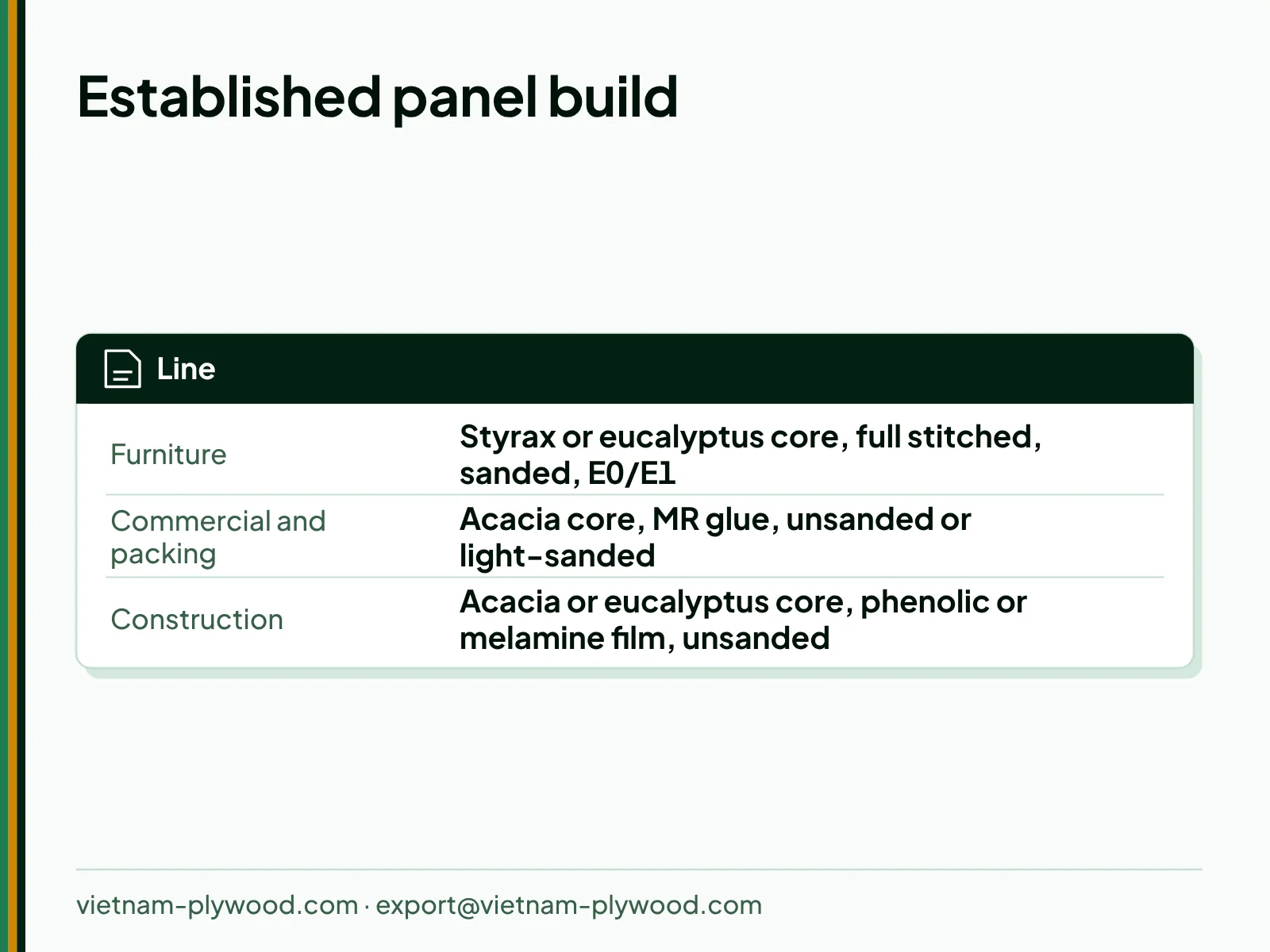
| Line | Established panel build | Relevant LVL discussion |
|---|---|---|
| Furniture | Styrax or eucalyptus core, full stitched, sanded, E0/E1 | Slat or door-stock fit and finish requirements |
| Commercial and packing | Acacia core, MR glue, unsanded or light-sanded | Runner section, cutting and packaging requirements |
| Construction | Acacia or eucalyptus core, phenolic or melamine film, unsanded | Separate formwork-panel supply; bearer design needs its own evidence |
These panel descriptions are established line capabilities; they do not establish an LVL section range, adhesive qualification or structural rating. For the broader product distinction, see LVL meaning and uses and LVL supplier specifications.
Which sections fit bed slats and door stock?
Bed slat dimensions start with the frame’s clear width, support spacing and acceptable movement under the furniture maker’s loading requirements. Specify the cross-section after testing the finished furniture assembly, including its fastening method and edge treatment.
Door stock starts with the finished door component drawing. The cutting allowance must account for profiling, trimming and rejection criteria for twist or bow. A wide blank and several narrow strips can have different yield even when their total nominal volume matches.
A sanded face is a finish requirement, while emission class and adhesive system are separate specification fields. For adjacent panel applications, consult LVL for furniture frames and LVL production process.
What dimensions work for packing runners?
Packing runner dimensions follow the crate footprint, forklift contact points and fastening layout. A narrow runner saves material per piece but can change local bearing pressure and fastener edge distances. The package designer should approve the cross-section against the actual load path.
State whether the runner is a continuous length or several shorter members. The cutting list should identify piece count per package, permitted joints, end condition and orientation. A buyer can then compare material use by multiplying each section area by its finished length.
For commercial and packing plywood, HCPLY uses acacia core at 580 kg/m³. That figure describes the specified plywood core; it is not a measured LVL runner density. Do not apply it to LVL freight weight without a density value for the ordered build.
How do LVL sections change pieces per container?
A thicker or wider section consumes more cubic metres per piece at the same length, reducing the theoretical count for a fixed volume. Calculate piece volume = thickness (m) × width (m) × length (m). Divide the usable packed volume by this figure only after allowing for pallets, voids and loading geometry.
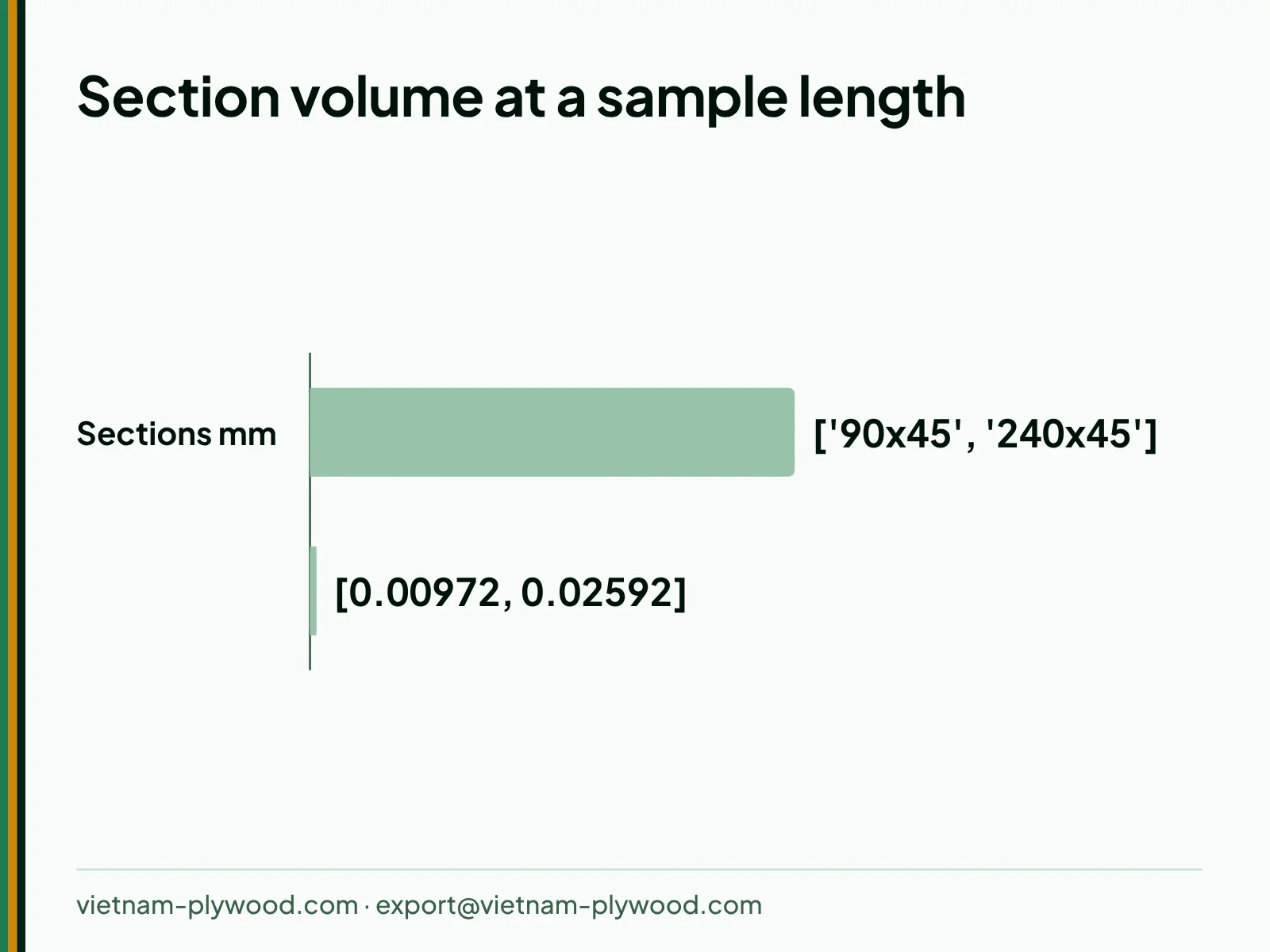
For a dimensional illustration at a 2.4 m hypothetical cut length, a 90 × 45 mm piece occupies 0.00972 m³, while a 240 × 45 mm piece occupies 0.02592 m³. The second section consumes about 2.67 times the wood volume per piece. These are geometric examples, not HCPLY stocked sections or container quantities.
A 40HC payload limit in the HCPLY panel-loading model is 28.5 t. LVL loading needs its own measured density and packaging layout before a piece count is quoted. The container loading reference covers the separate plywood-sheet calculations.
What tolerance applies to LVL dimensions?
LVL tolerance must be written separately for thickness, width, cut length, straightness and squareness. A tolerance accepted for sanded plywood sheets cannot simply be transferred to narrow LVL members. Specify the measurement position, conditioning state and sampling plan with the factory drawing.
APA – The Engineered Wood Association’s 2022 technical topic TT-131 explains that LVL changes dimension with moisture content. Its published summary states: “Laminated Veneer Lumber (LVL), like other wood products, experiences dimensional changes due to moisture content variations.” See the APA technical topic.
Record dimensions when the material is inspected and document the storage conditions before a dispute arises. For an order with downstream precision machining, agree which readings control acceptance at dispatch.
Are structural LVL lumber dimensions interchangeable?
Structural LVL sizes are tied to a tested product, its grade, load direction and design method. A 240 × 45 member cannot be substituted for another member merely because its outside dimensions match. Formwork bearers need an approved design for spans, supports, loading and allowable deflection.
The general LVL beams guide explains beam terminology, while LVL strength properties separates dimensional labels from performance. For a structural-grade claim, HCPLY discusses the proposed build only against a test report the buyer accepts.
Do not use an industrial packing runner’s section as evidence of structural capacity. Ask the project engineer to approve the specific product evidence before cutting a bearer schedule.
What can an inspector check at the producing factory?
An inspector can compare the cutting schedule with the purchase drawing and measure actual thickness, width and length on identified pieces. The inspection record should include the measuring instrument, piece identifiers, observed deviations and the agreed sampling method.
For slats and door stock, inspect surface condition, straightness and end squareness. For packing runners, check the contact faces, fastening zones and bundle identification. For bearers, reconcile the physical markings and documentation with the engineer-approved build and accepted test report.
HCPLY arranges on-site quality control and buyers can inspect goods at the producing factory. The factory office is available for buyer visits, with the actual goods inspected where they are produced.
What belongs on the cutting and packing list?
The cutting list needs one row per section and length combination, with quantity, tolerances, end treatment and bundle label. Separate bundles by part number to prevent similar-looking sections from being mixed during assembly or receiving.
A shipment’s packing list records the actual goods loaded, alongside the commercial invoice and bill of lading in the export paperwork. After loading, the draft shipping documents come to you for approval. The size schedule should reconcile with bundle counts and the packing list before dispatch.
Mixed specifications can share a 40HC within its payload limit. The buyer still needs a section-specific packing study to establish the piece count and safe loading pattern.
How should an importer request LVL cut sizes?
Send a drawing with thickness, width and length on every line item, then state the application and destination port. Include whether the part will be machined after import, which faces must be finished and how the buyer will measure acceptance.
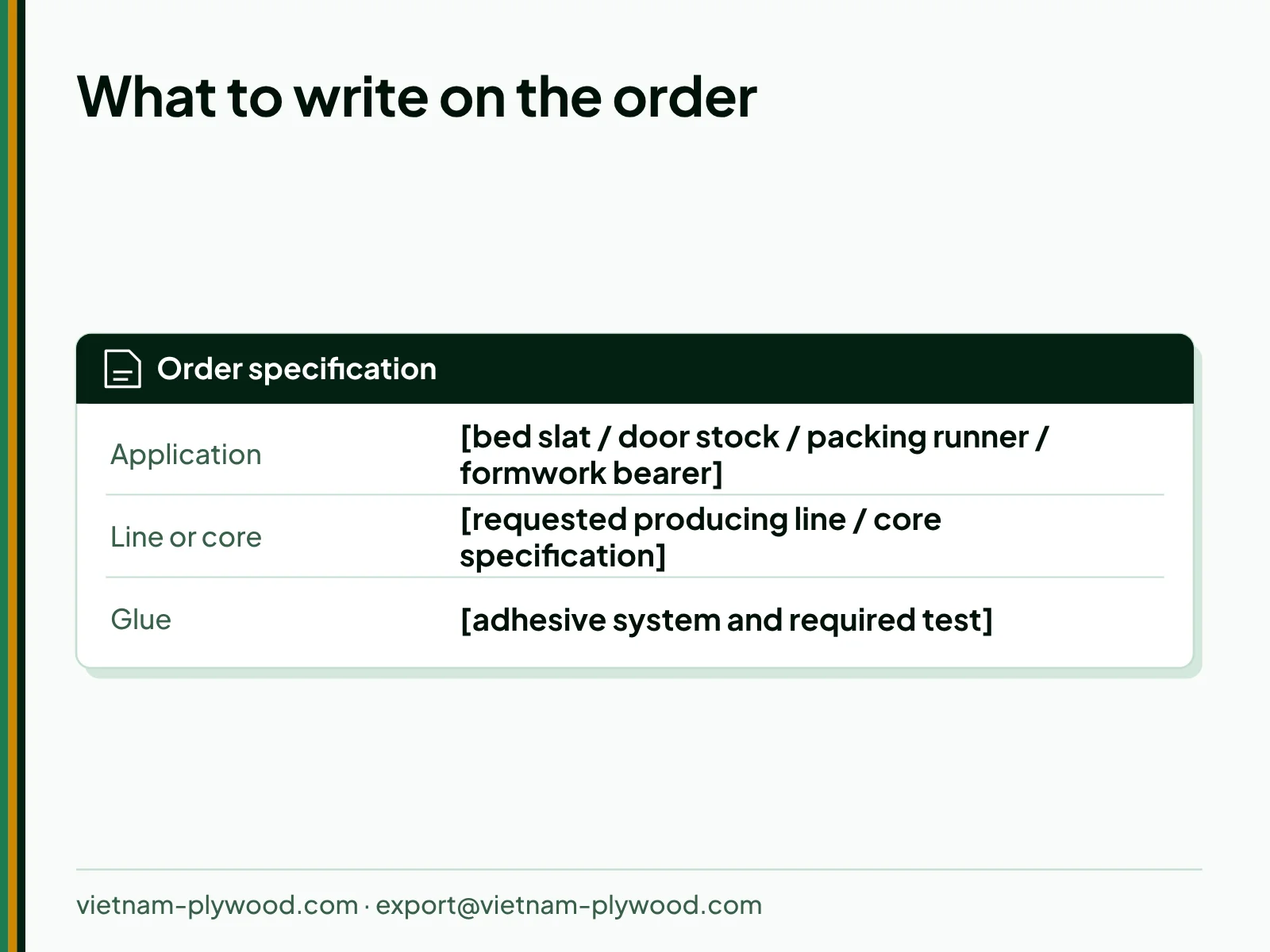
The minimum order is one 40HC. HCPLY’s production window is 15–45 days from the 30% deposit, set by order size, line loading and the contract. The remaining 70% is paid on the scan of the bill of lading, by T/T, or by irrevocable sight L/C. We ship FOB Hai Phong, or CFR (CNF) or CIF to your port.
For a shipment combining LVL requests with other plywood types, see one supplier, several plywood types. Send the following schedule to Lucy at export@vietnam-plywood.com:
Application: [bed slat / door stock / packing runner / formwork bearer]
Line or core: [requested producing line / core specification]
Glue: [adhesive system and required test]
Emission: [requested class or market requirement]
Face and grade: [face finish and appearance acceptance]
Thickness and tolerance: [mm, acceptance band]
Size: [thickness × width × finished length, mm]
Quantity: [pieces per section and length; bundle schedule]
Destination port: [port, country]
Request the LVL specification sheet with your cutting drawing.