





LVL columns use lengthwise laminated veneers to form straight, repeatable load-bearing posts; a lvl post is selected by verified compression capacity, section, length and end restraint. Choosing the wrong member can mean rejected material, costly redesign or lost installation days. HCPLY helps industrial buyers distinguish engineered structural columns from plywood packing posts and specify the correct factory build.
What section size should an LVL post have?
An LVL post section starts with the design load, unsupported length, bracing and connection geometry, rather than a catalogue width alone. The engineer checks axial compression, buckling about both axes, eccentric loading and bearing at the ends. A square section can simplify connection layouts, while rectangular sections require special attention to their weaker axis. Purchase dimensions only after the applicable design report identifies the member grade.
A retail example is a 3.5 × 3.5-inch section at 10 feet long. That is a market example, not an HCPLY stock dimension or a capacity rating. The same nominal cross-section cannot be substituted across manufacturers without checking design values and connection instructions. For LVL meaning and uses, the veneer orientation and product designation matter as much as dimensions.
Ask the engineer for the service load combination, effective column length, restraint at both ends, load eccentricity and connection details. Record actual section dimensions rather than relying on nominal lumber names. Where a column is built from multiple members, the connection schedule must be part of the approved design.
When does LVL beat a sawn post?
LVL is preferable where straightness, repeatable dimensions and an evaluated structural design justify the added manufacturing and documentation requirements. A sawn post can be more practical where its species, grade, section and local design rules already meet the load. Neither material wins on section size alone.
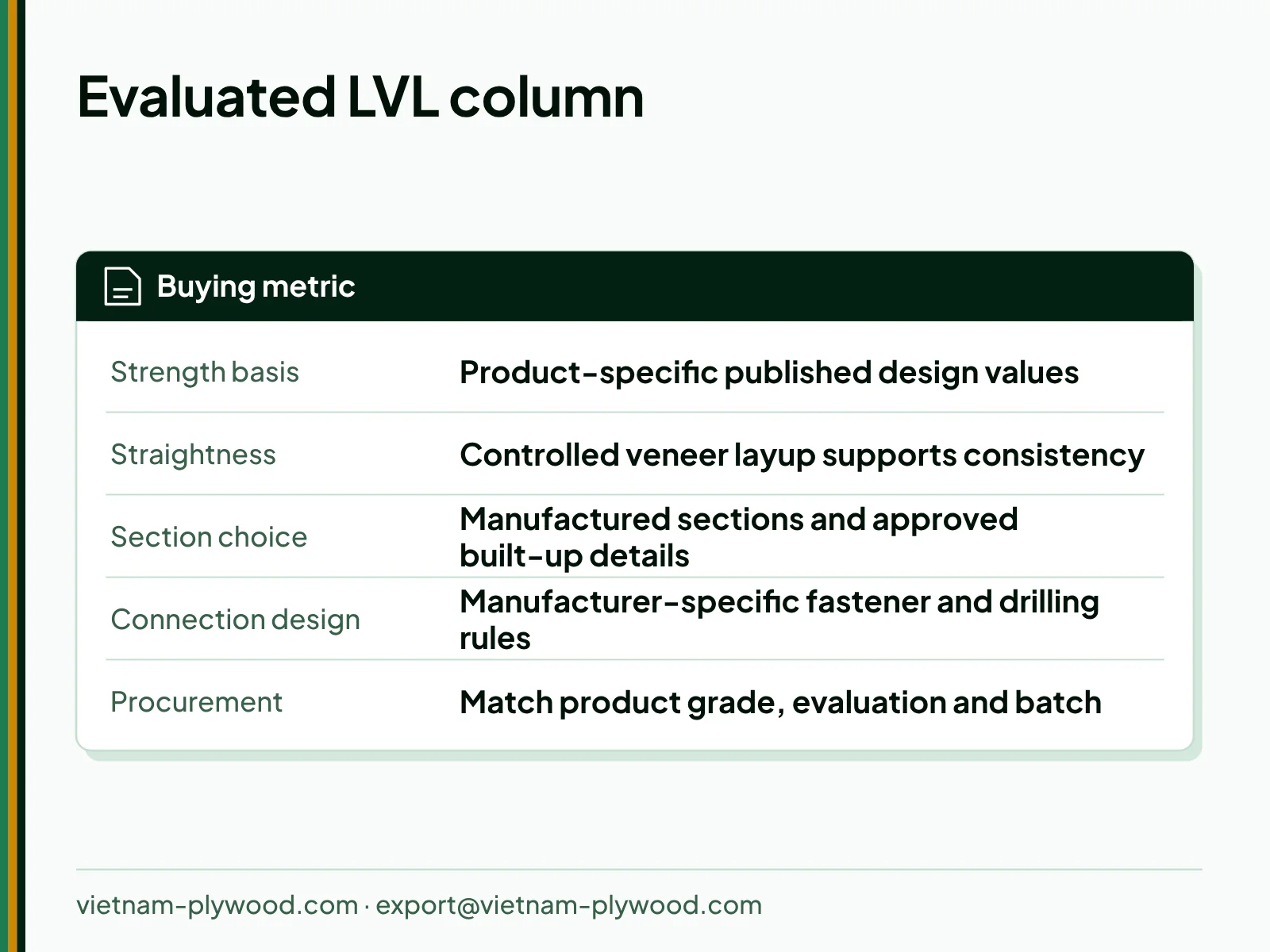
| Buying metric | Evaluated LVL column | Graded sawn post | Purchasing verdict |
|---|---|---|---|
| Strength basis | Product-specific published design values | Species-and-grade design values | Use the approved calculation for either |
| Straightness | Controlled veneer layup supports consistency | Individual pieces can twist or check | LVL for repeatable fit |
| Section choice | Manufactured sections and approved built-up details | Standard timber dimensions | Sawn where standard sections suffice |
| Connection design | Manufacturer-specific fastener and drilling rules | Grade and code-based connection rules | Choose the documented detail |
| Procurement | Match product grade, evaluation and batch | Match species, grade stamp and batch | Reject substitutions without design review |
The American engineered-wood standards body’s 2009 column design resource covers section sizes, design stresses, axial loading and eccentric loading for glued laminated timber, a different product from LVL. That distinction matters: glulam tables cannot be applied to LVL columns. See APA’s 2009 column-design resource for the scope of that method.
Which loads and restraints govern column selection?
Compression capacity is governed by the evaluated product properties and the installed member’s unsupported length, restraint and loading geometry. A post that works as a short, well-braced support can fail the design check when used taller or with eccentric loading. The weakest-axis buckling check often changes the preferred section.
Specify whether the column carries concentric axial load, combined bending and compression, or lateral effects. Include load duration and service moisture assumptions in the engineer’s calculations. The end connection must transfer load into the foundation or beam without crushing, splitting or an unapproved eccentricity.
A design schedule should name the governing code, edition, evaluation report and required product grade. Do not convert a bending strength advertised for an LVL beam into a post compression rating. LVL strength properties explains why stiffness and bending data are separate from column capacity.
Can a plywood post replace a structural LVL column?
A plywood packing spacer or post is not an interchangeable structural LVL column. LVL’s primarily lengthwise veneer arrangement and evaluated design values differ from cross-laminated plywood panel construction. HCPLY’s described production lines are plywood lines; we do not offer an independently rated LVL column in the stated range.
For transport crating, the relevant question is often whether a cut plywood spacer or packing support carries a defined shipping load, rather than a building load. An industrial buyer should specify the packing assembly’s load path, compression contact area, restraint and handling conditions. Structural building columns require an accepted structural product report and engineered connection design.
A factory cut strip may be suitable as a packing component after the buyer’s packaging design establishes its role. It should not inherit an LVL grade simply because it has bonded veneers. The LVL supplier overview covers the terminology used in procurement inquiries.
Which HCPLY line builds the relevant material?
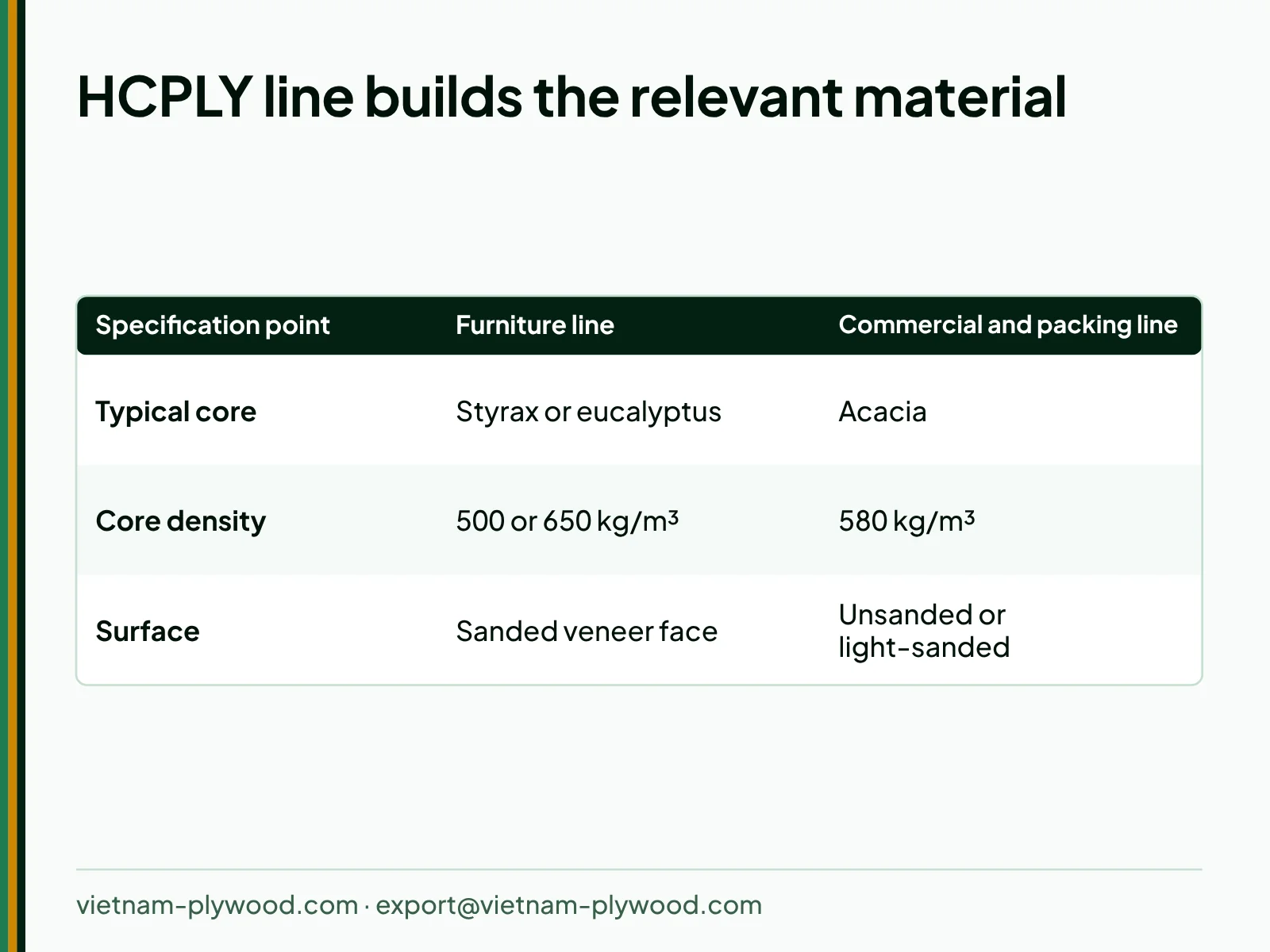
Our commercial and packing line is the relevant line for acacia-core plywood packing components; our furniture line builds sanded furniture panels, while our construction line builds film-faced formwork panels. None of these three plywood builds is a substitute for a specified structural LVL post.
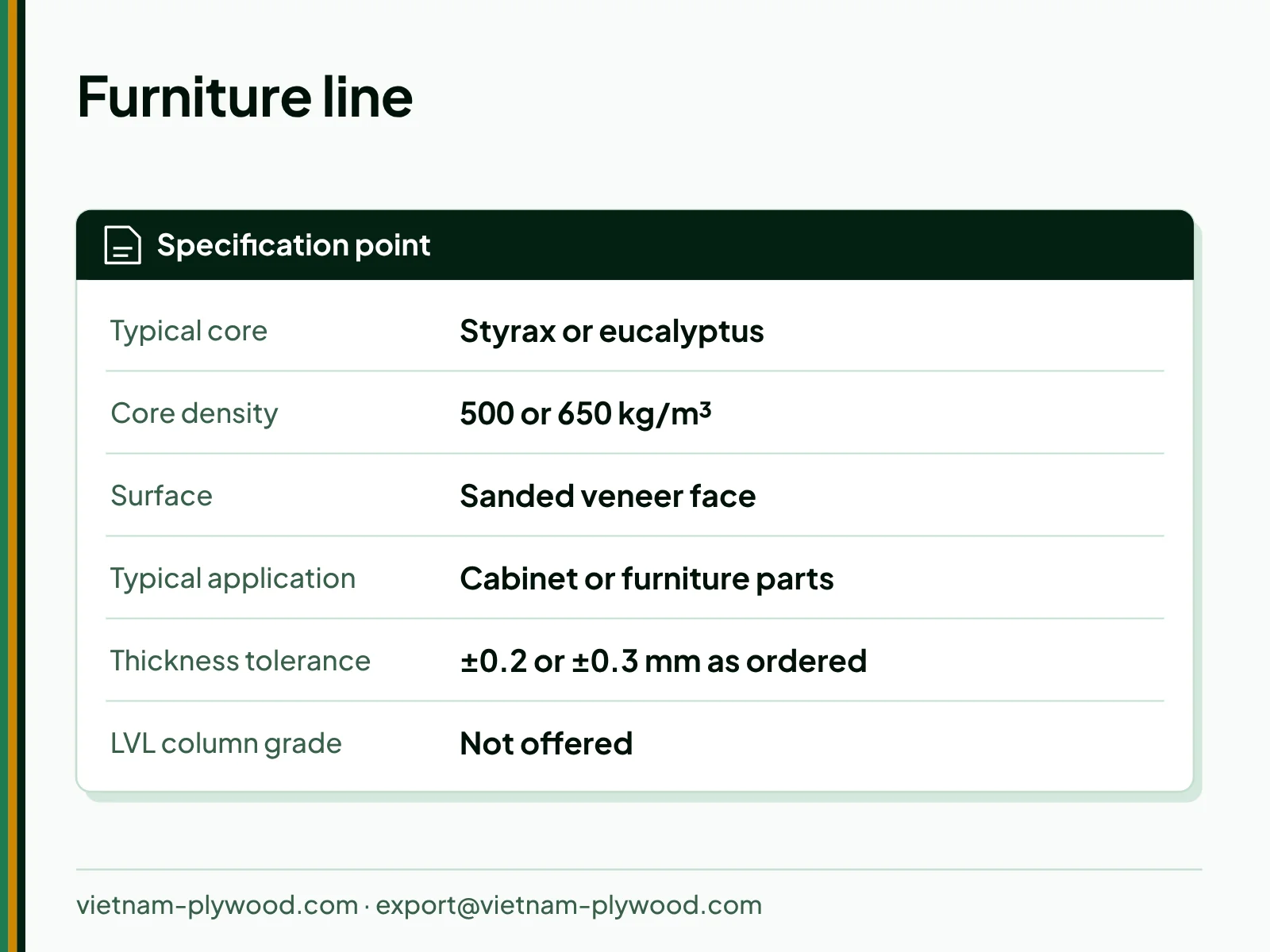
| Specification point | Furniture line | Commercial and packing line | Construction line |
|---|---|---|---|
| Typical core | Styrax or eucalyptus | Acacia | Acacia or eucalyptus |
| Core density | 500 or 650 kg/m³ | 580 kg/m³ | 580 or 650 kg/m³ |
| Surface | Sanded veneer face | Unsanded or light-sanded | Phenolic, melamine or anti-slip film |
| Typical application | Cabinet or furniture parts | Crates, packing supports | Concrete formwork |
| Thickness tolerance | ±0.2 or ±0.3 mm as ordered | Packing ±0.5–1.0 mm | ±0.5 mm |
| LVL column grade | Not offered | Not offered | Not offered |
The panel range is 3–40 mm thick; available sheet formats include 1220 × 2440 mm and 1250 × 2500 mm, with custom cutting. These are panel specifications, not LVL column section sizes. When the order is for plywood packing posts, define cut length, strip width, orientation and permitted joint construction separately.
For cabinet frame components, use LVL for furniture frames to distinguish the application from structural columns. For the pressing sequence, see LVL production process alongside the actual plywood construction requested.
What can packing supports share in a container?
Plywood packing supports can be ordered with compatible panel specifications, provided the combined load remains within the 40HC payload limit of 28.5 tonnes. A mixed shipment needs a packing plan by pallet, core density, sheet thickness and destination, rather than an assumption that every pallet has the same weight.
For 18 mm, 1220 × 2440 mm panels, the computed full-container reference is 990 styrax sheets at 26.52 t, 880 acacia sheets at 27.35 t, or 795 eucalyptus sheets at 27.69 t. Individual sheet weights are 26.79, 31.08 and 34.83 kg respectively. Those figures exclude film weight and describe full single-core loads, not a mixed-load promise.
As a worked mixed-pallet illustration, eight acacia pallets at 55 sheets each contribute 440 sheets; at 31.08 kg per sheet, their panel mass is 13,675.2 kg. Eight styrax pallets at 55 sheets each add 440 sheets; at 26.79 kg, their panel mass is 11,787.6 kg. Together the illustrated panel mass is 25,462.8 kg, leaving 3,037.2 kg below the payload ceiling for pallets, packing and other cargo. This arithmetic uses the rounded sheet-weight lookup, so the final load plan uses the shipment’s actual measured weights.
The mixed plywood container options page covers order grouping, while container packing quantities owns full-load calculations. HCPLY ships the selected specification from the producing factory, FOB Hai Phong, with loading coordinated against the approved packing list.
What should the factory inspector witness?
For plywood packing components, an inspector should witness dimension checks, core-construction checks and packing identification against the written order. At the producing factory, the buyer can compare the cut-piece drawing with actual lengths, widths and thicknesses, then examine exposed edges for gaps and joints.
The inspection record should identify the panel core, face, glue designation and emission class separately. For commercial and packing panels, the stated core is acacia with moisture-resistant (MR) glue; the panel may be unsanded or light-sanded. A surface label alone does not establish a structural compression grade.
Witness sample measurements across the batch and photograph the pallet labels before loading. Where the buyer needs an engineered column, inspection instead requires the named LVL product’s evaluation report, grade traceability and the approved connection design. The factory and product arrangement explains how different plywood orders are organized.
How do adhesive, moisture and exposure change the choice?
The adhesive specification controls the plywood bond requirement, while the emission class is a separate field. HCPLY uses melamine MR with a 12-hour boil specification or phenolic weather-and-boil-proof (WBP) with a 72-hour boil specification where the ordered plywood build calls for it. Neither figure is a structural post capacity.
Packing supports exposed to rain, condensation or wet cargo handling need an explicit moisture and edge-protection plan. For engineered LVL columns, use the product’s published service-condition limits and treatment instructions. A film face does not turn plywood into an outdoor-rated LVL column.
The LVL outdoor exposure discussion separates exposure classifications from structural load ratings. Specify cut-edge sealing and storage requirements in the purchase document when they affect the intended service.
How should a buyer write the acceptance specification?
An acceptance specification must identify whether the order is an evaluated structural LVL member or a plywood packing component. This decision comes before thickness, finish and quantity because the testing and documentation paths are different.
For LVL, record manufacturer and product designation, section, length, grade, compression properties, service conditions and approved fastening detail. Require a current report accepted by the project’s engineer and authority. For packing plywood, record core, joint construction, glue, emission class, face, tolerances and cut schedule.
For HCPLY packing plywood, face options include bintangor, okoume, engineered veneer, gurjan, pine, poplar, eucalyptus, birch and sapele, or a raw matt surface. Face names describe appearance; density follows the core. A decorative face grade must not be mistaken for a column strength grade.
Which export papers travel with the order?
The packing list and commercial invoice identify the shipped plywood specification and quantities; the bill of lading records the carriage. A shipment document set also includes the certificate of origin, phytosanitary and fumigation papers, and applicable agreed test or emission documents. For EU lots, the file includes EUR.1 and EUTR/EUDR documents; CIF shipments include insurance.
Member-factory FSC, CARB P2, ISO 9001 and CE documents can be shown with factory details masked, on request. Their availability does not replace a structural LVL product evaluation. After loading, the draft shipping documents come to you for approval.
For a post that forms part of a certified building system, the importer must obtain the structural product’s own grade and design documentation from its actual manufacturer. A plywood shipping document cannot certify a column load rating.
What determines the quotation and production arrangement?
A plywood packing-component quotation is driven first by core construction and cut yield, then adhesive and surface specification, followed by thickness tolerance and packing complexity. Full stitched cores cost more to prepare than loose-laid cores because the veneer preparation and assembly work differ. Cut-to-size packing components also require a clear waste allowance in the quoted specification.
The minimum order is one 40HC; one container can carry several specifications as long as the payload limit holds. Factory lead time runs 15–45 days from receipt of the 30% deposit; the exact figure depends on order size, line loading and what the contract fixes. The remaining 70% is paid on the scan of the bill of lading, by T/T, or by irrevocable sight L/C. We ship FOB Hai Phong, or CFR (CNF) or CIF to your port.
Samples cost nothing: a first-time buyer pays the courier, and that charge comes off the first confirmed order. Send the written cut schedule and destination port to contact Lucy at export@vietnam-plywood.com. A structural LVL column quotation would instead require the evaluated structural product and its designated manufacturer.
What should go on the inquiry sheet?
The inquiry should state the end use first and distinguish shipping supports from load-bearing building columns. HCPLY can then review the plywood packing specification against the commercial line and identify what must remain with a structural LVL producer.
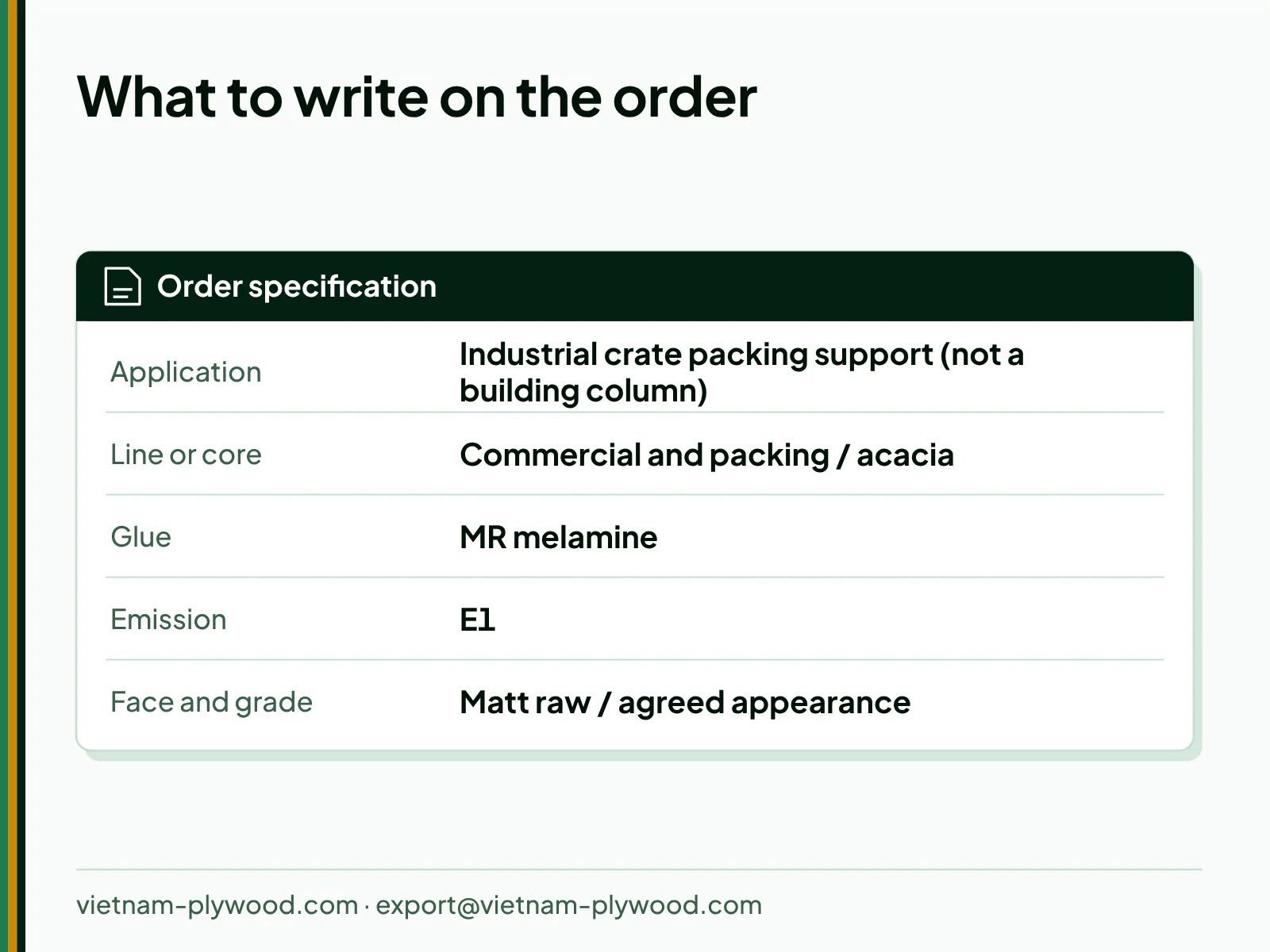
Application: industrial crate packing support (not a building column)
Line or core: commercial and packing / acacia
Glue: MR melamine
Emission: E1
Face and grade: matt raw / agreed appearance
Thickness and tolerance: 18 mm / packing ±0.5–1.0 mm
Size: cut schedule from 1220 × 2440 mm panels
Quantity: one 40HC, mixed specifications if listed
Destination port: [buyer to enter]
Ask Lucy for a sample set against the completed specification.