





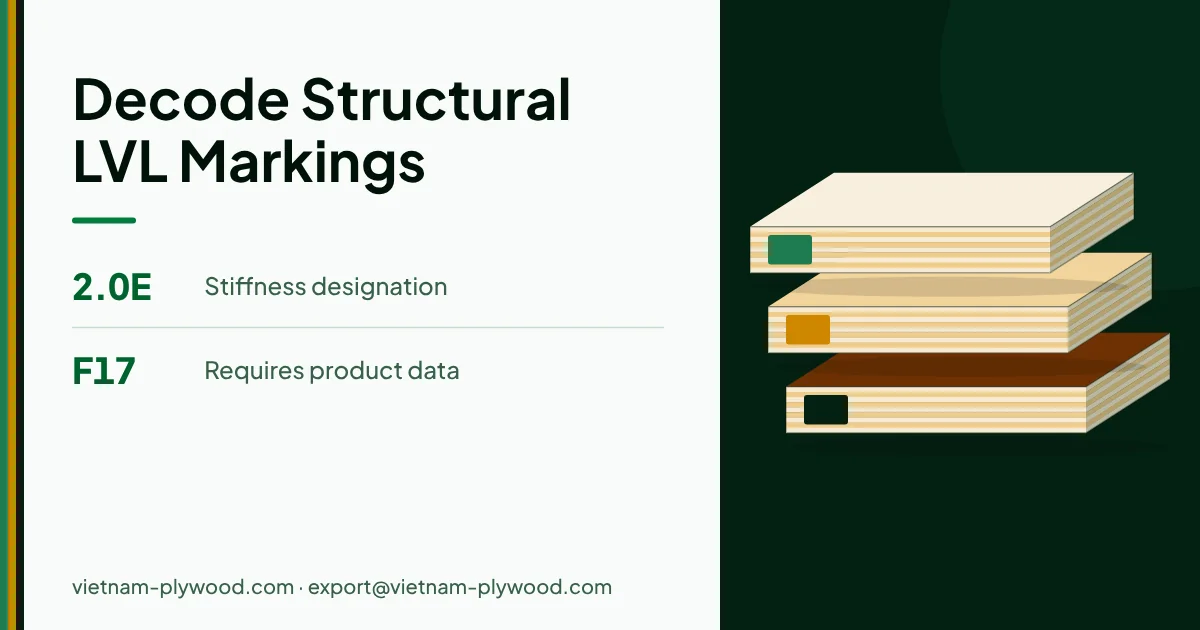
LVL 2.0E and LVL10 are grade-like designations whose meaning comes from a specific structural evaluation and design-property schedule. Choosing the wrong designation can lead to a rejected framing load, replacement costs and project delays. HCPLY explains how buyers should decode these markings before comparing imported laminated veneer lumber for beams or industrial uses.
What does lvl 2.0 mean?
LVL 2.0E identifies a longitudinal modulus of elasticity of 2.0 million pounds per square inch (psi) in a North American laminated veneer lumber (LVL) product designation. It describes stiffness, rather than a complete strength rating. The matching manufacturer’s evaluation report must identify bending, shear, compression, tension, fastening and service limits before an engineer selects a beam.
In a combined designation, Fb identifies allowable bending stress and E identifies stiffness. Compare both with the manufacturer’s applicable evaluation report and the full design-property schedule before selecting a member.
What does an LVL grade stamp certify?
A structural LVL marking identifies a particular manufactured product and connects it to documented design properties and limitations. It does not certify that every beam size works for every span. Read the manufacturer identification, product designation, governing evaluation or standard, production traceability and applicable use restrictions together.
The 2023 Engineered Wood Products Association of Australasia technical note explains that Australian LVL branding must connect the product to published design information. In North America, the applicable evaluation report can also specify installation, allowable holes, wet-service limitations and design adjustments.
A buyer should request a photograph of the exact production marking alongside the matching report, rather than accepting a generic catalogue image.
How do 2.0E, LVL10 and F17 compare?
These labels come from different systems, so a direct strength equivalence cannot be inferred from the numbers. A stiffness designation, an Australian product-name convention and an F-grade communicate different information. The appropriate comparison uses the full design-property schedule and the member’s intended loading direction.
| Label on enquiry | What the number communicates | What remains to check | Buying verdict |
|---|---|---|---|
| 2.0E | Nominal published stiffness category of 2.0 million psi in a North American designation | Bending, shear, bearing, span, service class | Consider for beams only with matching evaluation data |
| LVL10 / E10 | Often a product stiffness designation around 10,000 MPa, when the producer documents that meaning | Manufacturer’s complete characteristic properties | Compare for Australian framing by its own design sheet |
| F17 LVL | F17-style strength branding, sometimes paired with an E rating | Actual LVL-specific properties and test basis | Do not substitute for an F17 sawn-timber member automatically |
| LVL 11 / LVL 13 | Numbered supplier designation without universal structural equivalence | Exact report, units and design values | Request documentation before structural selection |
For the physical role of individual members, see our LVL beams guide.
What is F17 LVL?
F17 LVL is a supplier’s F-grade-style description of laminated veneer lumber; its design meaning must be established by the specific manufacturer’s documents. Some Australian catalogues pair F17 with E14 and a treatment designation. The F-number alone does not supply the complete bending, tension, compression, shear or connection properties.
Australia’s 2023 industry technical note states that some suppliers use F-grades to communicate part of LVL performance, while full product-specific design data remain necessary. For procurement, ask whether the F17 designation applies to the exact member and whether its engineering tables cover the specified orientation, spans and connections.
What do LVL 11, LVL 12, LVL 13 and other numbers mean?
LVL 11, LVL 12, LVL 13, LVL 14, LVL 17 and LVL 18 are labels whose meaning must be read in the issuing manufacturer’s specification. An E11 marking might suggest a stiffness class, but the Australian technical note warns that names such as E11 cannot be assumed to establish performance.
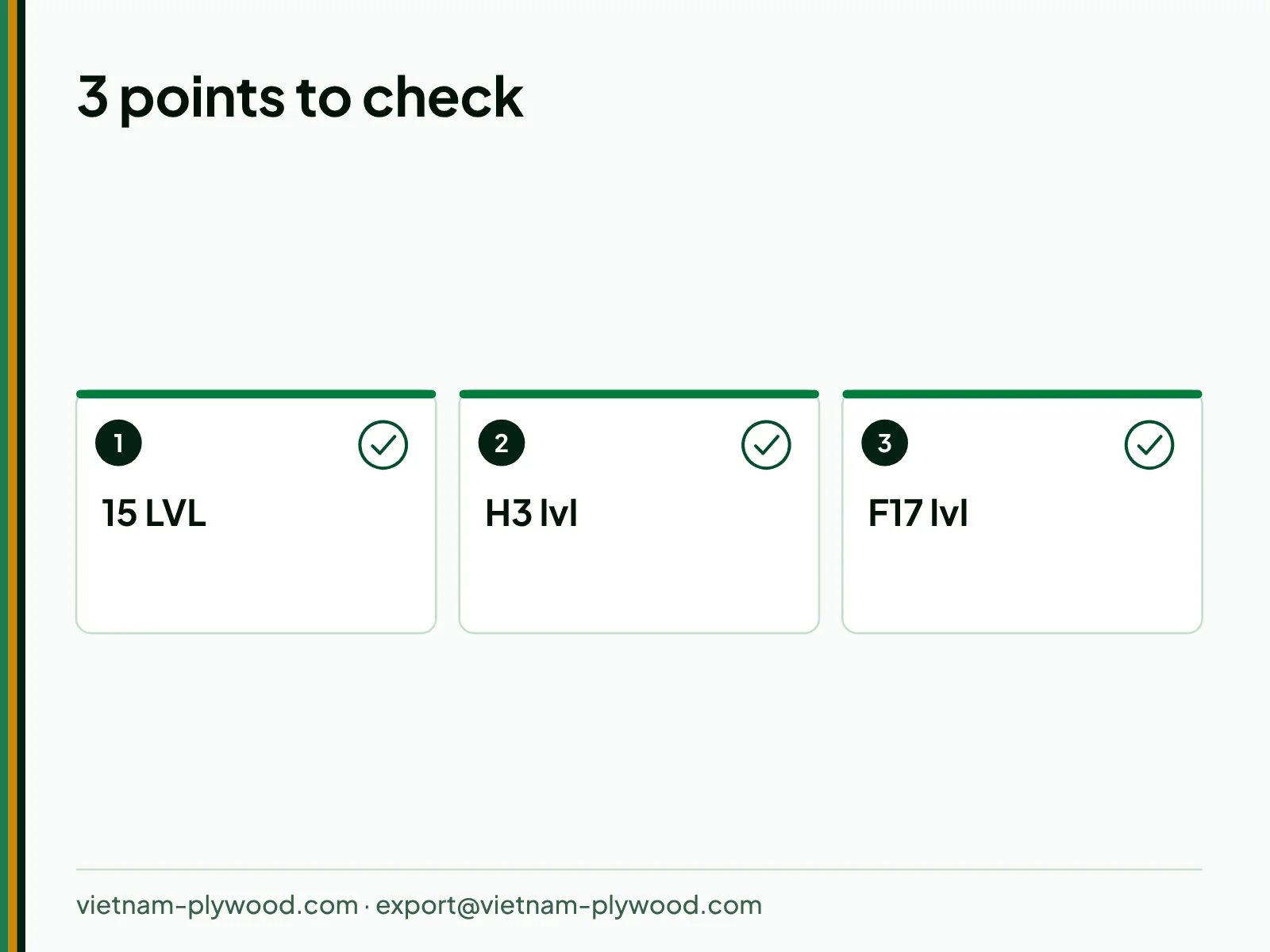
Likewise, 15 LVL, h3 lvl and f17 lvl in a purchasing message can refer to a dimension, preservative treatment or a grade description. Ask for the original label photograph and schedule before translating shorthand into a structural specification. Treatment labels also need a separate service-exposure check; see LVL outdoor exposure.
Can imported LVL be used for framing and beams?
Imported LVL can be used for structural framing when the particular product and installation satisfy the destination’s building-code compliance route. The importer needs accepted test evidence, published design values and an engineer’s application-specific selection.
For Australia, AS/NZS 4357.0:2022 addresses structural LVL manufacture, characterization and verification. The 2023 industry technical note describes conformity with that standard as the direct deemed-to-satisfy route; other evidence may require a performance solution. For North American work, the project designer should establish the applicable code and recognized evaluation basis, such as ASTM D5456 for a product evaluated under that route.
A report for one product or production facility cannot be transferred to a different producer’s load-bearing members. Do not purchase framing material on an appearance grade, glue name or advertised stiffness number alone.
What should an importer obtain before ordering framing LVL?
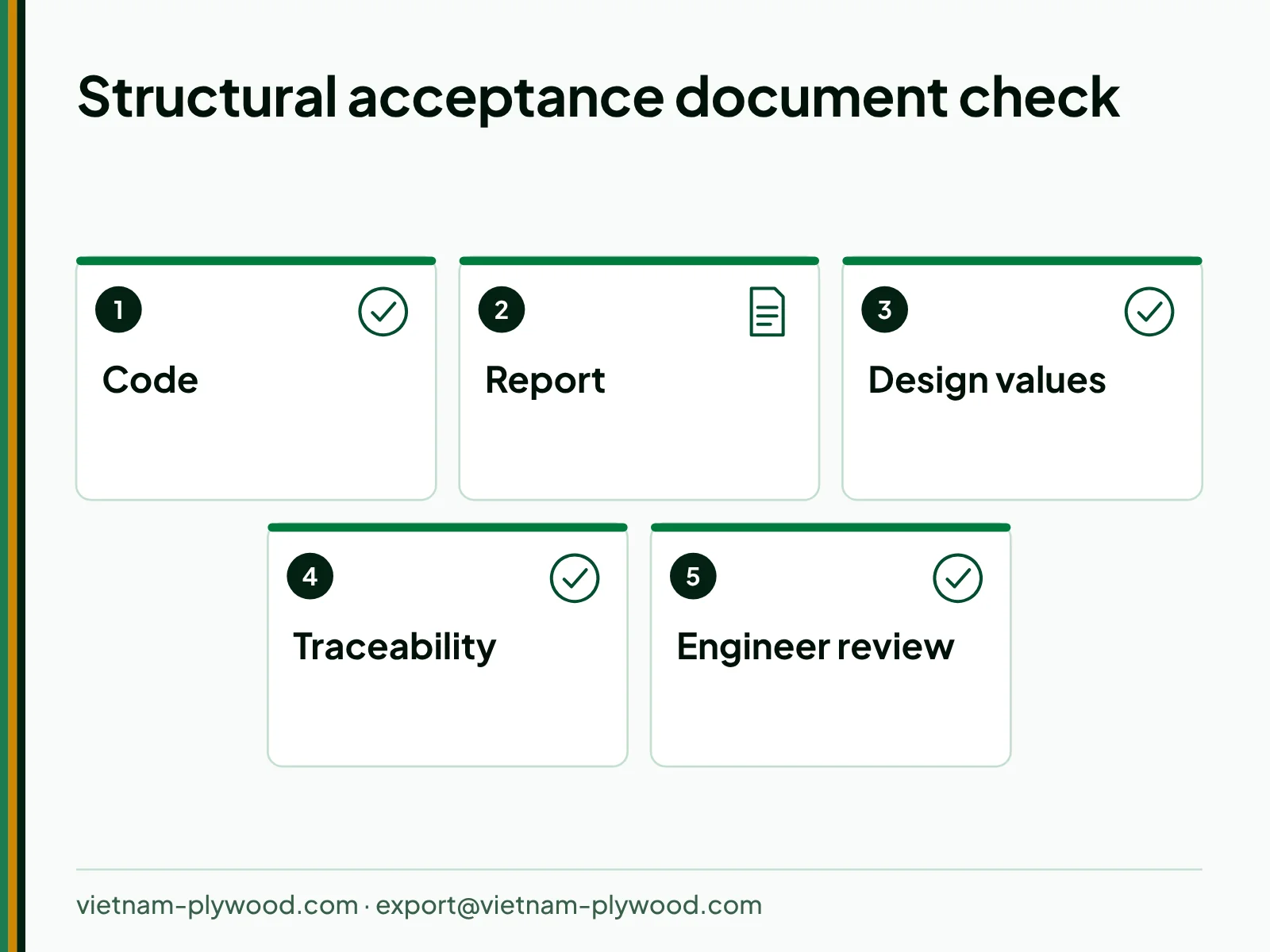
Obtain the product’s current evaluation package and have the project designer check it against the intended member schedule before issuing a purchase order. The buyer’s evidence request should identify the exact producing facility and batch marking.
- State the destination country, project code, member function, loading orientation, span and connection details.
- Request the applicable product standard, evaluation report, test basis and complete characteristic or allowable design-property table.
- Match the product mark and report scope to the offered cross-section, length, treatment and service conditions.
- Obtain engineer-approved span tables or calculations, including holes, bearing and fastener limitations.
- Specify inspection records, traceability photographs and the document package required for import and project approval.
Why does HCPLY quote industrial LVL by use?
Our commercial and packing line discusses industrial requirements by application and written build specification. Any structural-grade claim requires a product-specific test report accepted by the buyer. Buyers seeking transport supports or industrial packing should describe loads, handling, moisture exposure and dimensional requirements. We do not present these use-based quotations as structural framing approvals.
Our LVL supplier overview explains the enquiry route, while LVL meaning and uses separates industrial applications from building-member design. The distinction matters because an industrial support specification can prioritize cut size and handling, whereas a framing beam requires an accepted structural test regime and design values.
Our commercial and packing line uses an acacia-core, MR-glue, unsanded or light-sanded plywood build for its established panel range. LVL requirements are reviewed by intended use; a buyer should not infer a structural LVL grade from that plywood specification.
How do our three production lines handle a comparable request?
The producing factory and inspection plan follow the application rather than a shared grade label. We operate a furniture line, a commercial and packing line, and a construction line in Phu Tho and Hai Phong. Their plywood builds illustrate why a generic thickness request cannot replace a product specification.
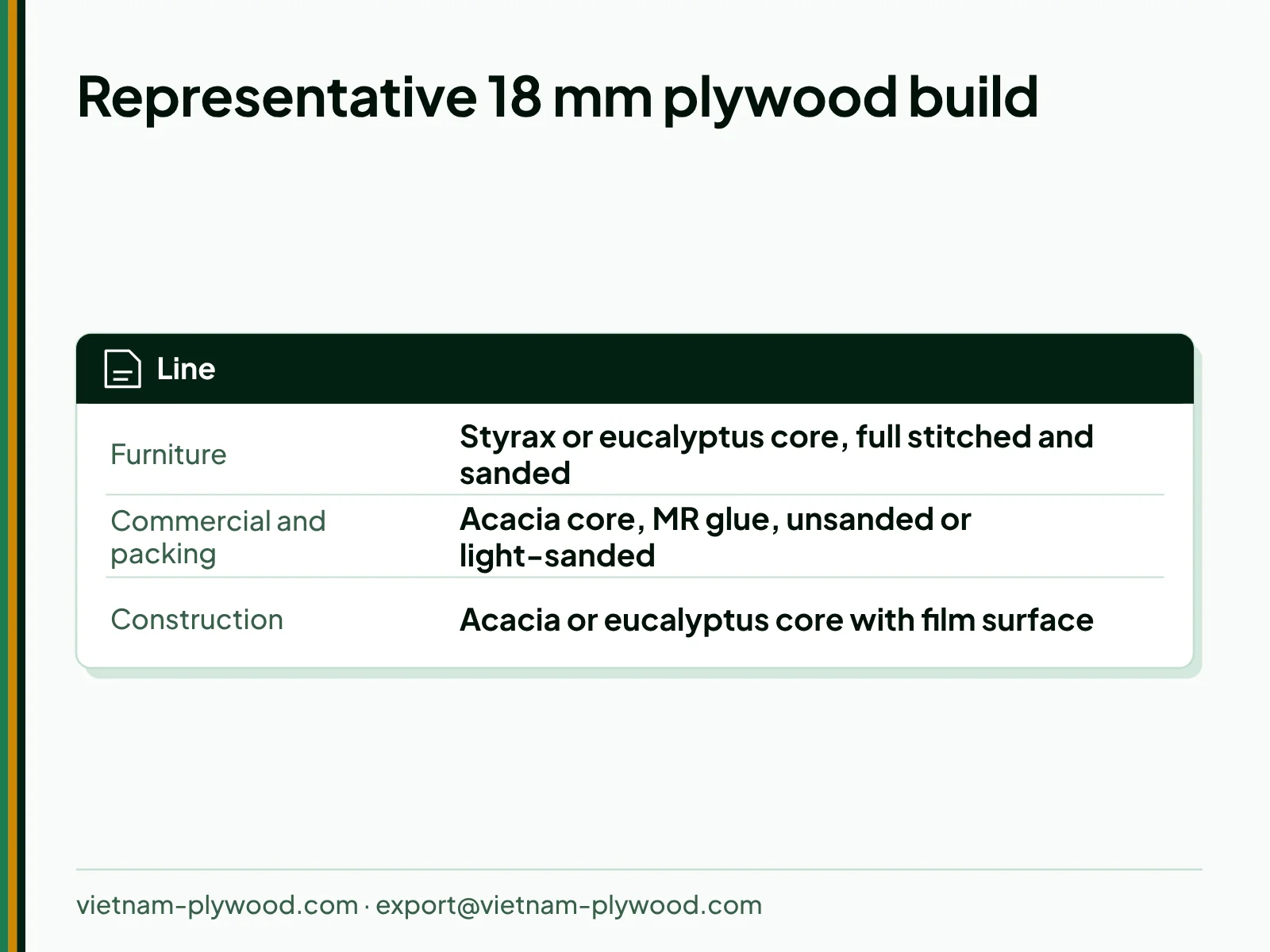
| Line | Representative 18 mm plywood build | Thickness tolerance | Relevant buyer use |
|---|---|---|---|
| Furniture | Styrax or eucalyptus core, full stitched and sanded | ±0.2 or ±0.3 mm as ordered | Furniture and cabinet components |
| Commercial and packing | Acacia core, MR glue, unsanded or light-sanded | ±0.5 mm commercial; ±0.5–1.0 mm packing | Industrial packing and commercial panels |
| Construction | Acacia or eucalyptus core with film surface | ±0.5 mm | Concrete formwork |
For how veneers and pressing affect products, see LVL production processes and LVL strength properties.
What can a buyer inspect and ship together?
At the producing factory, a buyer or inspector can witness identification against the written order, measure dimensions, examine veneer joints and surfaces, and check pallet labels against the packing list. Structural performance, when required, must also be backed by an applicable product-specific testing and evaluation package; a visual inspection cannot replace it.
For a documented plywood loading example, 18 mm sheets at 1220 × 2440 mm have the following full 40HC reference loads: styrax 990 sheets at 26.52 t; acacia 880 sheets at 27.35 t; eucalyptus 795 sheets at 27.69 t. The container payload limit is 28.5 t. Mixed specifications are possible within that limit, but an LVL shipment requires its own measured weights and packing plan; these plywood figures cannot be applied to LVL beams.
The minimum order is one 40HC. For the panel-loading method, consult container packing calculations and mixed-container arrangements.
Which shipping papers support the purchase?
The commercial invoice, packing list, bill of lading and certificate of origin identify the shipped goods and transaction. Shipment paperwork also includes phytosanitary and fumigation papers, insurance under CIF, and agreed certificate or test documents; EU lots carry the relevant EUTR/EUDR file set and EUR.1. After loading, the draft shipping documents come to you for approval.
A buyer ordering framing LVL should make that report a pre-order technical acceptance item, rather than waiting for shipping documents.
Our delivery terms are FOB Hai Phong, CFR (CNF) or CIF. Factory lead time runs 15–45 days from receipt of the 30% deposit; the exact figure depends on order size, line loading and what the contract fixes; the The remaining 70% is paid on the scan of the bill of lading, by T/T, or by irrevocable sight L/C.
What should the written enquiry say?
A useful enquiry names the intended load-bearing or industrial role before naming a grade. For structural use, attach the designer’s required properties and acceptance basis; for industrial packing, describe handling loads and environmental conditions. We can route a specified plywood requirement to the appropriate line and arrange an inspection at the producing factory.
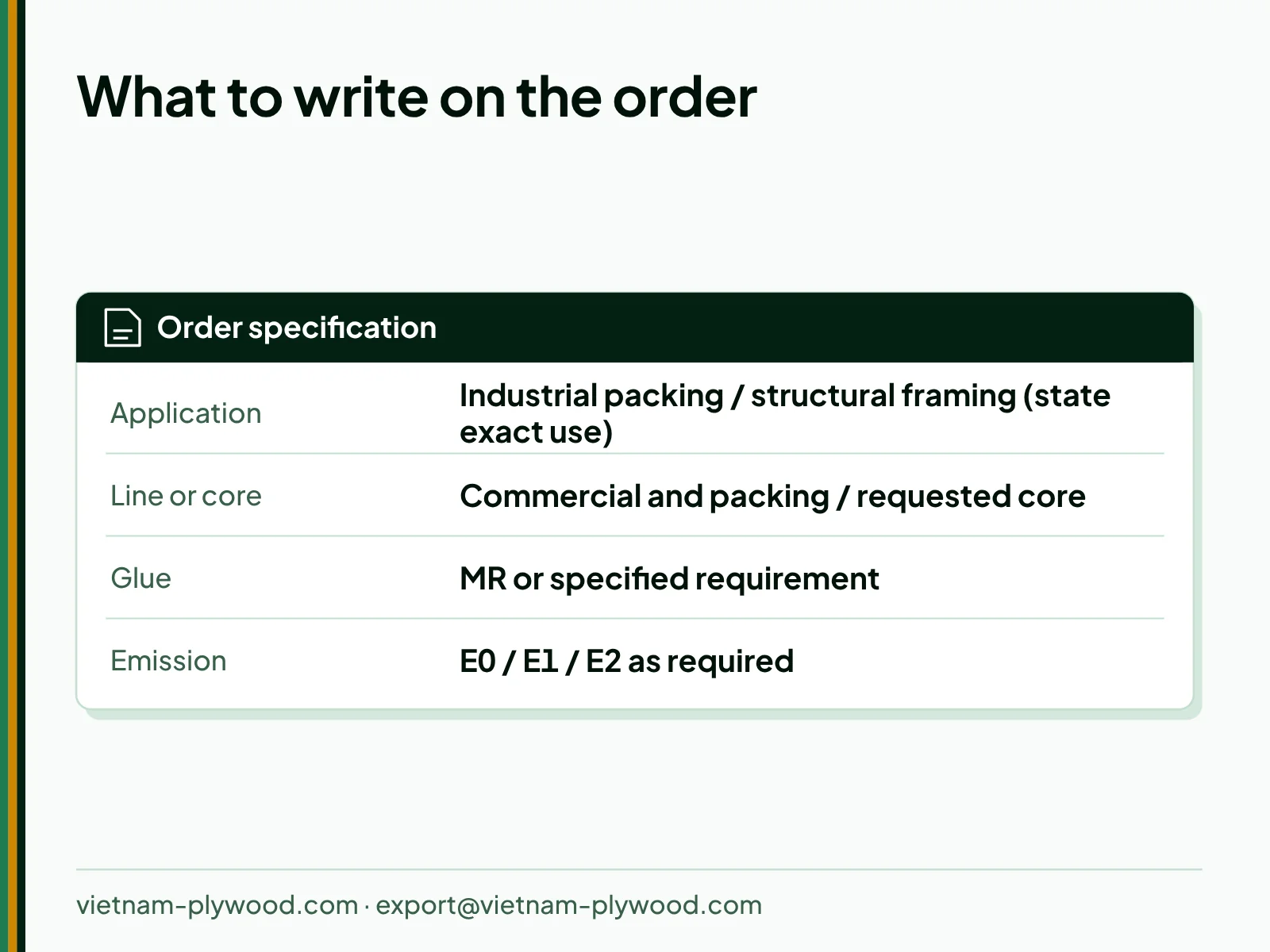
Application: industrial packing / structural framing (state exact use)
Line or core: commercial and packing / requested core
Glue: MR or specified requirement
Emission: E0 / E1 / E2 as required
Face and grade: stated face and appearance grade
Thickness and tolerance: mm and permitted deviation
Size: width × length in mm; beam section if applicable
Quantity: sheets or members and container plan
Destination port: port and country
Structural documents if framing: applicable standard, report, design values
Book a factory visit through Lucy (export@vietnam-plywood.com) to inspect the producing factory and discuss the specification.