






HCPLY can supply Japan-bound plywood against an agreed written specification; the offered panels carry no claimed Japanese certification mark. Ordering a marked construction grade without checking certification can cost an importer a rejected load, replacement material and lost site time. First determine whether the buyer accepts documented, unmarked material.
What is JAS plywood?
JAS plywood is plywood covered by Japanese Agricultural Standards, with product grading and a separate certification route for use of the JAS mark. Japan’s Ministry of Agriculture, Forestry and Fisheries (MAFF), in its JAS system explanation, identifies third-party certification as the basis for marking. A sample test alone cannot authorize marking. Importers should specify both the plywood category and the evidence their customer requires.
MAFF’s JAS system overview (2022) distinguishes standards for product specifications from standards for processes and testing. Its current standards list includes plywood among forestry products. Distinguish the product category from certification status.
This page belongs in our certifications and standards articles, where other market-specific document questions are covered separately.
What does the JAS standard require of imported plywood?
The JAS requirements depend on the product category, declared grade and end use; import origin alone does not create a mark. For a JAS-marked purchase, the importer should obtain the relevant category, grade, certification-body identity and evidence that the producing operator is covered.
MAFF’s certification-system explanation says accredited bodies certify operators and assess whether their output meets JAS criteria. Its official labeling FAQ says manufacturers overseas can also obtain certification through accredited bodies. This means a Vietnam origin does not itself disqualify a product, while origin does not establish certification either.
For an unmarked purchase, put the acceptance route in the purchase order: intended application, drawings, dimensions, face, bond specification, emission evidence and independent testing where requested.
Which JAS category matches the purchase order?
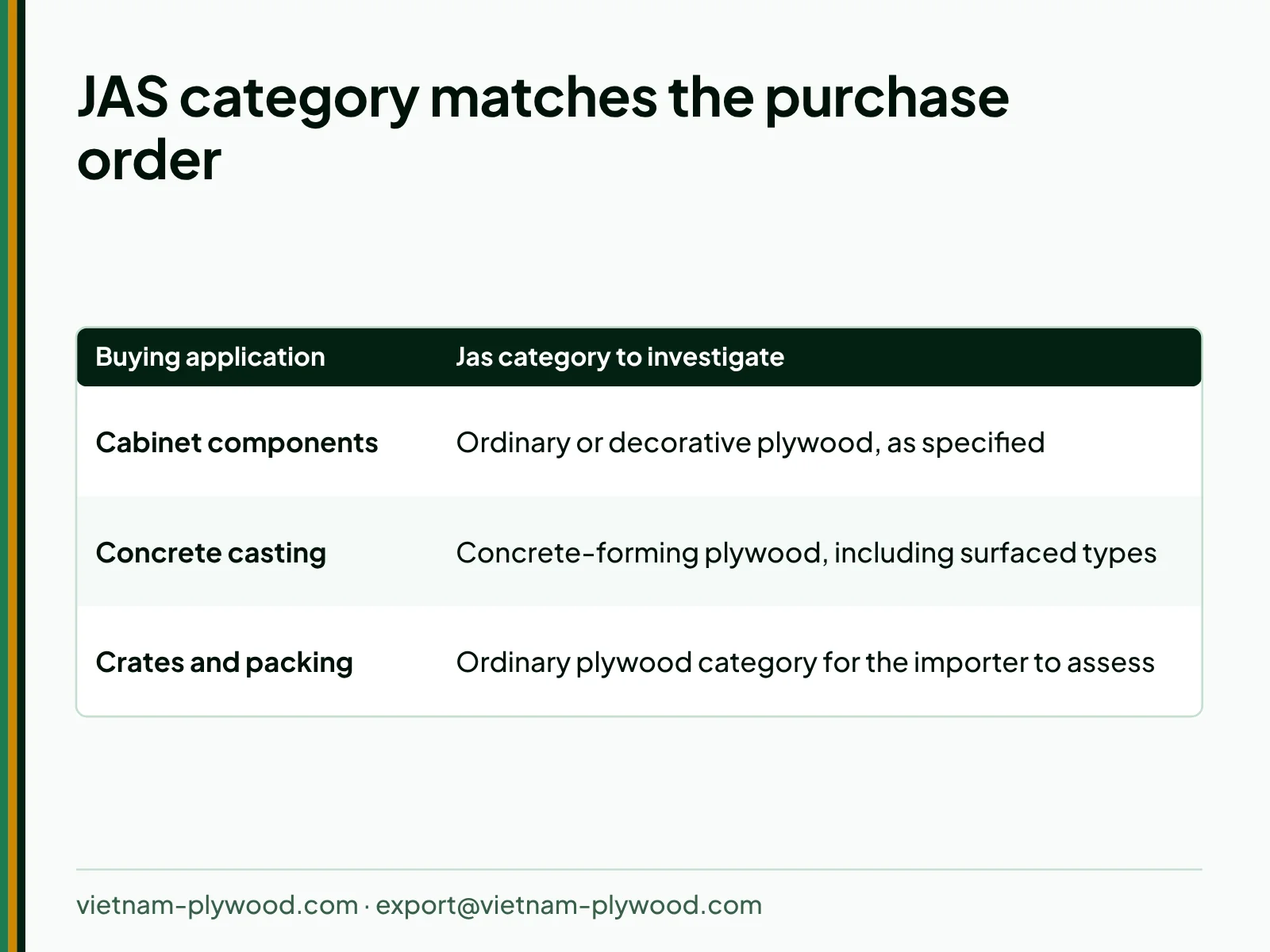
The category follows the intended function, whether casting, cabinets or packing.
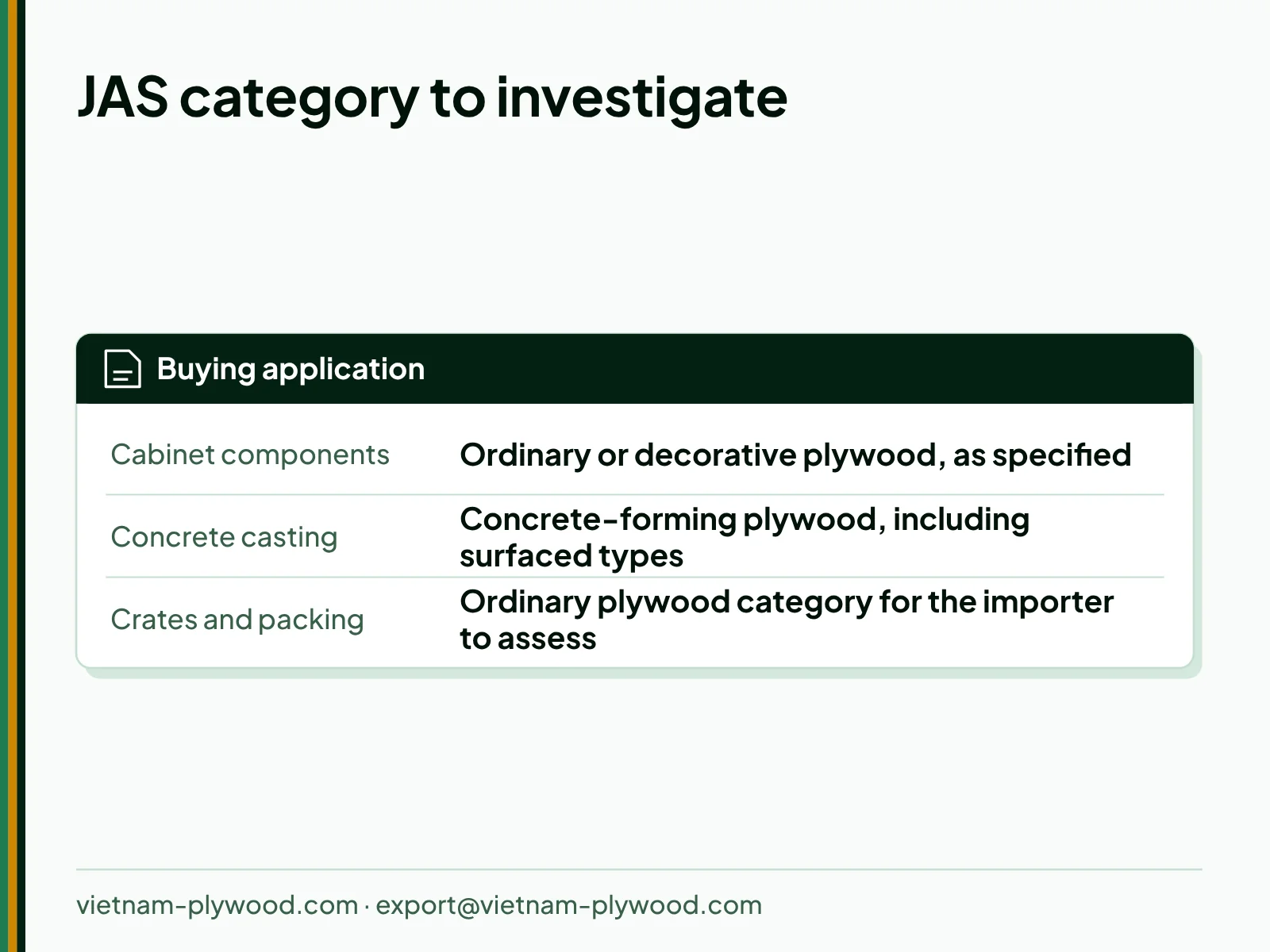
| Buying application | JAS category to investigate | Proposed production line and build | Importer’s decision |
|---|---|---|---|
| Cabinet components | Ordinary or decorative plywood, as specified | Our furniture line: full-stitched sanded styrax or eucalyptus core, E0/E1 emission class | Set face grade, surface finish and emission evidence |
| Concrete casting | Concrete-forming plywood, including surfaced types | Our construction line: film-faced acacia or eucalyptus core | Agree film, bond, size and job acceptance tests |
| Crates and packing | Ordinary plywood category for the importer to assess | Our commercial and packing line: acacia core, MR glue, unsanded or light-sanded | Define packing duty and dimensional limits |
For a comparable 18 mm order, furniture sanded thickness tolerance is ±0.2 or ±0.3 mm as ordered; commercial and film-faced tolerance is ±0.5 mm, and packing tolerance is ±0.5–1.0 mm. The line choice changes what the buyer should inspect even before any Japanese classification is discussed. See our furniture plywood specifications for the cabinet route.
What does F four star mean on plywood for Japan?
F☆☆☆☆, often written JAS F four star plywood, is a Japanese formaldehyde-emission classification, not an adhesive type or a substitute for JAS certification. Request the test method, class and report for the agreed build.
F☆☆☆☆ belongs to Japan’s building-material emission framework, where the class affects interior use. E0 or E1 does not establish F☆☆☆☆.
Glue and emission remain two fields on the order. Melamine MR or phenolic WBP glue specifications are available where applicable; these descriptions do not establish a Japanese star class. For interiors, agree the emission requirement before samples and production, then arrange the accepted testing route.
What is konpane plywood, and what is panekote?
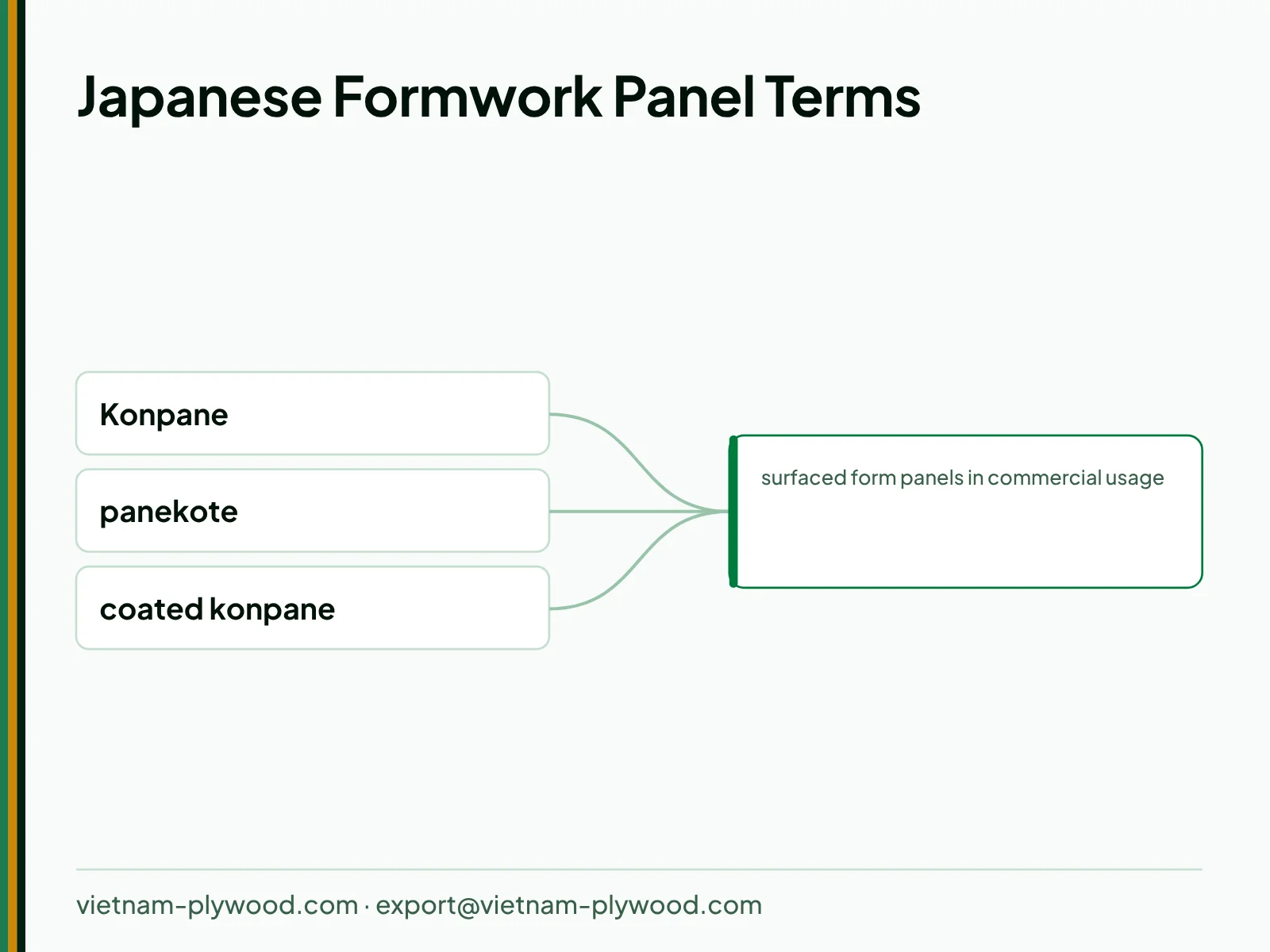
Konpane is a Japanese trade term for concrete-forming plywood; panekote and coated konpane refer to surfaced form panels in commercial usage. The terms do not, by themselves, identify a JAS grade, certificate or measured performance. Specify the finish in the drawing.
Our construction line presses film-faced panels with acacia or eucalyptus core. Available film descriptions are 120 g/m² standard, 135 g/m² premium and 220 g/m² anti-slip only. Specify the casting face, permitted defects and cut-edge treatment.
For concrete release, a coated surface helps the working face, while handling and sealing remain part of the site procedure. With proper handling, a release agent on every pour and sealed edges including cut edges, melamine-glue film-faced panels give about 12–15 pours; phenolic-glue panels up to about 25. These are handling-conditioned figures, not a JAS grade.
What does JAS ask of a 900 × 1800 formwork panel?
A 900 × 1800 mm format describes the requested sheet dimensions; it does not establish compliance with concrete-forming plywood requirements. A Japanese importer must identify the applicable JAS category, grading conditions and project specification separately from the size.
Standard formats include 915 × 1830 mm, with custom cutting available. For a 900 × 1800 formwork plywood inquiry, write the finished size explicitly rather than assuming that a nearby stock size will be accepted. Our standard length-and-width tolerance is ±2 mm; if the site drawing requires another acceptance rule, settle it before production.
Ask the inspector to record actual length, width and thickness at agreed sample positions. Include the face condition, edge sealing, panel flatness acceptance and the labeling requested by the customer.
Does plywood from Vietnam carry a JAS mark?
Vietnam-made plywood can enter the Japanese certification system when the relevant overseas operator is certified. The offered panels carry no claimed Japanese certification mark. MAFF’s official FAQ permits overseas manufacturer certification; its 2022 JAS overview reserves mark application for certified operators.
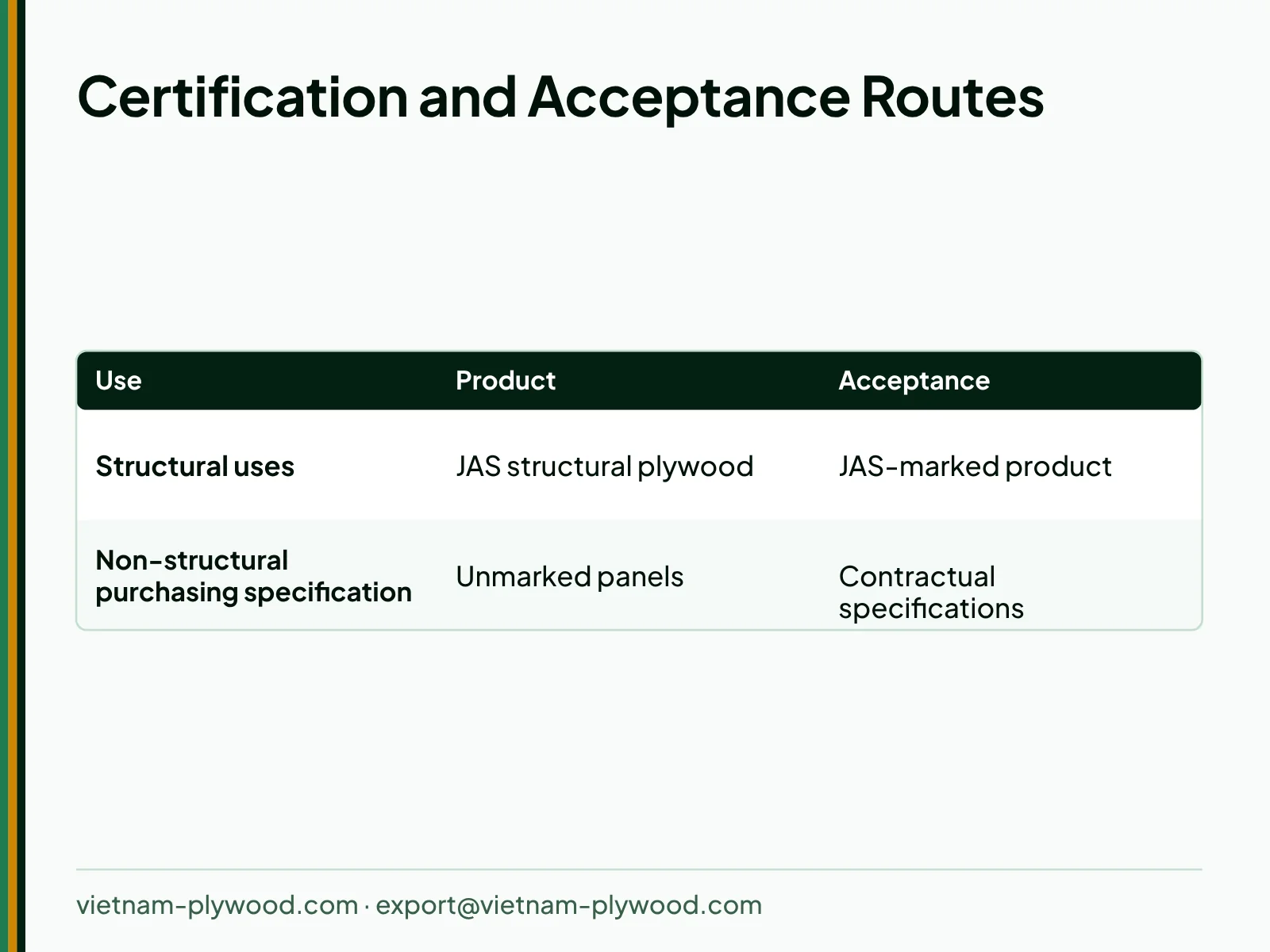
If the Japanese customer demands a JAS-marked product, obtain that requirement before placing the order. If the customer accepts unmarked panels against contractual specifications, write the acceptance tests and documents into the contract. Do not place a JAS symbol or F☆☆☆☆ rating on unmarked stock based on a generic sales description.
This distinction matters most for structural uses. A form panel accepted for a non-structural purchasing specification should not be represented as JAS structural plywood.
What can the buyer inspect at the producing factory?
The buyer can inspect the ordered dimensions, veneer and core arrangement, film surface, edge condition and packing before the container is sealed. HCPLY operates three factories in Phu Tho and Hai Phong; buyers visit the factory office and inspect goods at the producing factory.
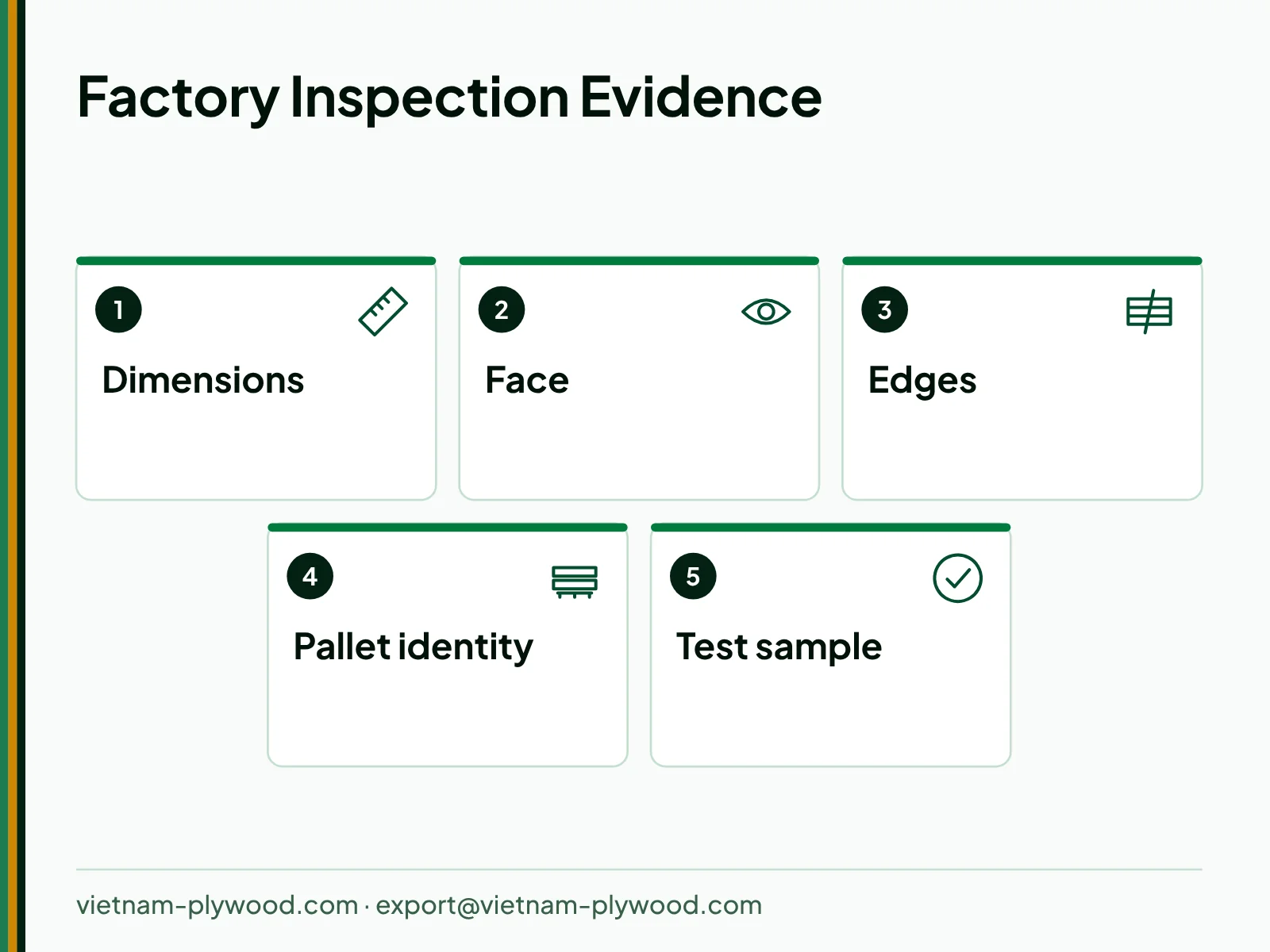
- Match the approved sample and written order to the production batch and face specification.
- Measure thickness and finished dimensions against the agreed tolerance, recording sample locations.
- Examine cut edges for voids, core gaps and sealing; compare film finish with the approved sample.
- Record panel and pallet identification, sheet count and loading condition in an inspection report.
- Where an agreed test is required, identify the sample, laboratory, method and report reference before dispatch.
Inspection records document the goods loaded without conferring a JAS mark. Our on-site quality-control role is to make the agreed build visible and traceable for the buyer.
How does a trial container work for Japan?
A trial container can combine agreed plywood specifications within the 40HC payload limit of 28.5 t. The minimum order is one 40HC, and mixed specifications can be loaded within that limit. See mixed container planning and the container loading reference for the detailed count method.
For example, a full 40HC of 18 mm, 1220 × 2440 mm acacia-core panels is 880 sheets, 47.15 m³ and 27.35 t before film weight. A full styrax-core load at the same thickness is 990 sheets and 26.52 t. Check mixed-order weight pallet by pallet.
We ship FOB Hai Phong, or CFR (CNF) or CIF to your port. Factory lead time runs 15–45 days from receipt of the 30% deposit; the exact figure depends on order size, line loading and what the contract fixes. The remaining 70% is paid on the scan of the bill of lading, by T/T, or by irrevocable sight L/C.
Which export documents support an unmarked order?
Shipment paperwork records identity, origin, quantities and agreed product evidence. Our export team prepares one set of export documents: commercial invoice, packing list, bill of lading, certificate of origin, phytosanitary and fumigation papers, plus insurance under CIF and any agreed certificate or test reports.
After loading, the draft shipping documents come to you for approval. Match the invoice and packing list to the contract’s panel description, quantity and finished dimensions. For a Japanese emission or bond test, the agreed report should identify the tested build and its test method.
Member-factory FSC, CARB P2, ISO 9001 or CE certificates can be shown with factory details masked, on request. None of those substitutes for JAS certification. Buyers comparing document routes for other destinations can consult our UK timber-import requirements and EU timber due-diligence comparison.
How should an importer write the first inquiry?
The first inquiry should identify the Japanese customer’s acceptance route and the exact panel build. We can then direct the request to the appropriate production line, prepare samples and set inspection points before the trial order.
Samples cost nothing: a first-time buyer pays the courier, and that charge comes off the first confirmed order. Send Lucy at export@vietnam-plywood.com the end-use specification and any Japanese purchaser drawing or testing clause. For a recurring program, see distributor supply planning.
Application: Japan concrete formwork / cabinet components; JAS mark required or unmarked acceptance route
Line or core: construction / acacia or eucalyptus; furniture / styrax or eucalyptus
Glue: melamine MR or phenolic WBP, as agreed
Emission: requested class and accepted test method/report
Face and grade: film weight and surface acceptance / veneer species and A/B grade
Thickness and tolerance: ___ mm; ___ mm
Size: ___ × ___ mm finished
Quantity: ___ sheets / pallets; one 40HC trial
Destination port: ___, Japan
Next step: plan a trial container with Lucy against this written specification.