





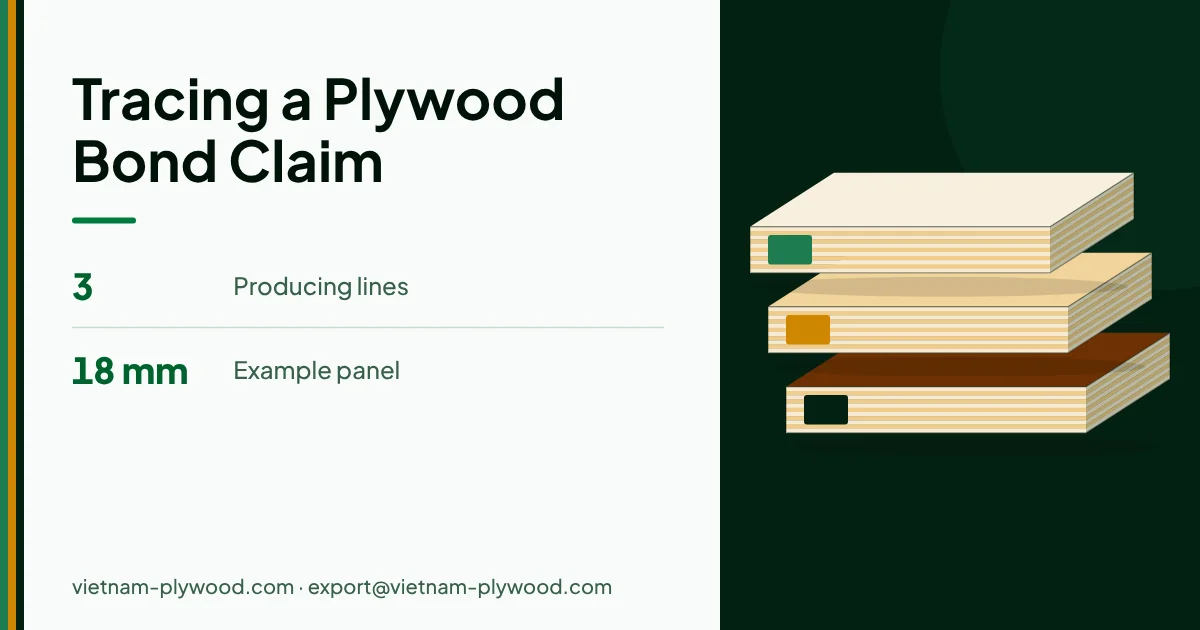
A delamination claim belongs with the line that pressed the plywood and the evidence of its bond. Choosing the wrong glue or missing a failed interface can cost rejected loads, machining waste and delivery days. HCPLY traces the disputed panel through its producing factory, comparing the ordered build with pre-loading checks and the buyer’s failure evidence.
What causes delamination of plywood?
Delamination of plywood starts when a veneer-to-veneer bond loses continuity or strength. Causes include incomplete glue coverage, unsuitable adhesive for the exposure, uneven veneer moisture, inadequate press contact, and wet storage. The location of the split and its history help distinguish a manufacturing bond fault from damage after delivery.
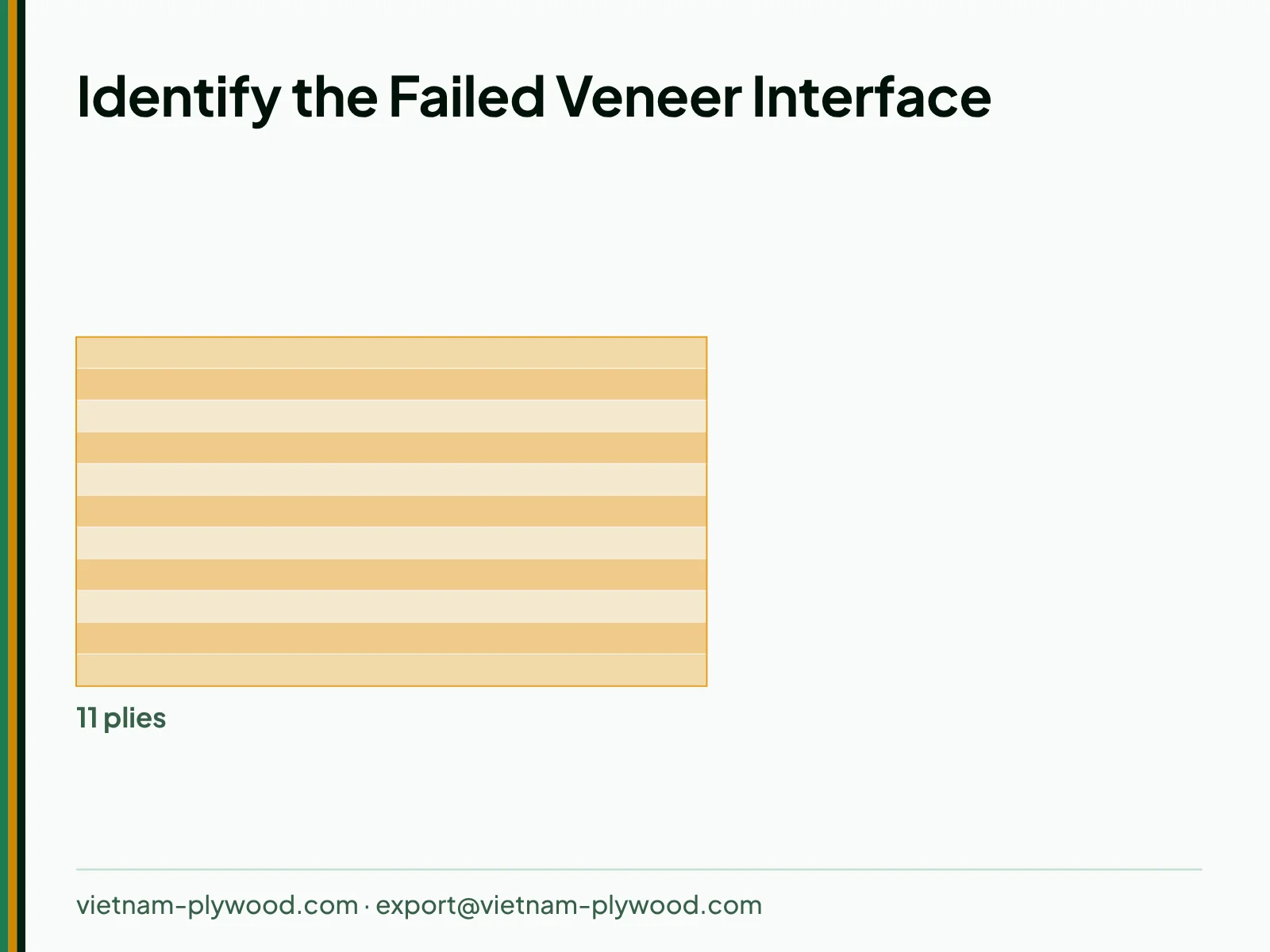
A split at an internal glue line differs from a torn face veneer or a film coating lifting from its surface. Record which interface opened before deciding which production step to investigate. A separated core can spoil machining accuracy and trigger rejected loads.
A face photograph alone rarely settles a delamination claim. Compare the failed interface with the ordered adhesive and the agreed bond-test method before assigning a cause.
Why do the layers of a plywood sheet peel apart?
Layers peel apart when the force holding adjacent veneers together falls below the stress placed on their interface. Peeling plywood can start at an exposed edge, a void, a saw cut or an area that has repeatedly absorbed water. Once an opening forms, moisture and handling can extend the split.
Look at the fracture surface. Clean, smooth veneer faces with little torn fibre suggest that the adhesive interface deserves investigation. Torn wood fibres point toward a different failure path, although photographs alone cannot establish a formal bond classification. A narrow surface check can resemble delaminated wood without reaching the glue line.
The 2021 APA moisture-damage FAQ discusses how to identify plywood delamination after severe wetting. Its guidance is useful for distinguishing an opened bond from changes in panel appearance. HCPLY asks buyers to identify the failed interface and exposure history before assigning a cause.
How do glue-line, press and veneer-moisture faults differ?
A glue-line fault begins with poor adhesive distribution, wetting or selection. A press fault leaves insufficient contact or cure at the intended interface. A veneer-moisture fault changes how the adhesive wets the wood and how the veneers move after pressing.
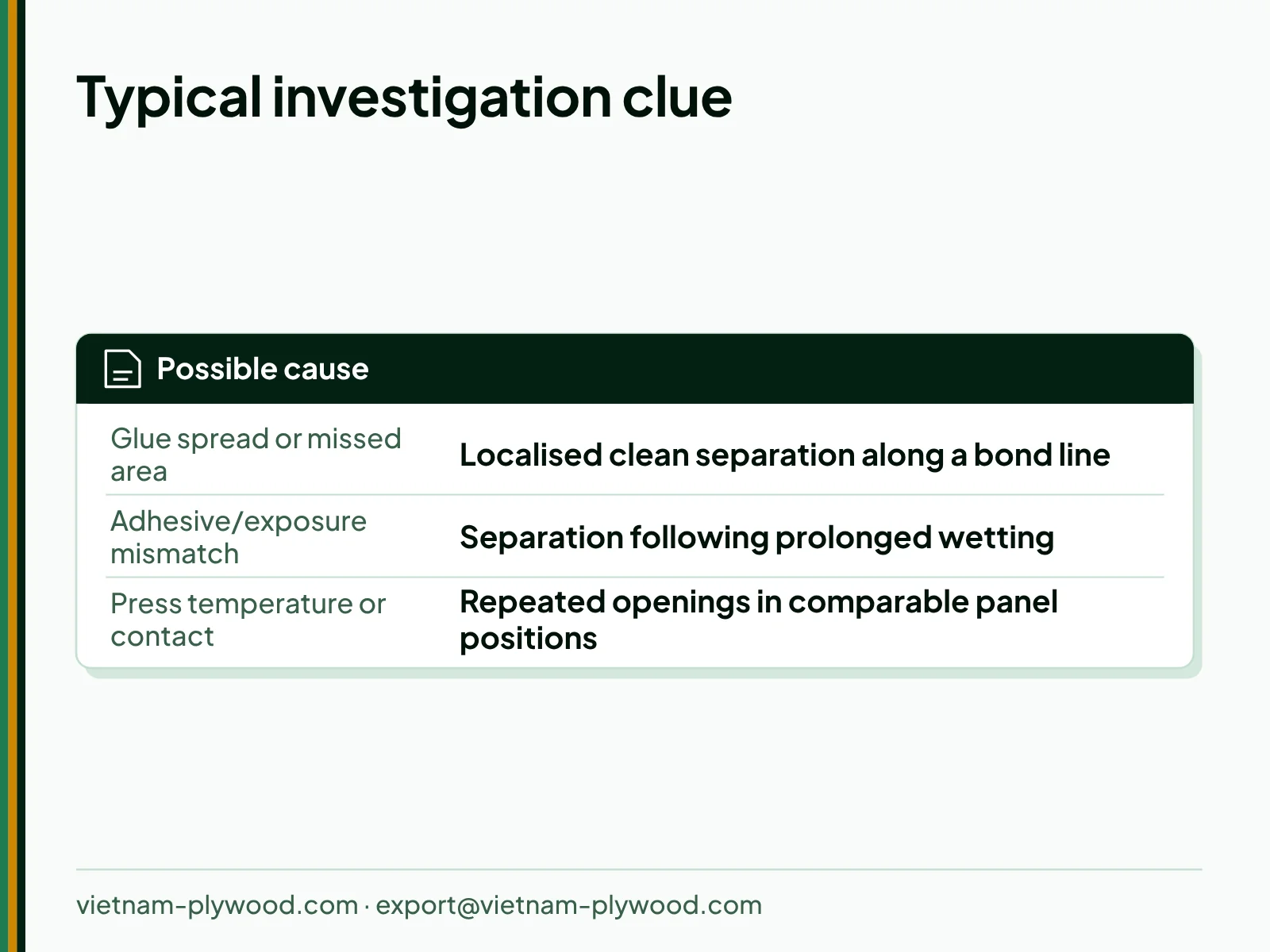
| Possible cause | Typical investigation clue | Factory record or check to compare |
|---|---|---|
| Glue spread or missed area | Localised clean separation along a bond line | Glue specification, application and cut-edge inspection |
| Adhesive/exposure mismatch | Separation following prolonged wetting | Ordered glue system and agreed conditioning method |
| Press temperature or contact | Repeated openings in comparable panel positions | Press setting and sampled cross-sections |
| Uneven veneer moisture | Distortion and splits around changing moisture exposure | Veneer drying and finished-panel observations |
| Core gaps or uneven veneer | Weak contact near internal discontinuities | Core layout and edge cross-section |
Our melamine moisture-resistant (MR) system has a 12-hour boil condition; phenolic weather-and-boil-proof (WBP) has a 72-hour boil condition. These are glue-system descriptions, not interchangeable claims of a finished panel’s measured bond strength. Our MR hot-press range is 110–120 °C; WBP is 130–145 °C. Temperature alone cannot establish cure without the other process conditions.
The British Standards Institution’s 1993 EN 314-2 listing separates bonding-quality requirements by end use. EN 314-1 identifies the associated testing framework. Agree the required class and conditioning procedure in the purchase specification rather than assuming a glue label establishes a test result.
Which producing line should answer a bond claim?
The producing factory answers the claim because its core layout, adhesive choice and press record identify the relevant interface. HCPLY operates a furniture line, a commercial and packing line, and a construction line in Phu Tho and Hai Phong. The order is built at the factory suited to its specification.
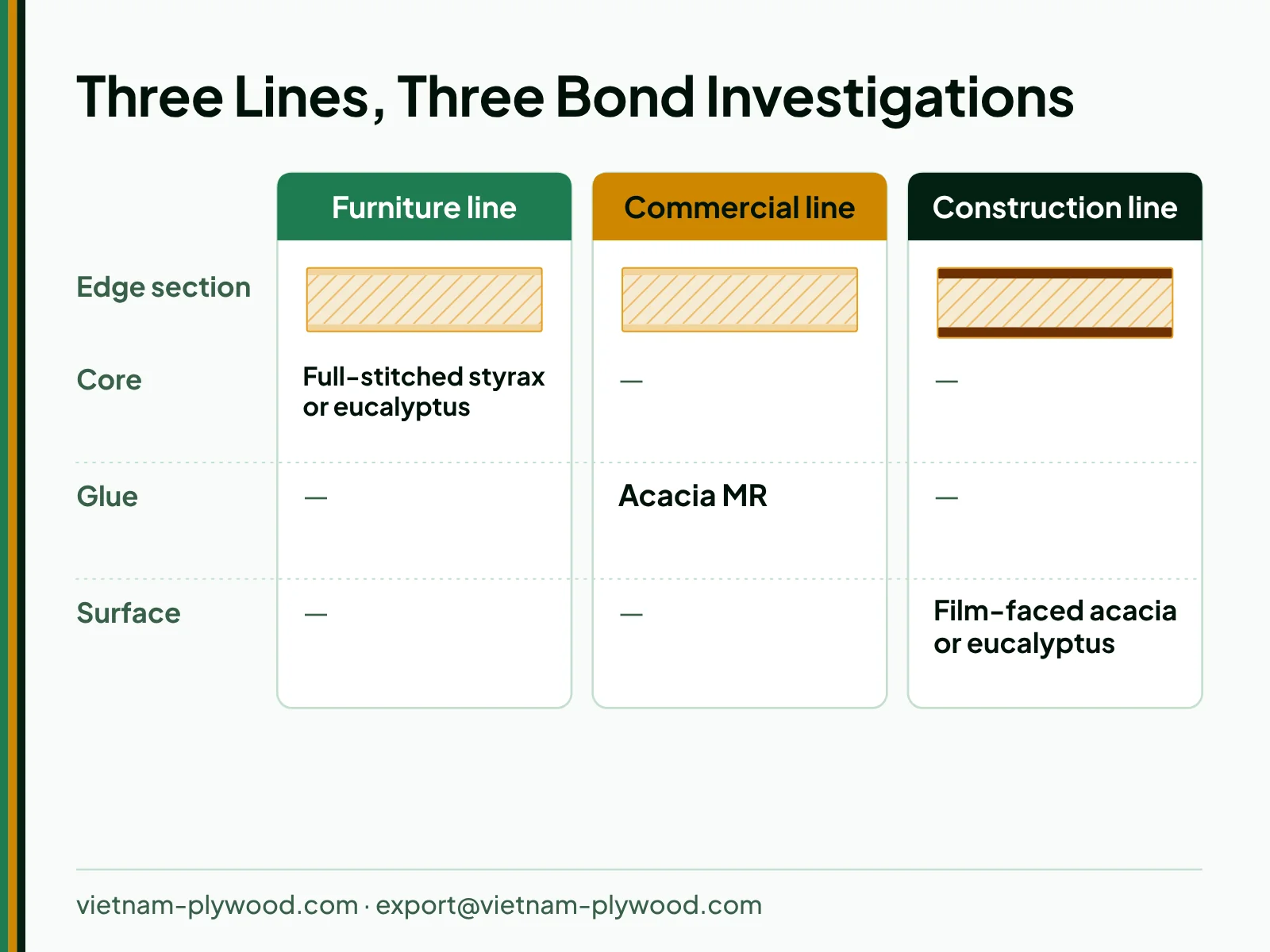
| Line | Build at 18 mm | Bond investigation priority | Different intended use |
|---|---|---|---|
| Our furniture line | Styrax or eucalyptus core, full stitched, sanded | Continuous internal bonds and machining edges | Furniture and cabinet components |
| Our commercial and packing line | Acacia core, MR glue, unsanded or light-sanded | Core contacts, gaps and packing exposure | Commercial sheets and packaging |
| Our construction line | Acacia or eucalyptus core, phenolic or melamine film, unsanded | Internal bond versus film-surface failure | Concrete formwork |
At 18 mm, a sheet can contain 11–13 plies because core veneer thickness is 1.4–2.0 mm. That range matters when locating the failed layer: the face and the internal core interfaces require separate photographs. A film lifting off the panel surface is investigated separately from veneer layers splitting within the core.
For the application choice, compare furniture plywood with commercial and packing plywood. The wider glue and emission category covers adjacent specification decisions.
What bond check can an inspector witness before loading?
A buyer or inspector can witness a sampled cross-section examination and an agreed bond-conditioning check at the producing factory before loading. The check should match the ordered glue and acceptance method. Record the sampled pallet or production batch, specimen preparation, conditioning, visible separation and any laboratory result.
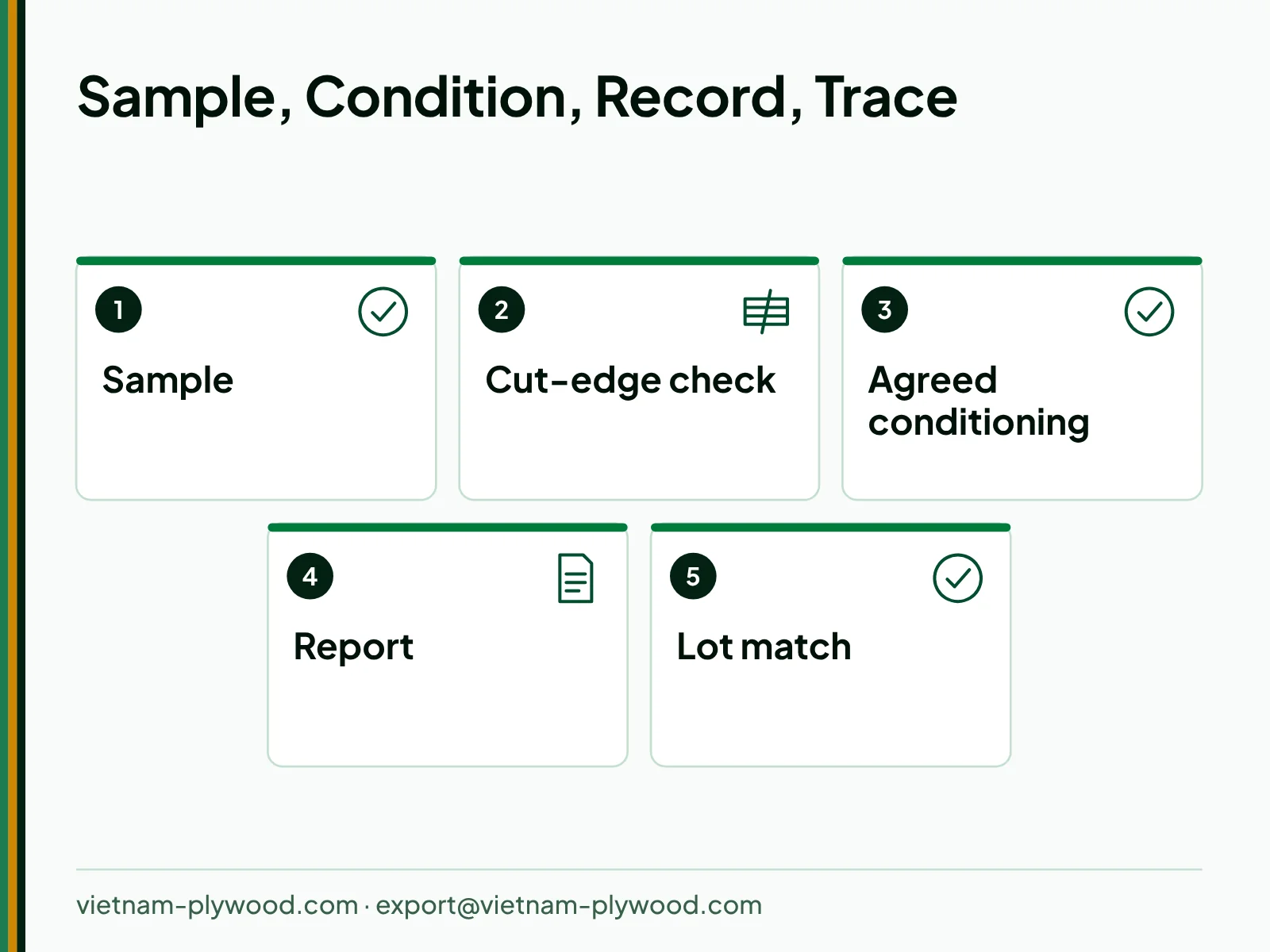
- Select representative sheets from the producing lot and identify the sample locations on the pallet record.
- Examine freshly cut edges for continuous layers, voids and already-open glue lines; photograph both faces and edges.
- Prepare specimens using the test method and conditioning cycle written in the order, with the inspector witnessing preparation.
- Record the outcome against the agreed acceptance criterion, including any failure surface and the test report reference.
- Attach the inspection record to the shipment’s traceable lot information before release for loading.
A cut-edge inspection is a screening observation, while a specified laboratory bond test establishes the agreed measured result. The BSI’s 2006 publication listing for EN 314-1 identifies plywood bonding test methods; it does not make every factory edge check an EN 314 test. A buyer can ask for the method, specimen conditioning and pass criterion on the specification sheet.
Our on-site quality control can coordinate that witness point at the producing factory. The agreed test report belongs with the order’s certificate documents, where a buyer can match the result to the actual build.
Can thickness, core layout or face grade hide a bond problem?
Thickness, core layout and face grade can affect where a split is found, but appearance grade cannot establish bond integrity. A clean face can conceal a void between inner veneers. Conversely, a visible face check can occur without an internal glue-line failure.
Our furniture line uses full-stitched cores and sanding; the commercial and packing line can use different core constructions according to the order. Across core construction choices, full stitched ranks above stitched outer layers with edge-trimmed inner veneers, then finger-jointed and loose-laid. Record the specified construction rather than inferring it from the face species.
For sanded furniture plywood, ordered thickness tolerance is ±0.2 or ±0.3 mm. Commercial and film-faced tolerance is ±0.5 mm, while packing plywood is ±0.5–1.0 mm. Length and width tolerance is ±2 mm. These measurements help match a disputed sheet to the order; none is a substitute for a bond test.
Face species name the product, whereas density follows the core. For example, bintangor-faced plywood can still have a styrax or eucalyptus core. Keep face and core fields separate when reporting a delaminating plywood panel.
How can transport or storage exposure affect the claim?
Water exposure, condensation and repeated moisture cycling can extend an existing opening or place new stress on veneer bonds. Record when the defect first appeared: before loading, on container opening, after warehouse storage or after machining. That chronology directs the investigation toward the right evidence.
APA’s 2017 moisture-exposure recommendations distinguish bond classifications according to service moisture conditions. APA’s 2021 dimensional-stability topic explains that wood panels respond to humidity and wetting through expansion and swelling. These sources describe material behaviour; they do not establish the cause of an individual shipment claim.
Photograph container walls, floor, wrapping, pallet condition and any water marks before moving the goods. Record warehouse humidity or wetting events when known. Retain an unopened comparison bundle where practical. If panels were cut or laminated after arrival, identify the processing date and the location of each opening.
Segregate affected sheets and protect stock from wetting. Preserve the original fracture surface for examination.
What evidence should a buyer send with a delamination claim?
Send the purchase specification, lot identification, affected quantity, failure photographs and exposure timeline. These items let the factory compare the disputed interface with the ordered build and the pre-loading inspection record.
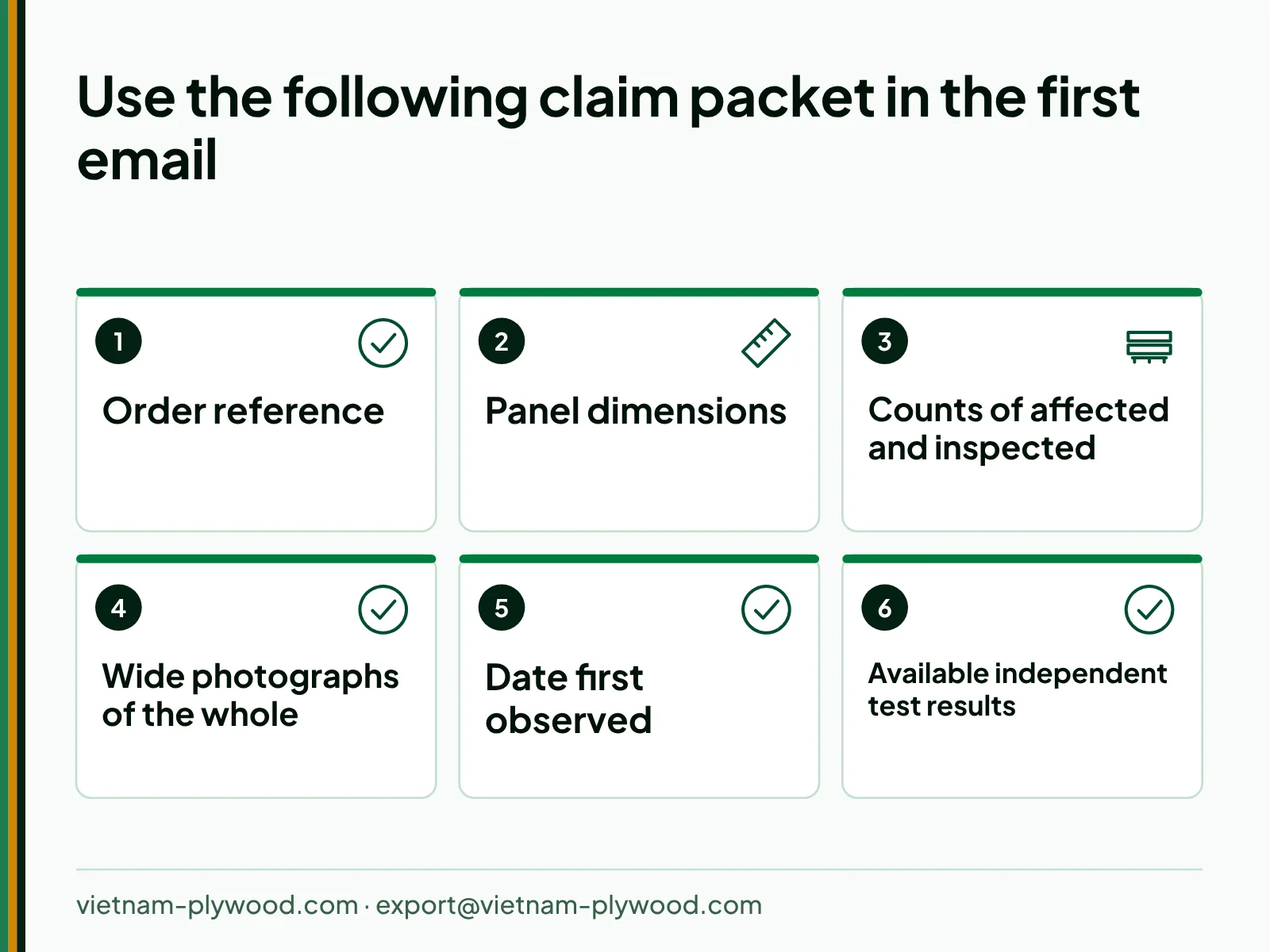
Use the following claim packet in the first email:
- Order reference, invoice or packing-list reference, container and pallet marks, and destination port.
- Panel dimensions, face and grade, core, glue, emission class and the intended application.
- Counts of affected and inspected sheets, with a clear sampling method and locations across pallets.
- Wide photographs of the whole panel, close-ups with a ruler, and a cut edge showing the exact failed interface.
- Date first observed, storage and transport conditions, and any wetting, cutting, finishing or pressing after delivery.
- Available independent test results with the method, specimen identification, conditioning and acceptance threshold.
Do not discard representative failed sheets. Keep a matching unaffected sheet and a sealed sample if an independent examination is needed. If the failure occurs only after a specific downstream process, describe the adhesive, heat or moisture introduced by that process without assuming its effect.
The commercial invoice and packing list identify the shipped goods; the agreed test report connects the technical acceptance criterion to the build. Draft shipping documents are sent for buyer approval after loading. This link between commercial identity and technical evidence is what makes a claim answerable.
How is a claim traced to the producing factory?
HCPLY traces a claim from shipment identifiers to the factory that pressed the disputed lot, then compares the ordered specification with the observed failure. The buyer’s packet begins the investigation; the producing factory supplies its applicable production and inspection context.
- Match the invoice, packing list and pallet identification to the shipment and producing line.
- Locate the ordered core construction, glue system, face and thickness specification.
- Compare the affected interface and sample distribution with the relevant press and inspection observations.
- Reconcile the agreed bond-test method with the test report and any independent retest.
- Issue a written technical response identifying the evidence reviewed and the next commercial decision.
A localised glue-skip pattern warrants different follow-up from widespread water damage after unpacking. A consistent opening at the same inner ply warrants examination of the matching manufacturing stage. Both situations need physical samples before a final cause is assigned.
For mixed-product export orders, several plywood types under one supplier explains how different applications can be specified together. The shipment identity still points each affected product to its own producing line.
Which specification prevents the next bond dispute?
A written bond specification prevents ambiguity by connecting intended exposure, adhesive, core construction and acceptance method before pressing. Start with whether the finished part will remain dry, face intermittent moisture or face repeated wetting. Then choose the adhesive and test criterion that correspond to that use.
Glue and formaldehyde emission are separate fields. E0, E1 and E2 describe emission classes; they do not describe a glue recipe or prove resistance to boiling. For furniture orders, record the required emission class alongside the MR or WBP adhesive choice. Compare melamine and phenolic glue for furniture and phenolic WBP glue before fixing the specification.
Choose the face grade for appearance and the core layout for internal continuity. State whether edges will be machined or left exposed. For a wet-service claim, include the exact test standard, conditioning procedure, pass criterion and whether the report must come from an independent laboratory.
The producing factory can show relevant member-factory FSC, CARB P2, ISO 9001 or CE documents with factory details masked, on request. Certificate paperwork and bond-test reports answer different questions; request the documents relevant to the actual order.
What should the buyer send to request the spec sheet?
Send a complete application and build description so Lucy can return the appropriate specification sheet and bond-check proposal. HCPLY handles specification, on-site QC, shipping documents and loading for orders shipped from the relevant factory.
Application: cabinet parts / fit-out / distribution / packing / formwork
Line or core: furniture / commercial and packing / construction; styrax / acacia / eucalyptus
Glue: melamine MR / phenolic WBP; required bond-test method and criterion
Emission: E0 / E1 / E2; applicable market documentation
Face and grade: species; A/B or birch D/E/F; film type if applicable
Thickness and tolerance: ___ mm; ___ mm
Size: ___ × ___ mm
Quantity: ___ sheets or ___ m³
Destination port: ___
Request the spec sheet from Lucy at export@vietnam-plywood.com through contact.