





HCPLY supplies plywood from Vietnam to Japan with factory specifications, shipment documents and timber-origin records for the Japanese importer’s filing. A mismatch between the ordered emission evidence, structural marking requirement and import paperwork can mean extra testing costs, storage days or a rejected load. For buyers asking how do I import plywood from Vietnam to Japan, the first decision is the Japanese end use.
How do I import plywood from Vietnam to Japan, step by step?
Start by fixing the Japanese application and its acceptance documents, then agree the plywood build, inspect production, arrange shipment and file the import declaration. The importer handles Japanese customs and Clean Wood Act duties; we prepare the producing factory’s records and export documents. Agree the evidence route before placing the order.
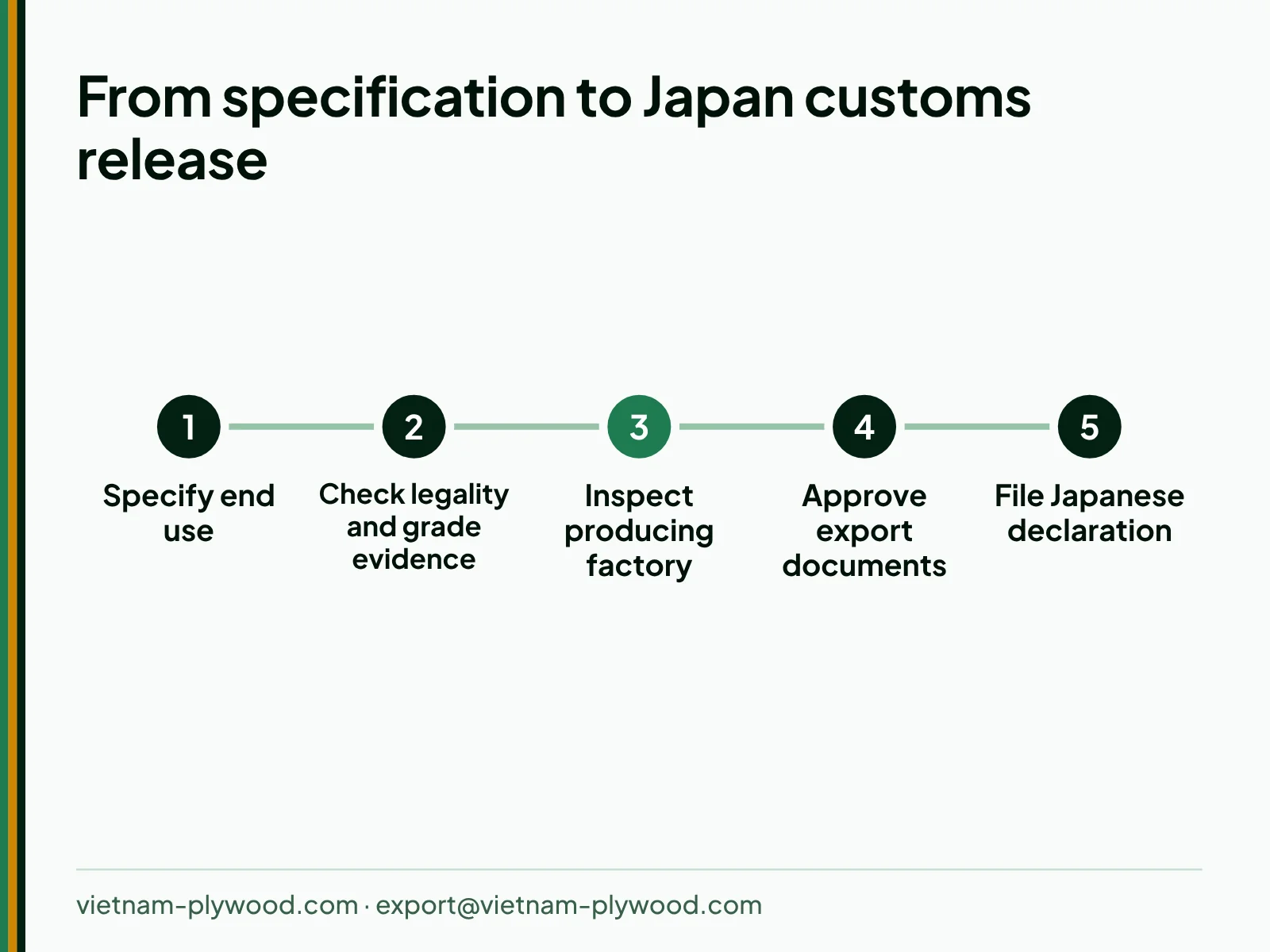
- Define the use. Identify furniture, cabinets, packing or construction, the destination port and any customer requirement for F★★★★ or Japanese Agricultural Standards (JAS) marking.
- Write the acceptance specification. Record core, face, glue, emission class, thickness, tolerance, sheet size, quantity and which test or certification documents the buyer will accept.
- Review legality evidence. The Japanese importer requests species, harvest country and relevant proof of lawful harvest before finalizing the order.
- Approve the producing line. Review a sample and agree the inspection checklist, including any independent test route.
- Book production and shipping. The minimum order is one 40HC; specifications can be mixed within the payload limit. Production takes 15–45 days from the 30% deposit, set by order size, line loading and the contract.
- Inspect and load. Inspect the finished lot at the producing factory; we prepare shipment papers and send draft shipping documents for buyer approval after loading.
- Clear in Japan. The importer or its customs broker files the declaration, addresses any applicable product controls, pays assessed charges and arranges release and delivery.
- Check the received lot. Match bundle identification, dimensions and condition to the packing list and agreed specification; see checking plywood on arrival.
For the broader export sequence, see how to import plywood from Vietnam.
Which Japanese import documents do we prepare?
We prepare the export-side records; the importer prepares and submits the Japanese declaration. Japan Customs, in its online 1107 import-clearance guidance, lists an invoice and bill of lading or sea waybill, with other supporting documents as applicable: Japan Customs document guidance.
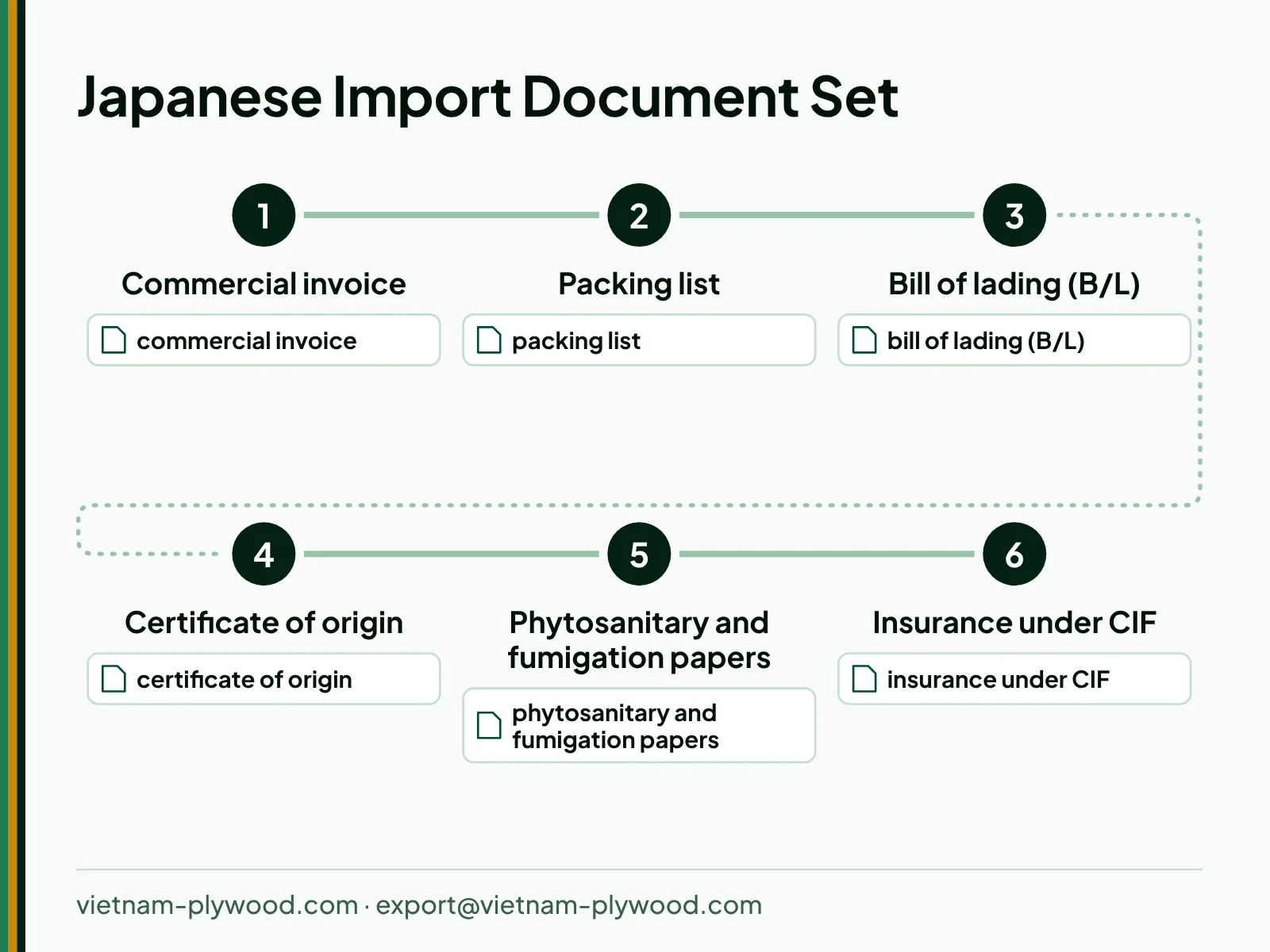
Our shipment paperwork comprises the commercial invoice, packing list, bill of lading (B/L), certificate of origin, phytosanitary and fumigation papers, insurance under CIF, and the order’s agreed certificate documents or test reports. The applicable factory certificates are shown with factory details masked, on request.
The buyer’s customs broker should check classification, origin treatment, applicable duties, consumption tax and any permits against the actual goods. Japan Customs’ 2025 declaration-item guidance requires the goods’ code, quantity, price, origin and shipping location, among other particulars: declaration fields. Compare the complete seven essential plywood import documents before approving drafts.
What legality records does Japan’s Clean Wood Act require?
Japan’s revised Clean Wood Act requires covered first-tier wood businesses, including importers, to collect and organize raw-material information and check legality. The Japanese Forestry Agency’s 2025 revision guidance identifies three information groups: wood species, harvest region and supporting evidence. Its official explanation also explains the importer’s evaluation and record-handling duties.
For a Vietnamese plywood order, request the species used in the core and relevant face veneers, the country of harvest for each wood input, and documents relevant to lawful harvesting. Vietnam as the manufacturing country does not automatically establish the harvest country of every veneer. The Japanese buyer evaluates the evidence under its own legal process and keeps the records required for its role.
Our export team coordinates the producing factory’s available material-origin information with the order and shipment identification. Ask for the legality-document list before paying the deposit, especially where different veneers or batches enter one order.
Is F★★★★ required for furniture plywood imported into Japan?
F★★★★ is the highest formaldehyde-emission classification in the Japanese plywood scheme, but it is not a universal import-entry requirement for every furniture panel. Its relevance turns on the panel’s use, applicable Japanese building controls and the buyer’s purchasing specification. The Japanese Plywood Manufacturers’ Association’s JAS classification explanation lists F★★★★ alongside lower emission categories for ordinary plywood.
A buyer specifying F★★★★ should require an accepted Japanese test and classification route in writing before production. Our furniture line uses E0 or E1 emission classes, which must not be represented as F★★★★ equivalence. Adhesive selection and formaldehyde-emission classification are separate fields; an MR or WBP glue description does not settle the Japanese emission grade.
For cabinet components and interior projects, ask the Japanese customer which application rule and evidence format govern acceptance. This avoids ordering an E1 panel and discovering that the project specification requires a different recognized classification. Review furniture plywood for the physical build options.
Does plywood from Vietnam carry a JAS stamp?
Vietnamese origin alone neither grants nor prevents JAS marking; a JAS mark depends on the applicable certification and inspection arrangements. A marked panel requires a separately certified production route. The Japanese Plywood Manufacturers’ Association describes separate JAS categories for ordinary, structural and concrete-form plywood in its standards overview.
Do not treat a laboratory strength result, a face grade or an export inspection as permission to apply a JAS mark. If the purchase order explicitly requires a JAS stamp, establish a certified supply route before placing that order. For a non-marked specification, agree the test report the buyer accepts; a mandatory marked order needs its own certified route.
What does a JAS-stamped structural order require?
A JAS-stamped structural order requires the buyer to specify the relevant structural plywood category, grade, dimensions, marking and certification acceptance route. The association’s standards overview distinguishes structural plywood from ordinary plywood and lists structural grades separately. Structural use also calls for the project’s design and inspection requirements to be identified before procurement.
Film-faced formwork plywood uses acacia or eucalyptus core and phenolic or melamine film; structural sheathing has a separate marking and acceptance route. A buyer seeking structural performance without that mark must identify the test report the buyer accepts and verify that the intended Japanese use permits that route.
Which producing line should make the order?
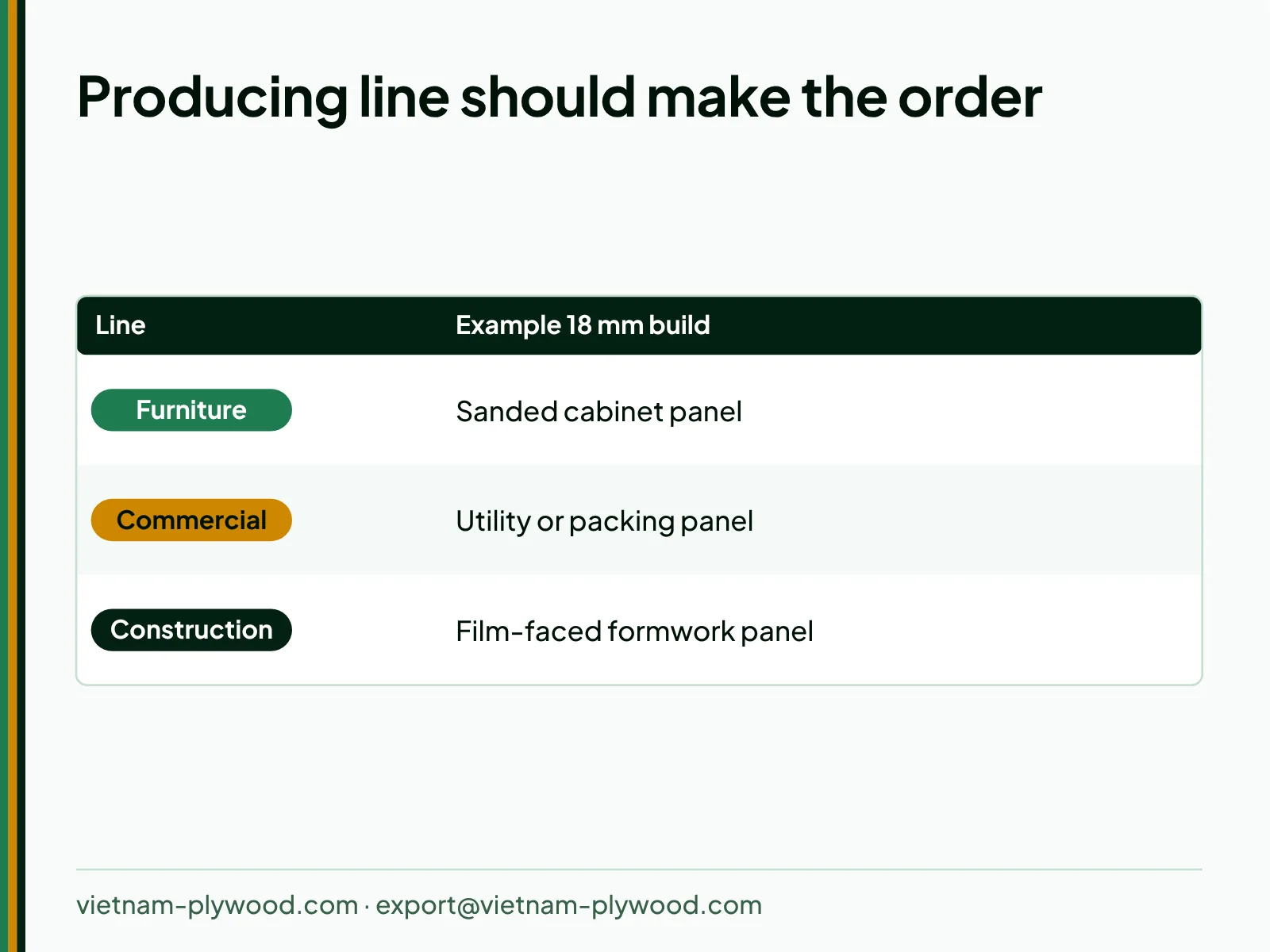
The producing factory follows the application and specification, rather than the destination country. The same 18 mm nominal thickness can represent three materially different builds:
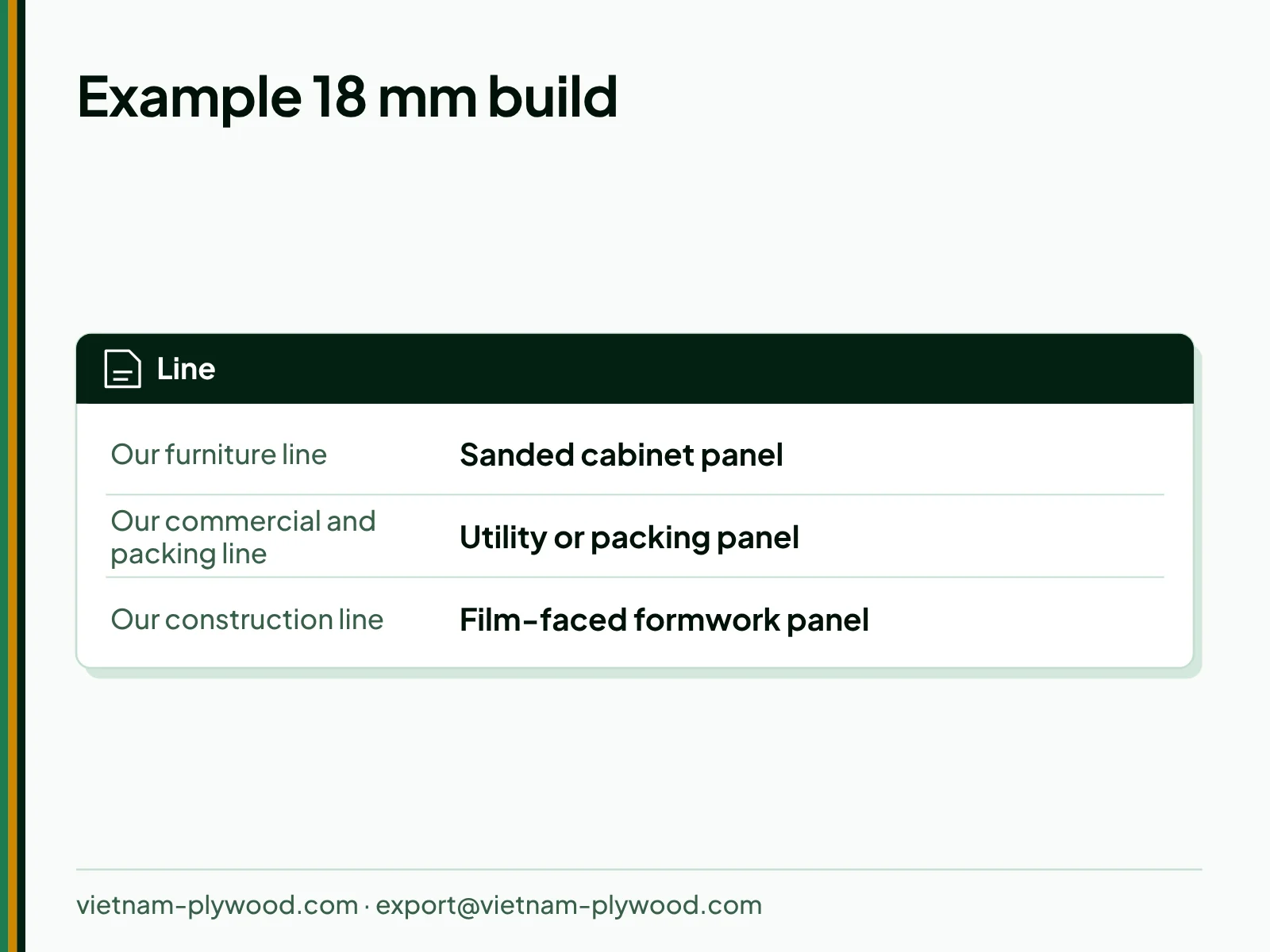
| Line | Example 18 mm build | Core and finish | Ordered thickness tolerance | Appropriate Japanese buying use |
|---|---|---|---|---|
| Our furniture line | Sanded cabinet panel | Styrax or eucalyptus; stitched core; selected veneer face | ±0.2 or ±0.3 mm | Cabinet and furniture components after emission-evidence review |
| Our commercial and packing line | Utility or packing panel | Acacia; MR glue; unsanded or light-sanded | ±0.5 mm commercial; ±0.5–1.0 mm packing | Packing and general non-structural uses |
| Our construction line | Film-faced formwork panel | Acacia or eucalyptus; film finish; unsanded | ±0.5 mm | Formwork where the buyer accepts the specified build |
Our three factories are in Phu Tho and Hai Phong. Orders are made at the matched factory and shipped directly from it. Compare the grades across factory lines when a distributor wants similar dimensions for different customers.
How should an importer calculate a mixed container?
The 40HC payload limit is 28.5 tonnes, so a mixed order must be checked by weight as well as sheet count. For 18 mm, 1220 × 2440 mm panels, the packing lookup gives 26.79 kg per styrax sheet, 31.08 kg per acacia sheet and 34.83 kg per eucalyptus sheet, excluding film weight.
The full-load lookup for these 18 mm sheets lists 990 styrax sheets at 26.52 t, 880 acacia sheets at 27.35 t, or 795 eucalyptus sheets at 27.69 t. Mixed specifications need a pallet plan and a payload check that includes packaging and film. The dedicated container packing calculator covers full-load sheet counts.
What can the inspector witness before shipment?
The inspector can compare the actual build and bundle identification against the signed purchase specification at the producing factory. A practical witnessed checklist includes veneer face and grade, edge/core construction, thickness measurements across selected panels, dimensions, visible bond defects, sanding and packing labels.
For our furniture line, the buyer can witness the sanded thickness against the ordered ±0.2 or ±0.3 mm tolerance. For the commercial and packing line, inspect the acacia-core build and the specified finish. For our construction line, check film face, edge sealing and the ordered thickness tolerance; the film choice is 120 g/m² standard, 135 g/m² premium or 220 g/m² anti-slip only.
A visual factory inspection cannot substitute for an accepted formaldehyde or structural test. Identify sampling, laboratory, report name and acceptance criteria in the purchase agreement.
How are price, payment and freight agreed?
Commercial plywood starts from US$250/m³ FOB Hai Phong (October 2026); furniture plywood starts from US$350/m³ FOB Hai Phong (October 2026). The written quote depends on core construction, face grade, glue, emission requirement, thickness tolerance and order mix. A full stitched, sanded furniture build costs more to produce than a utility packing build because it needs more core preparation and finishing.
We ship FOB Hai Phong, or CFR (CNF) or CIF to your port. The remaining 70% is paid on the scan of the bill of lading, by T/T, or by irrevocable sight L/C. Samples cost nothing: a first-time buyer pays the courier, and that charge comes off the first confirmed order. For destination charges and carrier quotes, use plywood freight rates from Vietnam, rather than treating an FOB quotation as landed cost.
What must be agreed before signing the purchase order?
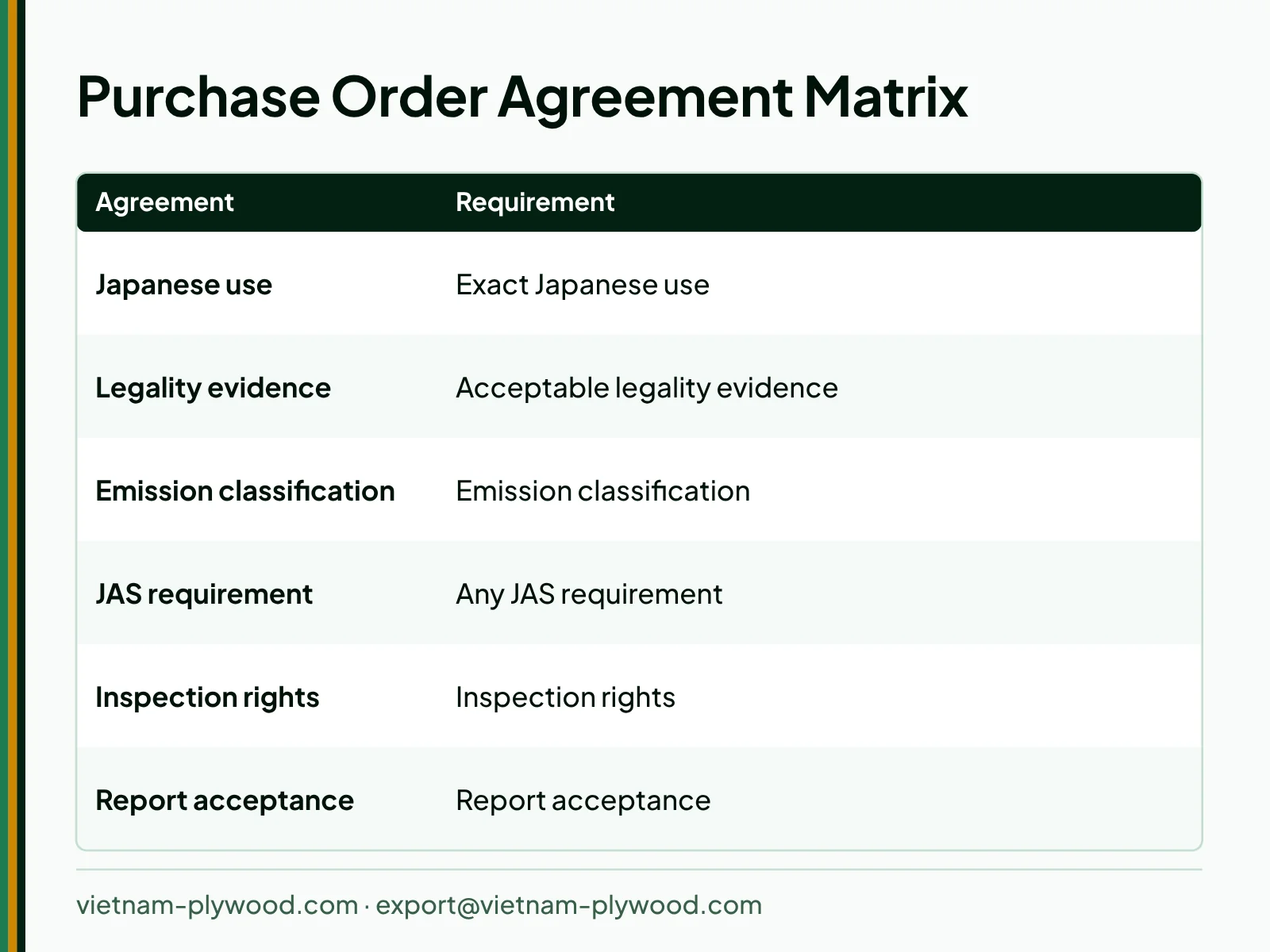
Agree the exact Japanese use, the acceptable legality evidence, emission classification and any JAS requirement before signing. A written specification should also name inspection rights, report acceptance, packaging, port, Incoterm and document review contact. For repeat buying, plywood supply programmes for distributors help separate recurring specifications from shipment-specific records.
Lucy at export@vietnam-plywood.com can review the specification and the export-side document list. Send the following lines together so the producing line and Japanese importer work from the same version:
Application in Japan:
Producing line or core:
Glue / bond requirement:
Emission class and Japanese acceptance evidence:
Face species and grade:
Thickness and tolerance:
Sheet size:
Quantity and container mix:
Destination port in Japan:
Legality records and test reports required:
JAS marking requirement (if any):
Request the Japan-order specification sheet from Lucy.