





FSC wood identifies wood-based products backed by a Forest Stewardship Council chain-of-custody claim, with three distinct label categories. A wrong claim can delay shipment clearance or leave an importer paying for material that fails the purchase specification. HCPLY approaches FSC-certified plywood through the core, face veneer, producing factory and invoice together.
What is FSC wood, and what does certification mean?
FSC wood is forest-based material sold with a valid Forest Stewardship Council claim through a certified chain of custody. For plywood, the claim concerns the eligible inputs, processing controls and sales records behind the sheet. FSC wood certification does not describe a veneer species, adhesive performance or structural grade. A buyer specifying FSC-certified wood should identify the required claim before agreeing on the panel build.
At HCPLY, the starting question is which input claim the producing factory can receive and pass into the finished plywood product group. A supplier’s forest certificate alone cannot establish the status of a later plywood shipment. FSC International’s 2021 chain-of-custody standard, FSC-STD-40-004, covers sourcing, processing, labelling and sale. Our broader quality and certifications overview explains how certificate documents fit alongside product tests.
For procurement, write the intended FSC claim on the purchase specification and ask for the relevant producing-factory certificate scope. The factory’s FSC documents are shown with factory details masked, on request. Match the final sales claim to the invoice and the identified shipment.
What does FSC mean on a plywood sheet?
On plywood, FSC identifies an eligible chain-of-custody claim for the finished product, rather than a wood species or a physical quality grade. A sheet can have an acacia core and an okoume face, yet its FSC status is determined by input eligibility and the certified production system. The same veneer appearance can therefore accompany different FSC claims.
A printed FSC certified logo is an on-product trademark label, while an invoice FSC claim is a sales-document designation. The two have different functions. FSC Malaysia’s undated official claim and label explanation identifies claims on invoices and packing slips; its guidance also distinguishes trademark licence codes from certificate codes.
What is the difference between FSC 100%, FSC Mix and FSC Recycled?
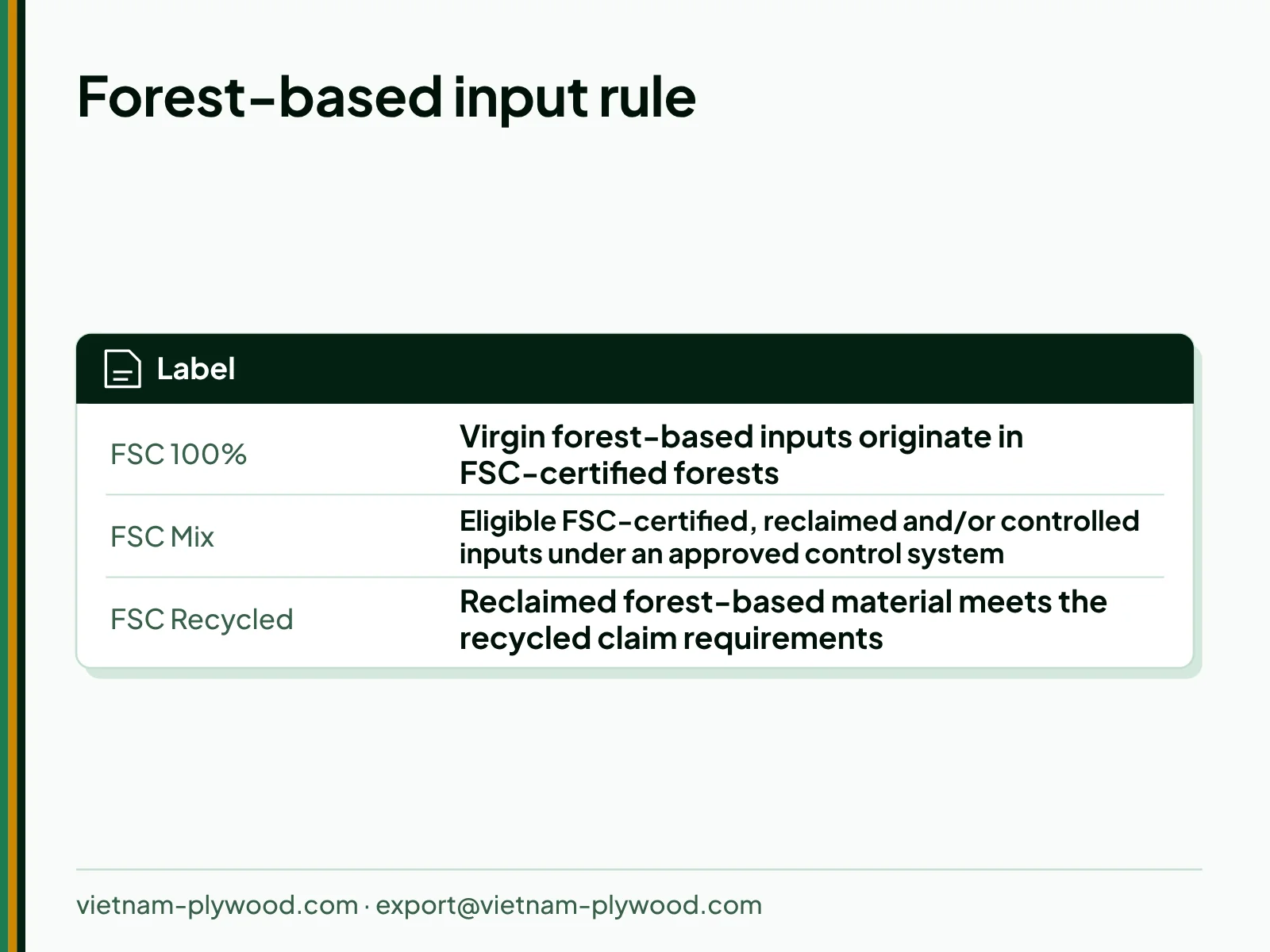
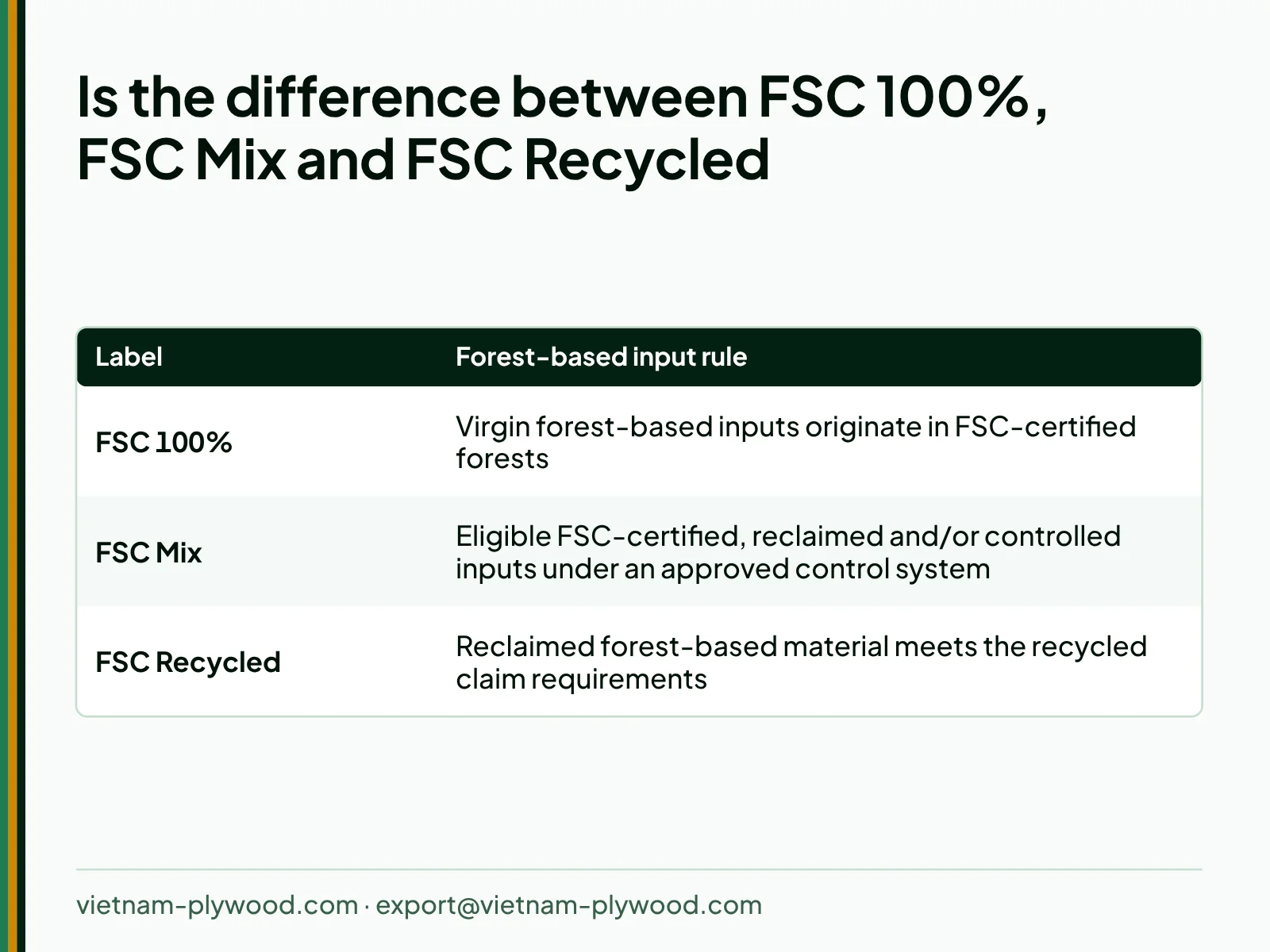
The three FSC labels describe different eligible material routes. FSC USA’s undated official on-product labels guidance defines FSC 100% as virgin material from certified forests, FSC Mix as a combination of eligible certified, recycled and controlled inputs, and FSC Recycled as recycled material.
| Label | Forest-based input rule | Plywood purchasing verdict |
|---|---|---|
| FSC 100% | Virgin forest-based inputs originate in FSC-certified forests | Specify when the buyer requires fully certified virgin forest inputs and the chain can support that claim |
| FSC Mix | Eligible FSC-certified, reclaimed and/or controlled inputs under an approved control system | Specify when the buyer accepts a Mix claim and its exact sales-document designation |
| FSC Recycled | Reclaimed forest-based material meets the recycled claim requirements | Appropriate only for a qualifying reclaimed-input product, not ordinary new-veneer plywood by default |
FSC Mix is not shorthand for an arbitrary percentage of certified veneer. Under approved transfer, percentage or credit systems, the claim follows specific input and output accounting rules. FSC Malaysia explains these systems and their consequences for labels. A product can carry an invoice claim without qualifying for the corresponding on-product label under a percentage system.
Neither FSC 100% nor FSC Mix independently proves formaldehyde emission class, bond durability or fitness for concrete formwork. Those are separate fields on the purchasing specification.
Is FSC-certified wood real wood?
FSC-certified wood is real wood or eligible reclaimed forest-based material covered by a chain-of-custody claim. Certification does not turn plywood into a substitute material. Veneer plywood remains layers of wood bonded together, whether its sales document has an FSC claim or not.
For our furniture plywood, a face such as bintangor, okoume or engineered veneer is specified separately from a styrax or eucalyptus core. The common face veneer thickness is 0.2–0.4 mm. The face names the product; the core drives density. FSC status is another field, alongside face grade, adhesive, emission class and thickness tolerance.
Do both the core and the face veneer need eligible FSC status?
Both core and face veneer must be accounted for as eligible inputs under the applicable FSC claim and certified control system. For an FSC 100% plywood claim, all virgin forest-based inputs must be from FSC-certified forests. For FSC Mix, the rules permit defined categories of eligible certified, reclaimed and controlled material. An uncertified imported face cannot simply be ignored because the core came from a certified plantation.
Consider an illustrative sheet with Vietnamese acacia core and an imported okoume face. A certified plantation supplying core veneer is only the first link. The face supplier’s eligible input claim, the producing factory’s incoming records, its approved product group and its output claim must all agree. An ordinary commercial invoice saying ‘okoume veneer’ is insufficient to establish FSC eligibility.
FSC Connect’s undated chain-of-custody explanation states that certified material is identified and separated from ineligible material through the supply chain. Its controlled-wood section also explains why controlled inputs are distinct from material sourced from FSC-certified forests.
At the producing factory, a buyer’s inspector can witness the receiving-lot identification for core and face veneer, compare supplier documents with batch records and trace the finished pallet to the output paperwork. This inspection should follow the factory’s actual certified product-group controls rather than assuming every stack in a warehouse has the same claim.
How does an FSC claim travel from plantation to invoice?
The claim travels through recorded transactions and certified processing controls, ending with the correct designation on the sales document. A forest-origin statement without subsequent chain-of-custody records does not complete that route.
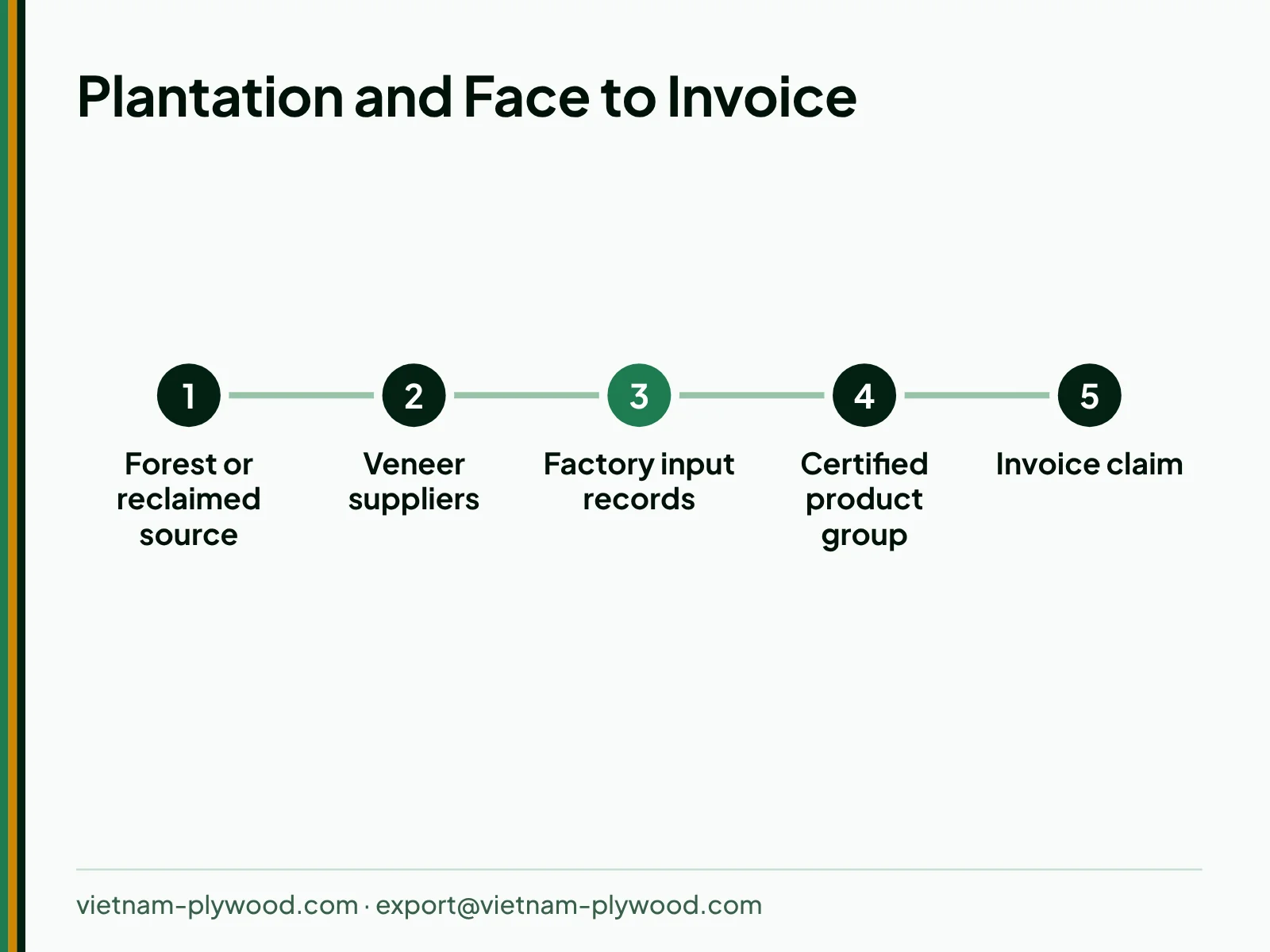
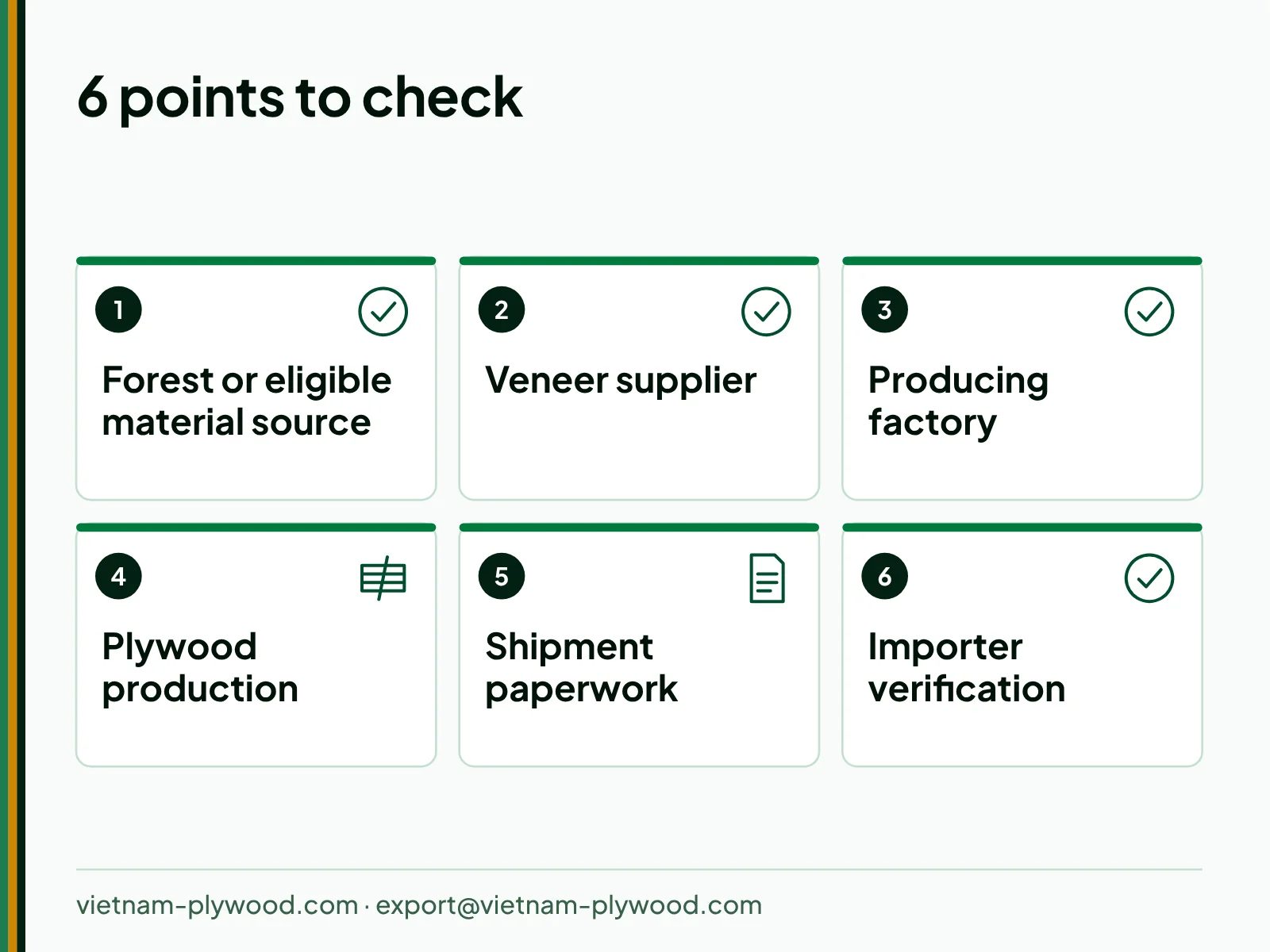
- Forest or eligible material source: record the origin and eligible material category for the plantation wood or reclaimed input.
- Veneer supplier: verify the supplier’s certificate status and scope, then obtain a sales document bearing the appropriate input claim.
- Producing factory: receive and identify the core and face lots, assign them to an eligible product group, and apply the approved transfer, percentage or credit system.
- Plywood production: connect input lots and production records to the finished panel specification and quantity.
- Shipment paperwork: place the correct FSC claim and certificate-holder information on the relevant sales documentation for the actual shipment.
- Importer verification: compare the invoice designation, quantity and supplier status with the agreed order and public certificate search.
FSC USA’s label guidance tells buyers to verify the supplying certificate holder, while the official FSC certificate search supports lookup by organization, licence code or certificate code. These checks are especially useful when the invoicing party and the factory named in technical records need to be matched.
HCPLY runs the export from specification through on-site quality control, documents and loading. The shipment document set includes the commercial invoice, packing list, bill of lading and the order’s FSC claim on sales documents where agreed. After loading, the draft shipping documents come to you for approval. The certificate itself belongs to the producing member factory.
Why can the claim differ across furniture, packing and construction plywood?
Different plywood builds use different input streams and factory product groups, so their eligible FSC claims must be checked separately. A claim approved for one product group does not automatically cover another panel or factory.
| Build and factory line | Core, face and process | FSC checkpoint | Buying use |
|---|---|---|---|
| Our furniture line | Styrax or eucalyptus core; sanded; bintangor, okoume or other specified face; E0/E1 | Match both core and decorative face input claims to the certified furniture product group | Cabinet and furniture panels requiring a named face and controlled thickness |
| Our commercial and packing line | Acacia core; MR glue; unsanded or light-sanded | Trace core veneer and any face veneer into the packing product group | Export crates, packaging and commercial sheet supply |
| Our construction line | Acacia or eucalyptus core; phenolic or melamine film; unsanded | Check wood inputs and the certified scope of film-faced output | Formwork and construction applications |
The same nominal 18 mm sheet can be made for distinct applications. Furniture sanded tolerance is ±0.2 or ±0.3 mm as ordered, commercial and film-faced tolerance is ±0.5 mm, and packing tolerance is ±0.5–1.0 mm. These differences affect inspection criteria, but do not determine FSC eligibility.
Our commercial and packing plywood and film-faced test-report guide address different performance questions. For FSC, ask the producing factory to demonstrate the actual input and output claim for the selected line.
What can an inspector verify before loading?
An inspector can verify the documented claim path, physical batch identity and the agreed panel specification before the goods leave the producing factory. Begin with the purchase order’s FSC claim, then follow the batch from received veneer to packed pallet.
Record the veneer source documents, lot identification, product-group designation and the quantity allocated to the order. Compare the face species and grade, core species, glue type, emission class, dimensions and pallet marks against the written specification. For film-faced panels, record the film build and inspect edges and surfaces separately from FSC paperwork.
An inspector can also compare the factory’s certificate scope with the output product group. FSC certification status is a documentation and control-system question; bond strength and emission results need their own accepted reports. Our plywood bonding-strength process describes the separate physical checks.
Buyers visit the factory office and inspect goods at the producing factory. For HCPLY, this gives the importer a practical point to compare the FSC sales claim with the actual pallets rather than relying on a generic catalogue description.
Can FSC and non-FSC specifications share a container?
Different specifications can share a 40HC within the 28.5 t payload limit, but their FSC status must remain identifiable by line item and pallet. Mixed loading is a shipping arrangement; it does not convert an ineligible batch into FSC-certified plywood.
For 18 mm sheets measuring 1220 × 2440 mm, the core-based lookup is 990 styrax sheets at 26.52 t, 880 acacia sheets at 27.35 t, or 795 eucalyptus sheets at 27.69 t for a full single-core 40HC. Film weight is excluded from those figures. These are separate full-load examples, not a proposed mixed-load total.
For a mixed specification, calculate each pallet’s weight and sum the actual quantities before loading. Keep the packing list and sales-document claims aligned to the correct product groups. The container-loading reference covers the load arithmetic; the FSC question is whether each claimed line remains traceable.
How should an importer specify and verify FSC plywood?
Specify the exact FSC output claim, the producing-factory certificate scope and the physical panel build in the same purchase inquiry. A request for ‘FSC plywood’ alone leaves the label type, sales claim and veneer construction unresolved.
Ask whether the proposed product group supports FSC 100%, FSC Mix or another precise eligible claim. Request masked factory certificate details for review, and compare the public certificate status with the production site and product scope. Where a buyer requires an on-product FSC certified logo, include that requirement before artwork and packaging are approved.
For EU shipments, the EUTR/EUDR file set is a separate documentation stream. FSC claims do not replace the buyer’s applicable regulatory checks. Our US compliance discussion and CE-marked plywood explanation likewise address distinct requirements; none should be inferred from an FSC logo.
A written quote should distinguish the price effects of eligible certified veneer supply, face selection, core construction and factory processing. Full stitched furniture construction and decorative face selection typically require more processing than a loose-laid packing build, while the availability of claim-eligible inputs can change sourcing choices. Request a quotation for the exact claim and build rather than applying a universal FSC surcharge.
What should the purchase inquiry contain?
The inquiry should identify the claim, material build and destination so the producing factory can check both certification scope and production fit. Use the following specification lines as the starting record; add the exact FSC claim to the application line.
Application: Import distribution; required FSC output claim and label
Line or core: Furniture / commercial and packing / construction; styrax / acacia / eucalyptus
Glue: Melamine MR or phenolic WBP, as specified
Emission: E0 / E1 / E2 or agreed market requirement
Face and grade: Named veneer or film; applicable grade or film weight
Thickness and tolerance: ___ mm; ___ mm tolerance
Size: ___ x ___ mm
Quantity: ___ sheets / pallets; one 40HC minimum
Destination port: ___
Send this specification to Lucy at export@vietnam-plywood.com through contact. The next step is to plan a trial container with the claim and inspection points written into the order.