






A film faced plywood test report is useful when its bond, bending, abrasion and emission results match the intended application. Choosing from an unmatched report can cost a rejected load, damaged panels or extra site days. HCPLY asks buyers to compare the test method and sample identity with the specified film-faced build before accepting a laboratory pass statement.
Which film faced plywood test report results matter for which use?
A film faced plywood test report should be read against the intended job: bond performance for wet formwork, bending results for span and loading, abrasion for surface wear, and emissions for a defined regulatory requirement. A single impressive figure cannot stand in for the other tests. Start with the method, specimen identity, measured value and acceptance criterion.
For contractors, repeated concrete pours put different stresses on the sheet from a transport platform or a temporary protective deck. Formwork needs adequate bending performance under the engineer’s design, a stable bond after moisture exposure, and a face that releases concrete without rapid damage. A traffic surface adds wear and slip considerations. A distributor comparing consignments also needs traceability between the report and the actual order.
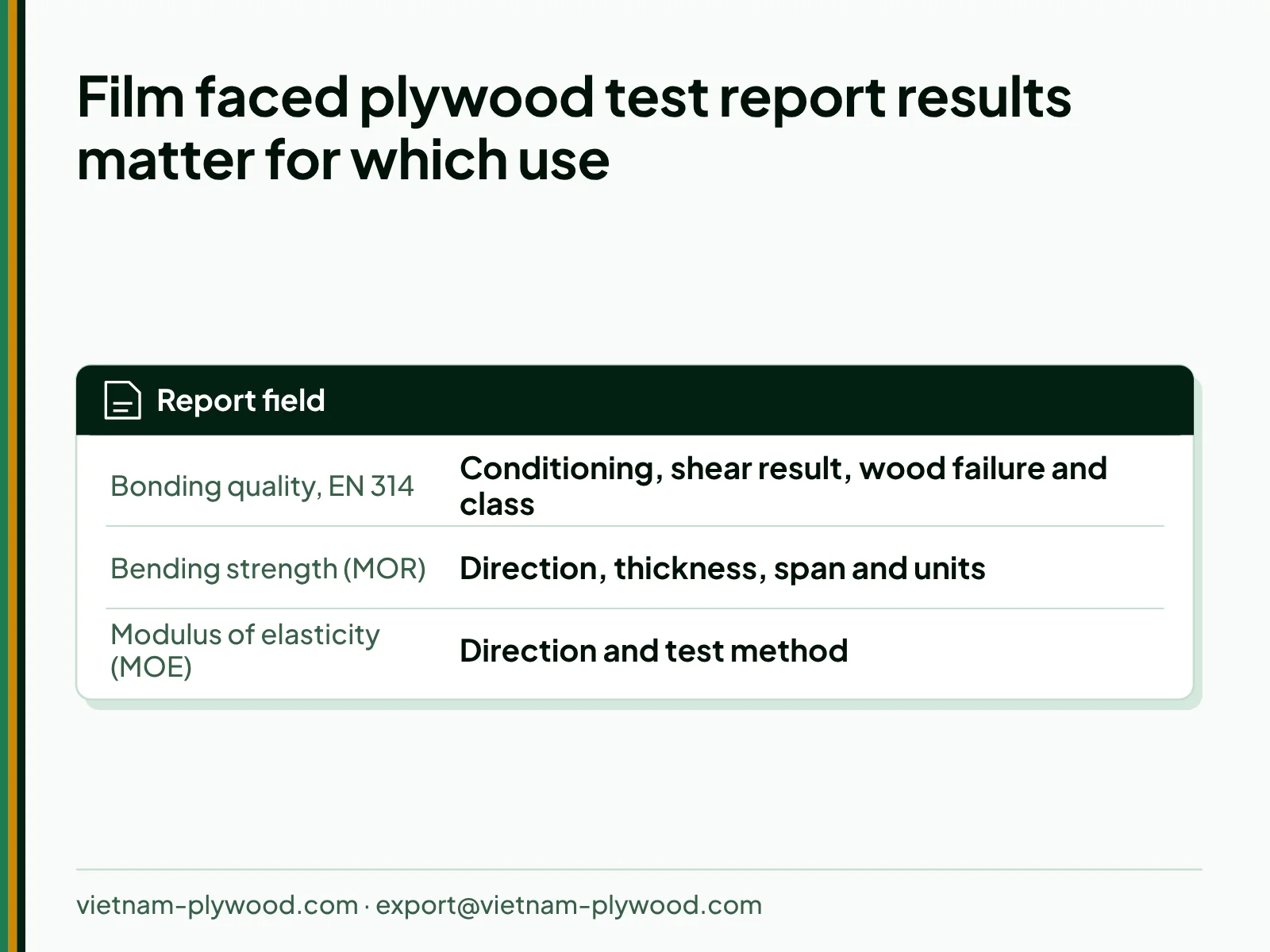
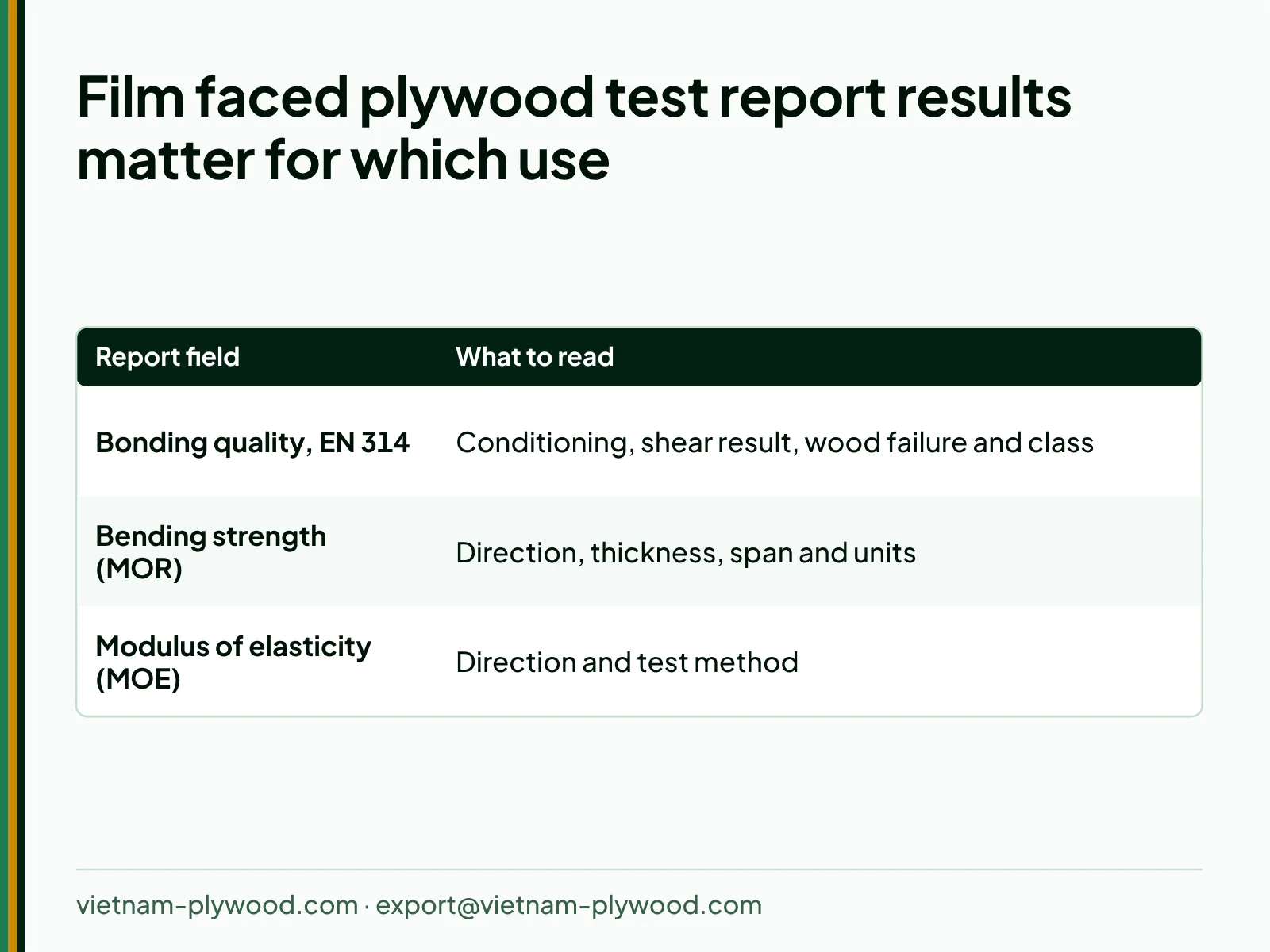
| Report field | What to read | Formwork decision | Platform or yard decision |
|---|---|---|---|
| Bonding quality, EN 314 | Conditioning, shear result, wood failure and class | Prioritise wet-exposure bond evidence | Check expected moisture exposure |
| Bending strength (MOR) | Direction, thickness, span and units | Use in engineering checks | Check load and support spacing |
| Modulus of elasticity (MOE) | Direction and test method | Assess deflection | Assess stiffness under traffic |
| Density | Core, method and kg/m³ | Predict handling and loading | Compare like-for-like builds |
| Taber abrasion | Wheel, load, cycles and endpoint | Indicative film-wear comparison | Higher priority for traffic wear |
| Formaldehyde release | Method, detection limit and unit | Match contractual requirement | Match destination-market requirement |
Each row requires separate evidence. The construction plywood specification sets the build; the quality and certification overview explains how buyers request supporting records. Read both before treating a laboratory summary as a purchase specification.
What does EN 314-2 bonding class 3 mean?
Class 3 identifies bonding quality intended for exterior conditions under EN 314-2; it does not classify the panel’s bending strength or film durability. The British Standards Institution’s 1993 listing describes EN 314-2 as requirements for bonding classes according to end use and directs the test method to EN 314-1 (BSI, 1993).
Read the laboratory’s classification alongside the actual shear measurements, pretreatment, specimen count and failure observations. The class statement alone does not show whether every glue line was sampled or how close a result sits to the required threshold. Ask for the test standard’s edition and whether the lab evaluated the complete relevant criteria.
Phenolic glue is described in our build specifications as WBP with a 72-hour boil condition; melamine glue is MR with a 12-hour boil condition. Those are production-build descriptors, not an automatic award of an EN 314 class. For a phenolic film faced plywood bonding test, ask whether the adhesive tested is the core bond, rather than assuming that a phenolic surface film proves the veneer bond.
The plywood bonding strength explanation covers the bond itself. A formwork purchaser should also check edge sealing and cuts because moisture can enter through exposed veneer even when a tested glue line performs well.
Which boil or soak pretreatments should appear?
The report should identify the EN 314-1 pretreatment actually applied, with its time, temperature and subsequent conditioning. A bare phrase such as “boil test passed” leaves out the exposure that produced the result. Ask the laboratory to identify the exact procedure and the EN 314-2 classification criteria used.
Different procedures include water soaking, boiling with cooling, and longer or repeated boiling sequences. Do not interchange them. A shorter conditioning procedure cannot be described as the same evidence as a longer one simply because both use hot water.
The report should show whether the pieces were cut from the intended thickness, whether all relevant glue lines were represented, and whether the shear test followed conditioning. Record any deviation, such as a different cooling period or specimen preparation. Where the order specifies exterior bonding, request a report using the conditioning route appropriate to that class.
For a witnessed check, a buyer or inspector can observe sample identification, cutting locations, immersion records and the subsequent test arrangements at the producing factory. An on-site demonstration does not replace documented classification.
What do MOR, MOE and density actually tell a buyer?
Modulus of rupture (MOR) measures bending strength at failure; modulus of elasticity (MOE) describes bending stiffness. Neither figure should be used without direction, thickness, test span and the governing test method. A formwork designer must evaluate supports, loading, deflection and safety factors for the actual application.
A longitudinal value may differ from a transverse value because veneer orientation affects bending. A report that prints only its higher direction can give an incomplete impression of performance. Ask for both directions where the application loads both, and compare panels tested under the same method and conditioning.
Density is a separate measured characteristic, and it follows the core rather than the face. HCPLY’s specified Vietnam cores are acacia at 580 kg/m³, eucalyptus at 650 kg/m³ and styrax at 500 kg/m³. A brown film on two panels tells you nothing reliable about which core lies underneath.
For an 18 mm, 1220 × 2440 mm acacia-core sheet, the nominal lookup weight is 31.08 kg, excluding film weight. This is a loading reference, not a measured mass for a particular sheet. See plywood strength values for the distinction between reported material properties and design decisions.
What does a Taber abrasion figure say about film wear?
A Taber abrasion figure describes wear under a specified laboratory abrasion setup; it does not predict a fixed number of concrete pours. To interpret abrasion revolutions plywood results, identify the wheel, applied load, rotation count, cleaning or resurfacing procedure and endpoint. “Passed 1,000 revolutions” without those fields is incomplete evidence.
The US National Institute of Standards and Technology’s 2020 abrasion-wheel study found that wheel selection can influence measured wear-related results (NIST, 2020). That research concerns nanocoatings, so it supplies no plywood-specific reuse rating.
A taber test film faced plywood report might state mass loss, film breakthrough, appearance change or cycles to a defined endpoint. Those are different outputs. Compare wear resistance film faced plywood only when both reports use compatible methods and endpoints. Film abrasion resistance can matter for scraping and handling, but concrete adhesion, edge damage and release-agent practice also affect field life.
Our construction line specifies 120 g/m² standard film, 135 g/m² premium film and 220 g/m² anti-slip film. Film weight identifies the specified facing; it does not substitute for a measured film faced plywood abrasion result. Request a comparable abrasion test where wear is a contractual acceptance point.
How should reuse estimates be read beside test results?
Reuse estimates describe handling conditions and cannot be derived from abrasion revolutions alone. For our film-faced builds, with proper handling, a release agent on every pour and sealed edges (cut edges included), melamine-glue film-faced is about 12–15 pours and phenolic-glue film-faced is up to about 25 pours.
Abrasion equipment rubs a specimen under controlled contact. Actual formwork adds wet concrete, stripping forces, fasteners, edge cuts, storage and cleaning. The abrasion number therefore supports a surface comparison but does not validate a jobsite reuse forecast.
Ask the site team to record panel identity, face condition after stripping, damaged edges and repair practice during a trial. Keep the release-agent method consistent across the compared builds. If a panel develops film breakthrough while its core bond remains intact, the failure mode points toward surface wear rather than an EN 314 bonding issue.
For heavy wear or a textured walking surface, specify the intended friction and abrasion checks separately. An anti-slip film is a surface option, but no slip rating follows automatically from its weight.
Does “formaldehyde not detected” mean E0 or zero emission?
No. “Not detected” means the laboratory did not quantify formaldehyde above the stated detection threshold using its chosen method. It does not establish zero release or automatically assign E0. Ask for the detection or quantification limit, unit, specimen conditioning, test method and the acceptance threshold.
The US Environmental Protection Agency’s 2016 final rule established a third-party certification program for formaldehyde emissions from regulated composite wood products (EPA, 2016). A different chamber or extraction method can report a different kind of measurement. Values from unlike methods should not be treated as directly interchangeable.
Our emission classes are E0, E1 and E2; glue is a different specification field. “Film faced plywood formaldehyde E1” therefore needs an emission test and class basis, while phenolic or melamine describes adhesive chemistry. CARB P2 and TSCA Title VI refer to a separate US compliance framework involving third-party certification, rather than an E1 synonym.
For a destination-market requirement, ask the importer to identify the applicable product scope and test method in writing. An emission result for one build cannot be applied to every core, adhesive and film combination without a documented basis. The export certification documents overview explains the records buyers should match.
Does one specimen report cover every panel in an order?
One specimen report describes the samples identified in that report, not automatically every sheet shipped. Coverage depends on sampling plan, lot identity, production consistency, test scope and any agreed conformity procedure. A report without traceable specimen details is weaker purchasing evidence than one linked to the production lot.
Match the report’s product description to the purchase specification: core, glue, film, thickness, dimensions and manufacturing line. Then compare production dates, batch identification, test date and sampling record. A report on a different build needs an accepted equivalence.
A laboratory tests selected pieces; the buyer should know how they were selected and what acceptance plan applies. Define retesting triggers when the build changes, when incoming materials change materially, or when the buyer’s acceptance rule requires another sample.
At loading, an inspector can check pallet labels, dimensions, visible edges and sample identifiers against the packing list. Keep photographed samples and the signed inspection record with the lot documents. This links the laboratory evidence to the goods more effectively than an isolated PDF.
Which HCPLY line makes the tested panel?
Our construction line presses the film-faced build, using acacia or eucalyptus core and phenolic or melamine film, including anti-slip film. The other lines build different products, so their test records cannot be substituted for a film-faced lot merely because thickness matches.
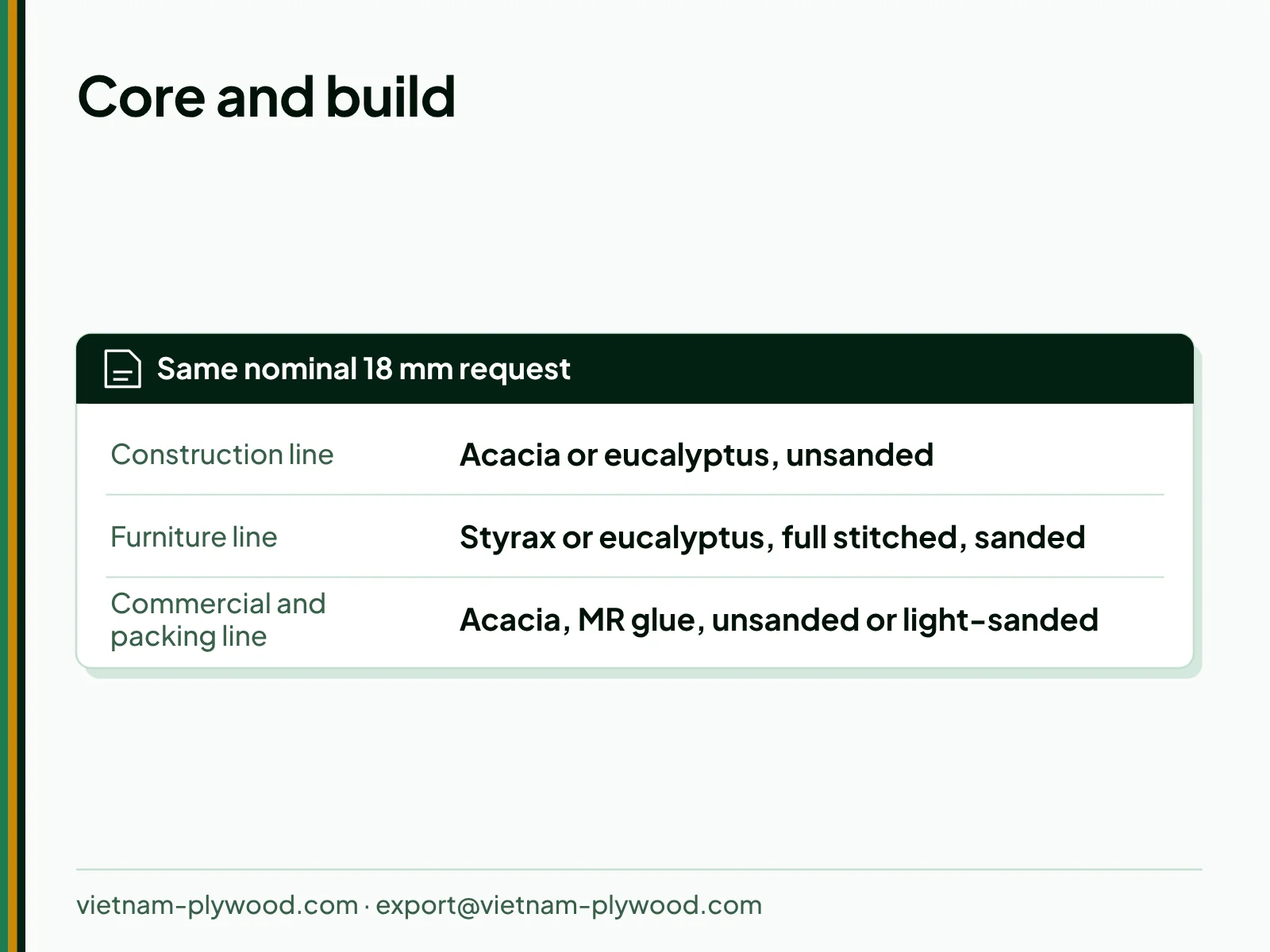
| Same nominal 18 mm request | Core and build | Surface and tolerance | Appropriate evidence |
|---|---|---|---|
| Construction line | Acacia or eucalyptus, unsanded | Film-faced; ±0.5 mm | Bond, bending, film abrasion |
| Furniture line | Styrax or eucalyptus, full stitched, sanded | Veneer face; ±0.2 or ±0.3 mm as ordered | Surface, dimensions, emission |
| Commercial and packing line | Acacia, MR glue, unsanded or light-sanded | Raw or specified veneer; commercial ±0.5 mm, packing ±0.5–1.0 mm | Packing suitability and bond |
A buyer can witness thickness readings, edge examination, sample selection and label reconciliation at the producing factory. The factory office is where visits begin; the goods are inspected where the order is made. Our three factories operate in Phu Tho and Hai Phong, with each order produced at the factory matching its specification.
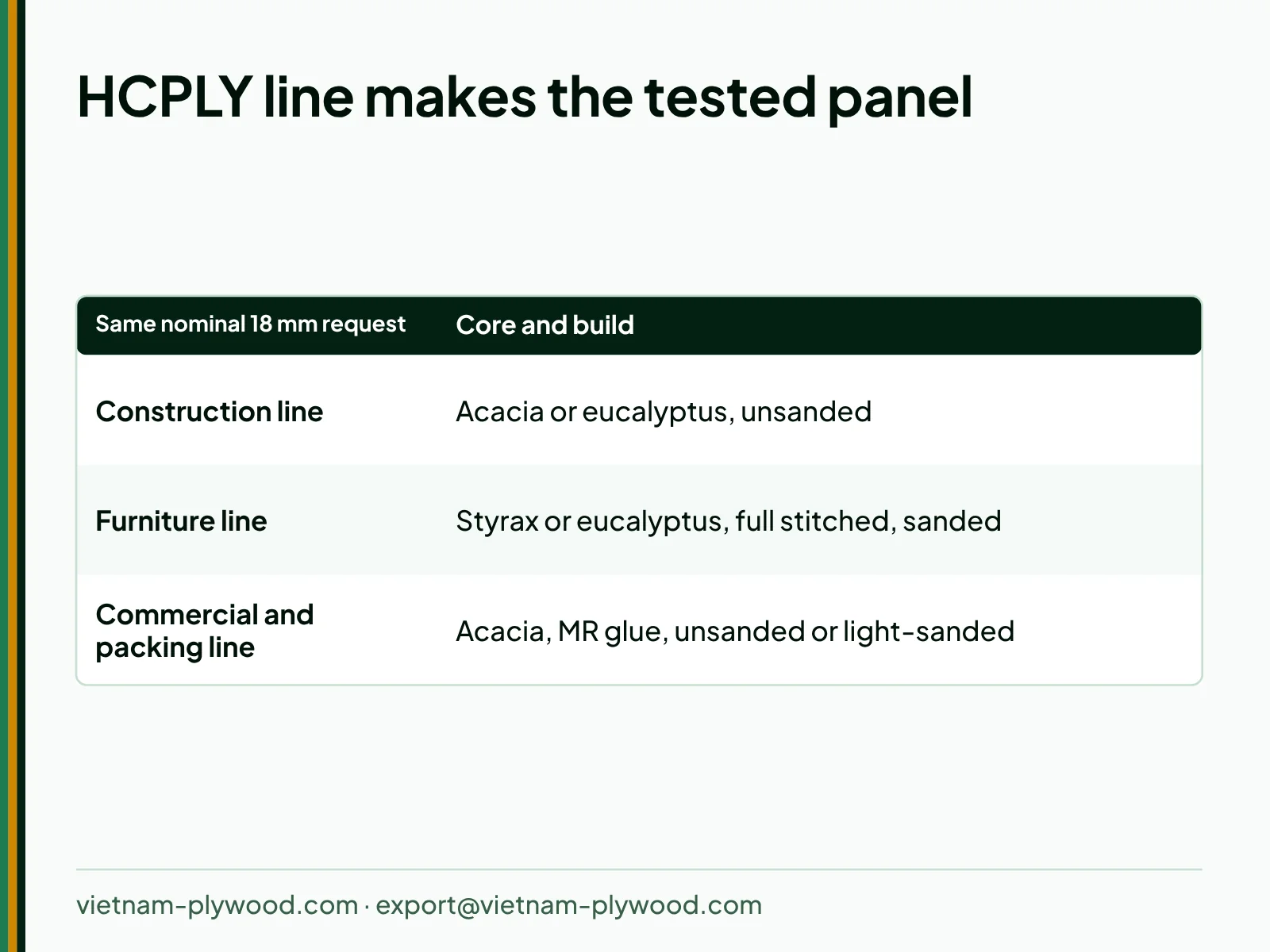
The comparison matters when thickness is specified without end use. An 18 mm furniture panel is not a substitute for a tested 18 mm formwork panel. Likewise, the commercial and packing plywood line serves a different duty.
Can the producing factory send a report before order confirmation?
Yes. HCPLY can show relevant member-factory test reports and certificate documents on request, with factory details masked. Ask for the intended build and test scope before treating a prior report as evidence for a proposed order. A report may establish the available test history while the purchase contract defines the new lot’s acceptance requirements.
The request should identify whether the buyer needs EN 314 bonding, bending, density, abrasion or formaldehyde evidence. It should also say whether a third-party report is mandatory and whether the report must match a particular specimen date or production lot. When a test has not been supplied, we should state that gap rather than imply a pass.
Member-factory FSC, CARB P2, ISO 9001 and CE documents, along with EUTR/EUDR documents where relevant, are shown with factory details masked, on request. The exact claim and applicable product scope must be checked before use in sales documents. For EU buyers, the EUDR due-diligence page addresses a separate document obligation.
Lucy can coordinate the requested records through export@vietnam-plywood.com and identify what remains to be tested for the order.
How do test records follow the shipment?
The agreed test reports belong with the order’s certificate documents in the export file. The shipment set also contains the commercial invoice, packing list, bill of lading, certificate of origin, phytosanitary and fumigation papers, plus insurance under CIF. EU lots use EUR.1 and the EUTR/EUDR file set as applicable.
After loading, the draft shipping documents come to you for approval. Match the product description on the invoice and packing list to the tested build, and retain the lot identification used during inspection. A test report that names a different film or core should be flagged before document approval.
The minimum order is one 40HC, and specifications can be mixed in a container within the 28.5 t payload limit. For 18 mm sheets at 1220 × 2440 mm, the single-core loading references are 990 styrax sheets (26.52 t), 880 acacia sheets (27.35 t) and 795 eucalyptus sheets (27.69 t), excluding film weight. The container loading calculation owns the full packing method; mixed-container planning addresses combining specifications.
Shipment quantity is not evidence of test coverage. A mixed load needs its own product identification for each build, with test and certificate records mapped to the applicable items.
What should a buyer check before accepting a report?
Accept a report only after its specimen identity, method, conditioning, result and intended use have been reconciled with the order. A short inspection sequence makes that decision repeatable for procurement and site teams.
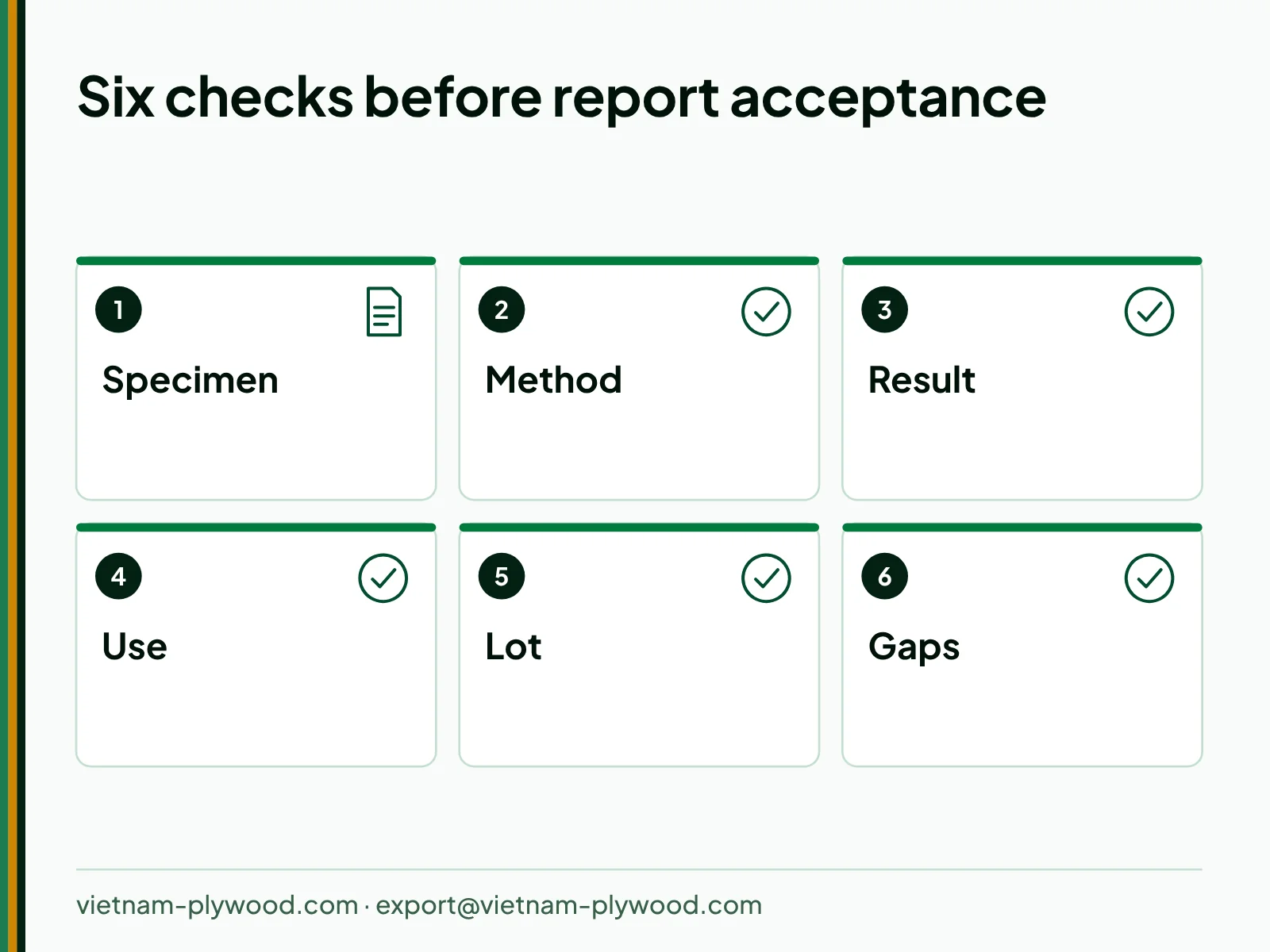
- Identify the specimen. Record core, adhesive, film weight, thickness, dimensions, sampling date and laboratory.
- Check the test method. Note the edition, conditioning route, measured units and any departures from the method.
- Read the actual result. Look beyond a pass stamp to measured values, direction, number of specimens and endpoint.
- Match the use. Prioritise bond and bending for wet formwork; add wear and slip evidence where traffic is expected.
- Connect the lot. Compare labels, packing records and the written acceptance plan with the reported specimen.
- Record open points. Ask for a targeted additional test if a required metric, method or traceability link is absent.
For a trial, agree the inspection points before pressing starts. Compare panels under the same stripping and edge-sealing conditions, then document wear separately from bond or bending failures. That produces usable feedback without claiming that a laboratory cycle count equals a site reuse count.
Send the build below to contact Lucy and request the available masked test report plus the specific missing checks.
Application: repeated concrete formwork / specify exposure and load
Line or core: construction line / acacia or eucalyptus
Glue: phenolic WBP or melamine MR
Emission: E0 / E1 / E2 as required; state test method
Face and grade: phenolic or melamine film, 120 or 135 g/m²; 220 g/m² anti-slip if required
Thickness and tolerance: 18 mm, ±0.5 mm (or specify another available thickness)
Size: 1220 × 2440 mm (or specified available size)
Quantity: one 40HC minimum; state mix and pallet quantities
Destination port: [buyer to enter]
Tests required: EN 314 bond, MOR/MOE, density, Taber abrasion, emission as applicable
Next step: plan a trial container against the written specification and agreed test acceptance criteria.