





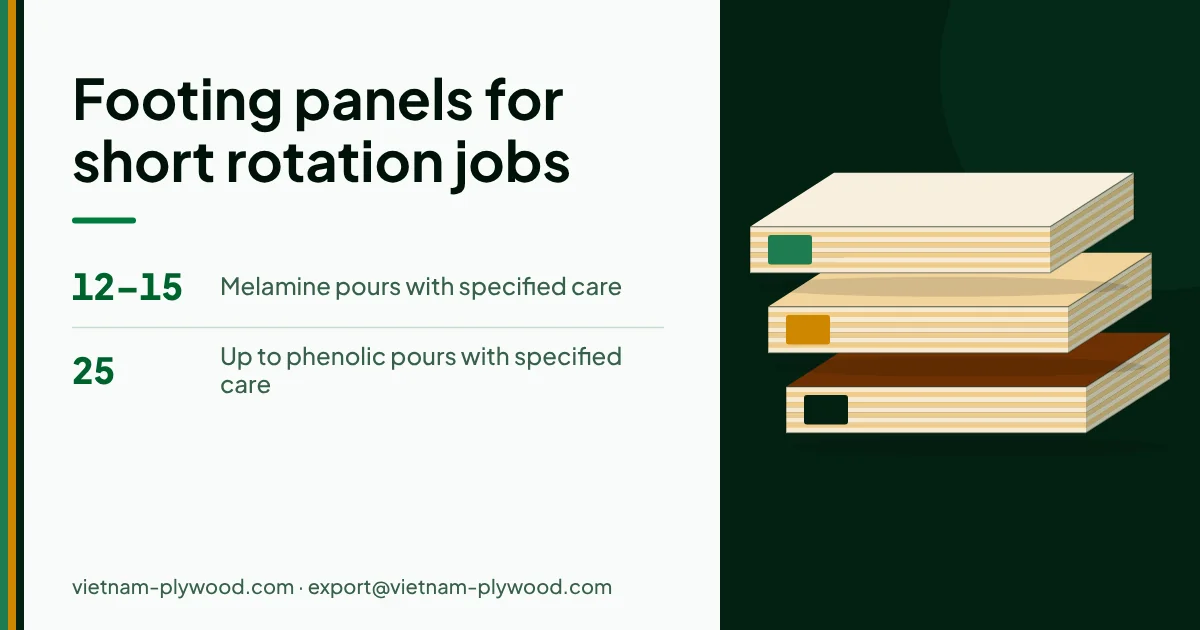
For footing formwork with few planned reuses, melamine-glue film-faced plywood is often enough when the engineered form layout and site handling suit it. Paying for phenolic on every short pour can waste budget, while choosing a weak build for wet repeated use can force replacement and delay work. HCPLY separates the panel specification from the structural design of the form.
Which plywood is used for footing formwork?
Footing formwork usually uses film-faced plywood as the concrete-contact skin, supported by studs, walers, stakes and braces designed for the pour. For short strip and pad footings with limited planned reuse, a melamine-glue film-faced build can be a practical purchase. HCPLY presses these panels on our construction line, with the bond and thickness specified separately from the supporting frame.
The panel creates the edge and surface of the concrete; its backing carries pressure into the bracing and ground anchors. Strip footing formwork follows a continuous trench, while pad footing formwork closes a box around an isolated base. Pile caps and ground beam formwork can demand different backing layouts because their geometry and placement sequence differ.
See the formwork selection by structural element for the wider application map and construction plywood for panel specifications. The footing designer should establish the fresh-concrete pressure and allowable support spacing before an importer fixes panel thickness.
Is 12 mm enough for footing sides?
A 12 mm sheet is a possible footing-side specification only when the formwork design supports its span, loading and deflection. Thickness alone cannot establish a safe form: stud spacing, bracing, concrete head, placement rate and the panel’s actual mechanical properties all matter.
A short pour does not automatically mean a lightly loaded form. A rapidly filled pad or a deeper pile cap can exert substantial pressure before the concrete stiffens. Contractors should submit their pour height, sequence and support layout for engineering review rather than substitute a thicker sheet for a missing design.
The United States Occupational Safety and Health Administration’s 2025 Code of Federal Regulations, 29 CFR § 1926.703, requires formwork to resist reasonably anticipated vertical and lateral loads. That rule addresses the whole system, including supports and braces, rather than certifying any plywood thickness for every footing.
For an order, 12, 15, 18 and 21 mm are available nominal thicknesses on the construction line; film-faced thickness tolerance is ±0.5 mm. Specify the design-approved thickness and inspection method on the purchase specification.
Do short below-ground pours need phenolic glue?
Short, dirty pours with few planned rotations often justify melamine-glue film-faced plywood when the exposure and handling plan suit that build. Phenolic-glue panels cost more because the bond is selected for more demanding wet exposure and longer rotation plans; neither glue replaces formwork design.
Melamine is the core adhesive here, not a decorative face. The melamine glue is MR (moisture-resistant), with a 12-hour boil designation; phenolic is WBP (weather and boil proof), with a 72-hour boil designation. Those process descriptors are not a site reuse guarantee. Both options can carry a film face, and the face weight must be stated independently.
Choose the melamine build when the contractor expects limited rotations, prompt stripping, careful cleaning and protected storage between pours. Choose phenolic for repeated wet handling, a longer rotation programme or a job where replacing damaged sheets interrupts production.
Where does melamine beat phenolic on footing jobs?
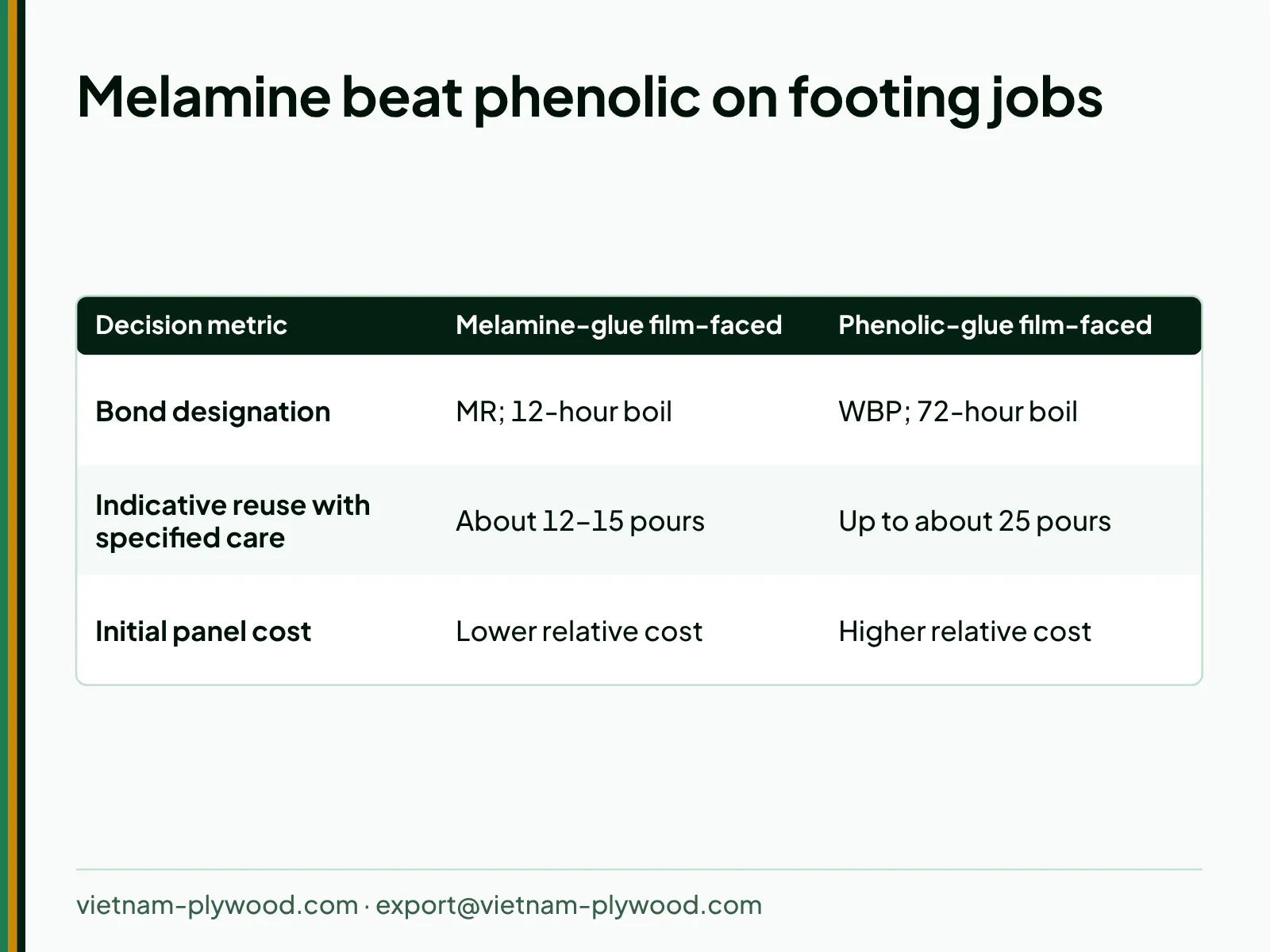
Melamine earns its place on limited-rotation footings; phenolic earns the higher initial cost when exposure and planned reuse are more demanding. The comparison below treats panel choice as a purchasing decision, while structural adequacy remains with the formwork design.
| Decision metric | Melamine-glue film-faced | Phenolic-glue film-faced | Buying verdict |
|---|---|---|---|
| Bond designation | MR; 12-hour boil | WBP; 72-hour boil | Phenolic for more demanding wet exposure |
| Indicative reuse with specified care | About 12–15 pours | Up to about 25 pours | Melamine for fewer rotations; phenolic for longer rotation |
| Initial panel cost | Lower relative cost | Higher relative cost | Melamine when replacement cost remains low |
| Cut-heavy strip and pad forms | Edge sealing still required | Edge sealing still required | Neither saves an unsealed cut |
| Surface specification | 120 g/m² standard film available | 120 g/m² standard film available | Compare like film weights before pricing |
The reuse figures assume proper handling, release agent on every pour and sealed edges, including all cut edges. Dirty ground, abrasive stripping and repeated cutting can shorten practical life below those indicative bands. For the same reason, a buyer should budget by completed usable rotations rather than apply the upper band to every job.
Which factory line makes these panels?
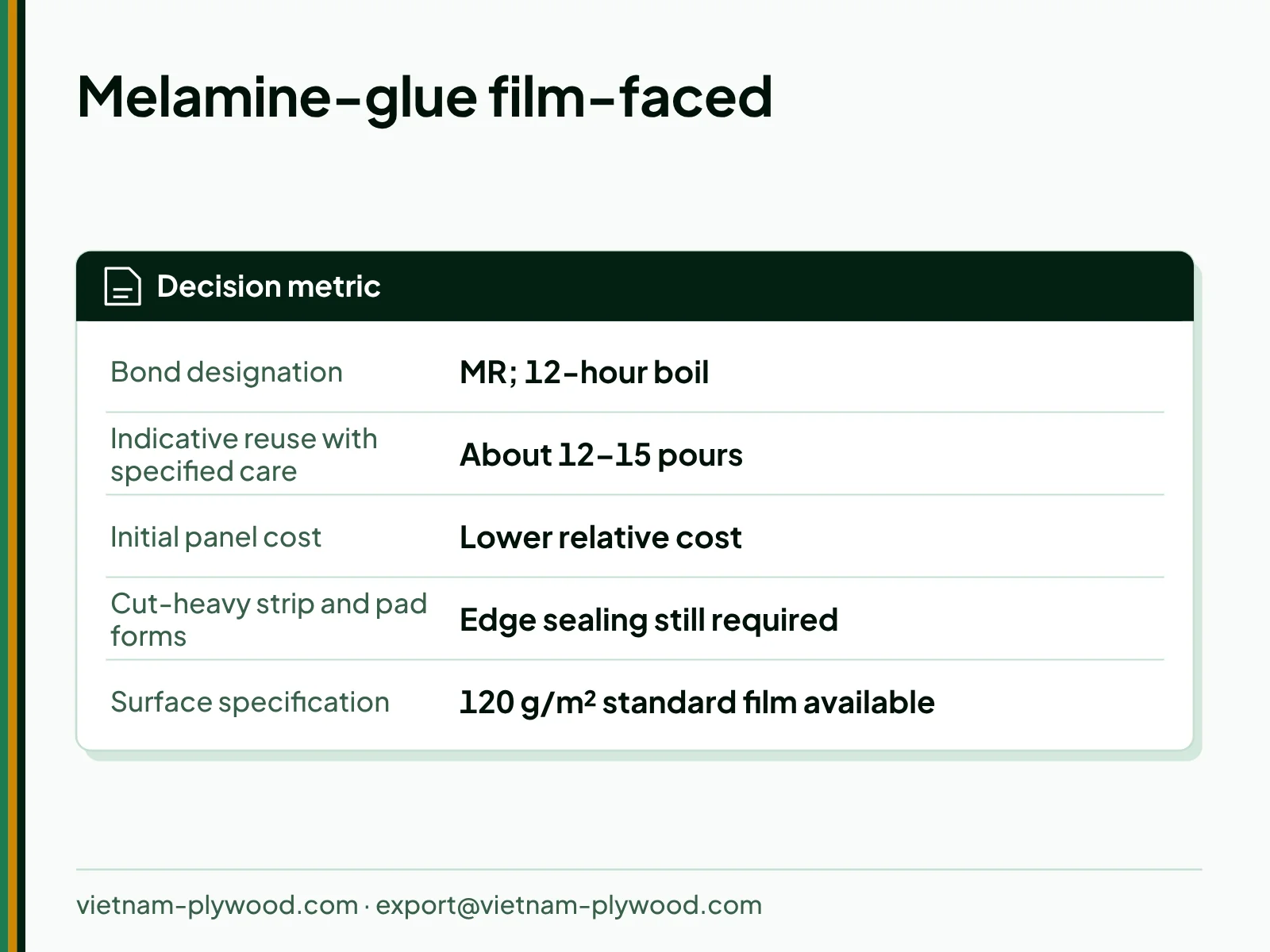
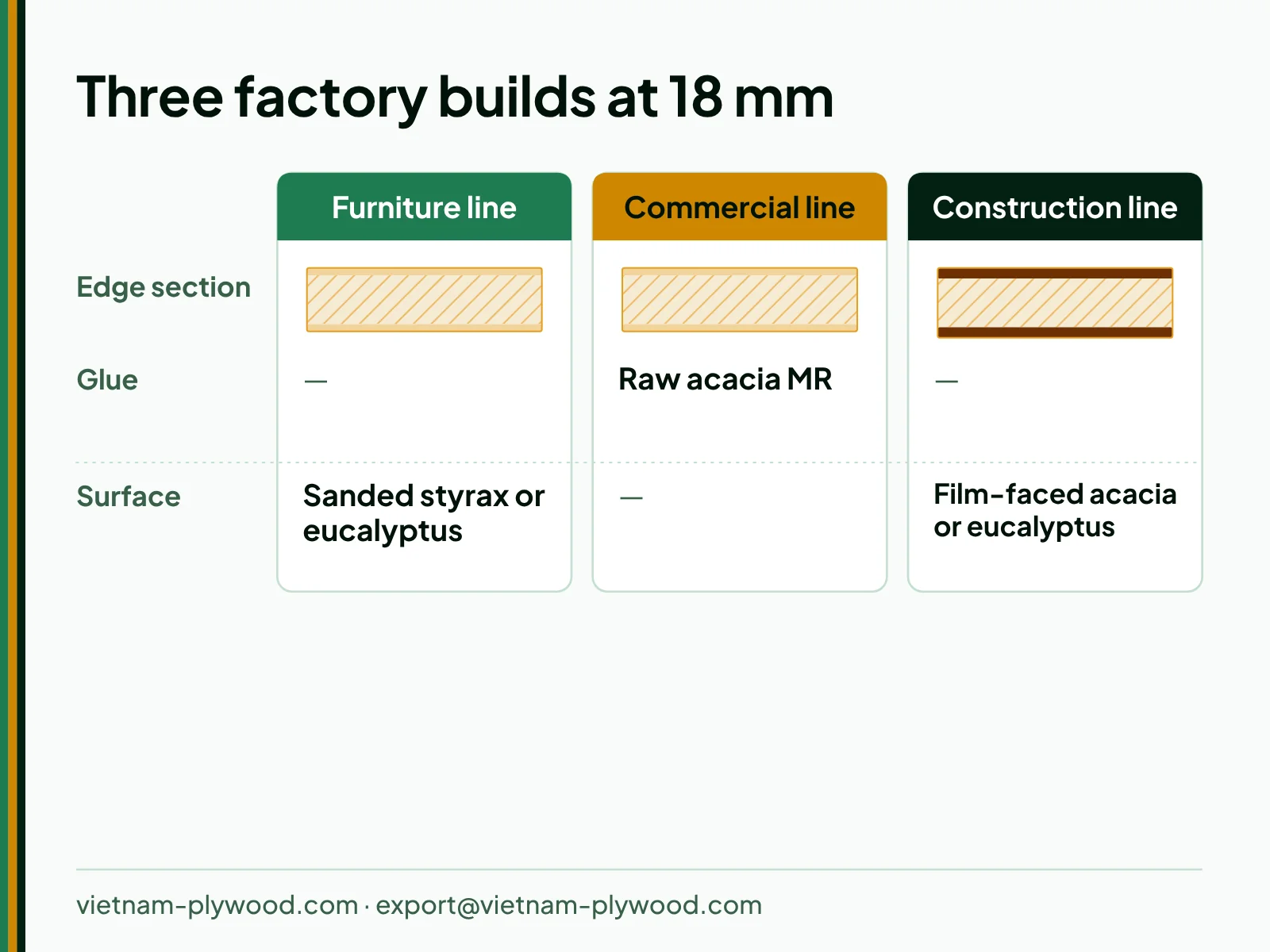
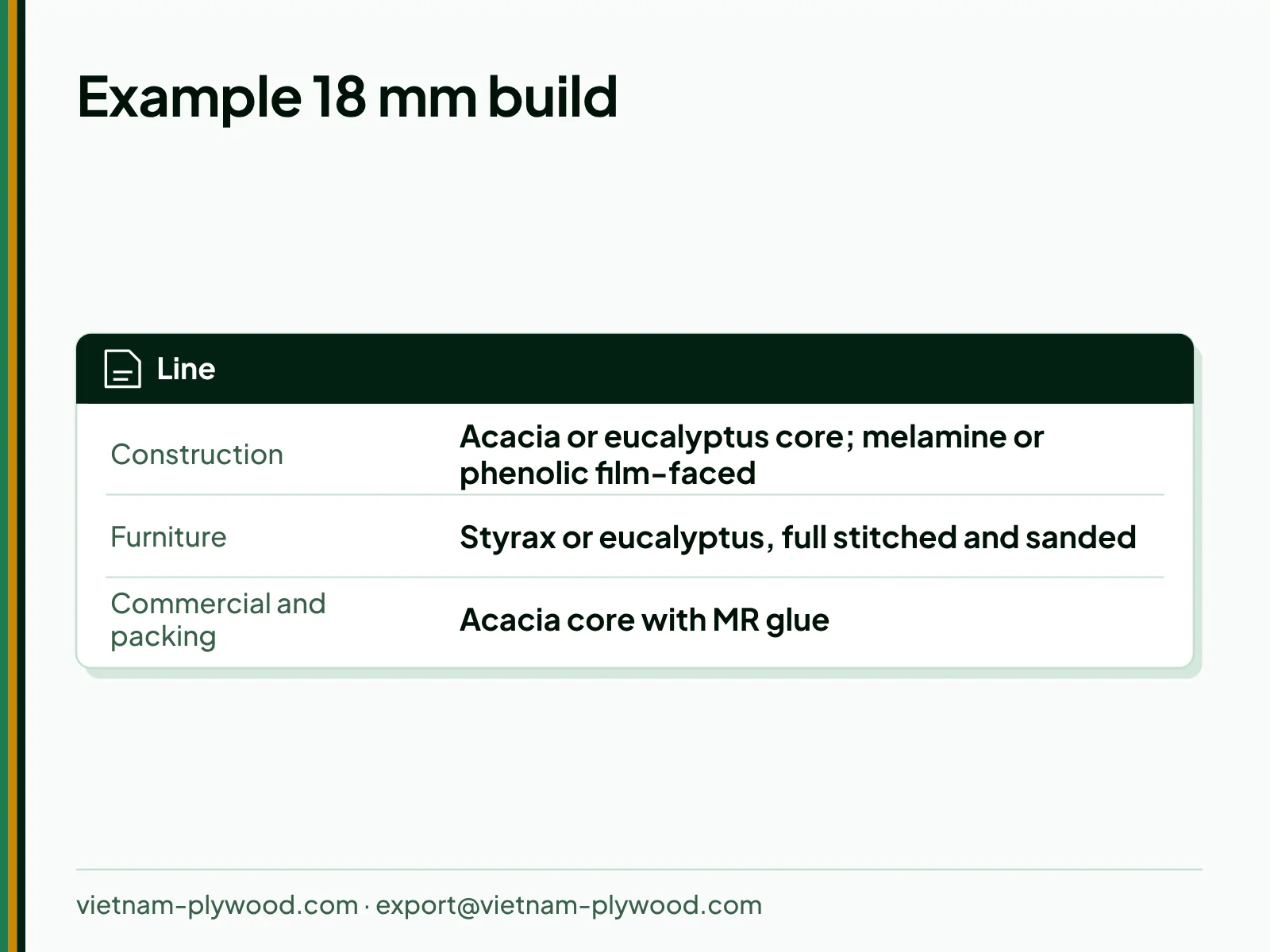
Our construction line presses the film-faced footing panel with acacia or eucalyptus core, unsanded beneath its film surface. The furniture and commercial lines serve different builds, so the same nominal thickness does not describe the same product.
| Line | Example 18 mm build | Face or finish | Appropriate work |
|---|---|---|---|
| Construction | Acacia or eucalyptus core; melamine or phenolic film-faced | 120 g/m² standard film | Footing and foundation forms |
| Furniture | Styrax or eucalyptus, full stitched and sanded | Decorative veneer, E0/E1 emission | Furniture and cabinet parts |
| Commercial and packing | Acacia core with MR glue | Raw, unsanded or light-sanded | Packing and general commercial panels |
Review the factory-line grade comparison and commercial or packing plywood before combining unlike specifications in an inquiry.
How should strip, pad and ground beam forms be specified?
Strip footings need long side runs and repeated end cuts; pad footings need short boxed faces and corner joints. Ground beams often need careful alignment between supports, while pile caps may involve deeper concrete heads. Each geometry changes cutting loss and the number of exposed edges.
For strip footing formwork, start with the approved panel thickness, standard sheet size and planned cutting pattern. For ground beams, state the beam depth and pour sequence so the designer can assess the face span and pressure.
HCPLY offers 1220×2440 mm and 1250×2500 mm sheets among its listed sizes, with custom cutting available. Length and width tolerance is ±2 mm. Specify whether factory cutting is useful, since every site cut needs sealing before contact with water or concrete.
What does the panel face actually change?
The film protects the casting face and supports release, while the glue bonds the internal veneers. A heavier film is not a substitute for stronger bracing or a more suitable adhesive.
The standard construction face is 120 g/m² film; 135 g/m² is the premium film option. A 220 g/m² anti-slip film is a separate surface intended for traction, rather than the default smooth concrete-contact face. State the intended cast finish, surface weight and whether panels will be cut into narrow strips.
For visible vertical faces, consult building wall forms plywood; for horizontal casting, see slab deck formwork plywood.
How many reuses survive dirty ground conditions?
A melamine-glue film-faced build can give about 12–15 pours, and a phenolic-glue build up to about 25 pours, with proper handling, release agent on every pour and sealed edges including site cuts. These are conditional reuse figures, not a fixed count for a muddy footing trench.
Wet soil, grit trapped between stacked panels, damaged corners and unsealed cuts increase the chance of premature replacement. Count usable casts after inspection rather than treating every panel as having the same remaining life. If a panel has delamination, severe edge swelling or damage affecting its form function, remove it from the next pour pending assessment.
What should an inspector witness at the producing factory?
An inspector should compare the finished panels against the written order: core, glue, film weight, dimensions, thickness tolerance and visible workmanship. HCPLY arranges inspection at the producing factory, where buyers can inspect goods before shipment.
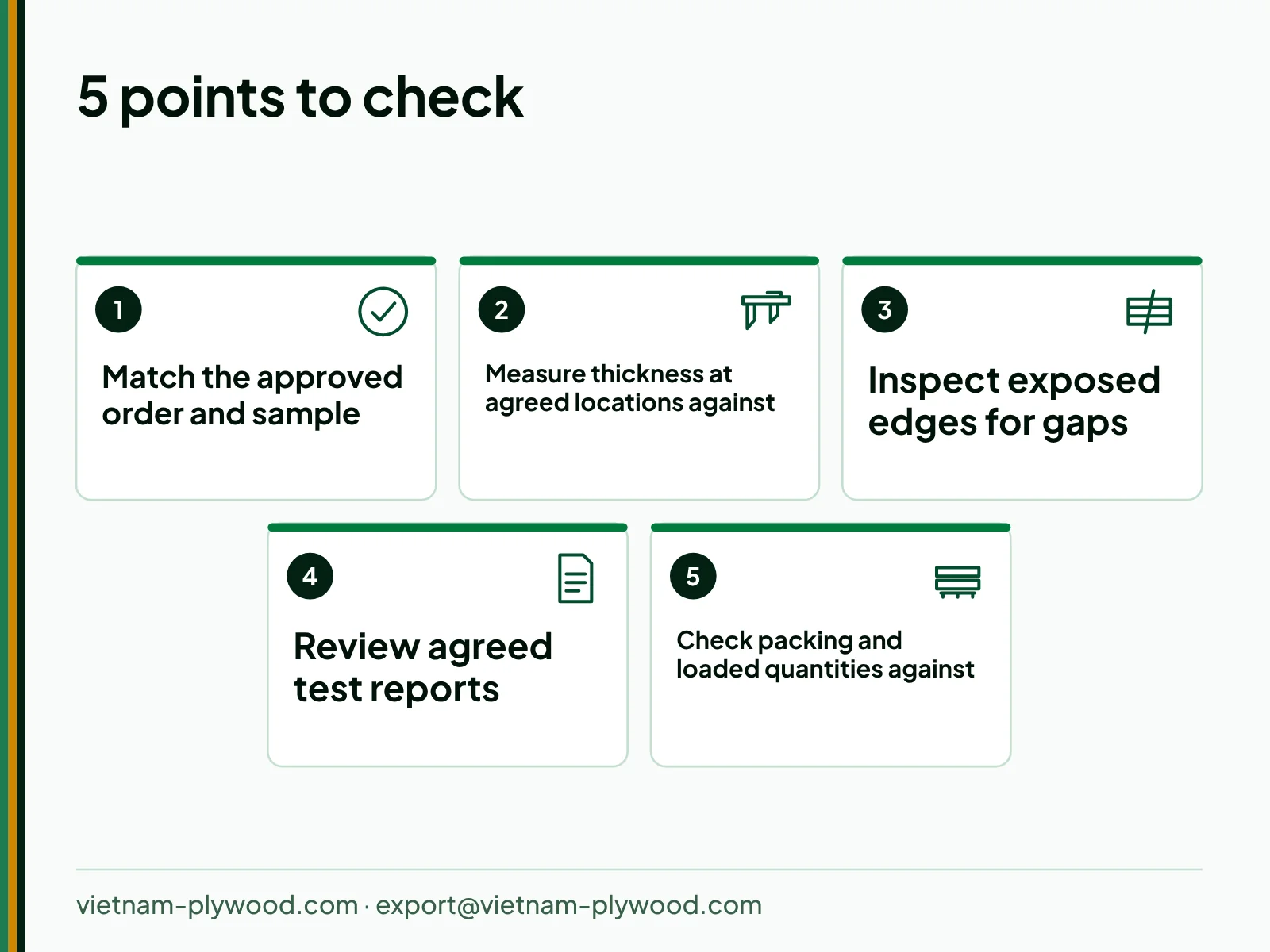
- Match the approved order and sample to the film face and specified acacia or eucalyptus core.
- Measure thickness at agreed locations against the ±0.5 mm film-faced tolerance; check length and width against ±2 mm.
- Inspect exposed edges for gaps, loose veneer, damage and the condition of factory edge sealing.
- Review agreed test reports for the ordered build and identify pallets by specification before loading.
- Check packing and loaded quantities against the packing list and draft shipping documents.
Can footing panels share a 40HC with other grades?
Footing panels can share a 40HC with other specifications within its 28.5 t payload limit. For a 1220×2440×18 mm acacia-core build, the reference full-container figure is 880 sheets, 47.15 m³ and 27.35 t, excluding film weight.
That leaves a limited weight margin before adding film, pallets and any mixed goods. For comparison, the 18 mm styrax-core furniture reference is 990 sheets, 53.05 m³ and 26.52 t, while eucalyptus-core construction reference is 795 sheets, 42.60 m³ and 27.69 t.
For a mixed load, allocate pallet positions by core and thickness, then recalculate the combined mass against the payload and actual packing. The container loading guide owns detailed sheet-count planning.
What should an importer put in the order?
An importer should state the footing geometry, approved thickness, planned reuse, core, glue, film and destination before requesting a quotation. For film-faced footing plywood, pricing is driven first by glue build and core, then by film weight, thickness, size, cutting and ordered mix.
HCPLY offers a minimum order of one 40HC, with mixed specifications within the payload limit. Factory lead time runs 15–45 days from receipt of the 30% deposit; the exact figure depends on order size, line loading and what the contract fixes. The remaining 70% is paid on the scan of the bill of lading, by T/T, or by irrevocable sight L/C; delivery terms are FOB Hai Phong, CFR (CNF) or CIF.
The export document set includes the commercial invoice, packing list, bill of lading, certificate of origin, applicable phytosanitary and fumigation papers, insurance under CIF and agreed certificate or test documents. EU lots also include EUR.1 and the EUTR/EUDR file set. After loading, the draft shipping documents come to you for approval.
What specification should be sent for a quotation?
Send a complete specification with the structural thickness already approved for the pour layout. Lucy can arrange a build-specific sheet and quotation from HCPLY against that written requirement.
Application: strip / pad footing / ground beam; pour depth and rotation plan
Line or core: construction line; acacia or eucalyptus
Glue: melamine MR or phenolic WBP
Emission: E0 / E1 / E2 as agreed separately from glue
Face and grade: film-faced; 120 or 135 g/m²; agreed appearance
Thickness and tolerance: design-approved mm; ±0.5 mm
Size: 1220×2440 mm or agreed listed/custom size
Quantity: sheets and pallet mix; minimum one 40HC
Destination port: [port and country]
Request the footing panel specification sheet from Lucy at export@vietnam-plywood.com.