






Slab formwork plywood is a film-faced deck sheet selected for the support grid, concrete finish and stripping method. A wrong thickness, bond or cut pattern can cost a rejected load, damaged soffits or extra site days. HCPLY presses slab-deck sheets on our construction line and builds the order around the contractor’s deck drawings.
What plywood is used for slab formwork?
Slab formwork uses plywood as the concrete-contact skin above joists, bearers and shores. Film-faced construction plywood gives a consistent forming surface, while the support system carries wet-concrete and construction loads. The formwork designer must check panel bending, deflection, bearing, joints and the complete load path before selecting a thickness. A plywood designation alone cannot establish a safe joist span.
Start with the project’s slab thickness, beam drops, openings, intended concrete finish and deck support layout. For the wider application family, see formwork by structural element.
Which film, glue and thickness suit a slab deck?
Choose the film for the concrete-contact finish and handling cycle, the glue for wet exposure, and thickness from the engineered support layout. Our construction line presses acacia- or eucalyptus-core panels with phenolic or melamine film, including anti-slip film for the appropriate walking surface. Film weight describes the overlay, while glue describes the bond; they are separate specification fields.
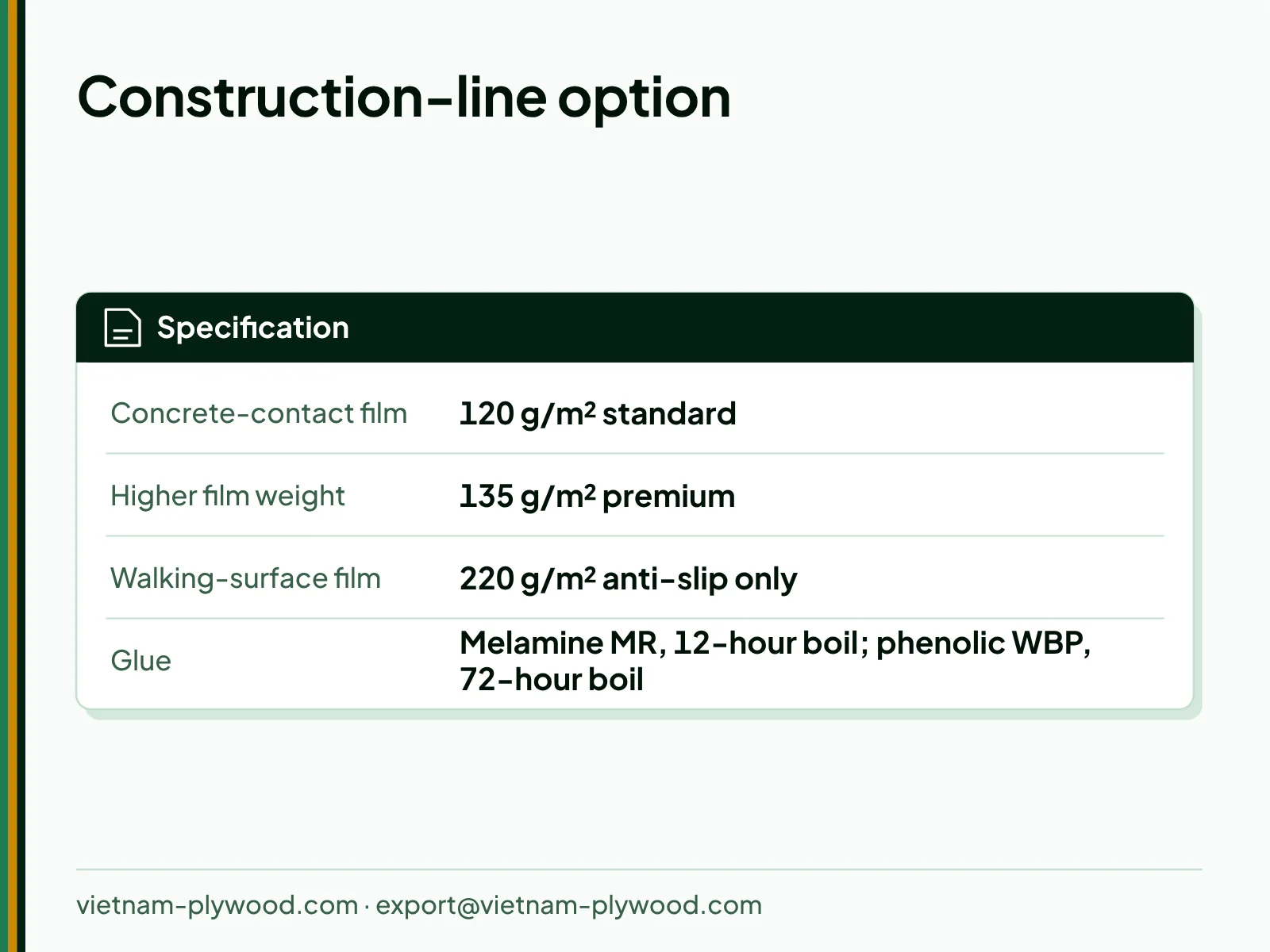
| Specification | Construction-line option | Buying decision |
|---|---|---|
| Concrete-contact film | 120 g/m² standard | Baseline deck facing for a defined finish |
| Higher film weight | 135 g/m² premium | Consider for a more demanding handling and finish schedule |
| Walking-surface film | 220 g/m² anti-slip only | Use where the specified exposed face needs grip, not as an automatic soffit upgrade |
| Glue | Melamine MR, 12-hour boil; phenolic WBP, 72-hour boil | Select bond against exposure and planned cycles |
| Thickness | 3–40 mm range; 12, 15, 18 and 21 mm among common sizes | Engineer checks loads, spans and deflection |
| Sheet tolerance | ±0.5 mm thickness; ±2 mm length and width | Match table seats, joint lines and cut schedules |
With proper handling, a release agent on every pour and sealed edges including cut edges, melamine-glue film-faced plywood gives about 12–15 pours; phenolic-glue film-faced plywood reaches up to about 25 pours. These are handling-dependent reuse figures, not a substitute for inspecting each panel before reuse. See the film-faced plywood product for the base construction specification.
How do table, drop-head and loose decks differ?
The deck system determines panel dimensions, handling and the replacement schedule before the plywood is ordered. Table formwork moves large assembled deck units; a drop-head system lowers designated deck components while retaining required supports; loose decking is assembled sheet by sheet on joists. The plywood can have the same film and core in each system, but its cutting and attachment details differ.
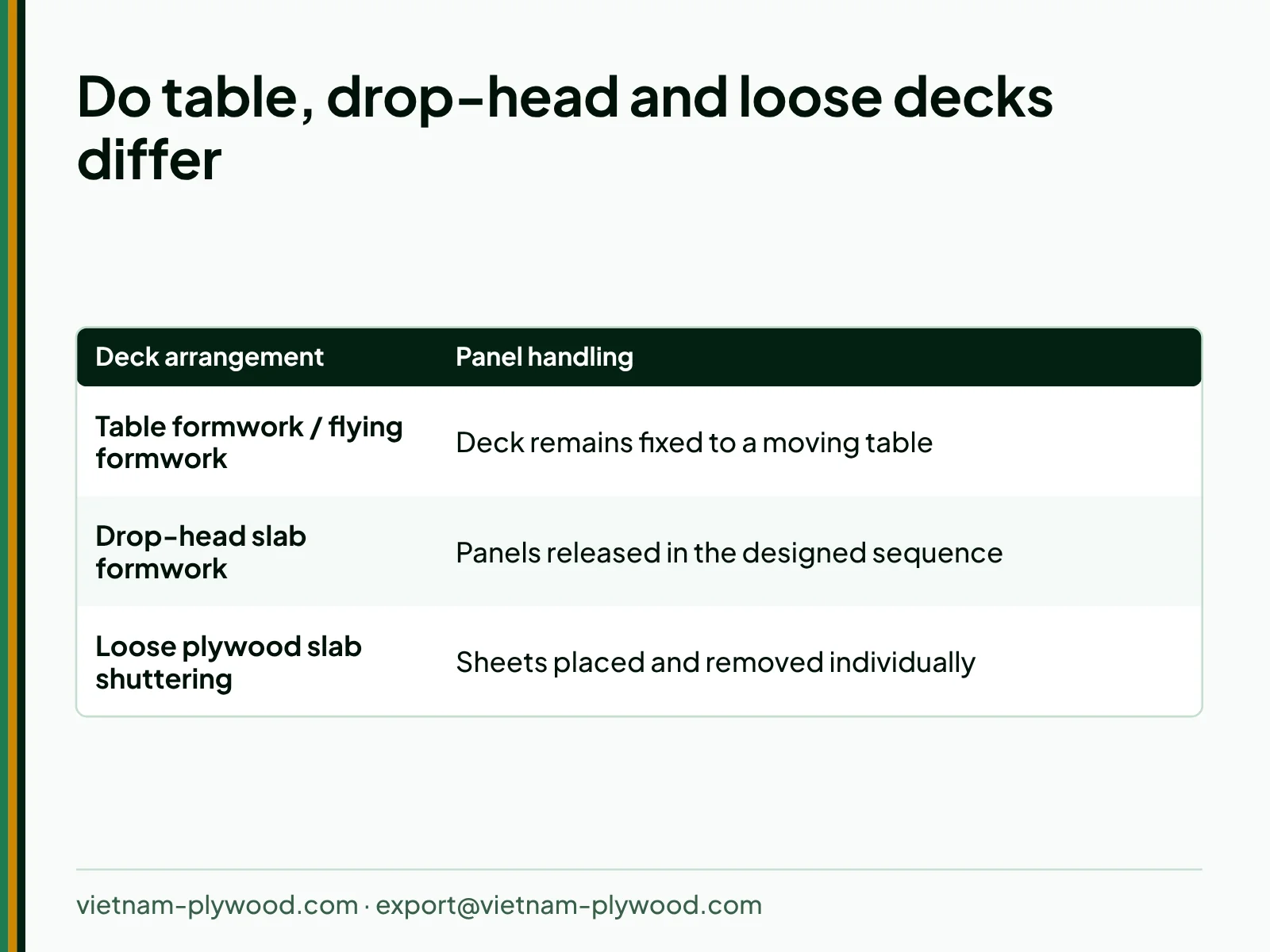
| Deck arrangement | Panel handling | Interface to specify | Verdict by use |
|---|---|---|---|
| Table formwork / flying formwork | Deck remains fixed to a moving table | Frame opening, screw layout, lift handling | Repeated floor plates with reusable table frames |
| Drop-head slab formwork | Panels released in the designed sequence | Head clearance, bearing and retained shores | Faster panel cycling where the proprietary system permits |
| Loose plywood slab shuttering | Sheets placed and removed individually | Joist grid, edge support and cut map | Irregular rooms, edges and changing geometry |
Which panel should I order for tableform deck replacement?
Order replacement table formwork plywood to the existing table’s panel seat and fastener pattern, then select film and bond for the planned pours. Record whether the replacement is a full deck sheet or a smaller infill.
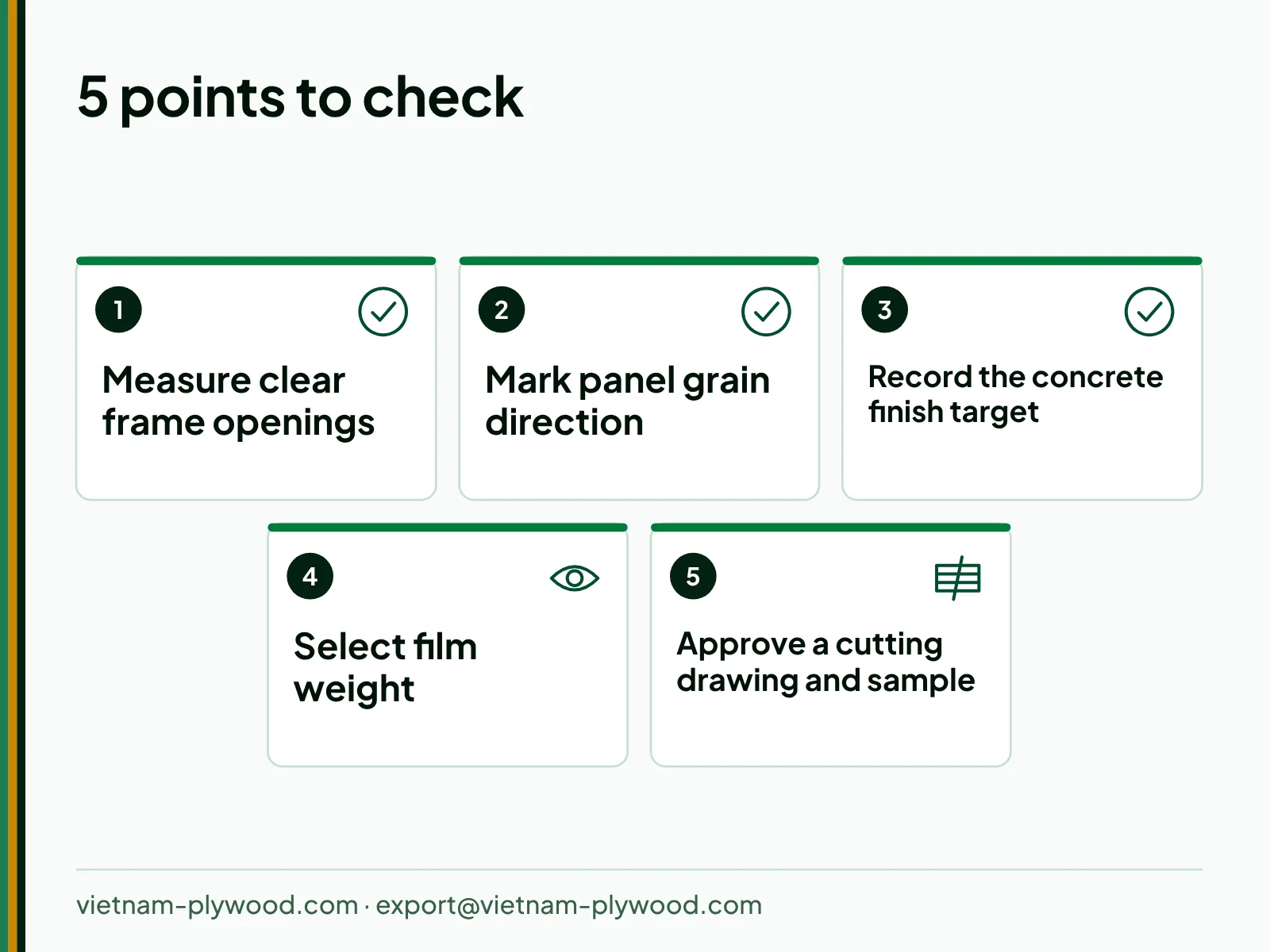
- Measure clear frame openings, edge-bearing widths and any rebates on the existing formwork tables.
- Mark panel grain direction, joist direction, penetrations and the exact fastener positions.
- Record the concrete finish target and current release-agent practice.
- Select film weight, glue, core, thickness, sheet size and permitted thickness tolerance.
- Approve a cutting drawing and sample before repeating the order across tables.
HCPLY can cut to a written schedule. Common full-sheet formats include 1220×2440 and 1250×2500 mm; the table design determines whether either is usable without further cutting. Keep exposed edges sealed after machining.
What does our construction line build for this application?
Our construction line presses the film-faced deck panels, using unsanded acacia or eucalyptus cores. The other lines make different plywood for different duties. This distinction matters when a project importer also orders cabinetry or transit protection for the same site.
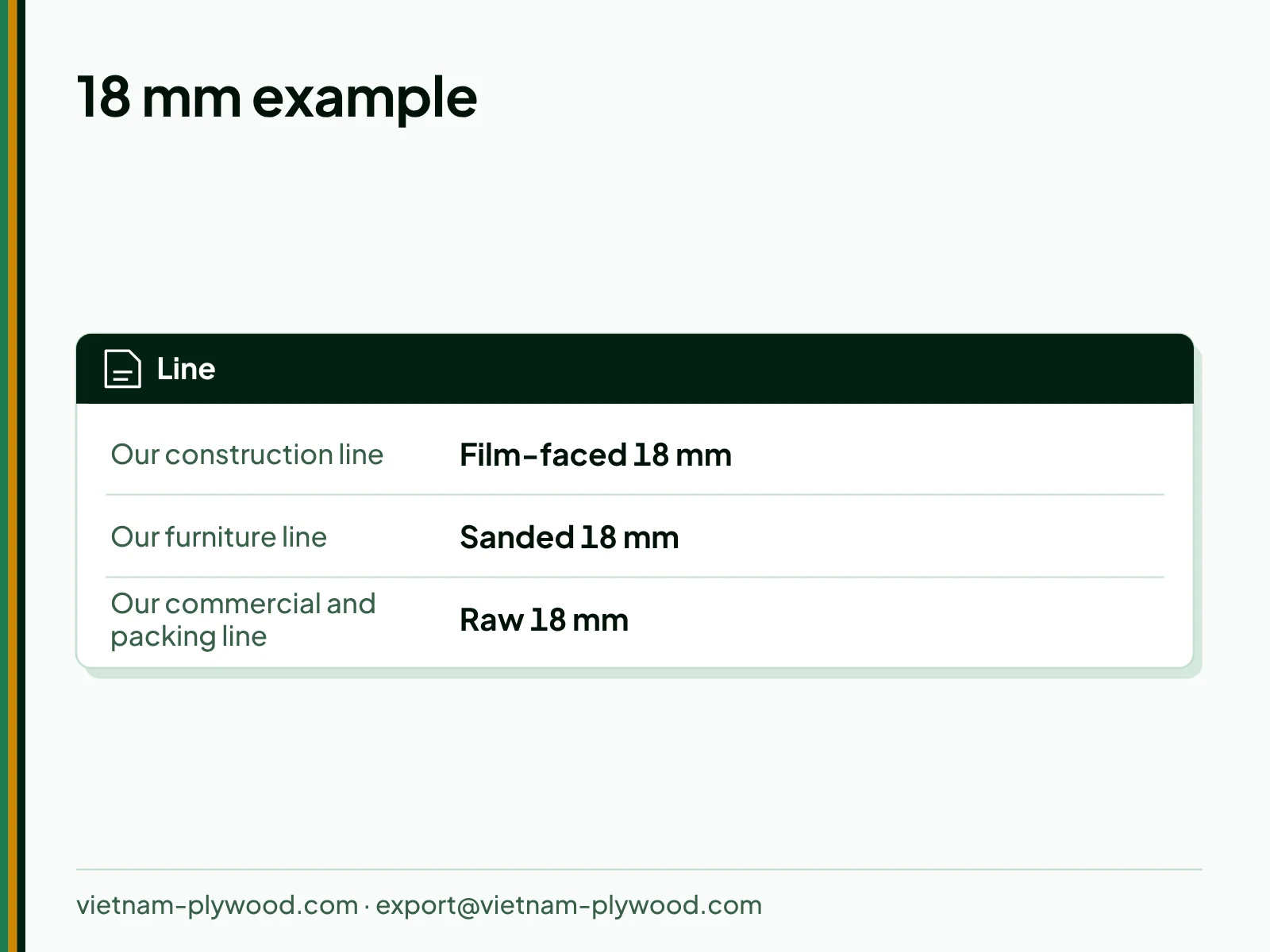
| Line | 18 mm example | Core and surface | Appropriate order |
|---|---|---|---|
| Our construction line | Film-faced 18 mm | Acacia or eucalyptus; unsanded core | Slab deck concrete-contact panels |
| Our furniture line | Sanded 18 mm | Styrax or eucalyptus, full stitched, E0/E1 | Furniture and cabinet components |
| Our commercial and packing line | Raw 18 mm | Acacia, MR glue, unsanded or light-sanded | Packing and commercial panels |
For related wall work, compare building wall forms plywood.
Can deck panels and LVL bearers share a container?
Deck panels can share a 40HC with other agreed specifications within its 28.5 t payload limit. LVL bearers require their own dimensions, mass, packaging and sourcing decision before inclusion in a combined loading plan. HCPLY does not press LVL bearers on its plywood lines, so an LVL component should never be assumed part of the film-faced panel build.
For 18 mm, 1220×2440 mm acacia-core plywood, one sheet weighs 31.08 kg. A full acacia-only 40HC lookup is 880 sheets, 47.15 m³ and 27.35 t; a mixed load must reserve payload and physical space for any other cargo. For a mixed load, check the pallet weights, bearer weights and packing against the payload limit and available space.
See plywood decks on H20 beams for the interface between sheathing and bearers, and container loads for pallet-based loading calculations.
What plywood suits a suspended-slab soffit?
Film-faced construction plywood suits a suspended-slab soffit when its tested properties and engineered support layout meet the project requirements. The formwork designer specifies joist centres, orientation, allowable deflection, bearing, shores and reshoring. A visible soffit may require tighter control of joint lines and film marks than a concealed ceiling.
The United States Occupational Safety and Health Administration’s 2025 Code of Federal Regulations, 29 CFR 1926.703, requires formwork to resist anticipated vertical and lateral loads and requires formwork drawings at the jobsite. The same rule addresses shoring inspections and removal after the concrete has sufficient strength. See the 2025 official regulation.
How should panels be laid out, poured and stripped?
Set the plywood layout from the approved temporary-works drawings, keeping panel joints on designed support and all cut edges protected. Site teams should treat corners, column openings, beam drops and service penetrations as planned details rather than improvised cuts.
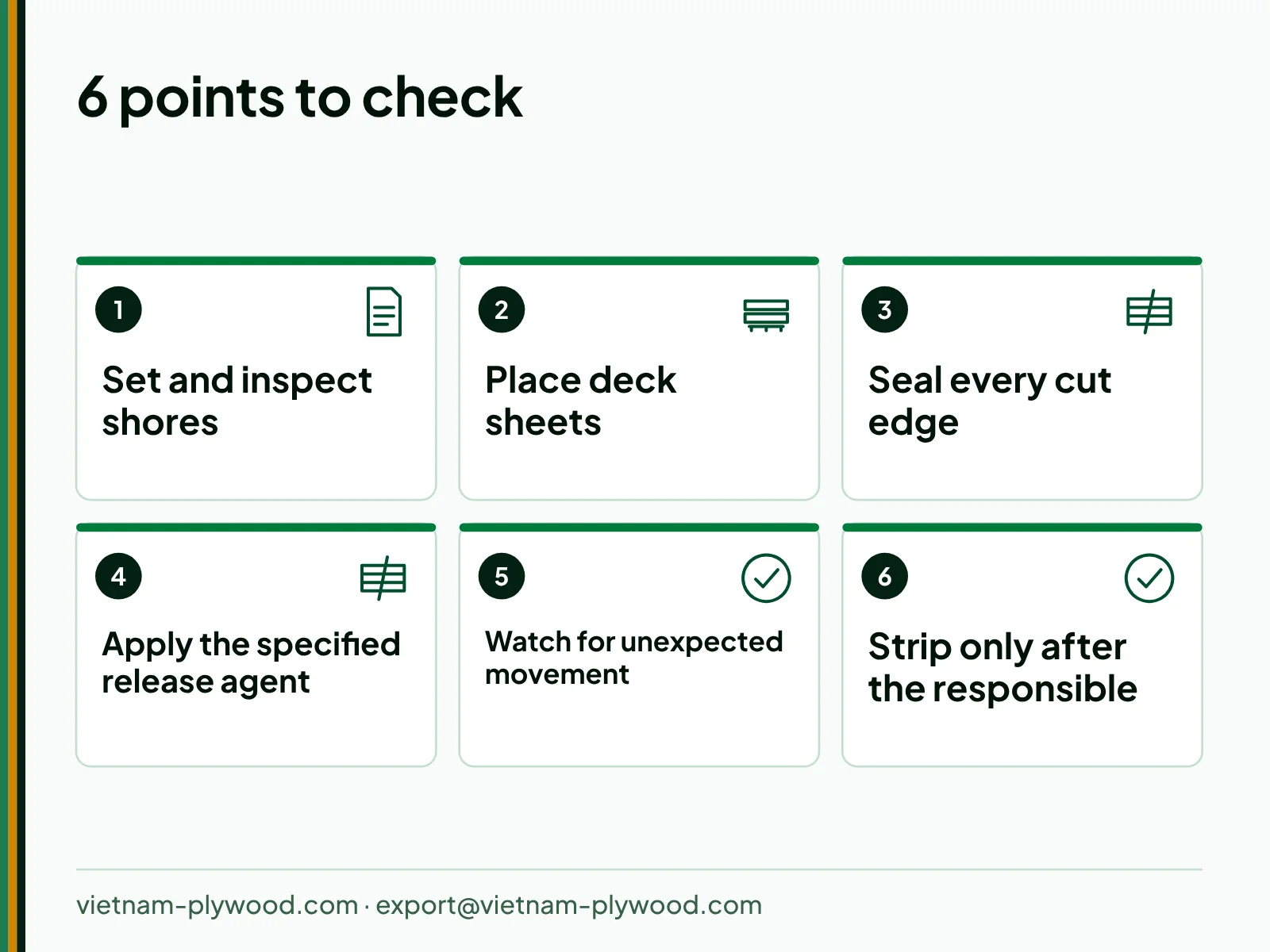
- Set and inspect shores, heads, bracing and bearer levels against the approved drawings.
- Place deck sheets in the specified orientation with continuous designed bearing at joints.
- Seal every cut edge; inspect film, fixings, openings and edge forms before reinforcement and pouring.
- Apply the specified release agent on every pour, avoiding contamination of reinforcement and concrete joints.
- Watch for unexpected movement, leakage or support changes during placement; follow the site engineer’s stop-work procedure.
- Strip only after the responsible designer’s strength and reshoring criteria are met; clean and grade each sheet for the next cycle.
What can an inspector witness at the producing factory?
An inspector can compare the approved panel schedule with measured sheets, film appearance, edge condition and packing marks at the producing factory. For slab-deck orders, check the sheet’s concrete-contact face and its dimensions before the load is wrapped. A factory visit also allows a buyer to see the line pressing the specified panel.
The check sheet should record thickness at agreed measurement points, length and width, visible face defects, panel edges and pallet identification. Ask for the agreed bond or performance test report when a structural specification requires evidence. An inspection of appearance cannot replace a structural test or the temporary-works designer’s calculations.
Which order and export documents matter?
The order specification and agreed test reports establish the panel build; the packing list identifies the dispatched quantities. For each shipment, the document set includes commercial invoice, packing list, bill of lading, certificate of origin, phytosanitary and fumigation papers, and agreed certificate documents. EU lots include EUR.1 where applicable and the EUTR/EUDR file set; CIF shipments include insurance. After loading, the draft shipping documents come to you for approval.
Member-factory FSC, CARB P2, ISO 9001 or CE documents, where relevant to the agreed order, are shown with factory details masked, on request. Specify any project test-report acceptance criteria before production. For mixed product orders, see one supplier, several plywood types.
How do I request a trial slab-deck container?
Send the deck system, approved panel schedule and destination port so Lucy can price the exact film, glue, thickness, cutting and packing build. Price drivers are film specification, glue selection, core choice, machining and order mix; a premium film or more demanding machining costs more than a simpler build. Ask for a written quotation rather than using a generic slab-deck price.
Minimum order is one 40HC, with mixed specifications within the payload limit. Factory lead time runs 15–45 days from receipt of the 30% deposit; the exact figure depends on order size, line loading and what the contract fixes; the The remaining 70% is paid on the scan of the bill of lading, by T/T, or by irrevocable sight L/C. We ship FOB Hai Phong, or CFR (CNF) or CIF to your port. Samples are free; new buyers book their courier, and that cost can be credited against a real order.
Application: suspended slab / table formwork / drop-head / loose deck
Line or core: construction line / acacia or eucalyptus
Glue: phenolic WBP or melamine MR
Emission class: E0 / E1 / E2 as specified
Face and grade: 120 or 135 g/m² film; agreed face acceptance
Thickness and tolerance: ___ mm / ±0.5 mm
Size: ___ × ___ mm; cutting drawing attached
Quantity: ___ sheets; mixed-load items listed separately
Destination port: ___; requested term FOB / CFR / CIF
Plan a trial container with Lucy at export@vietnam-plywood.com through contact, using the approved deck drawing and panel schedule.