





Switching formwork boards from 3-ply to film-faced changes module fit, handling, repair options and the cost of each accepted concrete pour. A poor match can mean wasted sheets, additional labour or rejected concrete finishes. HCPLY makes film-faced plywood on our construction line, while a European yard must compare it against the 3-ply panels already in service.
What are formwork boards?
Formwork boards are the contact panels that hold fresh concrete to the required shape while the supporting frame carries construction loads. The term includes wood forming panels, shuttering panels and other sheet materials, but their connections, stiffness and surfaces differ. The concrete formwork specification guide explains the wider system specification.
For a yard replacing yellow shuttering panels, the first decision is whether its existing frames accept a different board format. A panel that fits the opening but bends excessively or leaves unsuitable joints is a failed substitution. The US Occupational Safety and Health Administration’s rule, 29 CFR 1926.703(a)(1), requires formwork to support reasonably anticipated vertical and lateral loads without failure. Use that design principle with the applicable local engineering requirements.
What is a 3-ply shuttering panel?
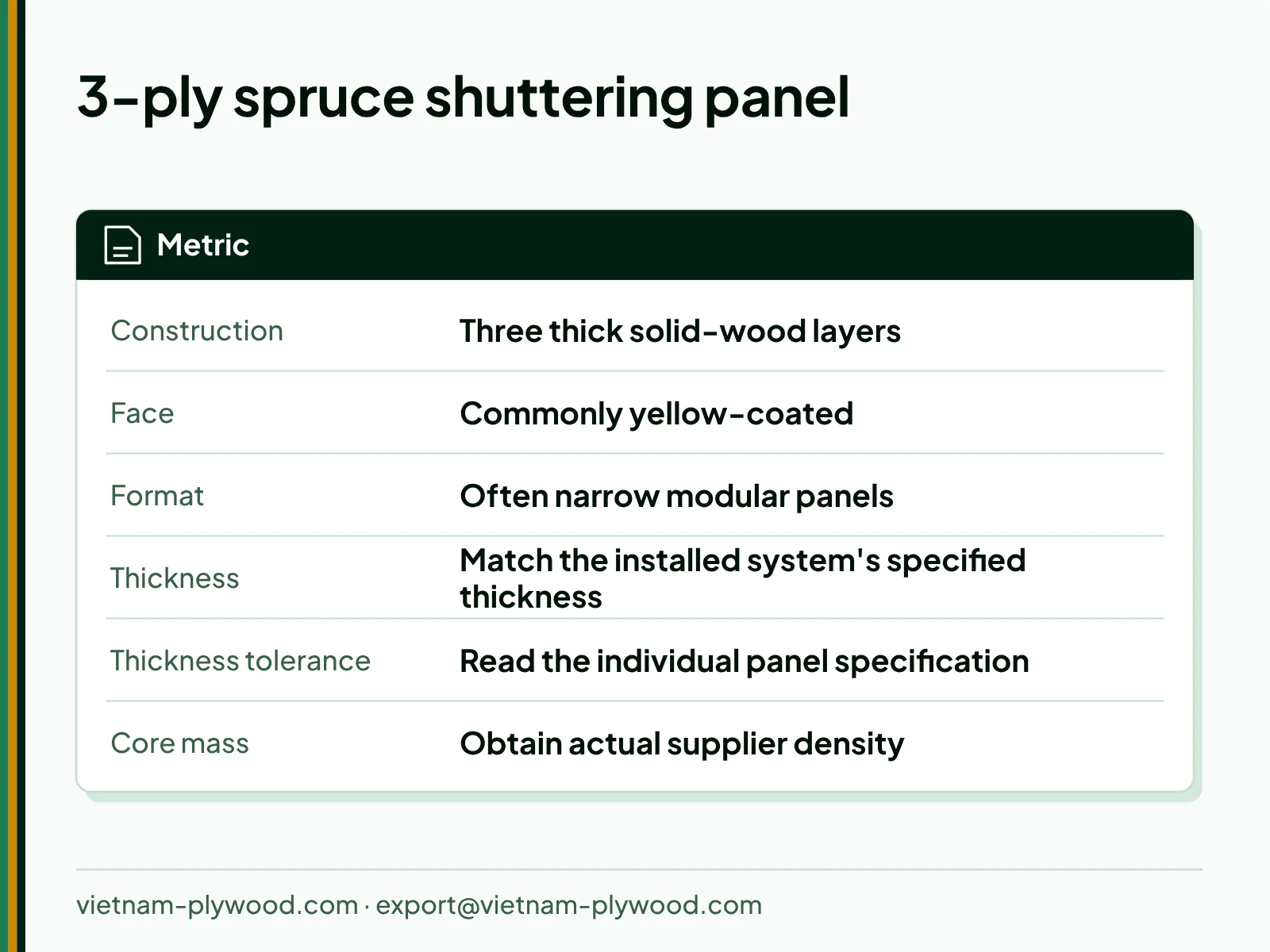
A 3-ply shuttering panel is a solid-wood panel assembled from three relatively thick layers, usually with the middle grain running across the outer layers. European yards often recognise the yellow shuttering panel by its coated surface and narrow modular dimensions. Colour identifies a finish convention, not a universal strength class.
The construction is different from plywood made from many thin veneers. A 3 ply shuttering panel can be cut and its exposed edges protected, but cuts can reduce its usefulness as a reusable standard-size insert. Existing panel drawings and the frame supplier’s requirements determine whether a replacement is suitable. Our construction line does not manufacture 3-ply spruce panels.
How do formwork boards compare when switching?
Film-faced plywood substitutes a multi-veneer, coated sheet for a thick-lamella panel. The change affects frame fit, edge care, handling and replacement economics; neither material alone determines safe support spacing. Compare the actual board specification rather than treating the word forming board as a grade.
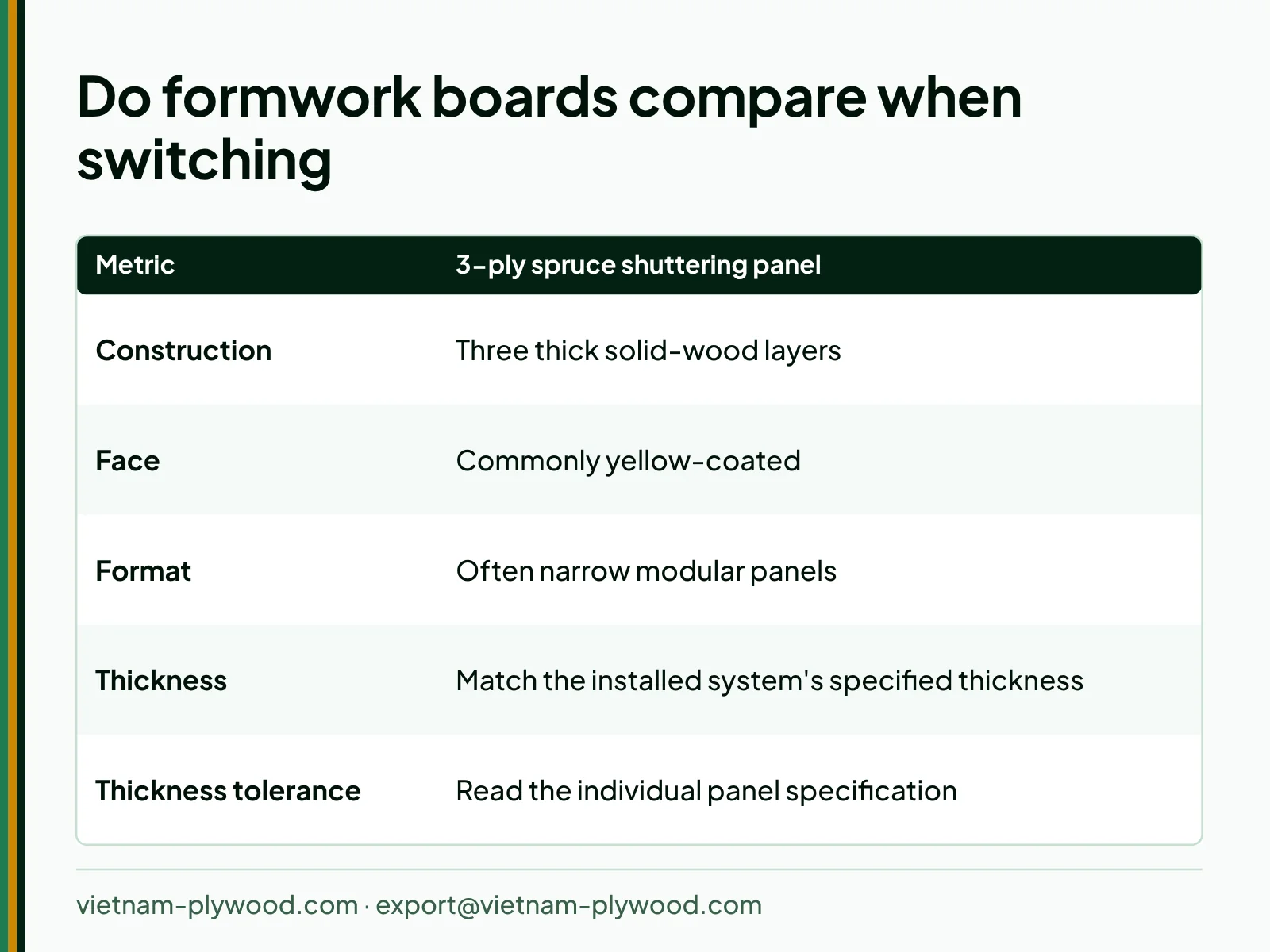
| Metric | 3-ply spruce shuttering panel | Film-faced plywood | Verdict by use |
|---|---|---|---|
| Construction | Three thick solid-wood layers | Multiple thin veneers, acacia or eucalyptus core | Keep 3-ply where a proprietary module requires it |
| Face | Commonly yellow-coated | 120 g/m² standard or 135 g/m² premium film | Trial concrete finish before changing |
| Format | Often narrow modular panels | 1220 × 2440 or 1250 × 2500 mm among available sizes | Film-faced suits custom-cut infill |
| Thickness | Match the installed system’s specified thickness | 3–40 mm range; 18 and 21 mm common | Match engineered deflection and fastening needs |
| Thickness tolerance | Read the individual panel specification | ±0.5 mm | Check fit at frame joints |
| Core mass | Obtain actual supplier density | Acacia 580 kg/m³; eucalyptus 650 kg/m³ | Compare measured panel weights |
| Repair | Coating restoration may be possible on suitable boards | Edge resealing is practical; failed film or bonds warrant replacement | Keep 3-ply where refurbishment is routine |
| Reuse | Record actual yard history | Conditional film-faced figures below | Choose by cost per accepted pour |
For film choices and core builds, see film-faced plywood. The thickness selection page covers the next design decision.
How many reuses should the yard budget?
With proper handling, a release agent on every pour and sealed edges including cut edges, melamine-glue film-faced plywood gives about 12–15 pours; phenolic-glue film-faced plywood reaches up to about 25 pours. These are product-use figures under the stated care conditions, not a comparison against a measured 3-ply fleet.
For 3-ply formwork panels, ask the existing yard for actual cycles by panel type, repair method and concrete finish acceptance. The useful endpoint is the last pour producing an acceptable surface and a sound panel, not the last time a damaged sheet can be mounted.
Specify the release-agent routine in the trial log and use the release-agent guide for application questions. After stripping, inspect faces, edges, corners, nail holes and any separation between layers before assigning the panel to another pour.
What changes in lifting weight and container planning?
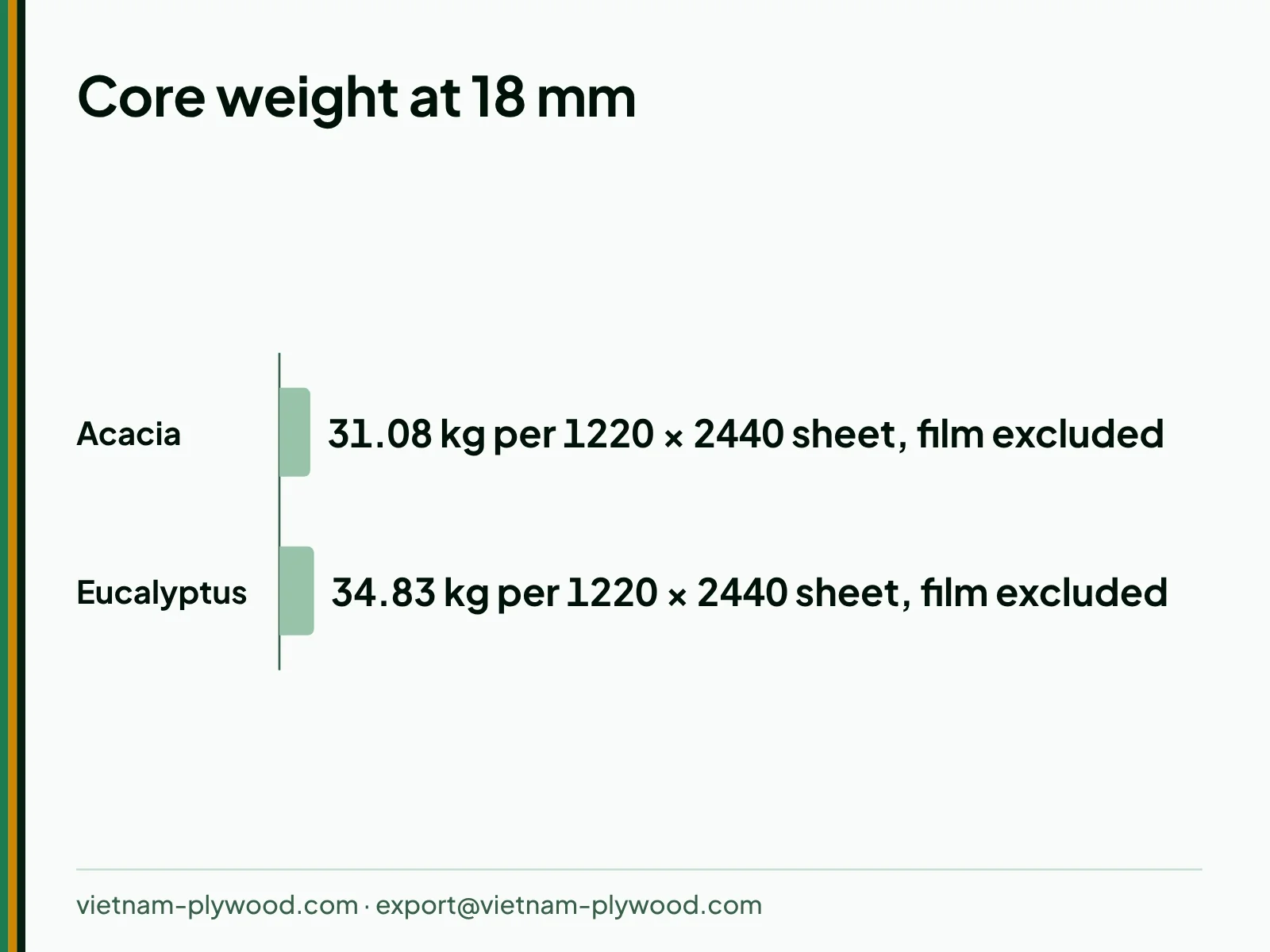
At 18 mm and 1220 × 2440 mm, an acacia-core film-faced sheet has a calculated wood weight of 31.08 kg; eucalyptus core is 34.83 kg. These figures exclude film weight. A 3-ply board needs its own size, density and measured weight before a fair handling comparison.
For a full 40HC reference load at this size and thickness, the acacia calculation is 880 sheets, 47.15 m³ and 27.35 t; eucalyptus is 795 sheets, 42.60 m³ and 27.69 t. The payload ceiling is 28.5 t. A mixed specification can share a container if the combined cargo stays within that limit; pallet arrangement and actual packed weights still need checking. The container loading page owns detailed load calculations.
For yard handling, measure the carried panel, not merely kilograms per cubic metre. Record crew lifts, cutting loss and required lifting equipment in the same trial.
How do cutting and repairs change?
Cutting film-faced sheets creates raw edges that must be sealed before wet concrete exposure. Clean the sheet after stripping without gouging the film, then inspect the face for punctures, abrasion and concrete residue. Damaged edge coating can be renewed when the panel remains sound; bond separation or widespread film failure calls for removal from the reusable stock.
A 3-ply yard may already have a process for sanding and recoating selected solid-wood panels. That repair route cannot be assumed for thin film over plywood veneers. Compare repair hours and material cost against replacing a sheet; a repair that leaves a visible imprint on exposed concrete is not an economic saving.
Is film-faced plywood cheaper per m² of formwork?
Film-faced plywood can have a lower initial sheet cost than a specialised 3-ply insert, but the winning cost per formed square metre depends on achieved reuse and yard operations. For film-faced sheets, the main quotation drivers are glue and film build, core, thickness, format, ordered quantity and delivery terms. Phenolic-glue and premium-film builds cost more than the corresponding melamine-glue and standard-film builds because the specified materials and processing differ.
Use cost per accepted formed m² = (landed board purchase + cutting + handling + repair + disposal − recoverable value) ÷ total accepted formed area. Keep frame rental or ownership, additional supports and concrete-face remediation as separate lines, then add them for a full system comparison. A lower board purchase price can lose if replacement, labour or rejected finishes consume the saving.
Request like-for-like written quotations for both systems. No single film-faced selling price captures the required construction specification.
What should a yard trial first?
Trial one representative bay using the existing 3-ply build as the control and film-faced plywood as the candidate. Keep concrete mix, pour conditions, release agent, stripping practice and finish acceptance criteria comparable. Obtain the frame designer’s approval for changed sheet dimensions, fixing and support spacing before the trial.
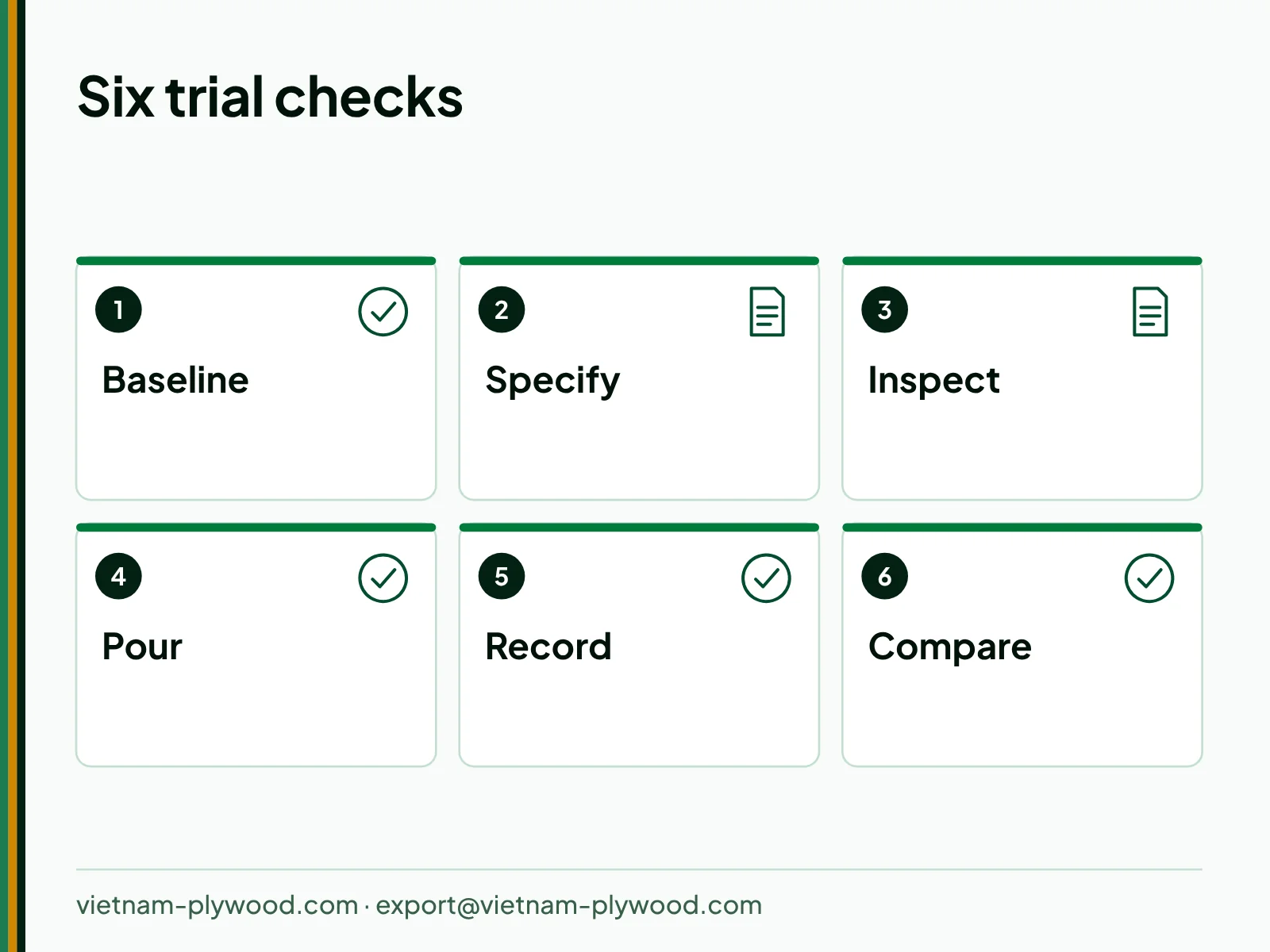
- Record the current 3-ply panel dimensions, weight, fixings, support layout and actual reuse history.
- Select the film-faced core, glue, film weight, thickness and cut plan against the bay drawing.
- Inspect both incoming faces and all edges; mark cut edges for sealing.
- Pour the control and trial bays using the agreed handling and release-agent routine.
- Photograph the stripped concrete and panels; record labour, repairs and rejected finish area.
- Repeat until the agreed acceptance limit or planned trial endpoint, then calculate cost per accepted formed m².
Which HCPLY line builds the alternative?
Our construction line presses film-faced plywood with acacia or eucalyptus core, phenolic or melamine glue and a specified film surface. Our furniture line builds sanded, full-stitched styrax- or eucalyptus-core plywood for interior applications. Our commercial and packing line builds acacia-core, MR-glue panels with unsanded or lightly sanded faces.
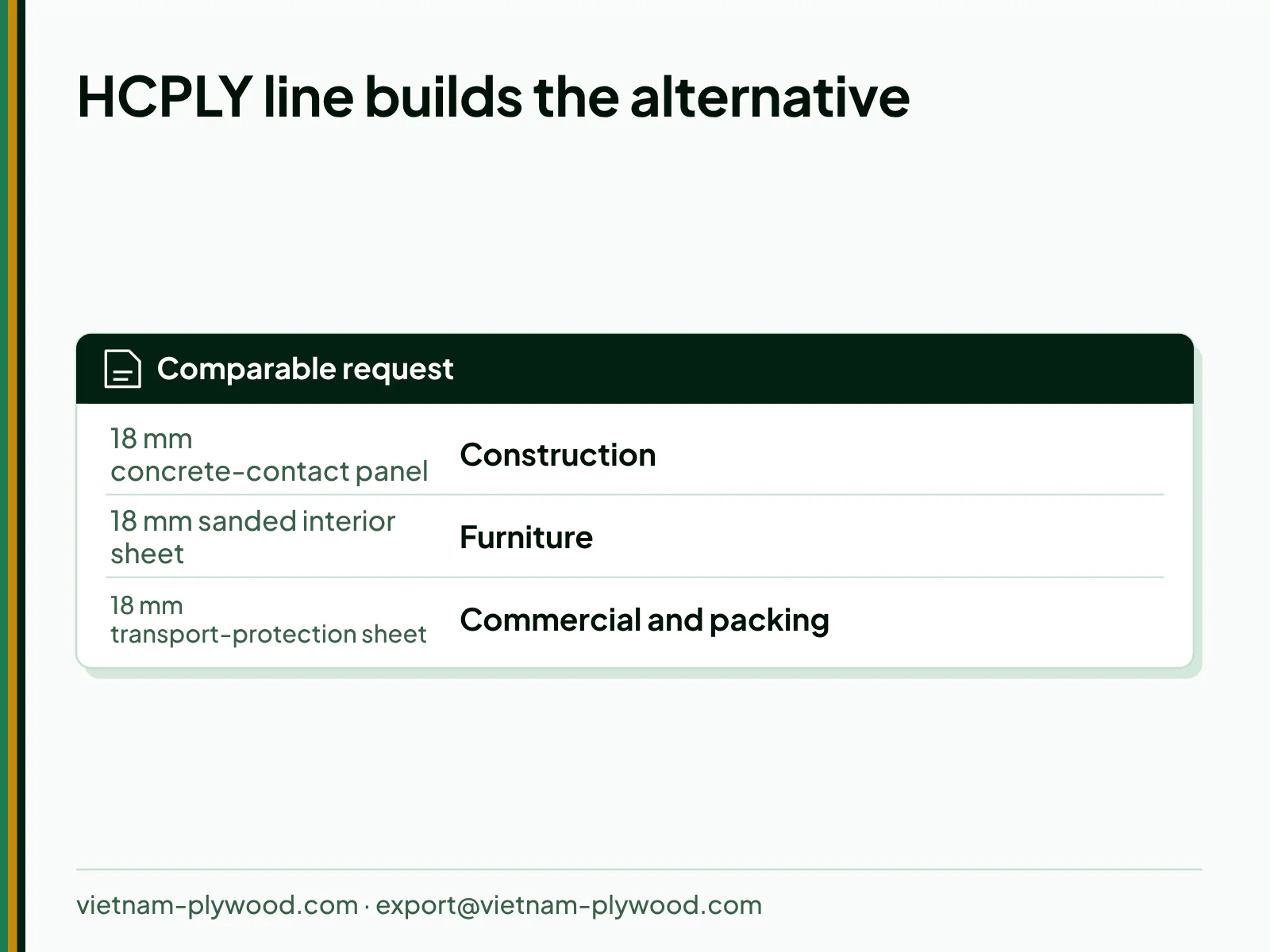
| Comparable request | Producing line | Build and buyer use |
|---|---|---|
| 18 mm concrete-contact panel | Construction | Film-faced acacia or eucalyptus core for a formwork trial |
| 18 mm sanded interior sheet | Furniture | Full-stitched styrax or eucalyptus core for cabinetry |
| 18 mm transport-protection sheet | Commercial and packing | Acacia-core MR panel for packing applications |
A buyer or inspector can visit the producing factory and witness thickness checks, face inspection, edge condition and pallet identification against the approved order. HCPLY manages specification, on-site quality control, shipping paperwork and loading. Our three factories are in Phu Tho and Hai Phong; the order ships from its producing location through FOB Hai Phong arrangements.
Which checks and export papers belong in the order?
Melamine glue is MR with a 12-hour boil specification; phenolic glue is WBP (weather and boil proof) with a 72-hour boil specification. E0, E1 and E2 are emission classes, not glue types. For a film-faced construction order, request the agreed test report and acceptance method for the intended use.
The shipping set includes commercial invoice, packing list, bill of lading, certificate of origin, phytosanitary and fumigation papers, and the agreed test or certificate documents. For EU lots, EUR.1 and the EUTR/EUDR file set are included as applicable to the order. After loading, the draft shipping documents come to you for approval; the packing list identifies the panel specification and quantity being shipped.
Member-factory FSC, CARB P2, ISO 9001 and CE documents, where relevant to the agreed factory and product, are shown with factory details masked, on request.
What should the written trial request contain?
A useful trial request names the current 3-ply frame and the candidate film-faced build in one comparison. The panel-name crosswalk helps prevent different trade names from hiding different constructions.
We can discuss a mixed-specification 40HC order within the payload limit. Factory lead time runs 15–45 days from receipt of the 30% deposit; the exact figure depends on order size, line loading and what the contract fixes. The remaining 70% is paid on the scan of the bill of lading, by T/T, or by irrevocable sight L/C. We ship FOB Hai Phong, or CFR (CNF) or CIF to your port; free samples are available, with new buyers booking their own courier and that courier cost creditable against a real order.
Application: European formwork-yard comparison; existing 3-ply frame and bay drawing
Line or core: Construction line; acacia or eucalyptus core
Glue: Melamine MR or phenolic WBP
Emission: E0 / E1 / E2 class required by order
Face and grade: Film-faced, 120 g/m² standard or 135 g/m² premium
Thickness and tolerance: 18 mm or 21 mm; ±0.5 mm
Size: 1220 × 2440 mm or agreed custom cut
Quantity: Trial quantity and planned 40HC specification mix
Destination port: [buyer to enter]
Next step: book a producing-factory visit with Lucy to witness the proposed trial-panel checks; contact export@vietnam-plywood.com.