






Film faced plywood storage protects the sealed faces and edges from container unloading through every formwork cycle. Poor stacking, trapped water and abrasive cleaning can cost a contractor usable pours and replacement days. HCPLY sends sealed, strapped construction-line panels; receiving yards preserve that condition with level supports, airflow, prompt cleaning and resealing after cuts.
How should film faced plywood storage work on site?
Film faced plywood storage starts with flat, level support above the ground, a weather cover and open airflow. Keep the stack away from standing water, direct sun and site traffic. Protect the film from grit and sharp objects, and inspect the edges before panels return to a formwork cycle. A sealed bundle still needs a dry storage location after unloading.
Put bearers on firm ground with their tops level and aligned vertically through the stack. Avoid unsupported overhangs and uneven loading that bend sheets. Do not lean loose sheets against a wall for prolonged storage; edge loading and distortion can make joints harder to close. Keep bundles segregated by size, specification and condition, with the identification label visible.
The wider concrete formwork plywood specification guide explains selection before the panels arrive. Storage should preserve that agreed build until the contractor installs it.
How should a delivered lot be covered and stacked after unloading?
After unloading, inspect the strapped lot before removing its transport protection, then move it onto level bearers under a roof or ventilated cover. Our construction line dispatches film-faced panels sealed and strapped; opening the bundle transfers day-to-day protection to the receiving yard.
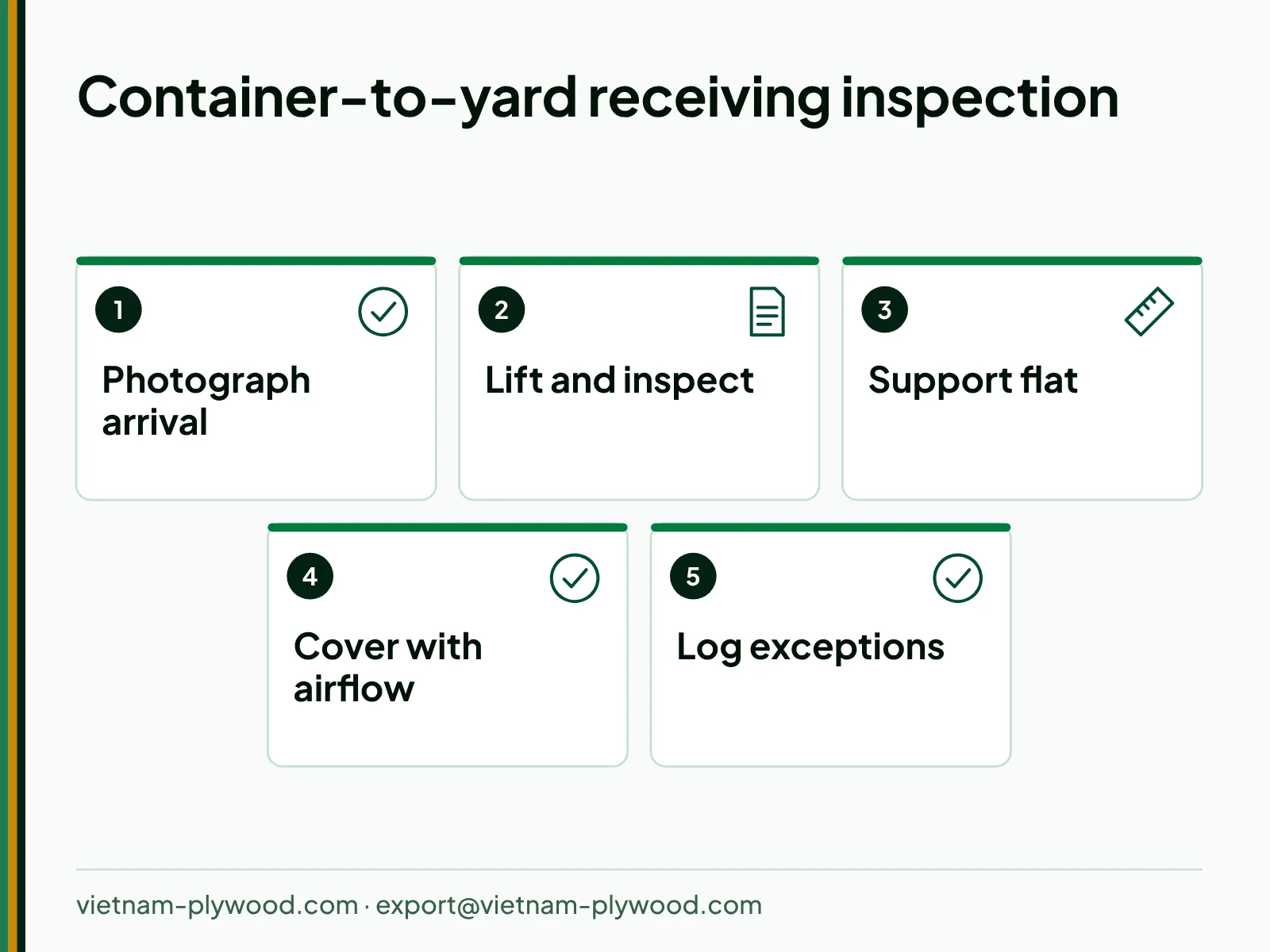
- Photograph the container opening, pallet labels, straps, wrapping, exposed corners and any visible wet areas before moving bundles.
- Lift with equipment rated for the bundle and protect contact points from fork and strap damage; never drag a sheet across another film face.
- Put each bundle on aligned bearers above wet ground, with a stable footprint and clear access for inspection.
- Cover the top and weather-facing sides while leaving ventilation paths. Remove wet transport wrapping rather than trapping condensation against wood.
- Separate visibly damp or damaged sheets for examination, and record their location and condition before the rest enter service.
A roof gives the clearest rain protection. Where a tarpaulin is used, pitch it to shed water and keep it from lying directly against wet film. Recheck after storms, yard moves and prolonged storage.
How do you clean film faced plywood between pours?
Clean soon after safe stripping, while cement residue can still be lifted without scraping through the film. Start with a plastic or wooden scraper and a nylon brush. Use a damp cloth or controlled light rinse only where the panel and site procedure permit it; dry the panels with airflow before restacking.
Keep steel chisels, wire brushes, grinders, unknown solvents and uncontrolled high-pressure jets away from the overlay. A hard jet directed into a cut or tie hole can drive water into exposed veneer. If hardened residue cannot be removed without gouging the face, hold the panel for inspection instead of forcing the tool.
Remove accumulated release-agent residue before recoating. Photograph scratches, lifting film, swelling and persistent concrete adhesion while the face is clean. Cleaning is also the moment to check whether the panel still meets the specified concrete finish.
Do cut edges of film faced plywood need to be resealed?
Yes. Every site cut opens veneer end grain that needs a compatible protective edge coating before the next wet exposure. Inspect drilled holes, notches and damaged corners as well as straight saw cuts. The factory edge protection remains useful only while its coating stays intact.
Brush away dust, check that the exposed core is sound and dry, then coat the entire exposed thickness using the approved edge-sealing product. Follow that product’s preparation, recoating and curing instructions. Keep the sealer off the casting face where it could print into concrete. Record the repair if the yard tracks panel reuse.
Paint cannot restore a swollen core or a separated glue line. Hold such sheets for the formwork supervisor’s assessment. The detailed method belongs in sealing plywood edges; this storage routine makes resealing a required step after cutting.
How do you make formwork plywood last longer?
The repeatable routine is careful stripping, prompt cleaning, resealing exposed wood, ventilated storage and a compatible release agent on every pour. Assign a crew member to record each panel’s condition after stripping; a film face that still looks glossy can hide edge swelling or open holes.
With proper handling, a release agent on every pour and sealed edges including cut edges, melamine-glue film-faced plywood achieves about 12–15 pours; phenolic-glue film-faced plywood reaches up to about 25 pours. These figures describe the specified handling conditions and different glue builds. The coating, concrete finish requirement, stripping technique and site handling also affect when a sheet must leave service.
Apply a thin, even coat of release agent following its instructions. Avoid waste oil and pooled product, which can stain the casting face. Never continue using a panel solely to reach a target cycle count when its condition fails the approved formwork design or finish requirement.
Which construction-line build fits the planned care routine?
Our construction line presses the film-faced formwork panels; the other lines produce different surfaces and core constructions for their applications. A buyer comparing the same nominal thickness should keep the use, face and edge-protection requirement visible rather than substituting a packing or furniture sheet.
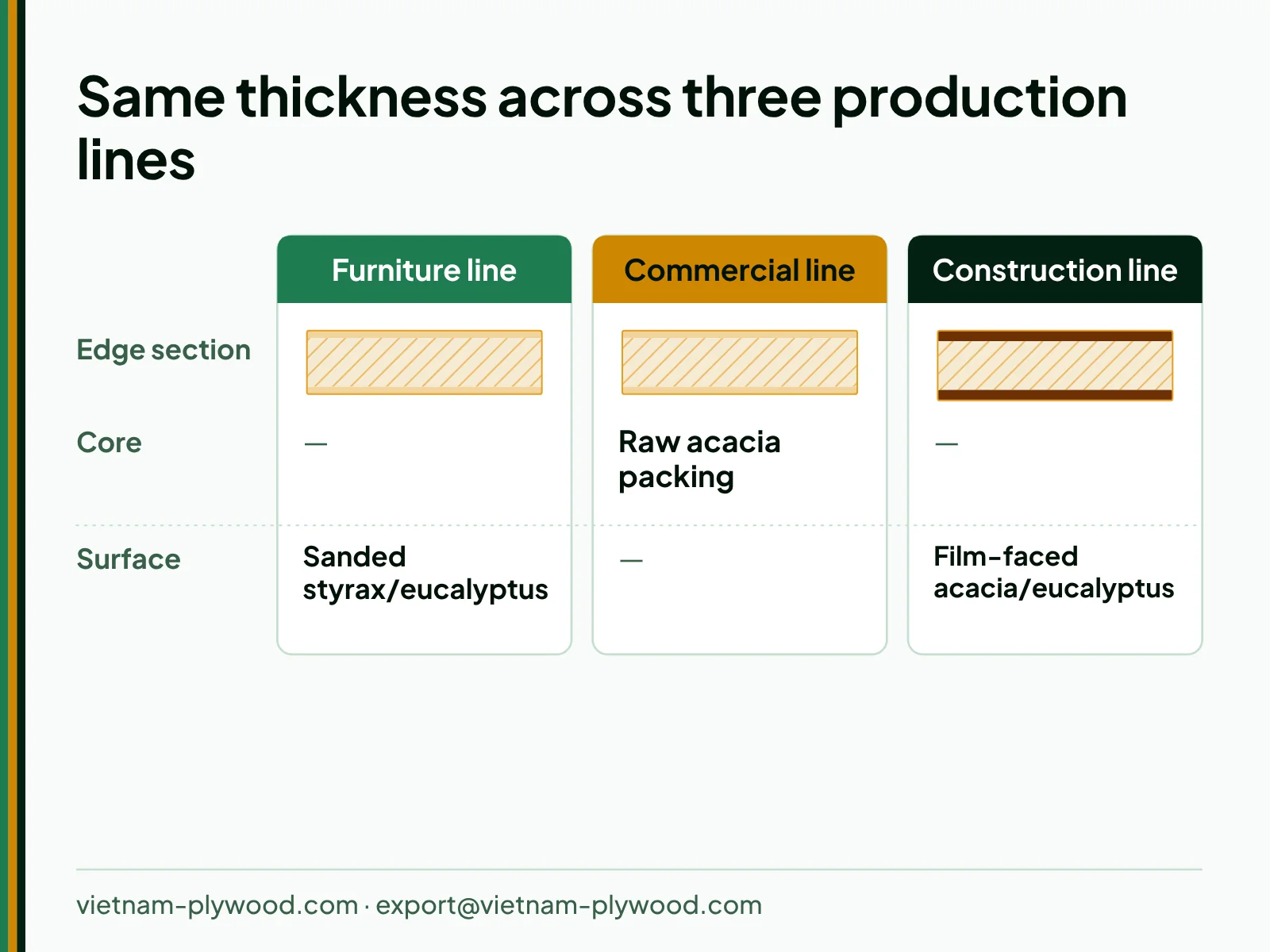
| Line | Example at 18 mm | Core and face | Site-care implication |
|---|---|---|---|
| Construction | Film-faced formwork | Acacia or eucalyptus core; 120 g/m² standard film or 135 g/m² premium film | Protect coated faces and reseal all cuts |
| Commercial and packing | Raw packing sheet | Acacia core, MR glue, unsanded or light-sanded | No factory film barrier for repeated concrete casting |
| Furniture | Sanded furniture panel | Styrax or eucalyptus core, full stitched, E0/E1 | Intended for furniture finishing rather than concrete release |
The construction range also includes 220 g/m² anti-slip film, which is a separate surface choice. Film-faced panels use a thickness tolerance of ±0.5 mm and length and width tolerance of ±2 mm. For grade distinctions, see shutterply sizes and grades and the cross-line plywood comparison.
What should the receiving inspector witness and record?
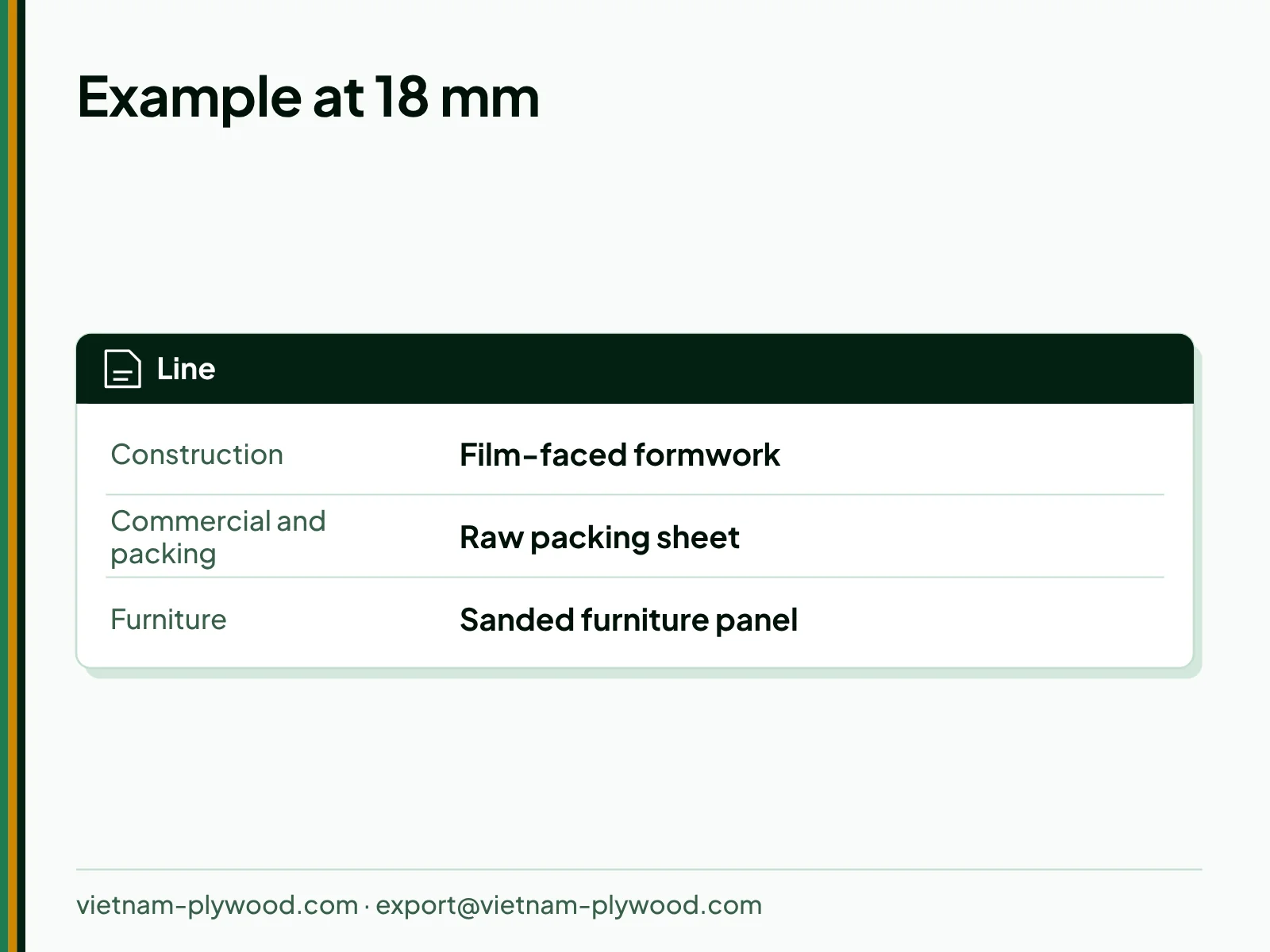
The receiving inspector should compare the unloaded lot with the order, record visible damage and preserve a time-stamped trail from container opening to protected storage. At the producing factory, a buyer can witness the film surface, edge coating, dimensions, bundle condition and loading photographs before dispatch.
HCPLY’s on-site quality control can show the agreed film weight designation and core specification against the production lot. Check for continuous edge coating, intact film, sound corners and consistent sheet dimensions. Inspectors should distinguish a pre-existing film defect from a scratch made by a fork, strap or abrasive site tool.
The packing list identifies shipment quantities and packages; it should be compared with the receiving tally and photographs. After loading, the draft shipping documents come to you for approval. Keep the receiving report with the order’s shipment documents so later damage claims can be traced to the same lot.
Which damage is storage damage rather than a manufacturing fault?
Damage first appearing after an identifiable storage or handling event points toward site exposure; defects documented before unloading or at the producing factory call for a production review. Classify by chronology and physical evidence rather than appearance alone.
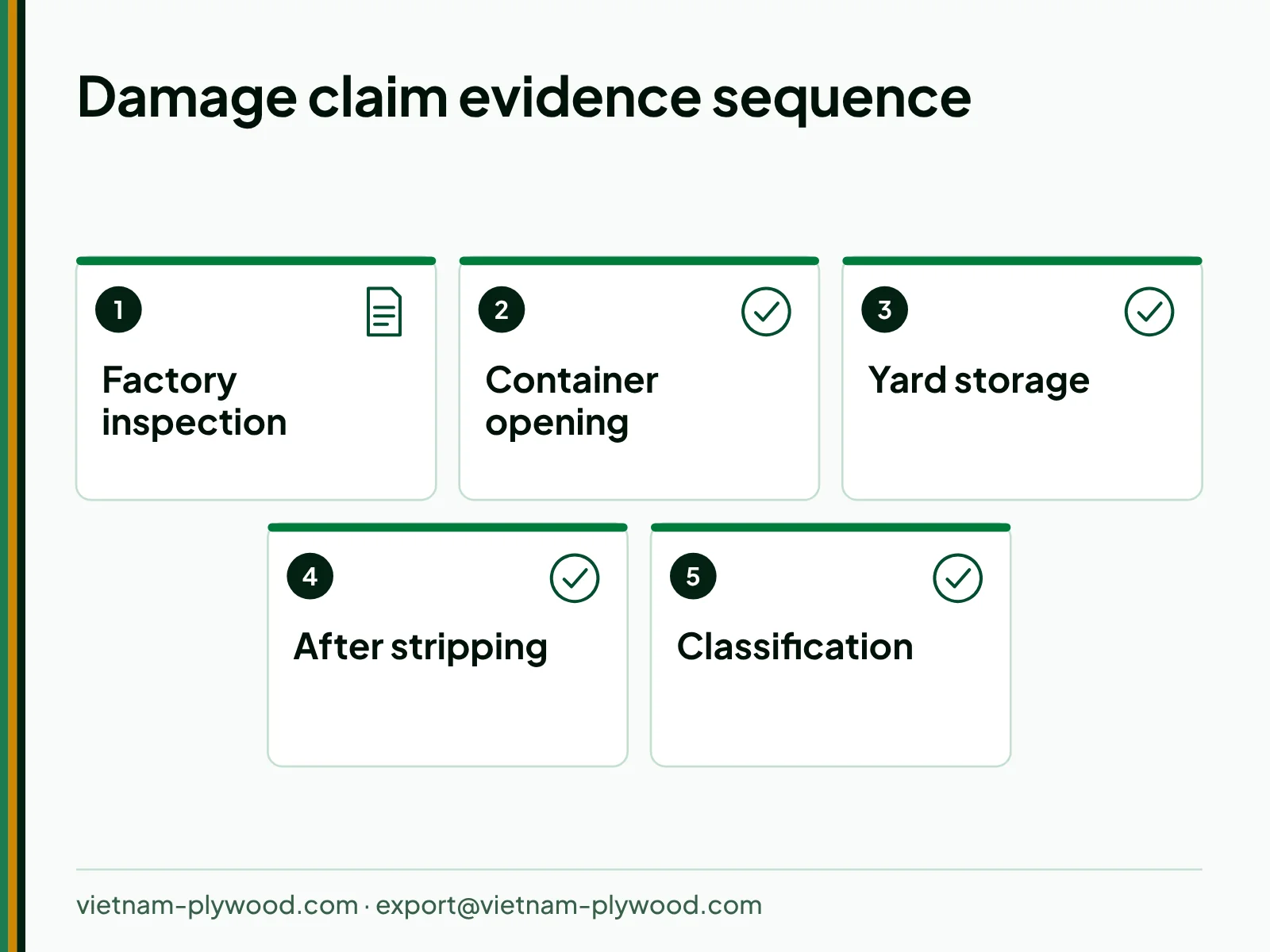
| Observation | Evidence to examine | Initial classification |
|---|---|---|
| Water marks beneath a leaking cover, followed by edge swelling | Yard photographs, weather exposure, open cut edges | Storage exposure |
| Fork puncture or crushed corner after unloading | Handling log and impact photographs | Handling damage |
| Scratch lines matching a metal scraper after stripping | Cleaning record and face photographs | Maintenance damage |
| Film blister visible on untouched sheets at container opening | Opening photographs and factory inspection record | Potential production or transit issue; investigate |
| Repeated glue-line separation in dry, uncut panels | Lot identity, inspection samples and exposure history | Potential manufacturing issue; investigate |
Quarantine affected sheets and photograph the face, edges and full stack before repairs. A factory assessment should compare the condition at dispatch, container arrival and site use. Avoid declaring every delamination a glue fault or every wet edge a storage fault without the chronology.
When should a sheet be held, downgraded or retired?
Hold a panel when its core, bond, shape or film condition could affect the next pour. A minor cosmetic mark might be acceptable for concealed concrete yet unsuitable for an exposed finish; that decision belongs to the project’s approved criteria and formwork professional.
Check for lifting film, soft spots, open glue lines, persistent warp, crushed fastening zones and repairs that protrude onto the casting face. Separate sound panels ready for use from panels awaiting assessment and those withdrawn from formwork service. Do not mask a structural defect with filler or a fresh layer of release agent.
For United States projects, the Occupational Safety and Health Administration’s 1996 rule at 29 CFR 1926.703(a)(1) requires formwork to be maintained to support anticipated vertical and lateral loads without failure. That safety requirement is distinct from a manufacturer’s reuse estimate.
What should the importer specify before ordering?
The order should identify the formwork application, film surface, core, glue, thickness, tolerance and destination, plus the yard’s planned cutting and care procedure. Our construction line uses acacia or eucalyptus core with melamine or phenolic glue; the chosen build should match exposure and reuse planning.
HCPLY can discuss a lot built for repeated casting through the film-faced plywood product page. A 40HC has a 28.5 t payload limit; specifications can be mixed within that limit. For 18 mm, 1220 × 2440 mm sheets, the core-only lookup gives 880 acacia sheets at 27.35 t or 795 eucalyptus sheets at 27.69 t; film weight is excluded. Use the container-loading reference for the complete calculation.
A quote should follow the written specification, including coating and glue choice. Buyers can arrange inspection at the producing factory and discuss the receiving-yard procedure with Lucy at export@vietnam-plywood.com.
What should the buyer send for a storage-ready order?
Send the intended pour environment and inspection expectations with the panel build. This makes it possible to align factory checks, edge protection and the receiving-yard procedure before loading. For related procurement arrangements, see several plywood types under one export arrangement.
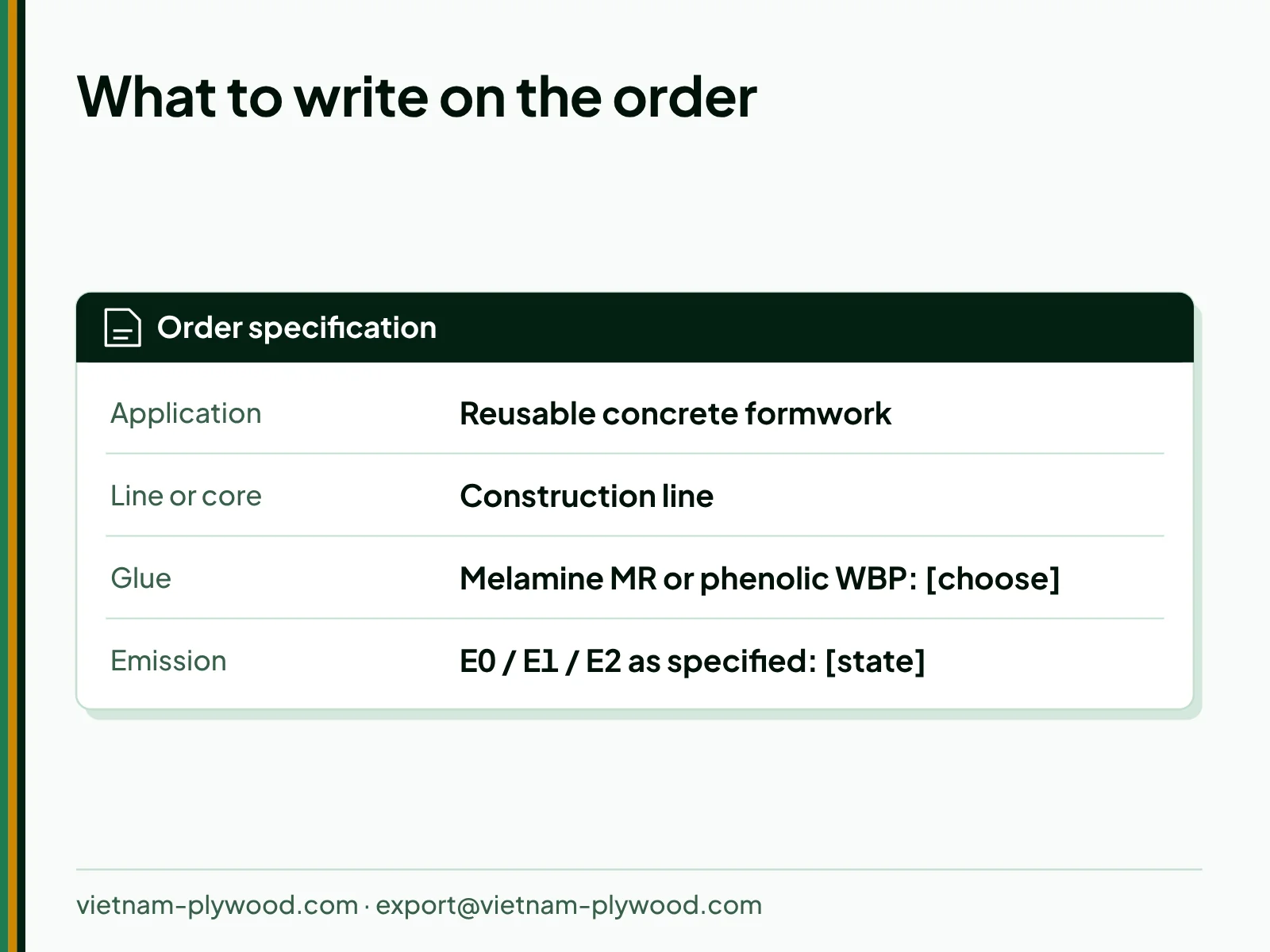
Application: Reusable concrete formwork; required concrete finish: [state]
Line or core: Construction line; acacia or eucalyptus core: [choose]
Glue: Melamine MR or phenolic WBP: [choose]
Emission: E0 / E1 / E2 as specified: [state]
Face and grade: Film-faced; 120 g/m² standard or 135 g/m² premium: [choose]
Thickness and tolerance: [mm]; ±0.5 mm
Size: [mm × mm]
Quantity: [sheets / 40HC]
Destination port: [port, country]
Receiving care: Flat ventilated storage; cut-edge resealing; release agent every pour
Book a factory visit through contact to inspect the producing lot and agree on the receiving checks.