





Film faced plywood price Europe comparisons change when a container mixes thicknesses, cores and other plywood builds: the freight bill must be allocated across the actual cargo. A wrong comparison can inflate a tender, delay customs clearance or leave a formwork yard with unsuitable panels. HCPLY quotes the specified construction build FOB Hai Phong and separates destination costs before comparing European merchant offers.
What does film faced plywood price Europe mean per square metre?
The useful price is the landed cost of a specified sheet divided by its covered area, with port, date, currency and delivery stage stated. An 18 mm and a 21 mm panel can cover the same area but carry different wood volume, mass and purchase cost. No verified current European merchant quotations or film-faced factory prices are available for a numerical per-square-metre comparison here.
For a 1220 × 2440 mm panel, divide the quoted sheet amount by the sheet area in square metres. Do not divide a cubic-metre quote directly by area without applying thickness. A 1250 × 2500 mm sheet has a different area, so use its own divisor.
For an import comparison, keep three columns: factory FOB cost, importer’s landed cost and local merchant selling price. The film-faced plywood price overview explains the wider specification choices; this page concentrates on European import calculations.
Which specification drives the quote most?
Core construction, glue system and thickness set the principal build differences; film weight, tolerance and sheet size then refine the quote. Compare the same specification before attributing a merchant premium to geography.
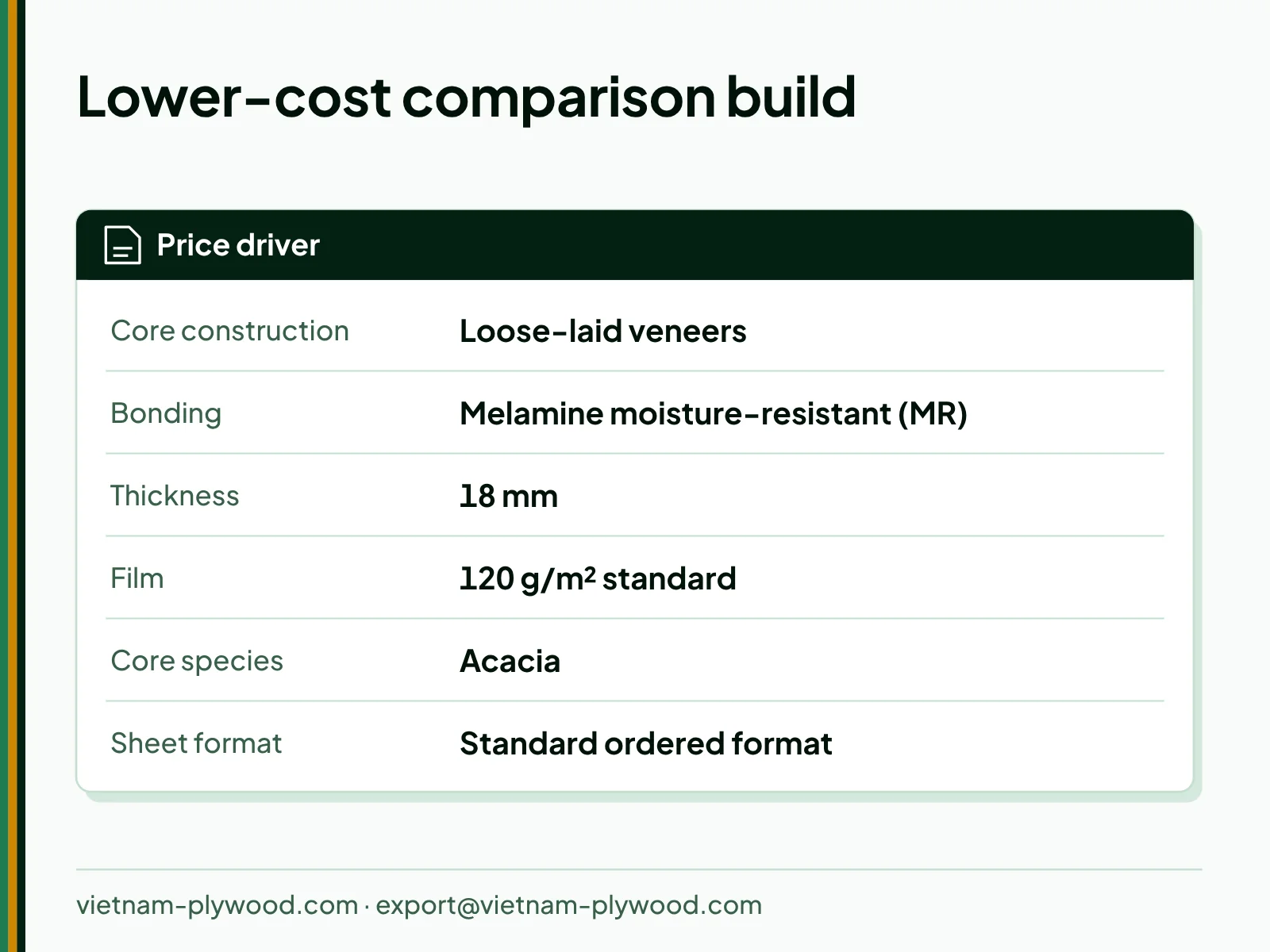
| Price driver | Lower-cost comparison build | Higher-cost comparison build | What to request |
|---|---|---|---|
| Core construction | Loose-laid veneers | Full stitched veneers | Core cross-section and void acceptance |
| Bonding | Melamine moisture-resistant (MR) | Phenolic weather-and-boil-proof (WBP) | Glue specification and agreed test |
| Thickness | 18 mm | 21 mm at the same construction | Nominal and measured thickness |
| Film | 120 g/m² standard | 135 g/m² premium; 220 g/m² anti-slip is a different surface | Film weight and surface type |
| Core species | Acacia | Eucalyptus at the same dimensions | Core declaration and weight |
| Sheet format | Standard ordered format | Custom cutting with different yield | Exact dimensions and packing |
Our construction line presses film-faced panels with acacia or eucalyptus cores and an unsanded substrate. Phenolic or melamine film and anti-slip film are available there. The order should specify glue independently of emission class: E0, E1 and E2 describe emission classes, whereas MR and WBP describe bonding.
How do 18 and 21 mm prices differ across EU markets?
A 21 mm sheet uses more wood volume than an 18 mm sheet of identical length and width, so a like-for-like thicker build normally requires a higher factory quote. Germany and Poland can show different merchant prices because the listings include different stock positions, taxes, delivery distances and panel specifications. A reliable country spread needs dated, matched offers, which are unavailable for this page.
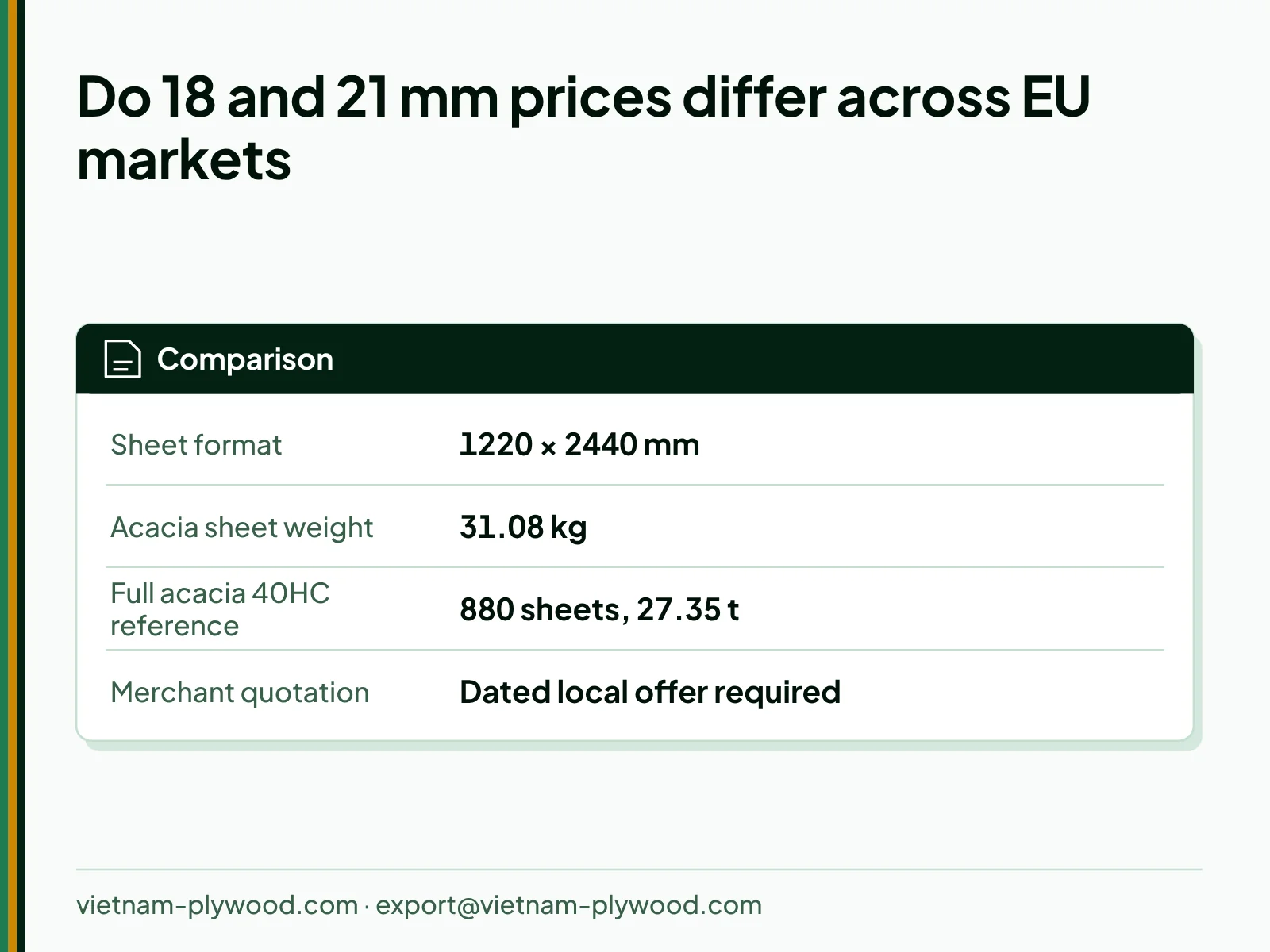
| Comparison | 18 mm | 21 mm | Reading for a buyer |
|---|---|---|---|
| Sheet format | 1220 × 2440 mm | 1220 × 2440 mm | Equal coverage per sheet |
| Acacia sheet weight | 31.08 kg | 36.26 kg | Thicker cargo uses more payload |
| Full acacia 40HC reference | 880 sheets, 27.35 t | 752 sheets, 27.27 t | Compare freight per sheet and per m² |
| Merchant quotation | Dated local offer required | Dated local offer required | Match VAT basis, collection or delivery |
For a film faced plywood price Germany comparison, record whether the quote is ex-warehouse, delivered to the yard or inclusive of value-added tax. For a phenolic plywood price Poland comparison, first establish whether “phenolic” refers to the glue, surface film or both. Neither phrase defines the core construction or declared performance.
What does freight to an EU port add?
Freight adds the actual ocean charge allocated to the shipped sheets, plus the relevant import and port charges. No current carrier quotation for a named European port is available, so an invented per-sheet surcharge would mislead. Request the freight amount, sailing route, surcharges, destination terminal costs and currency on the same date as the panel offer.
For a single-specification load, ocean freight per sheet equals total freight divided by loaded sheets. Freight per square metre equals total freight divided by the sum of sheet areas. For mixed cargo, use a documented allocation rule, such as occupied cubic metres or weight, and retain the same rule when comparing offers. Freight is a shared container cost; a small batch should not be assigned the entire container charge.
We offer FOB Hai Phong, CFR (CNF) or CIF. Under CIF, insurance belongs in the shipment document set. Sea transit from Hai Phong to Mediterranean ports is 25–35 days and to Northern Europe 30–40 days, by carrier and route. These are sailing intervals, separate from production and customs processing.
Does EVFTA zero duty remove import cost?
A zero preferential customs-duty rate, where the product’s classification, origin and applicable tariff schedule qualify, removes that duty component only. It does not remove ocean freight, insurance, import value-added tax, terminal charges or inland delivery. Do not apply a zero rate to every film-faced sheet merely because it ships from Vietnam.
The European Commission’s 2024 customs update states that the EU–Vietnam Free Trade Agreement (EVFTA) product-specific origin rules were updated to the 2022 Harmonised System version. Its 2024 notice on the revised rules is a reason to check the exact commodity code and applicable origin rule, rather than reuse an old tariff worksheet.
The European Commission’s proof-of-origin guidance explains that preferential treatment needs documentary origin evidence. For an EU shipment, the export set includes the certificate of origin (EUR.1 for EU lots) and the EUTR/EUDR file set. The importer should have its customs representative check the current tariff line, preference eligibility and declaration before booking the landed-cost assumption.
What should a landed-cost worksheet contain?
A landed-cost worksheet must show the same incoterm boundary and the same denominator for every offer. Start with the written factory specification, then add each verifiable cost to the chosen destination point.
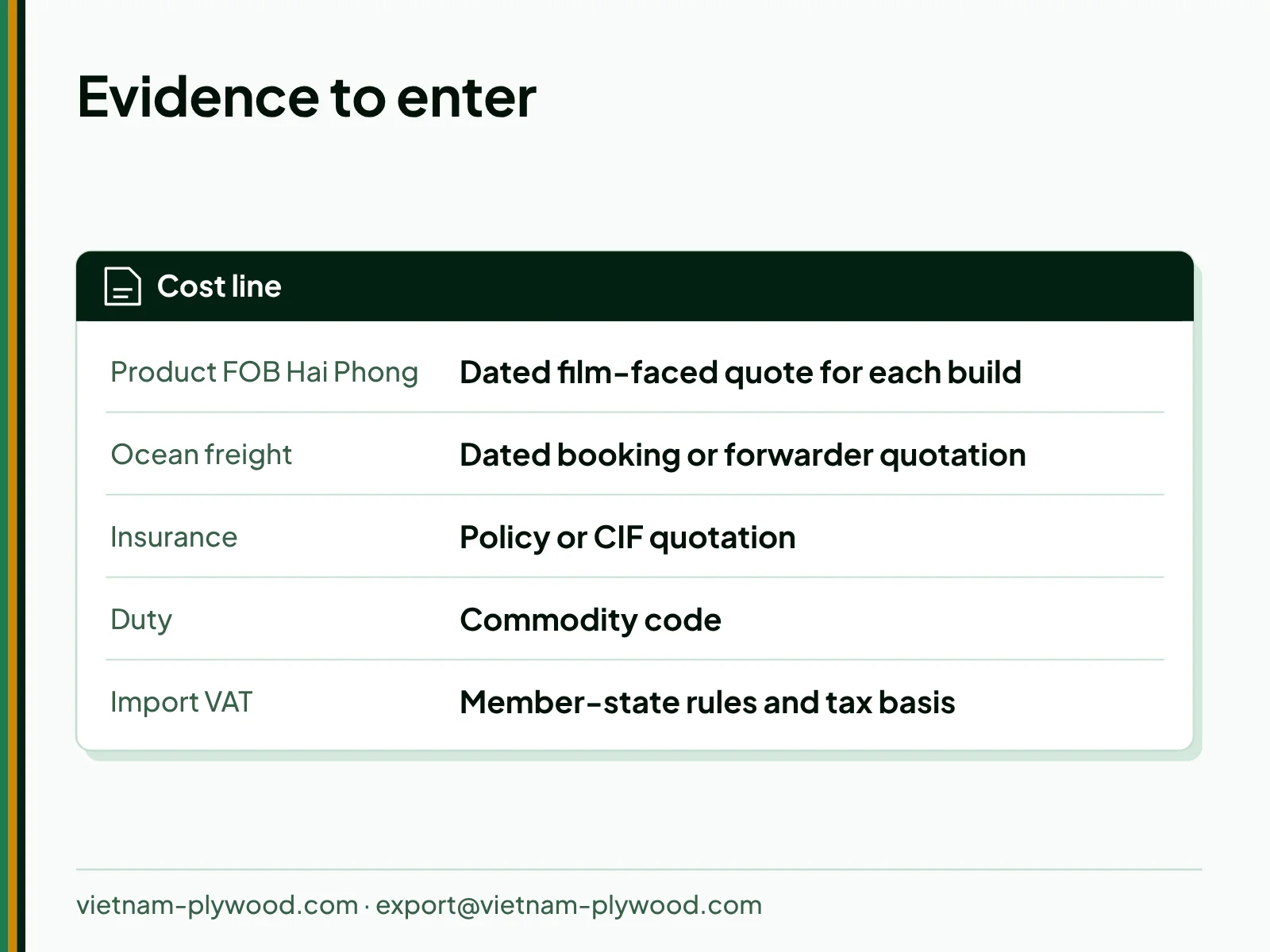
| Cost line | Evidence to enter | How it affects comparison |
|---|---|---|
| Product FOB Hai Phong | Dated film-faced quote for each build | Sheet cost before ocean leg |
| Ocean freight | Dated booking or forwarder quotation | Allocate across actual loaded cargo |
| Insurance | Policy or CIF quotation | Include where applicable |
| Duty | Commodity code, origin evidence and tariff date | Apply the verified rate to customs value |
| Import VAT | Member-state rules and tax basis | Keep recoverable tax separate in business analysis |
| Terminal and clearance | Port and customs invoices or quotations | Distinguish fixed from variable charges |
| Inland delivery | Destination and carrier offer | Convert port landing to yard delivery |
| Local merchant offer | Dated, matched listing | Compare on the same tax and delivery basis |
Calculate landed cost per sheet from the sum allocated to that specification. Then divide by sheet area to get cost per m².
What does a mixed order change in the landed price?
A mixed order changes the number and type of saleable sheets sharing the container’s fixed freight and handling costs. It can fill an importer’s assortment without separate containers, but weight, pallet positions and factory specifications still constrain the plan. The minimum order is one 40HC; one container can carry several specifications as long as the payload limit holds.
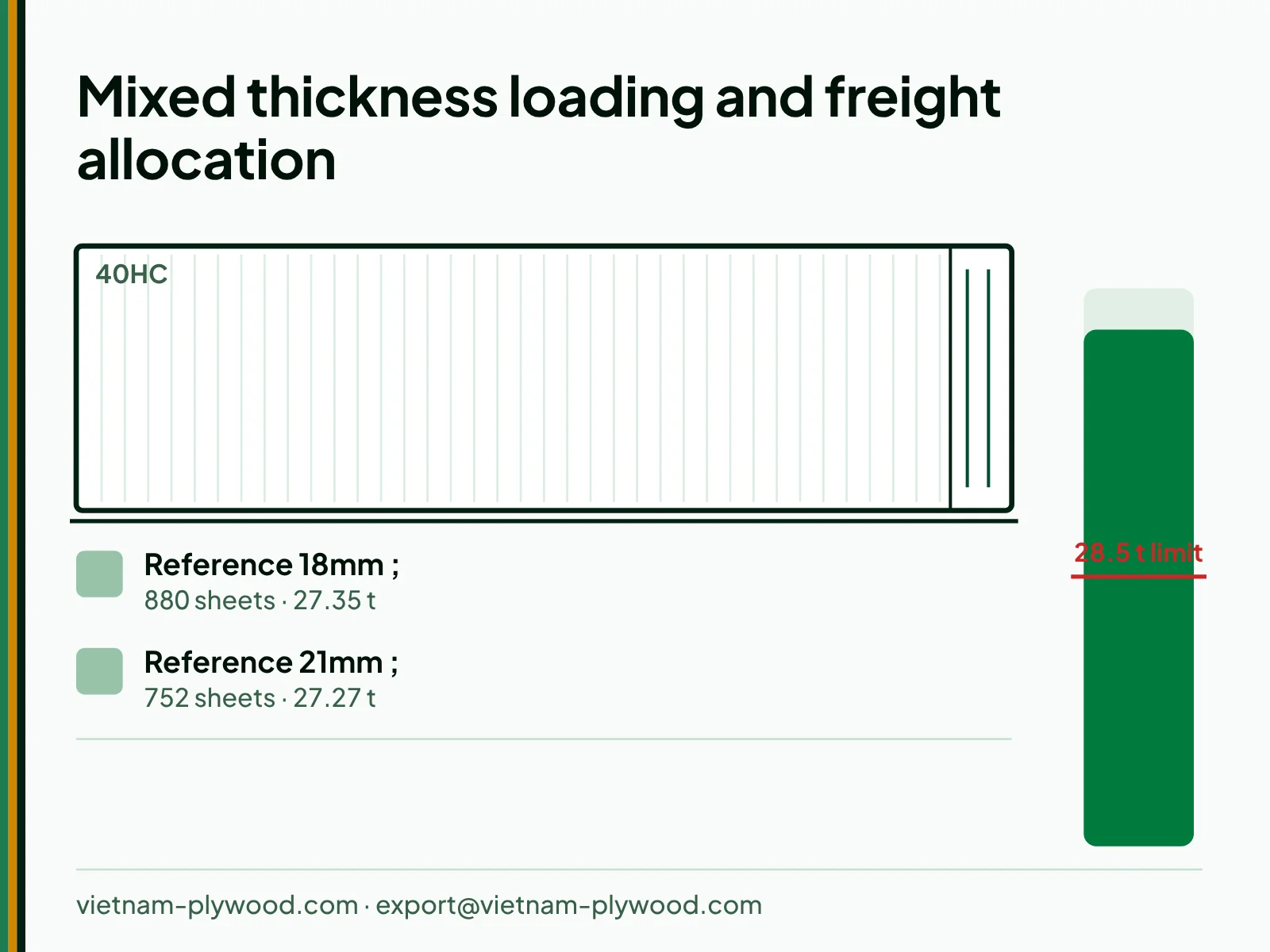
For 1220 × 2440 mm acacia-core construction panels, the full-load reference is 880 sheets of 18 mm at 27.35 t, or 752 sheets of 21 mm at 27.27 t. Those are alternative full-container reference loads, not quantities that can both be placed in one box. A 40HC payload limit is 28.5 t, so a mixed packing plan must total the weight of every pallet and retain room for packing materials and other cargo.
For example, a planning worksheet can begin with 18 mm sheets at 31.08 kg each and 21 mm sheets at 36.26 kg each. Use the producing factory’s pallet-by-pallet packing plan, including packing mass, to check the payload. The container loading reference owns full packing calculations, while mixed-container ordering covers combining specifications.
Allocate freight by a stated method and show the allocation alongside each product’s FOB cost.
Which factory line makes each build?
Our construction line makes the film-faced formwork panels in this comparison. The other two lines make different plywood for different purchasing purposes, so their dated starting prices cannot stand in for a construction quote.
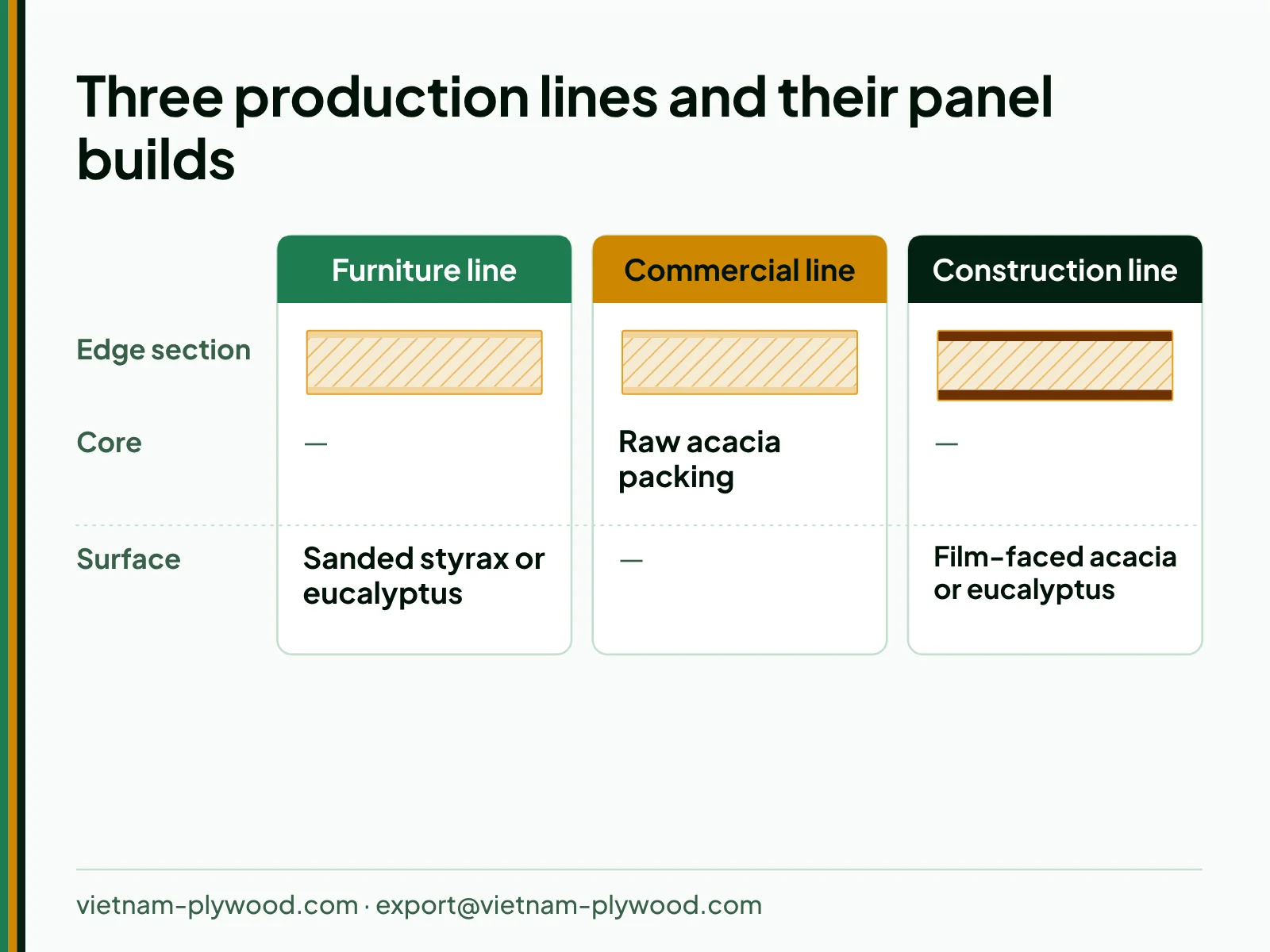
| Line | Example 18 mm build | Core and surface | Buying purpose |
|---|---|---|---|
| Our construction line | Film-faced, unsanded | Acacia or eucalyptus; film overlay | Concrete formwork |
| Our commercial and packing line | Raw commercial or packing panel | Acacia, MR, unsanded or light-sanded | Crates and industrial packing |
| Our furniture line | Sanded furniture panel | Styrax or eucalyptus, full stitched | Furniture and cabinet components |
The published starting figures are commercial plywood from US$250/m³ FOB Hai Phong (October 2026) and furniture plywood from US$350/m³ FOB Hai Phong (October 2026). Neither is a film-faced price. For construction plywood specifications, ask for a written quote against film, core, glue, thickness and destination port.
HCPLY has three factories in Phu Tho and Hai Phong. Each order is produced at the factory suited to its specification and shipped directly from it. We manage specification, on-site quality control, export papers and loading.
Why are birch panels priced higher?
Birch-labelled European formwork panels can command a premium when their construction, supply channel or declared properties differ from acacia-core film-faced plywood. We do not press birch-core plywood.
Ask a seller to identify whether the listing is birch-faced, birch-core or a different engineered panel. Then compare ply construction, bonding, overlay, dimensions, declared use and the accepted test evidence.
A separate formwork question is reuse cost. With proper handling, a release agent on every pour and sealed edges (cut edges included), melamine-glue film-faced panels achieve about 12–15 pours and phenolic-glue panels up to about 25 pours. Divide the actual purchase cost by a defensible project-specific use estimate; the figures are conditional, not a substitute for site inspection.
What can an inspector verify before loading?
An inspector can witness dimensions, film identity, core construction and pallet counts at the producing factory before shipment. This is a practical way to keep a landed-price comparison tied to the goods actually ordered.
- Match the approved sample and order sheet to the film type, core species, glue and surface specification.
- Measure thickness against the film-faced tolerance of ±0.5 mm and length and width against ±2 mm.
- Inspect representative panel edges for core gaps, veneer arrangement and sealed cut edges where specified.
- Count bundles and pallets, record actual dimensions and compare the packing list with the loading plan.
- Review agreed test reports and the order’s certificate documents before approving the shipment paperwork.
Certificates including FSC, CARB P2, ISO 9001 and CE belong to member factories and are shown with factory details masked, on request. Where a buyer requests a specific certificate or report, the order must identify the producing factory and the applicable document. Factory office visits and goods inspection take place at the producing factory.
Which documents follow the European load?
The shipment documents connect the physical load to its invoice value, declared origin and customs entry. HCPLY provides a commercial invoice, packing list, bill of lading (B/L), certificate of origin, phytosanitary and fumigation papers, and insurance under CIF. The order’s certificate documents and agreed test reports accompany the relevant build.
For EU lots, the export file also includes EUTR/EUDR documents. After loading, the draft shipping documents come to you for approval.
See distributor supply programmes. Factory lead time runs 15–45 days from receipt of the 30% deposit; the exact figure depends on order size, line loading and what the contract fixes. The remaining 70% is paid on the scan of the bill of lading, by T/T, or by irrevocable sight L/C.
What should the buyer send for a comparable quotation?
A comparable quotation needs a single specification per item and a named destination port. Request the film-faced factory amount separately from freight and destination charges, then ask the local merchant to quote the same surface, thickness and delivery basis. That makes an 18 mm versus 21 mm comparison auditable across Germany, Poland and other EU markets.
Use the following brief for each requested line item:
Application: Concrete formwork / yard use
Line or core: Construction line; acacia or eucalyptus
Glue: Melamine MR or phenolic WBP
Emission: E0 / E1 / E2 as specified
Face and grade: Film-faced; 120 or 135 g/m² (220 g/m² anti-slip if required)
Thickness and tolerance: 18 mm or 21 mm; ±0.5 mm
Size: 1220 × 2440 mm or 1250 × 2500 mm
Quantity: Sheets by thickness; mixed 40HC plan
Destination port: Named EU port; FOB / CFR / CIF comparison
Ask Lucy at export@vietnam-plywood.com for a sample set through the contact page. Samples cost nothing: a first-time buyer pays the courier, and that charge comes off the first confirmed order.