





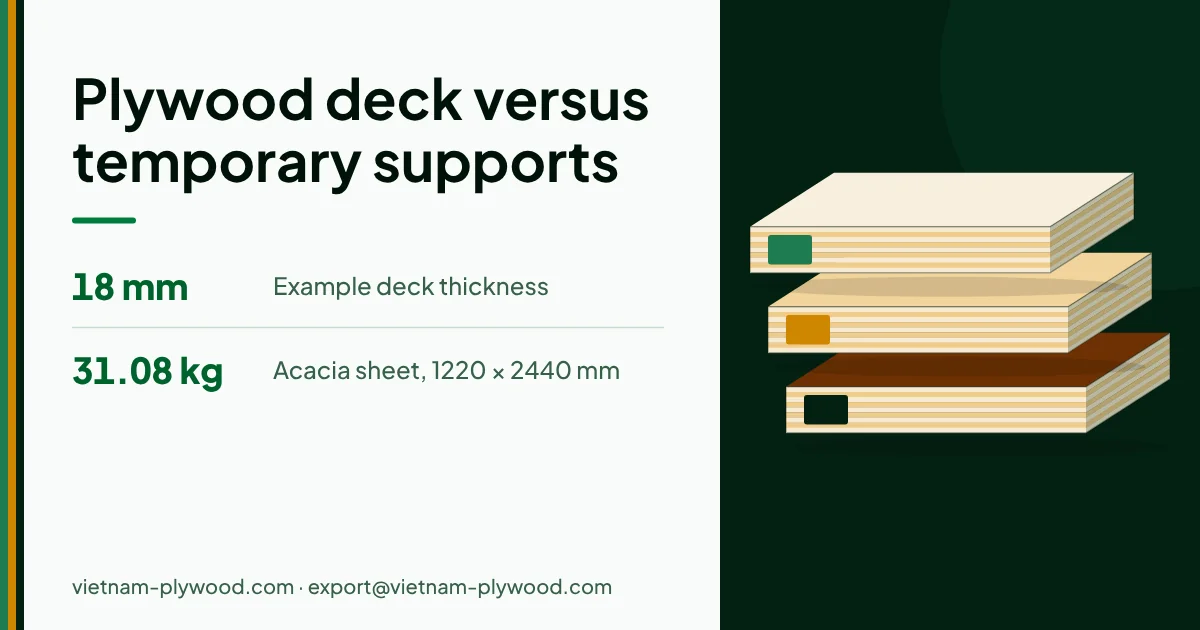
Falsework supports the concrete-forming assembly, while formwork shapes the concrete; HCPLY supplies plywood deck panels for the forming face. Confusing these purchases can delay a pour, waste hardware expenditure or cause a panel delivery to be rejected. The difference matters when a contractor splits the deck, bearer and shoring schedules.
What is the difference between falsework and formwork?
Falsework formwork terminology separates the temporary support structure from the mould that contains fresh concrete. Falsework transfers construction loads through shores, towers and beams; formwork sets the concrete geometry and contact finish. A plywood deck is a formwork component even when it rests directly on falsework beams. Buying the deck cannot replace the engineered supports beneath it.
| Buying metric | Falsework | Formwork | Verdict by use |
|---|---|---|---|
| Primary duty | Carry temporary vertical and lateral loads | Contain concrete and establish shape | Specify both for elevated slab pours |
| Typical items | Props, towers, bracing, primary beams | Plywood face, frames, ties, clamps | Order plywood for contact surfaces |
| Design check | Load path, stability, foundations | Concrete pressure, panel spans, finish | Engineer checks the assembled system |
| Removal condition | Structure has strength to carry loads | Concrete has strength for face removal | Follow approved striking sequence |
For the broader distinction between mould systems, see formwork explained. A wall form can use ties and braces without a slab-support tower; an elevated soffit needs support underneath.
What is falsework?
Falsework is temporary construction support that carries formwork, fresh concrete, reinforcement and work loads until the permanent structure can carry the required loads. Its elements can include adjustable shores, braced frames, tower assemblies, bearing heads and load-distributing beams. It must have a defined path for loads to reach a suitable bearing surface.
The UK Health and Safety Executive (HSE, 2026) lists falsework for above-ground concrete pours among temporary works requiring planning and management. Its temporary works guidance also calls for suitable design and checks. A purchase order for plywood does not establish permissible shore spacing, tower capacity or ground bearing resistance.
Where does plywood sit in a falsework system?
Plywood forms the concrete-contact deck above the joists and support beams; it is part of the formwork assembly. On a suspended slab, the sequence from the ground to the wet concrete makes the boundary visible:
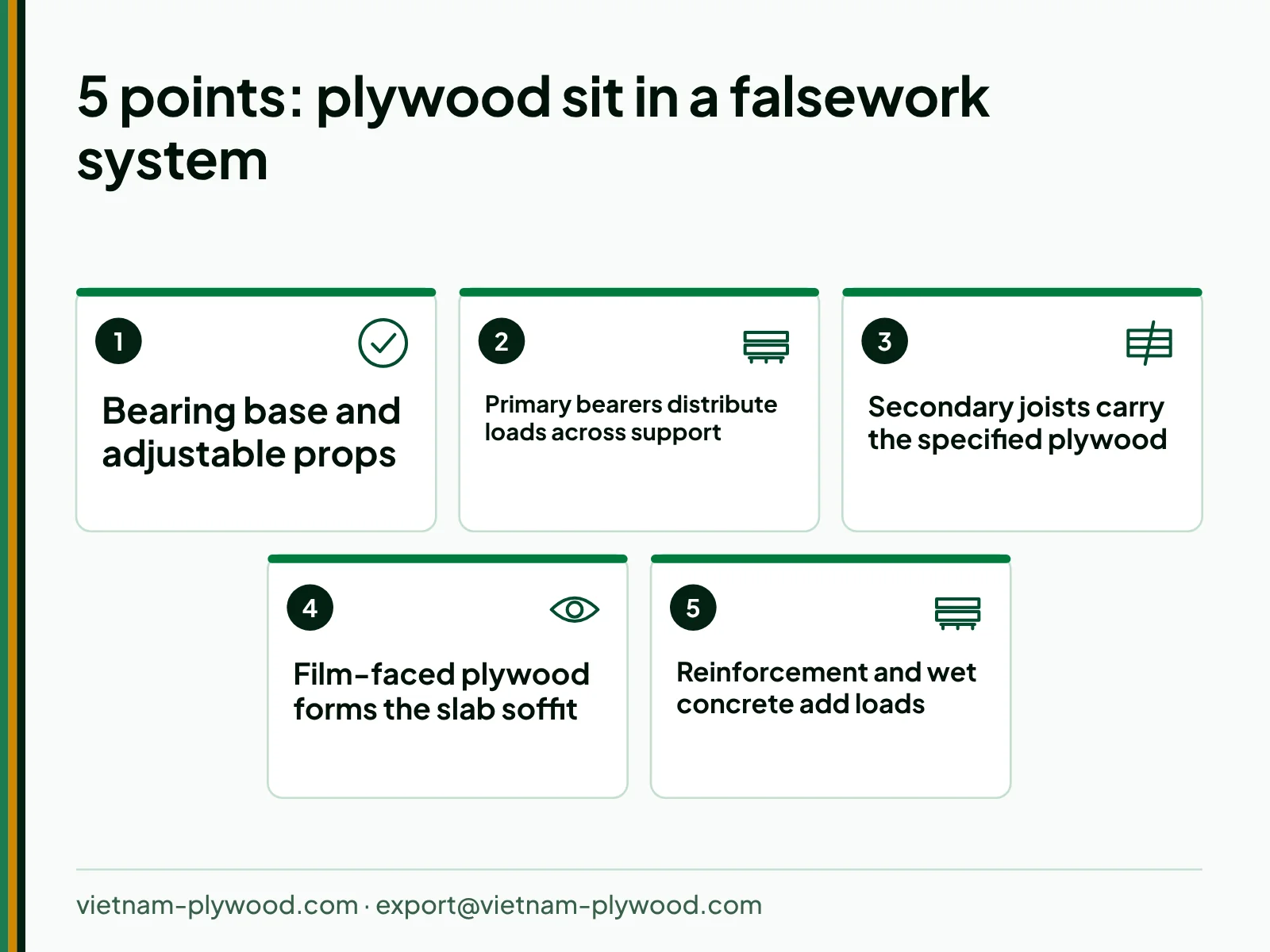
- Bearing base and adjustable props or braced towers support the temporary assembly.
- Primary bearers distribute loads across support heads.
- Secondary joists carry the specified plywood panel spans.
- Film-faced plywood forms the slab soffit and receives fresh concrete.
- Reinforcement and wet concrete add loads that the temporary works designer accounts for.
The film face affects concrete appearance and release. Panel thickness, core, edge condition and support spacing affect deck performance. An unsupported sheet edge or incorrect joist spacing cannot be corrected by selecting a heavier face film. For panel builds, see construction plywood.
Which items can HCPLY supply?
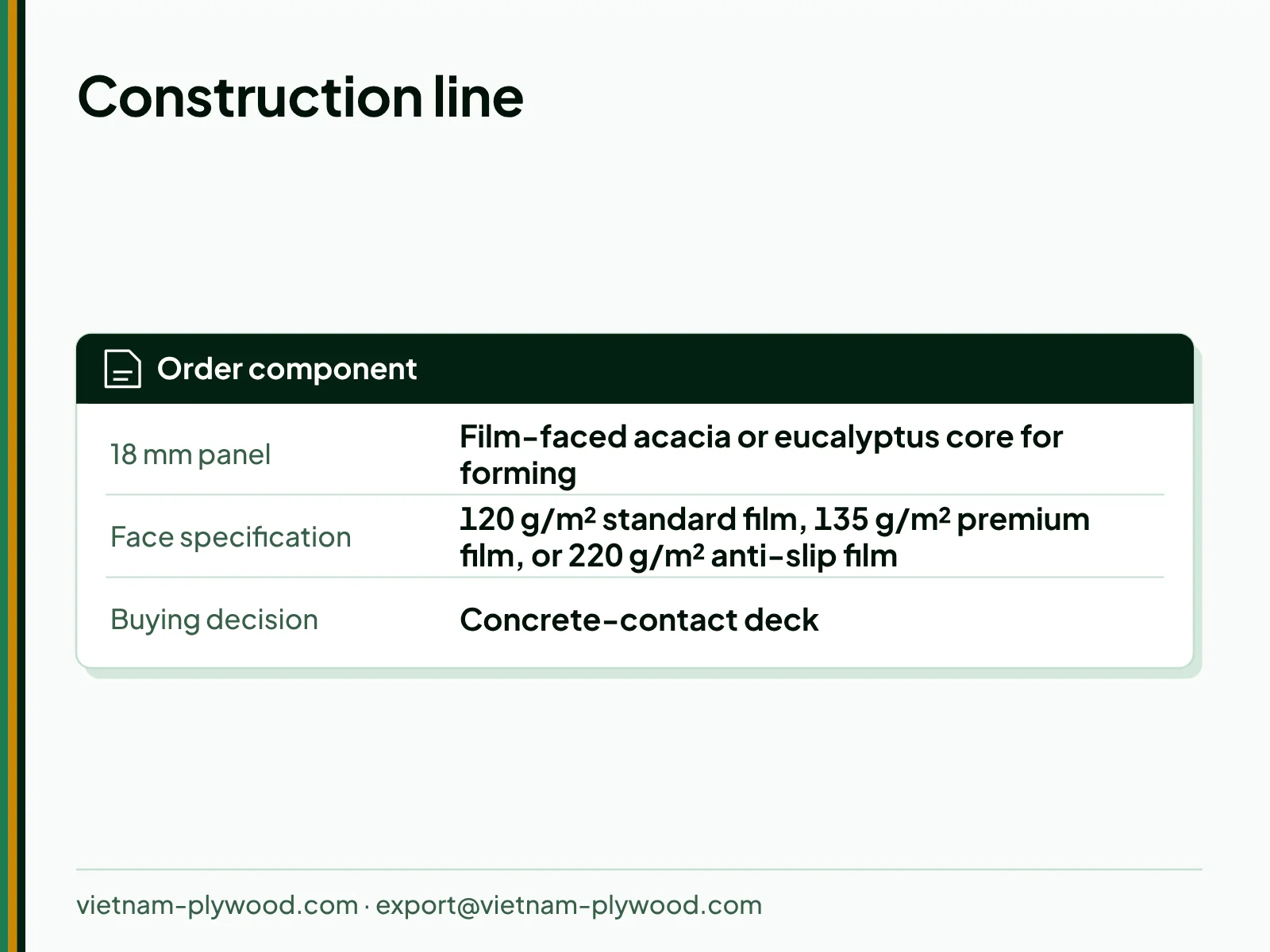
HCPLY’s construction line presses film-faced plywood for concrete-contact decks and shutters. Our commercial and packing line makes acacia-core MR-glue boards for packing and commercial uses, while our furniture line makes full-stitched, sanded styrax- or eucalyptus-core panels for furniture applications. Those other lines are alternatives for different applications, rather than replacements for an engineered concrete-contact panel.
| Order component | Construction line | Commercial and packing line | Furniture line |
|---|---|---|---|
| 18 mm panel | Film-faced acacia or eucalyptus core for forming | Acacia-core MR board, unsanded or light-sanded | Styrax or eucalyptus core, full stitched and sanded |
| Face specification | 120 g/m² standard film, 135 g/m² premium film, or 220 g/m² anti-slip film | Raw commercial face | Furniture veneer face |
| Buying decision | Concrete-contact deck | Packing or commercial board | Cabinet or furniture panel |
For this falsework and formwork order, we quote the plywood forming panel. Steel shores, tower frames, clamps, ties, anchors and complete shoring assemblies are system hardware outside our plywood production. LVL bearers can appear in a contractor’s bill of materials, but no LVL manufacturing or supply capability is stated for HCPLY; request a separate confirmed source for them.
Who designs the falsework and who supplies the deck panel?
The contractor’s appointed temporary works designer specifies the support arrangement and checks the complete load path. The formwork designer sets deck spans, concrete pressure allowances, face requirements, connection details and the striking sequence. The buyer then translates the approved panel schedule into a manufacturing specification.
HSE guidance distinguishes the temporary works coordinator’s role in arranging design and checking from the equipment manufacturer’s instructions. A panel factory can inspect what it makes, while site engineers remain responsible for the erected support system. The buyer should send the approved joist spacing and support detail with the panel inquiry, rather than asking the panel factory to approve the falsework design.
What are the main falsework types?
The principal falsework types differ in how they distribute loads and reach the ground or another bearing structure.
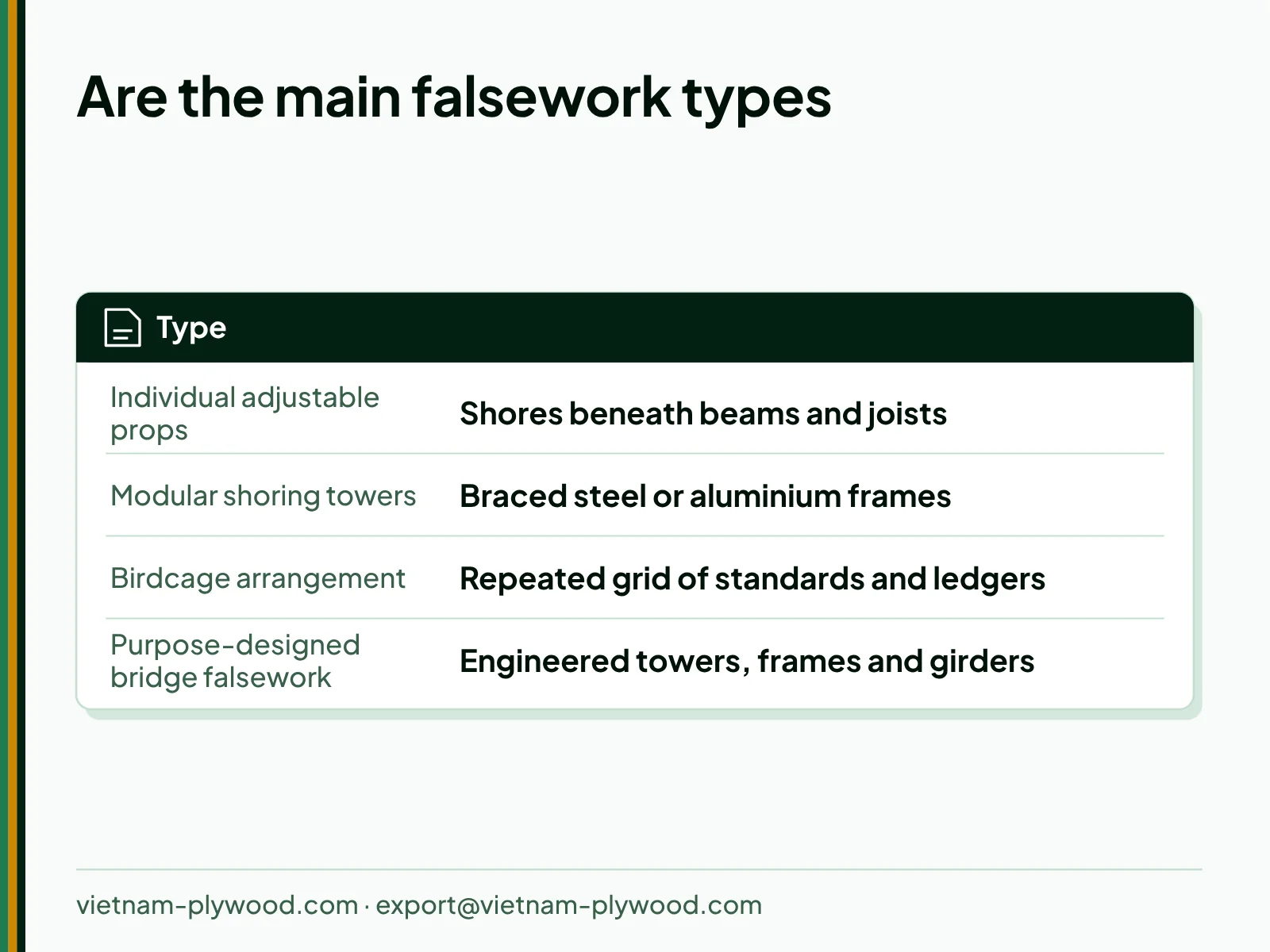
| Type | Support arrangement | Typical selection factor |
|---|---|---|
| Individual adjustable props | Shores beneath beams and joists | Headroom, loads and bracing plan |
| Modular shoring towers | Braced steel or aluminium frames | Higher deck elevations and concentrated loads |
| Birdcage arrangement | Repeated grid of standards and ledgers | Wide supported soffit areas |
| Purpose-designed bridge falsework | Engineered towers, frames and girders | Span, geometry and construction stages |
| Centering | Curved temporary support under an arch | Arch geometry and staged load transfer |
Primary and secondary timber or engineered-wood beams can be components within several arrangements; they are not automatically a complete falsework type. The project engineer chooses bearing conditions, stability measures and allowable loads before purchasing components.
Is shoring the same as falsework?
Shoring overlaps with falsework when it means temporary support beneath a concrete pour. In some markets, a shoring tower is described as falsework; in other contexts, shoring means excavation support or temporary bracing of a wall. The intended load and supported element must appear on the order.
Access scaffolding serves a different primary purpose: providing access and working platforms. Similar-looking frames are not interchangeable without an approved design for the actual load. When an inquiry says “shoring formwork,” ask whether the list covers the plywood deck, supporting beams, towers or all of them.
Which parts of the order are plywood, LVL or hardware?
Separate the bill of materials into concrete-contact panels, engineered timber bearers and system hardware. Film-faced plywood belongs in the panel schedule; laminated veneer lumber (LVL) bearers belong in a structural member schedule; steel or aluminium props, bracing, heads, ties and clamps belong in the hardware schedule.
| Schedule | Describe | Procurement route |
|---|---|---|
| Plywood | Core, glue, film, thickness, size, quantity | HCPLY construction line |
| LVL bearers | Section, grade, design load, length, quantity | Separate qualified bearer supplier |
| Hardware | System make, component identifiers, load ratings, quantities | Compatible system supplier |
A plywood panel and an LVL bearer are different products, even if both contain bonded wood veneers. HCPLY does not present LVL bearers as an offered product here. For the wider project procurement context, see plywood supply for construction projects.
How should a buyer specify the plywood deck?
Specify the panel against the intended forming duty, concrete finish and approved support spacing. Our construction line offers acacia or eucalyptus cores, phenolic or melamine film, and anti-slip film where a walking-surface requirement calls for it. A film-faced board remains a panel component; it carries no independent system load rating in this offer.
Common panel thicknesses include 12, 15, 18 and 21 mm within the 3–40 mm range. Film-faced thickness tolerance is ±0.5 mm and length and width tolerance is ±2 mm. For repeated pours, specify the adhesive separately from the film: melamine MR glue has a 12-hour boil classification in our range, while phenolic weather-and-boil-proof (WBP) glue has a 72-hour boil classification.
With proper handling, release agent on every pour and sealed edges including cut edges, melamine-glue film-faced plywood gives about 12–15 pours and phenolic-glue film-faced plywood up to about 25 pours. The engineer still selects the panel span and striking conditions. Compare timber formwork options and aluminium versus plywood formwork when deciding the overall forming method.
What can an inspector check at the producing factory?
An inspector can check the actual deck panels against the purchase specification before loading. At the producing factory, the buyer can witness thickness measurements, length and width checks, film identification, edge condition and packing counts. Film appearance and panel dimensions can be checked directly; bond performance requires the agreed test method and report.
For a film-faced order, record the core selection, face-film weight, glue specification and panel dimensions on the inspection sheet. Keep emission class separate from glue type when the contract requests it. HCPLY handles on-site quality control, shipping documents and loading for the producing factory. Buyers can visit the factory office and inspect goods at that factory.
How do panels fit into the export order?
An 18 mm, 1220 × 2440 mm acacia-core panel weighs 31.08 kg before film weight. The 40HC lookup for that specification is 55 sheets per pallet and 880 sheets across 16 pallets, or 27.35 tonnes of wood-based panel weight. The container payload limit is 28.5 tonnes, so mixed specifications need a combined weight check before packing.
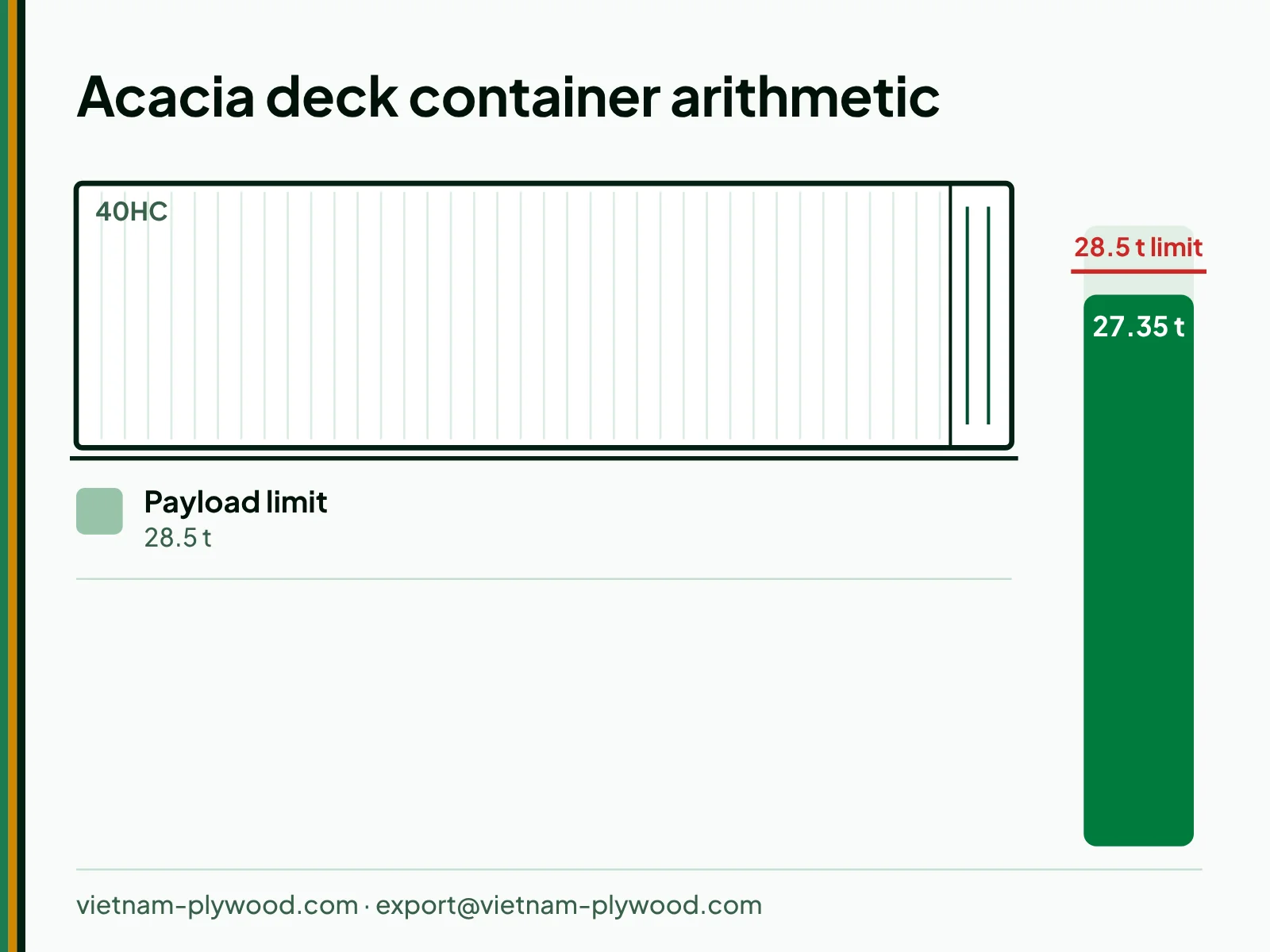
A minimum order is one 40HC, and specifications can be mixed within its payload limit. The mixed-container loading guide explains order combinations; the container packing guide owns detailed load counts. We ship FOB Hai Phong, CFR (CNF) or CIF. The shipment’s packing list identifies the loaded panel quantities, and after loading, the draft shipping documents come to you for approval.
What should the purchase inquiry include?
A useful inquiry identifies the deck panel independently from the engineered support system. Give the concrete-contact application, film finish, glue type, core, panel size and approved thickness. Attach the panel schedule and state whether separate LVL or hardware items will be purchased elsewhere.
HCPLY coordinates the plywood specification, production and export from our three factories, with the construction order made at the appropriate producing factory. Send Lucy the panel schedule at export@vietnam-plywood.com or use contact. The next step is to request a sample set against the written specification.
Application: Suspended-slab soffit formwork deck
Line or core: Construction line / acacia core
Glue: Phenolic (WBP)
Emission: E1, if required by the contract
Face and grade: 120 g/m² standard film; face grade per approved sample
Thickness and tolerance: 18 mm / ±0.5 mm
Size: 1220 × 2440 mm / ±2 mm length and width
Quantity: [sheets and pallet allocation]
Destination port: [port and country]