





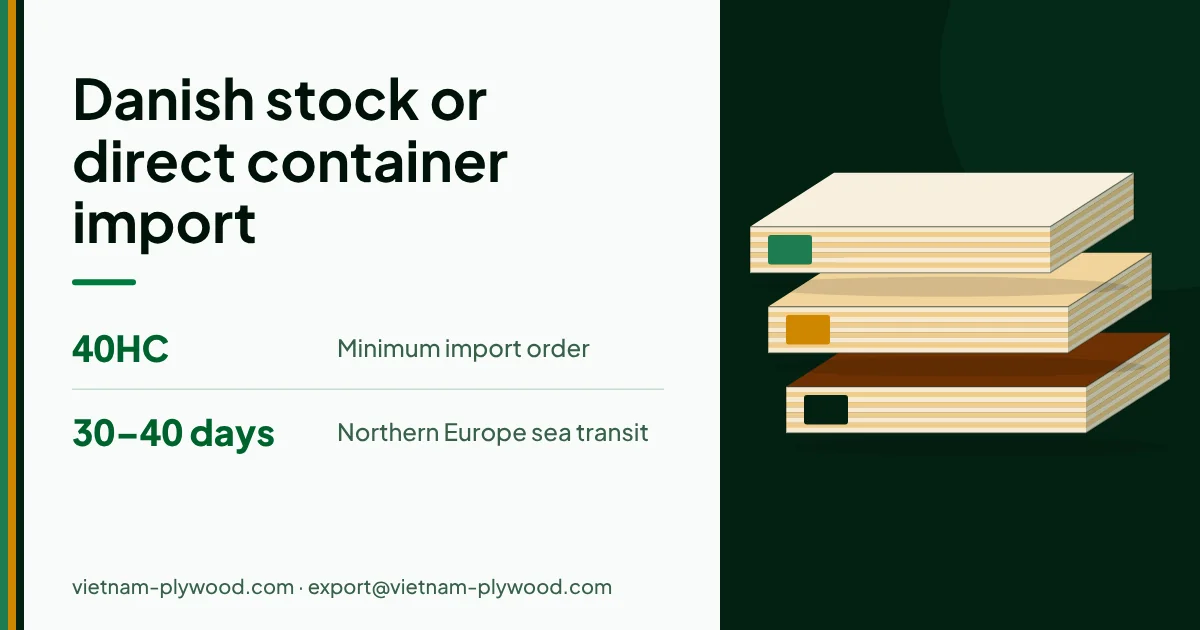
Danish stock is the faster choice for small urgent plywood orders; importing a full container can suit distributors with repeat demand. Choosing the wrong route ties up cash, adds days or leaves rejected panels in the warehouse. For plywood dansk purchasing, HCPLY offers factory-built specifications shipped from Vietnam, while Danish stockholders offer inventory already near the buyer.
Should plywood dansk buyers purchase locally or import?
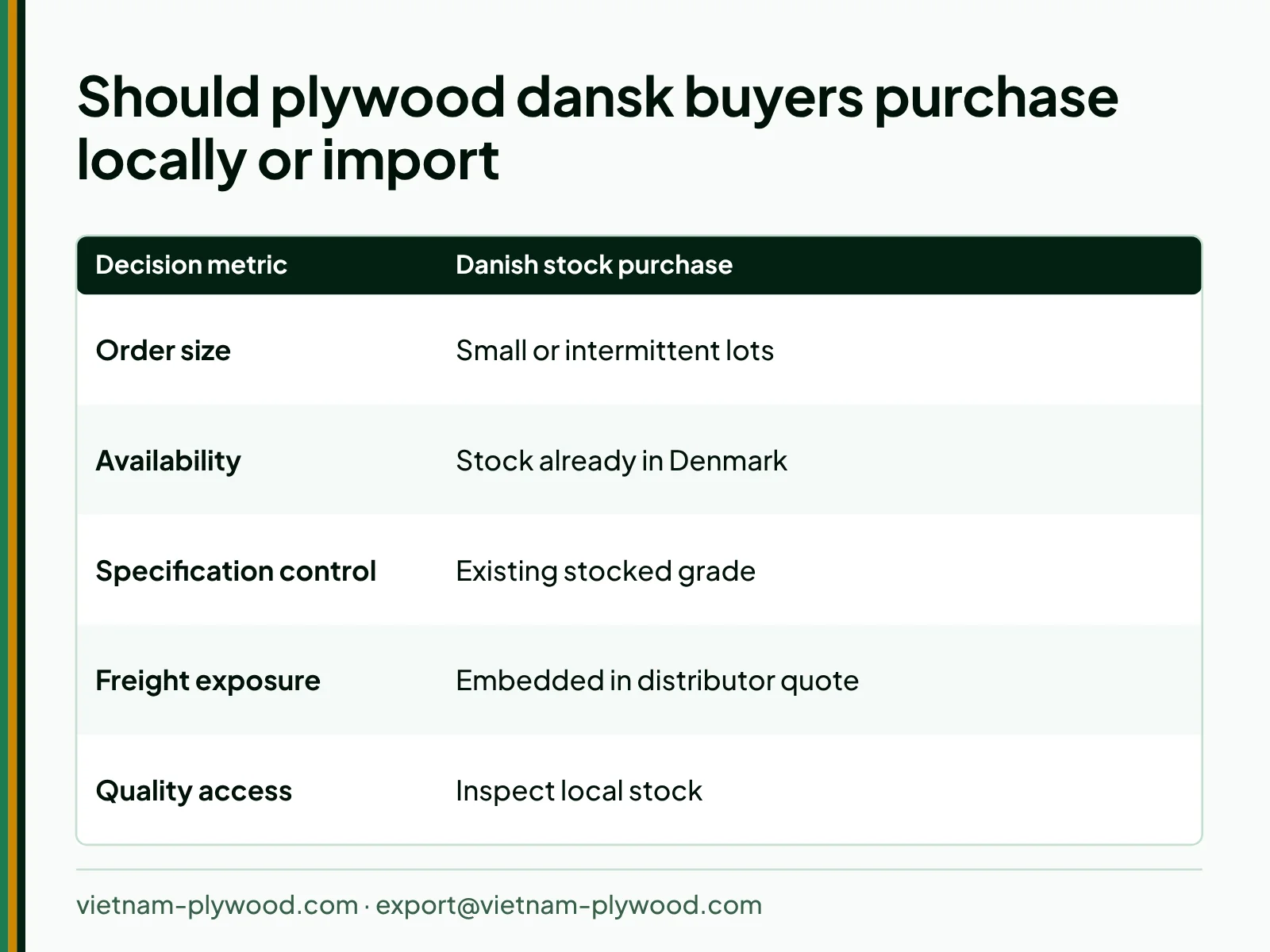
Local purchasing suits urgent replenishment, uncertain demand and small assortments. Direct container importing suits distributors with predictable turnover, warehouse space and a written specification that can be repeated. The correct comparison is landed cost per accepted sheet, including inland transport, finance, inspection and rejected-board exposure. A low factory quotation can lose its advantage when the wrong thickness, face or paperwork delays release.
Start with a buying guide and compare the same panel construction on both quotations.
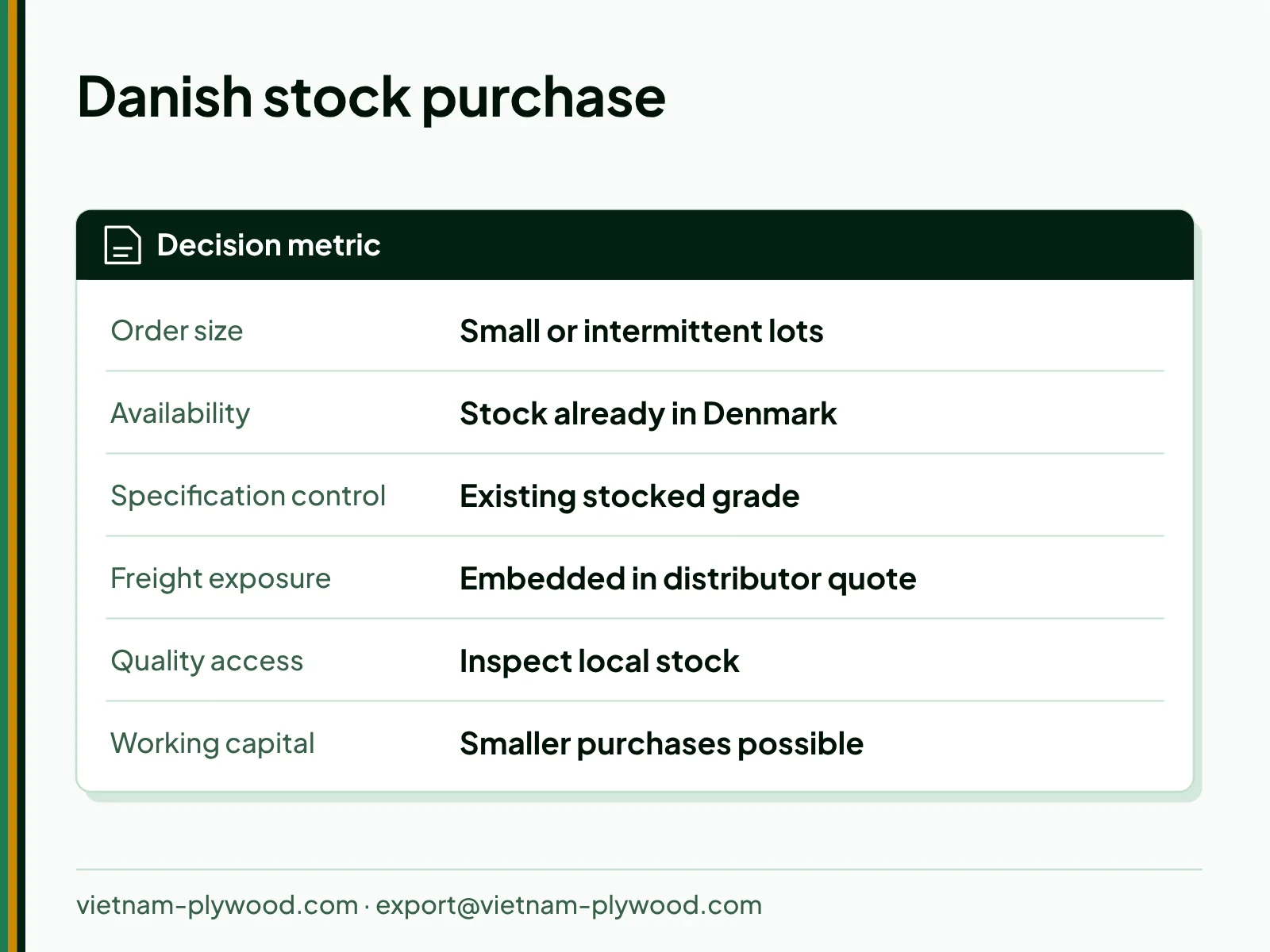
| Decision metric | Danish stock purchase | Direct 40HC import | Better fit |
|---|---|---|---|
| Order size | Small or intermittent lots | One 40HC minimum | Local for irregular orders; import for recurring stock |
| Availability | Stock already in Denmark | Production plus ocean passage | Local for urgent demand |
| Specification control | Existing stocked grade | Written core, face, glue and tolerance | Import for repeatable private specification |
| Freight exposure | Embedded in distributor quote | Ocean, port and inland charges priced separately | Compare landed cost per accepted sheet |
| Quality access | Inspect local stock | Inspect at the producing factory before loading | Choose by inspection capacity |
| Working capital | Smaller purchases possible | Container inventory and import cash cycle | Local for limited warehouse capital |
What does plywood dansk mean on a purchase order?
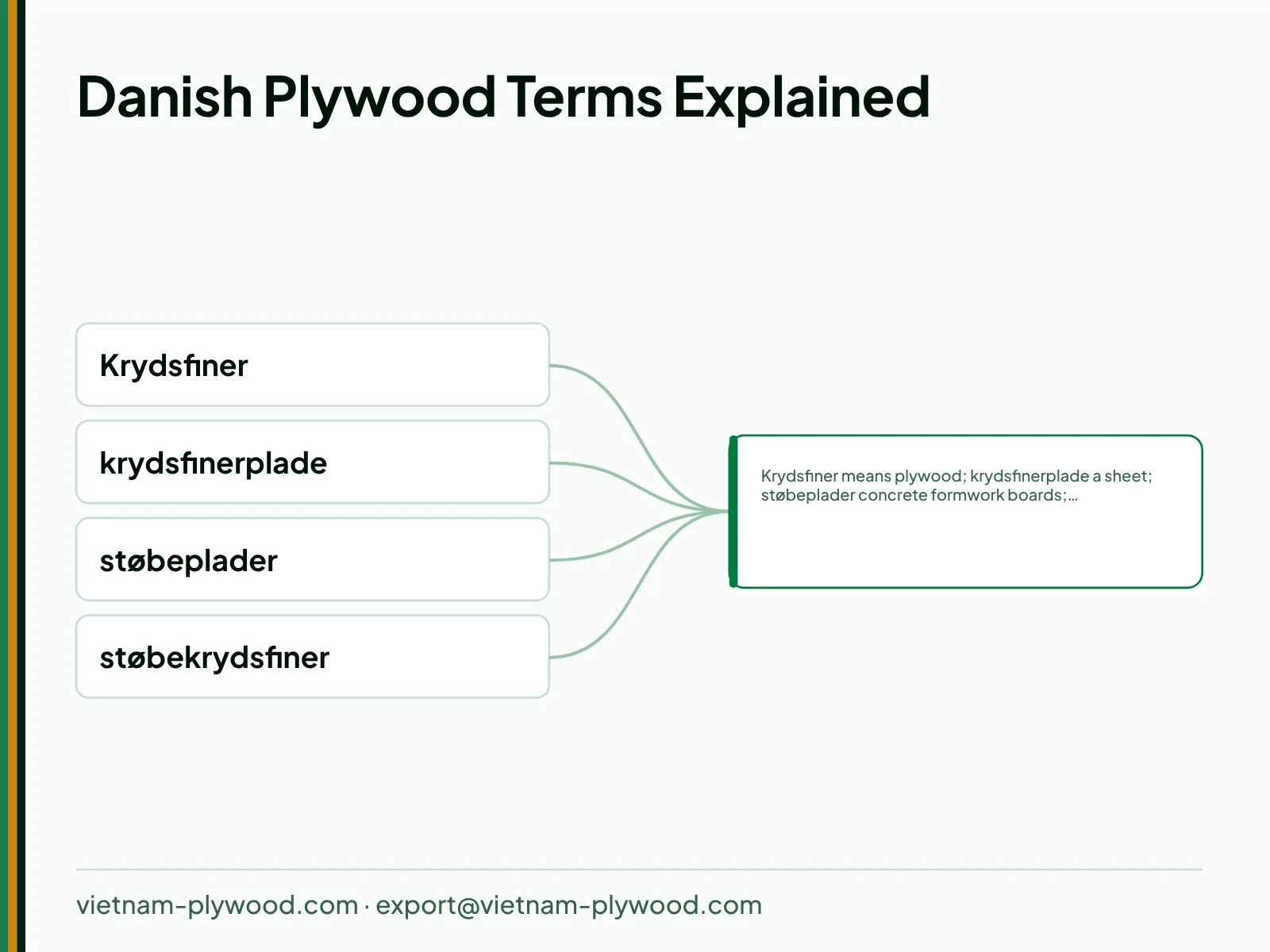
Plywood dansk is a search phrase; Danish purchase orders need precise panel terms. Krydsfiner means plywood, krydsfinerplade a sheet, støbeplader concrete formwork boards and støbekrydsfiner formwork plywood. Vandfast krydsfiner is a moisture-related description that still needs a defined glue system and intended exposure.
A furniture buyer should specify decorative face and surface finish. A formwork yard should specify film face, glue, core and intended pour handling. Neither the Danish name nor a generic description establishes a tested structural or marine classification. For marine or BS 1088 claims, evaluate the exact build against a test report the buyer accepts.
Which factory line makes each Danish order?
HCPLY assigns production to the line matching the written application. Our three factories in Phu Tho and Hai Phong have separate production roles, and the goods ship from the producing factory. The same nominal 18 mm thickness therefore describes substantially different products.
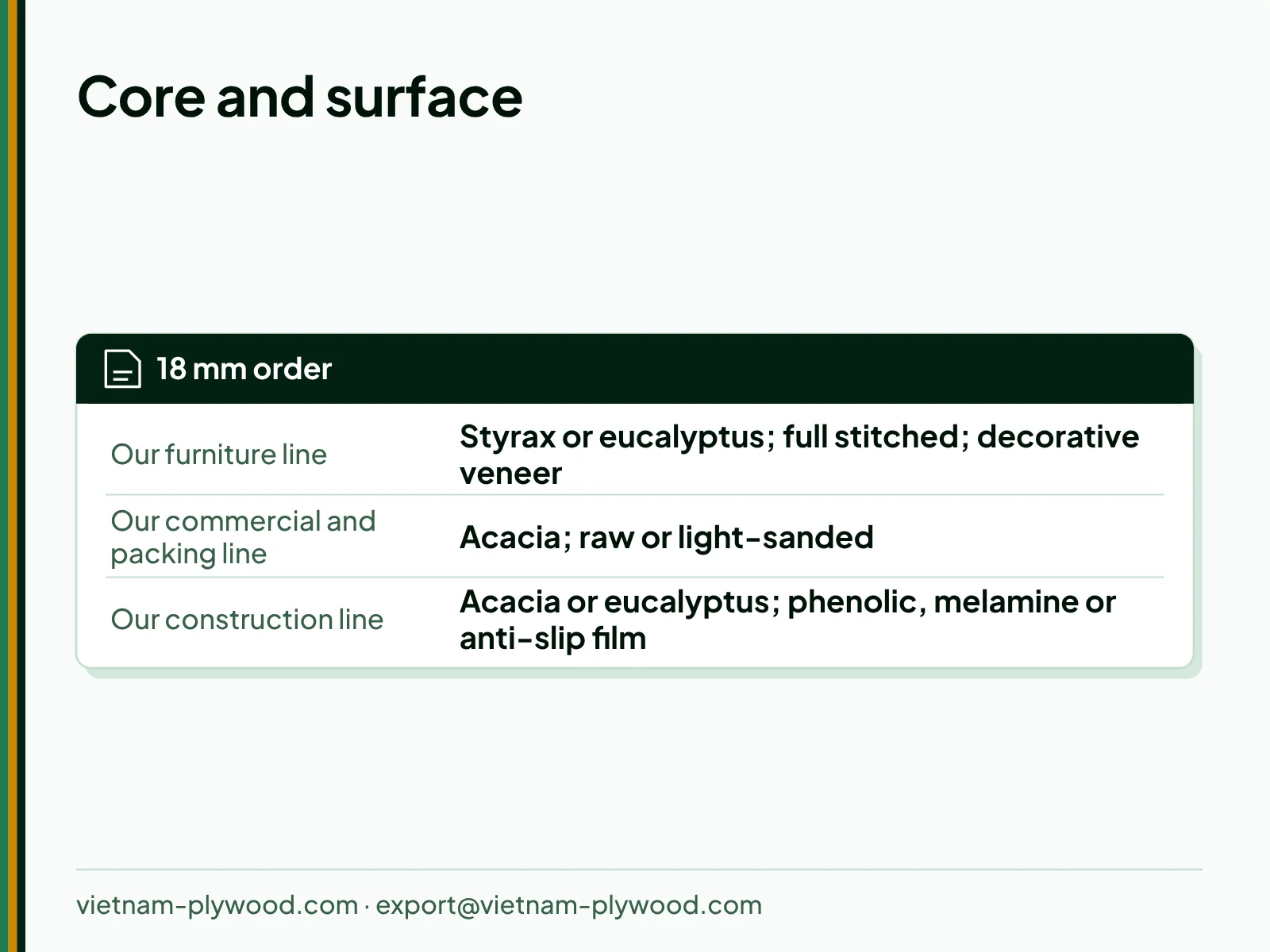
| 18 mm order | Core and surface | Glue and finish | Thickness tolerance | Appropriate buyer |
|---|---|---|---|---|
| Our furniture line | Styrax or eucalyptus; full stitched; decorative veneer | Sanded, E0/E1 emission class | ±0.2 or ±0.3 mm as ordered | Cabinet and furniture producer |
| Our commercial and packing line | Acacia; raw or light-sanded | MR glue; unsanded or light-sanded | ±0.5 mm commercial; ±0.5–1.0 mm packing | Distributor or packing company |
| Our construction line | Acacia or eucalyptus; phenolic, melamine or anti-slip film | Film-faced; unsanded | ±0.5 mm | Formwork yard |
The face identifies the product; the core determines the density. A decorative birch face does not mean a birch core. We do not press birch-core plywood, OSB, MDF, chipboard, blockboard, bamboo panels, MDO or HDO. Several plywood types from one producer explains how to organize a mixed specification.
Which sheet sizes, faces and grades belong in the comparison?
Compare 1220 × 2440 mm with 1250 × 2500 mm only after checking the Danish customer’s cutting plan. HCPLY also makes 1220 × 2135, 1220 × 1830, 915 × 2440, 915 × 2135 and 915 × 1830 mm, with custom cutting available. Thickness runs from 3 to 40 mm; common orders include 3, 5, 9, 12, 15, 18, 21 and 25 mm. Length and width tolerance is ±2 mm.
Decorative faces include bintangor, okoume, engineered veneer, gurjan, pine, poplar, eucalyptus, birch and sapele. Common face veneer thickness is 0.2–0.4 mm. Specify A/B face grades where applicable; birch face uses D/E/F grades. Matt describes an unfaced raw core. Furniture plywood needs a surface specification that covers face appearance, sanding and emission class.
How much fits in a 40HC for Denmark?
A 40HC has a 28.5 t payload limit in the HCPLY loading model. At 18 mm and 1220 × 2440 mm, a full styrax-core load is 990 sheets at 26.52 t; acacia is 880 sheets at 27.35 t; eucalyptus is 795 sheets at 27.69 t. These figures exclude film weight.
For a mixed load, use sheet weight before deciding the mix. An 18 mm styrax sheet weighs 26.79 kg, an acacia sheet 31.08 kg and a eucalyptus sheet 34.83 kg. For example, 400 styrax sheets and 400 acacia sheets total 10,716 kg + 12,432 kg = 23,148 kg of panels, before pallets, packing and any film. That combination leaves 5,352 kg against the payload ceiling for the remaining loading components.
Mixed specifications can share a container within the payload limit. Pallet count, stack height and the exact packing sequence still need a loading plan. See container packing for the detailed sheet-count topic.
How should Danish buyers specify formwork plywood?
Formwork procurement starts with film, adhesive and the planned release procedure. Our construction line uses 120 g/m² standard film, 135 g/m² premium film or 220 g/m² anti-slip film. State the core, panel size, thickness tolerance and surface before asking for a price.
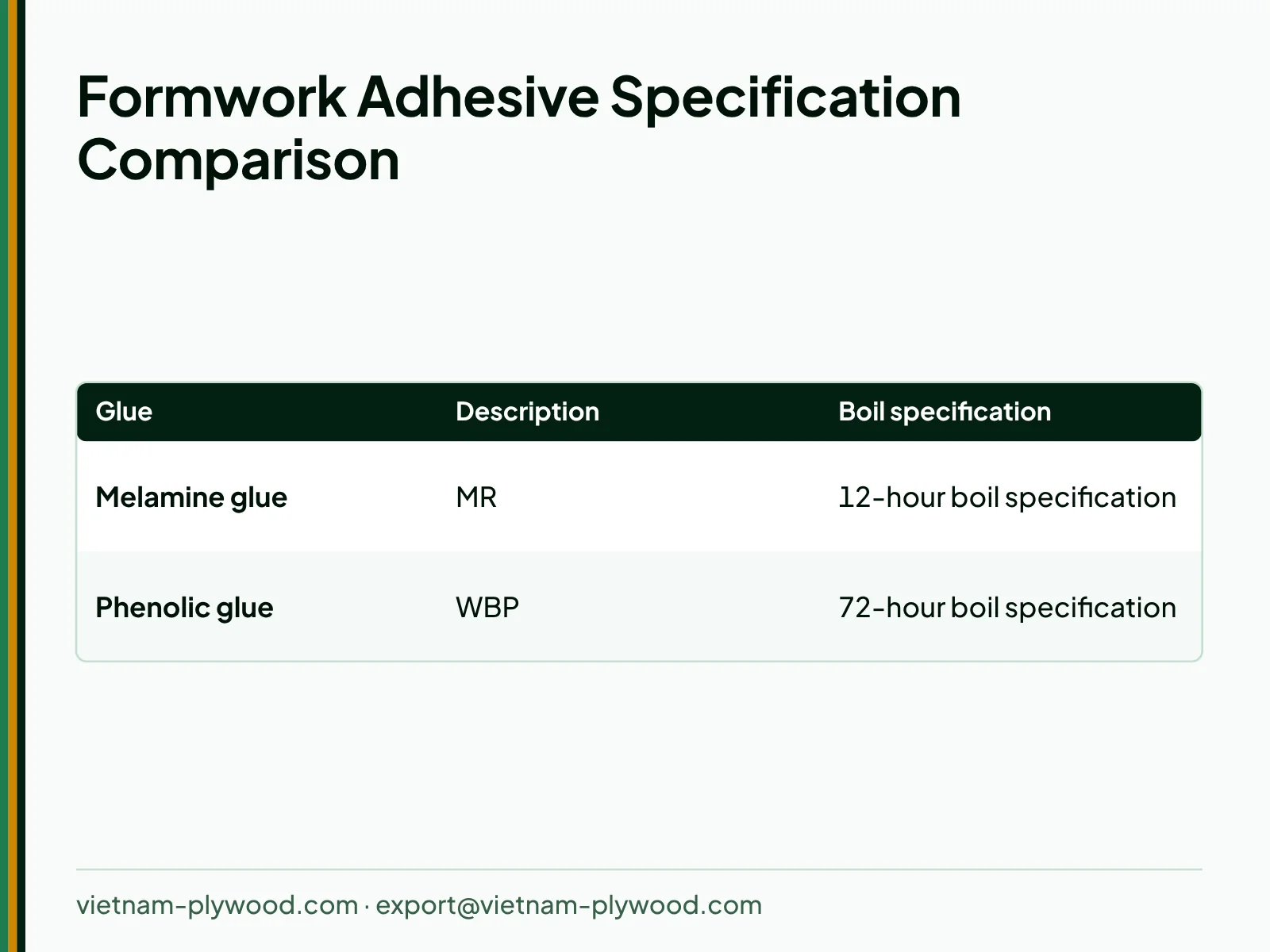
Melamine glue is MR with a 12-hour boil specification; phenolic glue is WBP, meaning weather and boil proof, with a 72-hour boil specification. These adhesive descriptions are separate from E0, E1 or E2 emission classes. With proper handling, a release agent on every pour and sealed edges including cut edges, melamine-glue film-faced panels reach about 12–15 pours; phenolic-glue panels up to about 25 pours.
A film face alone does not define the engineering performance.
What does importing cost compared with Danish stock?
For commercial plywood, the indicative starting point is from US$250/m³ FOB Hai Phong (October 2026). For furniture plywood, it is from US$350/m³ FOB Hai Phong (October 2026). Neither figure is a Danish landed price.
Compare the exact construction first: full-stitched, sanded decorative panels cost more to make than unsanded commercial boards because of core assembly, face selection and finishing. Film weight, adhesive system, core, thickness, size, order mix and testing requirements then affect the construction quotation. For film-faced and other builds without a published starting figure, request a written quotation.
Build the landed comparison from the factory quotation, freight, insurance where applicable, Danish terminal handling, customs classification and duty treatment, domestic haulage and finance. Do not apply an assumed tariff preference without checking origin evidence and the current tariff line. Use a sales contract checklist to align the quoted specification with acceptance terms.
What are the shipment terms and timing?
The minimum order is one 40HC, with mixed specifications permitted within its payload limit. Factory lead time runs 15–45 days from receipt of the 30% deposit; the exact figure depends on order size, line loading and what the contract fixes. The 70% balance is against the scanned bill of lading, by telegraphic transfer or irrevocable letter of credit at sight.
We ship FOB Hai Phong, or CFR (CNF) or CIF to your port. Northern Europe sea transit from Hai Phong is 30–40 days, depending on carrier and route; this is a regional sea-time range rather than a door-delivery promise to a Danish warehouse. Price the destination port and onward trucking separately.
Samples are free. New buyers book their own courier; that courier cost can be credited against a real order. Sampling before a production commitment helps both sides agree on face grade, core build and finish.
Which documents matter for Danish import compliance?
An EU import requires product classification, origin and timber due-diligence preparation alongside commercial shipping papers. The European Commission’s 2026 EUDR guidance lists 30 December 2026 for medium and large operators and traders, with 30 June 2027 for qualifying micro and small enterprises; timber transitional provisions need checking against the product and harvest dates. See the European Commission’s EUDR overview.
HCPLY’s shipment papers include commercial invoice, packing list, bill of lading, certificate of origin (EUR.1 for EU lots), phytosanitary and fumigation papers, insurance under CIF, agreed certificate documents and the EUTR/EUDR file set for EU lots. After loading, the draft shipping documents come to you for approval.
FSC, CARB P2, ISO 9001 and CE documents belong to the member factories and are shown with factory details masked, on request. Ask which factory’s records and test reports match the actual order. The importer should establish its own applicable customs and due-diligence obligations before the shipment is booked.
What can an inspector check before loading?
An inspector can visit the producing factory to compare the approved sample with the running order. The factory office hosts buyer visits, and goods are inspected where they are made. Factory visits in Vietnam covers practical visit arrangements.
For an 18 mm cabinet order, witness thickness measurements against the ordered ±0.2 or ±0.3 mm tolerance, inspect face grade under consistent lighting and examine stitched-core edges. For commercial packing boards, check core continuity and the agreed unsanded finish. For film-faced panels, check film appearance, cut-edge sealing and pallet identification.
Record the sample reference, measurement locations, rejected pieces and corrective action before authorizing loading. Repeat-order quality is easier to manage when inspection notes use the same criteria as the contract.
How should a distributor place the first order?
Send one written build schedule with the application, core, glue, emission class, face, thickness, size, volume and Danish destination port. Lucy at export@vietnam-plywood.com can coordinate the specification, on-site quality checks, documents and loading for HCPLY.
Use the following request as a starting point, then attach any accepted test-report requirement or approved face sample.
Application: Danish distribution / cabinet / packing / formwork
Producing line or core: furniture / commercial and packing / construction; styrax / acacia / eucalyptus
Glue: MR melamine / WBP phenolic
Emission class: E0 / E1 / E2, as specified
Face and grade: veneer species and grade / film weight / matt
Thickness and tolerance: ___ mm; ±___ mm
Sheet size: ___ × ___ mm
Quantity: ___ sheets or ___ m³; one 40HC minimum
Destination port: ___, Denmark
Ask Lucy for a sample set before finalizing the production specification through contact.