





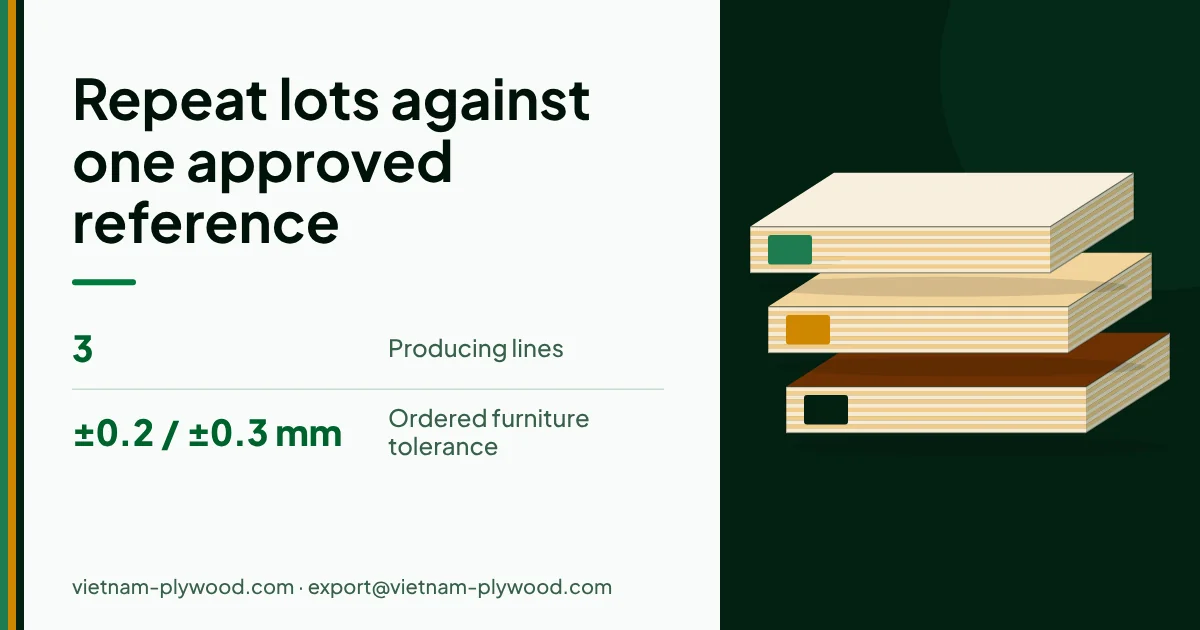
Consistent plywood quality means every lot is checked against the buyer’s approved specification and retained sample at the producing factory. A drifting face grade or thickness can cost machining time, replacement material and a rejected load. HCPLY keeps the reference with each relevant production line so repeat orders can be compared against the agreed build before loading.
How do you keep consistent plywood quality on repeat orders?
Consistent plywood quality comes from keeping the approved specification and retained sample as the reference for every lot, then checking the producing factory’s output before loading. We keep those references with the relevant production line, so a repeat purchase is checked against the buyer’s agreed build rather than a generic product name.
It identifies the intended application, core, joining method, face and back appearance, adhesive, emission class, finished dimensions, tolerances and packing. An approved sample fixes appearance where words such as “clear face” would leave room for disagreement. A repeat order refers to the same revision unless the buyer approves a change.
A factory inspection compares actual sheets with that revision. Thickness readings, visible veneer defects, exposed edges and packing identification give evidence about the lot being shipped. Records must identify which lot was inspected; a reading without a lot reference cannot explain a later disagreement. The Buying Guides section covers adjacent purchasing decisions.
An approved sample alone cannot settle hidden bond performance or emissions. Those requirements need the agreed test method and appropriate documents. The buyer should separate what can be seen and measured on the floor from what must be established by a test report.
How can I receive the same plywood specification in every container?
Use the same written revision on the purchase order, sample label, production instructions and pre-loading check. The phrase “same spec plywood every container” has meaning only when each of those references identifies the same panel construction.
Record face species separately from core species. A birch-faced panel, for example, is named for its face; it does not imply a birch core. Our furniture line uses styrax or eucalyptus cores. The commercial and packing line uses acacia. A face change should never silently become a core change.
State adhesive and emissions as separate fields. Melamine adhesive is specified as MR with a 12-hour boil description; phenolic adhesive is WBP with a 72-hour boil description. E0, E1 and E2 describe emission classes. CARB P2 and TSCA Title VI refer to a US formaldehyde limit and third-party certification, not to adhesive type. An emission requirement needs the corresponding agreed documentation.
Write dimensions as finished measurements. We offer thicknesses from 3–40 mm, including common 3, 5, 9, 12, 15, 18, 21 and 25 mm. Standard formats include 1220 × 2440 and 1250 × 2500 mm, alongside other listed formats and custom cutting. Length and width tolerance is ±2 mm. Do not substitute nominal dimensions for the agreed finished specification.
If a new face, thickness or tolerance is requested, mark the revision and identify the first affected lot. Keep the previous reference for earlier shipments. The sales contract checklist explains where the agreed construction and inspection terms belong in the order paperwork.
What changes when an order uses more than one factory line?
Each line holds the buyer’s approved specification and retained sample for the product it produces. HCPLY has three member factories in Phu Tho and Hai Phong, with each order made at the producing factory matched to its specification. A common buyer reference does not make unlike constructions interchangeable.
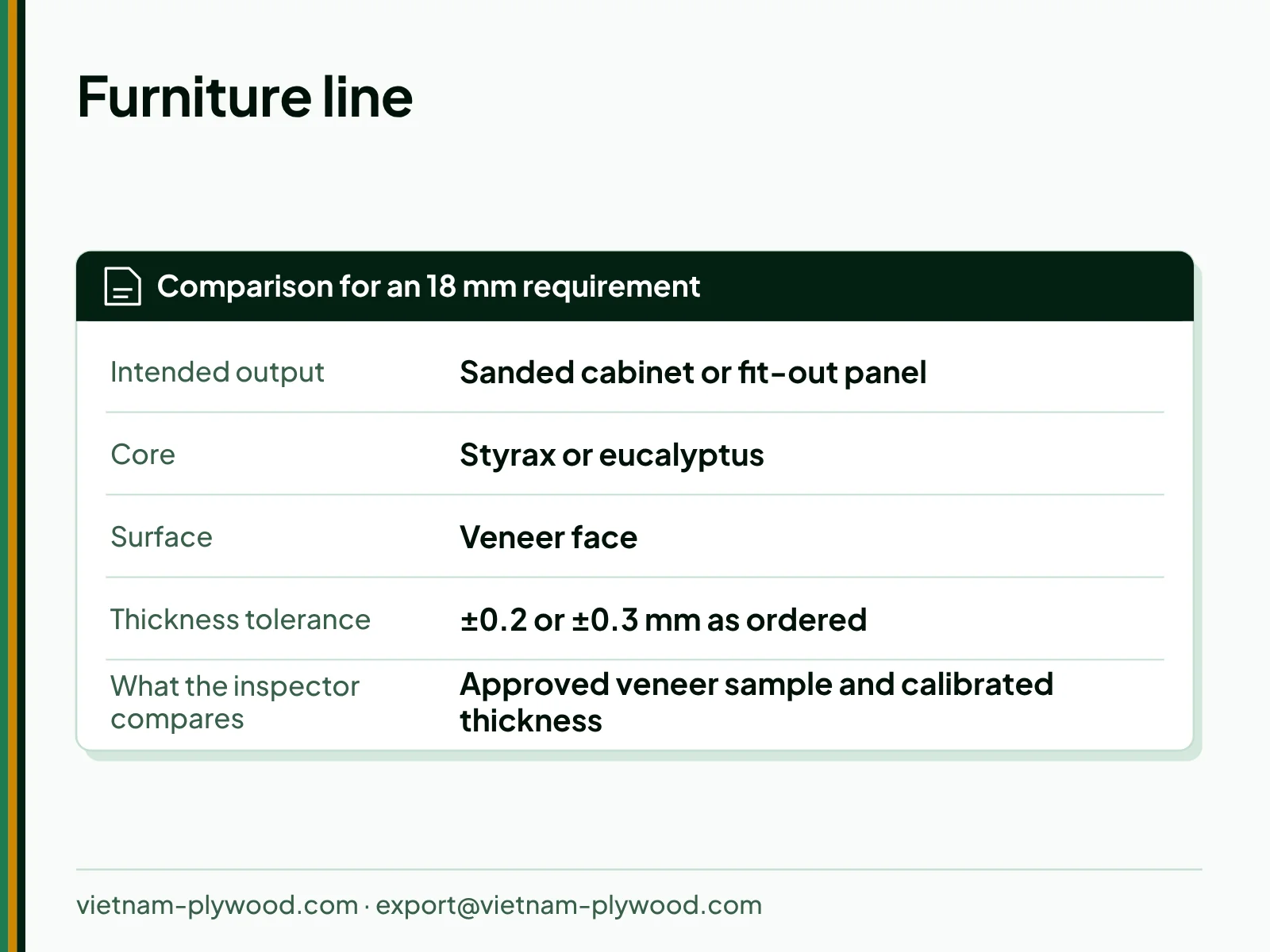
| Comparison for an 18 mm requirement | Our furniture line | Our commercial and packing line | Our construction line |
|---|---|---|---|
| Intended output | Sanded cabinet or fit-out panel | Commercial or packing panel | Film-faced formwork panel |
| Core | Styrax or eucalyptus | Acacia | Acacia or eucalyptus |
| Surface | Veneer face; full stitched core | Unsanded or light-sanded | Phenolic, melamine or anti-slip film; unsanded |
| Thickness tolerance | ±0.2 or ±0.3 mm as ordered | Commercial ±0.5 mm; packing ±0.5–1.0 mm | ±0.5 mm |
| What the inspector compares | Approved veneer sample and calibrated thickness | Approved appearance, edge and packing build | Film type and weight, edges and thickness |
| Verdict by use | Cabinet components needing a tighter finished thickness | Packaging and commercial work where its specified tolerance fits | Concrete forming and specified film surface |
An 18 mm panel has 11–13 plies depending on core veneer thickness of 1.4–2.0 mm. That range is not permission to change the approved construction unnoticed. Record the agreed core and edge appearance for each product; then inspect against the relevant sample.
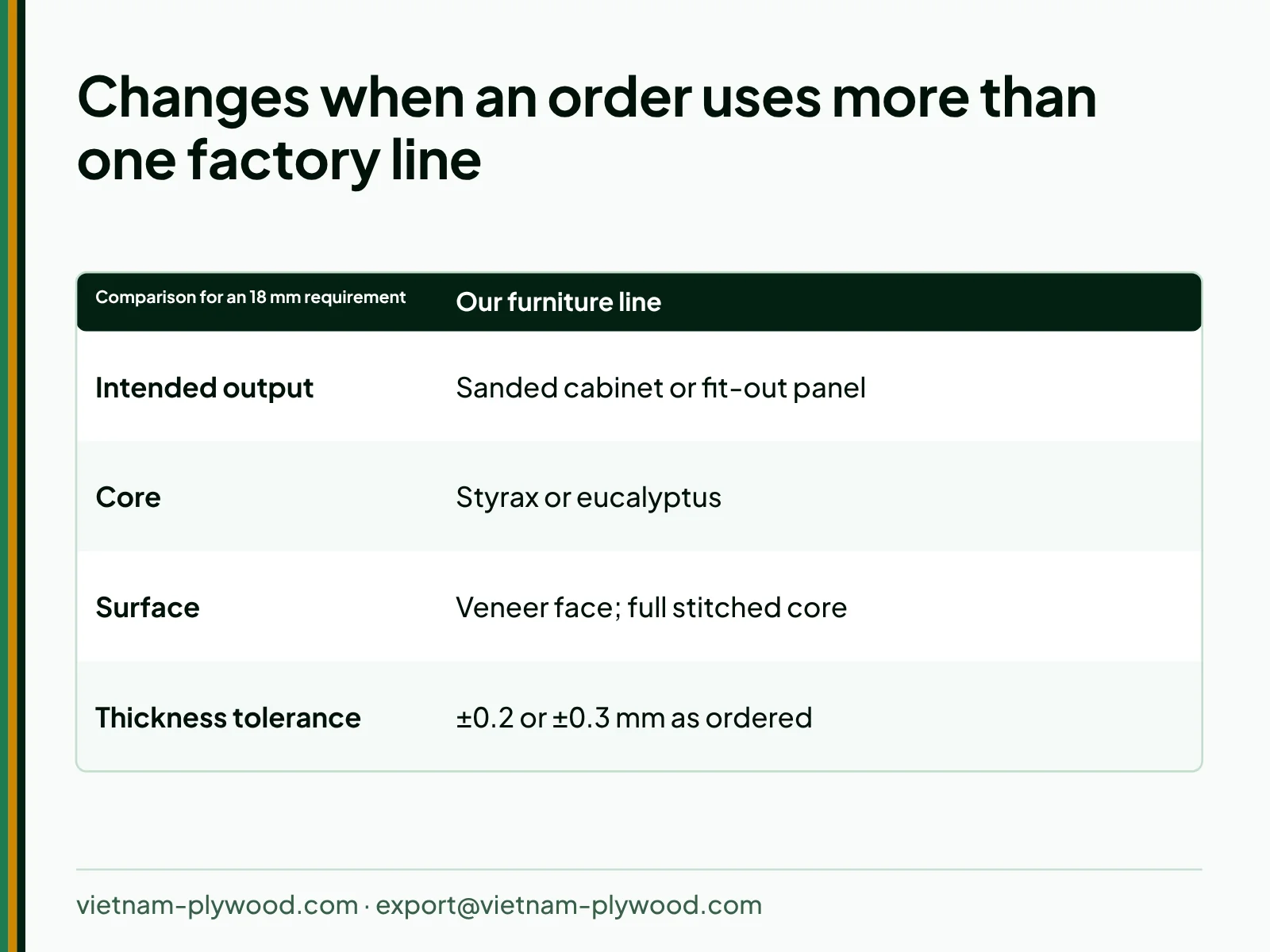
The furniture product is pressed on our furniture line. The other lines would make a commercial or packing panel, or a film-faced construction panel, rather than automatically duplicate the furniture build. See comparing grades across factory lines and ordering several plywood types for the distinctions that should appear on a mixed purchase order.
Is an approved sample kept for my orders?
Yes. For repeat orders across lines, each producing line keeps the buyer’s approved spec sheet and retained sample and checks lots against them before loading. The sample should be labelled with the product and specification revision so an inspector knows which reference applies.
A sample is most useful for the visible face and back grade, sanding, colour range and acceptable natural veneer features. The specification must still define core, adhesive, emission class, dimensions and packing. A sample from one line must not be treated as approval of a different line’s build.
When a buyer approves a replacement sample, record which order revision adopts it. Keep the previous sample identified for disputes concerning earlier lots. The practical question is whether the inspected sheet and the retained reference represent the same approved version, rather than whether they look broadly similar.
Samples cost nothing: a first-time buyer pays the courier, and that charge comes off the first confirmed order. Send the intended application and the required face grade before requesting the sample set. For the manufacturer’s available constructions, consult plywood manufacturing in Vietnam.
How is each lot checked before loading?
The producing factory compares the lot with its approved specification and retained sample before the panels are loaded. The buyer can ask to witness that comparison on selected sheets from the actual finished packs.
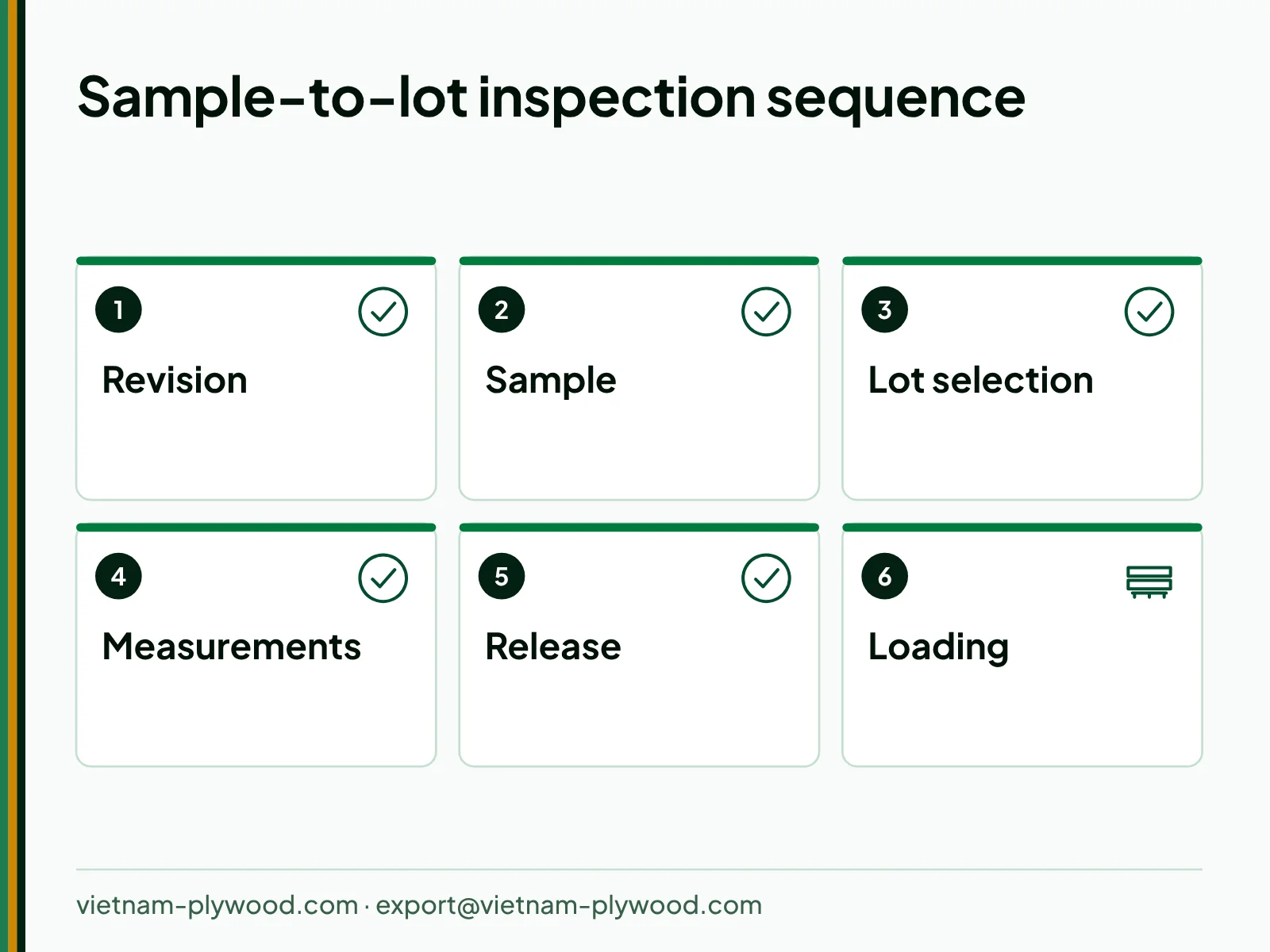
- Identify the lot. Match the order reference, specification revision, product and pack identifiers before opening the inspection.
- Select panels. Agree which packs and sheets will be checked, including sheets below the visible top layer. Set sampling and acceptance rules in the order before inspection.
- Compare surfaces. Place face and back beside the approved sample under consistent lighting. Record the agreed grade and observable defects.
- Measure dimensions. Use an appropriate caliper for finished thickness and a tape or rule for length and width. Write the readings beside the ordered tolerances.
- Inspect construction. Examine clean edges for core gaps, veneer arrangement and joining. If a destructive section is required, agree who selects it and how the lot will be represented.
- Check bond and emission evidence. Review the agreed test reports and certificate documents for the actual configuration. Visual inspection cannot replace a laboratory method.
- Release or hold. Record discrepancies, isolate disputed packs and agree corrective action and reinspection before loading.
- Reconcile loading. Match accepted packs to the packing list and container loading record. Record the final container and shipping document references.
Agree the inspection scope and destructive-test sampling in writing before the factory visit. The US Government Publishing Office’s 2025 edition of 24 CFR § 200.935 describes documented quality-assurance procedures for participating manufacturers (US Government Publishing Office, 2025). That certification-program example supports the value of recorded procedures; it does not establish certification of these panels. For a factory check, specify the instrument, method and record instead of accepting an unsupported measurement.
A buyer or appointed inspector visits the factory office and inspects goods at the producing factory. Ask in advance for access to the relevant finished packs, reference sample, dimensional station and order-specific documents.
Which plywood batch records should I request?
Ask for records that connect the approved revision to the inspected lot and loaded packs. Plywood batch records are useful only when the same product and lot identifiers appear across the documents.
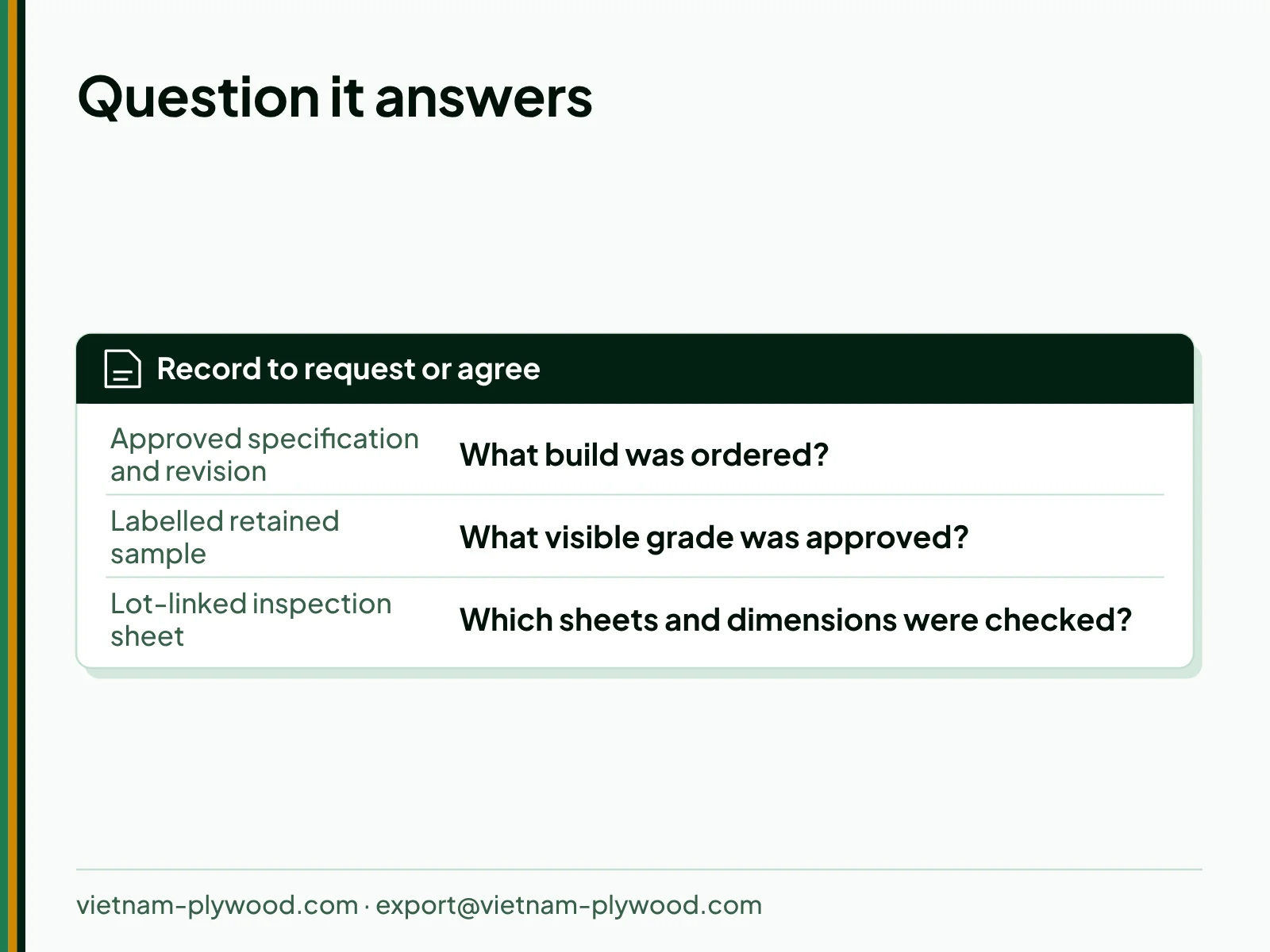
| Record to request or agree | Question it answers | Limitation |
|---|---|---|
| Approved specification and revision | What build was ordered? | Cannot prove the shipped panels match |
| Labelled retained sample | What visible grade was approved? | Does not prove bond or emissions |
| Lot-linked inspection sheet | Which sheets and dimensions were checked? | Requires a stated sampling basis |
| Test report for agreed build | Which tested property is supported? | Scope and specimen identity must match |
| Packing list and loading reference | Which accepted packs were shipped? | Counts alone do not establish quality |
| Change or deviation approval | Who accepted a difference? | Must be written before affected release |
Ask for actual readings rather than a blanket “passed QC” statement. An appearance record should refer to the approved sample and state the observed issue, if any.
Set the sample retention period and sampling percentage in the buyer’s written inspection instructions before production.
Which specifications are easiest to lose between repeat orders?
Appearance, core construction and thickness are common sources of confusion because a familiar product name can hide different builds. The buyer should state which differences would prevent the intended manufacturing operation.
For a cabinet component, the veneer grade and sanding condition affect visible matching and downstream machining. Our furniture line uses full stitched cores and sanded surfaces, with E0 or E1 emissions as specified. A furniture tolerance of ±0.2 or ±0.3 mm must be chosen in writing; neither is an automatic universal tolerance.
For commercial and packing uses, an acacia core and MR adhesive describe a different construction. Commercial thickness tolerance is ±0.5 mm; packing is ±0.5–1.0 mm. A repeat buyer should also identify whether the surface is unsanded or light-sanded and what edge appearance was approved.
For film-faced construction products, film weight matters. Standard film is 120 g/m², premium film 135 g/m² and anti-slip film 220 g/m² only. Film weight cannot stand in for core choice, adhesive or edge sealing. The agreed film type should be recorded independently of the panel thickness.
The face can be bintangor, okoume, engineered veneer (EV), gurjan, pine, poplar, eucalyptus, birch or sapele; an unfaced raw core is called matt. Common face veneer thickness is 0.2–0.4 mm. Face grades are A/B, while birch uses D/E/F. A buyer’s approved sample should resolve the appearance within the ordered grade.
Can different specifications share one 40HC without losing traceability?
Yes. The minimum order is one 40HC, and one container can carry several specifications as long as the payload limit holds. Keep each specification’s packs and inspection references separately identifiable even when they share the same shipment.
The stated 40HC payload limit is 28.5 t. For 18 mm sheets measuring 1220 × 2440 mm, the loading table gives 990 styrax-core sheets, 880 acacia-core sheets or 795 eucalyptus-core sheets in a single-core loading plan, at 26.52 t, 27.35 t and 27.69 t respectively. These are alternatives, not quantities to add together.
For a mixed load, request a pack-by-pack loading plan with the weight of each group and the pallet and packaging allowance. Check the combined loaded weight against the 28.5 t payload limit before approving the plan.
For 18 mm 1220 × 2440 mm sheets, the loading table lists 31.08 kg for acacia core and 26.79 kg for styrax core, excluding packaging. Check pallet and packaging mass in the final loading plan.
Use separate pack labels and lot references for the furniture and commercial components of a mixed order. The container load calculation owns the detailed sheet-count planning. Quality release remains a decision for each specified lot.
What if the inspected lot differs from the approved sample?
Hold the affected lot for a documented decision rather than changing the approved standard silently. Record the discrepancy against the exact specification line and sample revision.
A face mismatch needs side-by-side photographs with the approved reference. A dimensional mismatch needs readings, measurement locations and the tolerance used. A suspected bond or emission problem needs the agreed test method and evidence rather than a judgement based only on appearance.
The buyer and producing factory should document whether the affected lot can be reworked, reinspected or accepted under a written deviation. A concession should identify the affected lot and must not rewrite the specification for later containers. If the next order is meant to use the new construction, issue a new approved revision and sample.
On arrival, keep pack identification, photographs and measured readings linked to the container and invoice. Compare the findings with the pre-loading inspection record. This makes a complaint specific enough to investigate without claiming that every defect can be diagnosed from photographs.
Which export documents support a repeat-quality order?
The export document set identifies the shipment and includes the agreed product-related evidence. We handle specification, on-site quality control, documents and loading, with goods shipped directly from the producing factory.
For each shipment, the documents include the commercial invoice, packing list, bill of lading (B/L), certificate of origin, phytosanitary and fumigation papers, and insurance under CIF. EU lots include EUR.1 and the EUTR/EUDR file set. The order’s certificate documents can include an FSC claim on sales documents, an emission certificate and test reports for the agreed build.
Factory-held FSC, CARB P2, ISO 9001 and CE certificates, and EUDR/EUTR documents, are shown with factory details masked, on request. Their existence does not establish that every configuration has the same certificate scope. Check the exact product, member factory and buyer-required claim against the relevant document.
After loading, the draft shipping documents come to you for approval. Ask separately for the lot-linked inspection evidence agreed in the contract.
How should a repeat-order programme be written?
Write the repeat programme around a fixed product revision, a reference sample and a release checkpoint for each lot. Avoid replacing the technical specification with a short product nickname on later purchase orders.
Our production period is 15–45 days from the 30% deposit, set by order size, line loading and the contract. The remaining 70% is paid on the scan of the bill of lading, by T/T, or by irrevocable sight L/C. We ship FOB Hai Phong, or CFR (CNF) or CIF to your port. These commercial terms do not replace the inspection criteria.
For budget comparisons, request a quotation against the written specification for each construction. Core construction, face grade, adhesive, tolerance and order mix affect the quotation; quote validity and price changes addresses how to document a revised offer.
Ask the quotation to identify which line will produce each product, how the approved reference is recorded and which pre-loading inspection evidence is supplied. A later repeat order should reference the same revision explicitly. If the specification changes, obtain a revised quotation and a new sample approval before producing the affected lot.
What should I send before approving the next lot?
Send the intended application, approved sample reference, current specification revision and the inspection scope. The factory can then align the sample comparison, production instructions and shipment records around the same order.
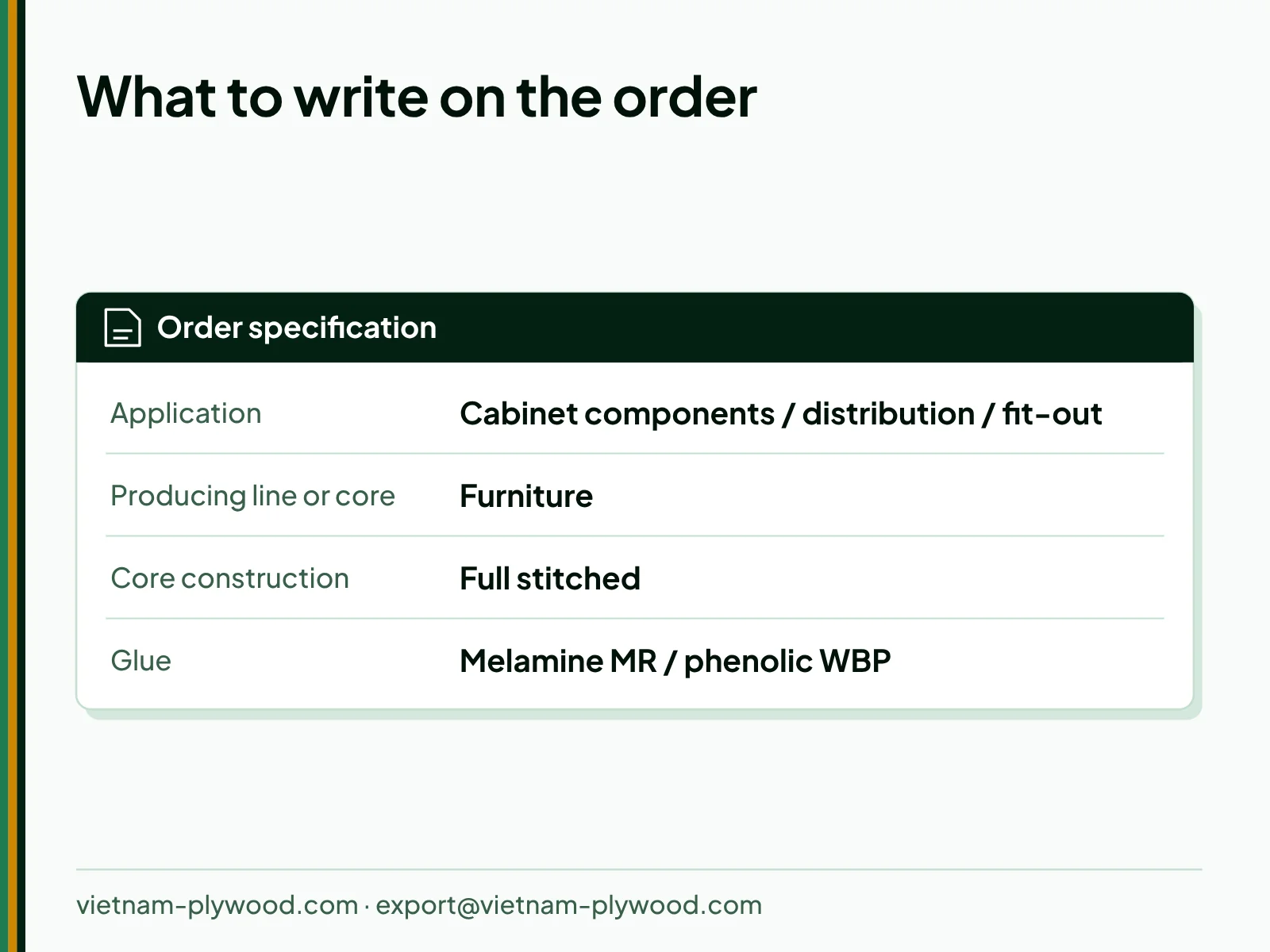
A furniture or cabinet buyer should make the visible face and thickness tolerance explicit. A distributor ordering multiple constructions should distinguish each product line and pack identity. The inspector should know the acceptance criteria and any test reports needed before visiting the producing factory.
Use this specification format for a repeat order:
Application: cabinet components / distribution / fit-out
Producing line or core: furniture; styrax core (or agreed alternative)
Core construction: full stitched; approved sample reference and revision
Glue: melamine MR / phenolic WBP, as agreed
Emission: E0 / E1 / E2 or specified market requirement
Face and grade: species; face/back grade; retained sample ID
Thickness and tolerance: 18 mm; +/-0.2 mm or +/-0.3 mm as ordered
Sheet size: 1220 x 2440 mm; length/width tolerance +/-2 mm
Quantity: sheets, packs and number of 40HC containers
Destination port: [buyer to specify]
Inspection: lot identity, sampling plan, witness and release criteria
Request a sample set from Lucy at export@vietnam-plywood.com through contact before approving the repeat-order reference.