





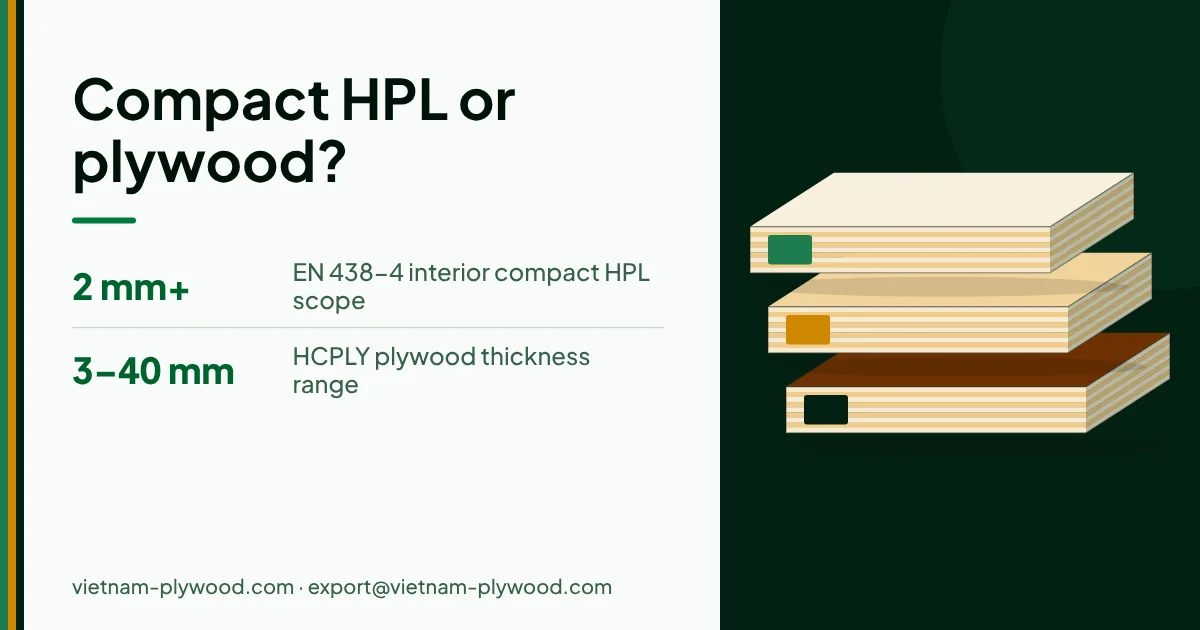
Compact HPL (phenolic) board is a resin-impregnated paper laminate used where a finished, durable panel is needed. Choosing it when a protected plywood assembly would work raises cost; substituting plywood in a wet cubicle can cause premature replacement and rejected specifications. HCPLY manufactures plywood alternatives across its three factories, while compact HPL itself is outside our production range.
What is a phenolic sheet in compact HPL?
A phenolic sheet in compact high-pressure laminate (HPL) is a dense, self-supporting panel made from resin-impregnated paper layers pressed together. Its phenolic-resin core differs from plywood’s wood-veneer core. Compact HPL is specified for finished partitions and other exposed surfaces; plywood is selected where the construction, fastening plan and finish system favour wood-based panels.
The Estonian Centre for Standardisation and Accreditation lists EN 438-4:2016 as covering interior compact laminates 2 mm and thicker. Its official standard description identifies resistance to wear, impact, scratching, moisture, heat and staining. The corresponding exterior-grade category is addressed separately under EN 438-6; an interior classification does not automatically cover an exterior installation.
A thin decorative HPL sheet bonded to plywood is another assembly. The decorative skin does not turn the plywood substrate into solid compact HPL. For the wider material taxonomy, see plywood types and the plywood definition.
Phenolic board vs plywood for toilet cubicles: which wins?
Compact HPL is the stronger starting specification for repeatedly wet, exposed toilet cubicle partitions when the tested grade, hardware and installation suit the project. Plywood can fit drier, protected cubicles where the architect accepts sealed edges, a compatible surface finish and a maintenance plan. HCPLY does not press compact HPL or laminate-faced panels; our furniture line presses wood-veneer plywood for suitable joinery.
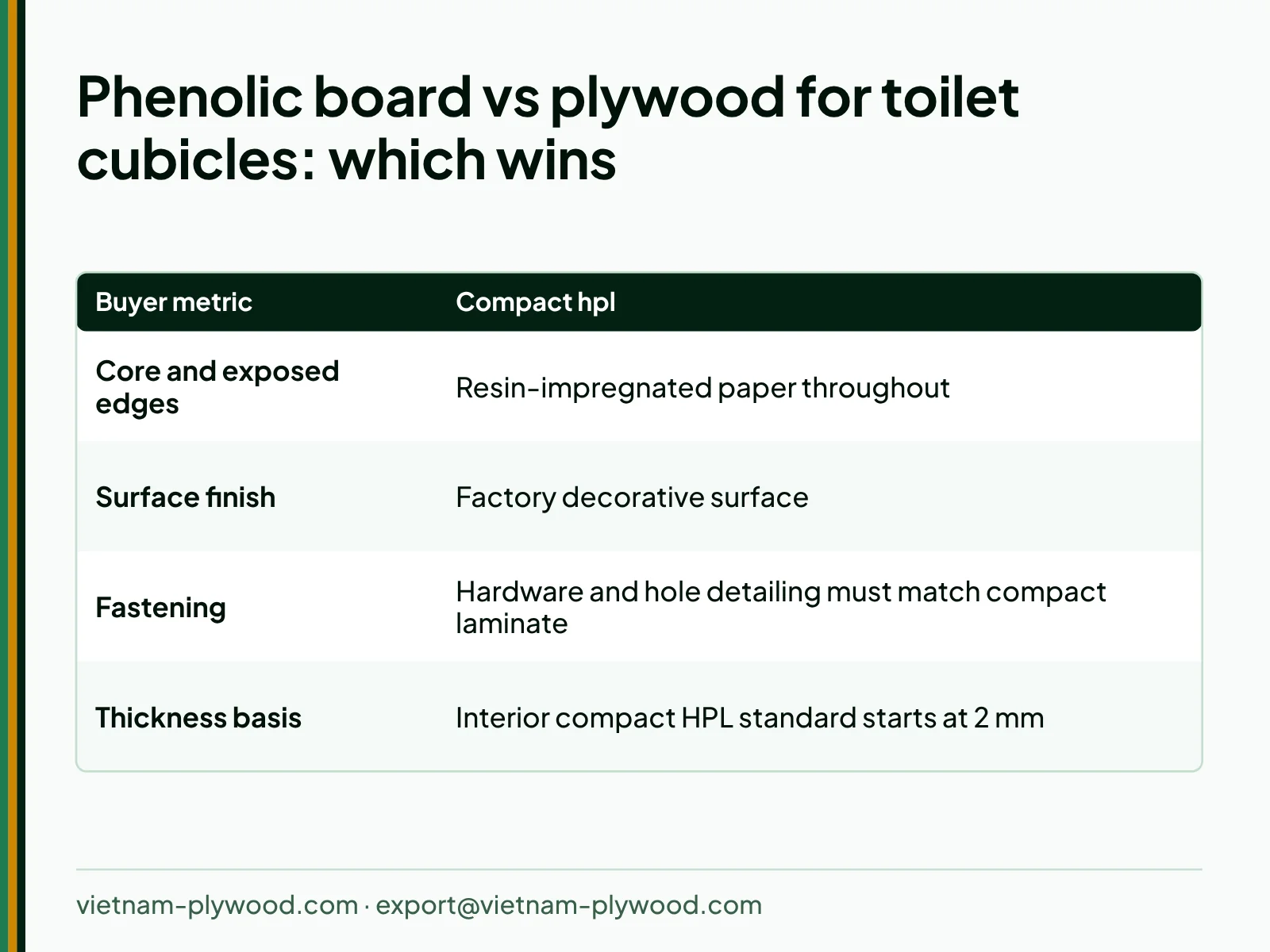
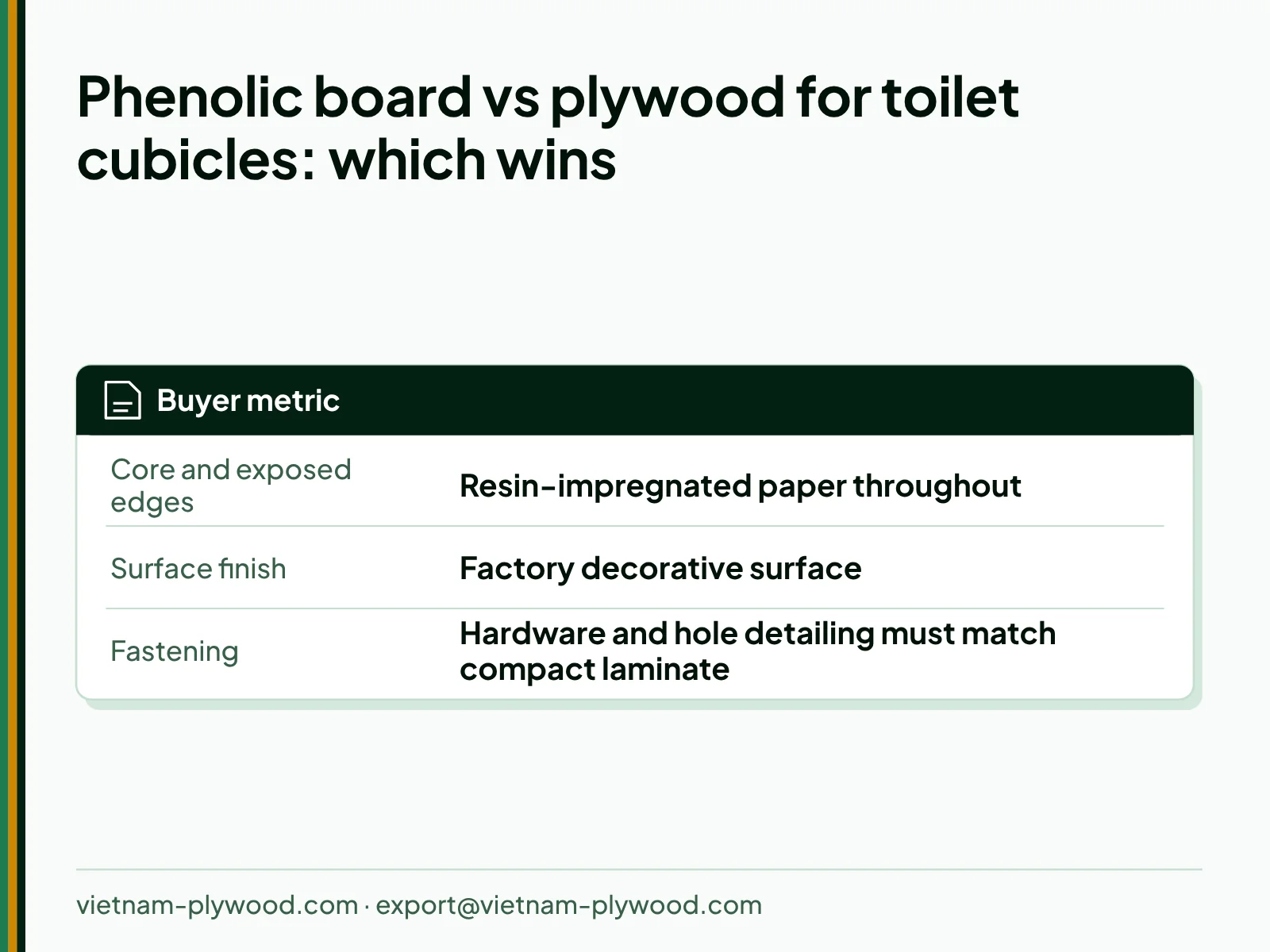
| Buyer metric | Compact HPL | Plywood alternative | Verdict by use |
|---|---|---|---|
| Core and exposed edges | Resin-impregnated paper throughout | Wood veneers; cut edges require suitable sealing | Compact HPL for exposed wet cubicle edges |
| Surface finish | Factory decorative surface | Veneer face requires the specified finishing system | Compact HPL for direct finished partitions |
| Fastening | Hardware and hole detailing must match compact laminate | Wood-panel fasteners and edge distances must match build | Select by tested hardware detail |
| Thickness basis | Interior compact HPL standard starts at 2 mm | Our plywood range is 3–40 mm | Compare at the designed stiffness and support spacing |
| Service environment | Specify interior or exterior grade explicitly | Specify glue, face, edge protection and exposure | Compact HPL for persistent splashing; protected plywood for dry joinery |
| Procurement | Obtain grade-specific test evidence from HPL producer | Obtain agreed plywood build and inspection record | Choose by documented application requirements |
For toilet partitions, ask for the tested HPL grade, panel thickness, fixing centres, edge treatment, cleaning-chemical resistance and installation instructions. A plywood quotation should identify exposed edges. Specify wet-service performance separately.
What determines compact phenolic board price per m²?
The largest cost drivers are usually grade and thickness, followed by decorative finish, sheet format, machining, order volume and delivery basis. A thicker exterior-grade compact panel with special surface requirements costs more to produce than a thinner standard interior panel because it uses more material and may require different performance testing. A machined cubicle kit also costs more than uncut stock sheets because it adds fabrication and hardware coordination.
For precio tablero compacto fenolico por m2, request a price per square metre at a named thickness, grade, finish and cut plan. Ask whether the quote covers raw sheets or a complete cubicle package. Compare delivered area after cutting waste, not just nominal sheet area. HCPLY does not quote compact HPL as a product; for our plywood alternatives we price the written build and destination.
Do not transfer a plywood cubic-metre rate into an HPL square-metre price. The material construction and commercial unit are different.
How should buyers compare a compact phenolic board price quotation?
A comparable quotation names the grade, thickness, surface on both faces, sheet dimensions, machining scope, hardware exclusions, packing, Incoterm and destination. It should also identify whether performance evidence applies to the exact colour, finish and thickness being purchased.
For a plywood alternative, HCPLY can quote against the veneer core, glue system, emission class, face grade and thickness tolerance. Furniture plywood starts from US$350/m³ FOB Hai Phong (October 2026); commercial plywood starts from US$250/m³ FOB Hai Phong (October 2026). These are different products and volumetric prices, not compact HPL prices.
If a contractor receives one offer in m² and another in m³, normalize only after establishing the actual panel thickness, usable dimensions and installation scope. Account for cutting, sealing and hardware.
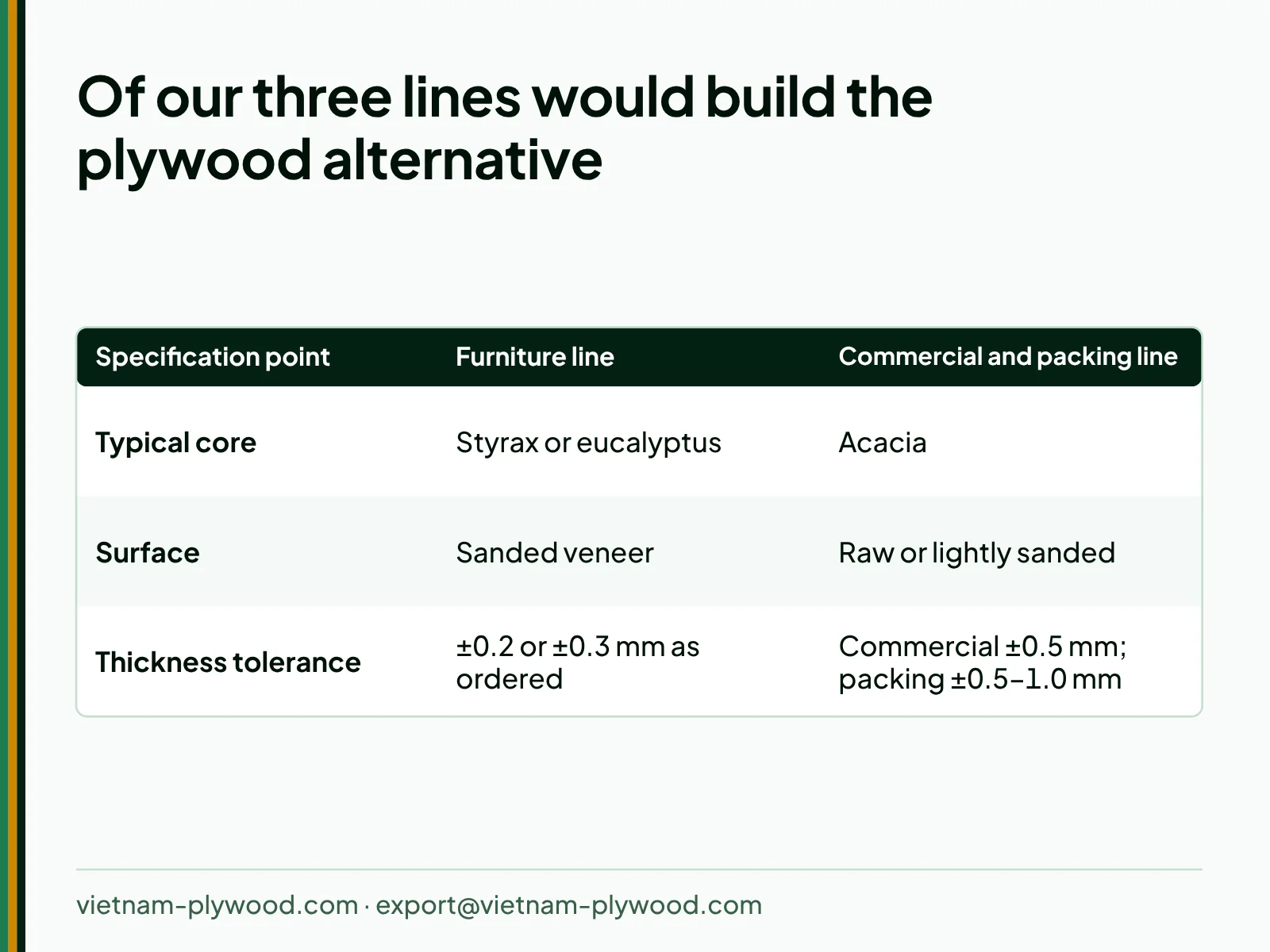
Which of our three lines would build the plywood alternative?
Our furniture line is the route for sanded veneer plywood used in protected interior joinery. Our commercial and packing line makes acacia-core MR plywood for general commercial or packing uses. Our construction line presses film-faced plywood for formwork and related site applications, rather than decorative cubicle surfaces.
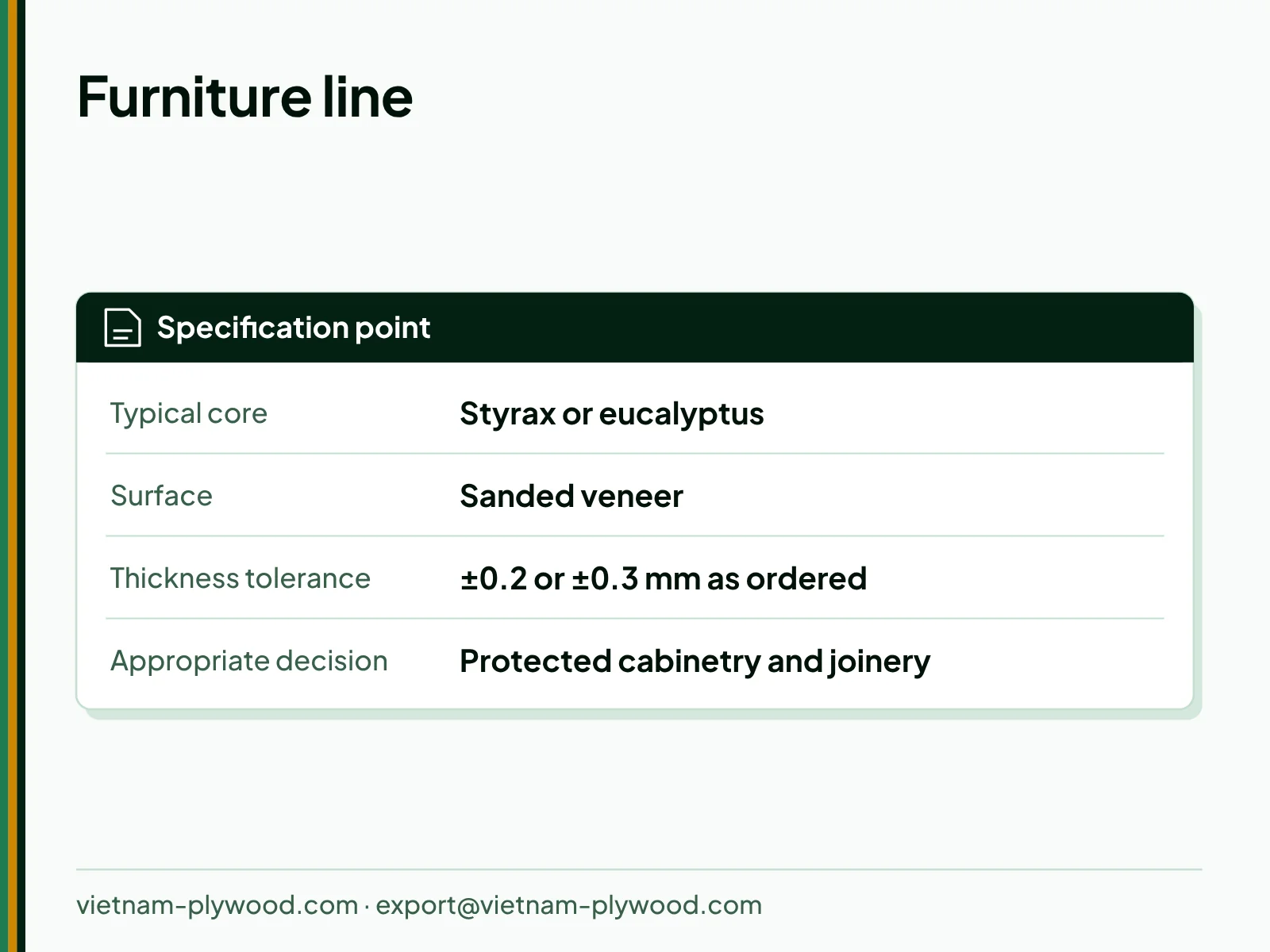
| Specification point | Furniture line | Commercial and packing line | Construction line |
|---|---|---|---|
| Typical core | Styrax or eucalyptus | Acacia | Acacia or eucalyptus |
| Surface | Sanded veneer | Raw or lightly sanded | Phenolic, melamine or anti-slip film |
| Thickness tolerance | ±0.2 or ±0.3 mm as ordered | Commercial ±0.5 mm; packing ±0.5–1.0 mm | ±0.5 mm |
| Appropriate decision | Protected cabinetry and joinery | Commercial backing or packing | Concrete formwork, not a finished cubicle face |
The same nominal thickness can describe different builds. Our classification of Vietnam plywood and core comparison explain why face naming and core selection must remain separate.
Does phenolic glue make plywood a compact phenolic board?
No. Phenolic glue in a wood-veneer plywood panel is a bonding specification; compact HPL uses resin-impregnated paper layers as its body. The term “phenolic board” is used loosely in procurement, so the material construction must appear on the purchase order.
Our phenolic plywood glue is the WBP, or weather and boil proof, option with a 72-hour boil specification. Melamine MR glue has a 12-hour boil specification. Those descriptions do not replace application-specific test reports or make either plywood construction equivalent to compact HPL.
Likewise, phenolic film on formwork plywood is a surface layer over a veneer core. Our construction line offers standard 120 g/m² film, premium 135 g/m² film and 220 g/m² anti-slip film. Film weight is a facing specification; it is not a compact-laminate classification.
Which technical documents should a cubicle buyer request?
Request the compact HPL producer’s grade designation, applicable EN 438 part, thickness and dimensional tolerances, test evidence, cleaning instructions and fixing details. For exterior use, ask for exterior-grade evidence rather than assuming an interior sheet qualifies. Match the document’s tested configuration to the proposed project build.
For a plywood alternative, the order should distinguish glue from formaldehyde emission class. Our furniture line offers E0 or E1 emission classes, while glue is separately specified. CARB P2 or TSCA Title VI concerns a US emission limit and third-party certification, not a synonym for a glue type.
Member-factory certificates, including FSC, CARB P2, ISO 9001 and CE, and EUTR/EUDR documents are shown with factory details masked, on request. They relate to the producing member factory and the agreed order, not to compact HPL.
What can an inspector witness at the producing factory?
For plywood, the buyer can inspect the face, core assembly, sanding, measured thickness, edge condition, panel count and packing against the signed specification. A cubicle application deserves particular attention to visible veneer defects and cut-edge finishing requirements. The inspection record should identify the actual plywood build rather than borrowing a compact HPL grade name.
Our furniture line uses full-stitched, sanded styrax or eucalyptus cores. For a sanded order, the specified thickness tolerance is ±0.2 or ±0.3 mm. Inspectors can measure representative panels and compare results with the purchase specification before loading.
For compact HPL bought elsewhere, ask its producer to demonstrate the relevant surface and edge checks and supply the grade-specific laboratory evidence. These inspections cover plywood only.
Can plywood alternatives share a container?
Specifications can be mixed within one 40HC container when the payload stays within 28.5 t. For 18 mm, 1220 × 2440 mm plywood, the calculated full-container loads are 990 styrax-core sheets at 26.52 t, 880 acacia-core sheets at 27.35 t, or 795 eucalyptus-core sheets at 27.69 t. These are separate full-load examples, excluding film weight.
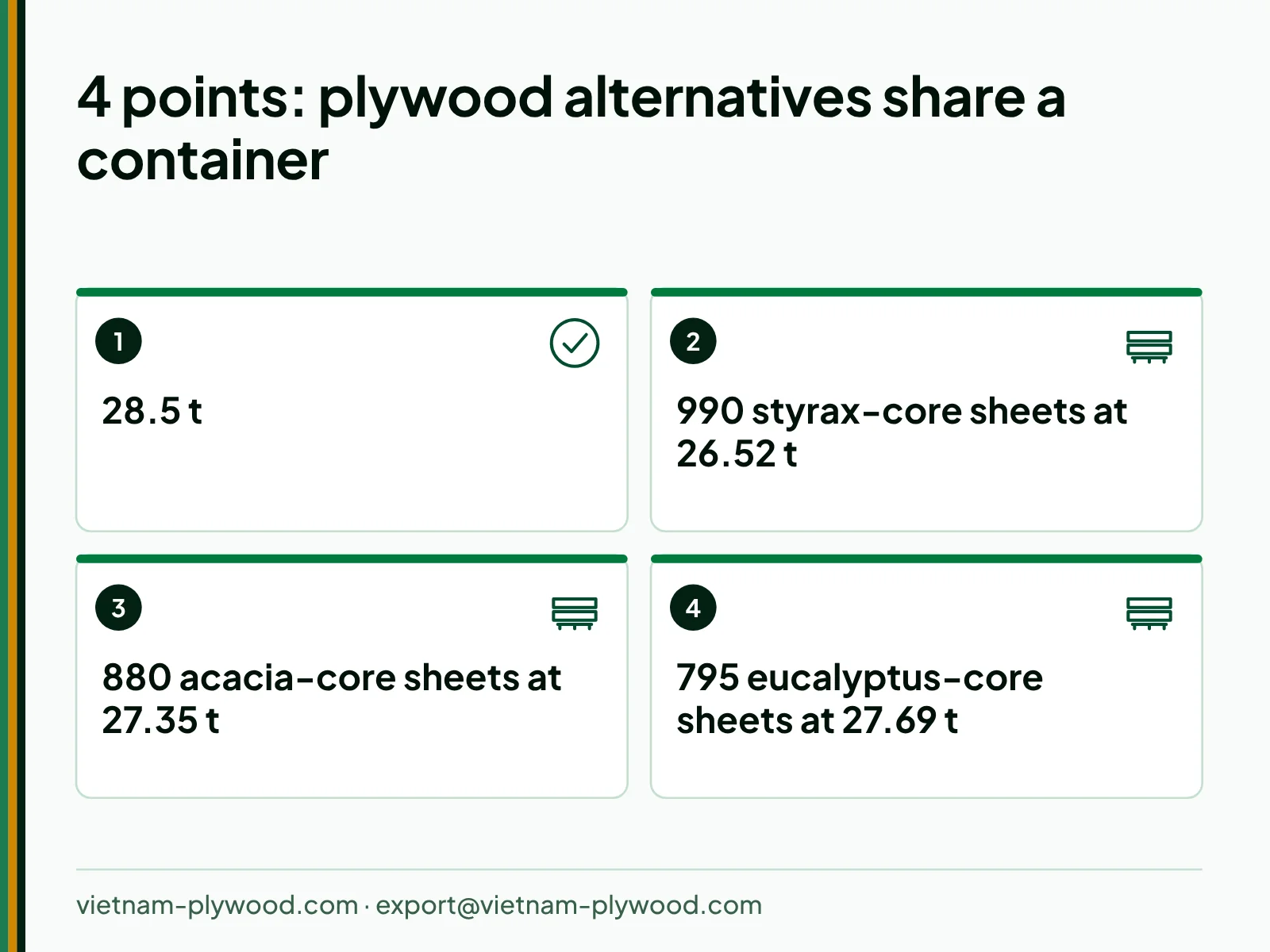
A mixed loading plan should total the weight of each actual specification, then check the pallet plan and payload limit. It must not add the three full-load counts together. The container loading reference covers the dedicated loading calculation.
For an importer sourcing joinery plywood alongside formwork sheets, several plywood types under one export arrangement explains the specification coordination. Compact HPL is outside our manufacturing range and cannot be counted as an HCPLY line item.
What export documents accompany the plywood order?
HCPLY manages the export documentation for the producing factory and shipment. The commercial invoice and packing list identify the goods and quantities; the bill of lading records the carriage. A certificate of origin, including EUR.1 for eligible EU lots, and phytosanitary and fumigation papers form part of the shipment paperwork.
Insurance is included under CIF, and the order’s agreed certificate documents, emission evidence and test reports are added where applicable. EU lots also have the EUTR/EUDR file set. After loading, the draft shipping documents come to you for approval.
We ship FOB Hai Phong, or CFR (CNF) or CIF to your port. Factory lead time runs 15–45 days from receipt of the 30% deposit; the exact figure depends on order size, line loading and what the contract fixes; the 70% balance is against the scanned B/L, by T/T or irrevocable L/C at sight. For scheduling detail, see plywood production lead time.
What specification should an importer send first?
Send separate specifications for compact HPL and plywood so the factory can price the correct material and inspection basis. For compact HPL, start with interior or exterior use, applicable EN 438 category, finish, thickness, panel size and fabrication details. For plywood, state the core, glue, emission, face, tolerance and edge requirements.
Our minimum order is one 40HC, with mixed plywood specifications allowed within its payload. Samples are free; a first-time buyer pays the courier, and that charge comes off the first confirmed order. Lucy at export@vietnam-plywood.com can review the plywood build.
Application: protected interior cubicle joinery / formwork / other
Line or core: furniture — styrax or eucalyptus / commercial — acacia / construction — acacia or eucalyptus
Glue: melamine MR / phenolic WBP
Emission: E0 / E1 / agreed class
Face and grade: named veneer and A/B / film type and weight
Thickness and tolerance: ___ mm; ___ mm
Size: ___ × ___ mm
Quantity: ___ sheets / ___ 40HC
Destination port: ___
Next step: Request the plywood specification sheet for the application and drawing package.