





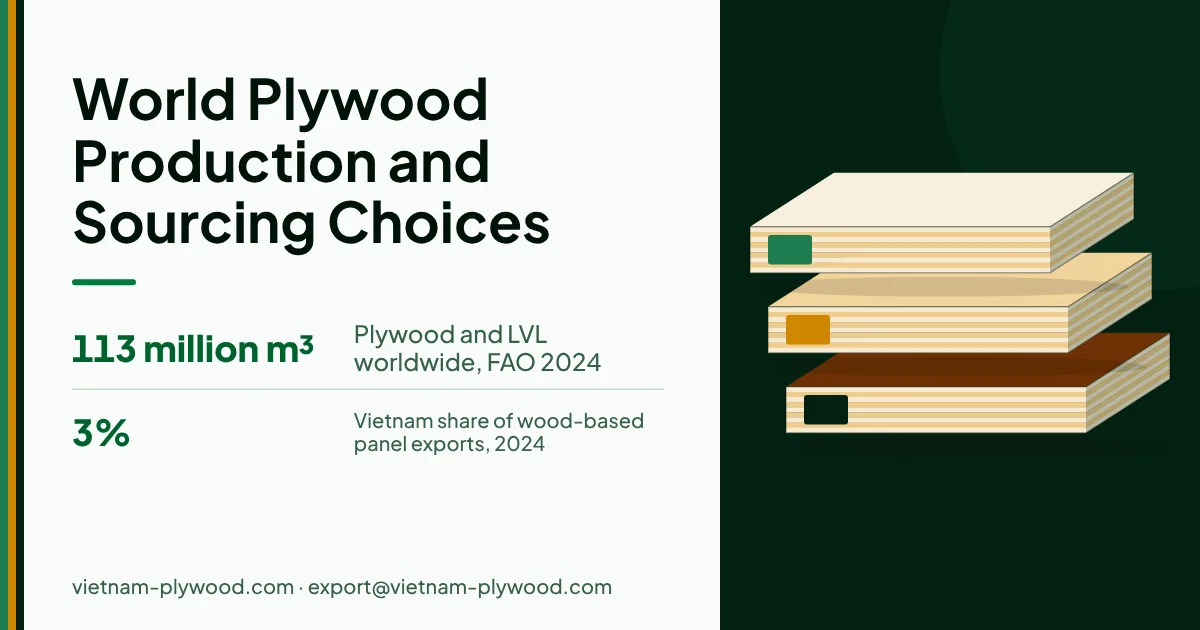
HCPLY compares the world’s plywood producers by country, product type and the evidence behind each factory claim. Choosing a supplier by an unsupported size ranking can cost rejected panels, rework and shipping days. The search for the largest plywood manufacturer in the world becomes useful when the buyer separates country production, company output and the actual grade needed.
Who is the largest plywood manufacturer in the world?
There is no defensible single-company answer to “largest plywood manufacturer in the world” without a common reporting year, plywood-only output and a consistent definition of the company. The largest producer by country is a different question from the largest individual factory. Buyers should request audited plywood capacity and actual output before accepting a corporate ranking.
The Food and Agriculture Organization of the United Nations (FAO) reports 113 million m³ of plywood and laminated veneer lumber (LVL) produced globally in 2024, with 30 million m³ exported. This combined category is useful for scale, but it cannot identify the largest plywood-only company. Its 2024 forest-products statistics also put China’s share of all wood-based panel production at 45%; that broader category includes particleboard, oriented strand board and fibreboard. Neither number should be relabelled as China’s plywood share.
A claim of first place needs a defined metric: annual plywood output in cubic metres, plywood-only installed capacity, or consolidated revenue from plywood. A manufacturer with extensive panel operations can rank differently under each measure. For a purchasing decision, compare the actual producing plant and the specification it can repeat.
Which is the biggest plywood factory in Asia?
No publicly comparable, plant-level plywood production table in the cited FAO statistics establishes Asia’s single biggest plywood factory. China is the dominant country in the broader wood-based panel category, but country output cannot identify one factory.
Some commercial lists identify large Indian panel businesses, while others discuss Chinese production clusters or Indonesian exporters. A corporate group may run several plants and multiple panel types. Ask for the factory address, plywood-only monthly output, operating press capacity and an inspection appointment. A group’s overall revenue is not a substitute for those fields.
For importers, a plant that produces the required face, core, glue and tolerance repeatedly is more relevant than an unsupported superlative. Inspect the producing factory and compare samples from the same specified build.
Who are the major manufacturers of plywood?
Major suppliers operate across several distinct production systems: high-volume Asian commodity panels, specialist European birch or softwood panels, North American construction panels, and tropical hardwood-faced export panels. No single list captures these groups fairly because their products and reporting boundaries differ.
An importer can screen companies by public annual reports, factory production disclosures, third-party test documentation and export shipment records. Record whether the evidence describes plywood alone or a larger wood-products group. Record whether the entity is one factory or a collection of facilities.
For purchasing, group candidates by end use before comparing capacity. Cabinet makers need face consistency and tight sanding tolerances. Packing buyers need economical cores and fit-for-purpose strength. Formwork yards need bond, film and edge-sealing details. Those are different buying contests.
Who are the top 10 plywood manufacturers in the world?
A verified worldwide top-ten company ranking cannot be assembled from national production totals. Published promotional lists use different years, mix plywood with other boards, and often omit audited plywood-only output. Presenting ten names in a precise order would suggest evidence that those lists do not provide.
Instead, build a comparable shortlist of ten candidates using the same data request for every company: legal manufacturing entity, factory location, plywood-only production volume, year, product mix, independent testing and export documentation. Rank only candidates that return comparable evidence. Keep missing fields visible rather than treating a company’s marketing prominence as production volume.
The distinction matters when assessing a factory’s ability to supply a repeated specification. A high-volume commodity plant might have limited decorative face selection; a specialist decorative plant might have little film-faced capacity. Neither is automatically preferable for the other application.
Which company manufactures the best plywood in the world?
The strongest plywood choice is the factory whose tested build meets the buyer’s intended application, dimensional tolerance and destination-market requirements. There is no universal company winner across furniture, packaging and concrete formwork.
For cabinet work, compare veneer face grade, sanding, internal core gaps, thickness spread and formaldehyde emission class. For packing, compare core construction, load requirements and the packing method. For formwork, compare the adhesive system, film weight, edge seal and an accepted bond test report. A structural or marine claim must be evaluated against a test report the buyer accepts.
A sample is useful only when it matches the production specification. Put the face species, grade, core, adhesive, emission field, thickness, size and acceptance criteria in writing before discussing an origin or supplier ranking.
Which plywood-producing country fits each buying job?
Choose origins by the grade and verification route the order requires. Country-level output is a screening signal, while factory-level product evidence decides the purchase.
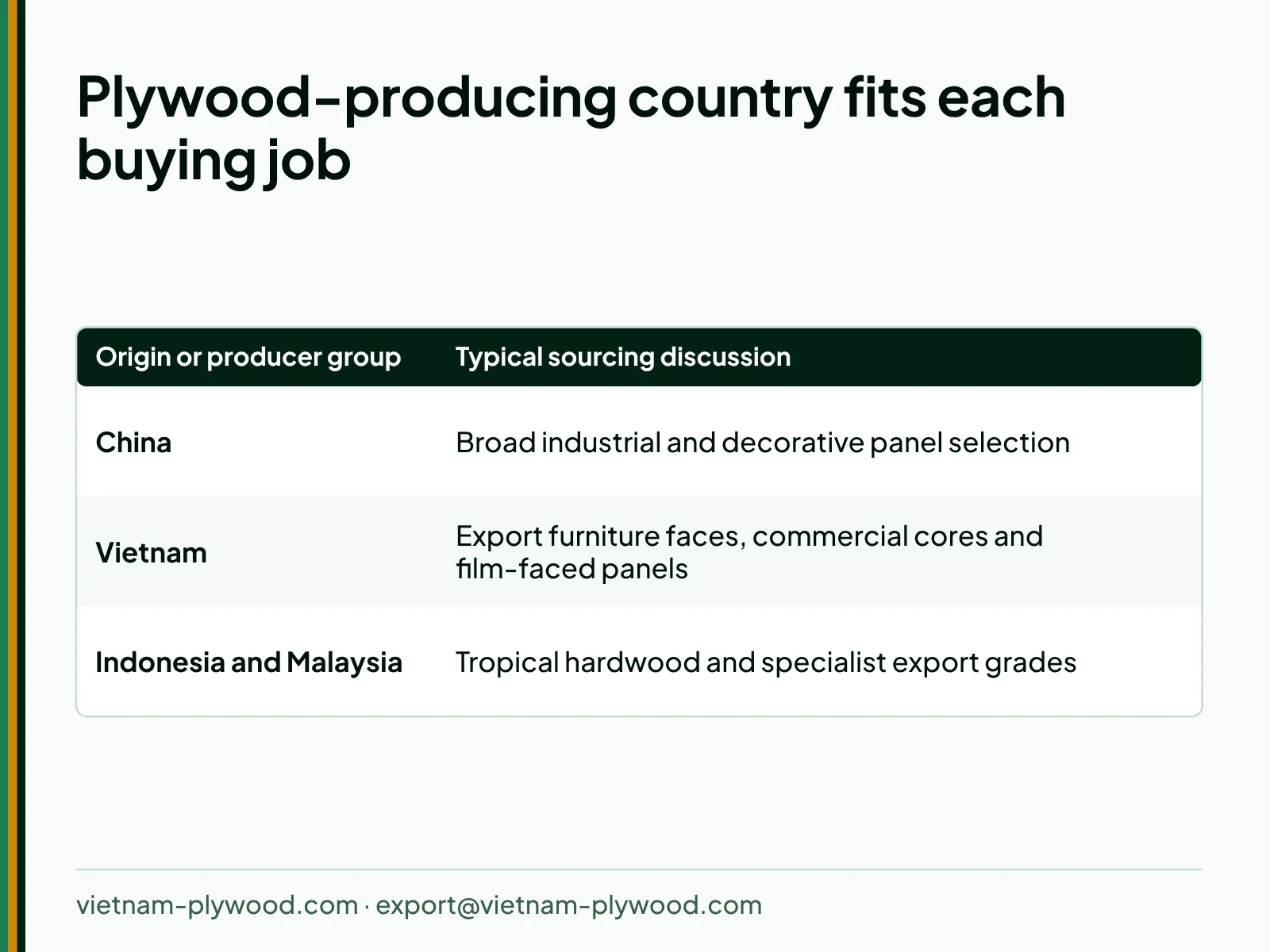
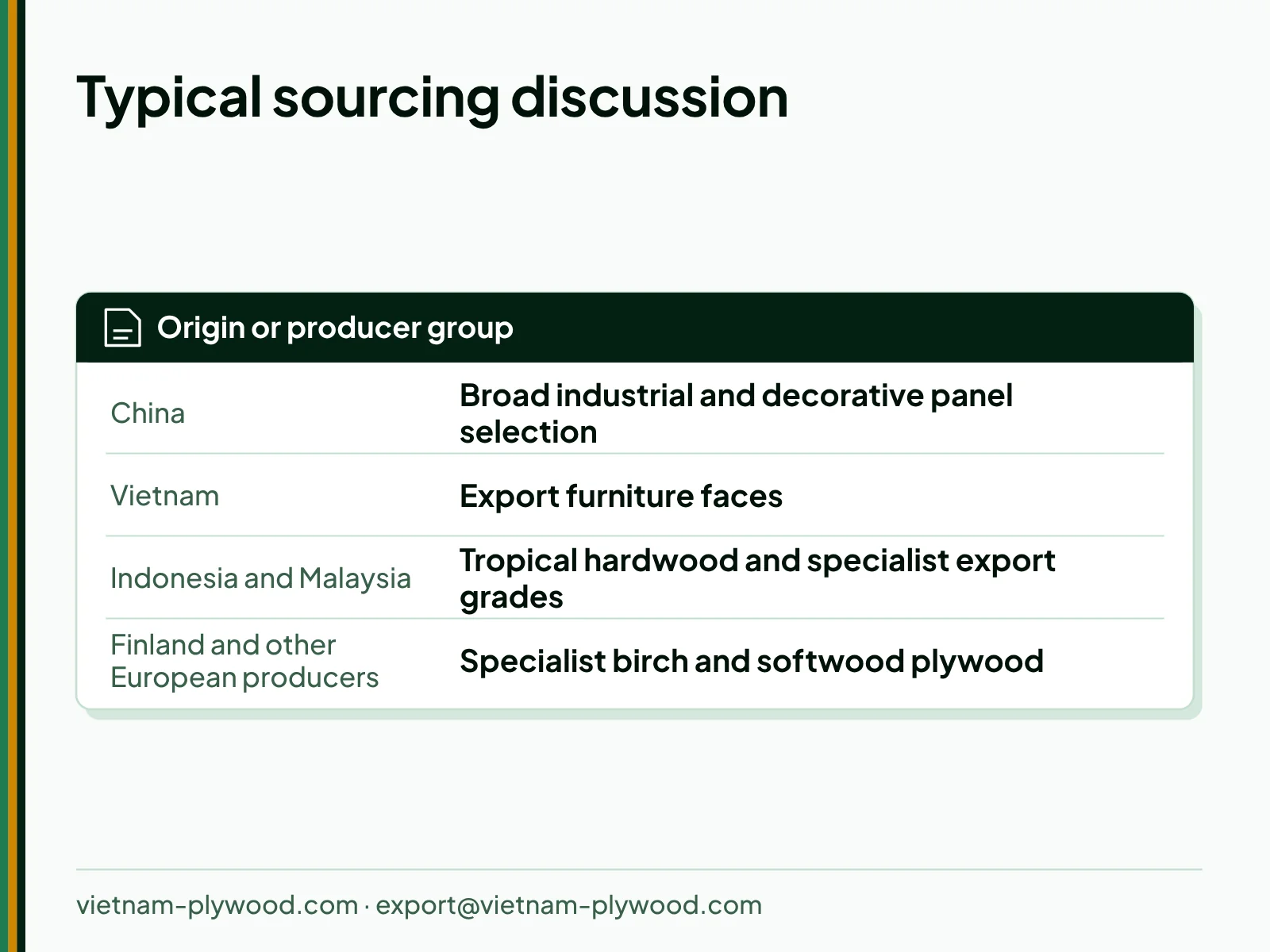
| Origin or producer group | Typical sourcing discussion | Evidence to compare | Buying verdict by use |
|---|---|---|---|
| China | Broad industrial and decorative panel selection | Actual factory and plywood-specific test records | Screen for broad specifications; audit the exact build |
| Vietnam | Export furniture faces, commercial cores and film-faced panels | Face grade, core construction and shipment documents | Consider for specified cabinet, packing and formwork orders |
| Indonesia and Malaysia | Tropical hardwood and specialist export grades | Species, legal-origin records and bond test | Compare when tropical face or project specification calls for it |
| Finland and other European producers | Specialist birch and softwood plywood | Product declaration and applicable testing | Consider for projects needing their particular panel specification |
| United States and Canada | Construction and industrial panel systems | Required structural grading and plant documentation | Use when the project requires the relevant domestic grading route |
For more country-level context, see best plywood producing countries, Vietnam versus Malaysia export-market insights and Vietnam versus Indonesia plywood supply comparisons.
Where does Vietnam fit in the global supply mix?
Vietnam offers a practical sourcing option when buyers define the panel build rather than purchase on country reputation alone. FAO’s 2024 statistics show Vietnam accounted for 3% of world wood-based panel exports by volume, a category wider than plywood. The same source reports 14% of global veneer-sheet exports from Vietnam. Neither percentage is a plywood-only production share.
At HCPLY, our three factories in Phu Tho and Hai Phong serve different specifications. Our furniture line makes sanded, full-stitched styrax- or eucalyptus-core panels with E0 or E1 emission classes. Our commercial and packing line makes acacia-core MR-glue panels. Our construction line presses film-faced panels on acacia or eucalyptus cores.
Buyers considering origins can also review Vietnam versus China plywood for export and Vietnam or China film-faced plywood.
How do the three production lines compare at 18 mm?
At 18 mm, the same nominal thickness can describe three different products with different face requirements, core weights and tolerances. Selecting the line starts with the application.
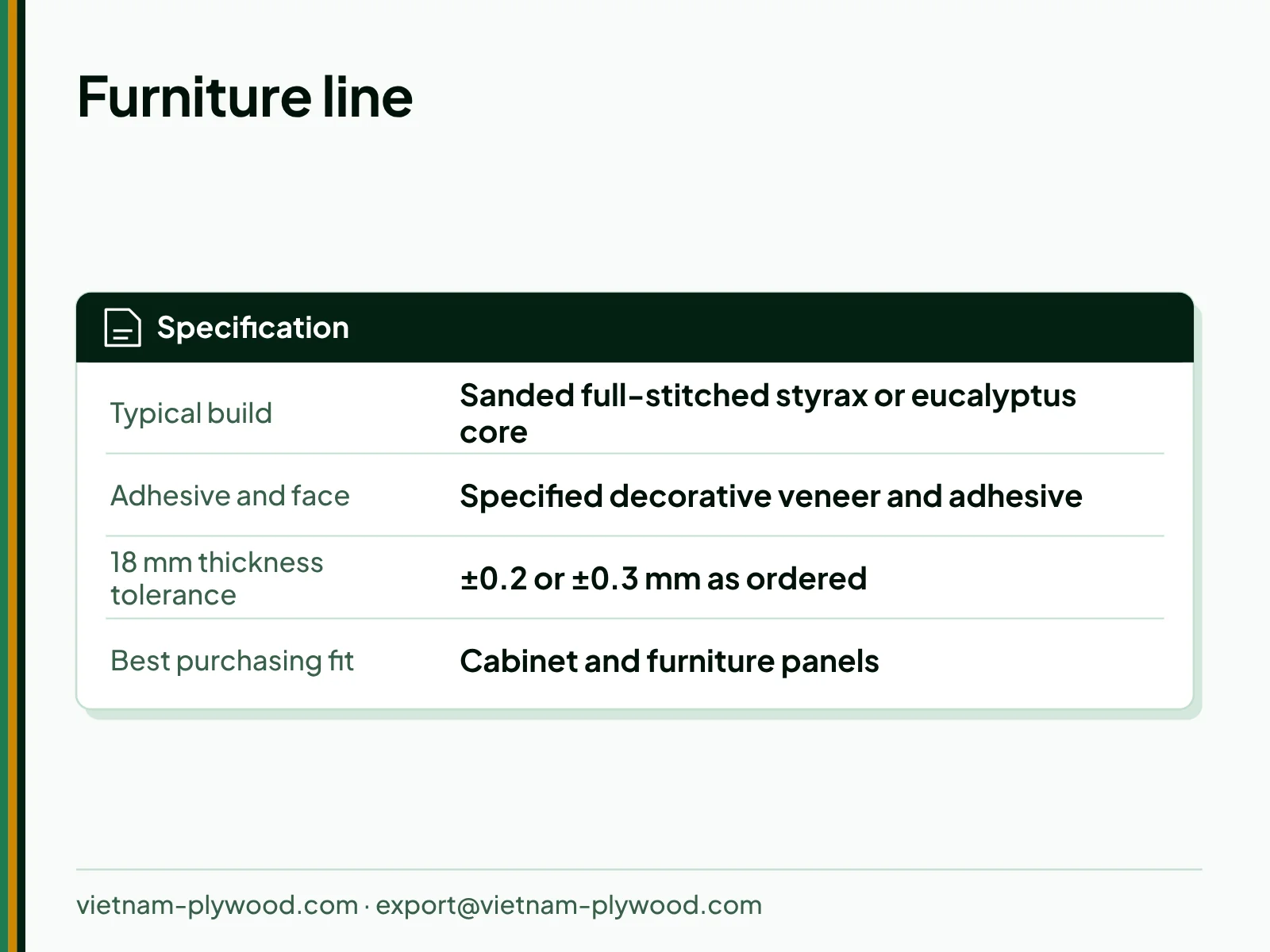
| Specification | Furniture line | Commercial and packing line | Construction line |
|---|---|---|---|
| Typical build | Sanded full-stitched styrax or eucalyptus core | Acacia core, unsanded or light-sanded | Acacia or eucalyptus core with film face |
| Adhesive and face | Specified decorative veneer and adhesive | MR glue, raw or light-sanded surface | Phenolic or melamine film; specified glue |
| 18 mm thickness tolerance | ±0.2 or ±0.3 mm as ordered | Commercial ±0.5 mm; packing ±0.5–1.0 mm | ±0.5 mm |
| Best purchasing fit | Cabinet and furniture panels | Commercial uses and packing | Concrete formwork |
Our furniture line is the right starting point for visible cabinet faces. The other lines instead make packing panels or formwork panels for different working conditions. The available decorative faces include bintangor, okoume, engineered veneer, gurjan, pine, poplar, eucalyptus, birch and sapele; birch face grading is D/E/F. Face naming does not change the density of the underlying core.
Read the furniture plywood specification when appearance and thickness tolerance drive acceptance.
What does a Vietnam container comparison reveal?
For 18 mm panels at 1220 × 2440 mm, the calculated full 40HC loads are 990 styrax-core sheets at 26.52 t, 880 acacia-core sheets at 27.35 t, or 795 eucalyptus-core sheets at 27.69 t. These are core-based calculations excluding film weight; the payload ceiling is 28.5 t.
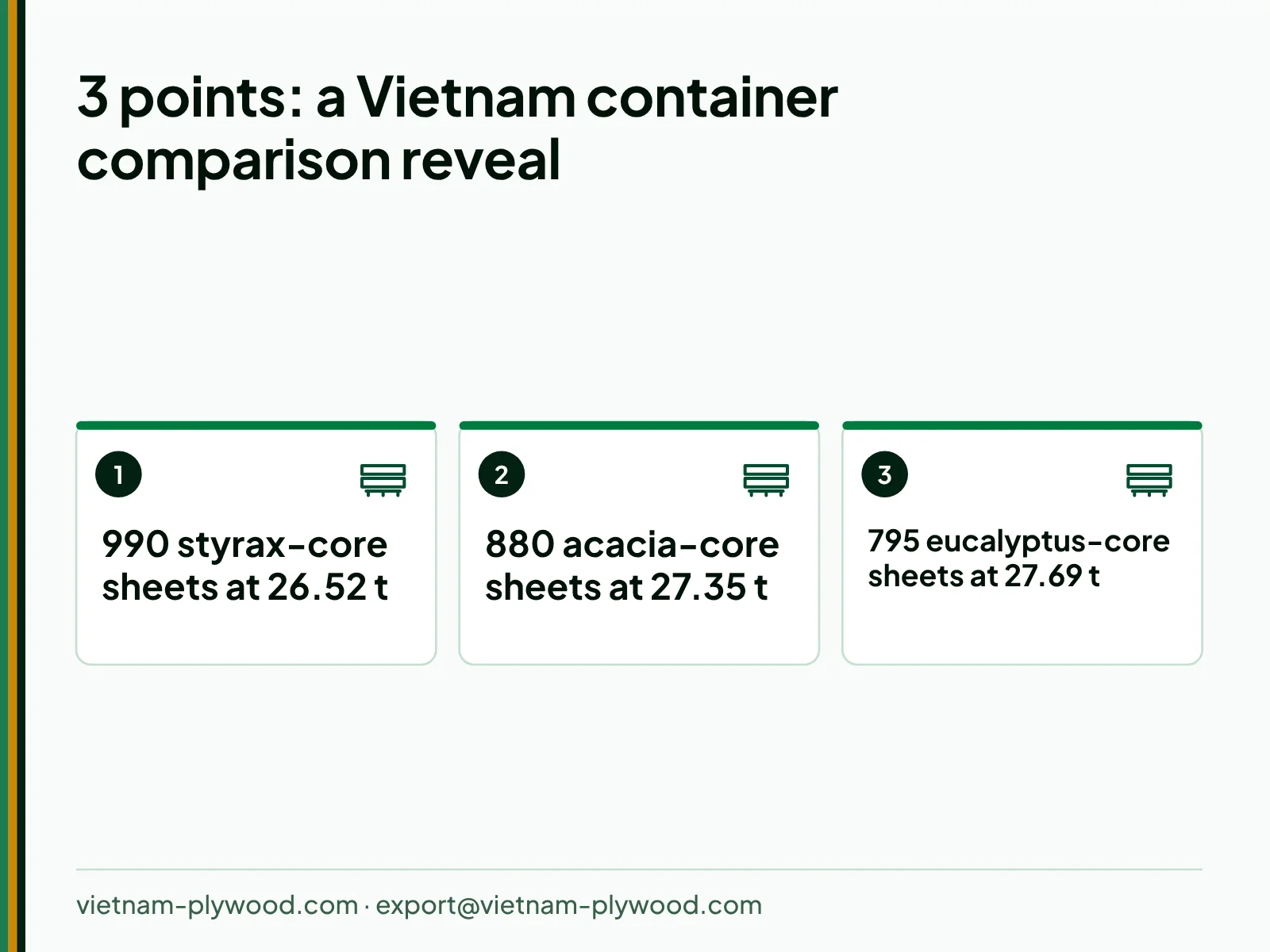
The difference matters when combining furniture and commercial orders. One styrax-core sheet weighs 26.79 kg; one acacia-core sheet weighs 31.08 kg; one eucalyptus-core sheet weighs 34.83 kg. A proposed mixed load must total its sheet weights and pallet arrangement against the payload limit before loading.
Specifications can be mixed within one 40HC order. Use mixed-container loading arrangements for combining grades and plywood container packing for full packing calculations. The volume of a container alone cannot decide the safe sheet count.
What can an inspector witness before export?
At the producing factory, a buyer or inspector can witness thickness measurement, face grading, core-edge inspection, packing count and pallet marking against the agreed specification. The inspection should sample actual production, with a written acceptance rule and recorded lot identification.
For furniture panels, check face defects, sanding and thickness spread. For packing panels, check the core and edge joints, the requested finish and the packing layout. For film-faced panels, check film description, edge sealing and bond-test documentation against the ordered build.
Certificates such as FSC, CARB P2, ISO 9001 and CE belong to the member factories and are shown with factory details masked, on request. Request the document relevant to the ordered build rather than assuming every certificate applies to every line. Our export team coordinates specification, on-site quality control, documents and loading.
Which export papers should the importer check?
The shipment document package connects the physical plywood load to the buyer’s order. It includes the commercial invoice, packing list, bill of lading, certificate of origin, phytosanitary and fumigation papers, and agreed product certificate or test documents.
For European Union shipments, the origin paperwork includes EUR.1 where applicable and the EUTR/EUDR file set. CIF shipments include insurance documents. The sales documents carry an FSC claim when agreed; emission documentation and test reports relate to the specified build. After loading, the draft shipping documents come to you for approval.
For recurring distribution orders, keep the same product fields and acceptance criteria across purchase orders. The plywood supply programmes for distributors page addresses repeat-order planning.
How should an importer request a comparable quote?
Send the same written specification to each candidate and compare the resulting build, acceptance criteria, delivery basis and supporting documents. HCPLY quotes commercial plywood from US$250/m³ FOB Hai Phong (October 2026) and furniture plywood from US$350/m³ FOB Hai Phong (October 2026). Actual quotations depend on the selected core, face, thickness, adhesive, emission requirements and quantity.
The minimum order is one 40HC. Factory lead time runs 15–45 days from receipt of the 30% deposit; the exact figure depends on order size, line loading and what the contract fixes. The remaining 70% is paid on the scan of the bill of lading, by T/T, or by irrevocable sight L/C. We ship FOB Hai Phong, or CFR (CNF) or CIF to your port. Samples cost nothing: a first-time buyer pays the courier, and that charge comes off the first confirmed order.
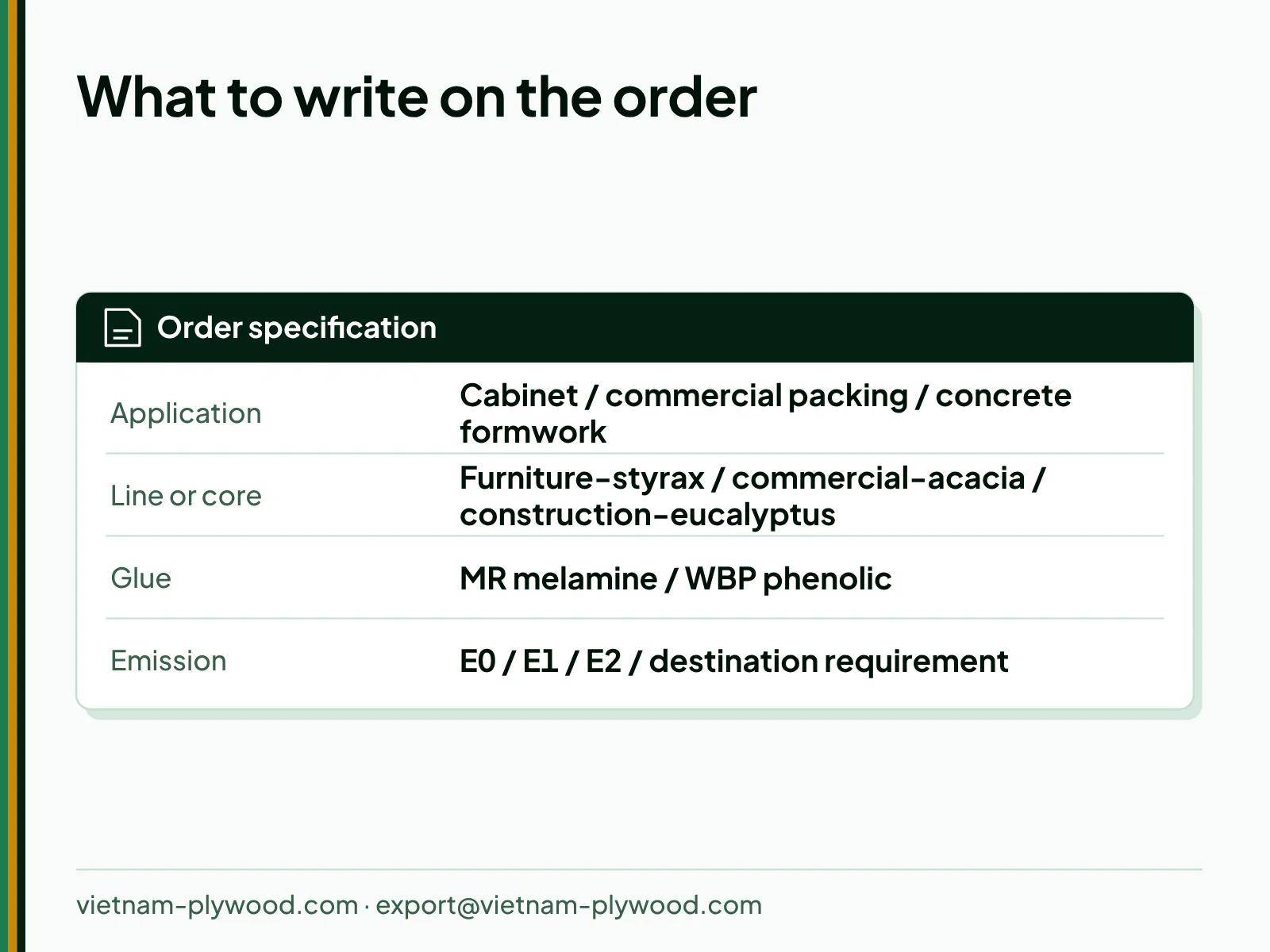
Send Lucy at export@vietnam-plywood.com the following specification and destination. The next step is to request the spec sheet.
Application: cabinet / commercial packing / concrete formwork
Line or core: furniture-styrax / commercial-acacia / construction-eucalyptus
Glue: MR melamine / WBP phenolic
Emission: E0 / E1 / E2 / destination requirement
Face and grade: species, A/B or birch D/E/F; film weight if applicable
Thickness and tolerance: mm, allowed deviation
Size: length x width in mm
Quantity: sheets or m3; proposed mixed load if relevant
Destination port: name and country