





Can you use plywood in a bathroom?
Yes. Plywood can serve bathroom vanities, enclosed wall backing and selected protected fit-out components when the glue, core and finish match the exposure. A failed adhesive bond can mean replacement cabinet boxes, installation delays and rejected material at incoming inspection. For a plywood bathroom specification, separate condensation from recurring splashes and direct water contact. HCPLY recommends specifying the complete panel build before ordering rather than buying by a face name alone.
A sound bond still leaves wood veneers vulnerable through exposed edges.
For other use cases, the applications library groups panels by installation environment.
What plywood should buyers order for each bathroom zone?
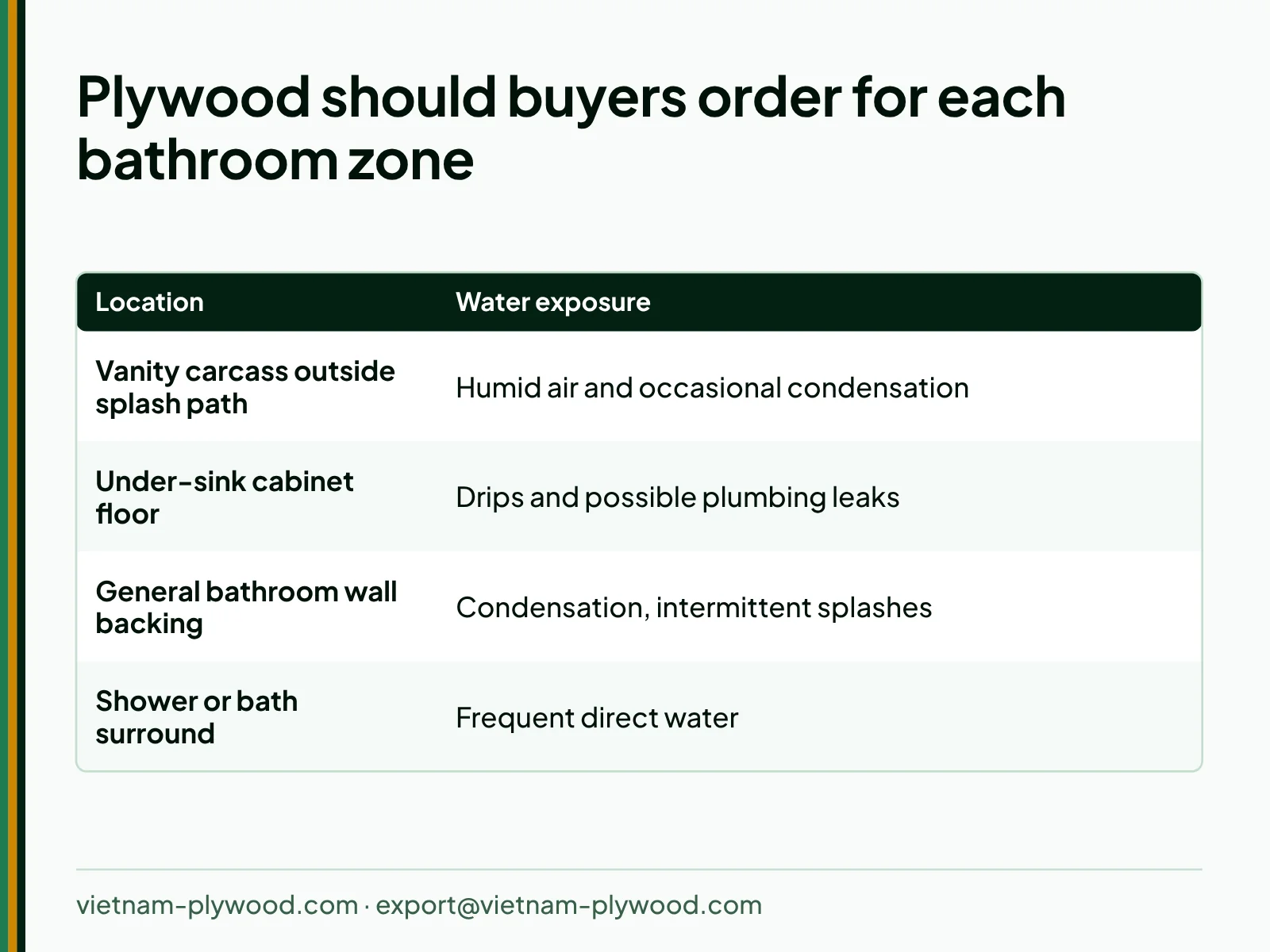
Choose by exposure: a protected vanity cabinet needs a different finish plan from shower backing. Directly wetted surfaces call for a tested waterproofing assembly; plywood alone is not the water barrier.
| Location | Water exposure | Buying decision | Installation boundary |
|---|---|---|---|
| Vanity carcass outside splash path | Humid air and occasional condensation | Sanded furniture-core panel; specify phenolic bond when repeated wetting is foreseeable | Seal cut edges, holes and finished faces |
| Under-sink cabinet floor | Drips and possible plumbing leaks | Phenolic-bonded build with inspected core and cleanable protective finish | Provide leak access and protect penetrations |
| General bathroom wall backing | Condensation, intermittent splashes | Panel and thickness chosen against framing and fastening design | Keep behind the specified lining and moisture control |
| Shower or bath surround | Frequent direct water | Prefer a wet-area backing system approved for the chosen membrane; plywood only where that system expressly allows it | Continuous membrane, sealed corners and penetrations |
| Tiled floor substrate | Moisture plus floor loads | Require project structural design and tile-system approval | Verify deflection, joints and waterproofing separately |
Contractors should obtain the membrane manufacturer’s substrate instructions and the project designer’s loading requirements.
Which glue belongs in a bathroom panel?
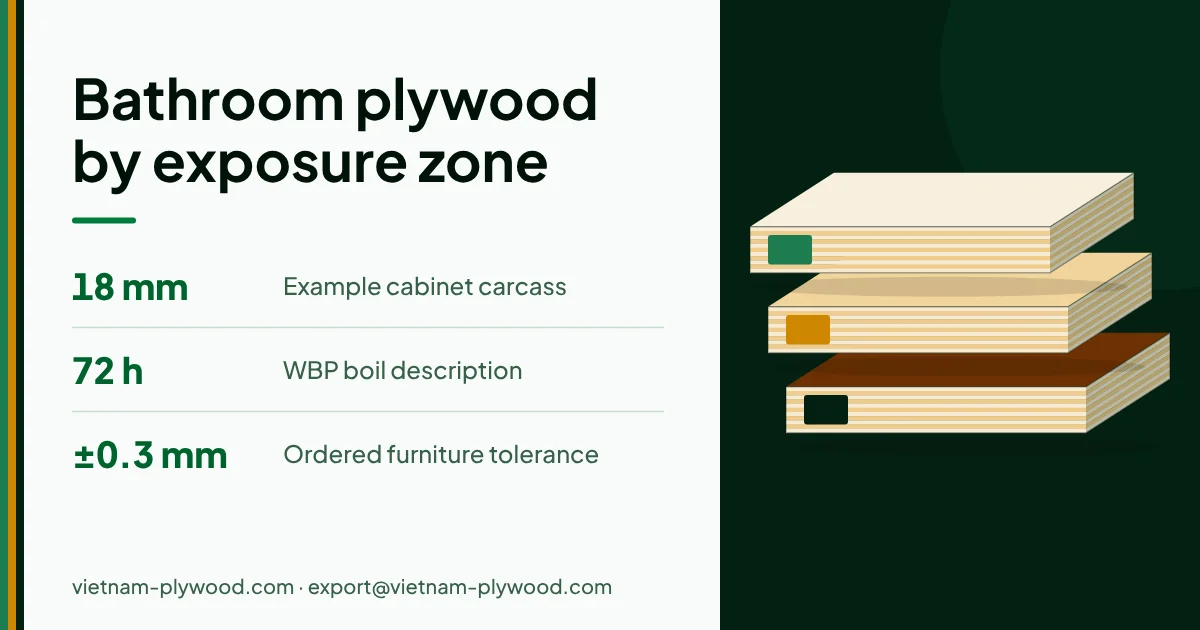
Phenolic weather-and-boil-proof (WBP) glue is the stronger choice where wetting or repeated humidity cycling is expected. The HCPLY build vocabulary also includes melamine moisture-resistant (MR) glue; the factory test descriptions are a 72-hour boil for WBP and a 12-hour boil for MR. Those process descriptions do not make an unsealed plywood sheet waterproof.
Glue and formaldehyde emission are separate specification fields. E0, E1 and E2 describe emission classes; they do not identify the adhesive.
An exterior plywood specification is a useful starting point for wet-adjacent cabinets. Do not assume an exterior bond automatically qualifies a panel as a certified structural substrate or a finished wet-room lining.
How would the three production lines build the same 18 mm need?
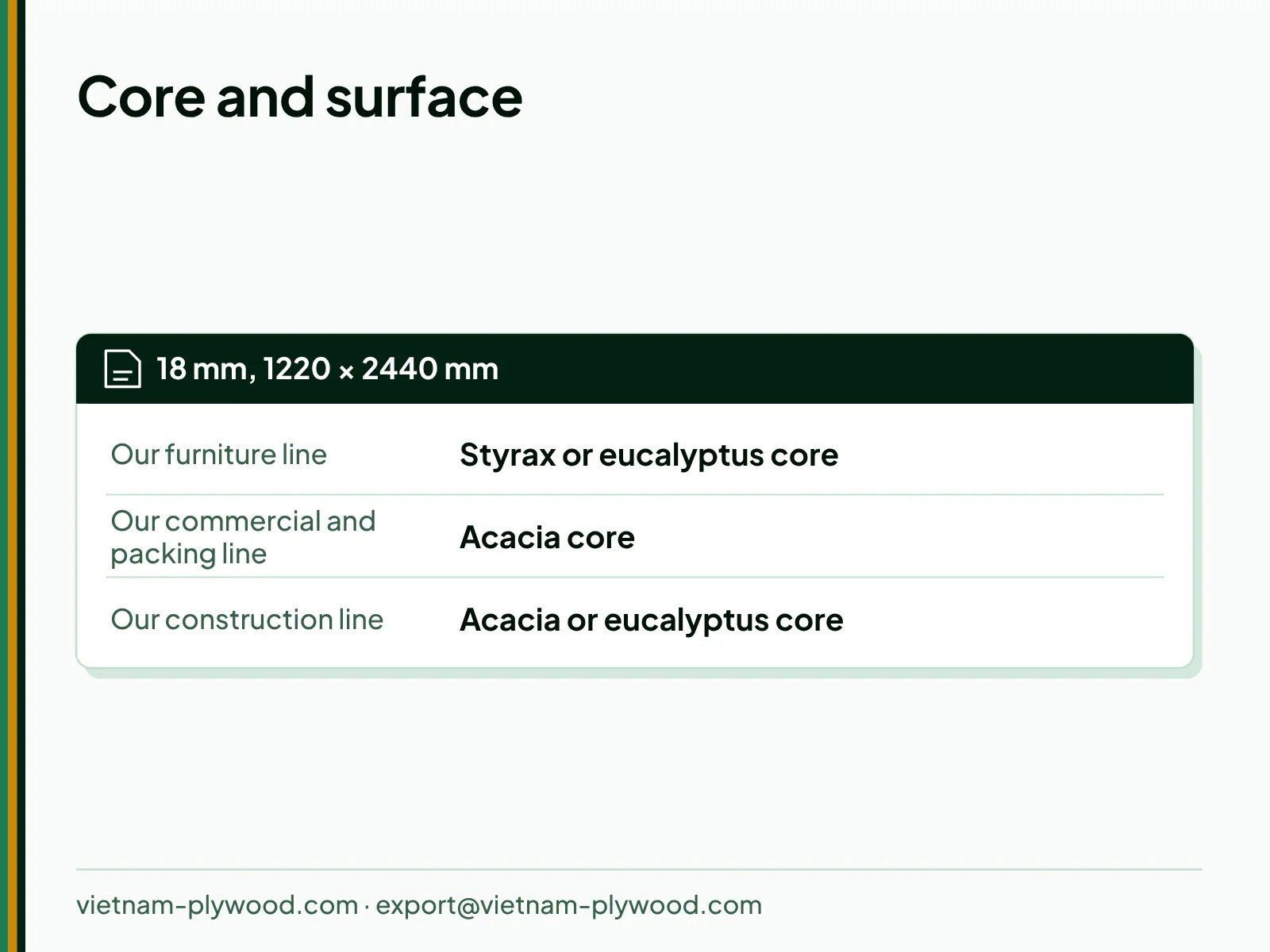
Our furniture line is the natural route for a sanded vanity component; our commercial and packing line makes a different 18 mm product, while our construction line presses film-faced panels for formwork. The buyer’s exposure and surface requirement decide which line should produce the order.
| 18 mm, 1220 × 2440 mm | Core and surface | Tolerance | Bathroom verdict |
|---|---|---|---|
| Our furniture line | Styrax or eucalyptus core, full stitched, sanded; E0/E1 | ±0.2 or ±0.3 mm as ordered | Cabinet carcass candidate with specified wet-area bond and sealed finish |
| Our commercial and packing line | Acacia core, MR glue, unsanded or light-sanded | ±0.5 mm commercial; packing ±0.5–1.0 mm | Packing or general commercial use; not the default wet-zone cabinet specification |
| Our construction line | Acacia or eucalyptus core, phenolic or melamine film, unsanded | ±0.5 mm | Formwork surface; film does not turn it into a bathroom waterproofing system |
HCPLY assigns each order to the producing factory matching its build. Film-faced stock is discussed in industrial plywood uses; it should not be substituted for a decorative cabinet face without a finish trial.
Can plywood be used for bathroom walls?
Yes, for protected backing where the wall design permits plywood and the moisture-control layers are specified. A wet shower wall requires a compatible waterproof membrane or an alternative approved backer; exposed plywood and grout cannot serve as the complete water barrier.
Wall-panel thickness must follow support spacing, fastening loads and the lining supplier’s instructions. A 12 mm board can be a candidate for a designed backing detail, but thickness alone says nothing about fixture loads or structural classification.
For decorative dry-side wall panels, select the visible veneer and finishing system together. Face species affects appearance; core construction, adhesive and edge protection control different failure paths.
How do fabricators waterproof plywood for bathrooms?
Waterproofing requires a continuous system over the exposed assembly, at edges and penetrations. A phenolic bond helps resist glue-line breakdown; it cannot stop wood from absorbing water at a raw cut.
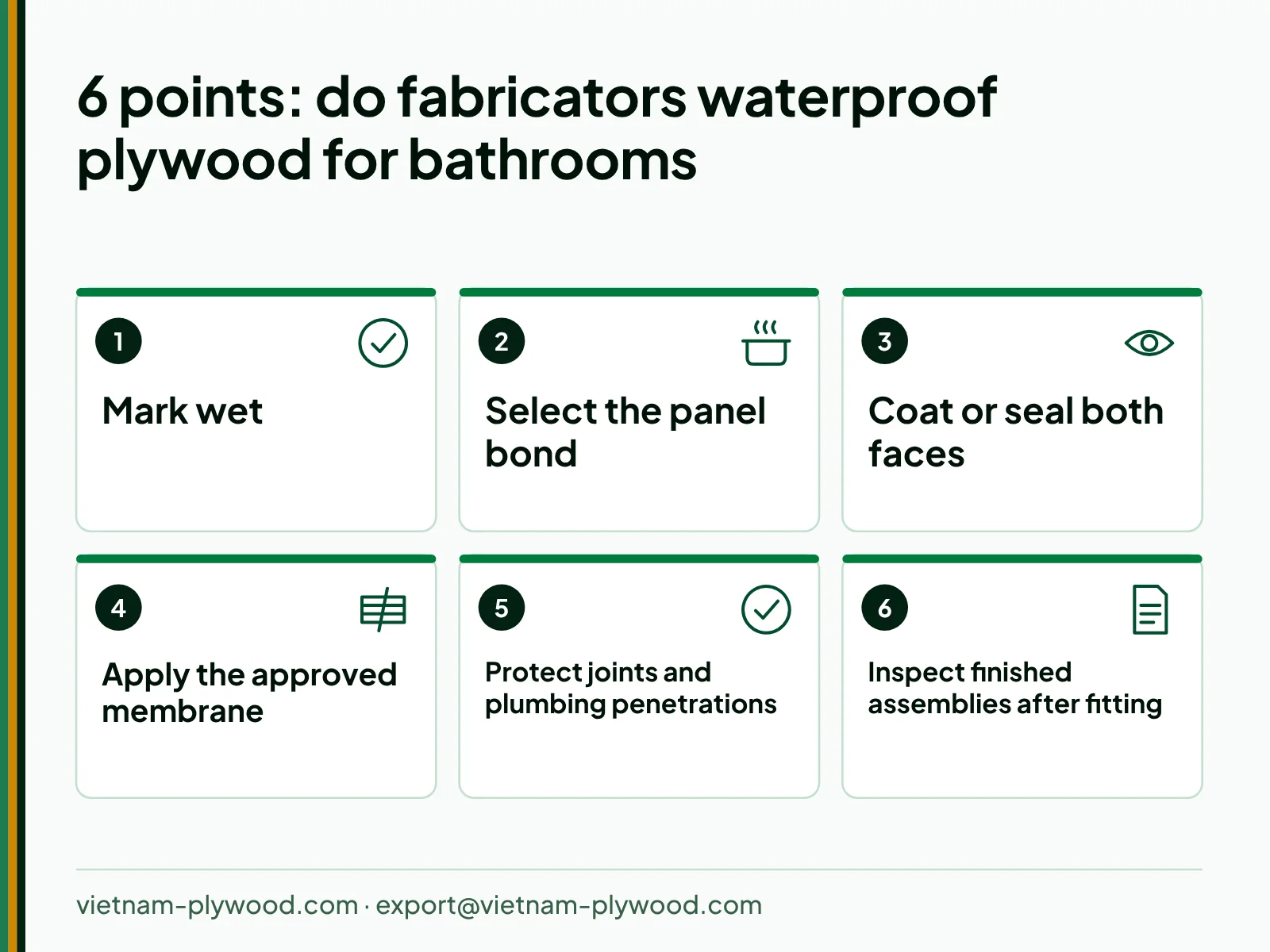
- Mark wet, splash and condensation zones on the fabrication drawing before cutting sheets.
- Select the panel bond and core construction for each zone, then check finish compatibility on a sample.
- Coat or seal both faces as required by the finish system, including cut edges, drill holes and sink openings.
- Apply the approved membrane at directly wetted walls or floors, following its substrate, corner and joint details.
- Protect joints and plumbing penetrations; maintain ventilation and provide access for leak inspection.
- Inspect finished assemblies after fitting and repair coating damage before handover.
Where a membrane supplier excludes plywood as a substrate, specify its accepted backer instead. For a different moisture-and-movement context, see caravan and RV plywood panels.
Is marine plywood necessary for a bathroom?
Marine plywood is a specification choice for demanding wet service, but a marine label alone is insufficient. Ask which standard, core construction, bond performance and independent test report the project accepts. HCPLY discusses marine or BS 1088 only against a test report the buyer accepts.
A protected vanity outside direct water often needs a well-made phenolic-bonded panel and disciplined finishing rather than a marine designation. A permanently wet detail may be better served by an approved non-wood backer and membrane system. Marine adhesive does not prevent exposed wood edges from absorbing moisture.
Compare the actual construction requirements with the marine and outdoor plywood applications.
What thickness, face and core should a cabinet maker specify?
For a cabinet carcass, 18 mm is a common starting thickness; 12 mm may suit a back panel when the cabinet design supports it. HCPLY’s range is 3–40 mm, with face veneers commonly 0.2–0.4 mm. Specify A/B face grade where the visible finish warrants it; birch faces use D/E/F grading.
Styrax core has a stated density of 500 kg/m³ and eucalyptus 650 kg/m³; the core controls the weight rather than the face veneer. Full-stitched core and sanded faces suit close-fitting furniture components. The 18 mm panel has 11–13 plies according to veneer thickness.
Bintangor, okoume, engineered veneer and other listed faces are appearance choices. A face named birch does not mean birch-core plywood. HCPLY does not press birch-core plywood, medium-density fiberboard, oriented strand board, chipboard, blockboard or bamboo panels. Melamine, high-pressure laminate and laminate faces are finish topics rather than HCPLY product lines.
What can an inspector check at the producing factory?
An inspector can witness thickness, face condition, core construction and the identification of the agreed adhesive build before loading. HCPLY coordinates on-site quality control, export paperwork and loading; buyers visit the factory office and inspect goods at the producing factory.
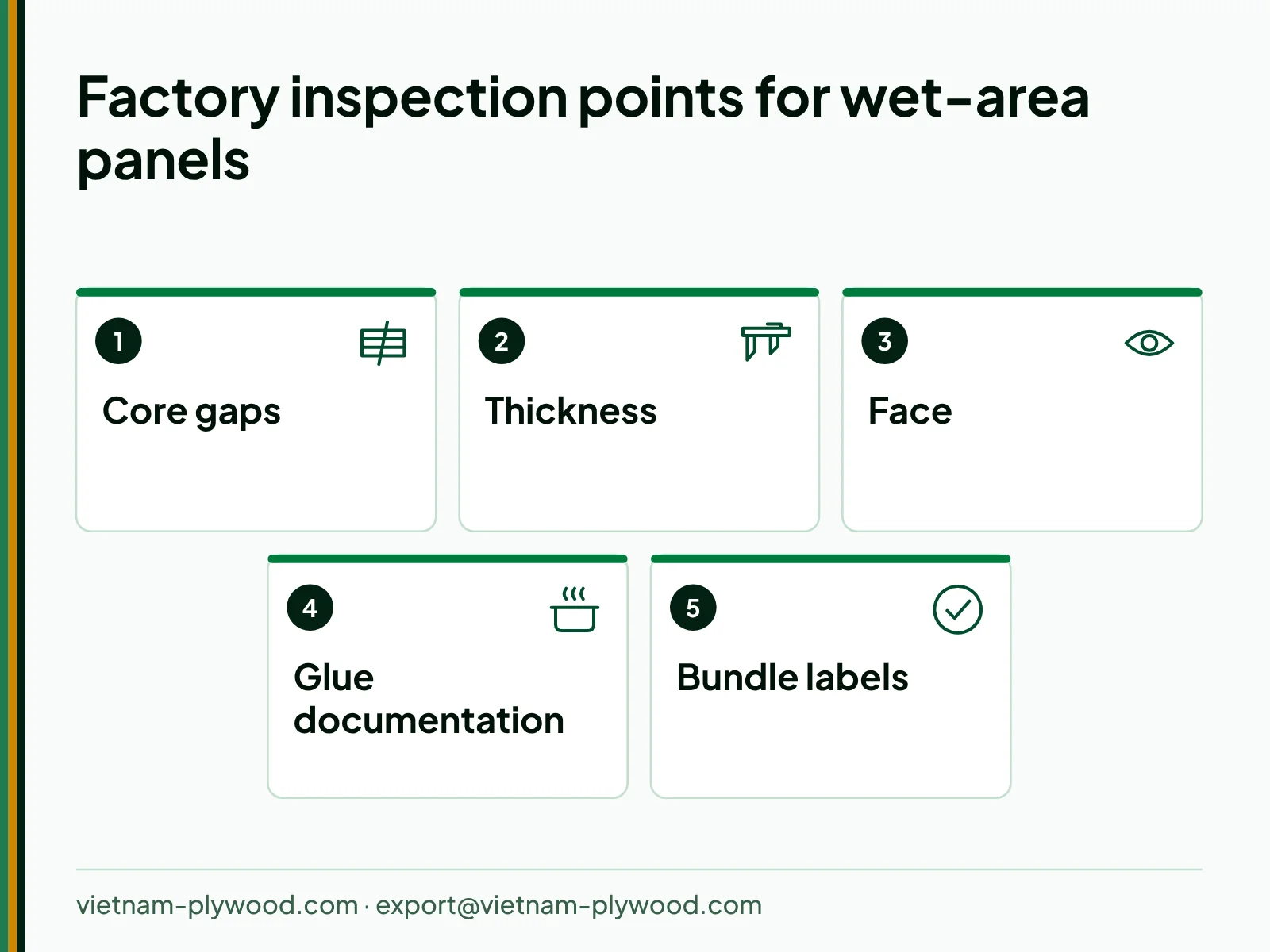
Start with the approved order sample. Check the cut cross-section for gaps and veneer placement, measure thickness at agreed points, examine sanding consistency, and record the lot identity. For a sanded furniture panel, order ±0.2 or ±0.3 mm thickness tolerance; length and width tolerance is ±2 mm.
For United States-bound regulated hardwood plywood, the US Environmental Protection Agency’s 2016 final rule establishes formaldehyde emission controls and third-party certification requirements under Toxic Substances Control Act Title VI. The EPA rule summary distinguishes those emissions requirements from moisture performance. Member-factory certificates and relevant documents are shown with factory details masked, on request.
How should mixed bathroom and general panels be shipped?
Mixed specifications can share a 40-foot high-cube container within its 28.5-tonne payload limit. For 18 mm sheets measuring 1220 × 2440 mm, the factored full-load references are 990 styrax sheets at 26.52 t, 880 acacia sheets at 27.35 t, and 795 eucalyptus sheets at 27.69 t; these exclude film weight.
For a practical mixed load, one styrax pallet holds 55 sheets and one acacia pallet holds 55 sheets. Their sheet weights are 26.79 kg and 31.08 kg respectively, so one pallet of each represents 55 × 26.79 + 55 × 31.08 = 3,182.85 kg of panel mass, before pallet and packing materials. Plan the remaining pallets against the weight limit, not just the available floor area.
The mixed-container ordering guide covers combining specifications, while container packing owns complete load calculations.
What does a bathroom plywood quotation need?
A useful quotation starts with the exposure zone, finished use and written panel build. A full-stitched sanded furniture core with a more demanding adhesive and finish requirement costs more to make than an unsanded commercial MR build because preparation, bonding and surface control differ.
Furniture plywood starts from US$350/m³ FOB Hai Phong (October 2026). Commercial plywood starts from US$250/m³ FOB Hai Phong (October 2026). These are starting references for their respective product families, not bathroom-grade prices; request a build-specific quote for phenolic-bonded vanity or wet-adjacent panels.
The minimum order is one 40HC, and specifications can be mixed within the payload limit. Factory lead time runs 15–45 days from receipt of the 30% deposit; the exact figure depends on order size, line loading and what the contract fixes. The balance is 70% against the scanned bill of lading, by telegraphic transfer or irrevocable letter of credit at sight. We ship FOB Hai Phong, or CFR (CNF) or CIF to your port. Free samples are available; new buyers book their courier, with that cost creditable against a real order. See production lead time for scheduling context.
Which documents and specification should accompany the trial order?
Test reports identify the agreed build; the packing list connects bundle quantities to the shipment. HCPLY prepares the commercial invoice, packing list, bill of lading, certificate of origin, phytosanitary and fumigation papers, and applicable order certificates. EU lots include EUR.1 and the EUTR/EUDR file set; CIF includes insurance. After loading, the draft shipping documents come to you for approval.
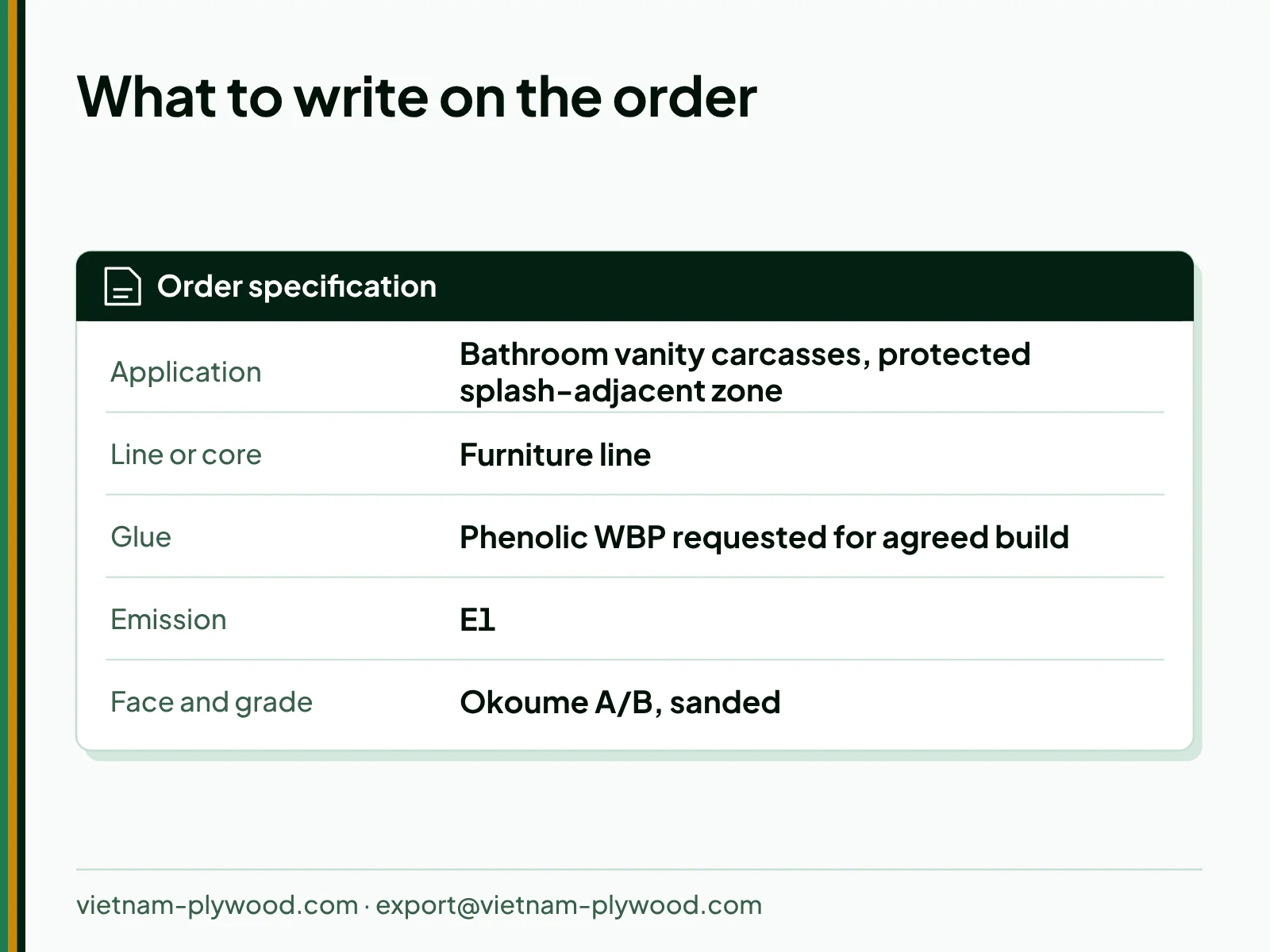
Use this short specification to align the fabricator, inspector and export team before the trial shipment:
Application: Bathroom vanity carcasses, protected splash-adjacent zone
Line or core: Furniture line; full-stitched styrax core
Glue: Phenolic WBP requested for agreed build
Emission: E1; supporting document required
Face and grade: Okoume A/B, sanded
Thickness and tolerance: 18 mm, ±0.3 mm
Size: 1220 × 2440 mm
Quantity: One mixed 40HC trial, breakdown by specification
Destination port: [buyer to insert]
Next step: contact Lucy to plan a trial container with the drawing and destination port.