





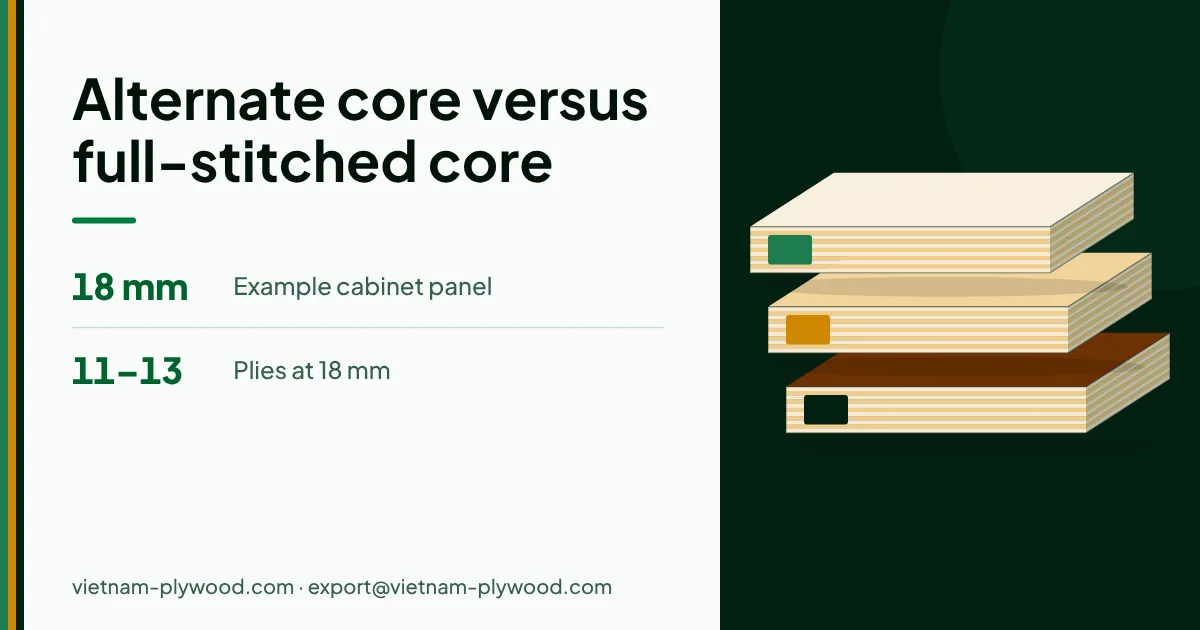
Alternate plywood is an Indian trade term for alternating veneer species in a plywood core; HCPLY maps that request to named Vietnam core builds. Choosing by the label alone can cost a rejected load, wasted machining time or a mismatch in cabinet finish. The purchase order must describe the layer schedule, core joints, face, glue and inspection sample.
What is alternate plywood?
Alternate plywood is a panel whose inner veneer layers alternate between different timber groups, often a denser hardwood and a lower-cost core wood in Indian trade descriptions. The word describes a layup pattern, not a measured strength class. A buyer should identify the species, placement and continuity of each veneer before treating two alternate-core offers as equivalent.
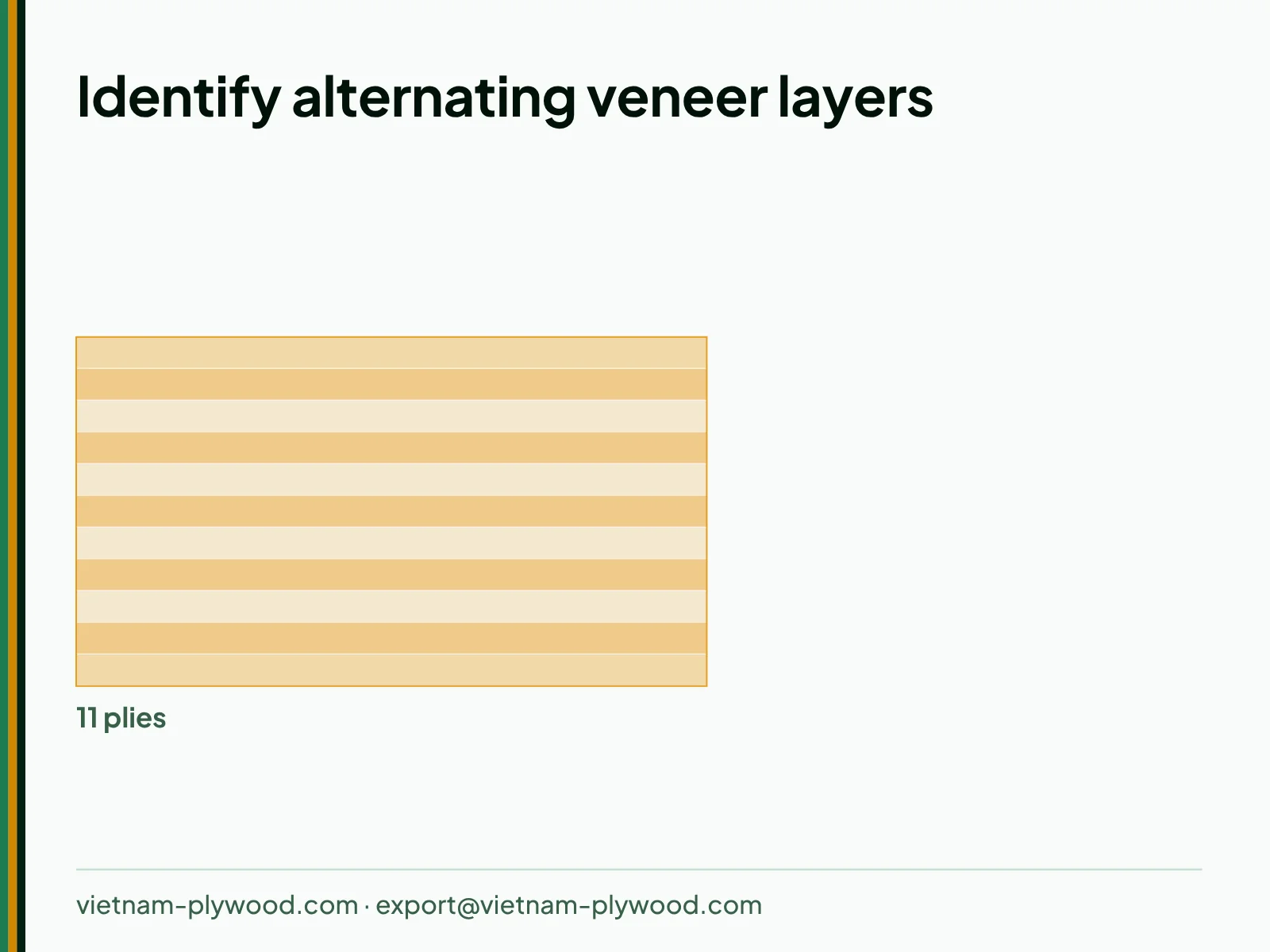
For procurement, record the permitted layer sequence and ask for a representative cut-edge sample. This makes an otherwise loose market label inspectable.
The core types library places this terminology alongside named-core builds. HCPLY describes its Vietnam panels by face species and specifies the core separately; an okoume face, for example, does not establish what lies underneath.
Is alternate plywood good or bad?
Alternate construction is useful when its actual layer schedule meets the cabinet or fit-out requirement. It can reduce material cost against a higher-cost all-hardwood layup, but a weak inner joint or open void can spoil machining and edge fastening. Judge the board against its intended use rather than its trade name.
For repeat cabinet production, inspect flatness, edge gaps, sanding and thickness consistency. Ask the supplier to identify whether internal veneers are full stitched, edge-trimmed, finger-jointed or loose-laid. HCPLY’s core-construction order, from tighter to more economical, is full stitched, stitched outer layers with edge-trimmed inner, finger-jointed, then loose-laid. A stronger-sounding species name does not cancel a poorly assembled core.
Where exposed edges, routed profiles or hardware holes matter, favour continuous, well-joined inner layers. See finger-joint core risks before accepting joined inner veneers.
What is the difference between alternate plywood and commercial plywood?
Alternate names the veneer arrangement; commercial plywood names a market and application category. These terms do not establish identical moisture resistance or emission performance.
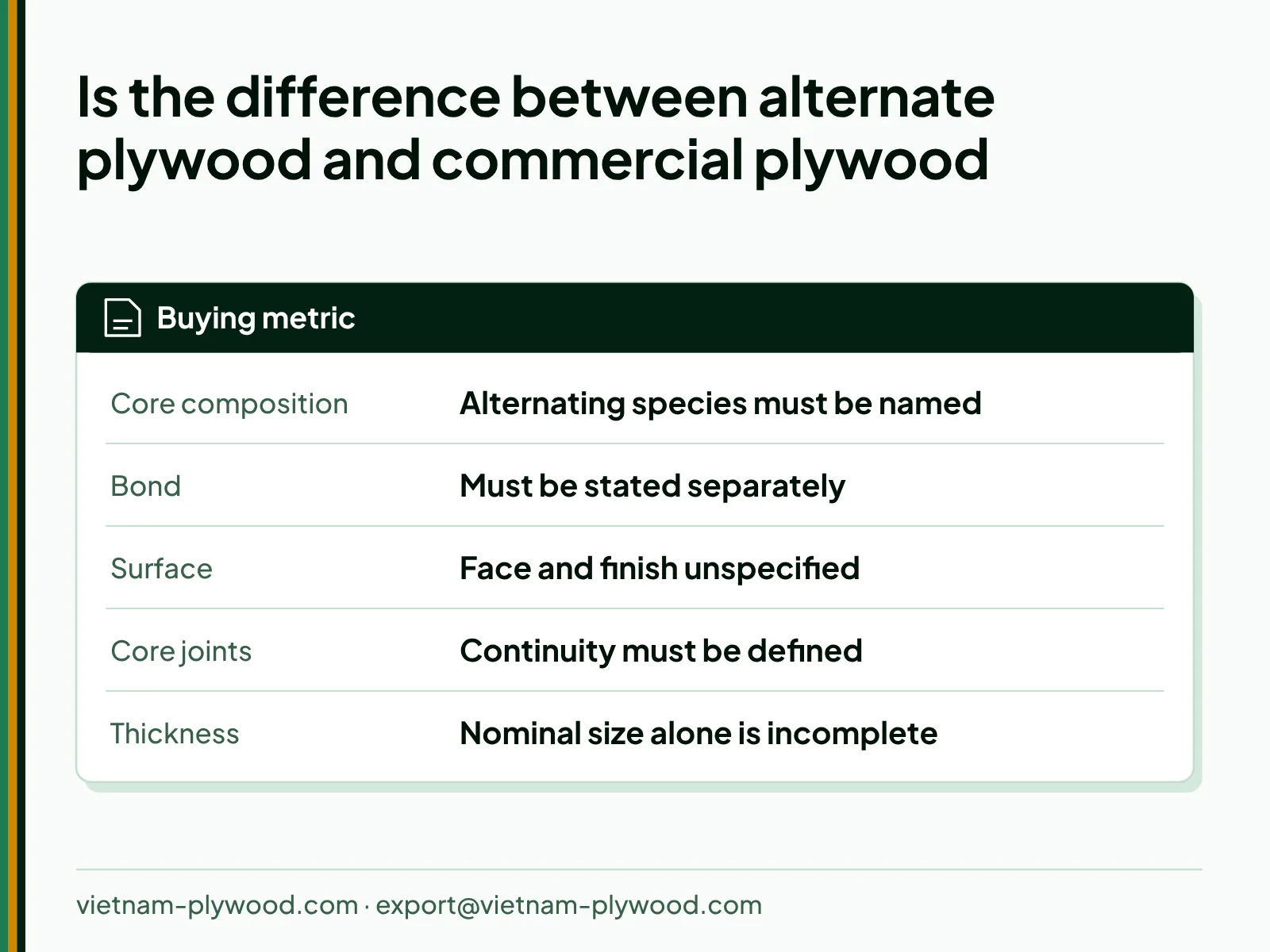
| Buying metric | Alternate-core description | HCPLY commercial build | Verdict by use |
|---|---|---|---|
| Core composition | Alternating species must be named | Acacia core | Choose the named core for repeatable packing orders; request a layer schedule for alternate cabinet stock |
| Bond | Must be stated separately | Moisture-resistant (MR) glue | Compare the agreed bond requirement for dry interiors |
| Surface | Face and finish unspecified | Unsanded or light-sanded | Choose a sanded furniture build for visible cabinetry |
| Core joints | Continuity must be defined | Core construction ordered separately | Specify stitched layers for machined edges |
| Thickness | Nominal size alone is incomplete | ±0.5 mm | Set the acceptance tolerance before cutting |
Our commercial and packing line presses acacia-core MR panels for commercial and packing applications. The commercial plywood range is a better starting point for that order than an unqualified alternate-core label.
What is full core plywood?
Full core plywood is a trade description buyers use for a panel whose inner veneers are expected to be complete and well joined across the sheet. It is not enough to say “full core” without defining whether gaps, patches, finger joints or mixed species are permitted. Specify construction and inspection criteria in the purchase order.
In our furniture line, full-stitched styrax or eucalyptus core is the closest defined construction for cabinet panels. The line sands the panel and offers E0 or E1 emission classes. Core species remains distinct from face veneer: a bintangor-faced panel can still have a styrax core.
If an uninterrupted veneer is essential, say so explicitly and request a sample cross-section before production.
What does full core full panel mean on an order?
“Full core full panel” should become a written requirement for complete inner layers across the ordered panel dimensions. Add a defined joint method, permitted gap criterion, core species and sample acceptance procedure. Without those fields, the phrase can be read differently by a buyer and a production team.
A workable clause is: “Full stitched core across the complete panel; no loose-laid inner veneers; core species as scheduled; edge appearance and internal gaps to match the approved cut sample.” Identify any permitted repairs in the signed sample record. Do not use a photograph of the face as proof of the core.
How does gurjan plywood compare with alternate plywood?
Gurjan describes a timber or face-veneer identity in many purchasing discussions; alternate describes the inner layer arrangement. They are different fields on a specification.
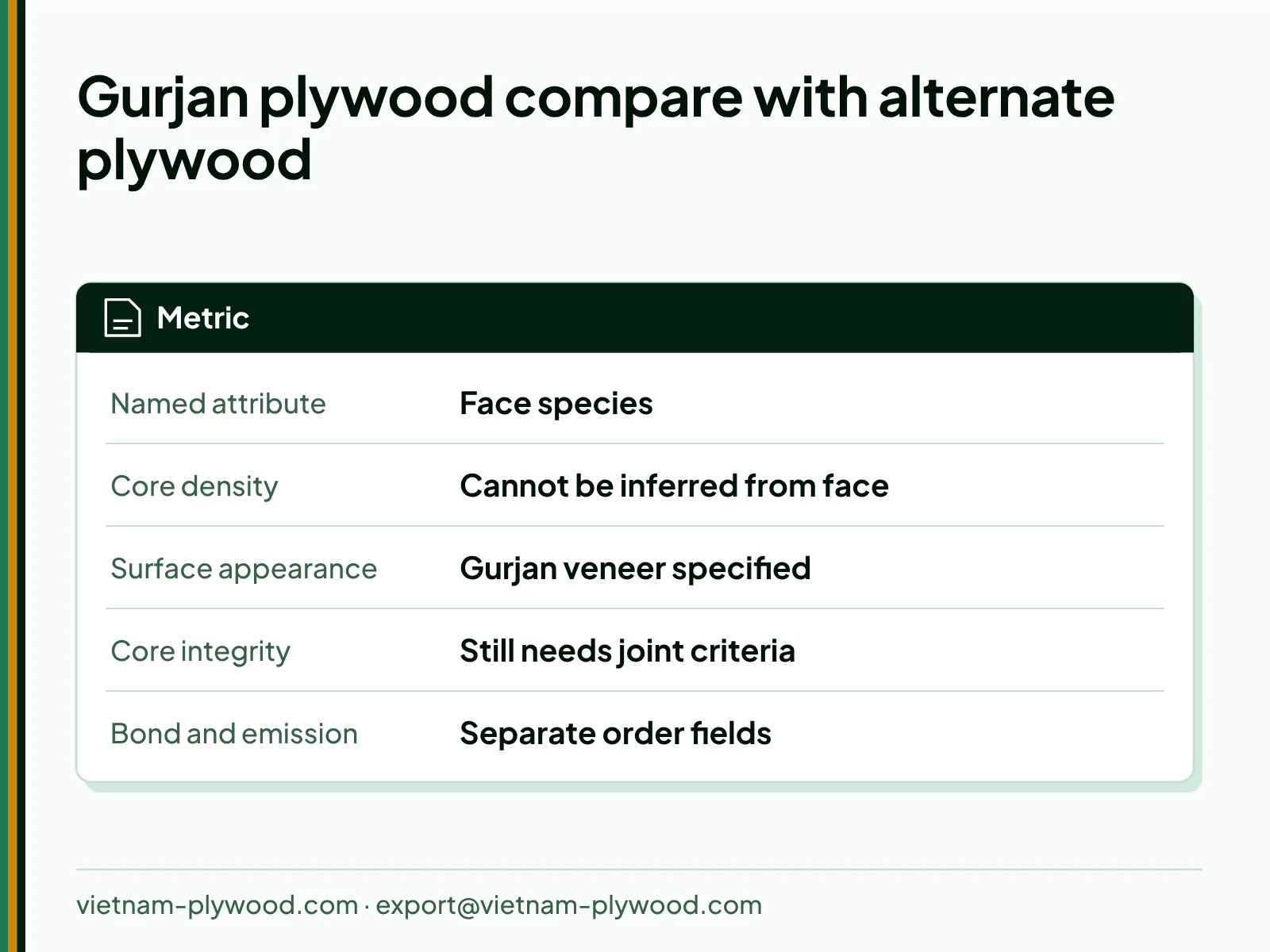
| Metric | Gurjan-faced request | Alternate-core request | Verdict by use |
|---|---|---|---|
| Named attribute | Face species | Inner veneer sequence | State both for decorative cabinet orders |
| Core density | Cannot be inferred from face | Depends on named core species | Calculate load from core, not surface colour |
| Surface appearance | Gurjan veneer specified | Face still to be selected | Use a face sample for visible panels |
| Core integrity | Still needs joint criteria | Still needs joint criteria | Inspect cut edges for either option |
| Bond and emission | Separate order fields | Separate order fields | Match the destination and application requirements |
Our gurjan-faced plywood can be discussed as a face option; it is not a claim that we press gurjan-core plywood. For a comparison of named Vietnam cores, see eucalyptus-core plywood and acacia-core plywood.
Which factory line matches the specification?
Our furniture line is the starting point for sanded, full-stitched cabinet stock. Our commercial and packing line handles acacia-core MR boards for packing or general commercial use. Our construction line presses film-faced acacia or eucalyptus core for formwork, a different surface and service requirement.
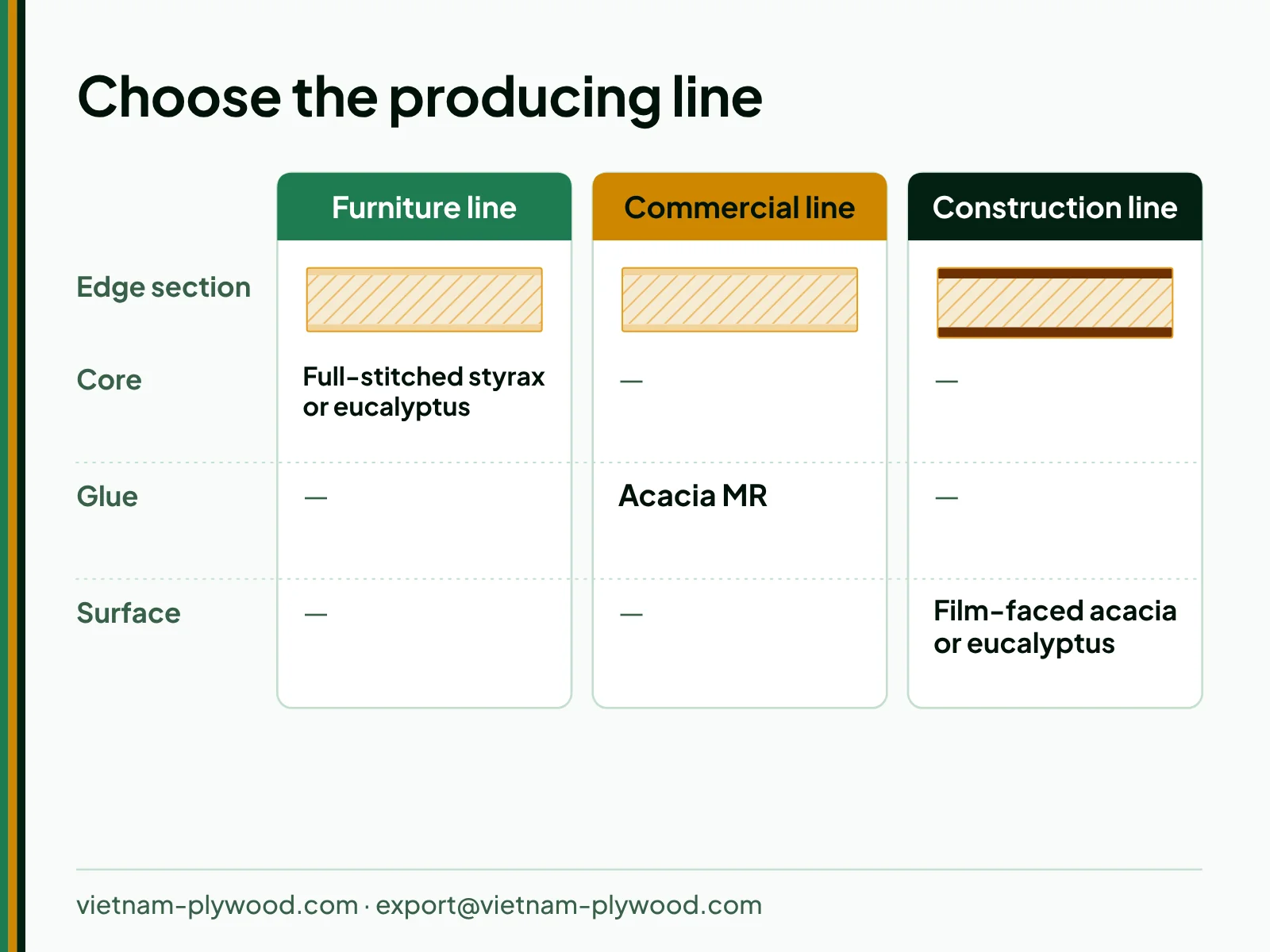
| Line | Example 18 mm build | Core and finish | Intended purchasing decision |
|---|---|---|---|
| Furniture | Cabinet panel | Styrax or eucalyptus, full stitched, sanded | Visible or precision-machined interiors |
| Commercial and packing | General commercial panel | Acacia, unsanded or light-sanded | Packing and less finish-sensitive components |
| Construction | Film-faced panel | Acacia or eucalyptus, unsanded | Concrete formwork rather than cabinetry |
For an 18 mm furniture panel, 11–13 plies is the stated construction range, reflecting veneer thickness of 1.4–2.0 mm. Our three factories are in Phu Tho and Hai Phong; each order is made at the line suited to its specification.
Which glue and emission class belong on the order?
Glue type and formaldehyde emission class are separate specification fields. Melamine MR glue has a 12-hour boil description in our range, while phenolic weather-and-boil-proof (WBP) glue has a 72-hour boil description.
The Bureau of Indian Standards lists IS 303:2024, Plywood for General Purposes — Specification (fourth revision) on its 2024 standard page. That is a useful reference for discussing Indian general-purpose categories, but a purchasing term such as “alternate” is not itself a compliance statement. Write the required test method and acceptance evidence separately; do not infer an Indian conformity mark from the panel name.
For the furniture line, choose E0 or E1 as the emission field. If a US destination calls for CARB Phase 2 or Toxic Substances Control Act Title VI evidence, request the relevant member-factory documentation with factory details masked, on request.
What changes when cores are loaded in a container?
Core density changes the sheet weight even at the same nominal dimensions. At 18 mm and 1220 × 2440 mm, styrax is 26.79 kg per sheet, acacia 31.08 kg and eucalyptus 34.83 kg. A full 40HC calculation is 990 styrax sheets at 26.52 t, 880 acacia sheets at 27.35 t, or 795 eucalyptus sheets at 27.69 t, excluding film weight.
These are separate full-load examples under a 28.5 t payload limit, not a mixed-load allowance. Mixed specifications can share a container when the combined loading plan stays within that limit. Use the container loading reference to check pallet counts and sheet totals before allocating several core types to a shipment.
Compare a finished-panel sample and packing schedule before converting a price per cubic metre into a landed cost.
How do I write full core into an import order?
Write full core as a measurable construction clause, then attach a cut-edge approval sample. The contract should identify species, core-joint method, glue, emission, face, grade, thickness, size and inspection procedure. A buyer’s inspector can witness cutting representative panels and compare the revealed layers with the signed sample.
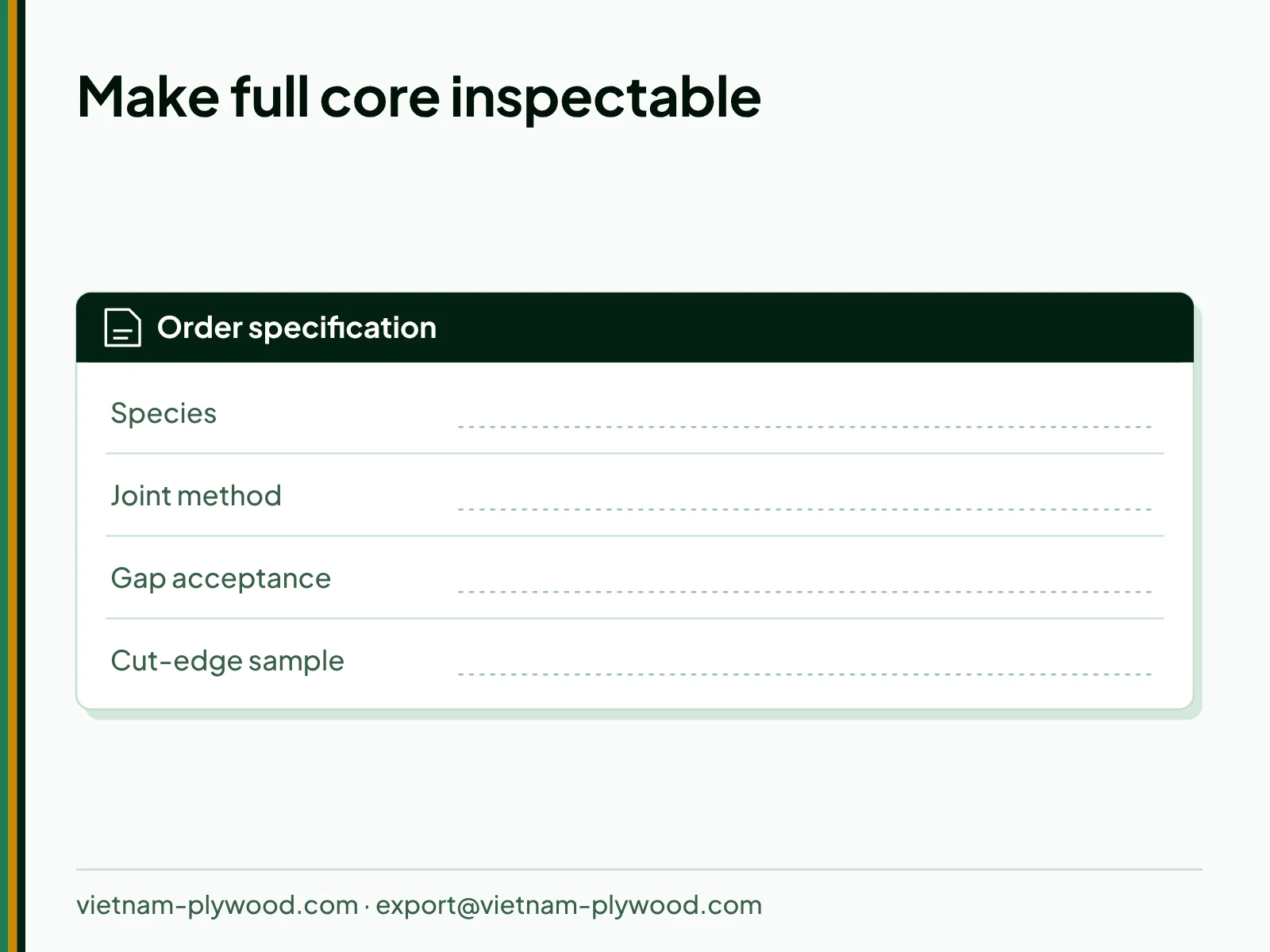
- State the cabinet or fit-out application and the face appearance required.
- Identify the producing line and the exact core species; reject “alternate” as the sole core description.
- Require full-stitched construction and describe permitted joints or repairs.
- Set thickness and dimensional tolerances, then approve a physical cut sample.
- Record how the producing factory will sample, photograph and document cross-sections before loading.
For sanded furniture panels, order ±0.2 or ±0.3 mm thickness tolerance; length and width tolerance is ±2 mm. HCPLY handles specification, on-site quality control, export paperwork and loading.
What should the quotation and shipping file show?
A quotation should separate core construction from face grade, bond and emission requirements. For a commercial acacia-core baseline, the indicative starting point is from US$250/m³ FOB Hai Phong (October 2026). For a sanded furniture build, it is from US$350/m³ FOB Hai Phong (October 2026). An alternate-specific or full-core configuration needs a written-specification quotation; the core-joint method, face and finish affect cost.
The minimum order is one 40HC, and specifications can be mixed within its payload limit. Production takes 15–45 days from the 30% deposit, set by order size, line loading and the contract. Balance is 70% against the scanned bill of lading (B/L), by telegraphic transfer (T/T) or irrevocable letter of credit (L/C) at sight. We ship FOB Hai Phong, or CFR (CNF) or CIF to your port; see production lead time.
The shipment file includes a commercial invoice, packing list, B/L, certificate of origin, phytosanitary and fumigation papers, insurance under CIF, and the agreed certificate or test documents. After loading, the draft shipping documents come to you for approval.
What specification should I send for sampling?
Send a build sheet that names the face and core independently and makes core continuity visible at inspection. The example below is a furniture-line request, with choices to be agreed against the approved sample.
Application: Cabinet and fit-out panel production
Line / core: Furniture line; full-stitched styrax core; no loose-laid layers
Glue: Melamine MR
Emission: E1
Face and grade: Bintangor face, A/B
Thickness and tolerance: 18 mm; ±0.2 mm
Size: 1220 × 2440 mm; length/width ±2 mm
Quantity: One 40HC; final pallet schedule to be agreed
Destination port: [named destination port]
Core acceptance: Cut-edge sample approved before production; inspect joints and gaps
Ask Lucy at export@vietnam-plywood.com for a sample set, or send the build sheet through the contact page. Samples are free; a first-time buyer pays the courier, and that charge comes off the first confirmed order.