





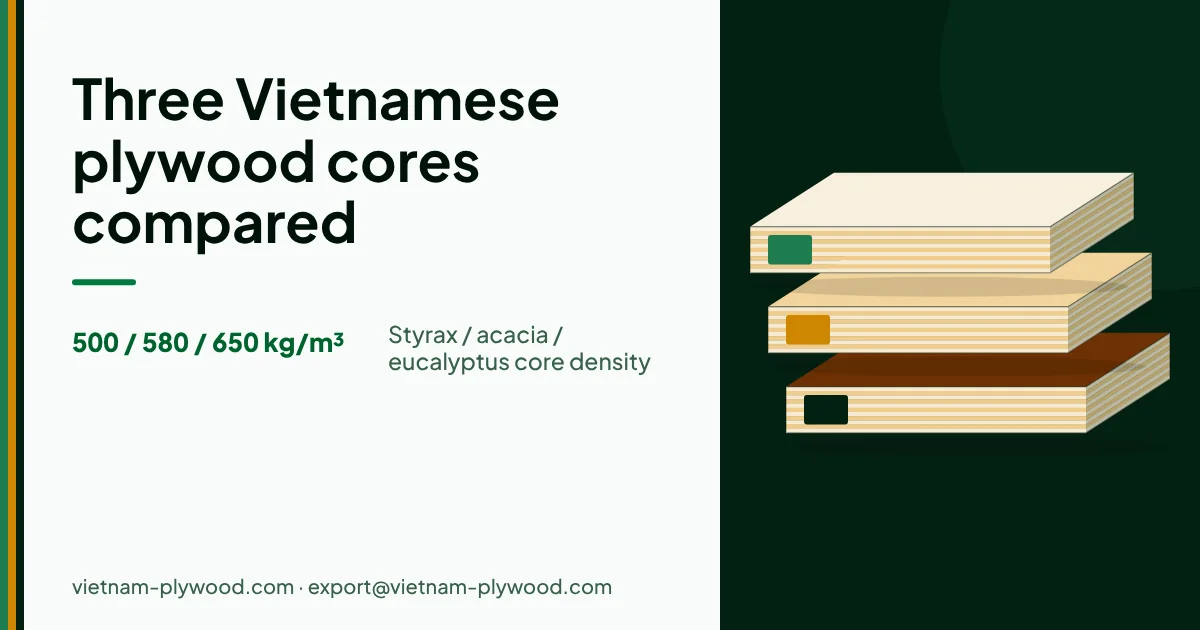
Vietnamese plywood is made with bonded wood veneers, often using acacia, eucalyptus or styrax cores and a separately chosen face. Choosing the wrong core or construction can add freight cost, delay cabinet production or cause a rejected load. HCPLY matches each written specification to the producing factory, so buyers can inspect the core, surface and shipment against the order.
What wood is Vietnamese plywood made from?
Vietnamese plywood can use acacia, eucalyptus and styrax wood cores, covered with decorative veneer or film according to the intended application. At HCPLY, acacia is used on our commercial and packing line, while styrax and eucalyptus are used on our furniture line; acacia or eucalyptus is used on our construction line. The core species, face, adhesive and construction method should be named separately in a purchase specification.
These are plantation-grown wood species used in Vietnam. Other plywood producers may use pine, poplar, rubberwood or different timber species, but those names do not describe our core range. The Vietnam plywood manufacturer overview explains how the producing factory is selected for an order.
What is the core of Vietnam plywood?
The core is the internal stack of wood veneers bonded between the outer faces. Its species affects density and sheet mass; its assembly affects the consistency of the edges and internal voids.
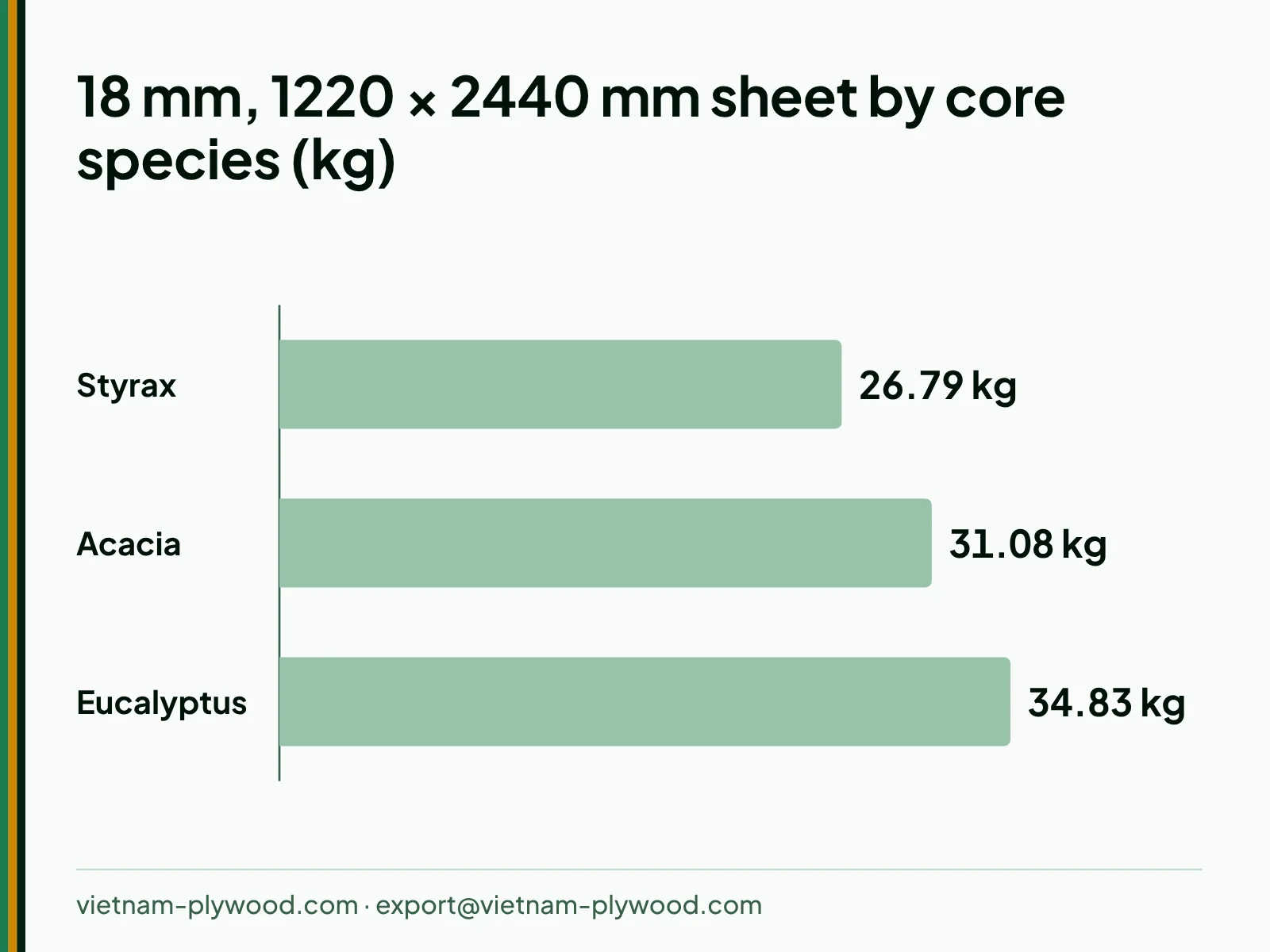
| Core species | Core density | 18 mm, 1220 × 2440 mm sheet | Typical HCPLY build |
|---|---|---|---|
| Styrax | 500 kg/m³ | 26.79 kg | Sanded furniture panel |
| Acacia | 580 kg/m³ | 31.08 kg | Commercial, packing or formwork panel |
| Eucalyptus | 650 kg/m³ | 34.83 kg | Furniture or formwork panel |
These sheet masses describe the core-based calculation; decorative and film layers are excluded from the lookup. A heavier sheet does not independently establish a structural grade, bending strength or moisture resistance. Those properties require the agreed construction and suitable test evidence. Read the eucalyptus plywood specification when that core is being considered.
How do the same thickness and application change by factory line?
An 18 mm order can be built differently according to the finished use. Our three factories make distinct panel constructions rather than treating the thickness as a complete specification.
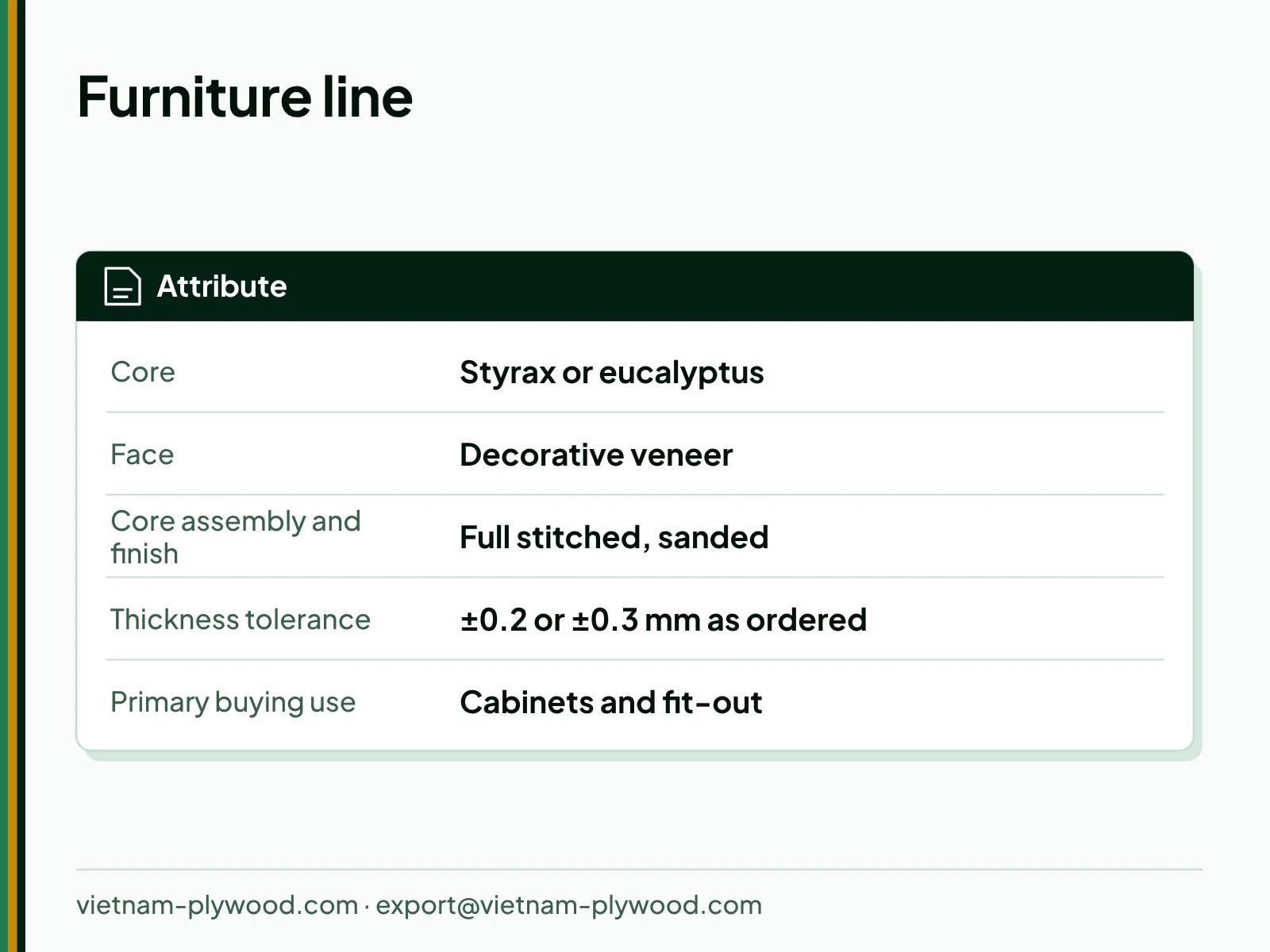
| Attribute | Furniture line | Commercial and packing line | Construction line |
|---|---|---|---|
| Core | Styrax or eucalyptus | Acacia | Acacia or eucalyptus |
| Face | Decorative veneer | Raw or specified veneer | Phenolic, melamine or anti-slip film |
| Core assembly and finish | Full stitched, sanded | Unsanded or light-sanded | Unsanded under film |
| Thickness tolerance | ±0.2 or ±0.3 mm as ordered | Commercial ±0.5 mm; packing ±0.5–1.0 mm | ±0.5 mm |
| Primary buying use | Cabinets and fit-out | Distribution and packing | Concrete formwork |
A cabinet maker buying 18 mm material for visible edges should specify stitched core and sanding. A packing company may instead prioritize acacia core and a practical unsanded surface. Formwork buyers should identify the film and adhesive as well as the core. Compare furniture plywood with commercial plywood before choosing the line.
Does the face veneer tell you which wood is inside?
No. A plywood product is commonly named after its face, while the core remains a separate specification. An okoume-faced panel can have a styrax or eucalyptus core on the furniture line; its name alone does not identify the inner veneers.
Available face descriptions include bintangor, okoume, engineered veneer (EV), gurjan, pine, poplar, eucalyptus, birch and sapele. Matt means an unfaced raw core. Common face veneer thickness is 0.2–0.4 mm. Face grades are A/B, while birch face grades are D/E/F. Birch face veneer should never be mistaken for a birch core: we do not press birch-core plywood.
Specify the appearance of the visible face, the back requirement and the internal core independently. This avoids a purchase order that says only “birch plywood” when the intended requirement is a birch face over another core.
How are veneers assembled into a plywood core?
Core construction changes the number and location of gaps a buyer can see at a cut edge. Our construction choices, from the highest core assembly grade to the lowest, are full stitched, stitched outer layers with edge-trimmed inner veneers, finger-jointed, and loose-laid.
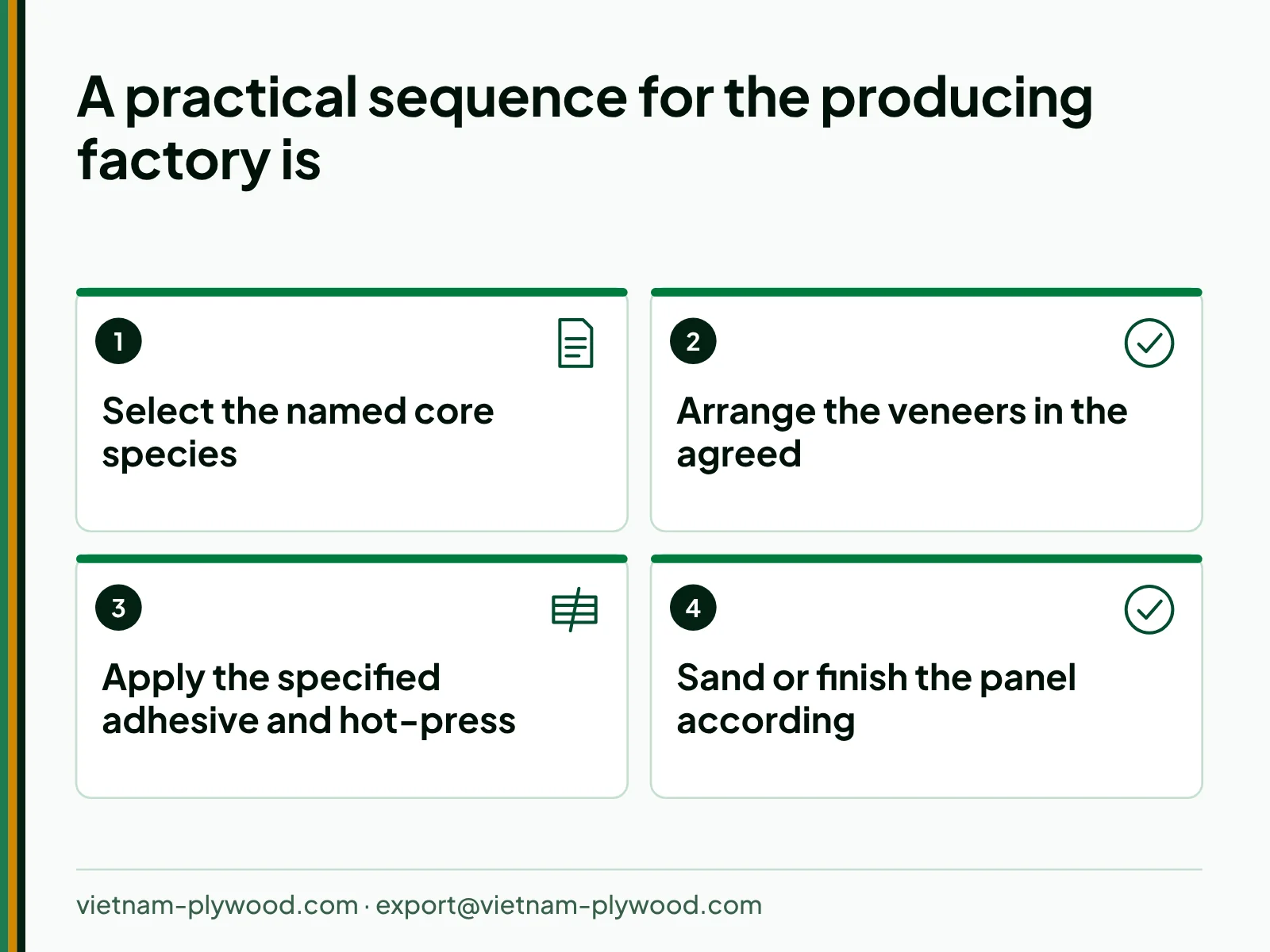
A practical sequence for the producing factory is:
- Select the named core species and veneer thickness for the order.
- Arrange the veneers in the agreed core construction, with grain directions alternating through the panel.
- Apply the specified adhesive and hot-press the stack.
- Sand or finish the panel according to the production line, then measure and inspect it.
Core veneers are 1.4–2.0 mm thick. An 18 mm panel has 11–13 plies, depending on veneer thickness. A ply count without a core-assembly description says little about open joints or edge appearance.
Which glue and emission class belong in the order?
Adhesive performance and formaldehyde emission classification are separate order fields. Melamine adhesive is described as moisture resistant (MR), with a 12-hour boil specification; phenolic adhesive is weather and boil proof (WBP), with a 72-hour boil specification.
MR hot pressing uses 110–120 °C, while WBP pressing uses 130–145 °C. Emission classes are E0, E1 and E2; the furniture line uses E0/E1. For relevant US-bound hardwood plywood, California Air Resources Board Phase 2 (CARB P2) and Toxic Substances Control Act (TSCA) Title VI involve emission limits and third-party certification, rather than a glue name.
The US Environmental Protection Agency’s 2025 Code of Federal Regulations, 40 CFR Part 770, defines hardwood plywood by its veneer layers and adhesive and sets separate rules for regulated composite wood products: official 2025 regulation. Request the applicable member-factory certificate or test documentation for the ordered build; documents are shown with factory details masked, on request.
What changes when core density meets a container limit?
Density changes how many sheets fit within the 28.5 t payload limit of a 40-foot high-cube (40HC) container. At 18 mm and 1220 × 2440 mm, the full-load reference is 990 styrax sheets at 26.52 t, 880 acacia sheets at 27.35 t, or 795 eucalyptus sheets at 27.69 t.
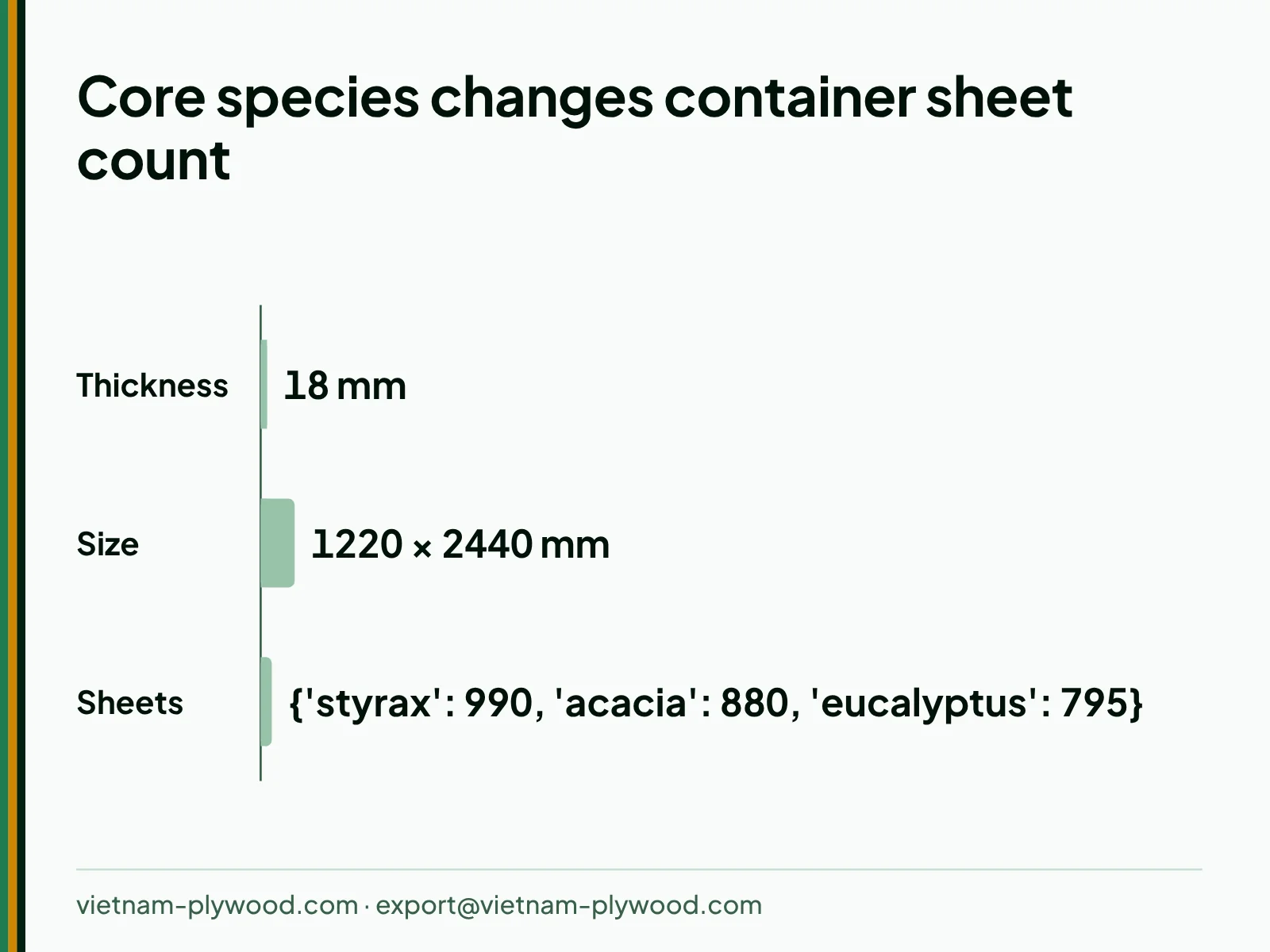
The same dimensions therefore cannot be assigned the same loading count across all cores. Specifications can be mixed in a container within the payload limit; the loading plan must add the mass of each pallet and account for the chosen mix. For the complete container calculation, see plywood container packing.
For distributors combining furniture and commercial stock, list the quantities by species, thickness and pallet before approving the packing list. The multi-type plywood programme explains how different panel requirements can be planned together.
What should an inspector check at the producing factory?
An inspector should match the physical sheet to the written core and face specification. Buyers visit the factory office and inspect goods at the producing factory, where the relevant production and loading steps can be witnessed.
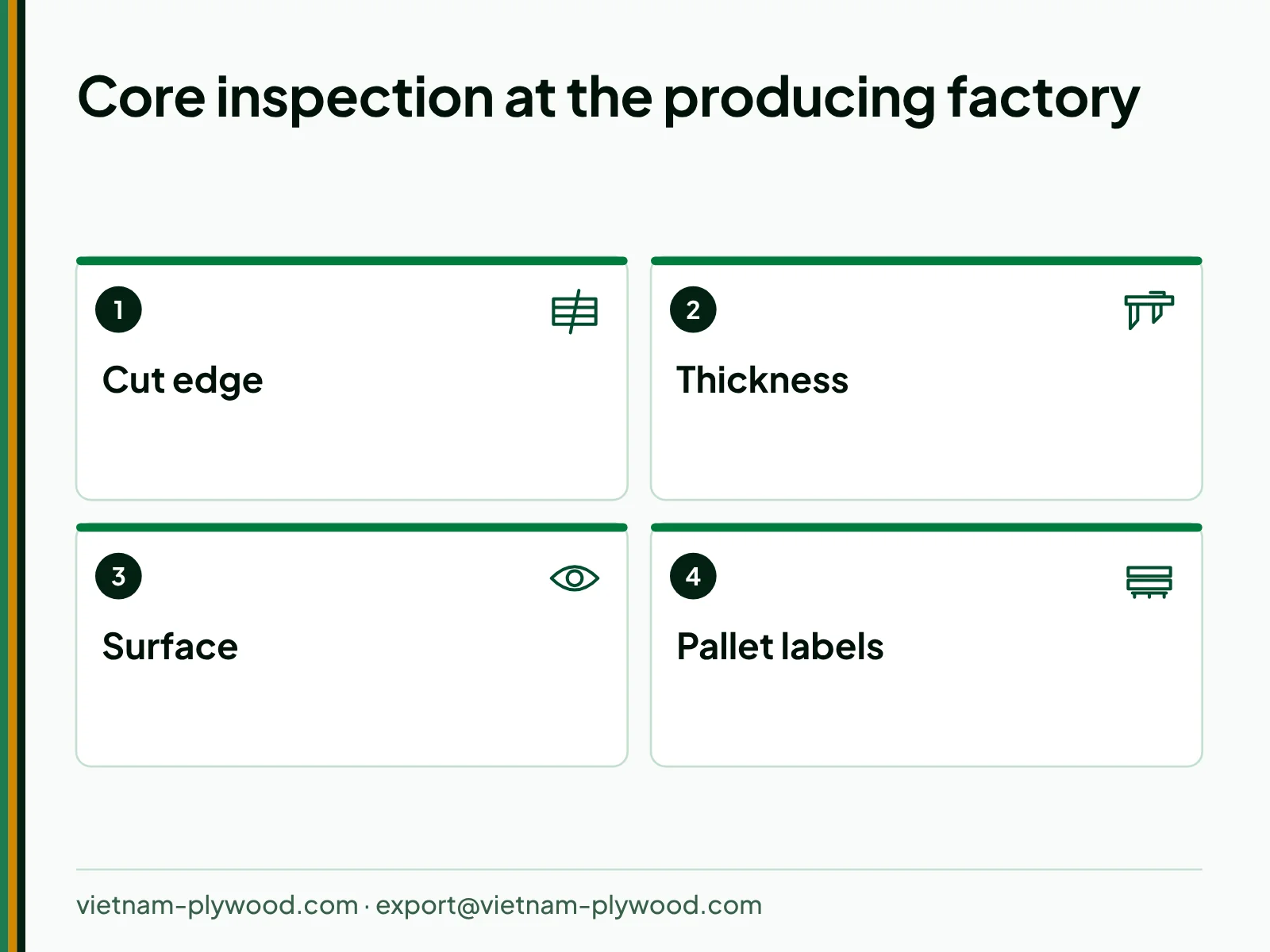
First, inspect a cut edge for veneer joints, voids and the expected ply construction. Next, measure thickness across sampled sheets against the ordered tolerance and inspect the surface for the agreed sanding or film. Finally, compare pallet labels, sheet sizes and quantities with the packing plan before loading.
Available standard sizes include 1220 × 2440, 1250 × 2500, 1220 × 2135, 1220 × 1830, 915 × 2440, 915 × 2135 and 915 × 1830 mm; custom cutting is available. The thickness range is 3–40 mm, and length and width tolerance is ±2 mm. Inspection should record the actual build rather than inferring species from face colour.
Which Vietnamese company makes custom-core plywood?
HCPLY manufactures plywood to written core, face, construction and size specifications through the line suited to the order. Our furniture line uses styrax or eucalyptus, our commercial and packing line uses acacia, and our construction line uses acacia or eucalyptus.
Custom-core means selecting among these available core species and constructions; it does not mean any requested timber species can be pressed. We do not press medium-density fibreboard (MDF), oriented strand board (OSB), chipboard, blockboard, bamboo, 3-ply spruce panels or birch-core plywood. Melamine, high-pressure laminate (HPL) and laminate faces can be discussed as material categories but are not offered as our product line.
For distributor programmes that need consistent repeat specifications, see plywood supply programmes and private-label plywood export.
What should the written order and shipping documents say?
The purchase specification should identify the core species independently from the decorative face, plus the core assembly, adhesive, emission requirement, size and tolerances. This gives production and inspection teams a common description of the goods.
HCPLY handles specification, on-site quality control, export documents and loading. Each shipment’s paperwork includes a commercial invoice, packing list, bill of lading (B/L), certificate of origin, phytosanitary and fumigation papers, and the agreed certificate documents. European Union lots also include EUR.1 and the applicable European Union Timber Regulation / Deforestation Regulation (EUTR/EUDR) file set; CIF shipments include insurance. After loading, the draft shipping documents come to you for approval.
The packing list records the species-specific quantities and shipment breakdown; the agreed test report or emission certificate addresses the relevant tested property. For a specification template and product choices, use the plywood catalogue.
How do you request a sample of the right core?
Start with the intended application, then identify core, face, glue, emission and physical tolerances. A reference sample should carry the same written build as the planned order, so a buyer can inspect both the face and the cut edge.
Commercial plywood starts from US$250/m³ FOB Hai Phong (October 2026); furniture plywood starts from US$350/m³ FOB Hai Phong (October 2026). Core selection, stitching, sanding, face grade and adhesive affect the final quotation. Minimum order is one 40HC, with mixed specifications permitted within its payload limit. Factory lead time runs 15–45 days from receipt of the 30% deposit; the exact figure depends on order size, line loading and what the contract fixes. The remaining 70% is paid on the scan of the bill of lading, by T/T, or by irrevocable sight L/C. We ship FOB Hai Phong, or CFR (CNF) or CIF to your port.
Send Lucy at export@vietnam-plywood.com the following specification:
Application: furniture / cabinet / packing / formwork
Line or core: furniture / commercial and packing / construction; styrax / acacia / eucalyptus
Glue: MR melamine / WBP phenolic
Emission: E0 / E1 / E2 / applicable market requirement
Face and grade: species or film; A/B or birch D/E/F as applicable
Thickness and tolerance: ___ mm; ___ mm
Size: ___ × ___ mm
Quantity: ___ sheets / pallets / containers
Destination port: ___
Ask for a sample set matching that specification through contact. Samples cost nothing: a first-time buyer pays the courier, and that charge comes off the first confirmed order.