





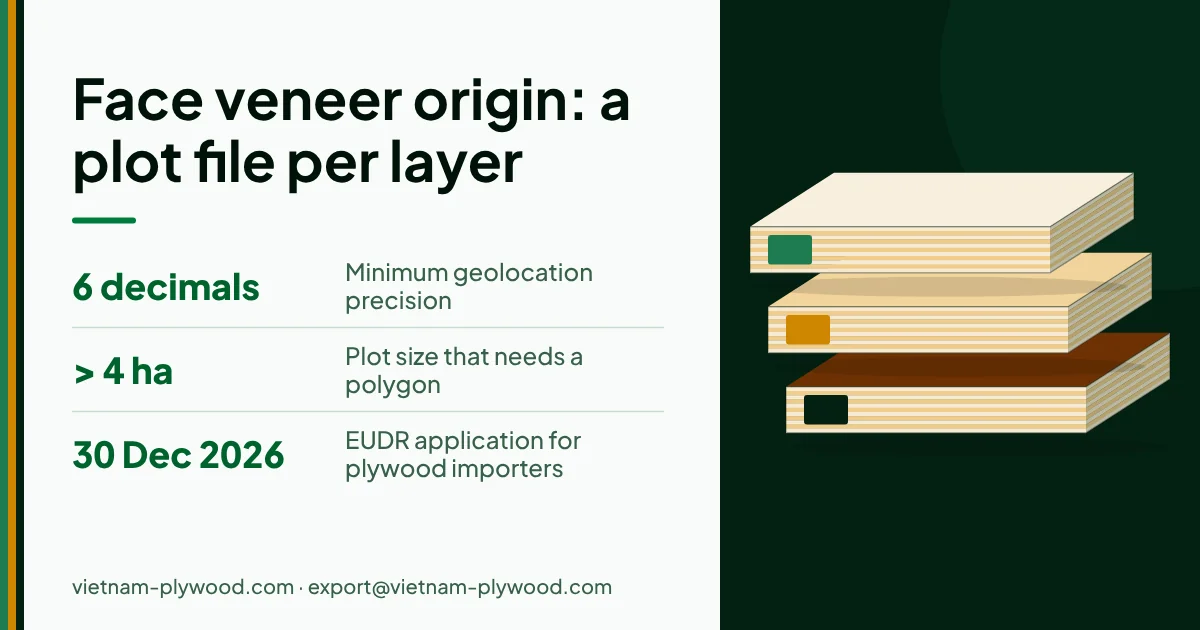
Under the EU Deforestation Regulation (EUDR), every wood layer in a plywood panel needs its own origin and plot geolocation, including the imported face and back veneers. A file that covers only the core leaves the EU importer without a complete due diligence statement, and without its reference number customs will not release the container. HCPLY builds the EUDR face veneer file beside the core file for each EU order.
This page sits with our other certification and compliance topics. It answers the questions importers and distributors ask while they are still writing the specification. The questions run in order of how often a missing answer stops a load.
Does the EUDR face veneer need its own geolocation data?
Yes. The regulation asks for the geolocation of every plot of land where the wood in a product was produced, and a face veneer is wood in the panel. A 0.3 mm okoume face therefore needs its own harvest-plot coordinates, species name and legality evidence, kept apart from the plantation-core file.
The rule is in Article 9(1)(d) of Regulation (EU) 2023/1115 (EUR-Lex, 2023). When a product is made with wood from different plots of land, the geolocation of all of those plots goes into the file. The same article adds that deforestation or forest degradation on any listed plot disqualifies all wood from that plot.
The 2023 regulation defines geolocation as latitude and longitude with at least six decimal digits. Plots larger than four hectares need a polygon that traces the perimeter, so a forest compartment or a concession block needs more than one point. Article 9(1)(a) also asks for the common name and the full scientific name of each wood species in the product.
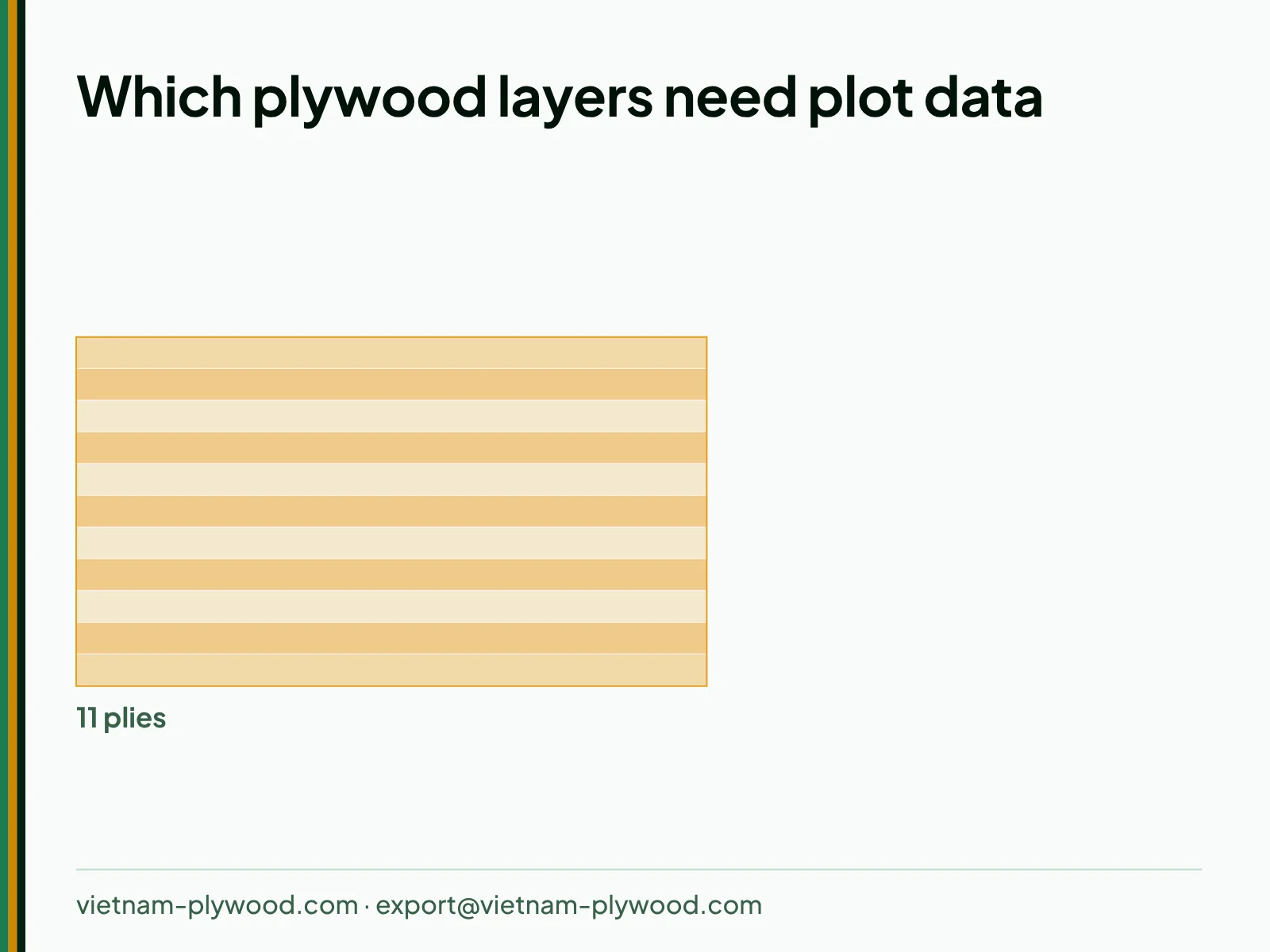
Our face veneers are commonly 0.2–0.4 mm, and an 18 mm panel has 11–13 plies. Together the face and back are 0.4–0.8 mm of the 18 mm, about 2–4% of the thickness. They carry the same obligation as the core.
Which wood layers in plywood need EUDR geolocation?
Every wood layer needs plot data, but the glue line does not. The table goes through a faced panel from our furniture line or our commercial and packing line, one layer at a time.
| Layer | Material on our panels | Wood under the EUDR? | Origin data in the file |
|---|---|---|---|
| Face veneer, 0.2–0.4 mm | bintangor, okoume, EV, gurjan, pine, poplar, eucalyptus, birch or sapele | Yes | species and scientific name, harvest-plot geolocation, harvest date or range, legality evidence |
| Back veneer | same species as the face or a different one, often a lower grade | Yes | its own entry whenever the lot or species differs from the face |
| Core and crossband veneers, 1.4–2.0 mm each | acacia, eucalyptus or styrax grown in Vietnam | Yes | plantation plot file for the core lots |
| Engineered veneer (EV) face | veneer reconstituted from peeled logs of a base species | Yes | plots of the base-species logs, carried through the EV plant |
| Glue line | melamine (MR) or phenolic (WBP) resin | No | none under the EUDR; emission class is a separate document |
| Film overlay, construction line only | resin-impregnated paper | Paper is listed in Annex I | ask the film supplier for its file and agree with your adviser how to treat it |
| Matt panel (unfaced raw core) | no separate face | Yes, core only | the core file covers every veneer |
Plot data follows the tree. If a veneer is peeled in one country from logs grown in another, the file needs the coordinates of the forest where the logs were cut. The address of the peeling plant cannot replace them.
This is why face veneer traceability is the harder half of the file. Our cores come from Vietnamese plantations of three species. Faces arrive in bundles from separate suppliers, each with its own upstream chain.
Does EUDR apply to veneer bought on its own?
Yes. Annex I of Regulation (EU) 2023/1115 lists heading 4408 (sheets for veneering) and heading 4412 (plywood, veneered panels and similar laminated wood). An EU company that imports loose face veneer is an operator for that veneer, just as a plywood importer is an operator for the panels.
A plywood press outside the EU buys veneer as a raw material, so nobody checks EUDR compliance when the veneer arrives at our factory. The obligation starts when the finished plywood reaches the EU border. The importer’s due diligence statement must then trace back through the panel to every veneer plot.
So imported veneer traceability is a condition of the panel sale. If the face file is missing when the plywood lands, nothing done at the EU port can rebuild it.
What does the producing factory collect from the veneer supplier for birch, okoume and poplar faces?
For each face lot, the producing factory collects:
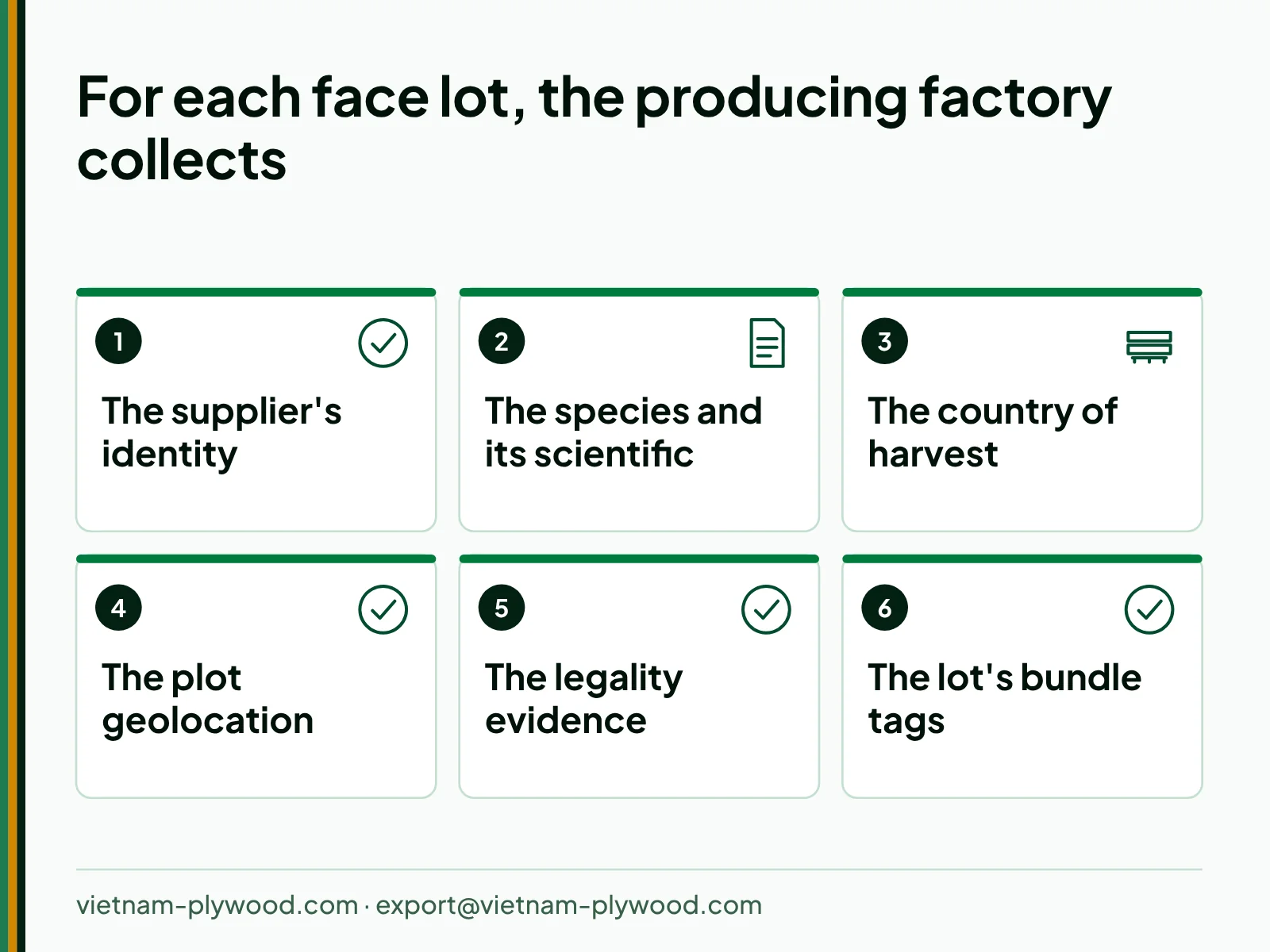
- the supplier’s identity;
- the species and its scientific name;
- the country of harvest;
- the plot geolocation and the harvest date range;
- the legality evidence;
- the lot’s bundle tags and quantity.
The species then decides which part of the evidence is hardest to get.
The common file for every face species holds these items:
- Supplier name and address, and the peeling plant if it is a different company.
- Country of production, meaning where the trees grew.
- Common and scientific name of the species.
- Geolocation of each harvest plot as a GeoJSON file: a point with six decimals, or a polygon for plots above four hectares.
- Harvest date or time range for the logs in the lot.
- Legality evidence under the law of the country of production, including the right to harvest that area.
- Evidence that the harvest did not follow deforestation or cause forest degradation after 31 December 2020.
- Veneer lot number, bundle tags and quantity, matching the supplier’s packing list.
The species table shows which part of each face file we check first.
| Face | Name for the file | Where the plot evidence comes from | What we check first |
|---|---|---|---|
| Birch (D, E or F grade) | Betula, with the species stated by the supplier | managed forest stands with a harvest permit per stand | forest degradation test and polygons for stands above 4 ha |
| Okoume | Aucoumea klaineana | natural-forest concessions in Central Africa | concession right, the cutting-area polygon and the legality chain |
| Poplar | Populus, with the species or clone stated by the supplier | plantations, often many small plots per lot | a complete plot list, one point per small plot, no unlisted logs at the peeling plant |
| EV | the base species of the reconstituted veneer | the plots of the base-species logs | base-veneer data passed through the EV plant |
| Bintangor, gurjan, sapele | Calophyllum, Dipterocarpus, Entandrophragma cylindricum | natural-forest harvest areas | as for okoume |
| Pine | Pinus, species stated | plantations or managed forest | as for poplar or birch, depending on the source |
For EUDR birch face plywood, the birch file covers only the two outer veneers. We do not press birch-core plywood, so the core file stays acacia, eucalyptus or styrax.
For birch and okoume, the most important test is forest degradation. Regulation (EU) 2023/1115 defines forest degradation as turning primary or naturally regenerating forest into plantation forest or other wooded land. A natural-forest face file therefore has to show that the stand was still forest after a harvest made after 31 December 2020.
For EUDR okoume plywood, the risk is the length of the supply chain. Logs go from the concession to a peeling plant, sometimes through a trader, before the veneer reaches us. Each step needs a document that links the veneer lot back to the cutting area.
How is imported face veneer traced for EUDR?
Imported face veneer is traced by linking the supplier’s plot file to a veneer lot number. That number then follows the veneer through lay-up, pressing and packing into the container. The steps run from specification to the importer’s statement.
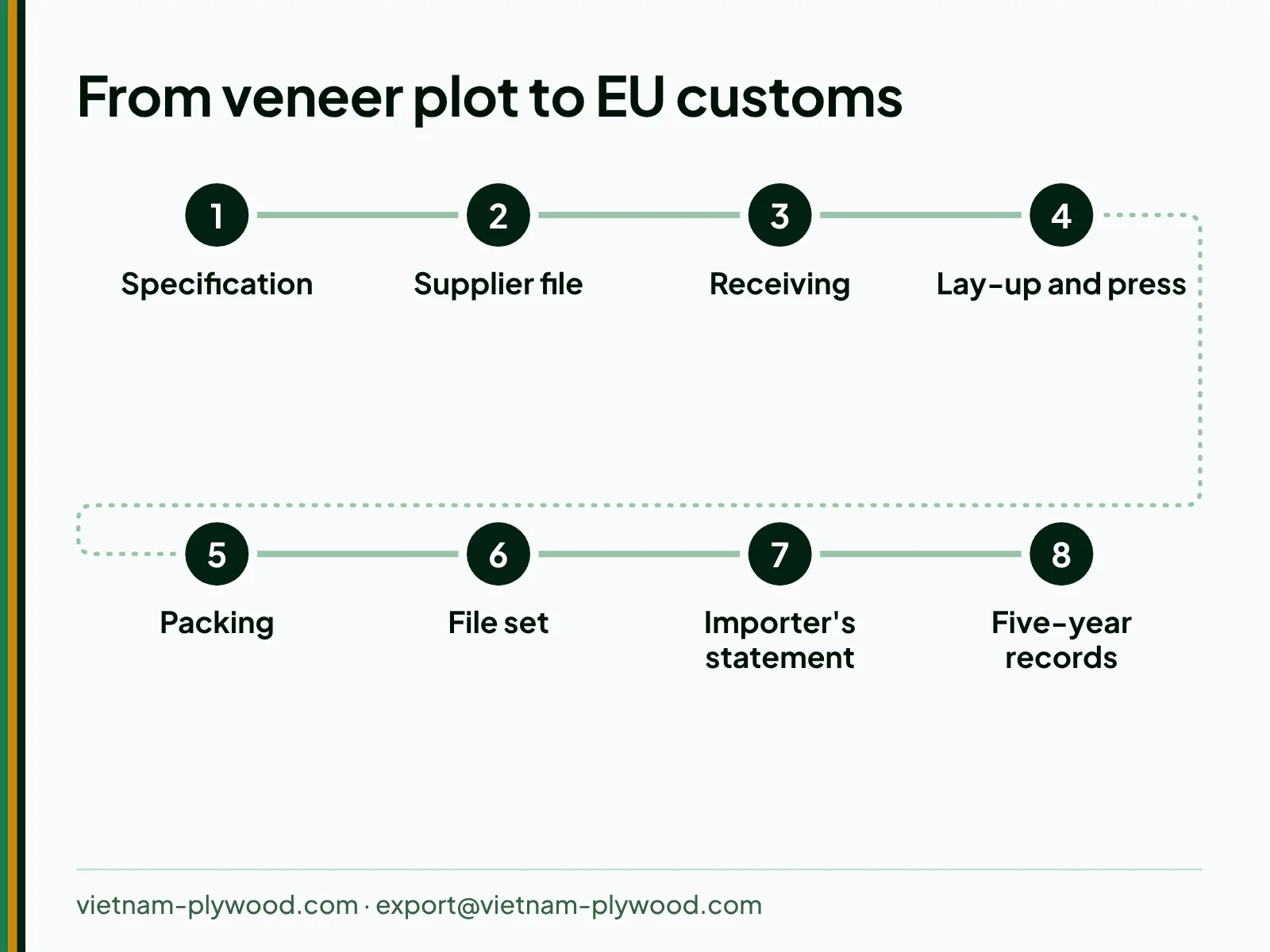
- Specification. The written specification names the face and back species. It marks the order as an EU lot that needs the EUTR/EUDR file set.
- Supplier file before purchase. The producing factory asks the veneer supplier for the file listed above. It checks that the GeoJSON opens, the coordinates have all six decimals and every plot above four hectares has a polygon.
- Receiving. Each incoming face lot is checked against the supplier’s packing list for species, bundle tags and quantity. Lots without a file are kept out of EU orders.
- Lay-up and pressing. The face lot number is written on the press batch record beside the core lot number. MR batches press at 110–120 °C and WBP batches at 130–145 °C, and the record carries the lot numbers for both.
- Packing. Each pallet label carries the press batch number. The chain then runs from pallet to press batch, face lot and supplier plots.
- File set. The container’s file combines the core plot file, one face file per face species and lot, and a back file where the back differs.
- Importer’s statement. The EU importer runs its risk assessment and files the due diligence statement. It then passes the reference number to the customs declarant before release.
- Records. Under the 2023 regulation, operators keep due diligence statements for five years. The supplier files stay matched to the container number for at least that long.
Mixed loads work the same way. Our minimum order is one 40HC, and one container can carry several specifications as long as the payload limit holds. Each face species in a mixed container adds its own file to the set.
Can face veneer imported from China be EUDR compliant?
Yes, when the supplier delivers plot geolocation for the logs behind the veneer. The regulation makes no exception for any producing or processing country. A poplar or EV face peeled in China can go into an EU lot only with its plot file, like any other face.
ATIBT reported in 2024 that China opposed the EUDR and refused to share geolocation data, citing security concerns. The same report quoted the German timber trade association GD Holz: “imports without coordinates were not possible and that there would be no exceptions for countries like China.”
Two points matter for EUDR veneer from China. First, the country of production is where the logs grew, so a Chinese peeling plant working imported logs needs coordinates from the forest of origin. Second, Article 13 of Regulation (EU) 2023/1115 lets operators skip risk assessment and mitigation (Articles 10 and 11) when all the wood comes from low-risk countries. The information duties of Article 9, including geolocation, still apply.
A face lot without plot data goes into a non-EU order. For the EU lot, we switch to a face species whose supplier delivers the file, or offer a matt panel in which every layer is core.
Who files the due diligence statement, and from which date?
The EU importer that releases the plywood for free circulation is the operator and files the due diligence statement. Under Regulation (EU) 2025/2650 (EUR-Lex, 2025), the main obligations apply from 30 December 2026.
The 2025 amendment gives micro and small operators established by 31 December 2024 a later date, 30 June 2027. That later date does not cover products listed in the Annex to Regulation (EU) No 995/2010, the old EU Timber Regulation (EUTR), and that annex listed plywood. Plywood importers of every size should plan for 30 December 2026.
The same 2025 amendment repeals the EUTR with effect from 30 December 2026. Lots placed on the EU market before that date stay under the EUTR, which is why the file set for EU lots carries both names.
The amendment also created the “downstream operator”, a company that sells products made from goods already covered by a due diligence statement. An EU cabinet maker buying plywood from the importer is a downstream operator. Only the first downstream operator or trader has to collect and keep the reference numbers.
Customs must receive the reference number before release. For micro or small primary operators, a declaration identifier takes its place. Commission Implementing Regulation (EU) 2026/1565 (EUR-Lex, 2026) deleted the reference to TRACES, and the rules now refer only to the Information System. Under the 2025 text, member states must set the maximum fine for a company at no less than 4% of its total annual turnover in the EU.
Orders placed now will arrive after the application date. Production takes 15–45 days from the 30% deposit, set by order size, line loading and the contract. The sea leg from Hai Phong is 25–35 days to the Mediterranean and 30–40 days to Northern Europe, by carrier and route. A lot deposited on 21 November 2026 reaches an EU port on 31 December 2026 at the earliest, one day after the EUDR applies. See production lead time for the full schedule.
Which line presses a face-veneered panel, and what would the other lines build?
Panels with an imported face veneer come from our furniture line and our commercial and packing line. Our construction line would build the same thickness with film on a plantation core. The table compares one need across the three lines: an 18 mm panel in 1220 × 2440 mm for an EU importer.
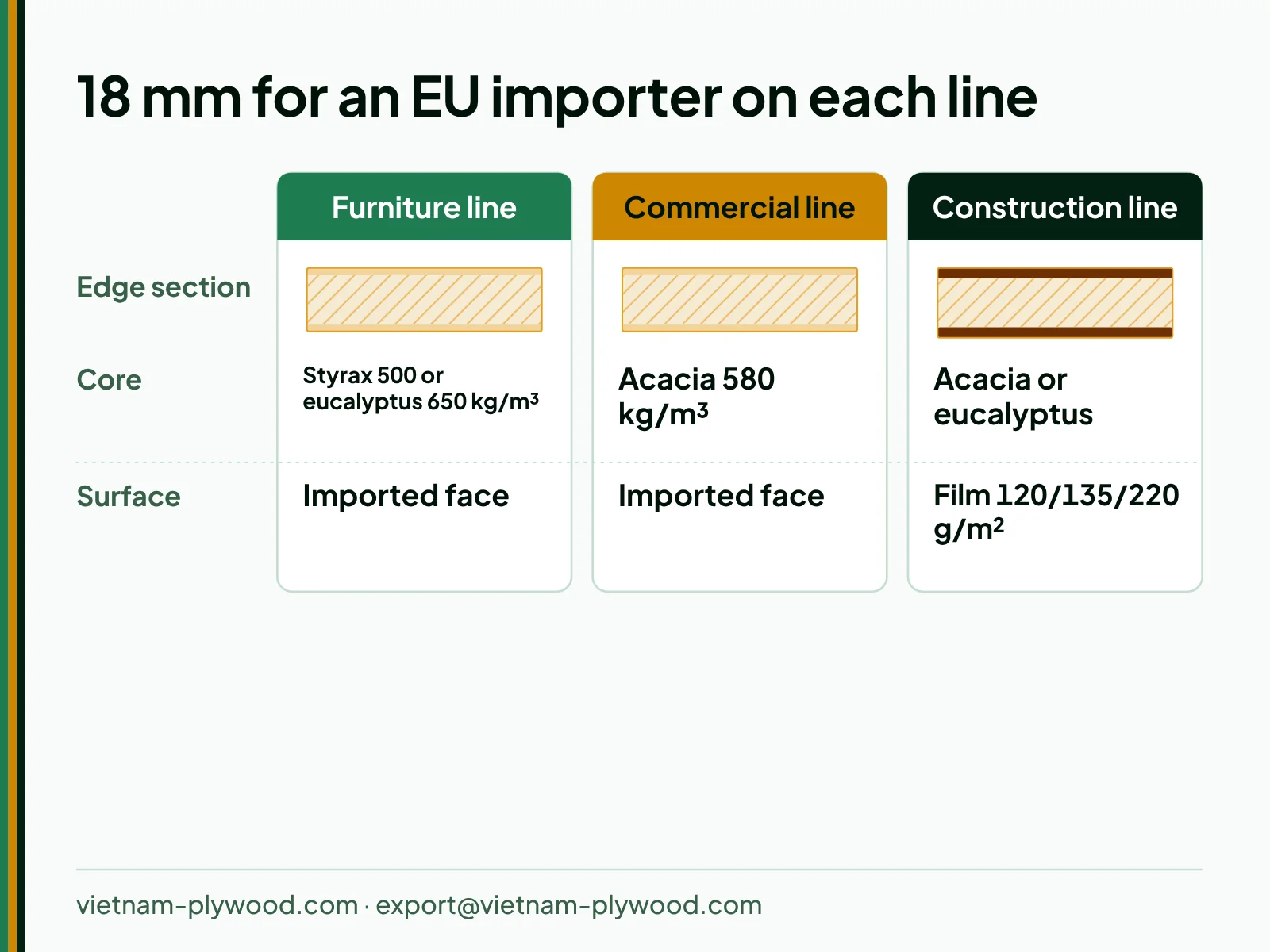
| Metric | Furniture line | Commercial and packing line | Construction line |
|---|---|---|---|
| Core species and density | styrax 500 kg/m³ or eucalyptus 650 kg/m³ | acacia 580 kg/m³ | acacia 580 kg/m³ or eucalyptus 650 kg/m³ |
| Surface | imported face, grade A/B (birch D/E/F) | imported face, grade A/B (birch D/E/F) | phenolic or melamine film, 120 g/m² standard, 135 g/m² premium, 220 g/m² anti-slip |
| Core construction | full stitched | as ordered | as ordered |
| Glue | MR or WBP, as ordered | MR | MR or WBP, as ordered |
| Finish and thickness tolerance | sanded, ±0.2 or ±0.3 mm as ordered | unsanded or light-sanded, ±0.5 mm | unsanded, ±0.5 mm |
| Wood origin files per lot | core plots + face plots + back plots | core plots + face plots + back plots | core plots, plus the film supplier’s position |
| Sheets per 40HC at 18 mm | 990 (styrax core) | 880 | 880 (acacia) or 795 (eucalyptus) |
| Verdict by use | cabinet and furniture makers who need a known face species | distributors and packing users who resell by face | formwork yards; no imported face to trace |
At 18 mm, a styrax-core load of 990 sheets carries 1,980 outer veneers (face and back). Each of those veneers must come from a lot listed in the file. The full container arithmetic, 26–29 t for these loads, is on the container loading page.
For cabinet work, see furniture plywood for the faces and grades our furniture line presses.
What can a buyer or inspector witness at the producing factory?
An inspector can trace one finished panel back to its face supplier’s plot file on the factory floor, following the records in the order they were made. Buyers visit the factory office and inspect goods at the producing factory, so this check fits into a normal pre-shipment visit.
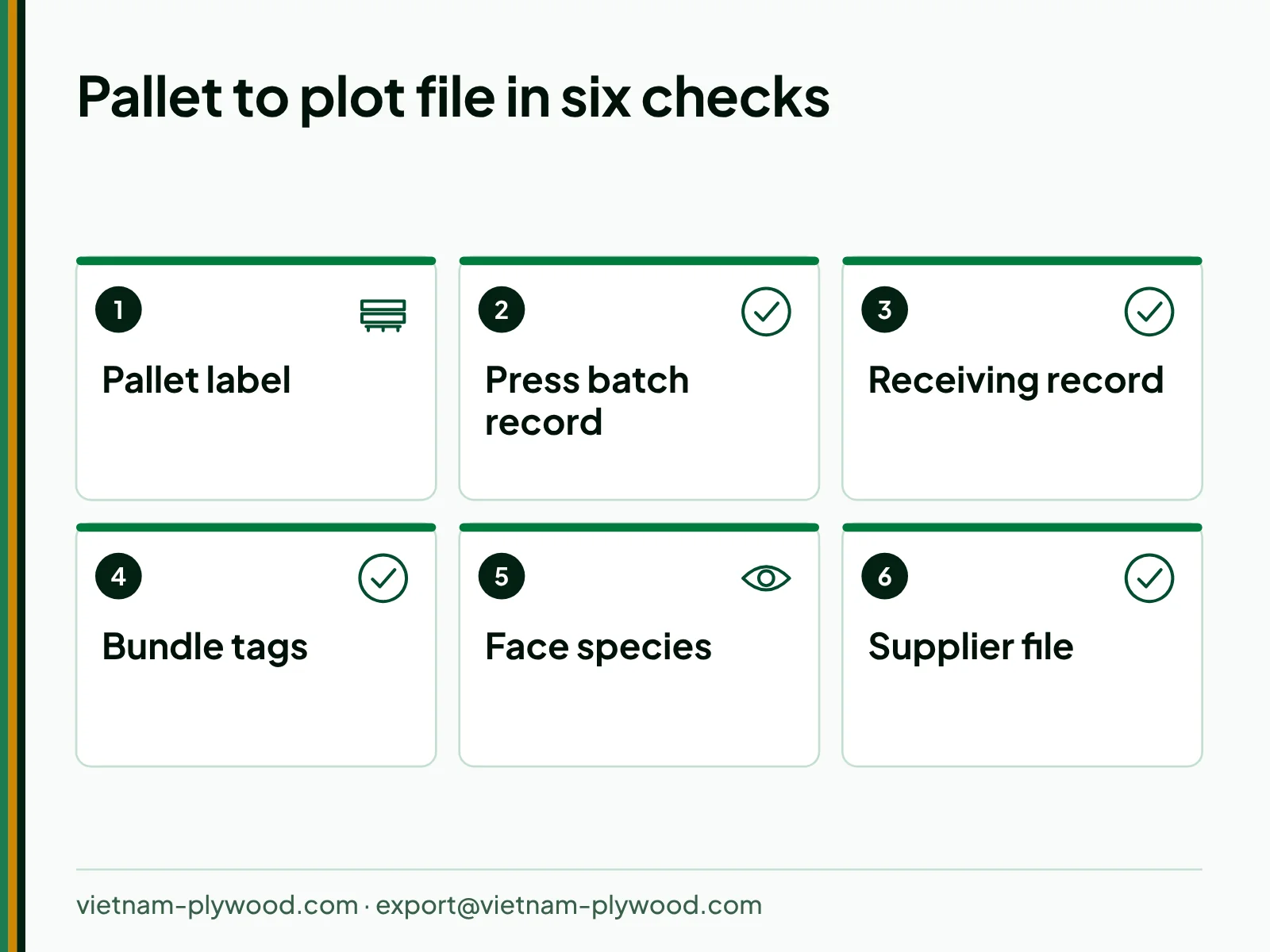
- Pick a pallet from the EU order and read the press batch number on its label.
- Open the press batch record and read the face, back and core lot numbers.
- Check the face lot number against the receiving record and the supplier’s packing list for species, bundle tags and quantity.
- Look at any remaining bundles of that lot in the store and compare the tags.
- Compare the face on the panel with the declared species. Okoume, birch and poplar look different on a sanded face.
- Open the supplier file for that lot and check that the plot entries, harvest date range and legality papers are present.
Article 18 of the 2023 regulation allows authorities to use anatomical, chemical or DNA analysis to find the species or the place of production. If a face is declared as one species and found to be another, the whole statement fails.
Where does the face file sit in the export documents?
The face file is part of the EUTR/EUDR file set that travels with every EU lot. The set also includes the commercial invoice, packing list, bill of lading (B/L), EUR.1 certificate of origin, phytosanitary and fumigation papers, and insurance under CIF. After loading, the draft shipping documents come to you for approval.
For EU orders, that one set of export documents carries:
- the core plot file for the acacia, eucalyptus or styrax lots;
- one face file per face species and lot, and a back file where the back differs;
- a map from the container to the pallets, press batches and veneer lots;
- the order’s certificate documents: the FSC claim on sales documents where ordered, the emission certificate and test reports for the agreed build.
Certificates belong to the member factories and are shown with factory details masked, on request. FSC helps the risk assessment, but it does not replace the plot file. Recital 52 of Regulation (EU) 2023/1115 says certification schemes can be used in the risk assessment but should not substitute the operator’s responsibility for due diligence.
When you approve the draft documents, check that the species named on the invoice match the species in the file. This check catches a face mismatch before the B/L is released.
UK and US lots need their own files. See UK timber regulation imports and Lacey Act plywood for those routes.
Which gaps stop a face veneer file at the importer’s desk?
A face file can fail on format, on a missing layer or on a species mismatch. The table lists each gap and how the producing factory fixes it before the lot is laid up.
| Gap | Why it fails | Fix before pressing |
|---|---|---|
| Coordinates with fewer than six decimals | does not meet the geolocation definition | supplier reissues the GeoJSON |
| One point for a plot above four hectares | a polygon is required | supplier adds the perimeter |
| Back veneer left out | the back is wood in the panel | back lot gets its own entry |
| EV file lists only the EV plant | plot data follows the base-species logs | EV supplier passes on the base-veneer plots |
| Species name differs from the face | species checks can detect it | file and invoice corrected, or lot withdrawn |
| Veneer lot mixed with unlisted logs | risk of mixing with products of unknown origin | lot kept out of EU orders |
| Face changed mid-order | new lot, new plots | new file added before release |
Distributors on repeat programmes can lock the face species and supplier for the programme. The file then stays the same from one container to the next. See supply programmes for distributors.
What specification lines should an EU importer send?
Send the build, the face species and the EUDR file requirement together. The producing factory can then buy face veneer with a file from the first lot. These are the lines HCPLY needs to quote an EU lot:
Application:          kitchen cabinet carcasses, EU market (EUTR/EUDR file set required)
Line / core:          furniture line, styrax core, full stitched
Glue:                 melamine (MR)
Emission:             E1
Face / back, grade:   okoume B / okoume B (Aucoumea klaineana); face and back plot files per lot
Thickness, tolerance: 18 mm, sanded, ±0.3 mm
Size:                 1220 × 2440 mm
Quantity:             one 40HC (990 sheets at 18 mm, styrax core)
Destination port:     [your EU port], CIF
Next step: request the spec sheet for your face species from Lucy at export@vietnam-plywood.com, or through the contact page.