





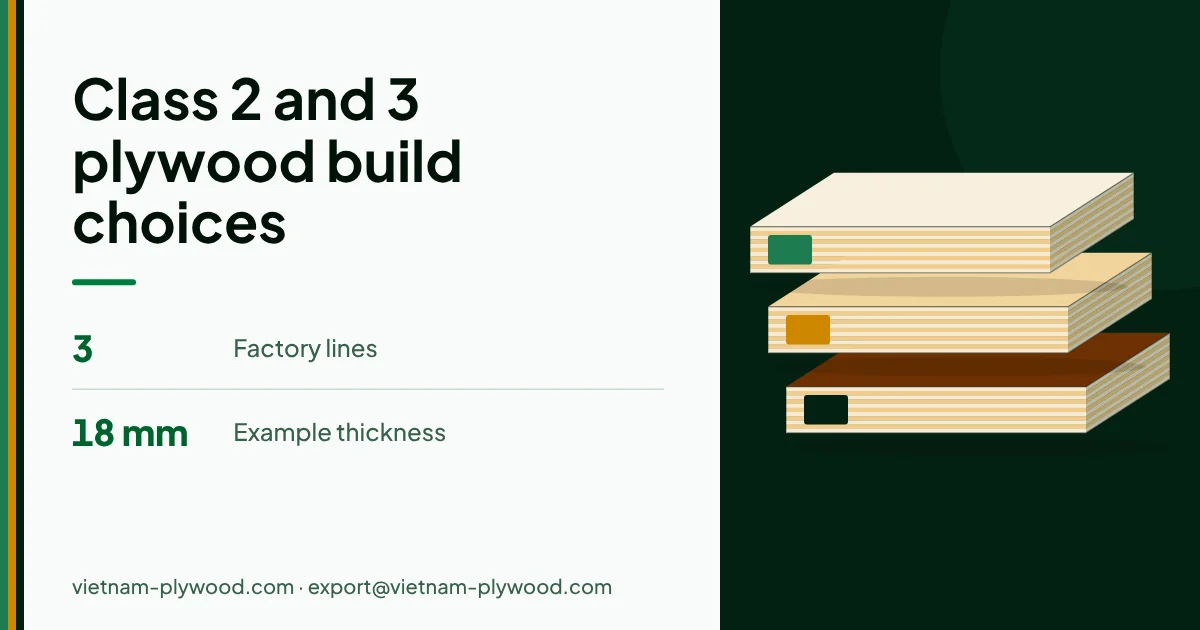
HCPLY’s construction line is the first build to assess for class 3 plywood on a UK exterior-use order; the required EN 636 evidence must match the actual panel. Choosing a humid-use panel for exposed work can mean rejected stock, replacement freight and lost installation days. Our furniture and commercial lines answer different exposure requirements.
What is class 3 plywood?
Class 3 plywood is plywood specified for exterior conditions under EN 636, where exposure can be more severe than a protected, humid interior. The designation describes the panel’s intended use environment and associated requirements. A phenolic adhesive or a dark film face alone cannot establish the classification. Ask for evidence tied to the precise build ordered.
The British Standards Institution (BSI), in its 2015-amended BS EN 636 listing, describes dry, humid and exterior conditions and covers general-purpose and structural plywood. Its standard overview also identifies bonding quality, durability and bending-property classification. That is why an exterior-use request needs a complete panel specification rather than a resin name.
An exposed sign, temporary site barrier or formwork panel presents different moisture and handling demands from a protected cabinet installation. Exterior use still calls for suitable edge treatment, surface detailing and maintenance. The class designation does not independently establish service life or structural capacity.
What is class 2 plywood?
Class 2 plywood is plywood intended for humid conditions under EN 636. It is a candidate for protected fit-outs and other locations where humidity rises, while direct prolonged weather exposure is a separate specification problem. The buyer must describe whether the panel is enclosed, intermittently damp or continuously exposed.
In UK purchasing language, plywood class 2 is sometimes shortened to a moisture-resistance label. That shorthand leaves out the distinction between veneer durability, glue-line performance and finished-panel properties. For cabinet and furniture buyers, face appearance, sanding and emission class also remain independent decisions.
A protected installation with controlled wetting can point toward a class 2 assessment. An uncovered outdoor installation points toward class 3 assessment. Neither designation replaces the project’s own requirements for loads, fixing or detailing.
What is the difference between class 2 and class 3 plywood?
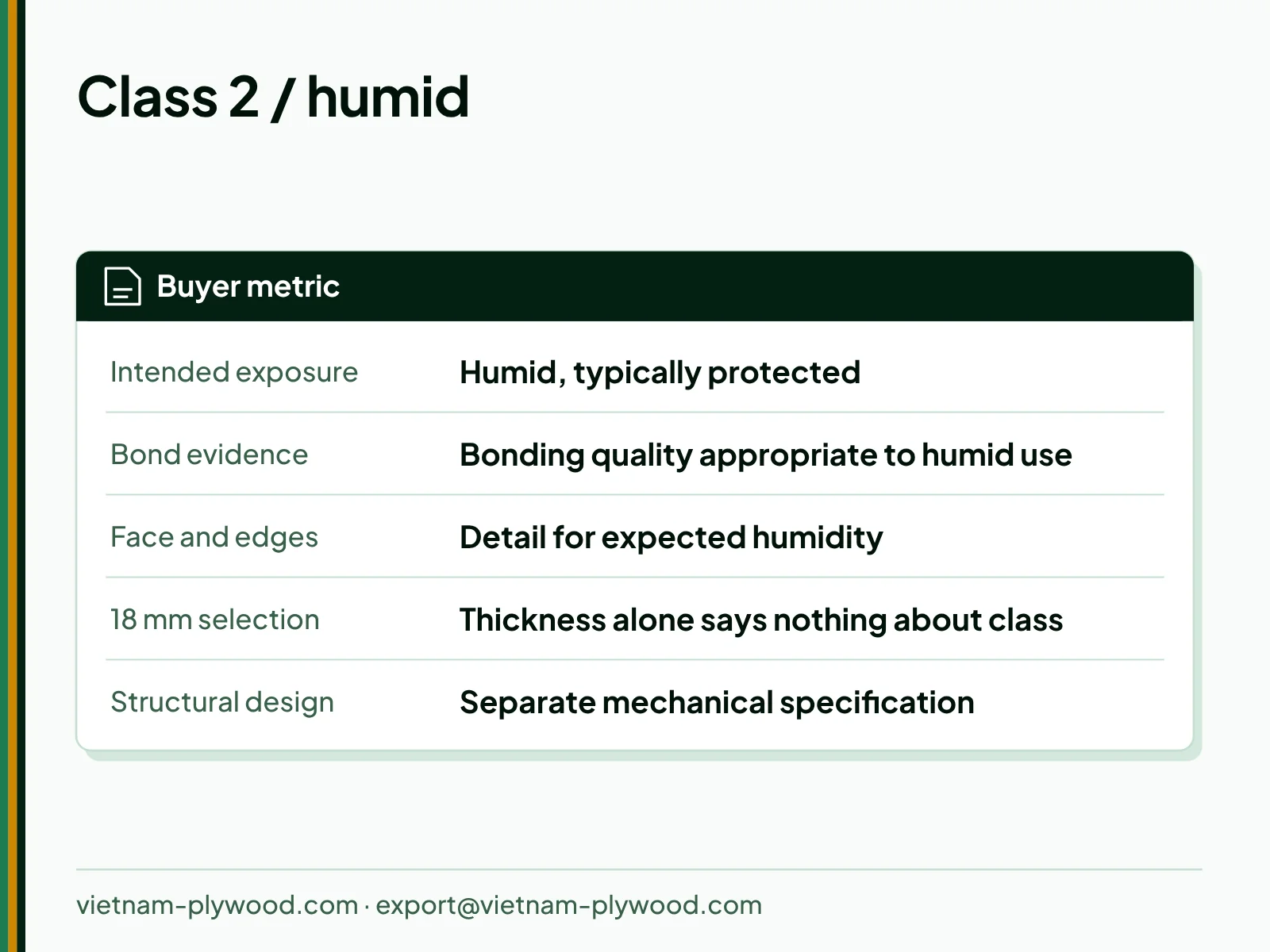
The difference between class 2 and class 3 plywood is the intended exposure: humid conditions versus exterior conditions. Both require a suitable finished panel and evidence of the specified bonding performance. The more demanding use class is not automatically the more appropriate purchase for every fit-out.
| Buyer metric | Class 2 / humid | Class 3 / exterior | Verdict by use |
|---|---|---|---|
| Intended exposure | Humid, typically protected | Exterior exposure | Protected cabinet areas: assess class 2; exposed panels: assess class 3 |
| Bond evidence | Bonding quality appropriate to humid use | Bonding quality appropriate to exterior use | Match the report to exposure |
| Face and edges | Detail for expected humidity | Detail for direct weather and cut edges | Exterior work needs stronger detailing discipline |
| 18 mm selection | Thickness alone says nothing about class | Thickness alone says nothing about class | Test the exact 18 mm build |
| Structural design | Separate mechanical specification | Separate mechanical specification | Neither use class is a design strength grade |
A plywood class 3 label on an invoice is not a substitute for a report. Conversely, buying an exterior-oriented panel for a protected furniture carcass can add an unsuitable surface or unnecessary processing. The correct choice starts with the exposure description.
How do UK use classes relate to EN 636 and EN 314?
UK class 2 and class 3 purchasing requests normally refer to EN 636 humid and exterior use categories; EN 314 addresses the bonding-quality evidence behind them. EN 314-1 is the test-method part, while EN 314-2 is the requirements part. Do not confuse the standard part number with a bonding class.
BSI’s 1993 BS EN 314-2 listing says that bonding classes are specified according to end use and that test methods are in EN 314-1. See the BSI bonding-quality scope. The correct report should name the actual bonding class achieved under the applicable method.
Earlier separate EN 636-2 and EN 636-3 editions are withdrawn; BSI lists BS EN 636:2012+A1:2015 as current. Specify the edition in the purchase order rather than asking only for an old part-number label. The complete standard governs the classification, including matters beyond glue.
Trade terms need translating carefully. MR refers to the melamine glue build used on our commercial and packing line, while WBP means weather and boil proof in our phenolic-glue terminology. These are manufacturing descriptions; an EN 314 bonding result and an EN 636 classification are evidence-based determinations.
Which HCPLY factory build should a UK buyer test?
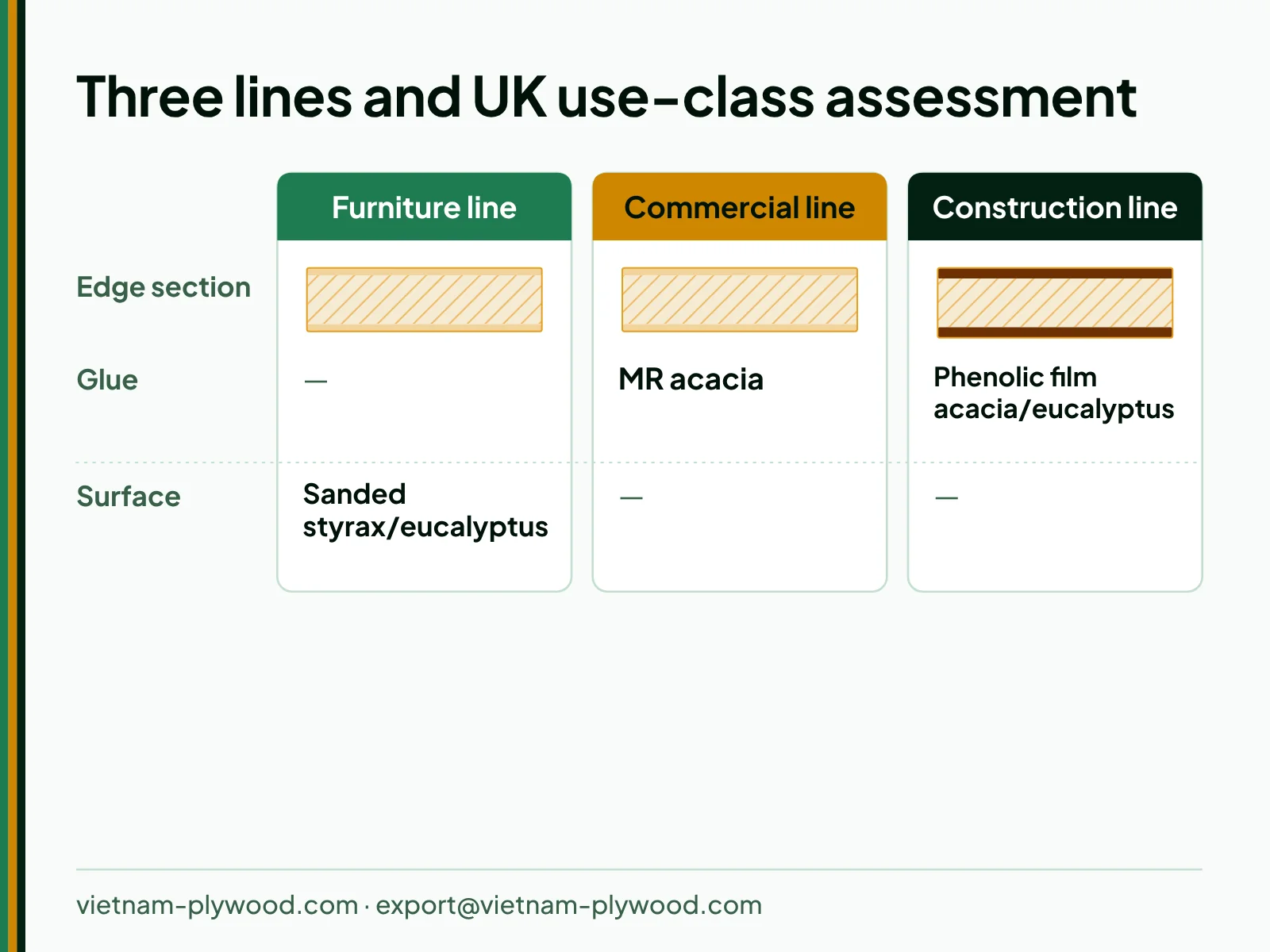
Our construction line is the primary candidate for a class 3 exterior-use assessment, with phenolic film and an acacia or eucalyptus core. The other lines serve furniture appearance or commercial and packing requirements. The same nominal 18 mm thickness can therefore represent substantially different orders.
| Producing line | Example 18 mm build | Glue / finish | Initial UK assessment |
|---|---|---|---|
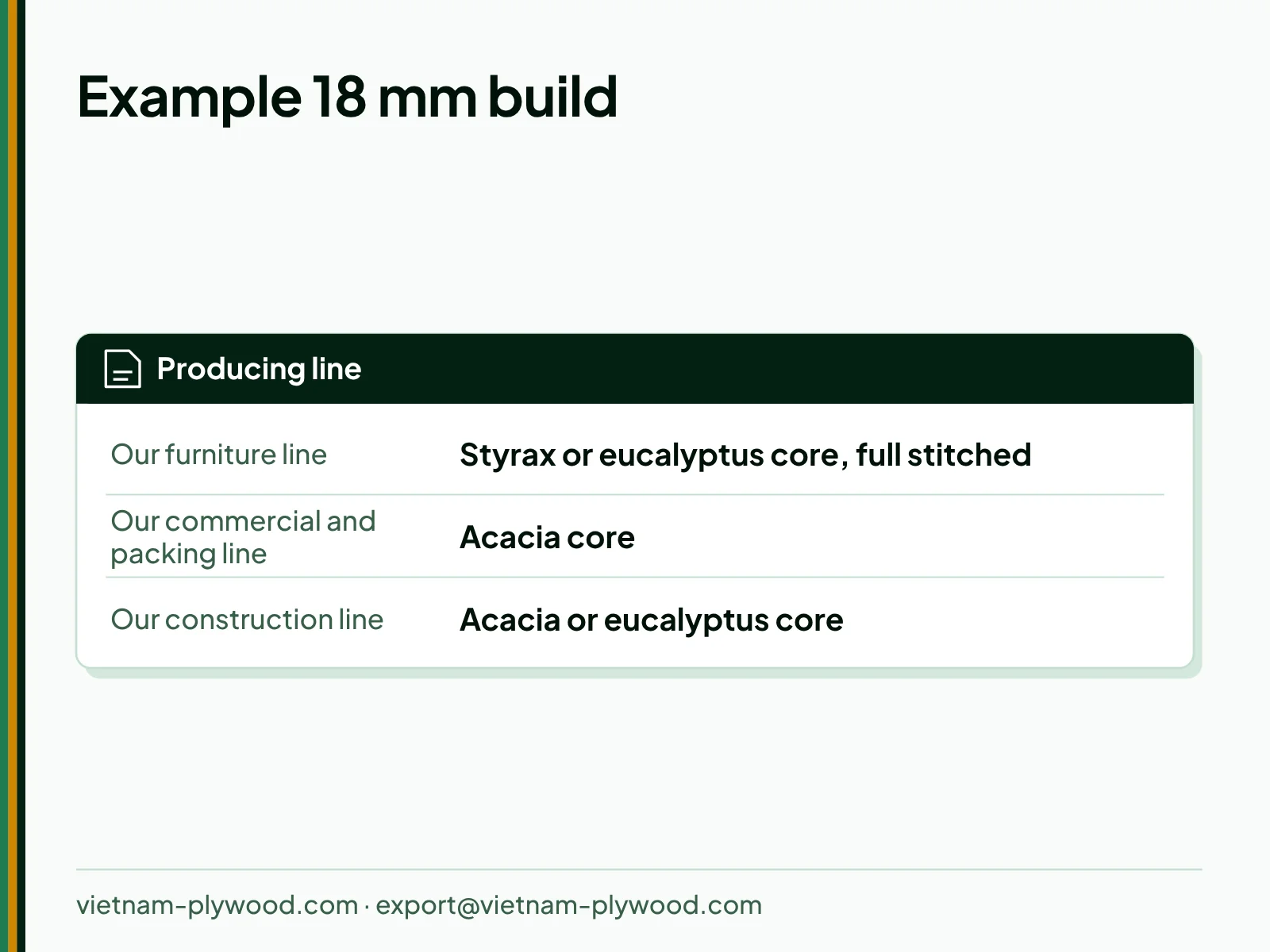
| Our furniture line | Styrax or eucalyptus core, full stitched | Sanded, E0 or E1 emission specification | Furniture and protected fit-out; evaluate humid use if requested |
| Our commercial and packing line | Acacia core | MR glue, unsanded or light-sanded | Packing and protected uses; evaluate the actual humid-use build |
| Our construction line | Acacia or eucalyptus core | Phenolic or melamine film, including anti-slip options | First candidate for exterior-use testing, especially with phenolic glue |
The table identifies build choices, not pre-awarded EN 636 classes. A phenolic film-faced panel still needs a relevant test report before a UK buyer can accept class 3 wording. For selection beyond exposure, see grades across factory lines and our exterior plywood specification.
Our three factories are in Phu Tho and Hai Phong. Each order is made at the producing factory matched to its specification, and buyers can inspect the panels there. For mixed product requirements, see several plywood types in one order.
Does phenolic glue make a panel exterior grade?
Phenolic glue supports an exterior-oriented build, but glue chemistry alone does not assign an EN 636 class. The construction line uses phenolic WBP glue with a 72-hour boil description; its hot-press range is 130–145 °C. Melamine MR glue is described by a 12-hour boil and a 110–120 °C hot-press range.
These production descriptors help a buyer identify which build to sample. They do not replace the EN 314 conditioning, testing and acceptance criteria. Core quality, veneer bonds and the final panel’s properties still matter.
Film face also answers a different question. Our construction line offers 120 g/m² standard film, 135 g/m² premium film and 220 g/m² anti-slip film. A heavier face can be relevant to the intended handling or surface requirement, but film weight is not an EN 636 class result.
When discussing class 3 plywood meaning with a technical buyer, keep adhesive, face, exposure class and emission class in separate fields. This prevents a product name from silently becoming a performance claim.
What changes when the order is for 18 mm plywood?
An 18 mm panel is a thickness choice, not a class designation. Both class 3 plywood 18mm and class 2 plywood 18mm requests need an identified construction, bonding specification and testing scope. HCPLY’s 18 mm builds use 11–13 plies according to the veneer thickness.
For a 1220 × 2440 mm panel, the sanded furniture tolerance is ±0.2 or ±0.3 mm as ordered. Commercial and film-faced tolerance is ±0.5 mm; packing tolerance is ±0.5–1.0 mm. Length and width tolerance is ±2 mm. A UK order should state which tolerance applies before samples are approved.
Face selection matters for furniture and cabinet makers. The furniture line can use named veneers such as bintangor, okoume or engineered veneer, with A/B face grades where applicable. The construction line instead uses film faces, and the commercial line is focused on practical packing specifications.
For container planning, the published 18 mm, 1220 × 2440 mm lookup is 990 styrax-core, 880 acacia-core or 795 eucalyptus-core sheets per full 40HC, with respective weights of 26.52, 27.35 and 27.69 tonnes. Mixed specifications must stay within the 28.5-tonne payload limit; use the container loading tool for the detailed load question.
What test report proves the class on a UK order?
A useful report identifies the tested plywood build and records the methods, results and classification against the agreed standard edition. Ask the laboratory to connect its sample identification to the producing factory’s order specification. A generic resin certificate cannot answer the finished-panel question.
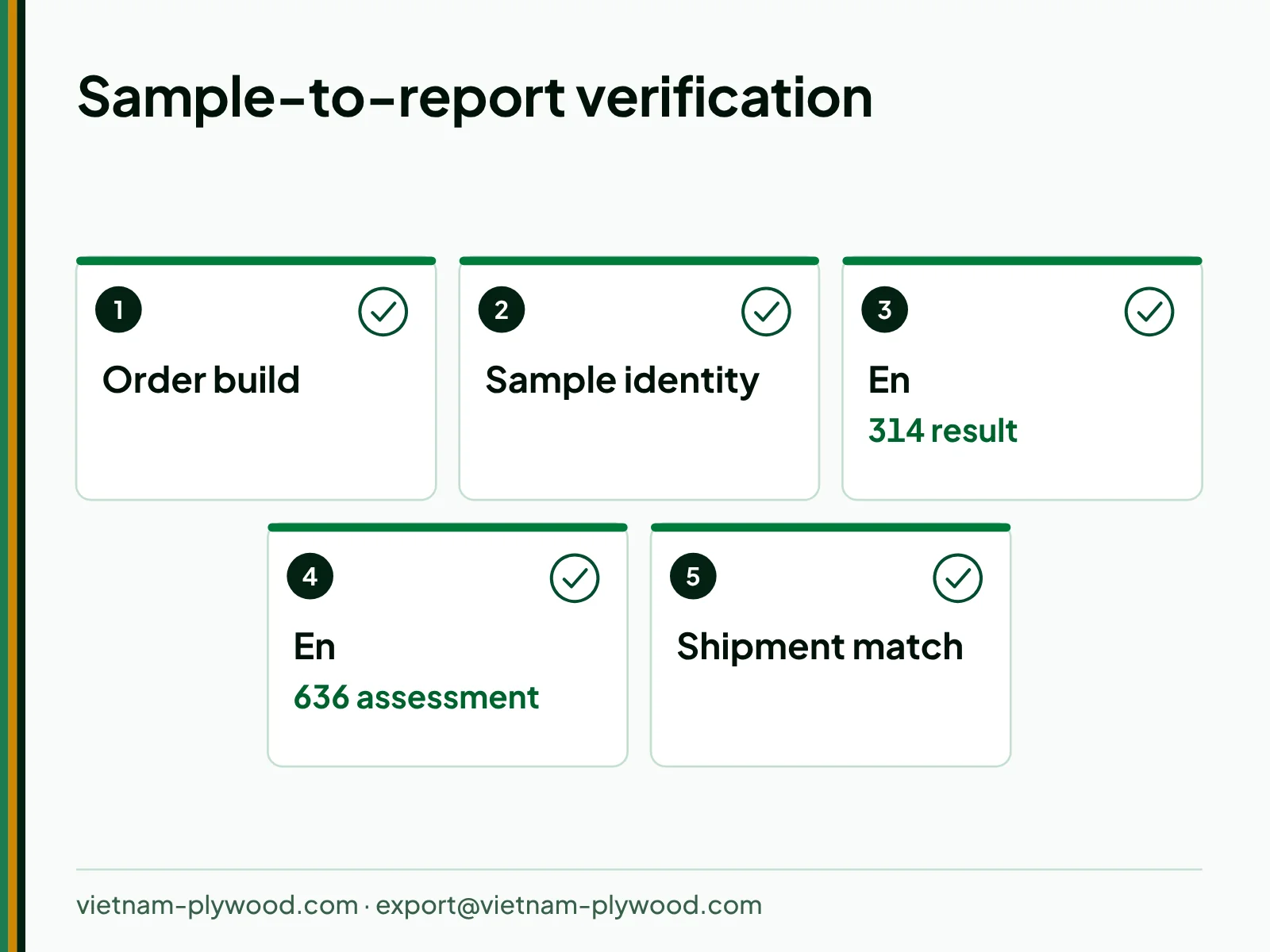
- Define the exposure: dry, humid or exterior; note whether faces and cut edges will be protected.
- Freeze the sample build: core, veneer arrangement, glue, face, nominal thickness, size and production line.
- Agree the standards: EN 636 classification and the relevant EN 314 bonding tests, with editions and acceptance criteria written down.
- Check traceability: sample marking, test date, laboratory identity, conditioning, results and reported class.
- Match shipment to sample: compare the production record and inspected panels against the tested construction before document approval.
At the producing factory, a buyer or inspector can witness thickness checks, inspect cut edges for core gaps, examine face and film consistency, and compare sample identifiers with the order. These visual checks complement laboratory results; they cannot independently certify a use class.
The shipment document set can include the agreed build’s test report and emission certificate, alongside the commercial invoice, packing list and bill of lading. After loading, the draft shipping documents come to you for approval. Our certifications articles explain related documentation topics.
Is an EN 636 use class enough for structural plywood?
An EN 636 use class is insufficient by itself to establish a structural panel’s design values. A structural specification needs the relevant strength and stiffness information, intended application and construction-product conformity route. This matters when a buyer moves from cabinet components to load-bearing sheathing or site structures.
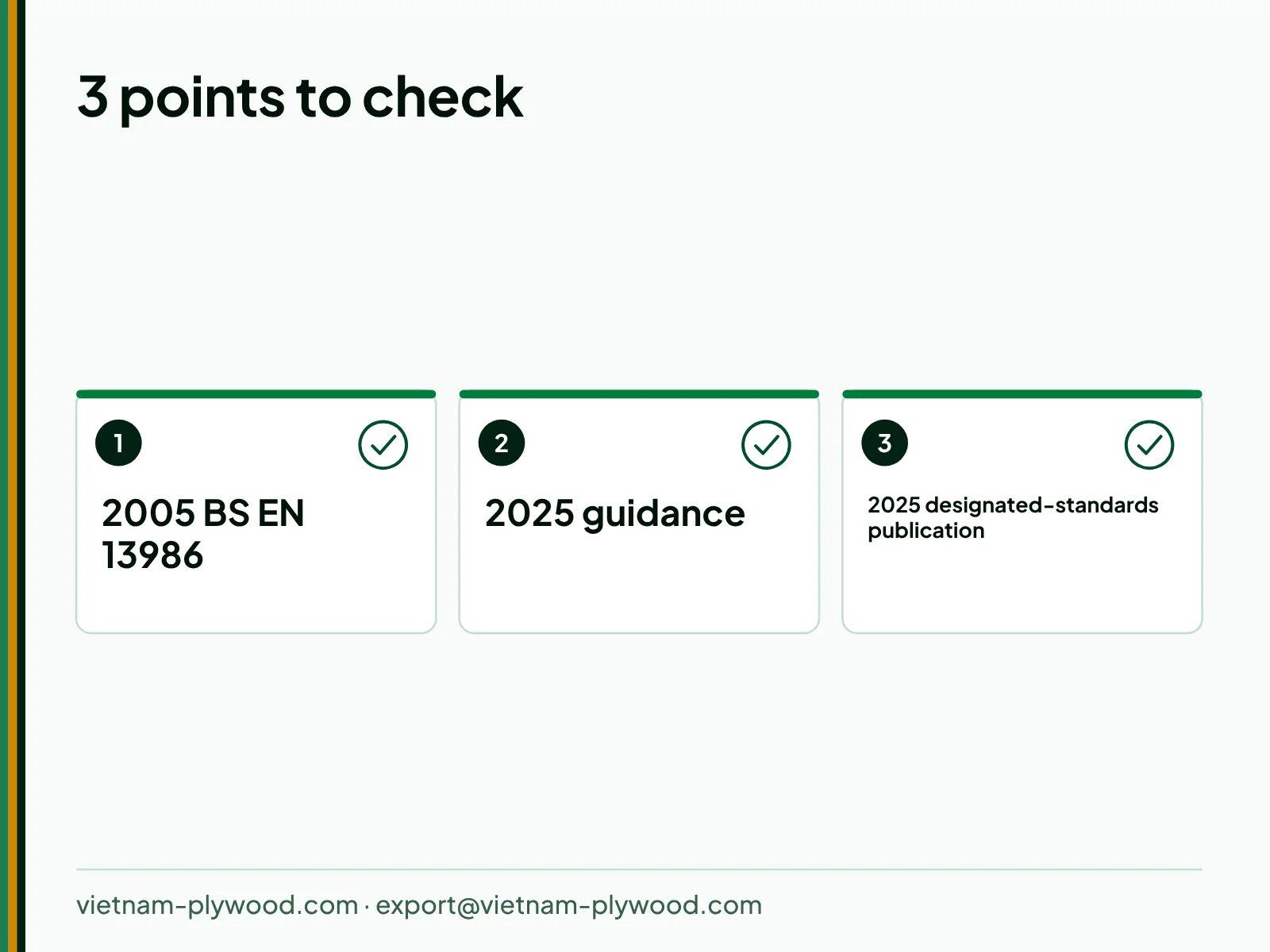
BSI’s 2005 BS EN 13986 overview identifies construction-panel characteristics and conformity evaluation for structural and non-structural applications. See the BSI EN 13986 scope. It addresses different applications, including external structural components.
The UK government’s 2025 guidance explains that designated standards form part of the construction-products framework in Great Britain. Its construction-products guidance also distinguishes Great Britain from Northern Ireland. For an actual construction placement, the importer should establish the applicable conformity and marking obligations for the intended market and product.
The UK government’s 2025 designated-standards publication provides the maintained list and explains how designated standards support the regulatory framework. See the official publication. A class 3 test report does not replace the wider conformity assessment where that assessment applies.
How should the UK importer write the order?
Write the purchase order around exposure, build identity and accepted test evidence. A vague request for exterior plywood can produce a film-faced construction panel when the project actually needs a sanded visible face. A precise specification makes the quotation and inspection criteria comparable.
For HCPLY, the minimum order is one 40HC, and different specifications can be mixed within the payload limit. Delivery can be FOB Hai Phong, CFR (CNF) or CIF. State the destination port and whether the consignment is intended for construction or furniture use.
Our export team handles specification, on-site quality control, documents and loading. For certificate requests involving member factories, FSC, CARB P2, ISO 9001 and CE records are shown with factory details masked, on request. Ask for the relevant document to match the actual producing factory and order.
When ordering UK construction panels, also identify whether the goods will enter Great Britain or Northern Ireland. The conformity route is a separate check from the moisture-use classification. The contact team can prepare the build specification for Lucy at export@vietnam-plywood.com.
What specification should the buyer send?
Send a written build and evidence request with the intended exposure clearly named. The sample, test report and eventual shipped panels should all refer to that same construction. Use the following lines as the purchasing starting point.
Application: UK protected humid fit-out / exposed exterior application
Line or core: construction / acacia or eucalyptus; or furniture / styrax or eucalyptus
Glue: phenolic WBP or melamine MR; specify intended bonding class and test
Emission: E0 / E1 / E2 as required; separate from glue
Face and grade: film weight or named veneer with applicable face grade
Thickness and tolerance: 18 mm; state ordered tolerance
Size: 1220 x 2440 mm or listed alternative
Quantity: one 40HC minimum; identify mixed specifications if needed
Destination port: [UK port]; GB or Northern Ireland market
Evidence: EN 636 edition, EN 314 methods, sample traceability and report scope
Request the spec sheet from Lucy at export@vietnam-plywood.com before arranging the test scope.