





SP101 plywood identifies a UK flooring and joinery product specification; it does not define a universal factory grade, glue or core. Choosing a sheet by its code alone can cause rejected flooring work, costly reordering or missed installation dates. HCPLY compares the requested build, test evidence and intended use before preparing a Vietnam factory quotation.
What is SP101 plywood?
SP101 plywood is a named UK flooring and joinery plywood product specification used in merchant listings, rather than a universal plywood grade. Buyers often associate it with a smooth hardwood face, controlled thickness, dependable bonding and flooring underlay work. The exact characteristics belong to the named product and its documents; an alternative panel must be assessed against a written schedule.
For an importer, the useful first step is to separate the product name from the properties that matter in the installation. A merchant listing for 6 mm SP101 describes flooring and joinery use, a sanded surface, an E1 emission class and an exterior bond classification. Those details give a starting comparison, but they do not turn every hardwood sheet into the same product. We quote the requested construction and evidence separately.
A cabinet or fit-out buyer may value the smooth face and thickness control more than the flooring application. A flooring contractor may require the named product, a particular approval or a documented installation system. Record which situation applies before inviting an alternative quotation.
Is SP101 an official plywood standard?
SP101 is a commercial product designation, not the number of a British or European plywood standard. A specification that says only “SP101 equivalent” leaves the actual face, bond, dimensions and acceptance evidence open to interpretation.
The relevant technical references can include EN 636 for plywood use conditions, EN 314-2 for bonding quality, and EN 13986 for wood-based panels in construction. These standards address different questions. They do not make SP101 a generic grade, and a glue recipe alone does not establish an EN bond classification.
The named flooring product is promoted for particular underlay applications. A substitute requires the project designer or purchaser to state the performance criteria and accept the evidence for the proposed panel. Where the project names a proprietary product without an alternative clause, quote that named requirement accurately rather than silently replacing it.
Which grade, glue and core does an SP101 quote usually mean?
A workable SP101-type enquiry normally asks for a smooth hardwood-faced sheet, a defined bond class, a controlled core and a stated emission class. It should identify the end use before choosing a production line. The merchant reference describes a 6 mm smooth-sanded mixed-hardwood panel with E1 emissions and EN 314-2 Class 3 bonding.
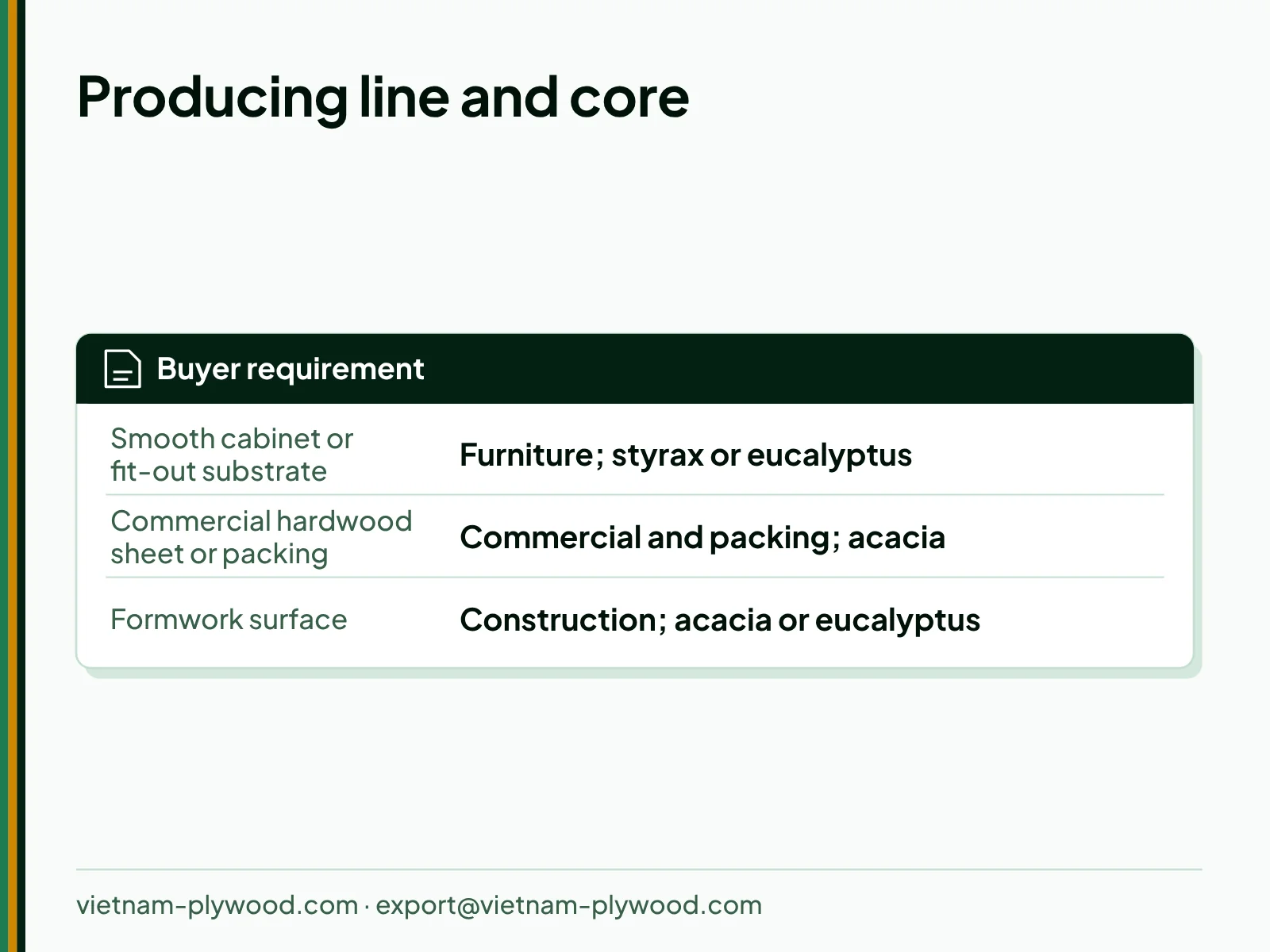
Our commercial and packing line builds acacia-core plywood with moisture-resistant (MR) glue and an unsanded or light-sanded finish. That can be quoted for a written commercial specification, but it is not automatically a substitute for a flooring panel requiring exterior bond evidence. Our furniture line is the more suitable starting point for a fully stitched, sanded cabinet or fit-out build, using styrax or eucalyptus core and E0 or E1 emission selection.
Glue and emissions belong on separate lines of the order. Melamine MR glue has a 12-hour boil description in our production range; phenolic weather-and-boil-proof (WBP) glue has a 72-hour boil description. Neither factory boil description should be rewritten as an EN 314-2 test result. If the purchaser needs Class 3 bonding, specify the accepted test report for the exact build.
How do the three factory builds compare?
The application decides which line should press the order. A sanded joinery panel, a light-sanded packing panel and a film-faced construction panel are different products even when the nominal thickness matches.
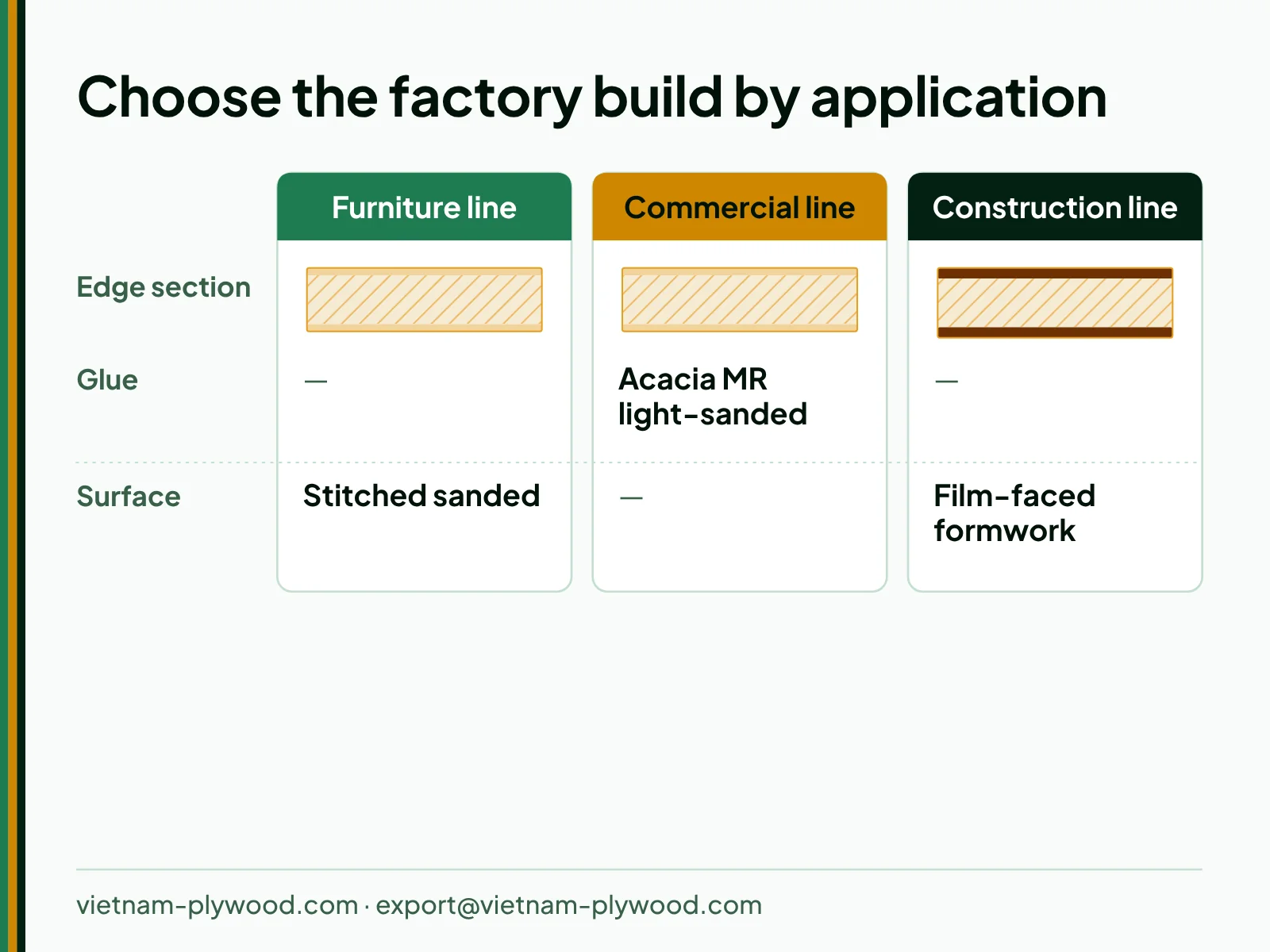
| Buyer requirement | Producing line and core | Face and surface | Glue or emission field | Purchasing verdict |
|---|---|---|---|---|
| Smooth cabinet or fit-out substrate | Furniture; styrax or eucalyptus | Selected veneer, fully stitched and sanded | E0 or E1; glue specified separately | Start here for controlled decorative substrate |
| Commercial hardwood sheet or packing | Commercial and packing; acacia | Raw or selected veneer, unsanded or light-sanded | MR glue; emission requested separately | Quote against commercial use, not a named flooring approval |
| Formwork surface | Construction; acacia or eucalyptus | Phenolic, melamine or anti-slip film; unsanded | Film and glue specification | Suitable category for formwork, not flooring underlay |
For commercial plywood, the written application and face grade guide the quote. For a smoother visible surface, bintangor plywood illustrates why the face name should be stated independently from the core. We produce orders at the factory matched to the specification and ships directly from that factory.
What SP101 plywood thickness should a buyer request?
The merchant reference lists a 6 mm SP101 sheet, with a 1220 × 2440 mm full-sheet option and a 610 × 2440 mm narrow-sheet option. For the named product’s broader range, request its current technical data sheet rather than treating a single stockist listing as the complete schedule.
Our production thickness range is 3–40 mm, with common sizes of 3, 5, 9, 12, 15, 18, 21 and 25 mm. We can discuss 6 mm against a written specification as well. Standard sheet formats include 1220 × 2440 mm and 1250 × 2500 mm, with custom cutting available. A 610 mm width should be specified as a cutting requirement rather than presumed stock.
For a sanded furniture build, the ordered thickness tolerance is ±0.2 or ±0.3 mm. Commercial plywood is ±0.5 mm; packing is ±0.5–1.0 mm. Length and width tolerance is ±2 mm. A quoted tolerance must be matched to the producing line and the inspection plan. The merchant’s 6 mm ±0.2 mm figure is a useful benchmark for a precise flooring enquiry, not a tolerance to transfer automatically to our commercial line.
Can a Vietnam manufacturer supply against an SP101 specification?
A Vietnam manufacturer can quote a panel against measurable SP101-type requirements, provided the buyer states which characteristics and documents are mandatory. A quoted equivalent is a separate build and should be approved by the buyer against the application.
HCPLY operates three member factories in Phu Tho and Hai Phong. The furniture line is the first option for a smooth, full-stitched joinery substrate. The commercial line can quote an acacia-core, light-sanded panel when the use permits its MR bond specification. If the application needs a different weather-exposure performance, discuss exterior plywood specifications and the exact test evidence instead of relying on a product nickname.
A practical quotation sequence is: first state the installed use and required standard; next fix face, core and glue; then define dimensions and tolerance; finally attach the acceptance documents. The buyer can inspect the goods at the producing factory and visit its factory office. This sequence keeps an appearance match from being mistaken for a performance match.
Which CE marking documents come with SP101-type plywood?
CE marking documentation must relate to the actual product and its intended construction use, rather than the words “SP101-type” on an enquiry. For a construction-product application, ask for the applicable Declaration of Performance, marking information, standard reference and supporting assessment evidence.
The UK government’s Construction Products Regulation in Great Britain guidance, updated in 2025, states that CE marking continues to be available for construction products placed on the Great Britain market. Its guidance also distinguishes CE assessment through an EU-recognised notified body from UKCA assessment through a UK-approved body. See the government’s construction products guidance.
Member-factory CE and other certificate documents are shown with factory details masked, on request. The document review must establish whether a specific declaration and supporting report cover the ordered panel, its intended use and the market. An existing certificate for another product is insufficient for that purpose. If the buyer needs EN 13986 evidence, put that requirement in the order specification before production.
A commercial invoice, packing list, bill of lading and certificate of origin form part of the shipment documents. Order-specific certificates and agreed test reports accompany the relevant document requirements. After loading, the draft shipping documents come to you for approval. The marking evidence and shipping paperwork answer different questions; ask for both where applicable.
What should an inspector check at the producing factory?
The inspection should compare the finished sheets with the approved specification, starting with dimensions and visible core construction. A buyer or appointed inspector can witness sampling and record the measurements before the load is closed.
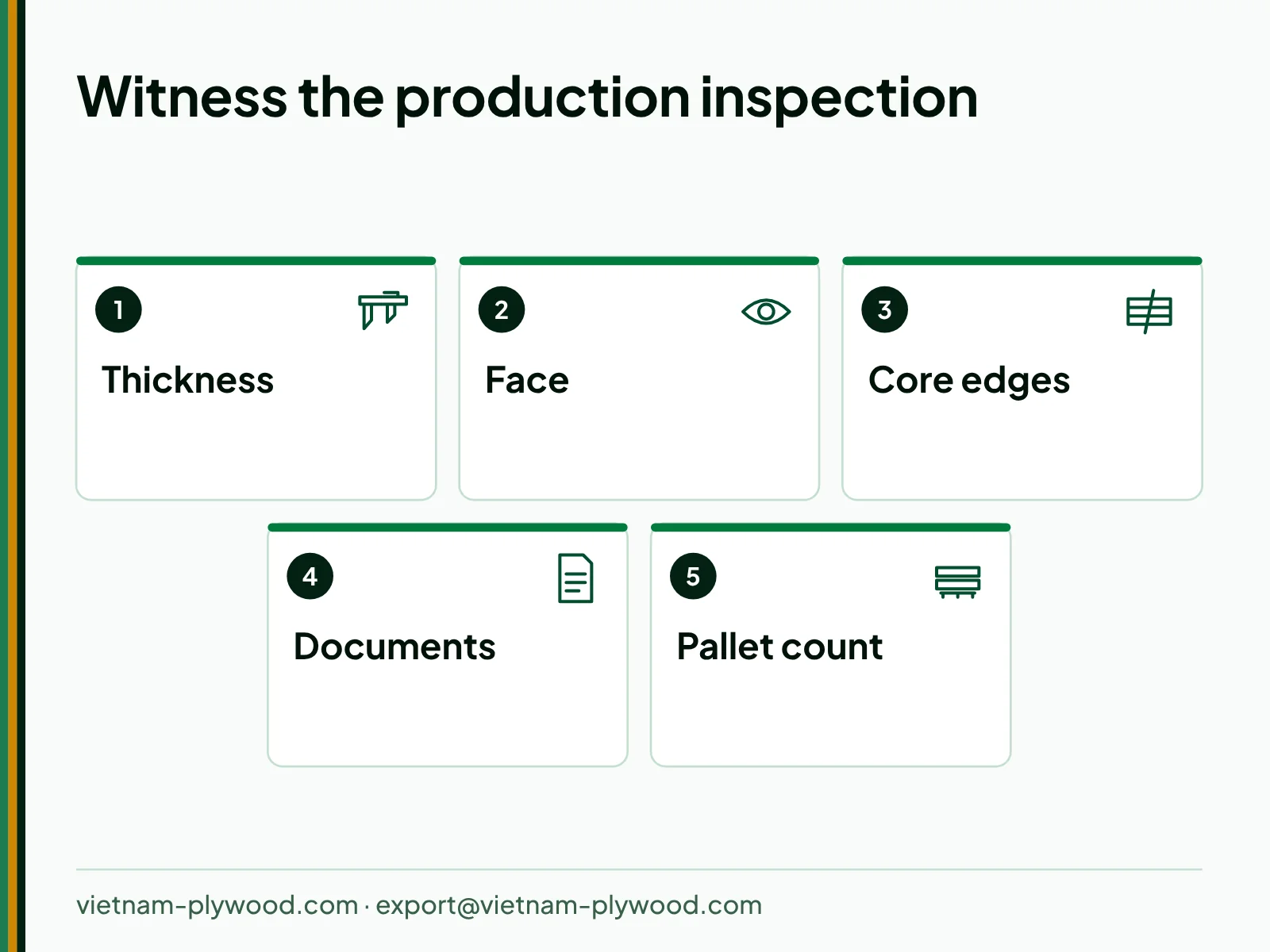
- Identify the producing line, order reference and labelled panel build.
- Measure thickness across representative sheets and compare with the ordered tolerance.
- Inspect face grade, sanding quality, edge gaps and core continuity at accessible edges.
- Check the agreed glue and emission documentation against the production identification.
- Match pallet counts, dimensions and labels with the packing list before loading.
A visual inspection cannot establish an EN bond class or emission result. Those claims require the relevant accepted reports. For furniture orders, full stitching and sanding are observable construction details; for commercial orders, edge-trimmed or light-sanded finishes must match the signed specification. The checklist can be added to a purchaser’s pre-shipment inspection instruction.
Can SP101-type sheets share a container with other plywood?
Specifications can be mixed within one 40HC container while respecting the 28.5 t payload limit. The mix should be planned by core density, sheet dimensions, thickness and pallet arrangement, rather than counting every panel as the same weight.
At 1220 × 2440 × 6 mm, an acacia-core sheet weighs 10.36 kg, while a styrax-core sheet weighs 8.93 kg and a eucalyptus-core sheet weighs 11.61 kg. A full single-core reference load is 2,656 acacia sheets at 27.51 t, 2,988 styrax sheets at 26.68 t or 2,415 eucalyptus sheets at 28.04 t. These values exclude any film weight.
For a mixed load, provide the quantities by core and thickness so the producing factory can check pallet geometry and the total loading mass. Pallet mass and other loading items also count toward the payload limit. See mixed-container arrangements and the container-loading reference for the loading question.
What changes the quotation and delivery plan?
The largest price drivers are the requested bond performance and accepted evidence, core construction, sanding tolerance and face selection. A fully stitched, precisely sanded furniture panel requires more finishing work than a light-sanded commercial panel. A specified test programme and narrower tolerance add work beyond an appearance-only comparison.
Commercial plywood starts from US$250/m³ FOB Hai Phong (October 2026); furniture plywood starts from US$350/m³ FOB Hai Phong (October 2026). Those are category starting points, not a price for an SP101-labelled panel or a declared flooring equivalent. Send the complete written specification for a product-specific quotation.
The minimum order is one 40HC, with mixed specifications permitted within payload. Production takes 15–45 days from the 30% deposit, set by order size, line loading and the contract. The 70% balance is against the scanned bill of lading, by telegraphic transfer or irrevocable letter of credit at sight. We ship FOB Hai Phong, or CFR (CNF) or CIF to your port. See production lead time for planning. Free samples are available; new buyers book their courier, and its cost can be credited against a real order.
How should a buyer compare SP101 stockists and alternatives?
Compare SP101 plywood stockists by the product identity, documented performance and delivered sheet format. A stockist listing may give useful information about an actual branded sheet, while a manufacturer’s quotation defines a new production build.
For a fair comparison, request the technical data sheet, intended-use statement, bond-class report, emission evidence, dimensions and surface acceptance criteria. Ask whether the named product’s certification is essential to the contract. The benchmark retailer lists 6 mm, a smooth-sanded face and a defined bond classification. Compare any proposed panel using its own technical data sheet and accepted test evidence.
For cabinet work, compare finish quality and machining requirements against the commercial versus packing plywood distinction. For more demanding mechanical applications, start with the heavy-duty plywood specification. If the design actually calls for laminated veneer lumber, use the LVL product category rather than describing ordinary plywood as LVL.
What specification should the purchasing team send?
A useful enquiry states the installed use and the exact evidence needed to approve a proposed alternative. The purchasing team should distinguish the named UK product from a factory build specified by properties.
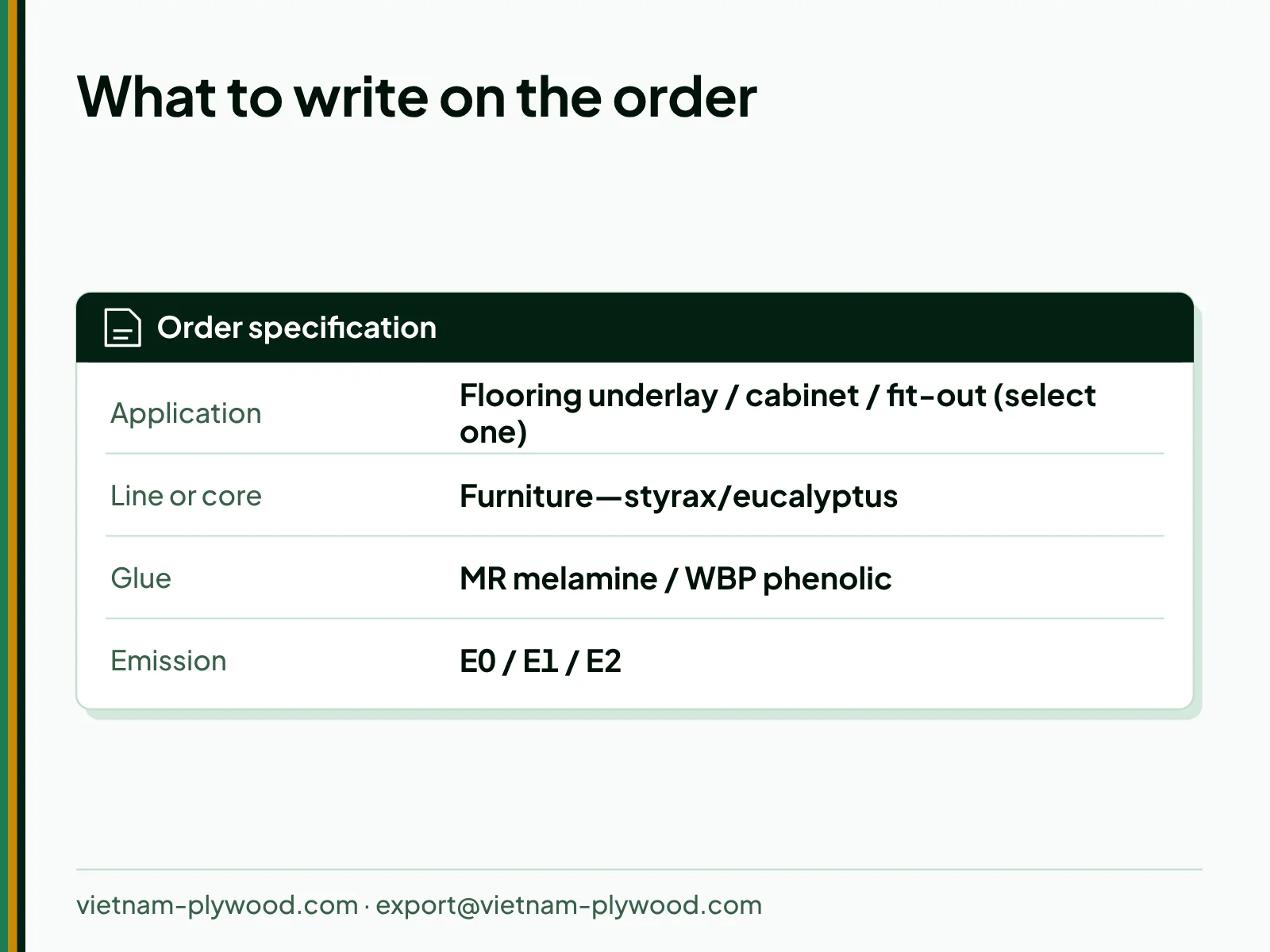
The lines below give Lucy enough information to direct the enquiry to the appropriate factory. State the destination port so that the delivery term and document requirements can be quoted together.
Application: flooring underlay / cabinet / fit-out (select one)
Line or core: furniture—styrax/eucalyptus; commercial—acacia
Glue: MR melamine / WBP phenolic; required bond test class
Emission: E0 / E1 / E2; accepted test evidence
Face and grade: veneer species, A/B; surface finish
Thickness and tolerance: ___ mm; ___ mm
Size: ___ × ___ mm; any cutting instruction
Quantity: ___ sheets / ___ m³; mixed-load schedule
Destination port: ___; delivery term ___
Book a factory visit through Lucy at HCPLY to inspect the proposed build at the producing factory before placing the order.