






Plywood decks on H20 beams work when sheet modules, supported seams and bearer positions follow the approved slab plan. A wrong module can mean extra cuts, lost pours or a rejected load. HCPLY supplies film-faced deck panels from our construction line and coordinates the export specification; bearer availability must be established separately.
Which sheet module suits a plywood deck on H20 beams?
Choose 1220 × 2440 mm when the approved bearer grid and edge supports fit that module; choose 1250 × 2500 mm when its larger footprint reduces joints without leaving unsupported edges. Neither module sets the H20 spacing. Start with the engineer’s deck drawing, then mark every sheet seam, cutout, and bearer contact line before ordering.
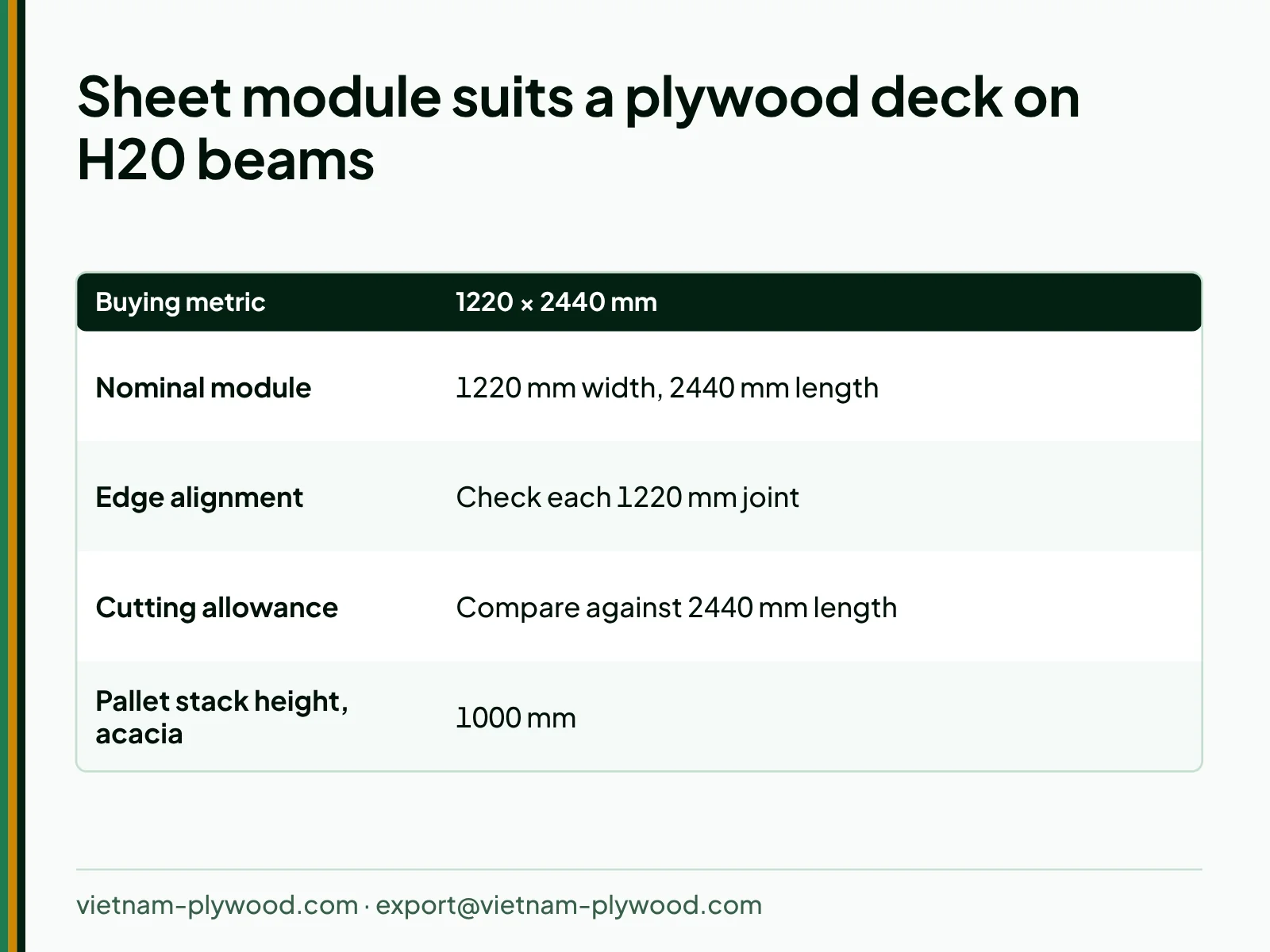
The 1220 × 2440 mm sheet has a smaller nominal footprint and can suit repetitive bays laid out around that module. The 1250 × 2500 mm sheet offers a larger uncut footprint, but only where its edges meet the designed support arrangement. Turning a panel or shifting a joint changes where the edge lands; a nominal sheet size cannot replace the bearer plan.
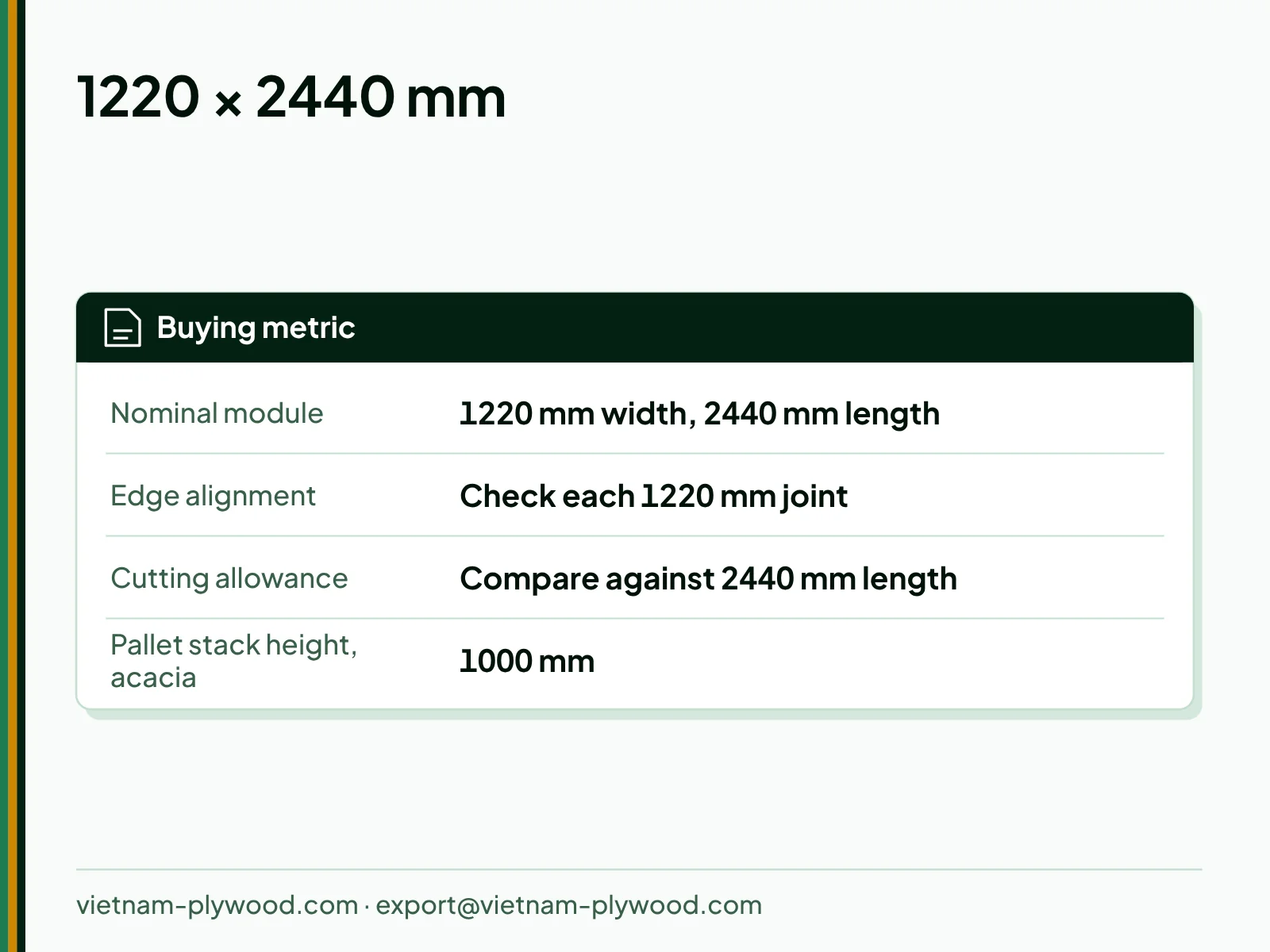
| Buying metric | 1220 × 2440 mm | 1250 × 2500 mm | Selection verdict |
|---|---|---|---|
| Nominal module | 1220 mm width, 2440 mm length | 1250 mm width, 2500 mm length | Match approved bay dimensions |
| Edge alignment | Check each 1220 mm joint | Check each 1250 mm joint | Choose the module with supported seams |
| Cutting allowance | Compare against 2440 mm length | Compare against 2500 mm length | Choose the lower-waste cutting plan |
| Pallet stack height, acacia | 1000 mm | 970 mm | Account for packing geometry |
A buyer should send a marked deck plan rather than an isolated request for a sheet size. Our slab deck formwork plywood overview explains the wider deck application.
What plywood thickness goes on H20 beams for a slab?
Specify thickness from the design load and supported span, then check the selected panel build against the engineer’s formwork calculations. Common thicknesses include 12, 15, 18, 21 and 25 mm, but none is an automatic H20 beam spacing approval.
Wet-concrete load, placement sequence, construction activity, panel bending stiffness, deflection limits and bearing conditions all affect the decision. A thicker panel may reduce deflection for an otherwise comparable build, but changes to core construction and bearer spacing also change performance. Ask for the actual span and loading schedule before choosing between 18 and 21 mm.
The US Occupational Safety and Health Administration’s rule, amended in 1996,, 29 CFR 1926.703, requires formwork to support reasonably anticipated vertical and lateral loads. It also calls for current formwork and shoring plans at the jobsite. This is a design responsibility, rather than a published universal plywood thickness chart.
Our construction line presses film-faced deck sheets with acacia or eucalyptus cores. The core affects sheet mass and the selected construction affects the response under load. For a proposed 18 mm build, the veneer schedule is 11–13 plies; the exact construction belongs on the purchase specification.
How should screw holes and cut edges be sealed?
Seal exposed screw penetrations and freshly cut edges with a compatible edge-sealing system before the next pour. A film surface protects the faces, while drilling and sawing expose paths where water can reach the veneer stack.
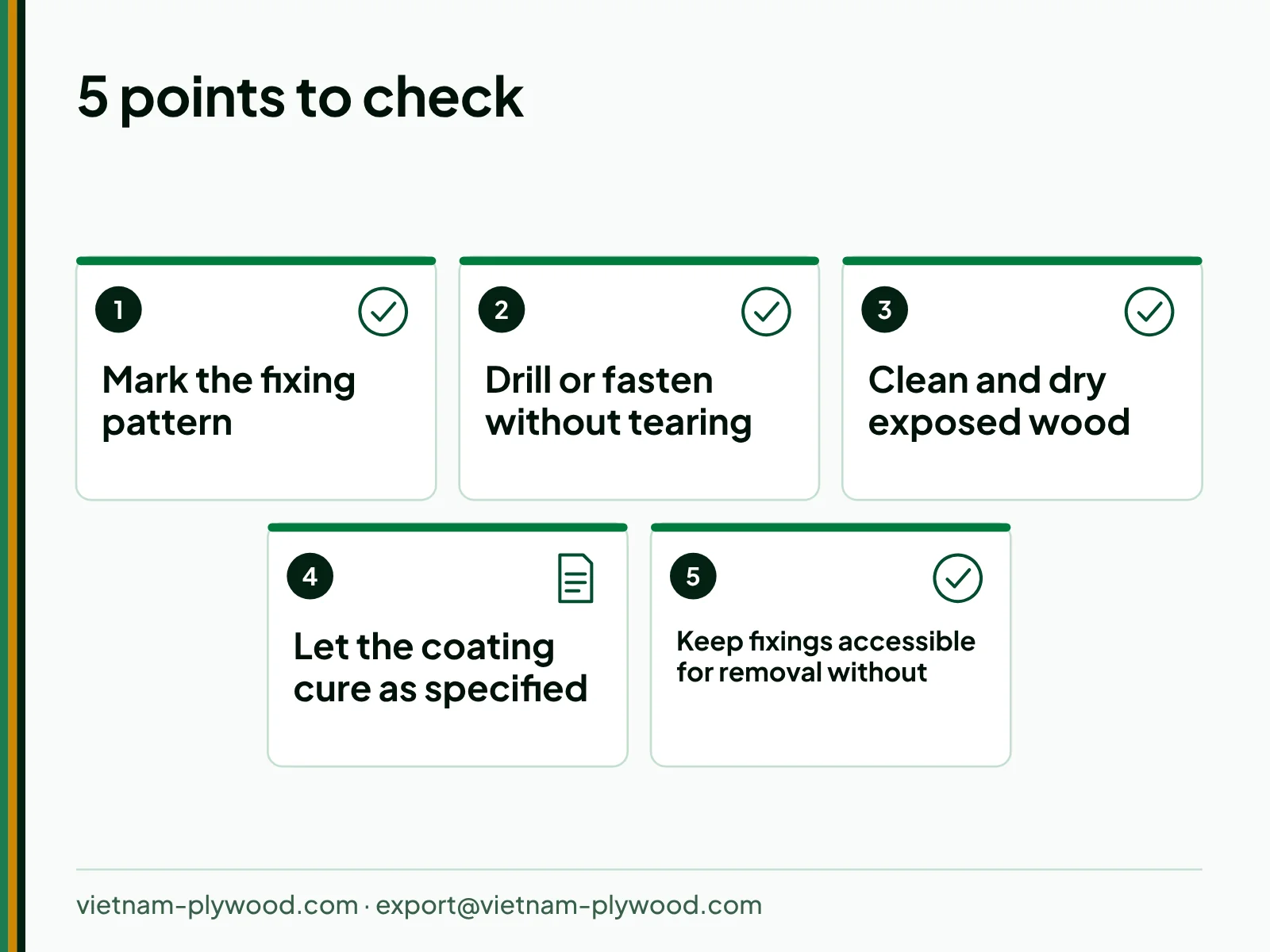
- Mark the fixing pattern from the approved deck drawing and avoid unnecessary penetrations.
- Drill or fasten without tearing the film around the hole; remove loose material.
- Clean and dry exposed wood, then apply a compatible sealer to hole walls and cut edges following its application instructions.
- Let the coating cure as specified before concrete contact; inspect and repair damaged spots after stripping.
- Keep fixings accessible for removal without levering against the panel face.
Do not assume that the face film automatically seals a screw hole. A buyer can request an inspection demonstration on a sample cut edge and drilled fixing point at the producing factory.
What thickness tolerance do deck panels hold?
Our construction line holds a stated thickness tolerance of ±0.5 mm for film-faced panels, with length and width at ±2 mm. Put both dimensions and the acceptance method on the order so the inspection follows the same reference points.
Thickness checks should sample across the panel, away from crushed corners and visible local damage. Record actual measurements and the gauge used. Compare the result with the ordered nominal thickness and tolerance, rather than comparing unrelated batches by touch.
Film weight is a separate specification: 120 g/m² standard, 135 g/m² premium or 220 g/m² anti-slip only. The anti-slip option is a distinct surface choice; the deck face must match the intended concrete finish. Film weight alone does not establish structural capacity.
Does fixing to H20 beams reduce panel reuse?
Fixing can reduce the useful number of pours when fasteners tear the film, holes admit moisture or stripping damages the face. A planned fixing pattern, sealed penetrations and careful removal protect the panel’s working surface.
With proper handling, a release agent on every pour and sealed edges, including cut edges, melamine-glue film-faced panels achieve about 12–15 pours; phenolic-glue film-faced panels reach up to about 25 pours. These figures assume the stated care conditions and are not a separate count for screw-fixed decks.
After each pour, clean without scraping through the film, inspect corners and screw locations, and store sheets flat. Retire panels with damaged bonds, severe distortion or surfaces that cannot meet the required concrete finish. A reusable deck is also a safe deck only after its condition is checked against the project requirements.
Can panels be cut to match the beam and prop layout?
Yes, custom cutting is available for a documented deck layout. Send the cut schedule with the bearer and prop drawing, identify every supported edge, and distinguish factory cuts from field adjustments.
A cut sheet must still transfer its loads through the designed support arrangement. Openings around columns and services need their own framing details. Avoid treating a narrow offcut as a full-width panel without a design check.
The practical sequence is to freeze the structural layout, prepare a numbered cutting list, mark face orientation and edge sealing, then match each piece to its bay. Our construction line can prepare specified panel dimensions; the project designer retains responsibility for support positions and fixings.
Can LVL bearers share the container with deck panels?
A mixed container can include specified items within the 28.5 t payload limit, but laminated veneer lumber (LVL) bearer availability and weight have not been established for this order. Treat LVL bearer availability, dimensions and mass as open quotation items before promising a combined shipment.
For a reference 40-foot high-cube (40HC) load of 18 mm, 1220 × 2440 mm acacia-core sheets, the full plywood allocation is 880 sheets, 47.15 m³ and 27.35 t. A mixed-load plan needs actual bearer cargo and packaging weights alongside the deck-panel allocation.
A smaller deck-panel allocation creates payload space, but the permissible bearer quantity must be calculated from actual dimensions, measured weight, pallet arrangement and securing design. For comparison, the full 18 mm eucalyptus-core allocation is 795 sheets at 27.69 t; the styrax-core reference is 990 sheets at 26.52 t, although styrax is a furniture-line core, not the specified film-faced construction build.
The detailed container arithmetic belongs to container loads and packing. Buyers can also review several plywood types in one order for specification coordination.
Which factory line makes each part of the order?
Our construction line makes the film-faced plywood deck; our commercial and packing line makes acacia-core commercial or packing plywood instead. Our furniture line makes sanded furniture plywood with styrax or eucalyptus cores. These are distinct builds, even when their nominal thickness matches.
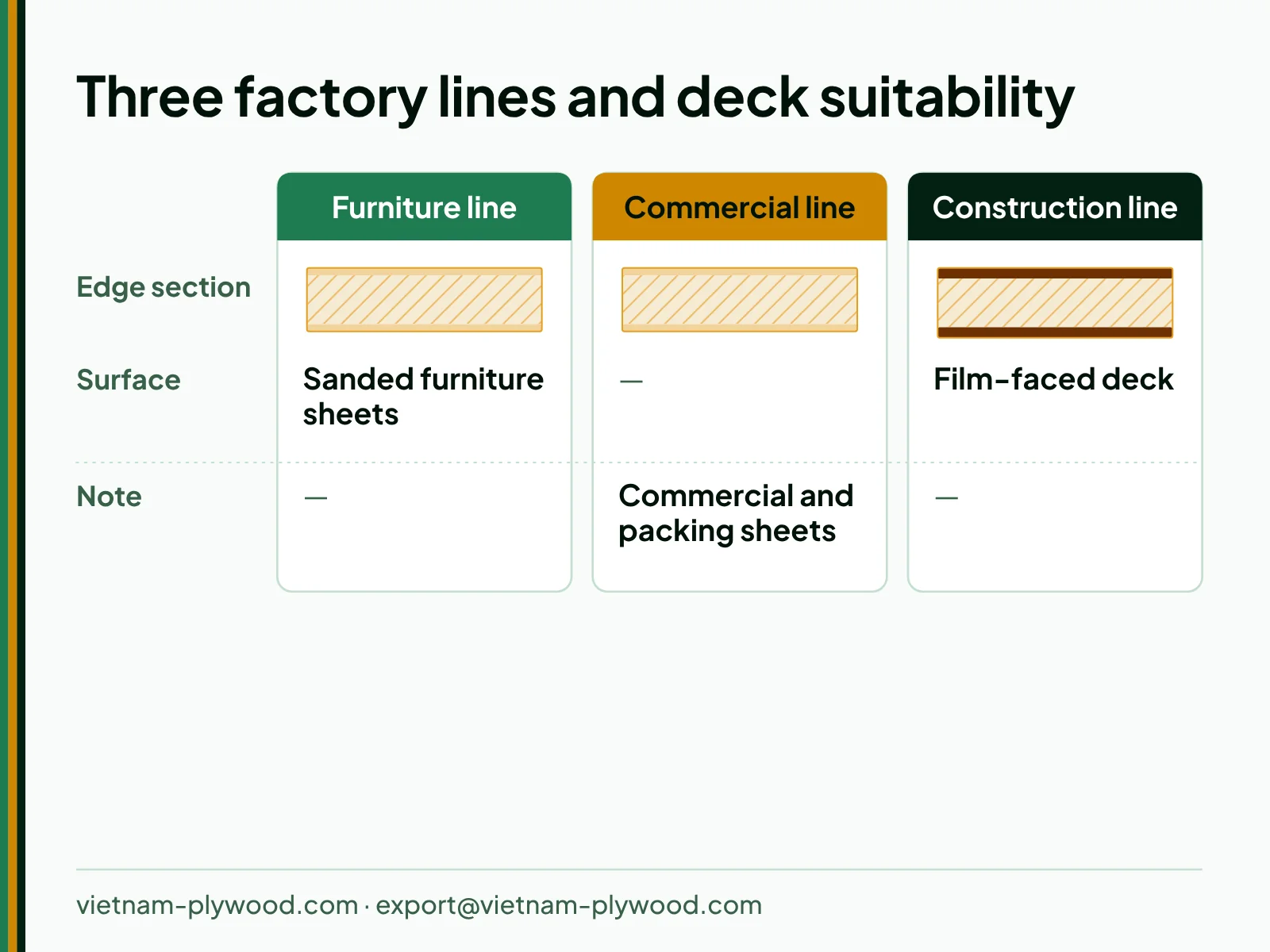
| Factory line | Typical relevant build | Surface and tolerance | Role in this deck order |
|---|---|---|---|
| Construction | Acacia or eucalyptus core, film-faced | Unsanded, ±0.5 mm | Deck panels |
| Commercial and packing | Acacia core, MR glue | Unsanded or light-sanded; commercial ±0.5 mm | Alternative packing or commercial sheets; LVL supply unverified |
| Furniture | Styrax or eucalyptus core, full stitched | Sanded, ±0.2 or ±0.3 mm as ordered | Furniture panels, not deck substitution |
We manage specification, on-site quality control, loading and export paperwork. The order is made at the producing factory matched to the build and shipped directly from it, FOB Hai Phong. A buyer can visit the factory office and witness panel measurements and packing checks at the producing factory.
For the company and product scope, see plywood manufacturing in Vietnam.
Which strength, bonding and finish checks matter?
Ask for a build-specific inspection plan covering core construction, glue, face film, edge treatment and dimensions. A smooth face cannot establish bending performance, and a thick sheet cannot compensate for an unsuitable support design.
Check the veneer assembly for gaps, overlaps and visible separation at representative edges. Compare the approved core schedule with the produced panel, and inspect film continuity around corners. Where the purchase requires a mechanical performance threshold, agree the test method and acceptance report before production.
The construction line uses phenolic or melamine film with acacia or eucalyptus core. Glue selection is a different field from emission class: melamine MR is associated with a 12-hour boil description, while phenolic WBP is associated with 72-hour boil. These are factory build descriptions, not a replacement for the project’s structural verification.
For a concrete finish requirement, specify the face and permitted surface defects. For reuse economics, inspect actual damage paths: corners, cut edges, fixings and film abrasion. A June 2026 shuttering-plywood buying guide addresses strength, resin, thickness, film quality, storage and cost; the deck-specific addition here is the joint-by-joint support layout.
What drives the deck-panel quotation?
Thickness and core construction are major cost drivers because more veneer and a more demanding assembly change material and processing needs. Film specification and glue selection follow, while cut complexity, inspection requirements and mixed-load packing also affect the quotation.
A thicker panel with the same core and face normally requires more wood per sheet than a thinner one. A 135 g/m² premium film uses a heavier face specification than 120 g/m² standard film; 220 g/m² anti-slip is reserved for the anti-slip option. A more complete stitched core requires more preparation than loose-laid construction.
For film-faced deck panels or LVL bearers, request a project-specific price rather than using a generic figure. Request a written quotation against the approved sheet module, thickness, core, glue, film, cutting schedule, inspection requirements and destination. Comparing a sheet-only price without its usable area and expected service condition can hide a higher cost per pour.
What shipping and inspection documents accompany the load?
The export document set identifies the shipped panel specifications, quantities and agreed test or certificate paperwork. It includes the commercial invoice, packing list, bill of lading and certificate of origin, plus shipment-specific papers.
Phytosanitary and fumigation papers are part of the shipment set; insurance is included under CIF. EU lots include EUR.1 and the EUTR/EUDR file set as applicable to the order. Any agreed emission certificate or test report is tied to the specified build. Factory-held FSC, CARB P2, ISO 9001 and CE documents are shown with factory details masked, on request.
After loading, the draft shipping documents come to you for approval. Agree how the packing list distinguishes deck sheets from any separately specified bearer cargo, including dimensions, packages and weights. Available delivery terms are FOB Hai Phong, CFR (CNF) or CIF.
What should the buyer send before a factory visit?
Send a deck drawing, panel cutting schedule and written acceptance criteria before arranging a factory visit. We can then align the sample, production checks and packing discussion with the intended slab system.
Identify the slab thickness, construction loads, bearer locations, joint supports and approved fixing method in the drawing package. Attach any required structural test report, finish requirement and inspection sampling plan. Keep the design sign-off with the responsible formwork engineer.
For a standard order, the minimum is one 40HC, and specifications can be mixed within the payload limit. Factory lead time runs 15–45 days from receipt of the 30% deposit; the exact figure depends on order size, line loading and what the contract fixes. The remaining 70% is paid on the scan of the bill of lading, by T/T, or by irrevocable sight L/C. Samples are free; new buyers book their courier, and its cost can be credited against a real order.
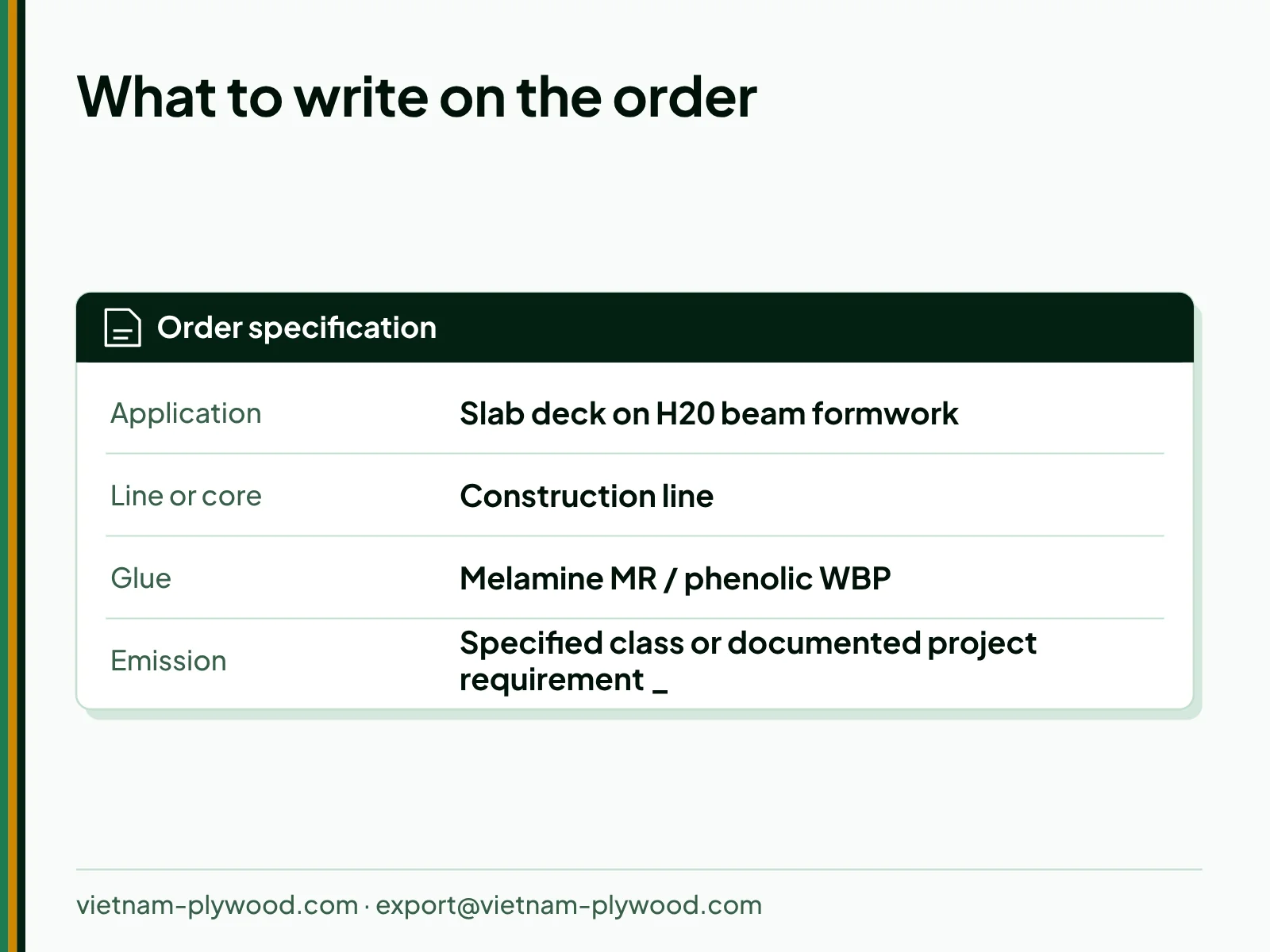
Send this specification to Lucy at export@vietnam-plywood.com or through contact:
Application: slab deck on H20 beam formwork; approved drawing reference ___
Line or core: construction line; acacia / eucalyptus core
Glue: melamine MR / phenolic WBP
Emission: specified class or documented project requirement ___
Face and grade: film-faced; 120 / 135 g/m² (or anti-slip 220 g/m²)
Thickness and tolerance: ___ mm; ±0.5 mm
Size: 1220 × 2440 / 1250 × 2500 mm; cut schedule ___
Quantity: ___ sheets; LVL bearer request and weights separately specified ___
Destination port: ___
Next step: book a factory visit to inspect the producing factory and review the marked deck-panel schedule.