





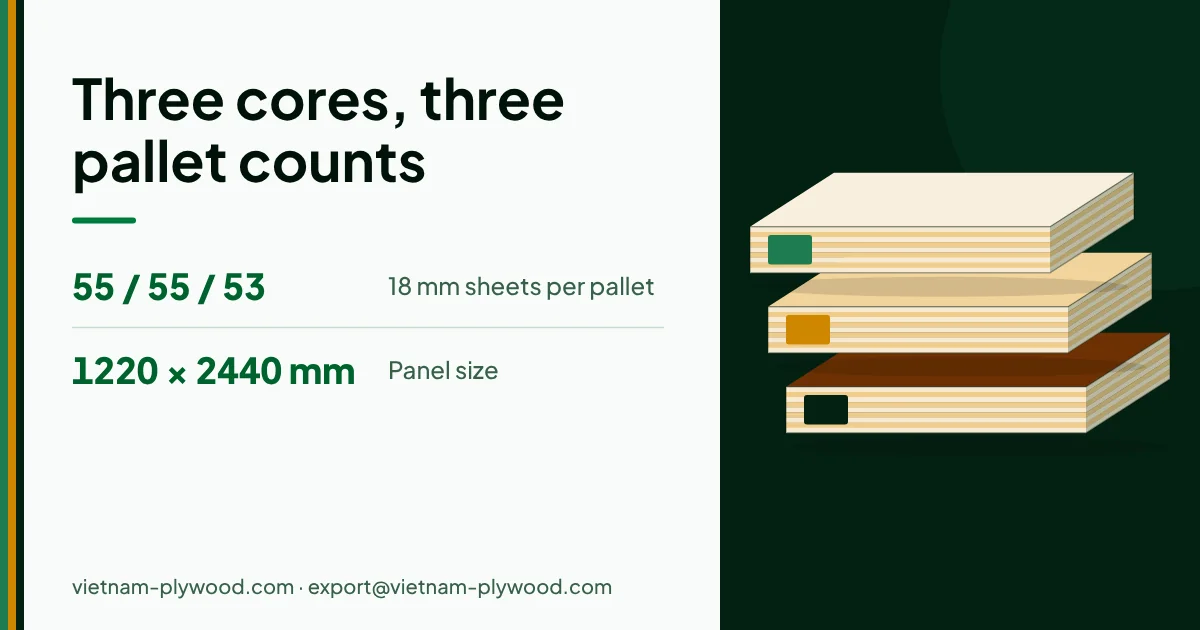
A bunk of plywood holds different sheet counts on HCPLY’s furniture and film-faced lines because core density and pallet stack height differ. Choosing the wrong count can mean extra freight cost, a delayed loading plan or a rejected weight declaration. At 18 mm and 1220×2440 mm, our styrax, acacia and eucalyptus packs contain 55, 55 and 53 sheets respectively.
How many sheets of plywood are in a bundle?
A bundle of plywood is a secured stack whose sheet count follows the panel thickness and the permitted stacking height. For 1220×2440 mm panels, our 18 mm export packs hold 55 sheets with styrax core, 55 with acacia core and 53 with eucalyptus core. A bundle count therefore needs a thickness and core alongside it.
Buyers use bunk, bundle, lift and pallet in different purchasing systems. A bunk or lift describes a grouped stack; a pallet adds the handling base. A quoted count without a panel size, actual thickness, core and packing arrangement cannot be transferred safely between orders.
At HCPLY, a pallet is the export handling unit used in the calculations below. A banded lift sold by a domestic distributor can have a different height or include a different number of sheets. Specify both the number of sheets and the total number of pallets on the purchase order.
For related shipping decisions, see our container and logistics articles. The pallet count answers a different question from the overall container loading calculation.
How many plywood sheets are on a pallet at each thickness?
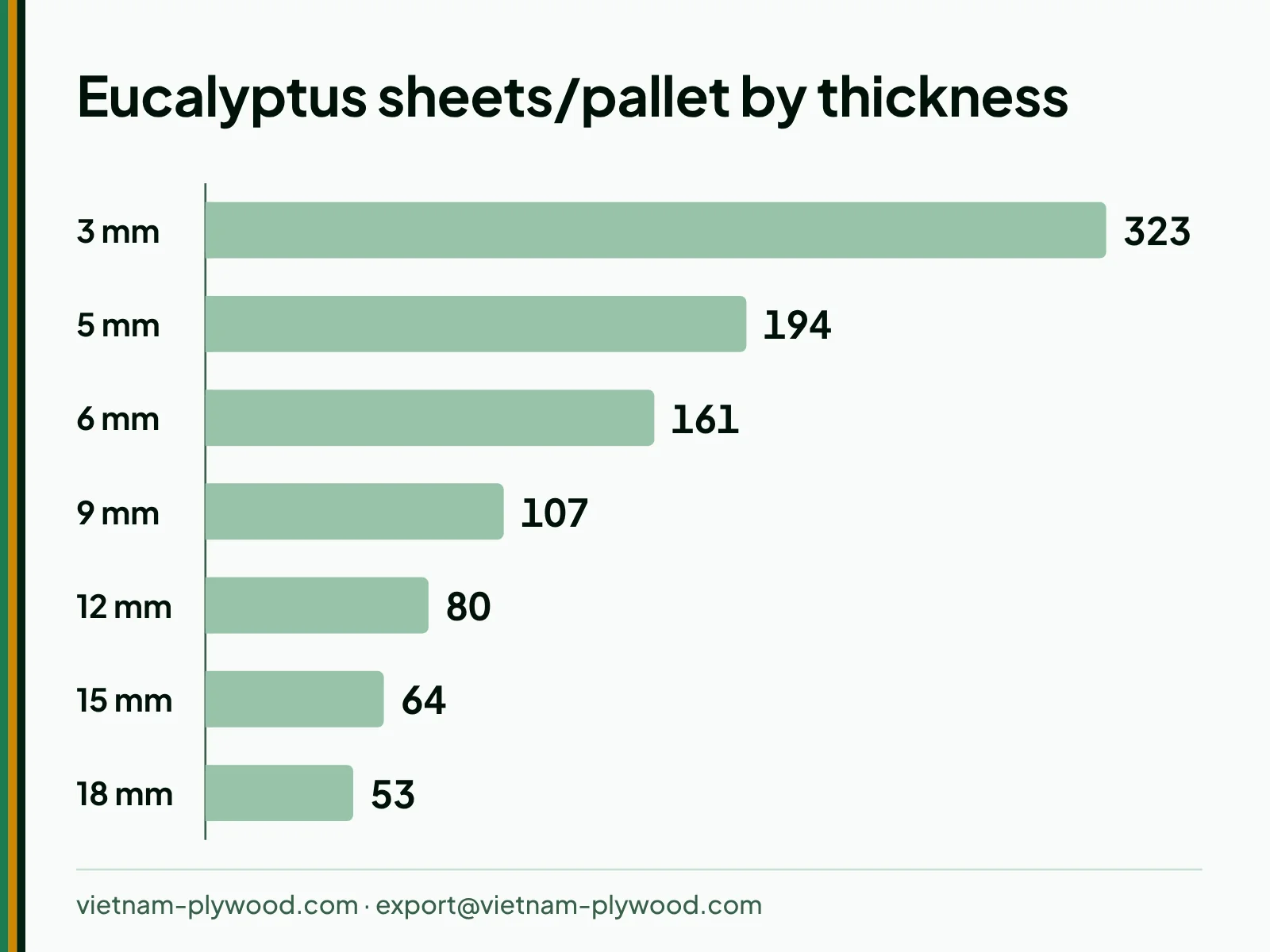
For 1220×2440 mm sheets, the count is the whole number of panels that fits the line’s stated stack height. The calculation is floor(stack height in mm ÷ sheet thickness in mm). The stack heights used here are 1000 mm for styrax, 1000 mm for acacia and 970 mm for eucalyptus.
| Thickness | Styrax sheets/pallet | Acacia sheets/pallet | Eucalyptus sheets/pallet |
|---|---|---|---|
| 3 mm | 333 | 333 | 323 |
| 5 mm | 200 | 200 | 194 |
| 6 mm | 166 | 166 | 161 |
| 9 mm | 111 | 111 | 107 |
| 12 mm | 83 | 83 | 80 |
| 15 mm | 66 | 66 | 64 |
| 18 mm | 55 | 55 | 53 |
| 21 mm | 47 | 47 | 46 |
| 25 mm | 40 | 40 | 38 |
The counts are packing calculations, rather than a universal lumberyard standard. A change to 1250×2500 mm also changes the permitted stack height: 1000 mm for styrax, 970 mm for acacia and 900 mm for eucalyptus. Custom cutting and other listed sheet sizes need their own packing layout.
Other offered thicknesses span 3–40 mm; the table concentrates on the dimensions where a complete packing lookup is available. See cubic metres per plywood thickness for the related volume method.
How much does a pallet of plywood weigh?
At 18 mm, each 1220×2440 mm sheet weighs 26.79 kg with styrax, 31.08 kg with acacia and 34.83 kg with eucalyptus core. Multiplying those sheet weights by 55, 55 and 53 gives panel-only pallet estimates of 1,473.45 kg, 1,709.40 kg and 1,845.99 kg respectively.
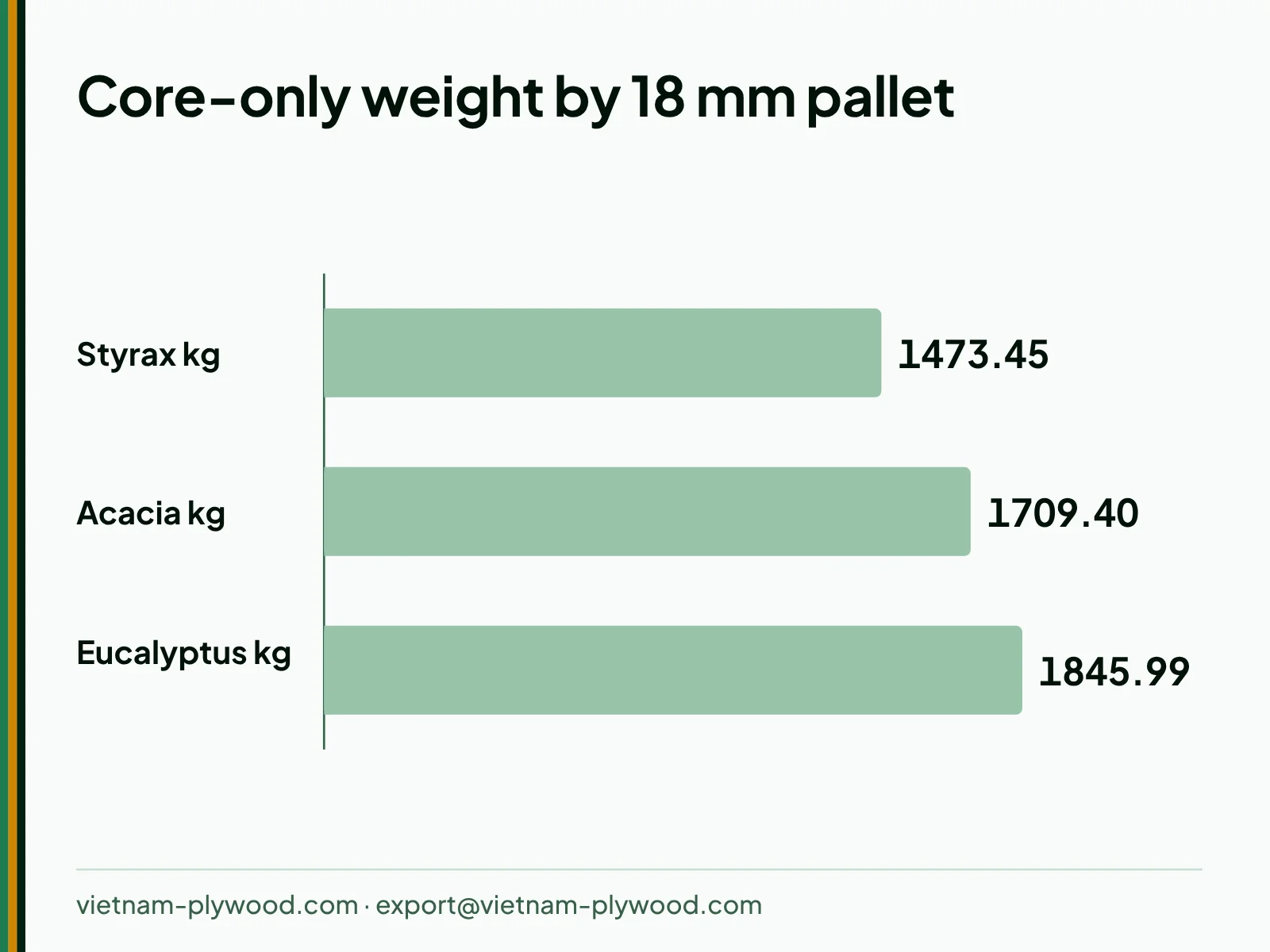
Those totals exclude the pallet base, bands, protection and other handling material. The full shipping mass must account for them separately. Film facing also adds material beyond the core-only weight lookup, so the table’s core-based figures should not be copied as a final packed film-faced pallet weight.
The underlying density assumptions are 500 kg/m³ for styrax, 580 kg/m³ for acacia and 650 kg/m³ for eucalyptus. Face veneer naming does not change the core density assumption. A birch-faced furniture panel with eucalyptus core therefore uses the eucalyptus calculation, rather than an assumed birch-core density.
For another thickness, multiply length × width × thickness × core density with dimensions in metres. Multiply the resulting kilograms per sheet by the actual sheets in that pallet. The plywood CBM calculation formula explains the volume component of this arithmetic.
Why do film-faced and furniture packs differ?
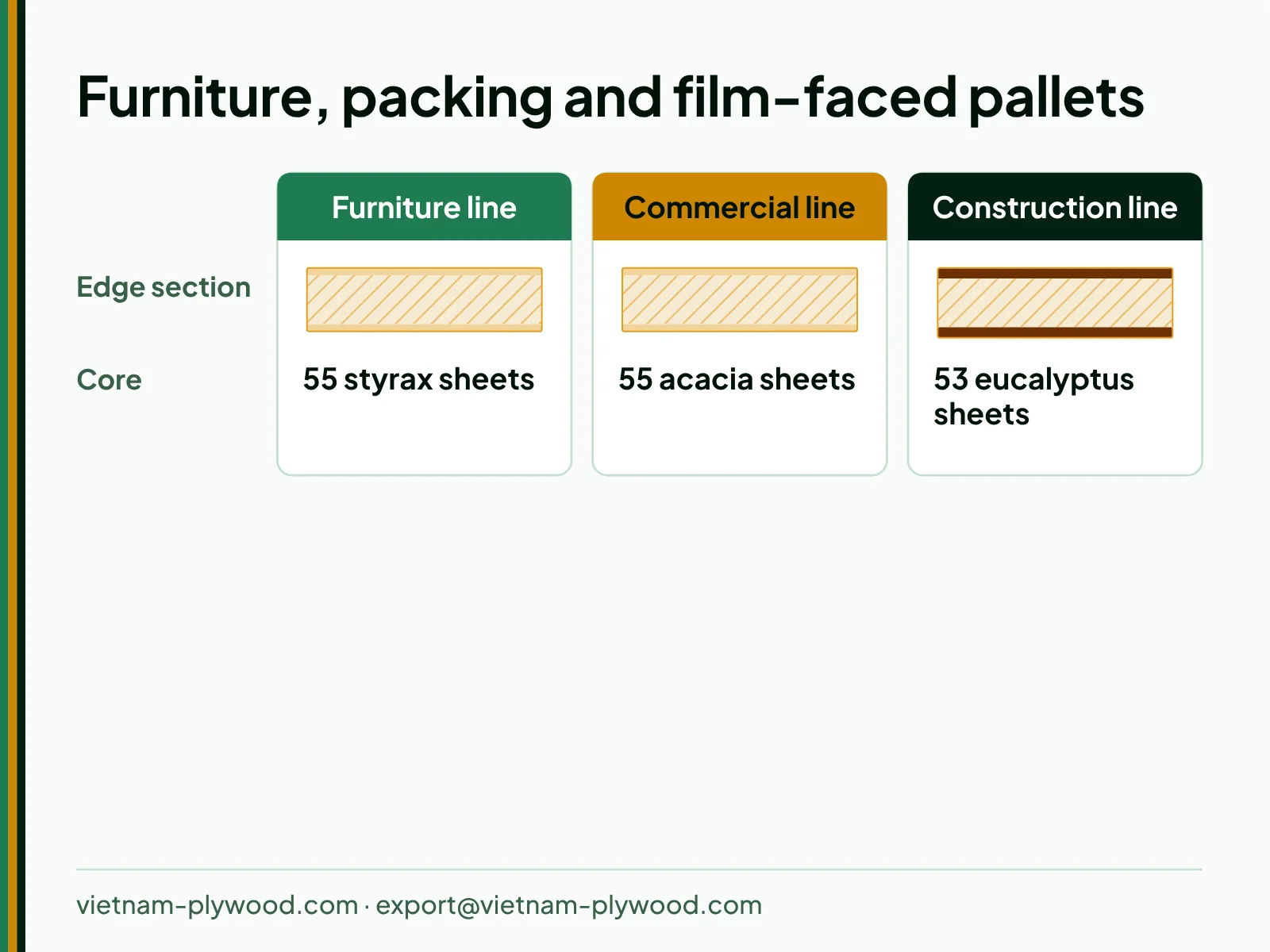
A furniture pallet and a film-faced pallet can have different sheet counts even when their nominal thickness matches. Our furniture line builds sanded, full-stitched styrax or eucalyptus panels; our construction line builds unsanded film-faced acacia or eucalyptus panels. Our commercial and packing line makes MR-glue acacia panels with unsanded or light-sanded surfaces.
| Metric at 18 mm, 1220×2440 mm | Furniture build | Commercial/packing build | Construction film-faced build |
|---|---|---|---|
| Core example | Styrax, 500 kg/m³ | Acacia, 580 kg/m³ | Eucalyptus, 650 kg/m³ |
| Sheets per pallet | 55 | 55 | 53 |
| Core-only sheet weight | 26.79 kg | 31.08 kg | 34.83 kg |
| Core-only panel mass per pallet | 1,473.45 kg | 1,709.40 kg | 1,845.99 kg |
| Finish | Sanded veneer face | Unsanded or light-sanded | Unsanded film-faced |
| Use verdict | Cabinet and furniture production | Packing and commercial supply | Concrete formwork |
The construction comparison uses an eucalyptus-core example; acacia-core film-faced panels are also built on that line. Film choices are 120 g/m² standard, 135 g/m² premium and 220 g/m² anti-slip only. Those film weights describe the surface, while the table’s panel masses use core-only lookup figures.
The furniture line’s sanded thickness tolerance is ±0.2 or ±0.3 mm as ordered. Commercial and film-faced tolerances are ±0.5 mm, while packing plywood uses ±0.5–1.0 mm. These tolerances affect inspection and stack measurements, although quoted pallet counts follow nominal thickness.
How do US plywood lift counts translate to export packs?
Translate a US lift into an export pallet by comparing actual sheet dimensions, actual thickness and sheets per strapped stack. A nominal 3/4-inch panel is commonly discussed alongside 18 mm export stock, while nominal 1/2-inch stock is often compared with 12 mm. These are purchasing comparisons, not statements of identical measured thickness.
A buyer asking how many sheets of 3/4 plywood in a lift should start with the seller’s actual thickness. For an 18 mm HCPLY pack, the answer is 55 sheets for styrax or acacia and 53 for eucalyptus. At 12 mm, the equivalent comparison is 83, 83 and 80 sheets.
Do not convert an entire US lift count by a single fixed multiplier. A lift could be strapped without a pallet, use another height, or combine sheet dimensions that differ from 1220×2440 mm. State the physical stack and number of sheets separately when converting a distributor’s quote into a factory order.
A US 4×8-foot label and a 1220×2440 mm export size are also slightly different dimensional descriptions. For purchasing and customs paperwork, write the metric dimensions that the producing factory will cut and load.
Can furniture and film-faced pallets share one container?
Yes, mixed specifications can share a 40-foot high-cube container within its 28.5-tonne payload limit. A full 18 mm, 1220×2440 mm core-only reference load is 990 styrax sheets across 18 pallets, 880 acacia sheets across 16 pallets or 795 eucalyptus sheets across 15 pallets.
The respective reference panel masses are 26.52 t, 27.35 t and 27.69 t. These are alternative full-load calculations, not quantities to add together. For a mixed load, multiply each pack’s sheet count by its core-only sheet mass, add the products, then account for pallet bases, bands, film and securing material before finalizing the weight plan.
A furniture pack can share space with commercial packing plywood or construction plywood when the loading plan matches the order specification. The exact mix should be agreed by pallet, rather than relying on a single full-container sheet total. See mixed container loading arrangements and the container packing tool for container-level quantities.
The International Maritime Organization’s 2014 Safety of Life at Sea amendment requires verified gross mass for packed containers, and its requirements entered into force in 2016. Its official guidance describes weighing the packed container or adding measured cargo, packaging, securing materials and container tare through an approved method. The container payload calculation and verified gross mass serve related but distinct purposes.
What should the buyer inspect at the producing factory?
The buyer or appointed inspector should reconcile each strapped pack with the purchase specification before loading. HCPLY coordinates on-site quality control and loading at the factory making the order, where the buyer can inspect goods and visit the factory office.
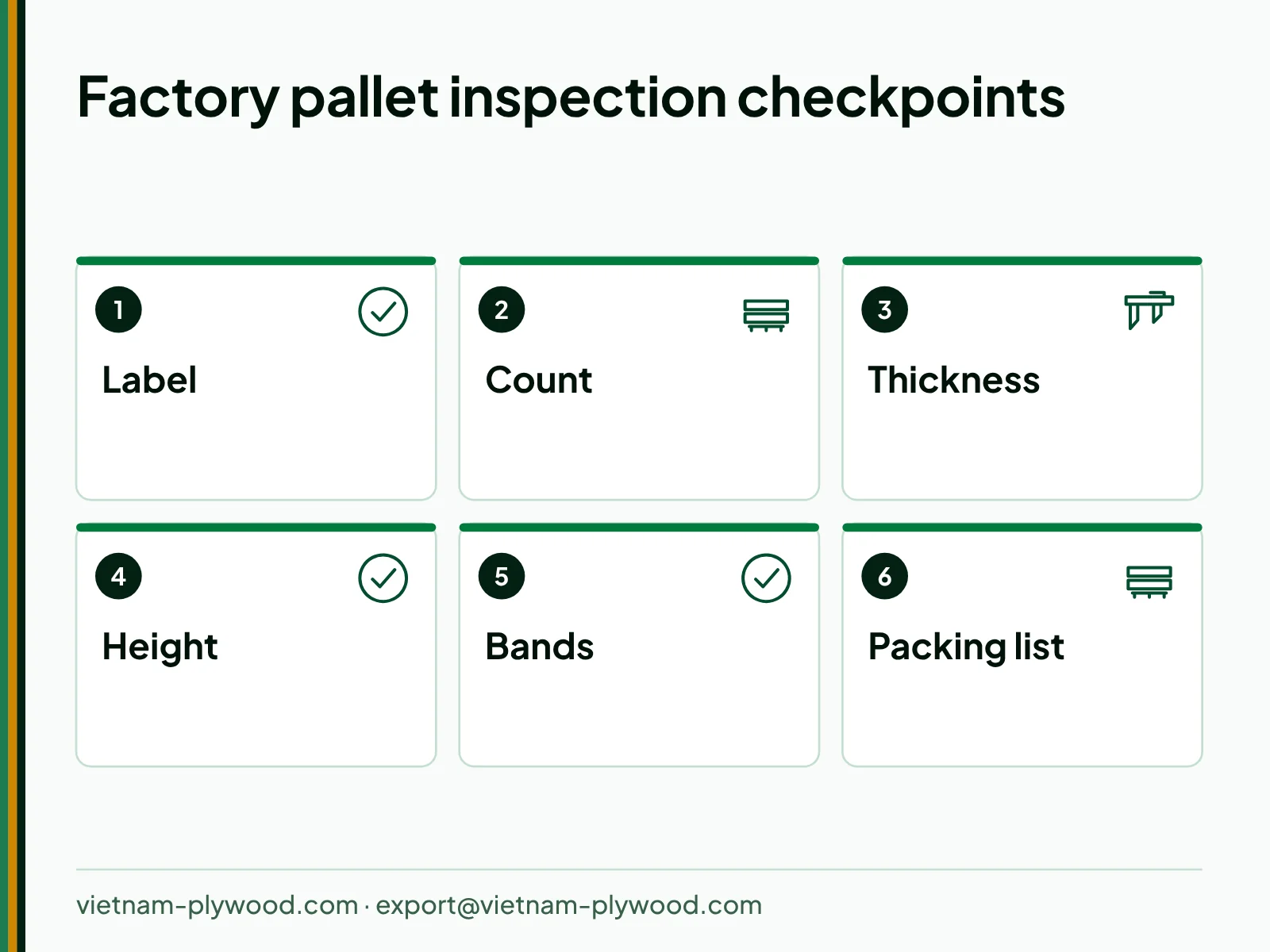
- Read the pallet label and match the line, core, face, size, thickness and intended application to the order.
- Count the sheets in a selected pack and compare the count with the nominal-thickness table.
- Measure sheet thickness and stack height, then examine exposed edges for core construction and gaps.
- Check the bands, pallet base, corner protection and any cut edges before handling.
- Record the pack count and measured mass for comparison with the load plan and packing list.
For furniture work, inspect sanding and face grade as well as the full-stitched core. For commercial packing work, inspect the acacia core and agreed surface finish. For film-faced work, check the film specification and the condition of the coated surface and edges.
The International Plant Protection Convention’s 2021 ISPM 15 publication distinguishes raw-wood packaging and dunnage from processed plywood packaging. That distinction matters when inspecting the wood pallet beneath a plywood bundle; it does not make the plywood panels themselves a substitute for compliant raw-wood packaging.
Which shipping document records the pallet count?
The packing list records the shipment’s packs and quantities, and the commercial invoice identifies the goods sold. The bill of lading records the sea shipment. After loading, draft shipping documents go to the buyer for approval so the packed quantities can be reconciled with the order.
The export file also includes a certificate of origin, phytosanitary and fumigation papers, and insurance under cost, insurance and freight terms. European Union lots include EUR.1 where applicable and the EUTR/EUDR file set; order-specific certificate documents and agreed test reports accompany the shipment as required.
For European Union wood products, Regulation (EU) 2023/1115, adopted in 2023, sets out information and due-diligence requirements for relevant products. The official EUR-Lex text specifies collection of product and supplier information. Buyers should connect the pallet identification and core description to their product documentation workflow.
The member factories’ FSC, CARB P2, ISO 9001 and CE documentation, and EUDR/EUTR documents, are shown with factory details masked, on request. Request the documents appropriate to the exact producing factory and agreed panel build.
What changes the commercial cost of a plywood pack?
The largest comparison begins with core construction, face specification and panel finish, followed by thickness, glue choice and the packing mix. Full-stitched furniture construction requires more core preparation and sanding than a simpler commercial packing build. Film-facing adds coating and surface handling to the construction build.
For a dated purchasing reference, commercial plywood starts from US$250/m³ FOB Hai Phong (October 2026) and furniture plywood starts from US$350/m³ FOB Hai Phong (October 2026). A film-faced quotation needs the written core, glue, film and loading specification rather than a generic pallet price.
One 40HC is the minimum order, and specifications can be mixed within the payload limit. Production takes 15–45 days from the 30% deposit, set by order size, line loading and the contract. The 70% balance is against the scanned bill of lading, by telegraphic transfer or irrevocable letter of credit at sight.
Delivery terms are free on board Hai Phong, cost and freight (CFR/CNF), or cost, insurance and freight (CIF). Samples are free; new buyers book their own courier, and its cost can be credited against a real order. These terms allow an importer to compare a trial container by panel volume and freight exposure rather than by an isolated lift count.
What should the purchase specification say?
A useful pallet specification states the panel build first, then its pack count and destination. It should distinguish the core-only calculated weight from the final packed mass and identify the factory line responsible for the build.
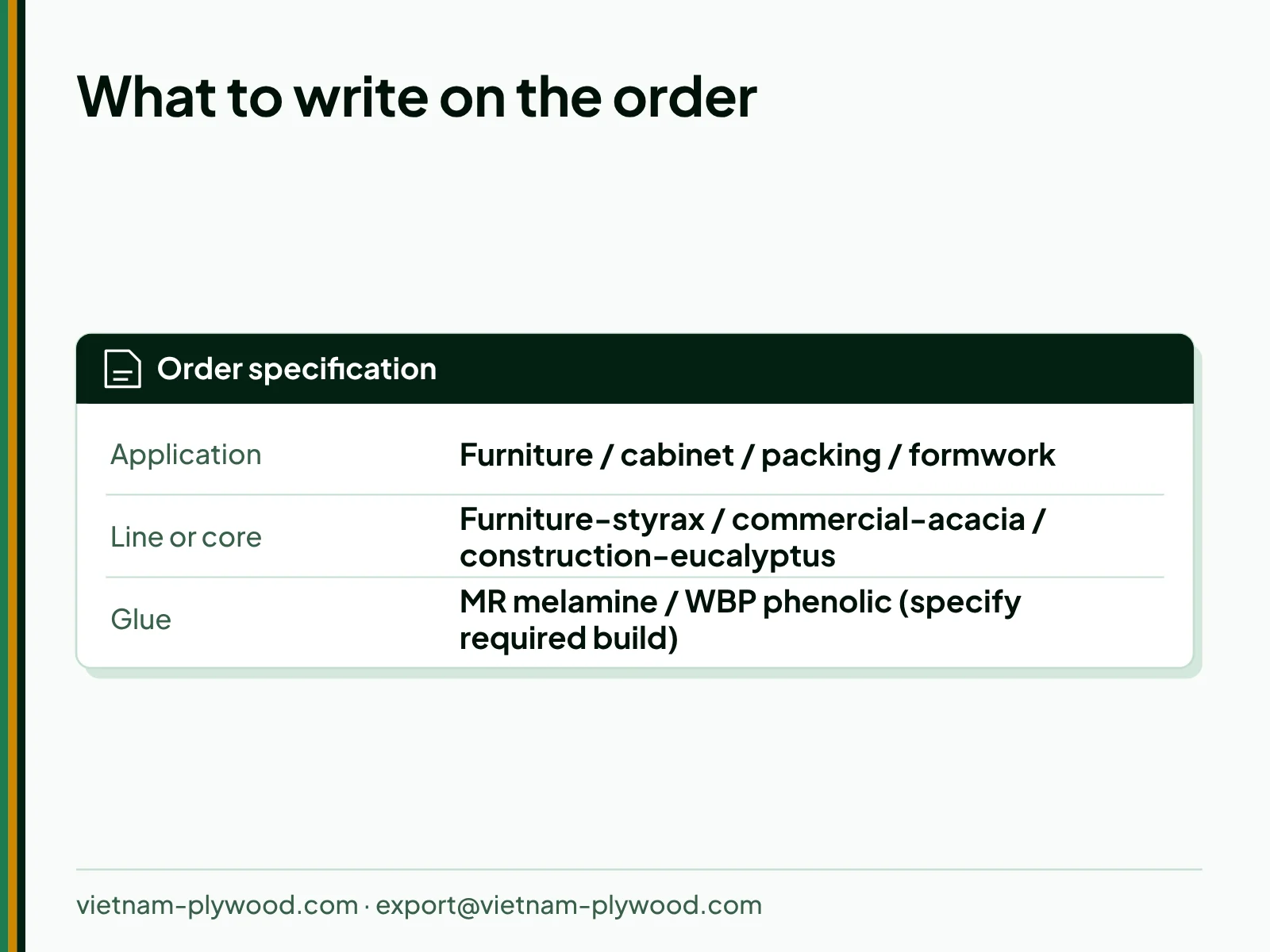
The manufacturing range includes 3–40 mm thickness and several sheet formats. The line chosen follows the application: our furniture line for sanded furniture panels, our commercial and packing line for acacia commercial or packing panels, and our construction line for film-faced formwork panels. For site-use specifications, see plywood supply for construction projects.
Send Lucy the following lines at contact, with the count expressed per pallet and in total. This allows the production and loading teams to check the same figures against the order and shipping documents.
Application: furniture / cabinet / packing / formwork
Line or core: furniture-styrax / commercial-acacia / construction-eucalyptus
Glue: MR melamine / WBP phenolic (specify required build)
Emission: E0 / E1 / E2 (state required class)
Face and grade: species or film specification; face grade
Thickness and tolerance: ___ mm; ___ mm
Size: ___ × ___ mm
Quantity: ___ sheets/pallet × ___ pallets; ___ sheets total
Destination port: ___
Plan a trial container with Lucy at export@vietnam-plywood.com, using the selected pack counts and destination port.