





Can plywood be recycled?
Plywood can be recycled when the receiving processor accepts its glue, face and contamination profile. Choosing the wrong disposal stream can mean a rejected load, extra charges and delayed collection. HCPLY buyers should distinguish clean furniture offcuts, packing panels and used film-faced formwork before claiming a recycling outcome.
A panel can remain useful as a cut component, be prepared for reuse, or enter a processor’s accepted wood stream. Those are different outcomes. The European Union’s 2008 Waste Framework Directive, in its 2025 consolidated text, defines recycling as reprocessing waste into products, materials or substances; energy recovery is excluded. See Article 3 and Article 4 of Directive 2008/98/EC. That distinction matters when a waste collector advertises general wood recovery.
The buyer needs the receiving facility’s acceptance criteria in writing: whether it accepts glued plywood, coated sheets, metal fasteners, residual concrete or treated material. A collection label saying ‘wood’ does not settle those questions.
Is plywood made from recycled wood?
Plywood is made from bonded wood veneers; recycled wood is not an automatic ingredient. Our furniture line uses styrax or eucalyptus veneer cores, while our commercial and packing line uses acacia cores. Our construction line uses acacia or eucalyptus cores beneath film faces. Those are descriptions of the wood used in the builds, rather than claims of recycled feedstock.
The distinction matters in supplier questionnaires. ‘Recyclable after use’ describes a possible future route. ‘Made with recycled content’ describes an input that needs a defined measurement and traceable evidence. Neither statement establishes the other. A buyer asking for recycled-content percentage should request a batch-linked declaration and calculation method rather than infer a percentage from the panel’s appearance.
Similarly, wood recovery at a factory does not establish that recovered material returns to new plywood. Keep input provenance, production offcuts and post-use collection as separate questions on the purchasing form.
Which plywood builds have different end-of-life routes?
A furniture sheet, a packing sheet and a film-faced formwork sheet create different sorting decisions. The following comparison uses the same nominal 18 mm thickness to isolate the build differences.
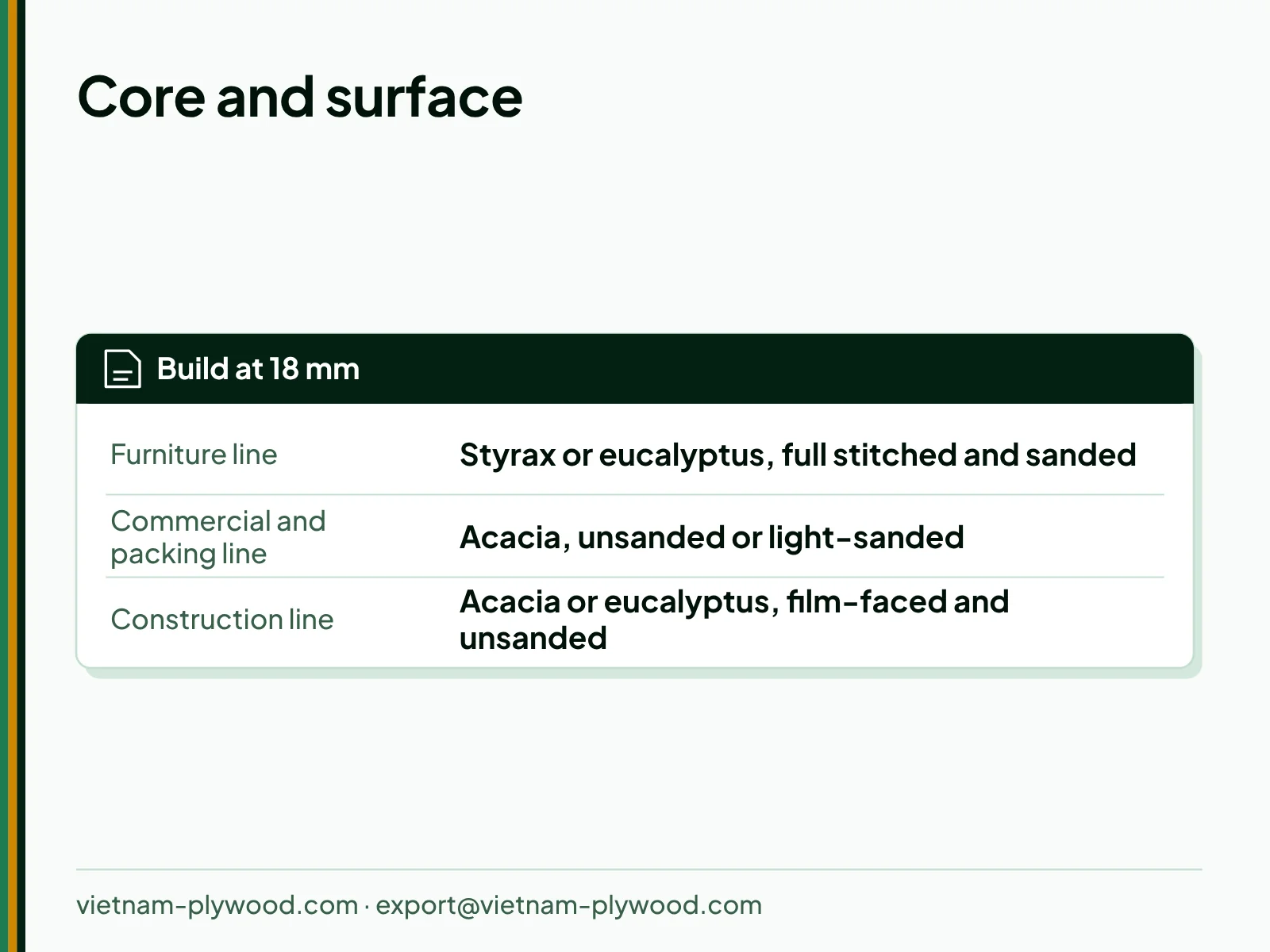
| Build at 18 mm | Core and surface | Glue or finish to identify | First end-of-life check | Buyer verdict |
|---|---|---|---|---|
| Furniture line | Styrax or eucalyptus, full stitched and sanded | Ordered glue and emission class | Clean, uncoated offcuts versus finished assemblies | Separate clean production trim first |
| Commercial and packing line | Acacia, unsanded or light-sanded | Moisture-resistant (MR) glue | Nails, labels and shipment contamination | Remove attachments before collector review |
| Construction line | Acacia or eucalyptus, film-faced and unsanded | Phenolic or melamine film; bond specification | Concrete residue, release agents and film | Ask for coated-formwork acceptance explicitly |
These are manufacturing distinctions, not declarations that any waste processor will accept the sheets. A furniture maker can often segregate fresh cutting trim more easily than demolition or formwork waste. A packing company must also identify what contacted the panel during transport. For product selection, compare the factory-line plywood grades against the actual application.
How does glue type affect plywood recycling?
Glue type affects processing because bonded veneers cannot be treated as loose, untreated timber. Melamine MR glue and phenolic weather-and-boil-proof (WBP) glue describe bond performance; neither name alone gives permission to put a panel into a local recycling stream. The receiving facility must evaluate its own equipment, permit and input specifications.
In our production terminology, melamine MR is associated with a 12-hour boil specification, while phenolic WBP is associated with a 72-hour boil specification. Those are bond descriptions, not recycling tests. The distinction is useful when a collector asks whether a load contains phenolic-bonded panels, but a laboratory bond result cannot replace a waste acceptance decision.
Emission classification is another field. E0, E1 and E2 refer to emission classes; they should not be written as adhesive types. A buyer should identify glue chemistry and emission class separately, then describe any subsequent coating or contamination. Where a destination requires an emission certificate, match it to the agreed panel build rather than use it as a recycling certificate.
Can film-faced formwork plywood be recycled after its last pour?
Film-faced formwork plywood can enter material recycling only where a processor accepts the film, adhesive and construction residues together or has a separation process. After its final pour, a sheet can carry concrete, edge sealant, release agent and fasteners. Those additions can change its classification and the practical route available.
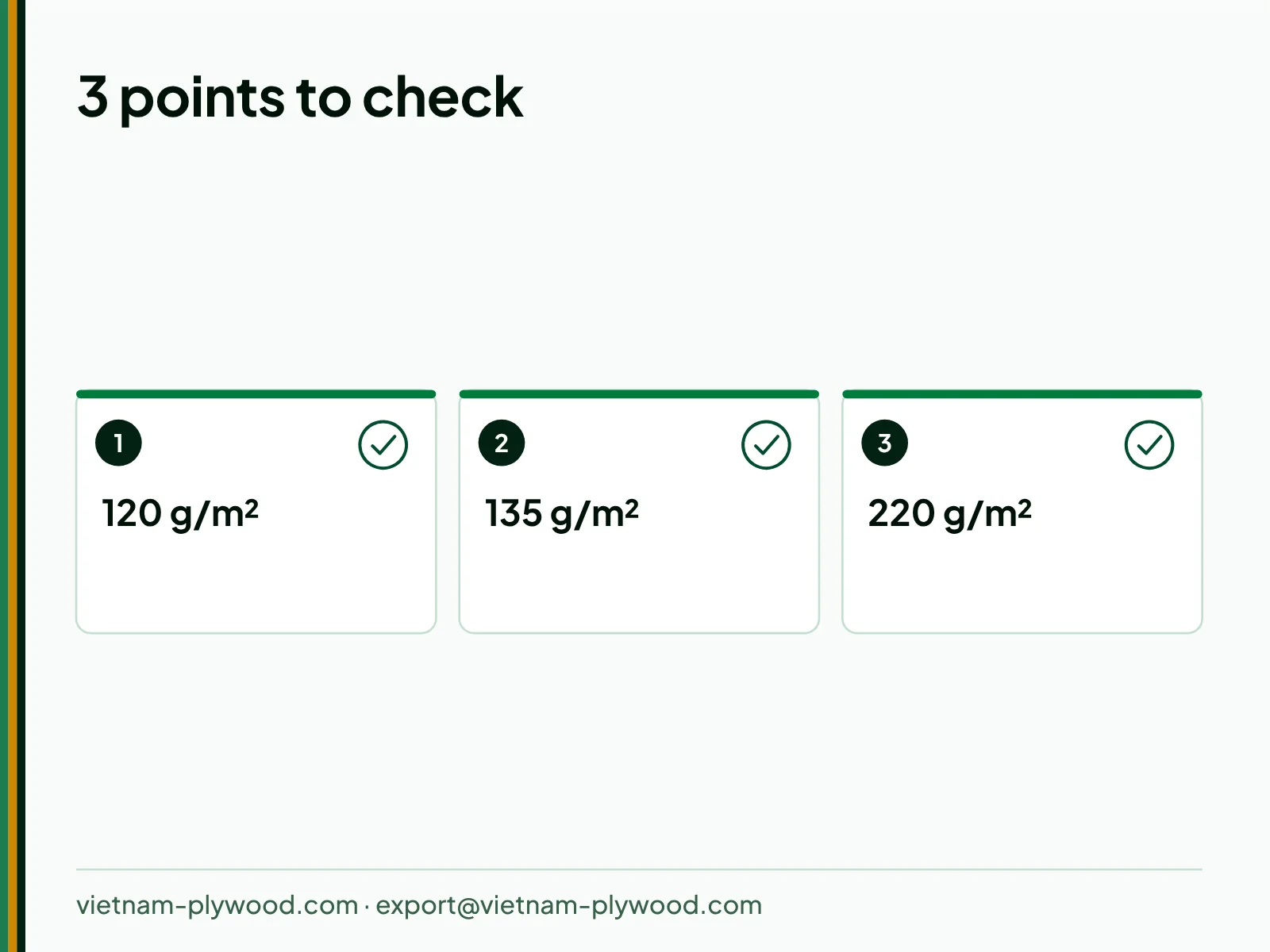
Our construction line makes film-faced plywood with phenolic or melamine film and acacia or eucalyptus core. Film weight is 120 g/m² for standard film, 135 g/m² for premium film and 220 g/m² for anti-slip film. Film weight describes the facing, not the amount of material a recycler can recover.
Before dispatch to a recycler, the formwork yard should segregate panels by build and visible contamination, remove removable metal fittings, and ask whether the processor accepts film-coated wood. A cleaner panel with an intact edge can also be assessed for continued formwork use before it becomes waste. Reuse and recycling should be recorded separately in procurement reporting.
What happens to trim and rejected sheets at a plywood factory?
Trim and rejected sheets arise at different production stages, so the buyer should ask for the actual handling route at the producing factory. Veneer cutting produces a different stream from finished panel trimming; a pressed sheet rejected for bond or face defects is different again. A responsible audit distinguishes these streams rather than recording all of them as ‘recycled wood’.
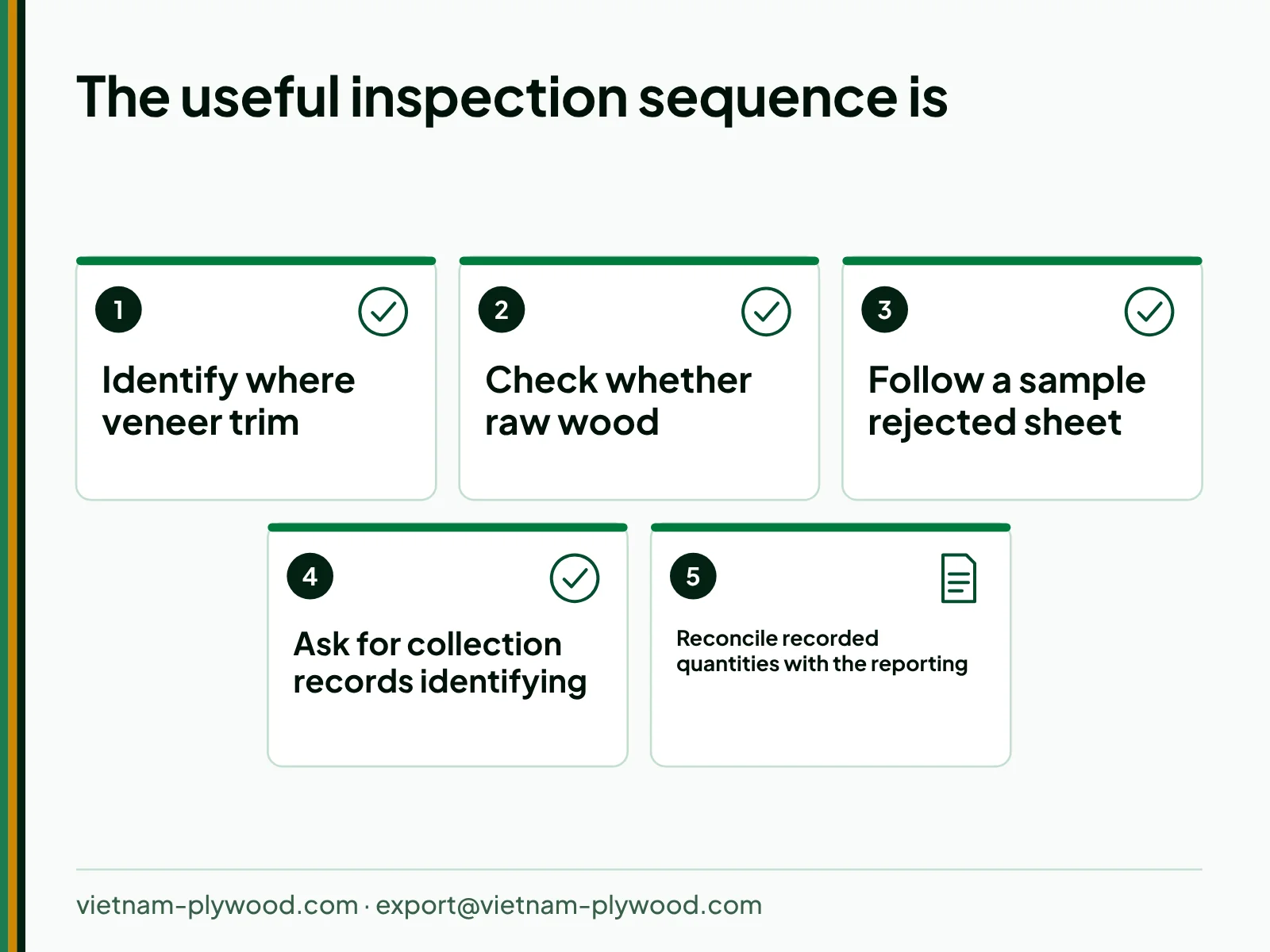
The useful inspection sequence is:
- Identify where veneer trim, edge cuttings and rejected pressed panels arise.
- Check whether raw wood, bonded plywood and film-faced material are kept in separate marked areas.
- Follow a sample rejected sheet from the quality-control decision to its recorded disposition.
- Ask for collection records identifying the receiving operator and the accepted material category.
- Reconcile recorded quantities with the reporting period and reject log.
These are checks buyers can request, not a claim that every listed practice is already operating at each factory. HCPLY runs specification, on-site quality control, documents and loading for orders made at the relevant producing factory. The factory visit provides the opportunity to see the actual segregation and ask for supporting records.
What can a buyer inspect at the producing factory?
A buyer or inspector can witness the separation point, inspect the rejected-sheet log and trace a selected item to its disposition record. At the producing factory, request a walk-through that starts at cutting, continues past pressing and ends at the finished-sheet rejection area. Record which bins contain raw veneer and which contain bonded or film-faced waste.
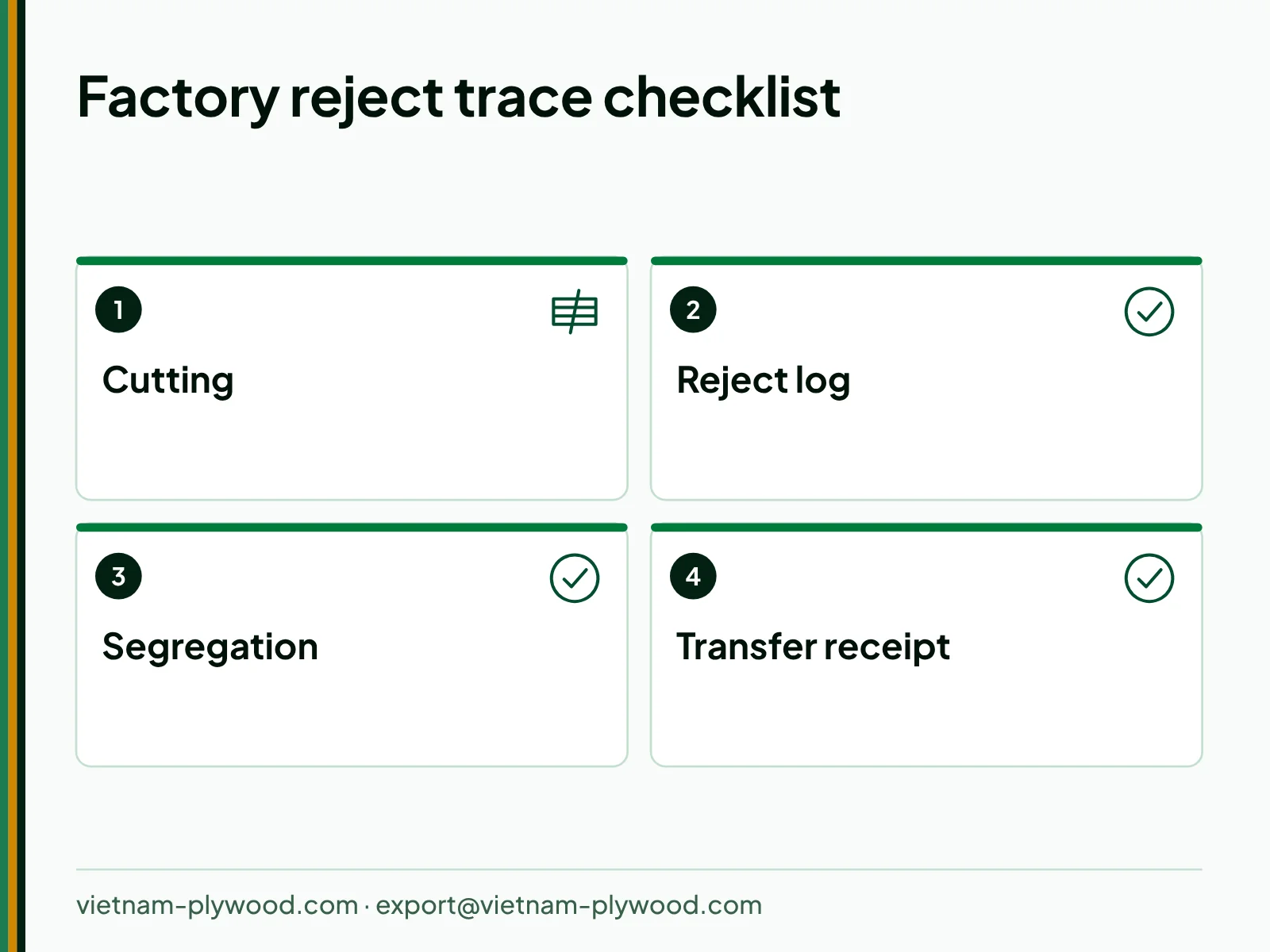
The inspector should ask to see dated records, not just an empty storage area. Useful evidence includes a waste transfer receipt, the recipient’s permitted material description and a reconciliation between production rejects and material leaving the site. Where these records are absent, report the gap without substituting an estimated recovery rate.
Our three factories in Phu Tho and Hai Phong have different production roles. The buyer visits the factory office and inspects goods at the factory producing the order. A documented inspection scope should identify the specific production line, the material stream and the dates covered; findings from one location should not be presented as measurements from another.
How should a buyer separate plywood waste after use?
Separate post-use plywood by surface treatment, adhesive information and contamination before arranging collection. Furniture-shop cuttings, packing panels and formwork sheets should start as distinct streams. This gives a receiving operator a clear description and reduces the risk that one coated or contaminated batch causes rejection of a larger load.
For furniture and cabinet makers, distinguish clean offcuts from pieces carrying hardware, decorative finishes or added coatings. For packing operators, remove accessible nails and staples and identify any oil or chemical contact. For contractors, isolate film-faced sheets with hardened concrete, release-agent residue or unknown treatments until the operator specifies a route.
Ask the collector to state whether the proposed outcome is reuse, material recycling, other recovery or disposal. Under the EU Waste Framework Directive’s hierarchy, these are distinct categories. Keep collection paperwork tied to the actual waste stream and destination, particularly where customer reporting asks for a recycling percentage.
Does panel specification change the recovery route?
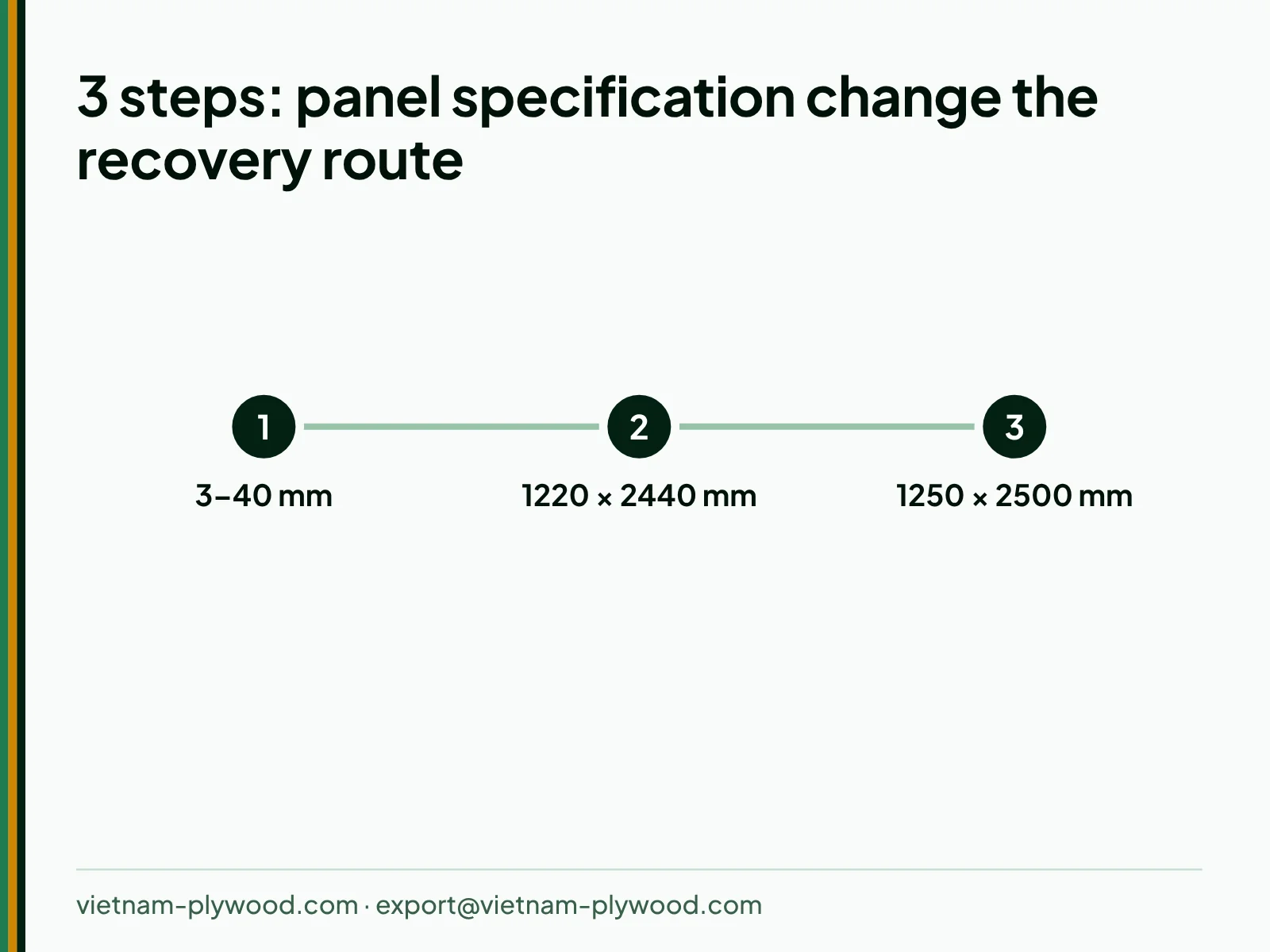
Panel specification changes both the amount of trim created and the information a recovery operator needs. HCPLY makes thicknesses from 3–40 mm, with common sizes including 1220 × 2440 mm and 1250 × 2500 mm. Custom cutting can reduce offcut generation when a buyer provides a reliable cutting plan, although it does not determine the fate of remaining trim.
A useful purchase specification identifies core species, glue, emission class, face, grade, thickness tolerance and panel size. A finished veneer face is a naming convention; density follows the core. For example, an okoume-faced furniture panel with a styrax core should be described by both fields in the waste record. The face alone cannot identify the underlying wood.
For furniture plywood, full-stitched construction and sanding are relevant production details. For a mixed shipment, see mixed-container plywood loads and the container packing calculator. Mixing specifications in transport is separate from mixing waste streams after use.
Which records should accompany a recycling discussion?
The export document set identifies the commercial shipment and the agreed panel specification; waste disposal records arise later from the party handling end-of-life material. A commercial invoice and packing list can identify what was delivered, while a bill of lading identifies shipment movement. They do not by themselves document what a recycler accepted years later.
For a batch-level inquiry, match the order specification to the relevant test reports or emission certificate where agreed. Member-factory certificates, including FSC, CARB P2, ISO 9001 and CE, and EUDR/EUTR documents are shown with factory details masked, on request. Those documents should be read for their stated scope rather than treated as proof of a downstream recycling route.
The buyer should retain the receiving facility’s acceptance statement and transfer evidence alongside the purchasing records. This connects product identity to the actual waste outcome without confusing a factory document with a waste operator’s declaration.
What should buyers ask before ordering?
Before ordering, buyers should ask which line will make the sheet, what adhesive and facing it uses, and whether the intended destination has a recycler accepting that build. Ask how production trim is separated, how rejected finished sheets are logged and whether transfer receipts can be inspected during a visit.
For furniture projects, prioritize a written cutting plan and clear identification of applied finishes. For packing applications, identify likely contamination from the shipped goods. For formwork, ask the local processor about film and concrete residues before planning a recycling claim. The right answer is a documented route for a specified panel, not a generic claim about wood.
Send the intended application, destination port and recovery requirements with the purchase specification. Lucy at export@vietnam-plywood.com can coordinate the producing-factory discussion. The contact page is the route for requesting the spec sheet and arranging the relevant questions.
Application: [furniture / packing / formwork]
Production line or core: [line; acacia / styrax / eucalyptus]
Glue: [MR melamine / WBP phenolic]
Emission class: [E0 / E1 / E2, as ordered]
Face and grade: [veneer or film; grade]
Thickness and tolerance: [mm; +/- mm]
Sheet size: [length x width, mm]
Quantity: [sheets / 40HC]
Destination port: [port and country]
Request the specification sheet through contact.