


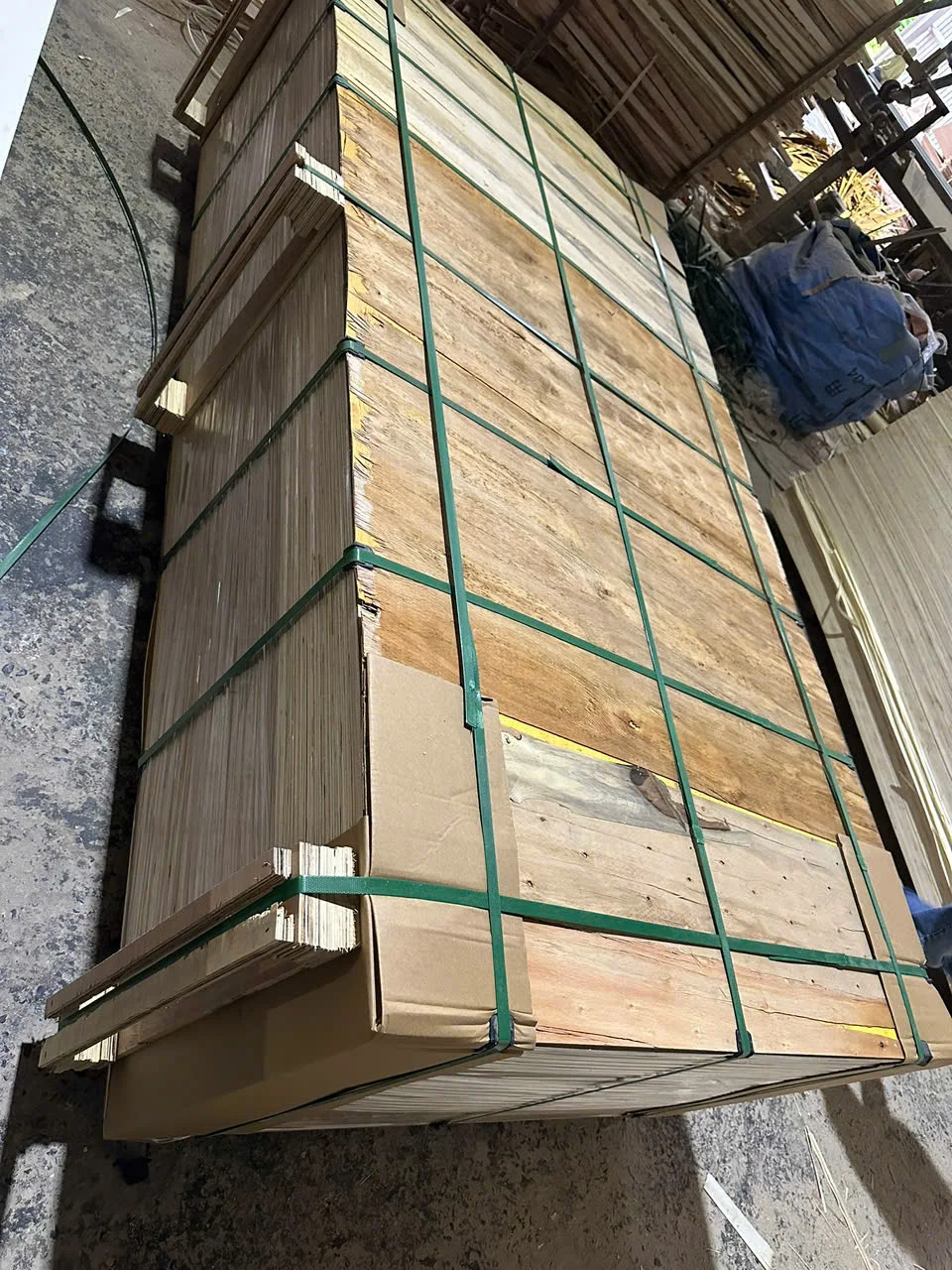
Three plywood pallets were rejected at a Korean port in 2024. The cause: stretch wrap only, no strapping, face veneer delaminated during 21-day ocean transit. The importer lost the entire shipment claim because the factory’s packing method didn’t meet the buyer’s specification — and no one had agreed on packing standards at the order stage.
Wrapping vs strapping is not a packaging technicality. For plywood export, it directly determines whether your goods arrive intact, whether your container passes port inspection, and what your landed cost actually is.
This cost and safety guide covers the practical comparison — material by material, cost by cost — based on HCPLY’s factory packing procedures for 200+ containers exported monthly from Hai Phong. Whether you are confirming pallet strapping for plywood export or evaluating a new supplier’s packing method, these specs apply directly to ocean freight shipments.
📋 TL;DR: Wrapping vs Strapping for Plywood Pallets
| Factor | Steel Strapping | Polyester (PET) Strapping | Stretch Wrap Only |
|---|---|---|---|
| Break strength | Highest | High (higher than steel in tensile flexibility) | Low |
| Load settlement | Poor (rigid, can bite) | Good (flexes with wood movement) | Poor |
| Moisture protection | None | None | Minimal |
| Cost per pallet | $1.20–2.00 | $0.80–1.50 | $1.50–2.50 |
| Forklift access | Full | Full | Restricted |
| Suitable for plywood export | Heavy loads only | Standard choice | Not recommended alone |
| Combined best practice | Strapping + corner boards + PE bag |
Bottom line: Polyester strapping with corner boards is the standard for plywood export. Stretch wrap alone fails under ocean transit conditions. Steel strapping is overkill except for eucalyptus-core heavy packs.
📦 Why Standard Packing Matters More Than You Think
Plywood pallets are dense, heavy, and mechanically predictable — but the ocean is not. A 40HC container from Hai Phong to Hamburg takes 25–30 days. During that time, the container passes through humidity shifts from tropical Vietnam to the North Atlantic. Wood absorbs and releases moisture. Sheets shift. Poorly secured pallets rack.
The consequences are not minor:
- Sheet shifting: Face veneer scratched by adjacent sheets. Claim rejected because “impact damage” can’t be proved as factory defect.
- Pallet collapse: Sheets topple inside the container. Entire pallet written off.
- Edge strap bite: Steel strap with no corner boards cuts into birch or okoume face veneer on the top sheet. Visible mark, immediate rejection.
- Port rejection: Some markets (Korea, Japan) require documented packing methods. “Stretch wrap only” triggers inspection.
⚠️ Important: Packing standard should be agreed in writing before order placement. If your PI does not specify strapping type, strap count, corner board requirement, and moisture protection — the factory will use their default, which may not match your buyer’s market requirements.
Get HCPLY’s standard packing specification document
🔧 Steel Strapping: When It Makes Sense
Steel strapping (typically 19mm or 25mm wide, 0.5–0.8mm thick) has the highest break strength of any strapping material. A 19mm steel strap holds 700–900 kg tensile load. Nothing settles under steel.
The problem with plywood: steel doesn’t flex.
When a plywood pallet is loaded in Vietnam at 28°C and 80% humidity, then arrives at a Rotterdam warehouse at 5°C and 60% humidity, the wood contracts. The pallet shrinks slightly. Steel strapping stays the same length — which means either the strap goes slack, or (more commonly for tight application) it bites into the corner of the top sheet when the wood contracts.
Steel strapping is appropriate for plywood when:
- Eucalyptus core, 18–21mm thickness, pallet weight exceeds 1,200 kg
- Shipments to destinations with confirmed heavy-handling (Middle East break-bulk, Africa project cargo)
- Customer specification requires steel (some Korean and Japanese buyers specify this explicitly)
At HCPLY, steel strapping is used selectively on eucalyptus core pallets destined for construction markets where face veneer appearance is secondary to structural integrity.
⚙️ Polyester (PET) Strapping: The Export Standard
Polyester strapping (PET, 19mm or 25mm, 0.8–1.0mm) has become the default for plywood export, and for good reason. PET tensile strength (500–800 kg at break) is comparable to steel for typical pallet loads, but PET has elongation recovery — it stretches 10–15% under load and returns, maintaining consistent tension even as the pallet settles.
This matters for plywood specifically:
“We switched from steel to PET strapping on furniture-grade pallets in 2022. Corner edge damage dropped significantly. The PET flexes with the wood — the strap stays tight through the whole voyage rather than going slack or biting.” — Lucy, International Sales Manager, HCPLY
PET strapping specifications used at HCPLY:
- Width: 19mm standard, 25mm for heavy packs
- Thickness: 0.8mm (standard), 1.0mm (heavy eucalyptus)
- Strap count: 4 per pallet (2 cross + 2 long), 6 for heavy packs
- Sealing: heat-weld (semi-auto) or metal buckle (manual)
PET strapping cost: approximately $0.80–1.50 per pallet (4 straps), depending on strap width and sealing method (HCPLY production data, 2026).
📊 Stretch Wrap: What It Does and What It Doesn’t
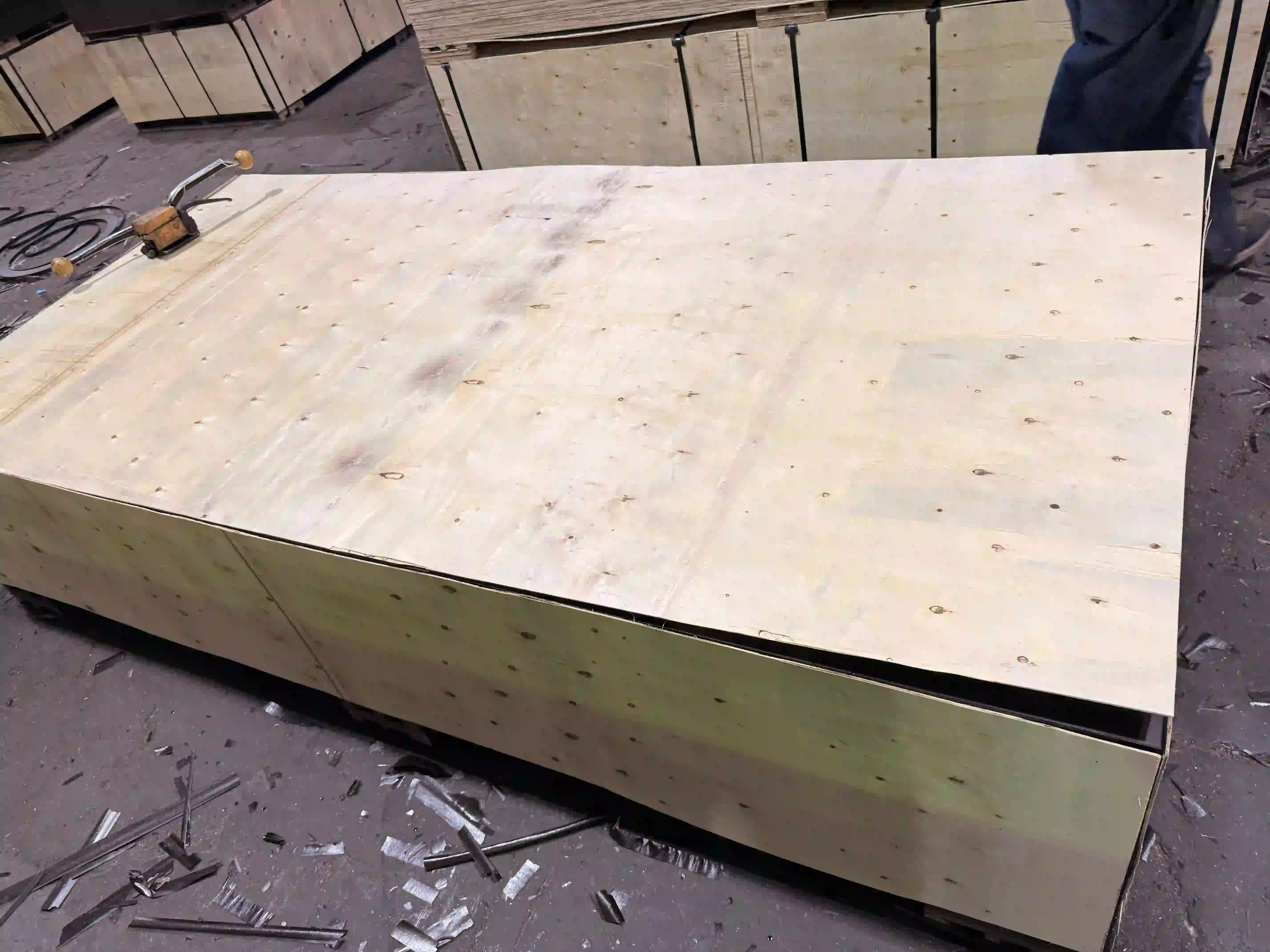
Stretch wrap (LLDPE film, 17–23 microns, 150–300% pre-stretch ratio) is excellent at one thing: unitizing. It holds the pallet shape, keeps sheets from spreading, and provides dust and light surface protection.
What stretch wrap cannot do for plywood pallets:
- Cannot hold tensile load. A forklift tine catches a stretch-wrapped pallet — the film tears. The pallet collapses.
- Cannot prevent sheet shift under vibration. Ocean freight vibration loosens stretch film at the pallet base within days.
- Cannot provide moisture barrier. LLDPE stretch film is permeable to water vapor. It slows condensation but does not block it.
- Cannot satisfy port inspection. Korea and Japan require strapping or banding documentation for heavy panel products.
Cost of stretch wrap per pallet: $1.50–2.50 with a semi-automatic machine at optimal pre-stretch, or $3.00–4.50 manual (IPS Packaging & Automation, 2025).
Where stretch wrap adds genuine value for plywood:
- Top and side wrapping to prevent dust during warehouse storage
- Secondary wrap over a strapped pallet to protect face veneer surface from condensation
- Unitizing mixed-spec pallets (multiple thicknesses on one pallet) before strapping
🏭 HCPLY’s Standard Export Packing Procedure
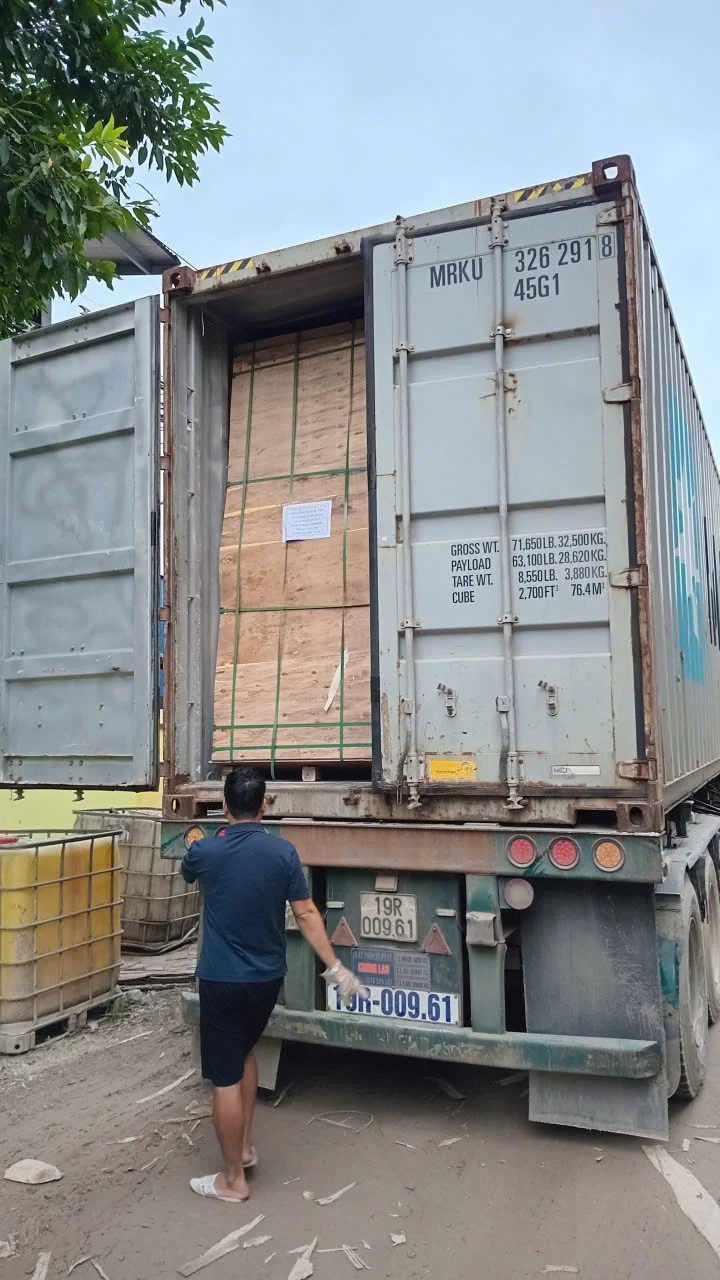
Based on HCPLY’s production documentation for 40HC container loading (2026):
Standard furniture-grade pallet (birch/okoume/EV face):
- Stack sheets to 1,000mm height (forklift-safe limit per plywood pallet configuration guide)
- Apply 4 corner boards (L-profile, 35mm × 35mm, cardboard or plastic)
- Apply 4 PET straps (2 cross-direction, 2 length-direction)
- Wrap in PE moisture bag (sealed top)
- Apply stretch wrap overtop for surface protection
Standard commercial/packing-grade pallet (bintangor/acacia core):
- Stack to 1,000mm height
- Apply 4 corner boards
- Apply 4 PET straps
- No PE bag (moisture protection not required for packing grade)
Heavy construction pallet (eucalyptus core, 18-21mm):
- Stack to 900mm height (weight limit precaution — eucalyptus core approaches 28.5 MT payload at full stack)
- Apply 4 corner boards
- Apply 6 steel straps (3 cross + 3 long)
- No stretch wrap (construction market, appearance secondary)
The full payload and pallet count rules for each core type are covered in plywood container packing calculation for 40HC.
💰 Cost Breakdown: Total Packing Cost per 40HC
Understanding per-pallet packing cost matters because it affects your landed cost calculation. On a 16-pallet acacia core shipment, even a $3 difference in packing method equals $48 per container — real money across 200 containers per month.
| Packing Method | Cost/Pallet | 16 Pallets (acacia) | 18 Pallets (styrax) |
|---|---|---|---|
| PET straps only (4) | $0.80–1.50 | $13–24 | $14–27 |
| PET straps + corner boards | $1.50–2.50 | $24–40 | $27–45 |
| PET straps + corner boards + PE bag | $3.00–5.00 | $48–80 | $54–90 |
| Steel straps (6) + corner boards | $2.50–4.00 | $40–64 | $45–72 |
| Stretch wrap only (NOT recommended) | $1.50–2.50 | $24–40 | $27–45 |
Sources: HCPLY production data (2026); IPS Packaging & Automation industry benchmarks (2025).
The lowest legitimate per-container packing cost (PET straps + corner boards, commercial grade) runs $24–40 USD. Budget $50–90 USD for full export-grade furniture packing with moisture protection.
These figures assume semi-automatic strapping machines. Manual strapping costs 20–30% more in labor time.
For a full plywood shipping cost per CBM analysis, packing cost is one of the five key inputs alongside FOB price, freight rate, insurance, and destination port charges.
📐 Corner Boards: The Non-Negotiable Component
Whether you choose steel, PET, or a combination, corner boards are mandatory on any export plywood pallet.
Why corner boards are critical:
- Strap distributes load across a flat board surface instead of a point-load on the veneer edge
- Prevents the strap from slicing through the top 2–3 sheets under tension
- Provides edge protection during forklift handling
- Required by most inspection standards for panel products
Corner board specifications:
- L-profile: 35mm × 35mm or 50mm × 50mm
- Material: cardboard (standard, economical) or plastic (reusable, stronger)
- Length: full pallet height (1,000mm) or shorter (600–800mm) for lighter packs
- Count: 4 per pallet minimum (one per corner)
Cardboard corner boards cost approximately $0.15–0.30 each, or $0.60–1.20 per pallet. This is the lowest-cost upgrade with the highest damage-prevention return.
💡 Tip: If your supplier’s packing photos show strapping without visible corner boards, this is a red flag for veneer damage on the outer sheets. Request corner boards as a stated packing requirement in your PI.
🔗 Choosing the Right Method by Plywood Type
| Plywood Type | Core | Recommended Packing | Reason |
|---|---|---|---|
| Furniture grade (birch/okoume/EV) | Styrax | PET + corner boards + PE bag | Face veneer sensitive; moisture protection needed |
| Commercial grade (bintangor) | Acacia | PET + corner boards | Standard export; no PE bag needed |
| Film-faced / anti-slip | Eucalyptus/acacia | Steel or PET + corner boards | Robust surface, appearance secondary |
| Packing grade | Acacia/styrax | PET + corner boards | Minimal packing cost acceptable |
| Heavy construction (18–21mm) | Eucalyptus | Steel (6 straps) + corner boards | High weight, rigid load |
For specification details by product type, see plywood pallet configuration and stacking guide and CBM calculation for 40HC containers.
✅ Key Decisions Checklist Before You Order
Before confirming packing requirements with your supplier, have answers to:
- What is the core species? (determines weight per pallet, affects strap count)
- What thickness? (affects sheet count per pallet)
- Is face veneer appearance-critical? (furniture → PE bag required)
- What is the destination market? (Korea/Japan → document packing spec)
- What is transit time and route? (longer = more moisture exposure)
- Does your buyer have a stated packing requirement? (get it in writing)
- What is the total pallet weight? (approach 28.5 MT → reduce stack height or strap count up)
Request HCPLY’s standard packing specification with your inquiry
📌 Conclusion
Stretch wrap alone is not a viable packing method for plywood pallets in ocean freight. The correct baseline is polyester (PET) strapping with corner boards on every export pallet — this handles the vast majority of Vietnam plywood shipments cost-effectively and safely.
Steel strapping applies selectively: eucalyptus core, heavy-thickness construction products, or buyer-specified markets. The cost premium over PET is real, and for furniture-grade pallets, steel actually increases the risk of veneer edge damage.
The one component that is never optional: corner boards. At $0.60–1.20 per pallet, they prevent the most common and most expensive packing damage claim in the plywood export trade.
HCPLY documents packing specifications in every PI and provides pre-loading photos via WhatsApp for every container. If packing accountability matters to your supply chain, contact HCPLY to discuss your shipment requirements.