





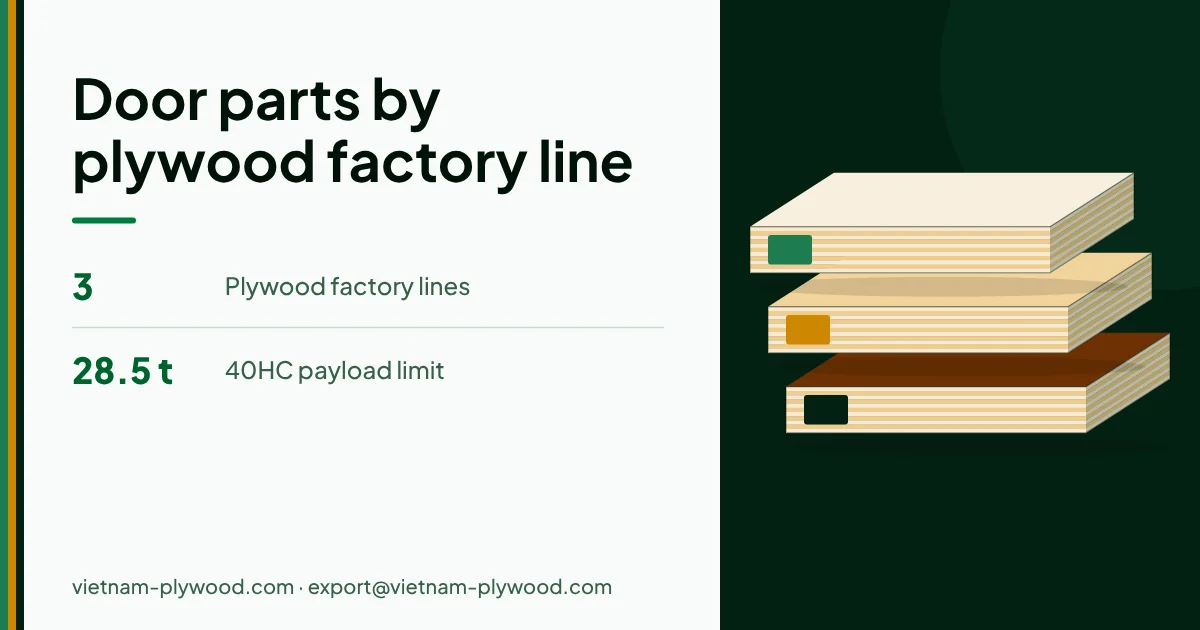
What plywood door parts does a manufacturer order?
A plywood door order starts with face skins, a core panel or blank, and stiles and rails that carry the edges and hardware. HCPLY assigns the plywood components to the producing factory according to the specified build. Choosing a face instead of a core grade can waste machining time, increase rejects, and delay a container.
The door maker should describe the finished door before choosing sheets. A flush door hides most of its structure beneath continuous skins. A panelled door exposes framed divisions, while a laminated door puts the surface treatment at the centre of the purchasing decision. All three need dimensional compatibility between the parts.
A purchase schedule should distinguish a plywood skin from a full-thickness plywood blank. It should also identify whether the stiles and rails are plywood strips, solid timber, or laminated veneer lumber (LVL). LVL is an engineered member made from bonded veneers; an LVL specification needs its own agreed dimensions and performance requirements. Do not substitute ordinary plywood strips for an engineered frame member without the door designer’s approval.
For decorative door skins, start with furniture plywood. For a raw substrate intended for further finishing, compare matt plywood. The finish and the intended exposure determine the next decision.
Which plywood suits skins, core panels and frames?
Door skins need a consistent visible face and controlled thickness; core panels need the correct build and machining allowance; framing members need an approved section and connection design. These are different purchasing specifications even when a sales description calls every item a plywood board door.
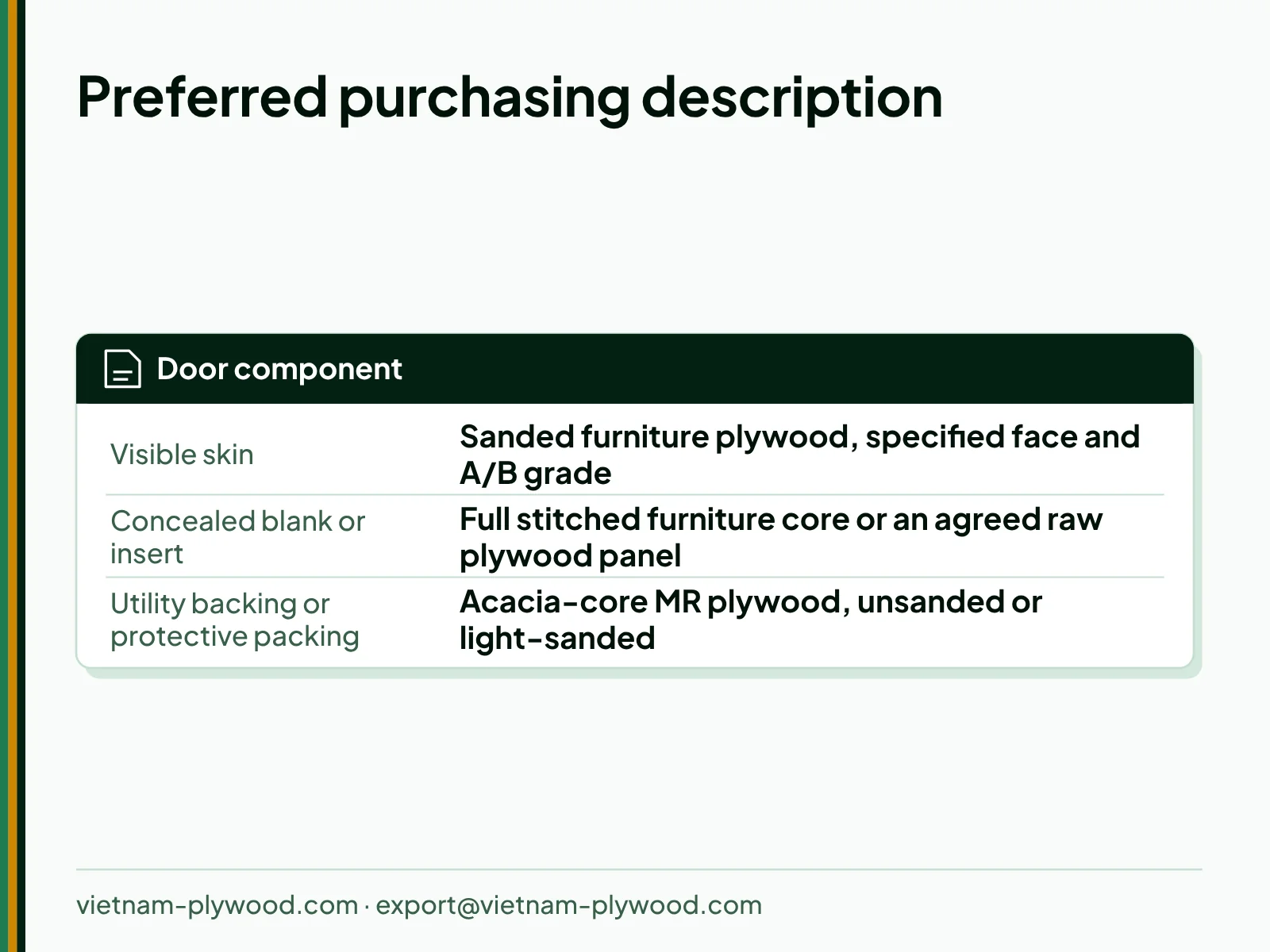
| Door component | Preferred purchasing description | Producing line or boundary | Main acceptance check |
|---|---|---|---|
| Visible skin | Sanded furniture plywood, specified face and A/B grade | Our furniture line | Face defects, thickness, sanding |
| Concealed blank or insert | Full stitched furniture core or an agreed raw plywood panel | Our furniture line | Core gaps, thickness, flatness |
| Utility backing or protective packing | Acacia-core MR plywood, unsanded or light-sanded | Our commercial and packing line | Edges, glue specification, dimensions |
| Wet-formwork sheet, outside the door assembly | Film-faced acacia/eucalyptus panel | Our construction line | Film, edge condition, thickness |
| LVL stiles and rails | Separately specified engineered frame stock | LVL manufacture and supply require separate verification | Section, bonding, straightness, test evidence |
This comparison prevents a common error: ordering construction film-faced plywood as if its film were a decorative laminate for a door. Our construction line presses phenolic or melamine film for construction applications; the film grades are 120 g/m² standard, 135 g/m² premium, and 220 g/m² anti-slip only. Those films are not an offered decorative door laminate.
Each plywood build is assigned to its designated producing line. LVL stiles and rails require a separately verified supplier, section specification and performance evidence before inclusion in a purchase schedule.
How do flush, panelled and laminated doors differ?
Flush doors usually consume continuous skins over a supporting core; panelled doors need inserts that fit the frame openings; laminated doors add a separately specified decorative surface process. The finished construction governs which plywood thickness and surface are ordered.
| Door type | Plywood requirement | Machining implication | Buying verdict |
|---|---|---|---|
| Flush | Paired skins and compatible core/blank | Match skin dimensions, bonding surfaces and hardware zones | Specify skins and core as separate items |
| Panelled | Sized inserts plus designed stiles and rails | Allow for grooves, movement and edge finishing | Buy insert stock against the frame drawing |
| Laminated | Smooth, consistent substrate for a decorative overlay | Surface preparation and adhesive compatibility | Specify plywood substrate; source overlay separately |
A flush door may have a solid plywood blank or a framed core with skins. Those are distinct designs with different weight, hinge and lock requirements. A manufacturer must state which is intended rather than assuming a full plywood slab from the phrase ply door.
For a panelled door, the frame takes much of the hardware load. The panel may float in a groove or be bonded into a designed assembly. Confirm the detail on the door drawing before selecting a panel thickness, because a tight insert can distort the assembly and an undersized insert can rattle.
A laminated door describes a surface finish rather than a single core construction. Melamine, high-pressure laminate (HPL), and other laminate faces are relevant finishing topics, but They are not offered as a product line. Our plywood substrate can be discussed separately from the downstream laminating process.
Which factory line makes each plywood door component?
Our furniture line presses the sanded, full-stitched plywood used for visible skins and specified door blanks. It uses styrax or eucalyptus core and E0/E1 emission classes. The core species affects panel density; the face veneer determines the product’s commercial name.
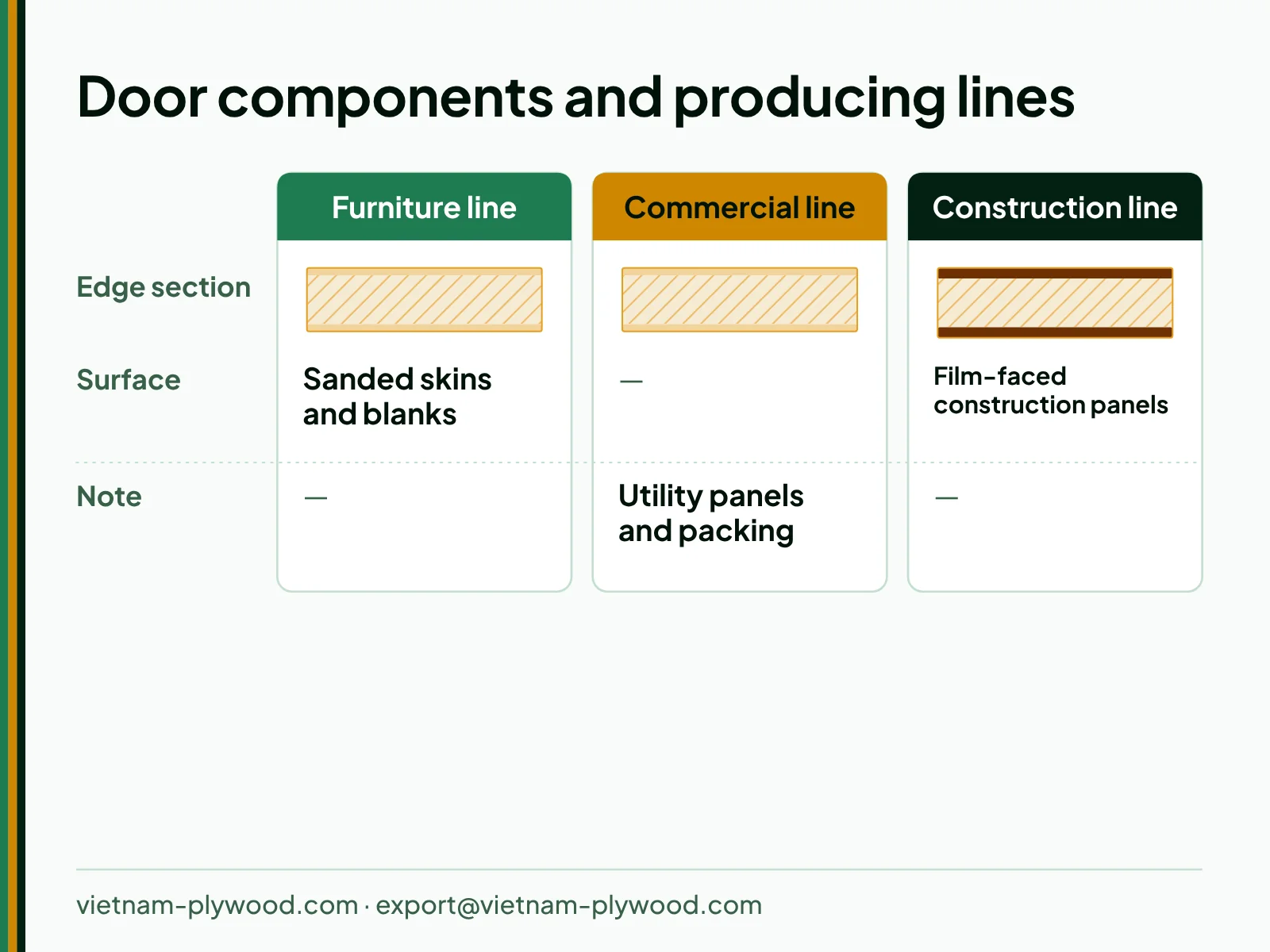
Our commercial and packing line presses acacia-core plywood with moisture-resistant (MR) glue, supplied unsanded or light-sanded. It is useful when the order calls for utility-grade panels or packing stock rather than a fine finished door face. A plywood strip cut from this material does not automatically become an LVL stile.
Our construction line presses film-faced panels with acacia or eucalyptus core. It belongs in a construction order, rather than the decorative skin schedule of a flush or panelled door. Buyers comparing all three builds can use factory-line grade comparisons and several plywood types in one order.
The factory allocation is made against the written specification. A door order can contain multiple plywood components, but every item needs its own line, surface, tolerance and acceptance criteria. The producing factory is the inspection location for the plywood assigned to that line.
How should a door maker specify faces, cores and thickness?
A usable door specification states the exposed face, core, adhesive, emission class, thickness tolerance and cut size. A thickness number by itself cannot distinguish a finish-ready skin from an unsanded backing panel.
Available face veneers include bintangor, okoume, engineered veneer (EV), gurjan, pine, poplar, eucalyptus, birch and sapele faces. Face veneer commonly measures 0.2–0.4 mm. A/B face grades apply to the usual face selection; birch is described only with D/E/F grades. Request approved face samples because the grade and appearance need to be judged against the actual finishing method.
Available thicknesses run from 3–40 mm, with common choices of 3, 5, 9, 12, 15, 18, 21 and 25 mm. Furniture sanded tolerance is ±0.2 or ±0.3 mm as ordered. Commercial and film-faced tolerance is ±0.5 mm, while packing is ±0.5–1.0 mm. Length and width tolerance is ±2 mm.
Standard sheet formats include 1220×2440, 1250×2500, 1220×2135, 1220×1830, 915×2440, 915×2135 and 915×1830 mm. Custom cutting is available. Compare sheet format with the door blank nesting plan, then reserve machining allowance for edge trimming and finished dimensions.
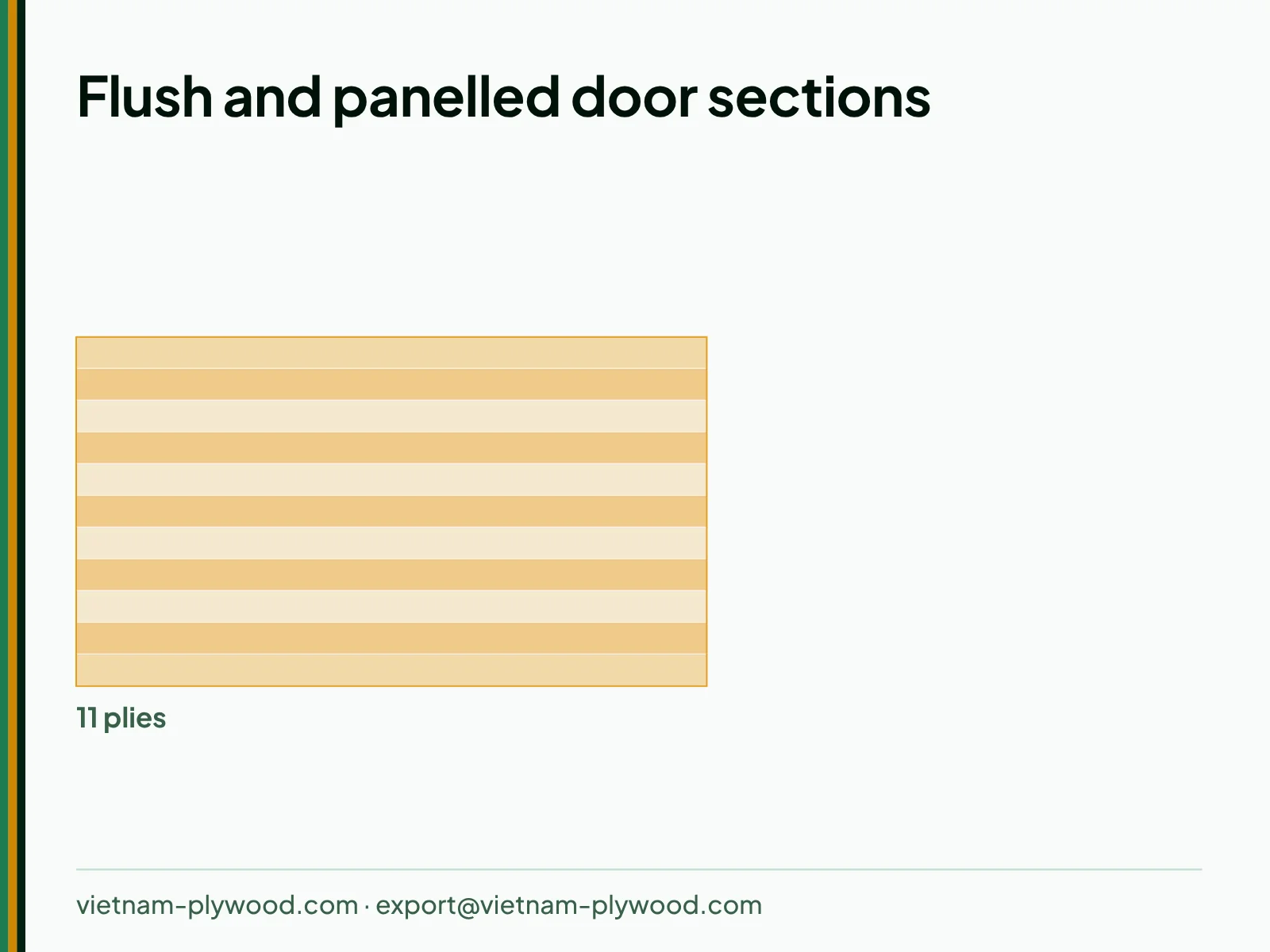
For an 18 mm panel, the core may contain 11–13 plies because individual core veneers are 1.4–2.0 mm. Ask to see the cut edge and the core construction. Full stitched is followed by stitched outer layers with edge-trimmed inner veneers, finger-jointed construction and loose-laid construction in descending construction quality.
Is a waterproof plywood door suitable outdoors?
An external plywood door needs an exposure-specific assembly design, verified bonding and protected edges. A waterproof plywood door label alone does not establish that a finished door will resist rain, movement or water entering around its frame.
For a plywood external door, identify direct rain exposure, shelter, finishing system, edge sealing and the expected maintenance regime. Specify the bonding test the buyer accepts and the full door assembly’s performance criteria. A water-resistant adhesive cannot replace suitable coating, drainage and sealing around cutouts.
The glue specifications distinguish melamine MR glue with a 12-hour boil description from phenolic waterproof-bond (WBP) glue with a 72-hour boil description. Those are glue descriptions, separate from E0, E1 or E2 emission classes. Neither label by itself assigns a structural grade or establishes finished-door weather resistance.
The U.S. Department of Energy’s Building Science Education guidance, accessed in 2026, explains that correctly installed flashing at door openings directs water outward and protects wall framing. Its separate guidance describes air sealing around the rough opening. These assembly details matter when a plywood front door or ply external door is installed: door-opening flashing guidance and rough-opening air-sealing guidance.
Ask for a test report accepted by the buyer before using a marine or BS 1088 designation. Specify any required structural grade against a test report the buyer accepts. An external door also needs an appropriate frame, hardware, finish and installation specification.
What differs for a plywood internal door?
A plywood internal door usually prioritizes surface appearance, machining consistency and the specified emission class. Exterior exposure details remain relevant only where the door faces moisture, cleaning water or an unusual service environment.
For a paint-grade interior door, select a face and grade that match the planned coating. For a clear-finished door, review grain, repairs and veneer consistency in an approved sample. For a door receiving a separate decorative overlay, review the substrate’s sanding and bonding compatibility with the downstream processor.
Furniture-line full-stitched core helps when the door maker needs a clean cut edge and a controlled surface. A concealed insert may accept a different face grade from a visible skin, but the two items should remain separately identified. A manufacturer should not buy an expensive decorative face for a part that will be entirely hidden.
The plyboard door and ply board door terms are used inconsistently across markets. Put the actual construction on the order: plywood skins, plywood blank, or a framed door with plywood inserts. We do not press blockboard, medium-density fibreboard (MDF), oriented strand board (OSB) or chipboard; those names should not be treated as interchangeable with plywood.
Can door skins, core stock and LVL share one container?
Different plywood specifications can share one 40-foot high-cube container within its 28.5 t payload limit. The minimum order is one 40HC. LVL stiles and rails require separately verified supply, dimensions and loading weights before they can be included in the same loading plan.
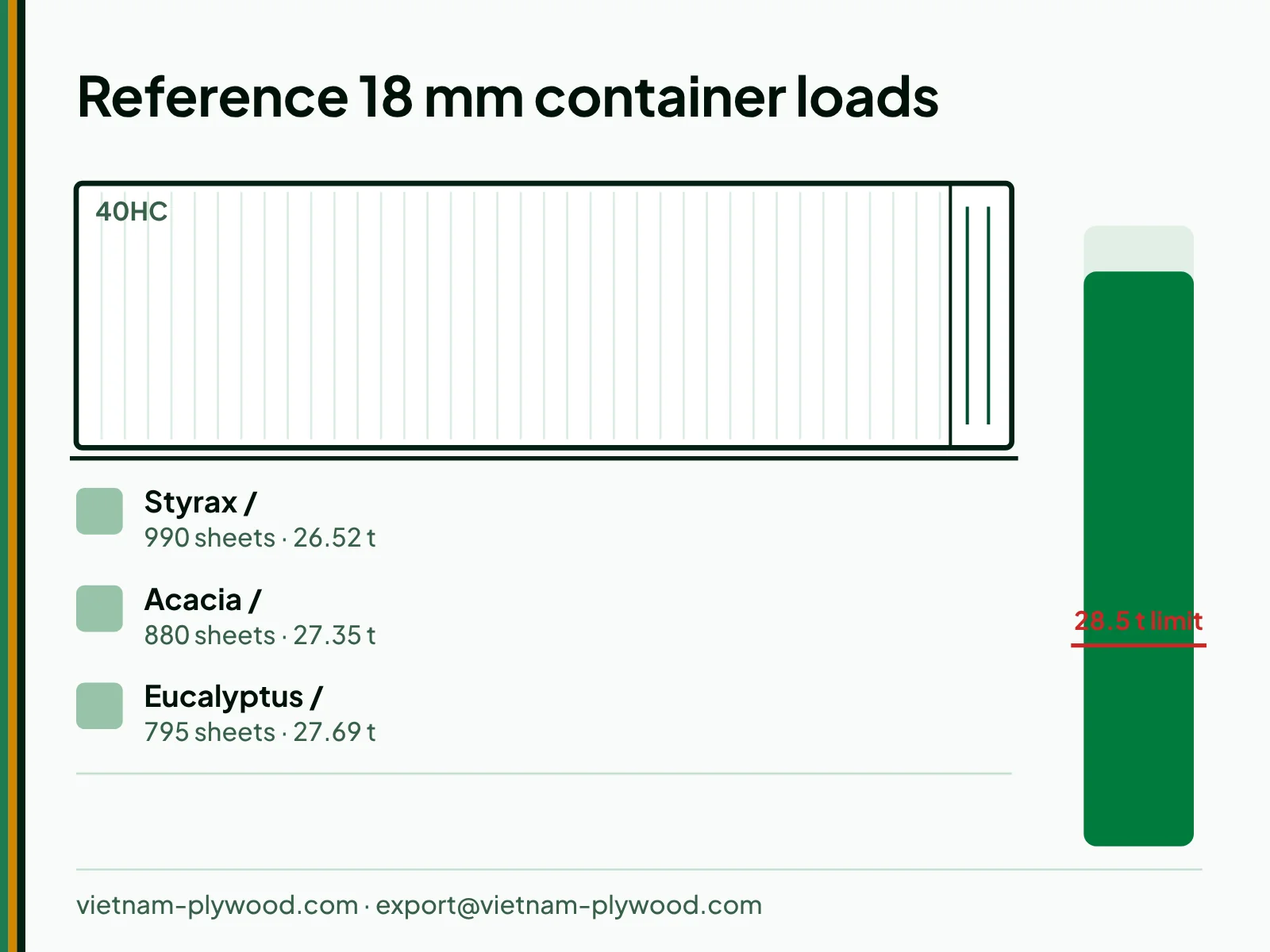
At 18 mm and 1220×2440 mm, a full styrax-core load is 990 sheets, 53.05 m³ and 26.52 t. An acacia-core load at the same thickness is 880 sheets, 47.15 m³ and 27.35 t; eucalyptus core gives 795 sheets, 42.60 m³ and 27.69 t. These are single-core reference loads, not a mixed-load promise.
The same sheet at 18 mm weighs 26.79 kg with styrax core, 31.08 kg with acacia core and 34.83 kg with eucalyptus core. When building a mixed order, multiply each component’s specified sheet weight by its quantity, add the other cargo and packing weights, and check the resulting load against the payload limit. LVL weight cannot be calculated without its confirmed section, length, density and quantity.
Use container loading calculations for the detailed pallet method. Door skins often use a different thickness from the reference 18 mm blank, so the actual mixed packing list must identify every item. Protect visible faces and cut edges during loading; separate packing grades from finished-face stock to prevent abrasion.
What can the buyer inspect at the producing factory?
A door maker’s inspection should match the sample, cut edge and dimensions to the signed component specification. HCPLY coordinates on-site quality control at the producing factory, where buyers can inspect the goods and visit the factory office.
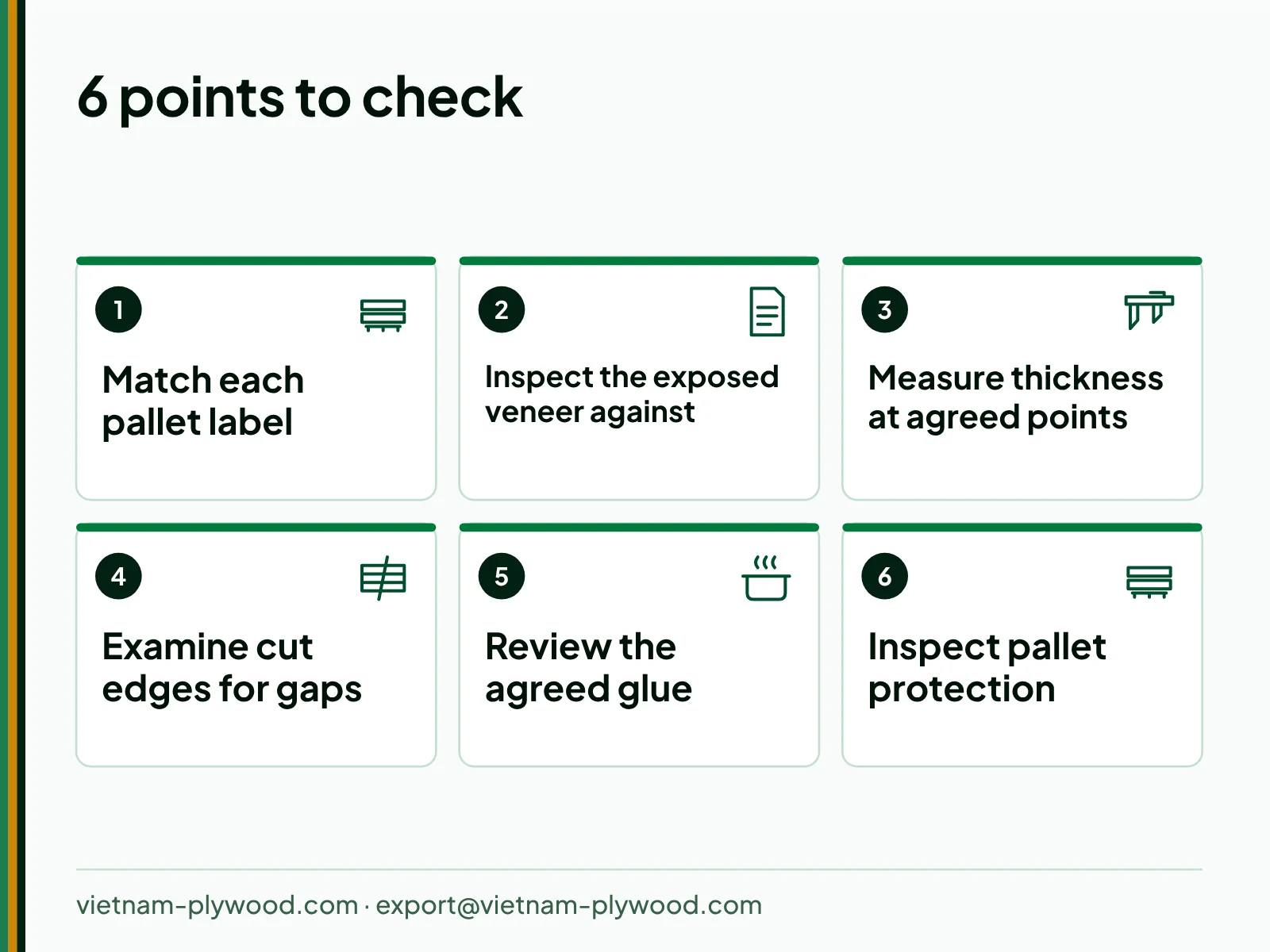
- Match each pallet label and production lot to the door-skin, blank or utility-panel item on the purchase schedule.
- Inspect the exposed veneer against the approved face sample and the specified grade, including repairs and grain consistency.
- Measure thickness at agreed points and check length and width against the ordered tolerances.
- Examine cut edges for gaps, overlaps and the specified stitched-core construction; check flatness against the buyer’s drawing.
- Review the agreed glue and emission documentation as separate fields, then witness any agreed sampling procedure.
- Inspect pallet protection, sheet counts and loading segregation before the container is closed.
A visible face inspection cannot establish the performance of a complete door assembly. Hinges, edge treatment, frame stiffness, laminate bonding and weather exposure must be assessed against the door maker’s finished-product requirements.
FSC, CARB P2, ISO 9001 and CE certificates, plus EUTR/EUDR documents, belong to the member factories and are shown with factory details masked, on request. Certificate relevance is checked against the producing factory and the particular order; do not substitute a general certificate image for the agreed evidence.
Which shipping documents describe the door order?
The commercial invoice and packing list identify the plywood door components and quantities shipped. We manage specification, on-site quality control, documents and loading through the export process, with shipment directly from the producing factory.
The export documents include the commercial invoice, packing list, bill of lading (B/L), certificate of origin, phytosanitary and fumigation papers, and insurance under cost, insurance and freight (CIF). European Union lots use EUR.1 where applicable and an EUTR/EUDR file set. The order’s certificate documents can include an FSC claim on sales documents, emission certificate and test reports for the agreed build.
After loading, the draft shipping documents come to you for approval. The item descriptions should preserve the distinction between finished-face skins, core panels and any separately sourced framing stock. An invoice that simply says plywood door material gives less useful information for receiving inspection than an itemized packing list.
Delivery terms are free on board (FOB) Hai Phong, cost and freight (CFR/CNF), or CIF. Factory lead time runs 15–45 days from receipt of the 30% deposit; the exact figure depends on order size, line loading and what the contract fixes. Balance 70% against the scanned B/L, by telegraphic transfer (T/T) or irrevocable letter of credit (L/C) at sight.
What drives the price of plywood for doors?
Core construction and surface grade usually drive the largest differences in door-panel quotations, followed by thickness, tolerance and the required glue and emission evidence. A full-stitched, sanded decorative skin costs more to make than a loosely assembled utility panel because it needs more controlled veneer selection and finishing.
An A-grade exposed face usually needs tighter veneer selection than a concealed backing face. A thicker blank consumes more wood volume than a thinner skin of the same area. A tighter ordered thickness tolerance calls for more process control and rejection of out-of-range sheets. Additional tests, documentation and custom cutting should be written into the request rather than assumed.
For furniture plywood, the indicative starting price is from US$350/m³ FOB Hai Phong (October 2026). This is a starting point for furniture plywood, not a quotation for a completed plywood door, a custom LVL frame or an exterior-rated assembly. Ask for a written quotation against the exact component schedule and destination port.
What specification should a door maker send?
A door maker should send one component-by-component schedule that identifies the finished door design and each plywood input. The specification below gives the producing factory a basis for samples, inspection and a shipment plan.
Describe whether the product is a flush, panelled or laminated interior door, or an exterior door requiring a separately agreed exposure test. Indicate which faces will remain visible, which edges will be machined, and which parts will carry hinges or locks. Where LVL is required, state that it is a separately verified component rather than assuming it is part of the plywood manufacturing range.
Application: flush / panelled / laminated door; interior or exterior exposure
Component and line/core: skin—furniture/styrax or eucalyptus; blank—furniture/full stitched; utility backing—commercial/acacia; LVL—separate verified specification
Glue: melamine MR or phenolic WBP as agreed for each plywood item
Emission: E0 / E1 / E2; buyer's required evidence
Face and grade: species, visible side, A/B; birch D/E/F only
Thickness and tolerance: mm per component; furniture ±0.2 or ±0.3 mm as ordered
Size: mm sheet size or agreed custom cut size
Quantity: sheets per component; mixed 40HC payload checked
Destination port: named port and agreed FOB Hai Phong / CFR (CNF) / CIF term
Ask Lucy at contact Lucy for a sample set of the specified door skins and core panels before approving the production schedule.