





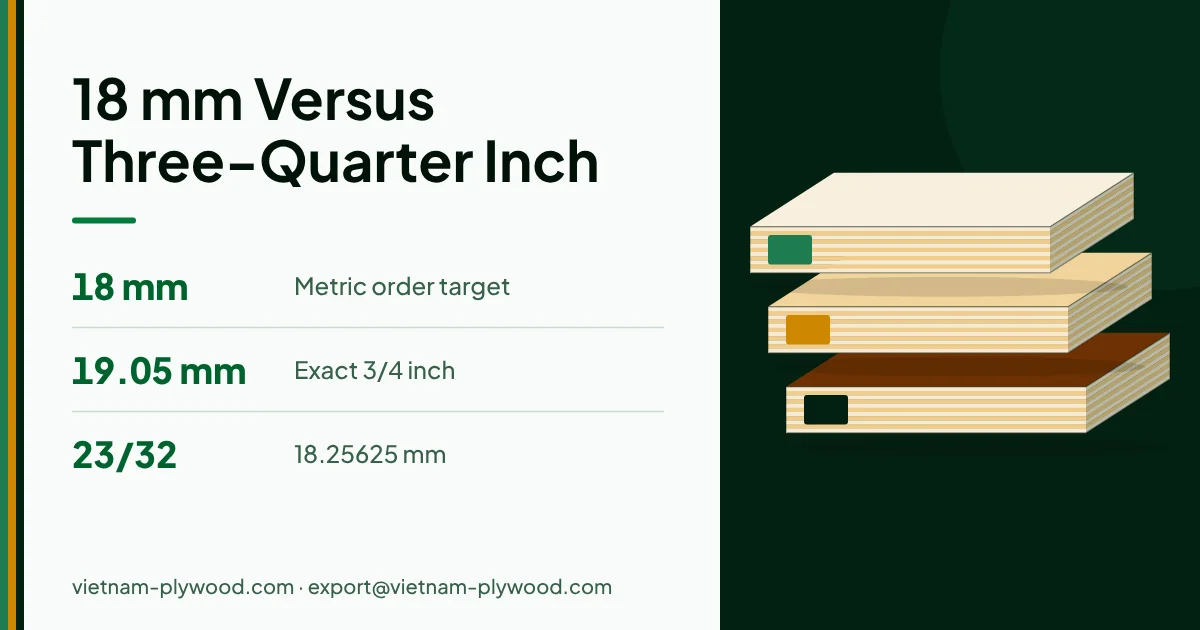
HCPLY builds 18 mm metric plywood for orders described as 3/4 plywood, with the actual thickness and tolerance written on the purchase specification. Confusing 18 mm with an exact 3/4 inch can mean rejected cabinet components, re-machining costs or delayed acceptance. The right build also depends on whether the sheet is for cabinets, packing or concrete forms.
What is 3/4 plywood in millimeters?
3/4 plywood describes a nominal three-quarter-inch panel. The exact mathematical conversion is 19.05 mm, because an inch is 25.4 mm. For an HCPLY order, 18 mm is a common metric production thickness; it must be written as 18 mm rather than silently substituted for 19.05 mm. The purchase specification controls the delivered panel, including its tolerance.
The US National Institute of Standards and Technology (NIST), in its 2025-updated SI Units – Length reference, states that the inch is exactly equivalent to 25.4 mm. That definition converts dimensions; it does not establish a plywood manufacturing tolerance. A nominal name on a sales listing therefore cannot replace a measured acceptance range. See our plywood sizes and thickness specification guide for the wider metric range.
Is 18 mm plywood the same as 3/4 inch plywood?
No. An 18 mm sheet is 1.05 mm thinner than the exact 19.05 mm conversion. It can be the agreed metric substitute for a nominal 3/4-inch order when the cabinet design, machining program and receiving inspection all call for 18 mm. A buyer needing a finished 19.05 mm panel should write that requirement separately rather than assume the nominal name delivers it.
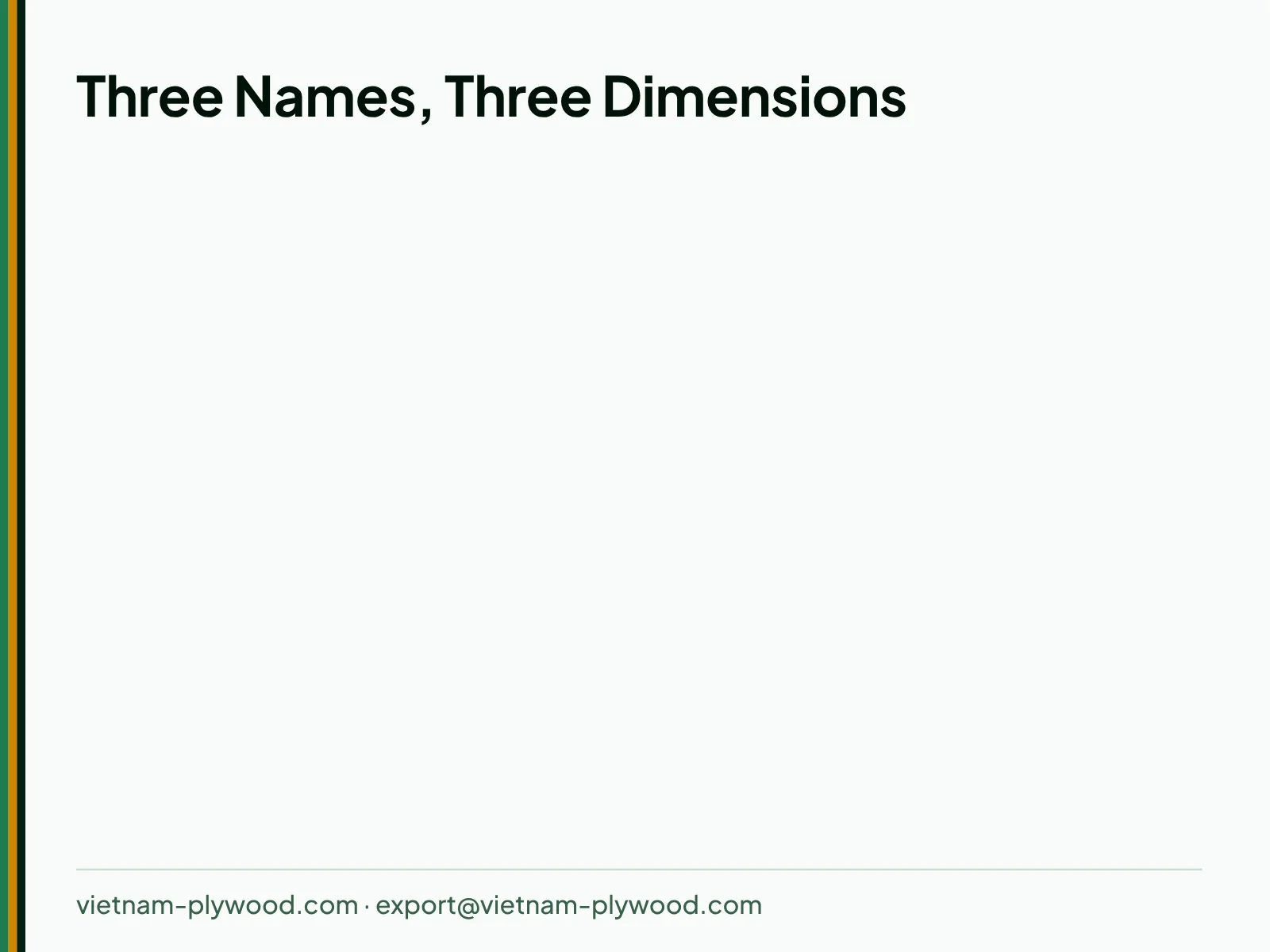
| Designation | Mathematical thickness | Difference from 18 mm | Buying verdict |
|---|---|---|---|
| 18 mm metric | 18.00 mm | 0 | Specify for HCPLY’s standard metric cabinet, packing or formwork build |
| 23/32 inch | 18.25625 mm | +0.25625 mm | Check the drawing and joint fit before substituting 18 mm |
| 3/4 inch | 19.05 mm | +1.05 mm | Do not write as an exact equivalent to 18 mm |
| 11/16 inch | 17.4625 mm | −0.5375 mm | Separate thinner nominal dimension; do not relabel 18 mm |
For sanded furniture panels, HCPLY’s ordered thickness tolerance is ±0.2 mm or ±0.3 mm. Commercial and film-faced panels use ±0.5 mm, while packing panels use ±0.5–1.0 mm. These bands apply around the written metric target; they do not change the target itself.
What is the difference between 23/32 and 3/4 inch plywood?
23/32 inch equals 18.25625 mm, while 3/4 inch equals 19.05 mm: a difference of 0.79375 mm. The two names sometimes appear in the same purchasing conversation, but they are distinct dimensions. Treat any retail-style nominal label as a starting point for questions about actual thickness, rather than a factory acceptance rule.
For a CNC cabinet program, set the dado width and shelf fit against the approved 18 mm sample and tolerance. For a distributor, print the actual ordered thickness on the carton and packing list. For a contractor, match panel thickness to the formwork design and support layout rather than translating a nominal inch label alone.
How should an importer write the thickness on an order?
Write “18 mm nominal, finished thickness tolerance ±0.2 mm” for a sanded furniture build when that band is selected. The same purchase line should name the core, surface, adhesive, emission class, dimensions and intended application. Avoid writing “3/4 inch = 18 mm” as though it were an exact conversion.
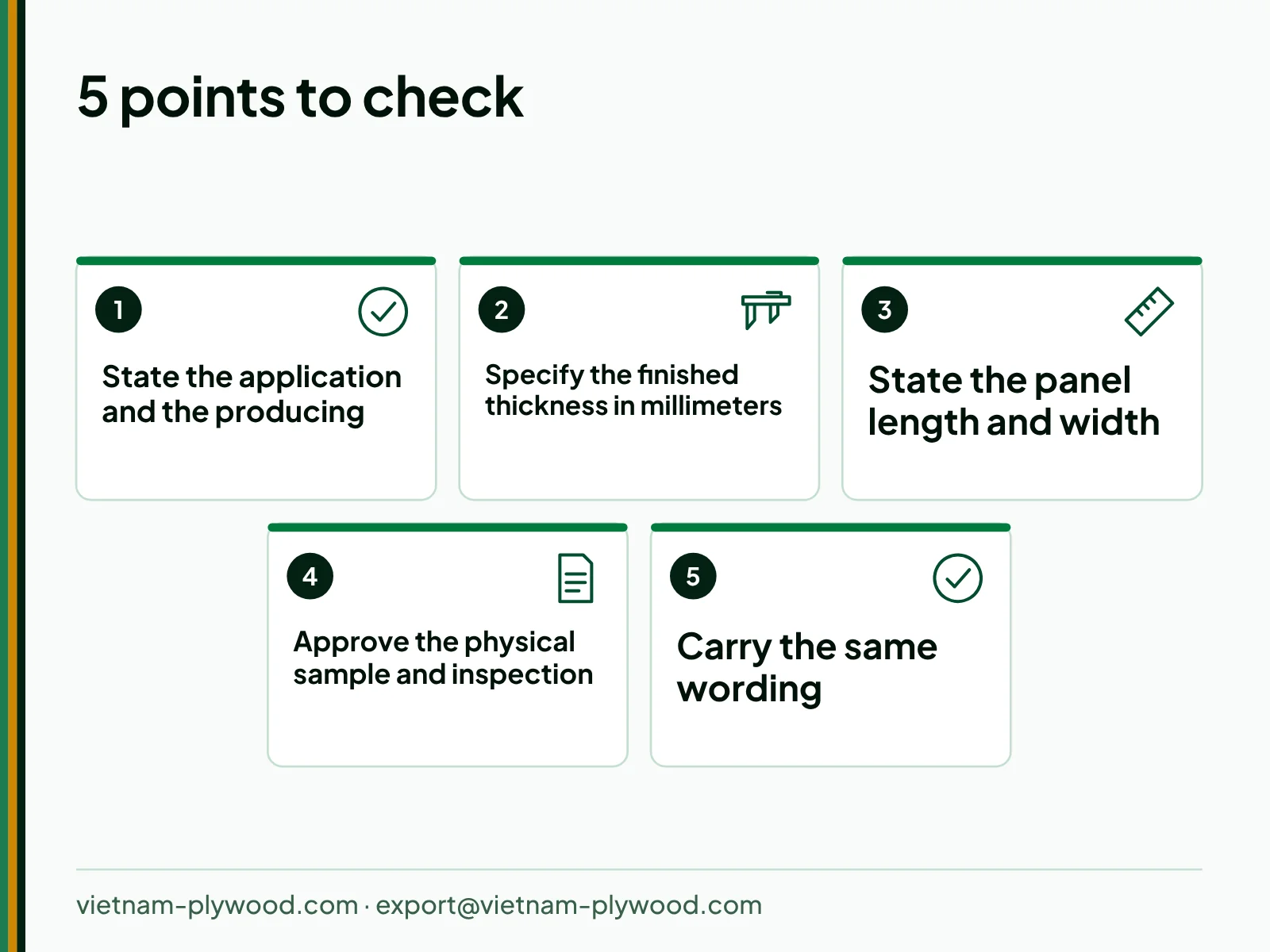
- State the application and the producing line, then choose the core and face.
- Specify the finished thickness in millimeters and the applicable tolerance band.
- State the panel length and width in millimeters; HCPLY’s length and width tolerance is ±2 mm.
- Approve the physical sample and inspection method before the production lot is accepted.
- Carry the same wording into the invoice, packing list and inspection instructions.
A caliper reading at the producing factory can be witnessed on panels sampled from the finished stack. Record positions and results against the signed specification. Thickness acceptance is a measurement decision, not a judgment based on the printed inch nickname.
Which HCPLY line presses an 18 mm panel?
All three HCPLY lines can make an 18 mm panel, but their constructions answer different purchasing needs. Our furniture line makes sanded, full-stitched styrax- or eucalyptus-core sheets for cabinets. Our commercial and packing line makes acacia-core panels with moisture-resistant (MR) glue. Our construction line makes film-faced acacia- or eucalyptus-core panels for formwork.
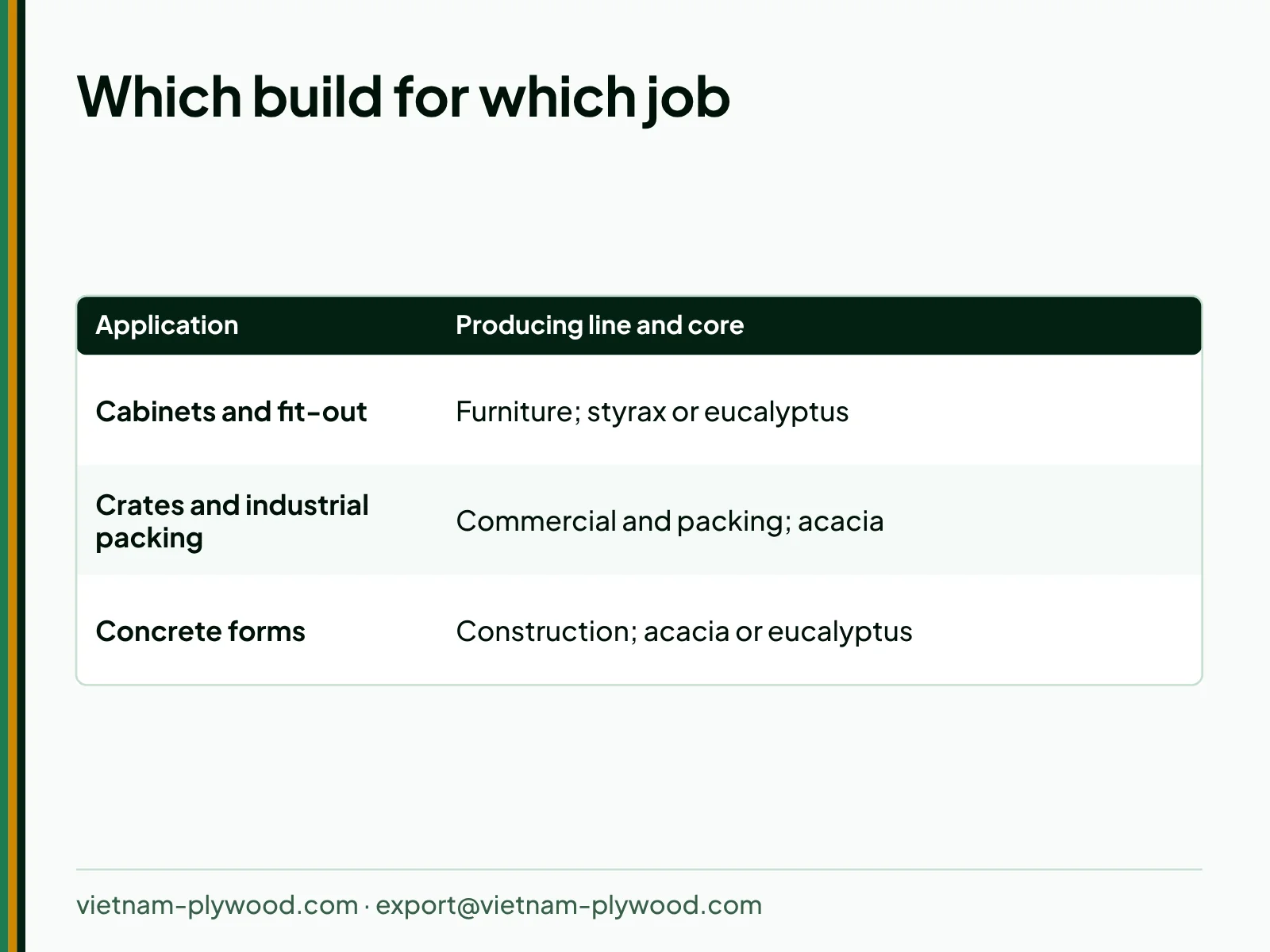
| Application | Producing line and core | Surface and glue | Thickness band | Verdict by use |
|---|---|---|---|---|
| Cabinets and fit-out | Furniture; styrax or eucalyptus | Sanded veneer face; selected glue and E0/E1 emission | ±0.2 or ±0.3 mm | Choose for visible furniture faces and machining fit |
| Crates and industrial packing | Commercial and packing; acacia | Raw or light-sanded; MR glue | ±0.5–1.0 mm for packing | Choose for packing where face appearance is secondary |
| Concrete forms | Construction; acacia or eucalyptus | Phenolic or melamine film | ±0.5 mm | Choose for shuttering and release-surface needs |
A furniture order should be described by its face veneer, not by its core species. The same thickness does not make a packing sheet a cabinet-grade sheet. Read the furniture plywood specification when face appearance and finished thickness drive acceptance.
Can I order plywood 4x8 3/4 from Vietnam?
Yes: order the metric 1220 × 2440 mm format at 18 mm thickness for the intended line. That is the listed near-4×8 export size, rather than an exact 48 × 96 inch conversion. HCPLY also lists 1250 × 2500 mm and other formats, with custom cutting available. Write both dimensions in millimeters on the order.
At 1220 × 2440 × 18 mm, a styrax-core sheet weighs 26.79 kg, an acacia-core sheet 31.08 kg and a eucalyptus-core sheet 34.83 kg. Core density drives those figures; a pine or birch face does not change the core designation. The 18 mm build has 11–13 plies, depending on veneer thickness.
For a full single-core 40HC reference load, the figures are 990 styrax sheets at 26.52 t, 880 acacia sheets at 27.35 t or 795 eucalyptus sheets at 27.69 t. These figures exclude film weight. Mixed specifications can share a container within the 28.5 t payload limit; the container loading calculation owns the detailed loading question.
Which hardwood faces can be ordered on 18 mm plywood?
HCPLY lists bintangor, okoume, engineered veneer (EV), gurjan, pine, poplar, eucalyptus, birch and sapele faces, plus matt unfaced core. A face name describes the outer veneer; it does not promise a matching solid-wood core. The common face veneer thickness is 0.2–0.4 mm.
A buyer comparing 3/4 maple plywood with 3/4 poplar plywood should separate face appearance from core performance. Maple is not among HCPLY’s listed faces; poplar is. Birch is a listed face with D/E/F grades only, while other listed faces use A/B grades. For a pine plywood 3 4 request, specify pine as the face and select an allowed core independently.
For cabinet production, choose the face and appearance grade from the approved sample, then define sanding and thickness. A sanded plywood 3/4 request is incomplete until the millimeter target and tolerance are written. We do not press birch-core plywood or melamine-, high-pressure-laminate- or laminate-faced product lines.
How do glue and emission specifications differ?
Glue and emission class are separate order fields. MR refers to a melamine adhesive build with a 12-hour boil description; weather and boil proof (WBP) refers to a phenolic build with a 72-hour boil description. E0, E1 and E2 are emission classes, while CARB P2 and TSCA Title VI concern a US emission limit and third-party certification.
The furniture line uses E0 or E1 emission specifications. Film-faced construction panels use the selected film and adhesive build; 120 g/m² film is standard, 135 g/m² premium and 220 g/m² is anti-slip only. The construction line uses unsanded cores under the film. A buyer seeking a particular emission or adhesive report should include the accepted document requirement in the purchase specification.
Member-factory FSC, CARB P2, ISO 9001 and CE certificates, and EUDR/EUTR documents, are shown with factory details masked, on request. The order’s certificate documents accompany the shipment when applicable.
What can the buyer inspect at the producing factory?
The buyer can inspect the actual finished thickness, surface, edge construction and packaging at the producing factory. HCPLY arranges inspection where the order is made, with buyers visiting the factory office and the producing factory. The inspection record should match the written application and tolerance rather than a broad nominal thickness label.
For cabinet panels, check caliper measurements, sanding and the approved face grade. For packing panels, inspect core gaps and edge condition against the approved sample. For film-faced panels, inspect the coating, cut-edge sealing and specified film category. The moisture content testing guide covers that separate receiving criterion.
Full-stitched core construction is the highest of HCPLY’s listed construction options, followed by stitched outer layers with edge-trimmed inner layers, finger-jointed construction and loose-laid construction. Put the selected construction in the contract so inspection can distinguish a deliberate economy build from a defect.
How does the 18 mm build affect export planning?
An 18 mm cabinet order and an 18 mm formwork order can share an export planning discussion, but their sheet weights, finishes and packing requirements differ. For example, replacing styrax-core cabinet sheets with eucalyptus-core sheets increases the reference weight from 26.79 kg to 34.83 kg per 1220 × 2440 sheet. That changes the payload calculation before a container is booked.
HCPLY’s minimum order is one 40HC, with mixed specifications allowed within the payload limit. Production takes 15–45 days from the 30% deposit, set by order size, line loading and the contract. The balance is 70% against the scanned bill of lading (B/L), by telegraphic transfer (T/T) or irrevocable letter of credit at sight. See mixed-container ordering and production lead time.
Shipment terms are FOB Hai Phong, cost and freight (CFR/CNF), or cost, insurance and freight (CIF). The export document set includes the commercial invoice, packing list, B/L, certificate of origin, phytosanitary and fumigation papers, insurance under CIF, and agreed certificate or test documents. EU lots also have EUR.1 and EUTR/EUDR files. After loading, the draft shipping documents come to you for approval.
What should the final 18 mm specification say?
The final specification should name 18 mm as the ordered metric thickness and attach the tolerance appropriate to the selected line. State whether the application is cabinets, packing or forms; that decision determines core preparation, face treatment and inspection priorities. For cabinet machining, approve the sample before locking tooling dimensions.
For an indicative budget, commercial plywood starts from US$250/m³ FOB Hai Phong (October 2026) and furniture plywood starts from US$350/m³ FOB Hai Phong (October 2026). Those are starting prices for their respective categories. Film-faced pricing requires a quotation against the written core, glue, film, thickness, volume and destination specification.
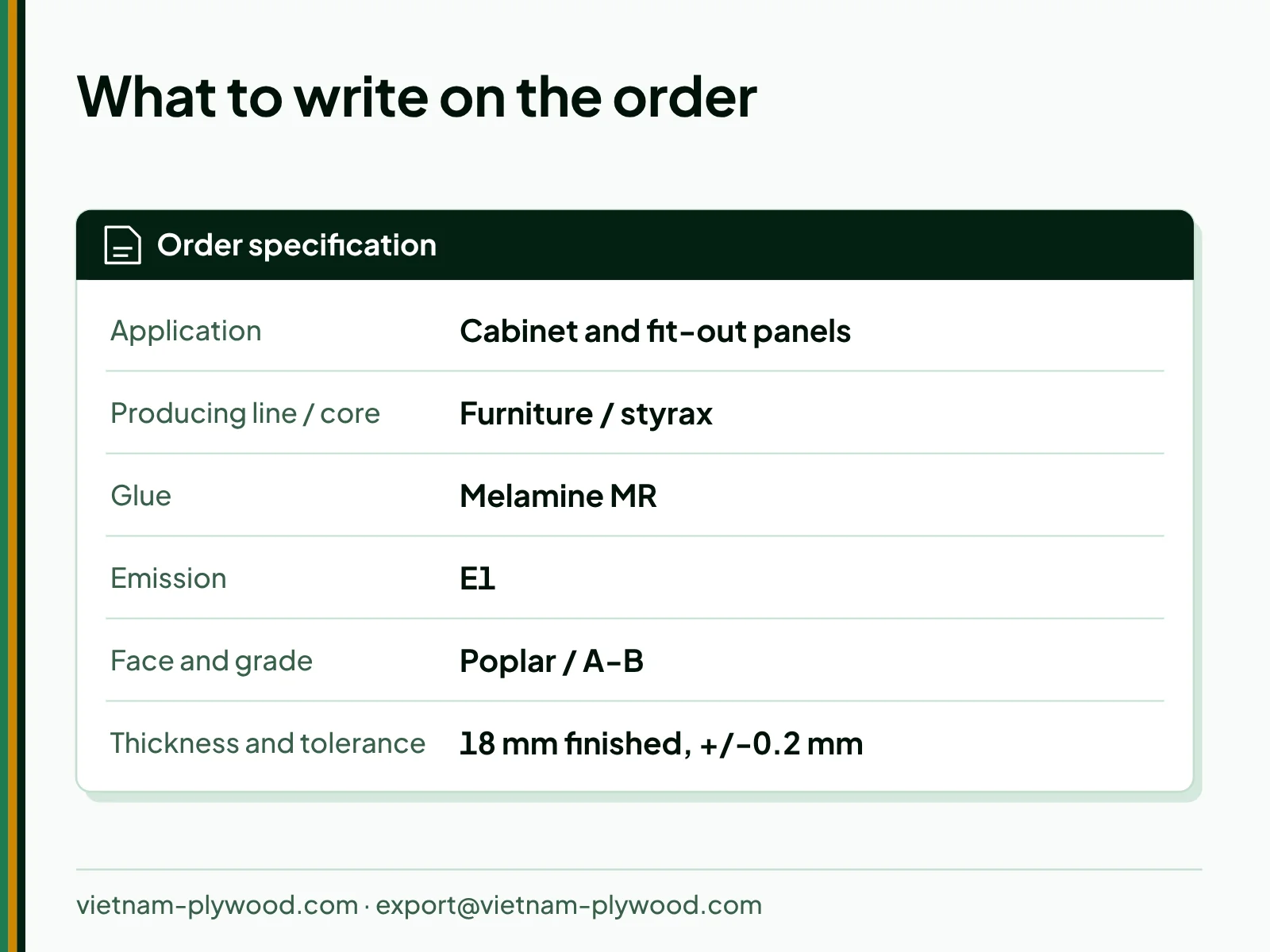
Use this cabinet example as an order-ready starting point, replacing the selected fields after sample approval:
Application: cabinet and fit-out panels
Producing line / core: furniture / styrax
Glue: melamine MR
Emission: E1
Face and grade: poplar / A-B
Thickness and tolerance: 18 mm finished, +/-0.2 mm
Sheet size: 1220 x 2440 mm
Quantity: one 40HC, sheet count per approved packing plan
Destination port: [buyer to specify]
Plan a trial container with Lucy at export@vietnam-plywood.com through the contact page, using the agreed 18 mm specification.