






What is Plyform plywood?
Plyform plywood is an APA-trademarked, Exterior-bond panel manufactured specifically for concrete forming. HCPLY manufactures Vietnamese film-faced formwork plywood through our construction line. Substituting a panel where a contract requires the trademark can mean a rejected submittal, replacement freight and lost site days. The first buying decision is whether the project requires the named certified product or accepts an engineered alternative.
APA – The Engineered Wood Association describes Plyform as a proprietary designation produced by APA member mills. Its Concrete Plyforms reference (APA, accessed 2026) identifies the class, bond classification, Performance Category and overlay information carried by its trademark. The broader concrete formwork specification guide explains how panel selection fits the form system.
What are the APA Plyform classes?
APA describes Class I, Class II and Structural I Plyform. These are veneer-group and structural-design distinctions; they are not a ladder of surface finishes. APA’s Concrete Plyforms guidance identifies Group 1 faces for Class I, Group 2 or 3 faces for Class II, and Group 1 species throughout for Structural I.
| APA designation | Veneer basis | What the buyer must check | Verdict by use |
|---|---|---|---|
| Class I | Group 1 faces | Required span, pressure and Performance Category | A specified high-stiffness forming option |
| Class II | Group 2 or 3 faces | Designer’s allowable pressure and span | Consider where approved form design permits |
| Structural I | Group 1 species throughout | Structural I marking and design tables | Select when the design calls for this rating |
An HDO face can appear on more than one class. A sales description that equates Class I with HDO or Class II with MDO confuses the structural grade with the surface. Read both fields on the trademark and compare them against the approved form drawings.
What separates B-B Plyform from HDO Plyform?
B-B Plyform has B-grade veneer on both faces and no overlay; B-C has a B face and C back. High-density overlay (HDO) Plyform carries a hard, resin-impregnated overlay designed for a smoother release surface. Medium-density overlay (MDO) offers a matte finish; neither overlay label by itself states the structural class.
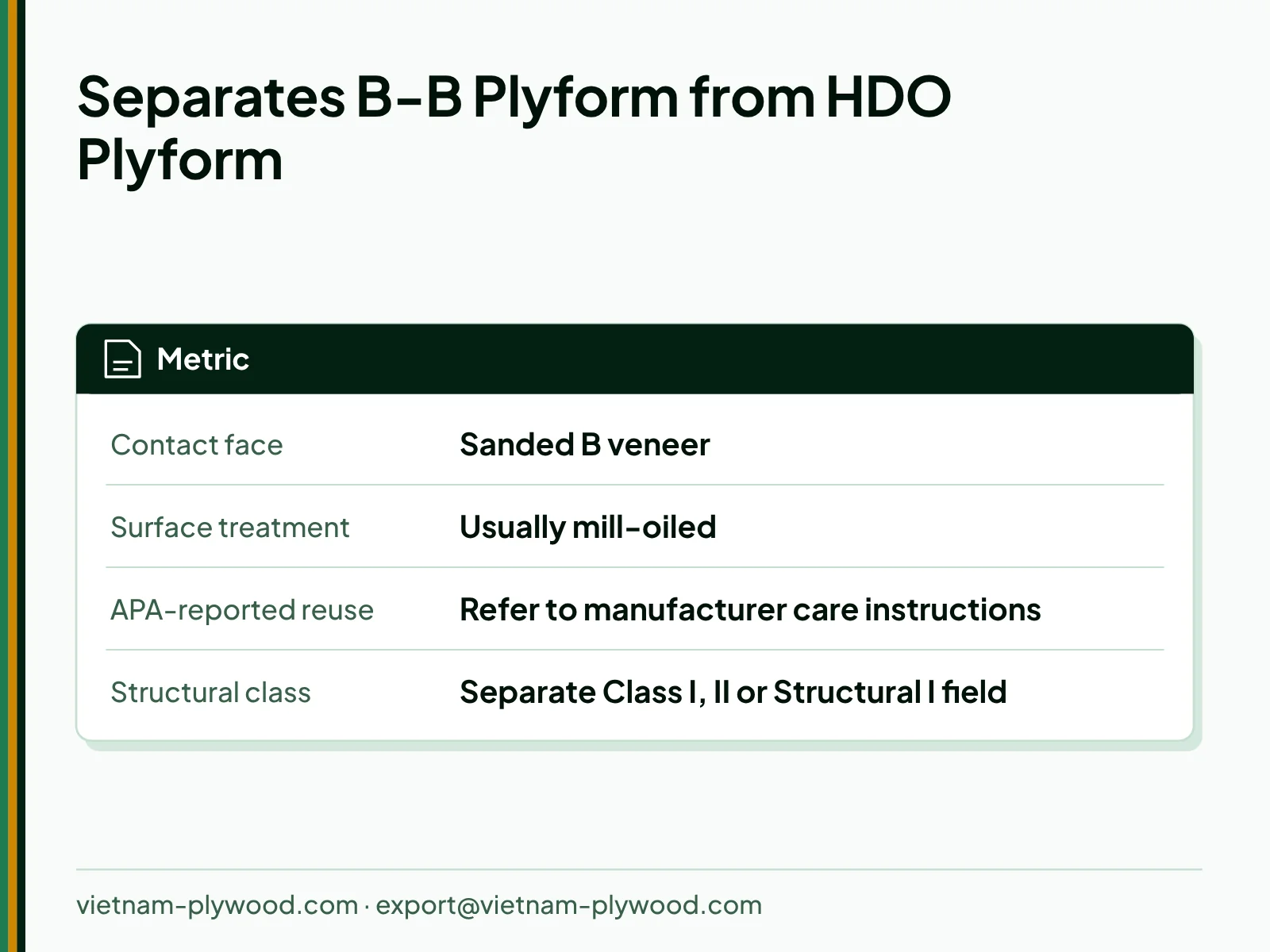
| Metric | B-B Plyform | HDO Plyform | Buying verdict |
|---|---|---|---|
| Contact face | Sanded B veneer | Hard resin overlay | HDO for demanding smooth finishes |
| Surface treatment | Usually mill-oiled | Release agent needed for pours | Write treatment into the order |
| APA-reported reuse | Refer to manufacturer care instructions | Refer to manufacturer care instructions | Evaluate actual handling and finish requirements |
| Structural class | Separate Class I, II or Structural I field | Separate Class I, II or Structural I field | Check class independently |
APA’s Concrete Forming page (APA, accessed 2026) distinguishes B-B/B-C, MDO and HDO and explains why surface care matters. Those reuse ranges describe the marked products in the association’s guidance.
How do US thickness and panel markings affect a purchase?
A US Plyform order identifies the Performance Category, grade, class, piece count and dimensions. Common categories identified by APA include 19/32, 5/8, 11/16, 23/32 and 3/4. The category on the trademark is part of the specification, rather than an invitation to round a metric panel to the nearest inch.
Our construction line offers 3–40 mm thickness and sizes including 1220×2440 and 1250×2500 mm. Its film-faced thickness tolerance is ±0.5 mm, with length and width ±2 mm. A form designer must assess the proposed actual thickness, support spacing, pressure, bending, shear and deflection before approving an alternative. See the formwork thickness selection guide for the dimensional decision.
When is the APA stamp mandatory?
The APA trademark is mandatory for acceptance when the project documents require APA Plyform and no substitution has been approved. An engineer’s acceptance of another panel is a separate decision; a supplier cannot create the APA designation by describing ordinary film-faced plywood as “equivalent.”
Check the specification’s product standard, manufacturer qualification, inspection and submittal clauses. Then read the drawings and approved materials schedule for any substitution process. A contract can impose an APA-only requirement even when a different panel might work mechanically. Conversely, a performance-based form specification can permit another build after review of relevant test reports and engineering calculations.
The APA Concrete Plyforms page explains what its trademark communicates. A packing label, mill invoice or informal product name is no replacement for the trademark when that is the stated acceptance criterion.
Can Vietnamese film-faced plywood be used instead?
Yes, where the buyer’s project specification admits alternatives and the responsible designer approves the particular panel build. The substitute must be assessed against actual concrete pressure, support spacing, finish requirements, panel orientation and intended reuse. A film coating alone does not establish a Plyform class or a structural design value.
Our film-faced plywood comes from our construction line with acacia or eucalyptus core and phenolic or melamine film. The line uses phenolic or melamine glue systems, and its product specification records the chosen construction. It does not press HDO or MDO Plyform. Where the approved schedule explicitly requires an APA-stamped product, buy that product from an eligible manufacturer rather than ordering an unstamped substitute.
A practical submittal compares the requested standard and panel markings with the alternative’s drawings, thickness, core, bond, surface, test evidence and the designer’s acceptance. The Vietnam film-faced formwork applications page covers the separate use case.
Which production line builds the proposed alternative?
Our construction line presses the film-faced alternative. The furniture line and commercial and packing line produce different panel constructions even when the nominal thickness is identical. The producing factory is selected by the written build, and buyers can inspect the panels there.
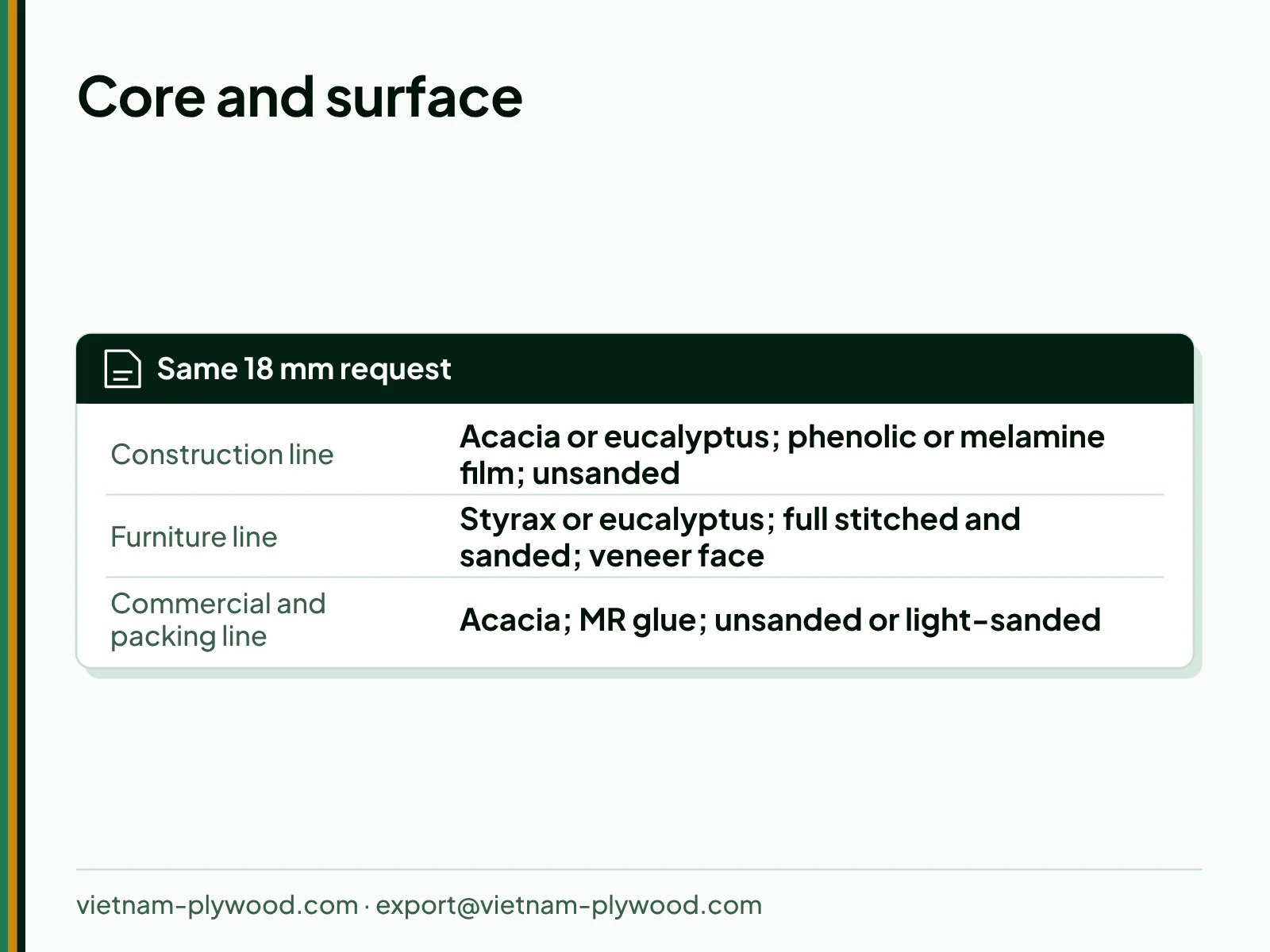
| Same 18 mm request | Core and surface | Intended order |
|---|---|---|
| Construction line | Acacia or eucalyptus; phenolic or melamine film; unsanded | Concrete form panel alternative |
| Furniture line | Styrax or eucalyptus; full stitched and sanded; veneer face | Furniture or cabinet component |
| Commercial and packing line | Acacia; MR glue; unsanded or light-sanded | Commercial or packing panel |
The buyer can witness thickness checks, film condition, edge sealing and the selected core build at the producing factory. A witnessed inspection documents the delivered construction; it does not grant an APA trademark. The one-supplier product comparison explains why identical thicknesses are not interchangeable across uses.
Which film and bond specification should be written?
Film-faced panels from our construction line use 120 g/m² standard film, 135 g/m² premium film or 220 g/m² anti-slip film. Anti-slip is a separate surface choice for a different contact requirement. The core can be acacia or eucalyptus; density follows the core rather than the face or film.
Specify glue and emission separately. Melamine is the MR, 12-hour-boil glue system; phenolic is the WBP, 72-hour-boil system. For a structural substitution, obtain a test report accepted by the buyer and written approval from the responsible designer. For exposed concrete, agree on finish expectations and inspect sample surfaces before committing a production lot.
With proper handling, a release agent on every pour and sealed edges including cut edges, melamine-glue film-faced plywood gives about 12–15 pours and phenolic-glue film-faced plywood up to about 25 pours. The release-agent guidance addresses the care requirement.
How should the buyer compare shipping quantities?
A US Plyform Performance Category and a metric panel thickness must be reconciled before a shipping quantity is fixed. For an 18 mm, 1220×2440 mm build, the core changes sheet mass and therefore the loading plan. The following figures exclude film weight.
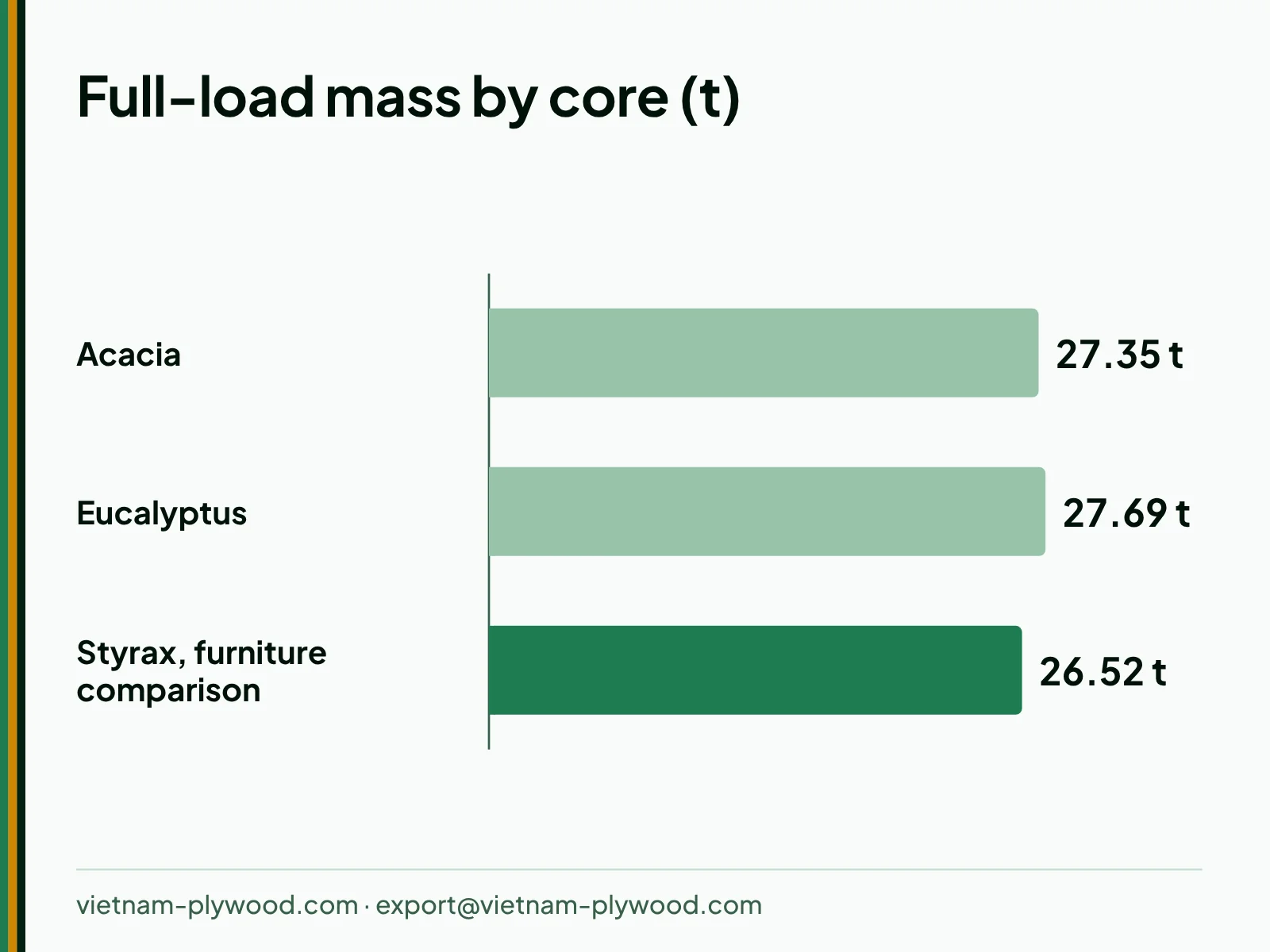
| Core | Sheet mass | Full 40HC sheets | Full-load mass |
|---|---|---|---|
| Acacia | 31.08 kg | 880 | 27.35 t |
| Eucalyptus | 34.83 kg | 795 | 27.69 t |
| Styrax, furniture comparison | 26.79 kg | 990 | 26.52 t |
The 40HC payload limit is 28.5 t. A minimum order is one 40HC, and specifications can be mixed within the payload limit. For a mixed load, calculate each panel build separately; the container loading reference owns the full loading method. Styrax in this comparison belongs to the furniture build, not the construction line.
What evidence belongs in the approval and export file?
The project approval file should contain the accepted panel specification, drawing or schedule reference, and the engineer’s decision on any substitution. An APA-only order additionally requires the actual marked APA product. For a proposed alternative, request the agreed build’s test reports and record the receiving inspector’s acceptance criteria before production.
HCPLY handles specification, on-site quality control, loading and shipping documentation. A shipment’s commercial invoice, packing list, bill of lading and certificate of origin identify the consignment; order-specific test reports address the agreed build. After loading, the draft shipping documents come to you for approval. Certificate materials belonging to our member factories can be shown with factory details masked, on request.
The shipment document set records what was sold and shipped. It does not turn film-faced panels into APA Plyform. Send the project acceptance language before agreeing on a replacement build.
How do you write a purchase request that avoids rejection?
Write the exact specification first, including whether APA trademarking is compulsory or an alternative is permitted. If an alternative is allowed, name the approval authority and request the performance evidence they will review. A sample and inspection plan should match the finish and dimensional criteria.
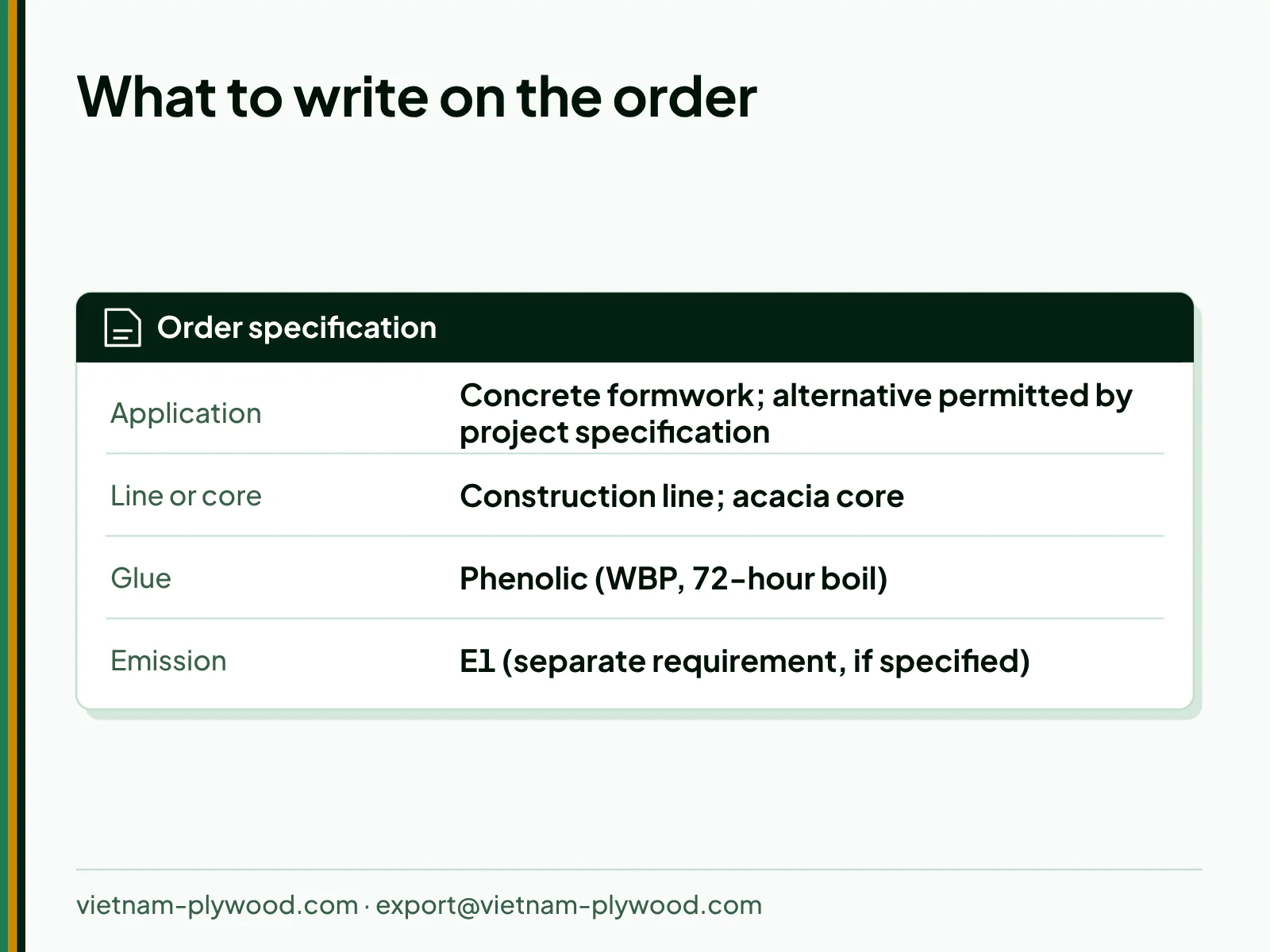
For HCPLY construction-line orders, request a written quotation for the specified film-faced build. Film type, core, glue, thickness, cut size and quantity determine the comparison. The specification below is a starting request for an approved alternative, not an APA order.
Application: Concrete formwork; alternative permitted by project specification
Line or core: Construction line; acacia core
Glue: Phenolic (WBP, 72-hour boil)
Emission: E1 (separate requirement, if specified)
Face and grade: Phenolic film, 120 g/m²; agree surface acceptance criteria
Thickness and tolerance: 18 mm; ±0.5 mm
Size: 1220 × 2440 mm; length/width ±2 mm
Quantity: One 40HC; confirm mix and loading plan
Destination port: [buyer to specify]
Project acceptance: Engineer's written approval and required test reports
Request the film-faced specification sheet from Lucy at export@vietnam-plywood.com.