





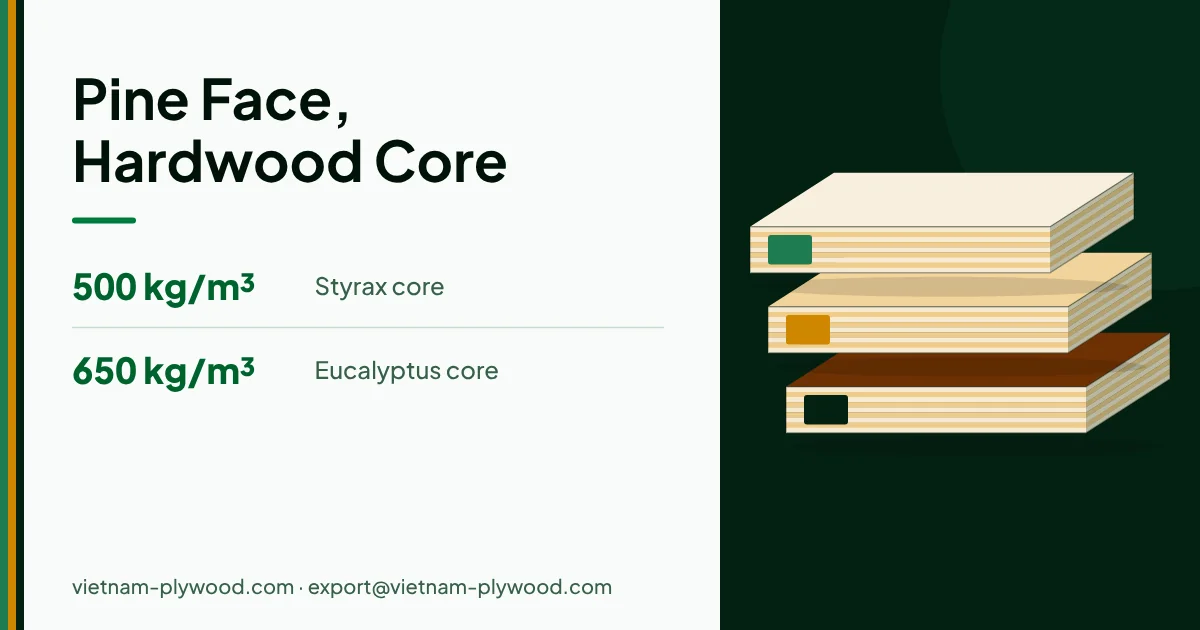
Pine plywood properties change substantially when the visible pine veneer sits over a hardwood core, as it does in HCPLY’s furniture build. Selecting by face name alone can mean rejected cabinet parts, extra finishing work or a delayed load. For buyers specifying panels, the core species, veneer quality and adhesive must be written separately.
What is pine plywood?
Pine plywood is a veneer panel described by its pine surface or, in some markets, by pine veneers throughout the panel. Our pine-faced plywood uses a decorative pine veneer over a Vietnamese hardwood core. That distinction affects sheet mass, edge fastening, finishing and the correct comparison with radiata or southern pine panels.
A plywood face names the visible species; it does not establish the inner veneers. Our pine plywood from Vietnam is specified by face, core, construction and finish together. The face veneer is commonly 0.2–0.4 mm, while the inner veneers carry most of the panel’s volume.
Pine has visible grain and can show knots, resin-related marks or colour variation. These features can be desirable on exposed furniture, but a clear, uniform cabinet finish calls for a defined face sample and acceptance criteria.
What are the main pine plywood properties?
The principal properties to compare are face appearance, core density, panel build, bond, thickness control and fastening behaviour. None is settled by the word “pine” alone.
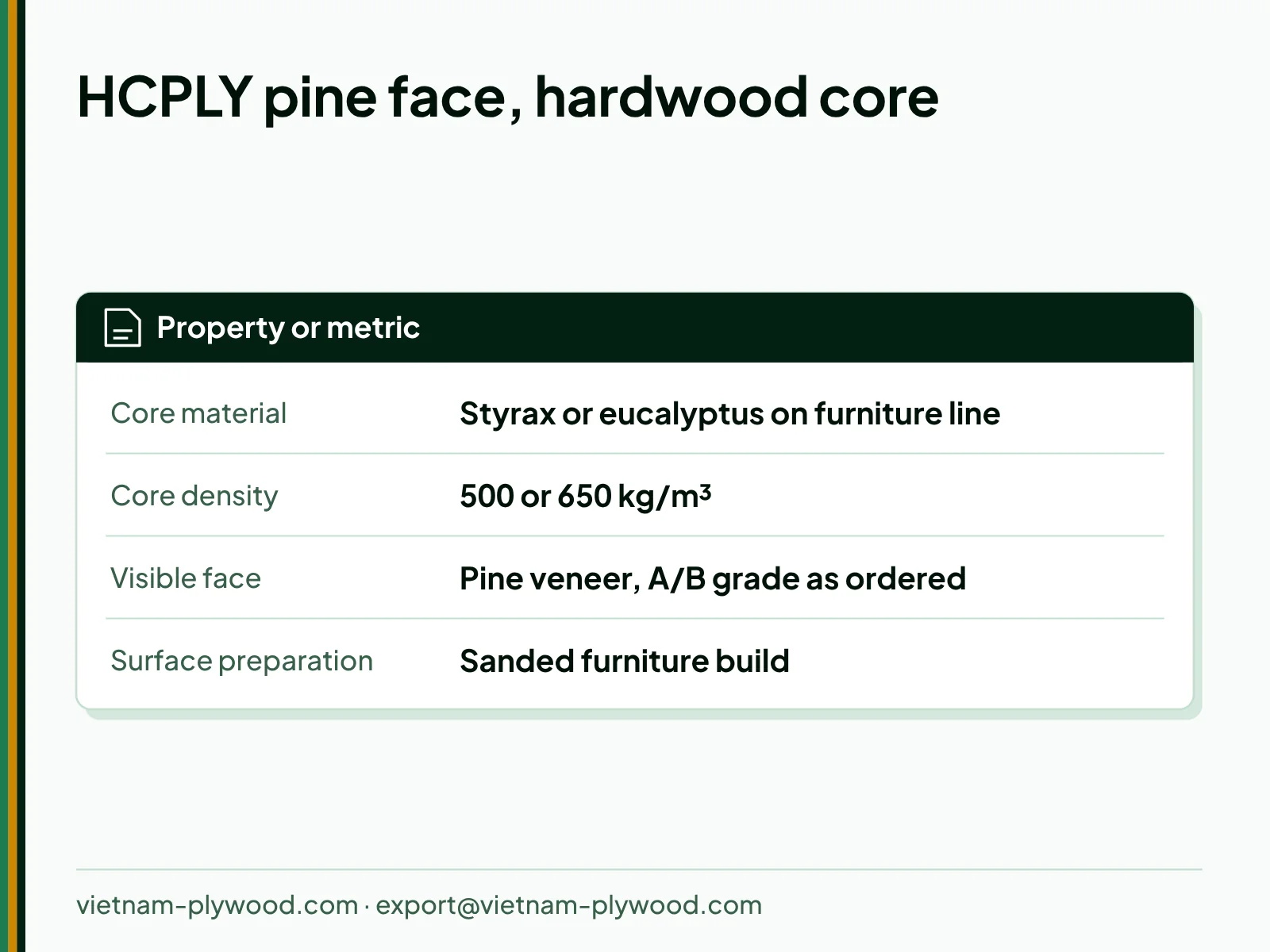
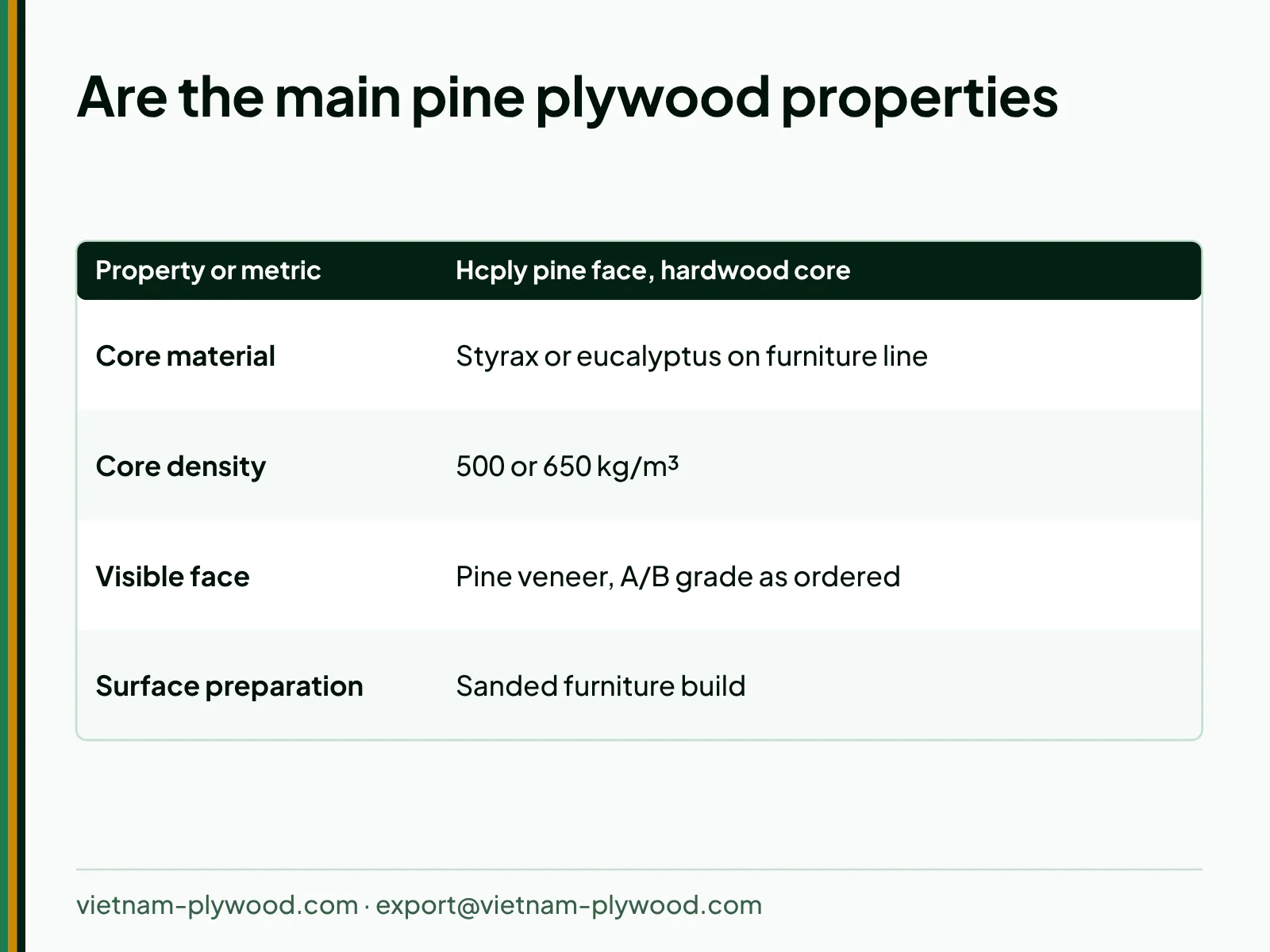
| Property or metric | HCPLY pine face, hardwood core | All-softwood radiata or southern pine panel | Buying verdict |
|---|---|---|---|
| Core material | Styrax or eucalyptus on furniture line | Pine veneers through the core, when specified as such | Identify every core before comparing |
| Core density | 500 or 650 kg/m³ | Species and build specific; request measured data | Use declared core for freight estimates |
| Visible face | Pine veneer, A/B grade as ordered | Pine veneer with its own grading system | Approve appearance samples |
| Surface preparation | Sanded furniture build | Depends on panel grade | Sanded build suits cabinet finishing |
| Thickness tolerance | ±0.2 or ±0.3 mm as ordered | Obtain producer’s tolerance | Furniture machining favours controlled tolerance |
| Edge screw holding | Influenced by hardwood core and core joints | Influenced by softwood veneers and core joints | Test the intended edge joint |
| Structural classification | No structural grade stated | Some market panels carry structural grading | Use a tested, accepted grade for structural work |
What is pine plywood density?
For HCPLY pine-faced furniture plywood, the specified core density is 500 kg/m³ for styrax or 650 kg/m³ for eucalyptus. Density follows the core rather than the thin pine face. These are core-based planning values, not laboratory measurements of every finished panel.
At 18 mm and 1220 × 2440 mm, the core-based sheet weights are 26.79 kg for styrax and 34.83 kg for eucalyptus. The difference matters for lifting, pallet planning and freight even though both sheets can show the same pine surface.
What is pine plywood good for?
Pine-faced hardwood-core plywood suits interior furniture components, display panels and utility fit-outs where its grain matches the finish schedule. The correct application depends on the visible face, expected wear, fastening pattern and moisture exposure.
For visible cabinet sides or retail fixtures, choose the face sample first, then check machining tolerance. For painted furniture, inspect knots and surface repairs under the intended primer. For concealed utility components, a decorative pine face can add cost without improving the function.
Is pine plywood good for cabinets?
Pine-faced plywood can work for cabinets when the core, face quality and fastener layout meet the cabinet maker’s requirements. Our furniture line builds sanded, full stitched styrax- or eucalyptus-core panels with E0 or E1 emission classes.
For doors and exposed end panels, review grain continuity, knot acceptance and colour matching across a production lot. For carcasses, prioritize flat machining surfaces, thickness tolerance and stable joints. A 0.2–0.4 mm face veneer gives a decorative surface, but aggressive sanding can cut through it.
Test hinge screws and shelf-support fittings in the actual proposed core. Edge screw withdrawal depends on core joints, screw diameter, pilot holes and edge distance; a pine face does not provide a screw-holding rating. If a component needs a documented mechanical performance value, make the accepted test report part of the purchase specification.
How does pine-faced hardwood plywood differ from radiata or southern pine plywood?
Our pine-faced panel keeps the appearance of pine while its hardwood core sets most of the sheet mass and internal fastening conditions. Radiata and southern pine plywood descriptions often refer to pine veneers through the panel, although constructions must be checked individually.
A buyer comparing a pine-faced eucalyptus core with radiata plywood is comparing different cores as well as faces. Greater core density does not automatically prove greater screw withdrawal, bending strength or moisture resistance. Those outcomes need comparable tests on the specified thickness, grade and fastener arrangement.
Which production line makes each pine-related build?
Our furniture line presses the pine-faced cabinet build; our commercial and packing line makes acacia-core utility panels, and our construction line makes film-faced formwork panels. The same 18 mm nominal thickness can therefore serve different jobs.
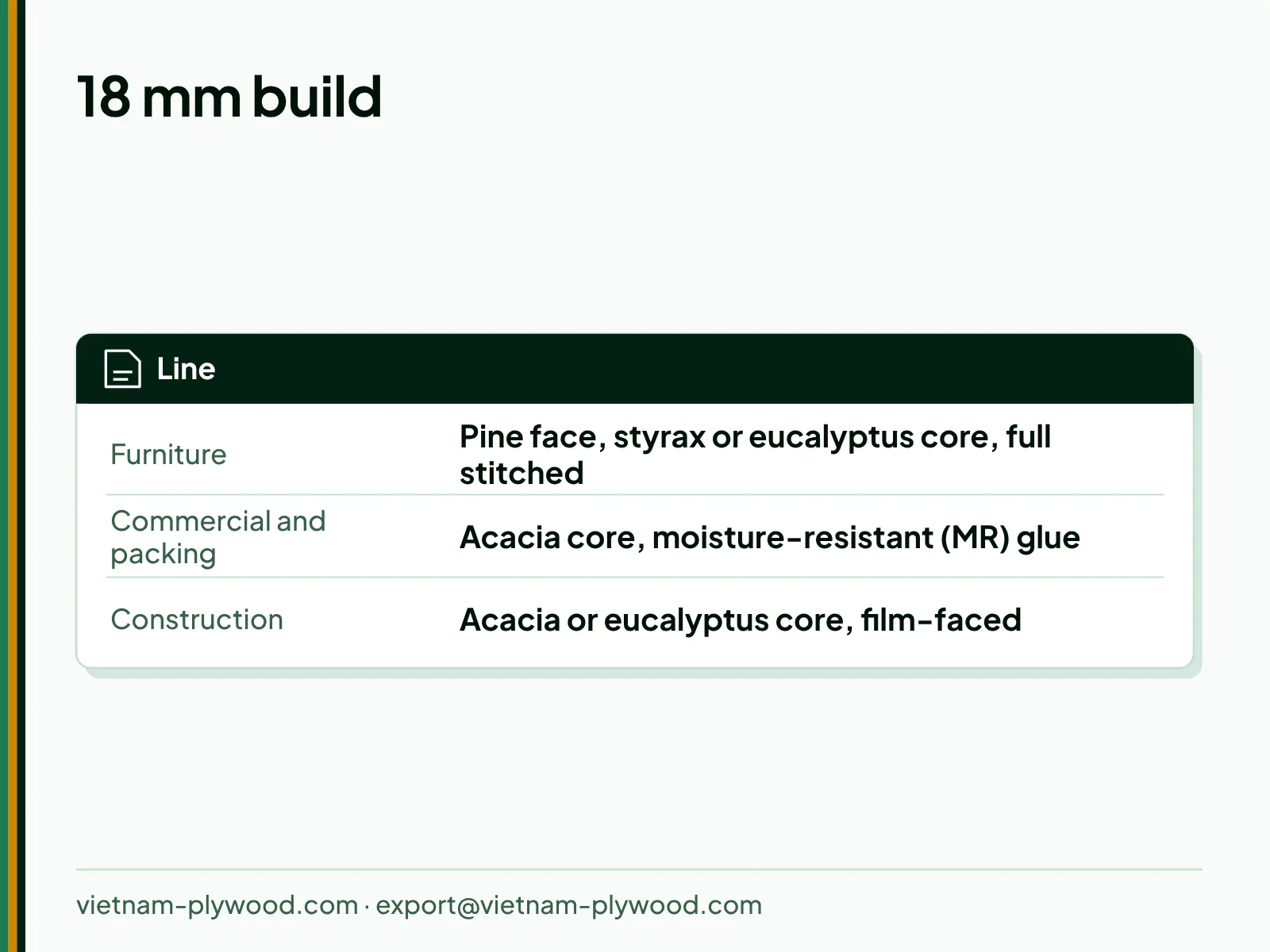
| Line | 18 mm build | Surface and tolerance | Suitable decision |
|---|---|---|---|
| Furniture | Pine face, styrax or eucalyptus core, full stitched | Sanded; ±0.2 or ±0.3 mm as ordered | Cabinets and visible furniture |
| Commercial and packing | Acacia core, moisture-resistant (MR) glue | Unsanded or light-sanded; commercial ±0.5 mm | Utility and packing parts |
| Construction | Acacia or eucalyptus core, film-faced | Unsanded; ±0.5 mm | Concrete formwork rather than pine display faces |
The producing factory is selected against the written specification. HCPLY handles specification, on-site quality control, export paperwork and loading; buyers can visit the factory office and inspect goods at the producing factory.
Is pine plywood furniture grade, and how is it specified?
Pine-faced plywood is furniture grade when its face, core construction, machining tolerance and emission class match the furniture order. A/B is our face grading language; it should not be confused with the different grading codes used for construction softwood plywood.
Choose full stitched core for the most consistent furniture build. A lower-cost alternative can use stitched outer layers with edge-trimmed inner veneers; finger-jointed and loose-laid cores are further down the construction hierarchy. These are distinct constructions, so ask for an edge sample instead of treating “plywood” as one grade.
Specify glue separately from emissions: melamine MR glue has a 12-hour boil designation; phenolic weather-and-boil-proof (WBP) glue has a 72-hour boil designation. E0 and E1 describe emission classes rather than adhesives. For a US-bound regulated interior panel, the US Environmental Protection Agency’s 2016 final rule, as explained in its current formaldehyde standards guidance, requires applicable hardwood plywood to meet Toxic Substances Control Act (TSCA) Title VI certification and labelling provisions. The factory’s relevant CARB Phase 2 or emission documents can be shown with factory details masked, on request.
What can an inspector check before accepting a load?
An inspector can compare a retained pine-face sample with production sheets, measure thickness and examine the core at a cut edge. These checks are more useful than judging a closed pallet from its face label.
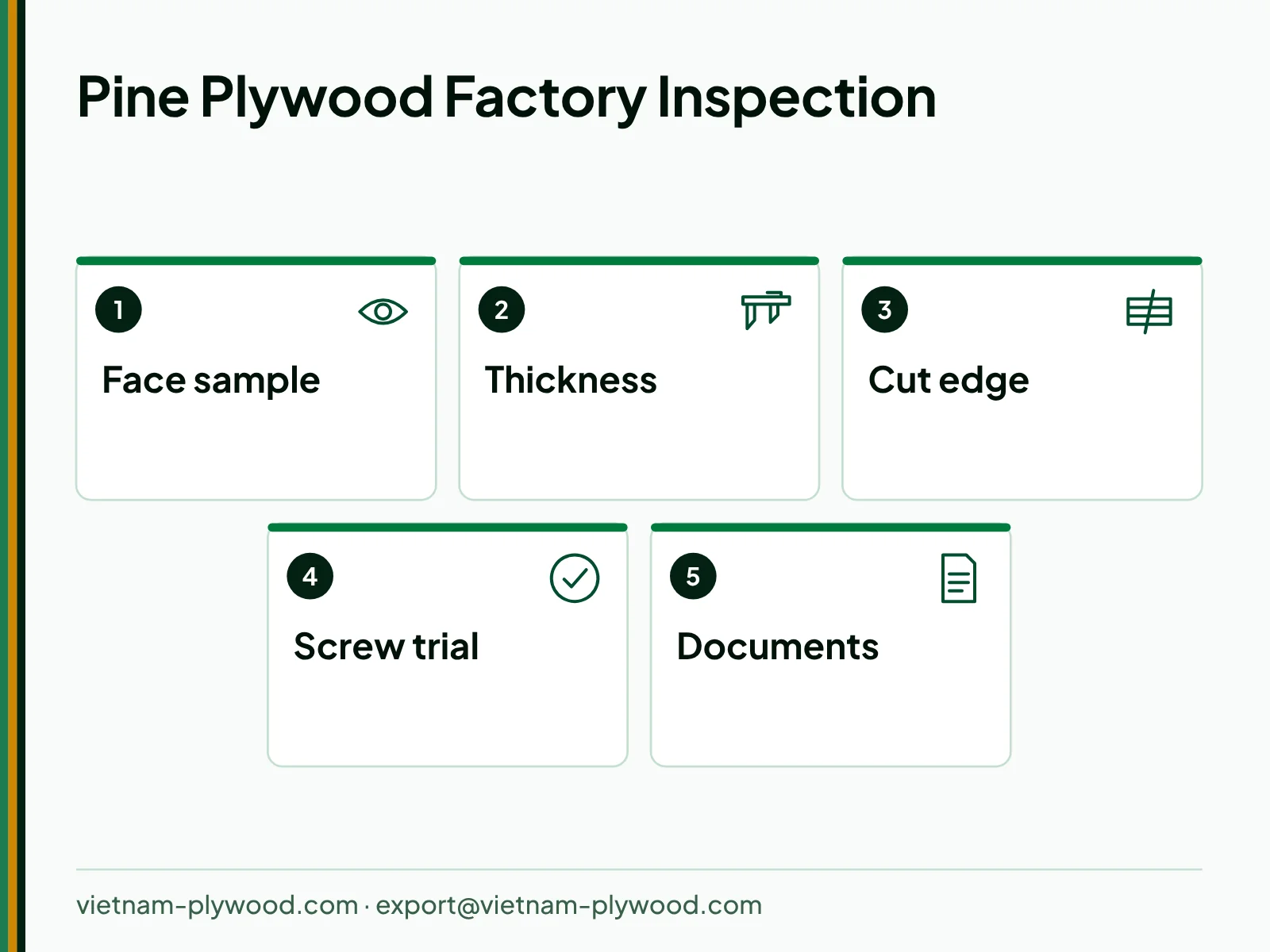
- Match the purchase specification and approved sample to the face grade, grain, knots and surface repairs.
- Measure thickness across representative sheets against the ordered ±0.2 or ±0.3 mm furniture tolerance; check length and width against ±2 mm.
- Inspect cut edges for full stitched construction, open joints and veneer gaps; check the panel after machining a representative cabinet part.
- Trial the actual hinge or connector screw in the chosen core, recording the joint configuration and acceptance result.
- Check the order’s emission certificate or agreed test report against the exact build and producing factory.
For export, the packing list identifies quantities and pack details; the agreed test and certificate documents address the ordered product properties. After loading, the draft shipping documents come to you for approval.
Can pine-faced sheets share a container with other plywood?
Pine-faced furniture sheets can share a 40-foot high-cube container with other specifications when pallet arrangement and total payload remain within 28.5 tonnes. The mix must be planned by core density, sheet thickness and packing layout.
For a single-specification reference at 18 mm, 1220 × 2440 mm, the styrax-core lookup is 990 sheets, 53.05 m³ and 26.52 tonnes per full 40HC. The eucalyptus-core lookup is 795 sheets, 42.60 m³ and 27.69 tonnes. These are alternative full-container plans, not quantities to add together.
Use the mixed-container loading options to discuss combinations and the container packing reference for load counts. Distributors planning recurring assortments can also review plywood supply programmes.
What should a buyer request for a pine plywood quotation?
A useful quotation starts with a cabinet or fit-out specification, an approved pine-face sample and a declared hardwood core. HCPLY can quote the build against size, surface grade, quantity and destination rather than against the name “pine plywood” alone.
For this furniture build, core selection and construction quality are major cost drivers, followed by face selection, finishing and thickness. A full stitched, sanded furniture build costs more to make than a lower-finish utility construction because it uses more veneer preparation and surface work. Request a written quotation for the agreed pine face and core.
The minimum order is one 40HC, with mixed specifications possible within the payload limit. Factory lead time runs 15–45 days from receipt of the 30% deposit; the exact figure depends on order size, line loading and what the contract fixes; the 70% balance is against the scanned bill of lading, by telegraphic transfer or irrevocable letter of credit at sight. We ship FOB Hai Phong, or CFR (CNF) or CIF to your port.
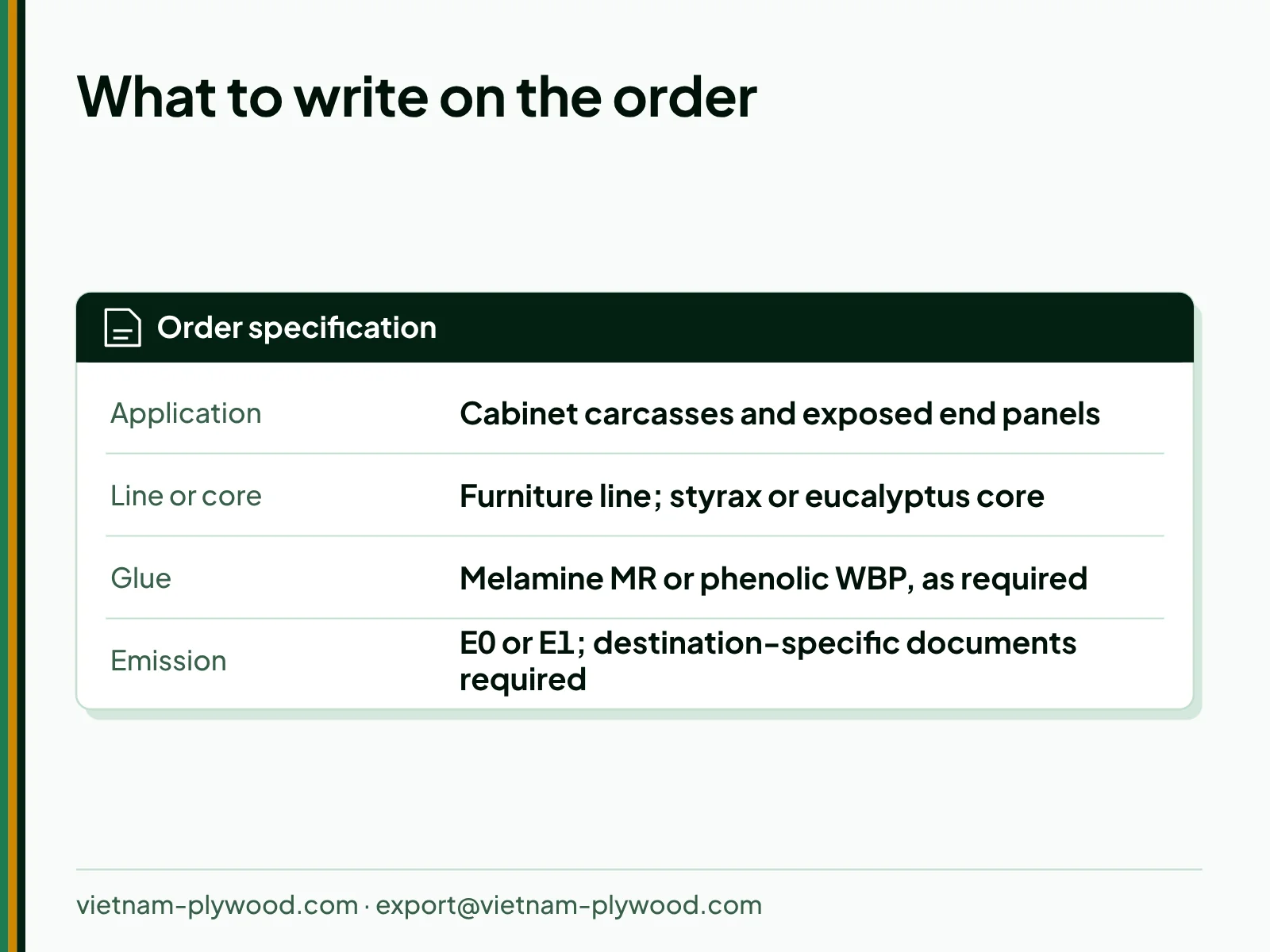
Send the following to Lucy at export@vietnam-plywood.com or through contact:
Application: cabinet carcasses and exposed end panels
Line or core: furniture line; styrax or eucalyptus core
Glue: melamine MR or phenolic WBP, as required
Emission: E0 or E1; destination-specific documents required
Face and grade: pine face, A/B; approved appearance sample
Thickness and tolerance: 18 mm; ±0.2 or ±0.3 mm as ordered
Size: 1220 × 2440 mm
Quantity: one 40HC or agreed mixed specification
Destination port: [name of port and country]
Ask for a sample set showing the pine face, cut edge and proposed cabinet machining finish.