





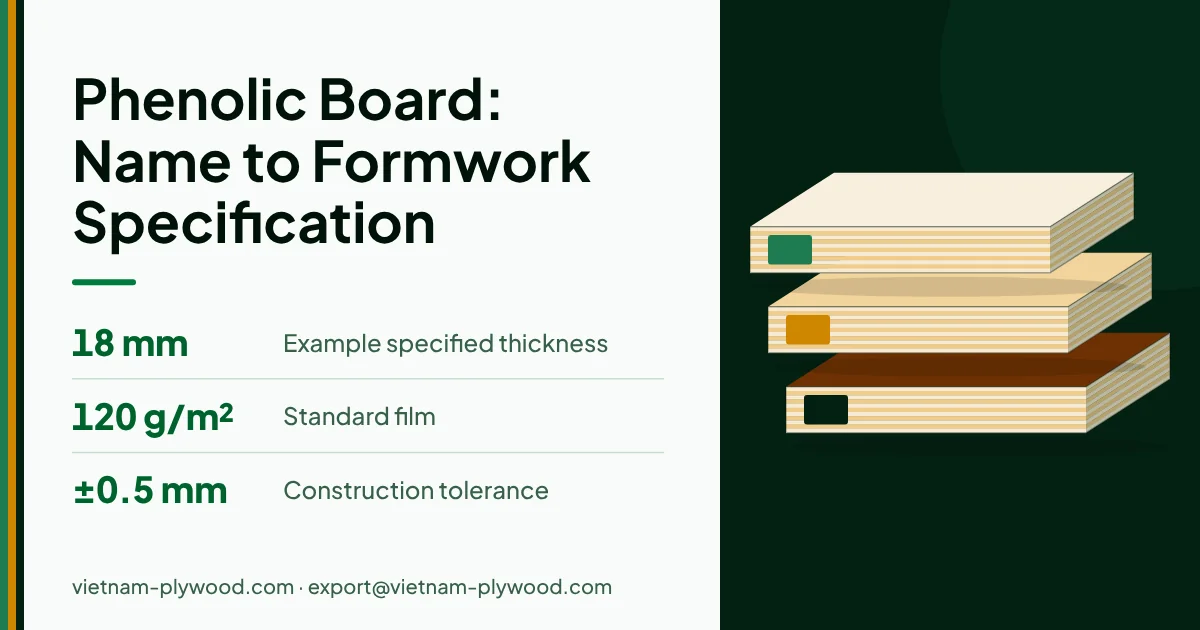
Phenolic board in Philippine formwork purchasing should be specified as a particular film-faced plywood build, rather than ordered by trade name alone. A wrong core, bond or thickness can mean rejected sheets, lost site days and replacement freight. HCPLY makes this construction product on our construction line and asks buyers to state the measurable build before production.
What is phenolic board?
Phenolic board is a trade name with two materially different meanings. Philippine construction buyers often use it for plywood faced with resin-impregnated film, especially shuttering sheets for concrete. Other catalogues use the same words for solid phenolic laminate made from resin-treated paper or fabric. A purchase order must distinguish the wood-veneer product from the solid laminate before thickness or price comparisons have value.
The TRSK explanation describes paper or fabric layers in solid phenolic laminate, a different material from our construction plywood.
For the wood-core product, start with the film-faced plywood specification and record the face, adhesive, core and thickness. Our construction line presses film-faced plywood; we do not press solid phenolic laminate, MDF, oriented strand board (OSB), chipboard or blockboard. A drawing or approved physical sample resolves a naming dispute faster than a trade-name-only quotation.
Is phenolic board the same as phenolic plywood?
Phenolic plywood means a wood-veneer panel carrying phenolic film or using a phenolic adhesive, but those features are separate. A smooth dark film can cover a melamine-glue plywood core. Likewise, a phenolic-glue plywood panel need not have a phenolic film face. Specify both fields explicitly.
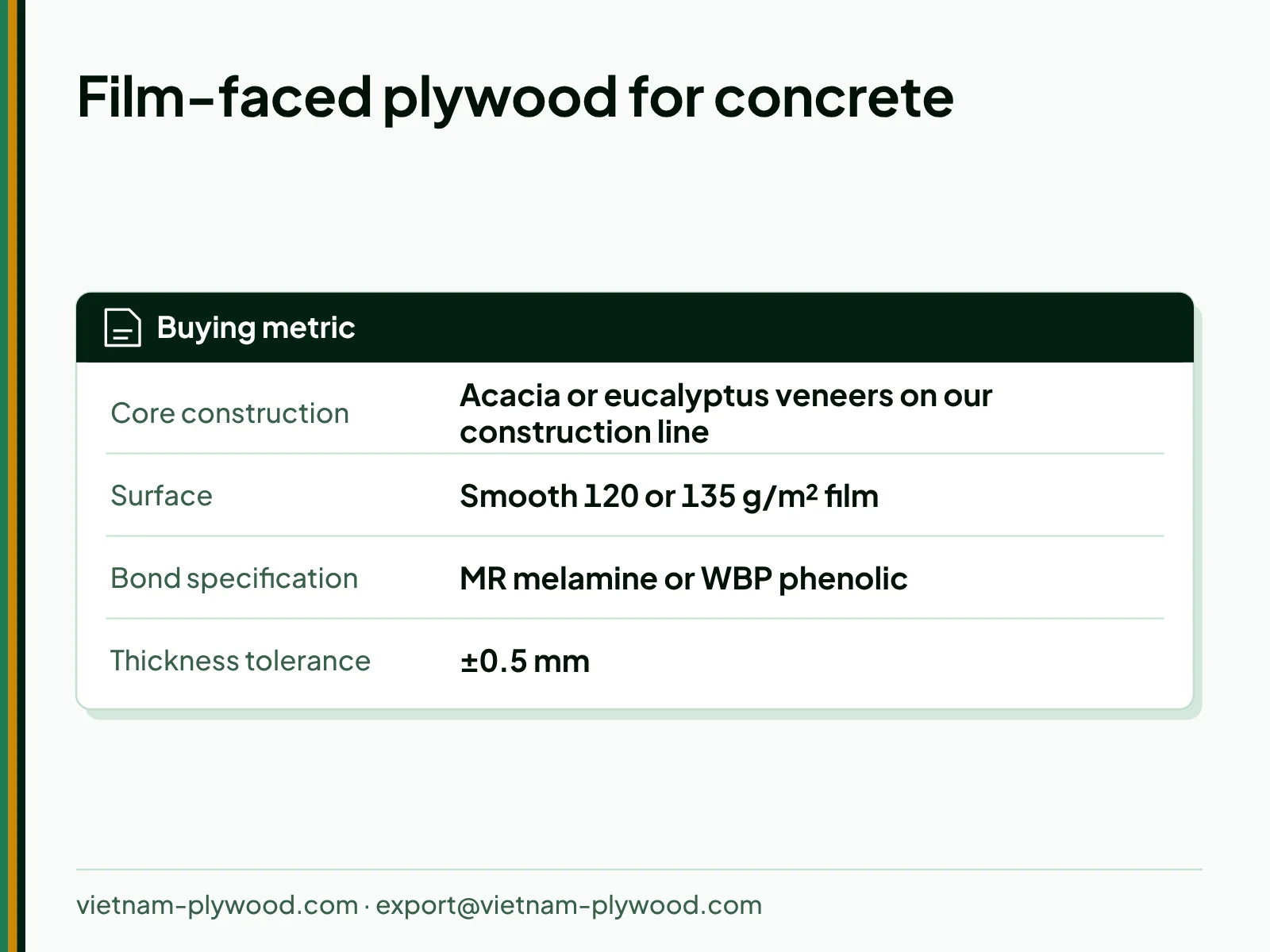
| Buying metric | Film-faced plywood for concrete | Solid phenolic laminate | Ordinary commercial plywood | Verdict by use |
|---|---|---|---|---|
| Core construction | Acacia or eucalyptus veneers on our construction line | Resin-impregnated paper or fabric | Acacia veneers on our commercial and packing line | Wood-core film-faced sheet for reusable concrete forms |
| Surface | Smooth 120 or 135 g/m² film; textured 220 g/m² anti-slip option | Solid resin laminate surface | Raw, unsanded or light-sanded veneer | Smooth film for concrete release; textured film for grip applications |
| Bond specification | MR melamine or WBP phenolic, ordered separately | Laminate resin construction | MR glue | Specify WBP where the intended formwork exposure calls for it |
| Thickness tolerance | ±0.5 mm | Supplier-specific, no figure assumed | ±0.5 mm | Inspect against the written order |
| Main purchasing risk | Damaged film or unsealed edges | Wrong product family for the intended system | Raw face and different surface finish | Do not substitute one material by name |
The comparison is functional, not a claim that one board is structurally superior. For another boundary, read film-faced or marine plywood: the word marine needs a test report the buyer accepts.
What is phenolic board made of?
Our phenolic plywood formwork build uses acacia or eucalyptus veneers, an ordered adhesive system and pressed surface film. The core species drives density: acacia is 580 kg/m³ and eucalyptus is 650 kg/m³. Film colour does not reveal either species, and a dark face does not prove the adhesive inside.
The construction line offers phenolic or melamine film, including an anti-slip film option, over an unsanded veneer core. Standard film weight is 120 g/m²; premium film is 135 g/m²; 220 g/m² is reserved for anti-slip film. Film weight describes the face material, not panel bending strength or a measured abrasion result.
Our adhesive terminology also needs care. Melamine glue is described as MR with a 12-hour boil condition; phenolic glue is WBP with a 72-hour boil condition. These are factory build descriptions, not automatic acceptance under a Philippine bonding class. The WBP hot-press range is 130–145 °C, while the MR range is 110–120 °C.
Emission is a separate field: E0, E1 or E2 describes a class, while CARB Phase 2 or TSCA Title VI refers to a US regulatory limit and third-party certification. Do not infer emission from adhesive type. Any certificate for a member factory, including FSC, CARB P2, ISO 9001 or CE, is shown with factory details masked, on request; its applicability to the ordered build needs checking.
What phenolic board sizes and thicknesses should be written?
Write dimensions in millimetres, with feet and inches only as a familiar cross-reference. A nominal 4 × 8 ft sheet corresponds approximately to 1220 × 2440 mm, or 1.22 × 2.44 metres. A nominal 18 mm panel is approximately 0.709 inch; calling it three-quarter inch does not make 18 mm equal to 19.05 mm.
Our available thickness range is 3–40 mm. Common thicknesses are 3, 5, 9, 12, 15, 18, 21 and 25 mm; the construction line has a ±0.5 mm thickness tolerance. Available sizes are 1220 × 2440, 1250 × 2500, 1220 × 2135, 1220 × 1830, 915 × 2440, 915 × 2135 and 915 × 1830 mm, with custom cutting available.
For a 12 mm sheet, write 12 mm ±0.5 mm, not simply “half inch.” For 18 mm, write 18 mm ±0.5 mm, not “three-quarter inch.” Length and width tolerance is ±2 mm. This avoids an imperial label silently replacing a metric acceptance criterion.
Ply count is another inspection field rather than a fixed marketing number. Veneer thickness is 1.4–2.0 mm, and an 18 mm panel has 11–13 plies. For dimensional comparisons across panel types, the construction plywood range provides the related product context.
Is phenolic board waterproof?
Film-faced plywood resists contact with wet concrete better than an unprotected raw face, but a panel should not be described as permanently waterproof. Moisture can enter through cuts, fastener holes, film damage and unsealed edges. The adhesive bond and surface barrier must both fit the actual exposure.
A phenolic adhesive with a WBP build is distinct from a phenolic film surface. A sheet sold as phenolic board could have a different adhesive beneath the film. Ask for the glue field and an agreed test report before treating a wet-use claim as a purchasing requirement.
Seal factory edges and every newly cut edge before pouring. Apply a release agent on every pour, keep panels supported, and avoid scraping the face during stripping. A film surface is consumable under site abrasion; scratches are an inspection finding even when the veneer core remains intact.
For reuse planning, with proper handling, a release agent on every pour and sealed edges (cut edges included), melamine-glue film-faced plywood gives about 12–15 pours and phenolic-glue up to about 25 pours. See the melamine film-faced plywood comparison when deciding which adhesive build belongs in the request.
Is phenolic board stronger than ordinary plywood?
A film face alone does not establish a higher load capacity than ordinary plywood. Bending strength, stiffness and allowable span depend on the veneer build, orientation, thickness, support layout and test method. A supplier’s film weight cannot replace a load table or test report.
A formwork engineer should provide the concrete pressure, support spacing, deflection criterion and intended reuse conditions. Match those to test evidence for the exact offered panel. Ask for the accepted bending test report and project load table before assigning a structural rating.
An 18 mm construction sheet can have 11–13 plies, but that count alone does not certify a structural grade. A visually tidy edge is useful for spotting voids and loose layers, yet it does not quantify bending strength. Treat an unsupported strength comparison as an unresolved specification, not a purchasing verdict.
The advantage of film-faced plywood is practical: its surface can release from concrete more cleanly when maintained correctly. That is different from proving greater strength. For a cost comparison that separates face and core choices, see film-faced versus commercial plywood.
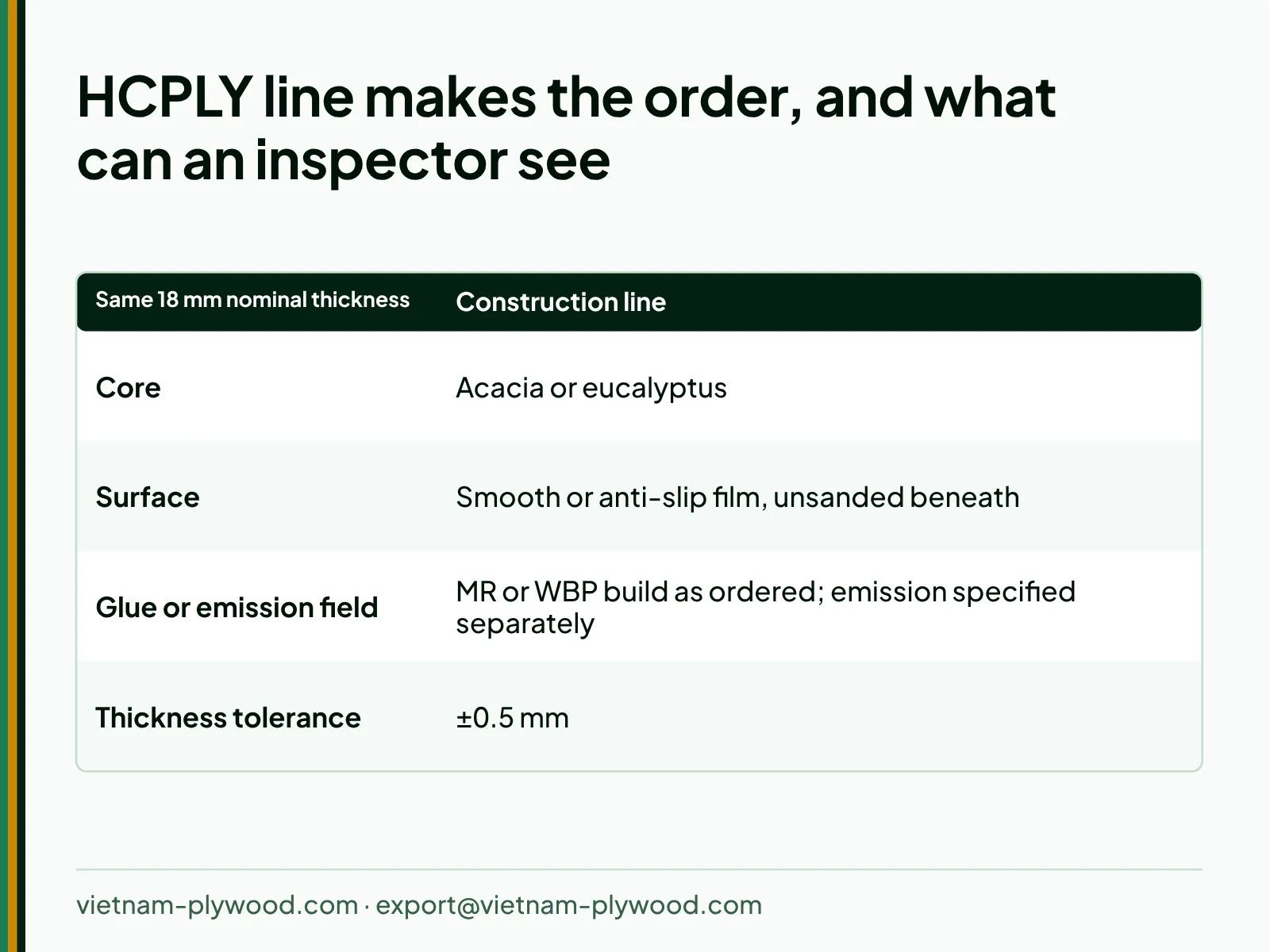
Which HCPLY line makes the order, and what can an inspector see?
Our construction line presses the film-faced build for formwork, while the other lines serve different end uses. A buyer can witness dimensions, film condition, exposed core construction and packaging at the producing factory. HCPLY coordinates specification, on-site quality control, documents and loading from the factory selected for the order.
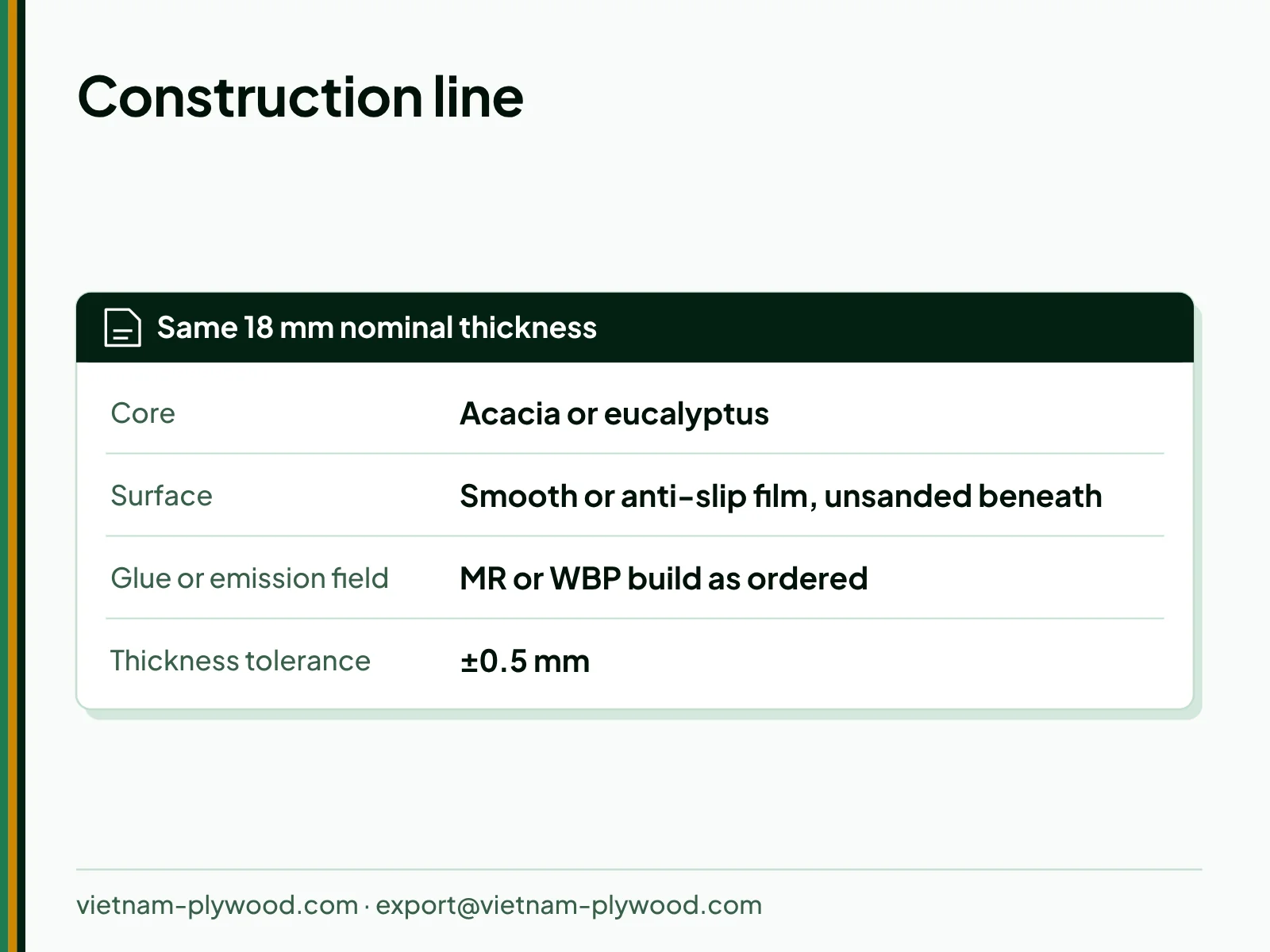
| Same 18 mm nominal thickness | Construction line | Commercial and packing line | Furniture line |
|---|---|---|---|
| Core | Acacia or eucalyptus | Acacia | Styrax or eucalyptus |
| Surface | Smooth or anti-slip film, unsanded beneath | Raw, unsanded or light-sanded | Full stitched, sanded face |
| Glue or emission field | MR or WBP build as ordered; emission specified separately | MR glue | E0 or E1 emission class |
| Thickness tolerance | ±0.5 mm | ±0.5 mm commercial; ±0.5–1.0 mm packing | ±0.2 or ±0.3 mm as ordered |
| Intended purchase | Concrete formwork or selected textured industrial uses | Commercial or packing sheet | Furniture and cabinet parts |
At the factory office, compare the signed sample and specification with the lot being made. At the producing factory, inspect film weight designation, surface continuity, edge seal, core layers, thickness and cut size. Check the pallet labels against the packing list and the agreed product description before loading.
Our three factories are in Phu Tho and Hai Phong, with each order produced and shipped directly from its assigned factory. Factory visits include the producing location, where the buyer can inspect goods rather than relying only on a catalogue image. Do not infer a measured test result from a visual visit; request the agreed report separately.
What Philippine standard applies to phenolic plywood formwork?
Plywood entering the Philippine market falls within the Department of Trade and Industry Bureau of Philippine Standards (DTI-BPS) mandatory certification framework. In its 2021 notice, DTI-BPS identified Department Administrative Order 20-06, series of 2020, and requirements for foreign manufacturers holding valid Philippine Standard (PS) licences. Its official plywood standards page lists PNS ISO 12465:2017, Plywood — Specifications.
The DTI-BPS 2021 notice also lists marking fields: registered trade name, manufacturer and importer details, country of origin, hardwood or softwood type, bonding class, thickness in millimetres, formaldehyde emission information, batch identity and PS mark with licence number. These are national regulatory fields, separate from a seller’s “phenolic” description.
Before placing an import order, the importer must verify the currently applicable product scope, foreign-manufacturer licensing route and required markings directly with DTI-BPS.
A procurement specification should distinguish the factory’s MR/WBP adhesive description from the PNS bonding class, and E0/E1/E2 descriptions from the Philippine FE marking. The buyer’s compliance specialist should map those fields using accepted evidence. Where that mapping is absent, mark the compliance gate open rather than writing an unverified class into the order.
How do you calculate a mixed formwork container?
The first loading constraint is the 40HC payload limit of 28.5 tonnes, followed by core density, pallet count and stack height. For 1220 × 2440 mm sheets at 18 mm thickness, the factory loading calculation gives 880 acacia sheets or 795 eucalyptus sheets. The acacia case uses 16 pallets at 1000 mm stack height; eucalyptus uses 15 pallets at 970 mm.
For acacia, the loading table lists 31.08 kg per sheet, 880 sheets and 27.35 t per full 40HC. For eucalyptus, it lists 34.83 kg per sheet, 795 sheets and 27.69 t per full 40HC. Check the actual pallet plan and payload before loading.
Mixed specifications can share a container within that payload limit. The mixed-container ordering explanation covers the commercial decision; container loading calculations own the detailed sheet-count method.
Minimum order is one 40HC; one container can carry several specifications as long as the payload limit holds. Ask for a packing plan with the actual core mix before approving quantities.
What are the disadvantages of phenolic board?
Film-faced plywood can lose useful face quality through abrasion, impact, careless stripping and exposed cut edges. A poor match between core, glue and site conditions can make a nominally similar board perform differently.
Smooth film offers a concrete-contact face but should not be assumed slip resistant. Anti-slip film gives texture, yet its grip needs testing under the actual wet or contaminated conditions. Neither film type creates a fire rating, chemical-resistance certificate or structural grade without appropriate evidence.
Transport weight is another trade-off. At 18 mm and 1220 × 2440 mm, eucalyptus-core sheets are heavier than acacia-core sheets because the core densities differ.
Finally, “phenolic board” can conceal a material-family mismatch. A solid laminate intended for partitions or wet-area cubicles is not a drop-in substitute for wood-core shuttering plywood.
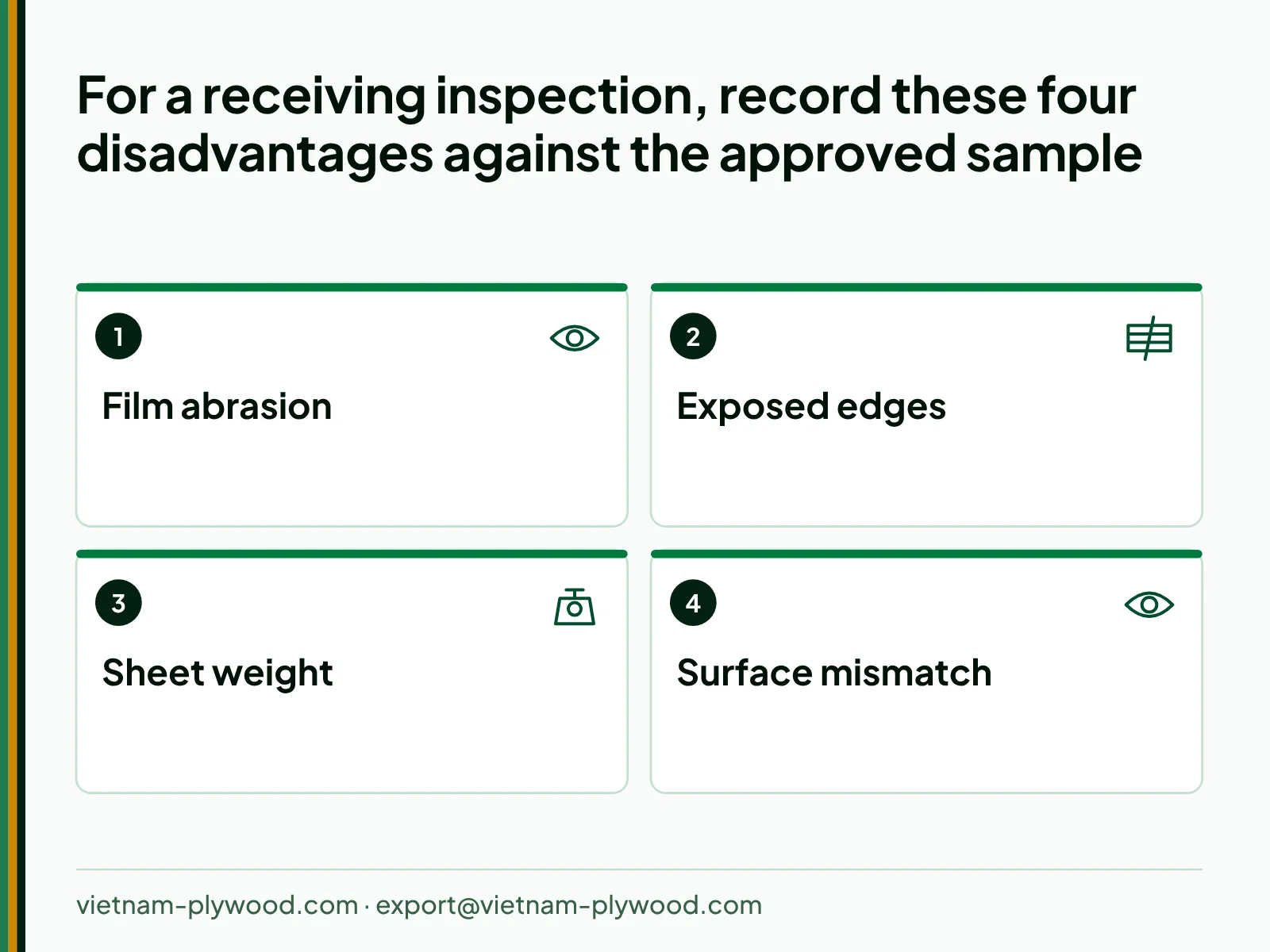
For a receiving inspection, record these four disadvantages against the approved sample:
- Film abrasion: Look for scratches or worn patches that affect the concrete-contact face.
- Exposed edges: Identify cuts and fastener holes that need sealing against moisture entry.
- Sheet weight: Check the ordered core species and pallet plan before approving handling and loading.
- Surface mismatch: Separate smooth formwork film from textured anti-slip film when checking the intended use.
Can phenolic board be used as flooring?
Textured anti-slip film-faced plywood can be evaluated for selected vehicle or industrial flooring, but acceptance needs load, support and slip evidence for the exact build. Smooth film-faced formwork sheets should not be presented as rated walking surfaces. For transport flooring, specify the surface texture and obtain project-specific slip and load evidence before approval.
Our 220 g/m² anti-slip film is the relevant face option when a buyer requests texture. State the expected traffic, moisture exposure, fastening method and support spacing. Request an accepted slip test and bending evidence where the application requires them; no performance class is implied by the film weight.
For concrete shuttering, a smooth 120 or 135 g/m² film is the more direct specification. For an industrial deck, face texture and mechanical design need a separate approval. Avoid turning a formwork reuse estimate into a flooring service-life claim.
How should a Philippine buyer compare quotations?
Compare quotations against one written bill of materials, including compliance evidence, rather than against the trade name. The largest cost differences usually come from the core construction and adhesive system, then film specification, thickness, size and inspection requirements. A phenolic-glue WBP build costs more than a comparable MR build because the adhesive and pressing conditions differ; premium or anti-slip film also adds face cost compared with standard film.
No fixed phenolic board price is provided here. Request a quotation against the exact build, quantity and delivery term. A retail price for a solid laminate or a different country’s stocked sheet is not a valid import comparison for Philippine formwork plywood.
Factory lead time runs 15–45 days from receipt of the 30% deposit; the exact figure depends on order size, line loading and what the contract fixes. The remaining 70% is paid on the scan of the bill of lading, by T/T, or by irrevocable sight L/C. We ship FOB Hai Phong, or CFR (CNF) or CIF to your port. Samples cost nothing: a first-time buyer pays the courier, and that charge comes off the first confirmed order.
The shipment document set includes commercial invoice, packing list, bill of lading (B/L), certificate of origin, phytosanitary and fumigation papers, insurance under CIF, and the order’s agreed certificate and test documents. After loading, the draft shipping documents come to you for approval.
What specification should go to the factory?
A complete request identifies the application, the producing line, core, glue, emission class, film, dimensions, tolerance, quantity and destination. It also names the Philippine compliance documents to be checked before an import commitment. HCPLY can then quote a build that an inspector can compare with a sample and the purchase order.
For a formwork yard, send the following editable lines rather than “phenolic board, 4 by 8.” Keep the national bonding-class and marking decisions as explicit approval gates until supported by accepted evidence.
Application: Reusable concrete formwork; project support and pour conditions attached
Producing line / core: Construction line / acacia core (580 kg/m³)
Glue: Phenolic WBP (72-hour boil build description)
Emission: E1 requested; acceptance evidence to be agreed
Face and grade: Smooth phenolic film, 120 g/m² standard; film designation on both faces
Thickness and tolerance: 18 mm ±0.5 mm (approximately 0.709 in)
Size: 1220 × 2440 mm (approximately 1.22 × 2.44 m), ±2 mm
Quantity: 880 sheets, acacia-core reference loading; final packing plan required
Destination port: Philippine discharge port to be named by buyer
Compliance gate: DTI-BPS PS licence, PNS bonding class and marking evidence to be verified
Ask Lucy at export@vietnam-plywood.com for a sample set matched to these specification lines through the contact page.