





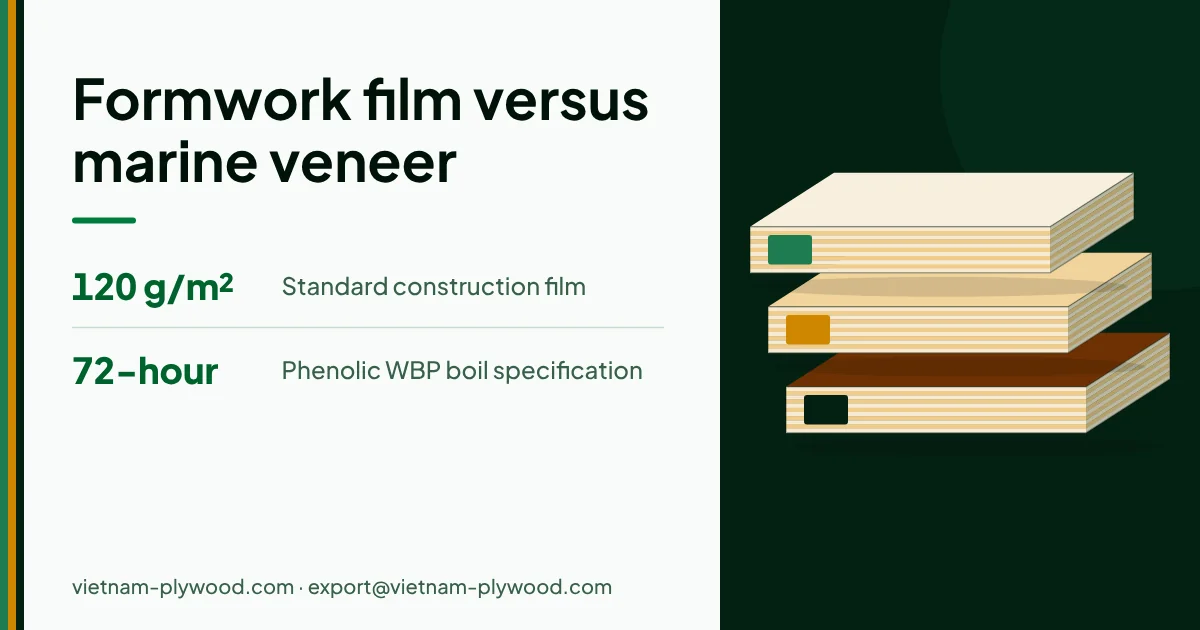
Film-faced plywood serves repeated concrete pours; marine plywood serves documented long-term wet applications. Choosing the wrong panel adds veneer cost, stripping labor or rejected concrete surfaces. For contractors comparing film faced plywood vs marine plywood, HCPLY recommends specifying the contact face and bond separately, then checking the core, exposure requirements and any marine claim against a test report the buyer accepts before ordering.
What is the difference in film faced plywood vs marine plywood?
Film-faced plywood is built around a resin-film contact surface for repeated concrete pours; marine plywood is specified around core integrity and long-term wet service. The face, bond, core acceptance criteria and intended service must all match the purchase order. A dark surface alone cannot establish marine performance. For a formwork yard, the film normally matters more than paying for a marine-grade veneer selection.
HCPLY makes film-faced plywood on our construction line, with acacia or eucalyptus cores and a phenolic or melamine film. A marine requirement such as BS 1088 must be assessed against a test report the buyer accepts. We do not treat a film-faced sheet as a marine-grade substitute simply because its glue withstands a boil test.
How do surface, bond, reuse and price compare?
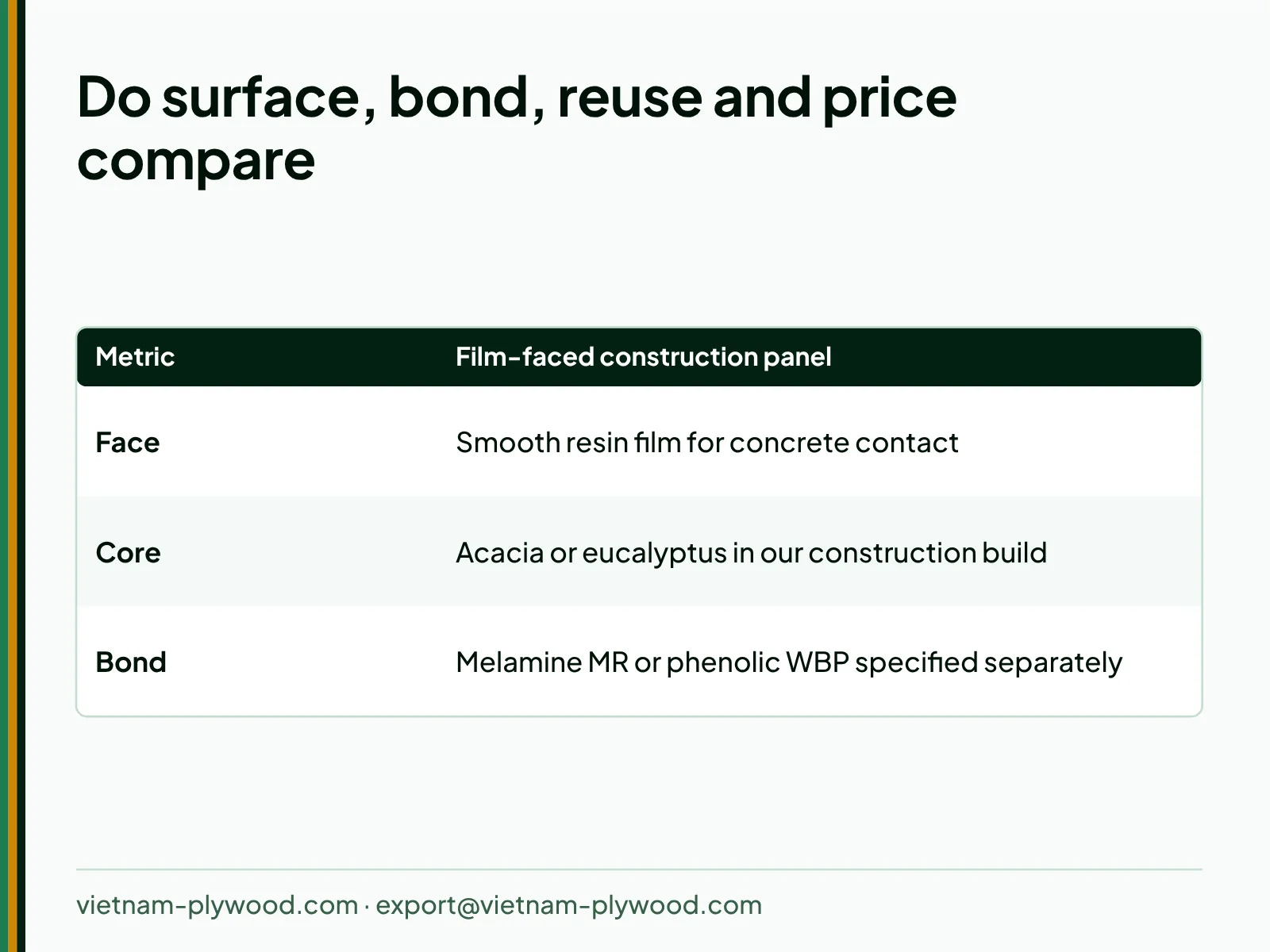
The useful comparison is performance in the actual application, rather than a generic claim that one panel is stronger. The following metrics separate the surface that touches concrete from the wood and glue underneath.
| Metric | Film-faced construction panel | Marine-specification plywood | Verdict by use |
|---|---|---|---|
| Face | Smooth resin film for concrete contact | Typically exposed graded veneer for coating | Film-faced for clean stripping; marine for specified finishing |
| Core | Acacia or eucalyptus in our construction build | Veneer quality and permitted gaps assessed against a test report the buyer accepts for the named marine specification | Marine for documented marine core criteria |
| Bond | Melamine MR or phenolic WBP specified separately | Bond must meet the named marine standard | Test the ordered bond, whichever product |
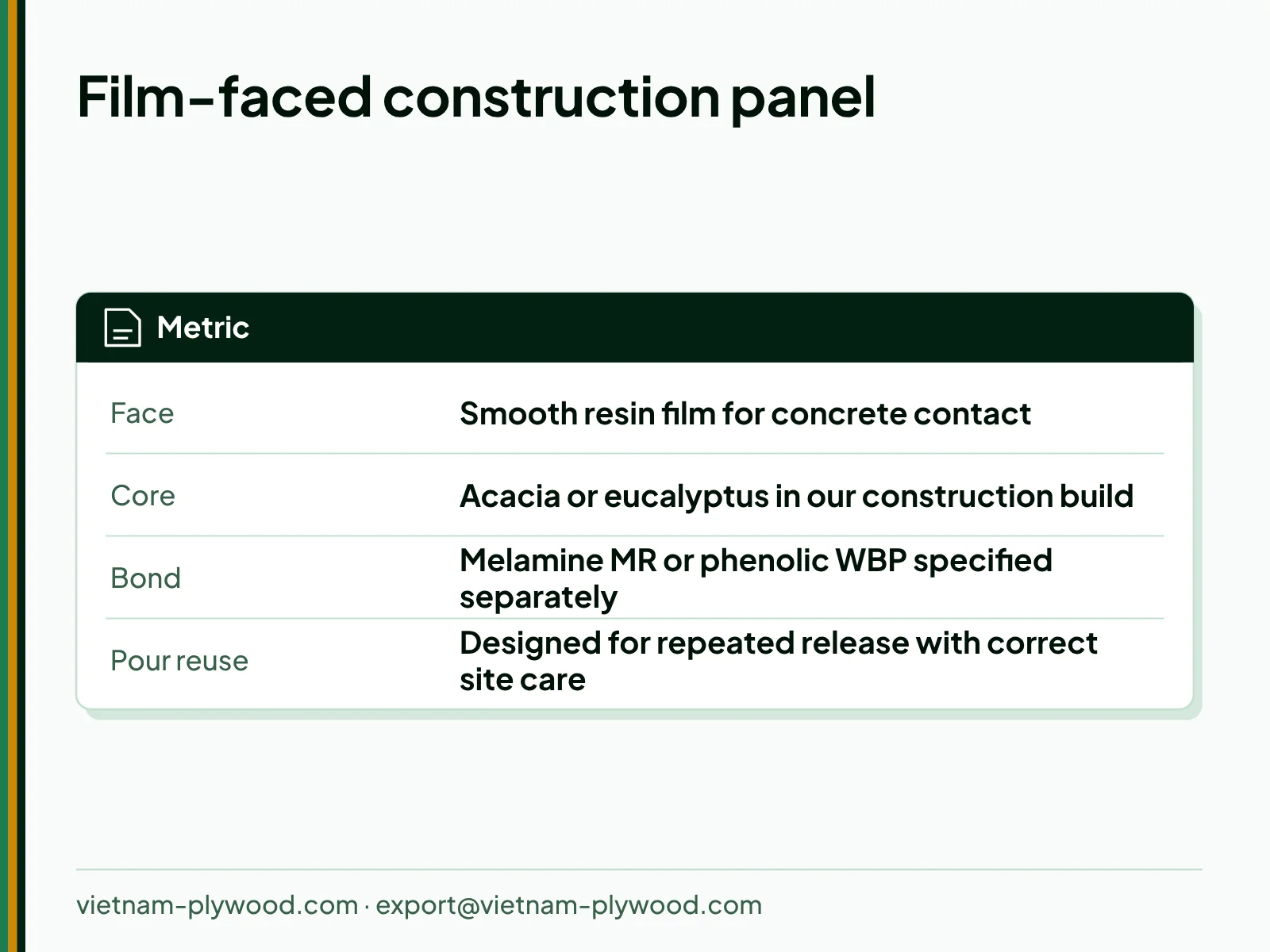
| Pour reuse | Designed for repeated release with correct site care | No inherent forming-film advantage | Film-faced for repeat pours |
| Wet service | Faces protected; cuts and penetrations need sealing | Selected for long-term marine exposure when certified by accepted evidence | Marine for boats and waterways |
| Price driver | Film weight, adhesive, core, dimensions and order | Higher veneer-selection and marine evidence costs | Compare cost per acceptable pour for formwork |
| Floor surface | Smooth film or purpose-made anti-slip film | Bare face to receive an engineered finish | Choose by traction and service exposure |
A 120 g/m² film is our standard construction face; 135 g/m² is premium, while 220 g/m² is reserved for anti-slip film. These are face weights, not proof of glue chemistry. For full construction specifications, see film-faced technical requirements.
Do I need marine plywood for formwork?
For ordinary concrete formwork, specify a suitable film-faced panel rather than paying for a marine build whose defining features do not improve concrete release. Wall forms, columns, slab decks and precast work need an appropriate face, support design and stripping procedure. A marine sheet can contact concrete, but its bare veneer normally needs a separate release-facing solution.
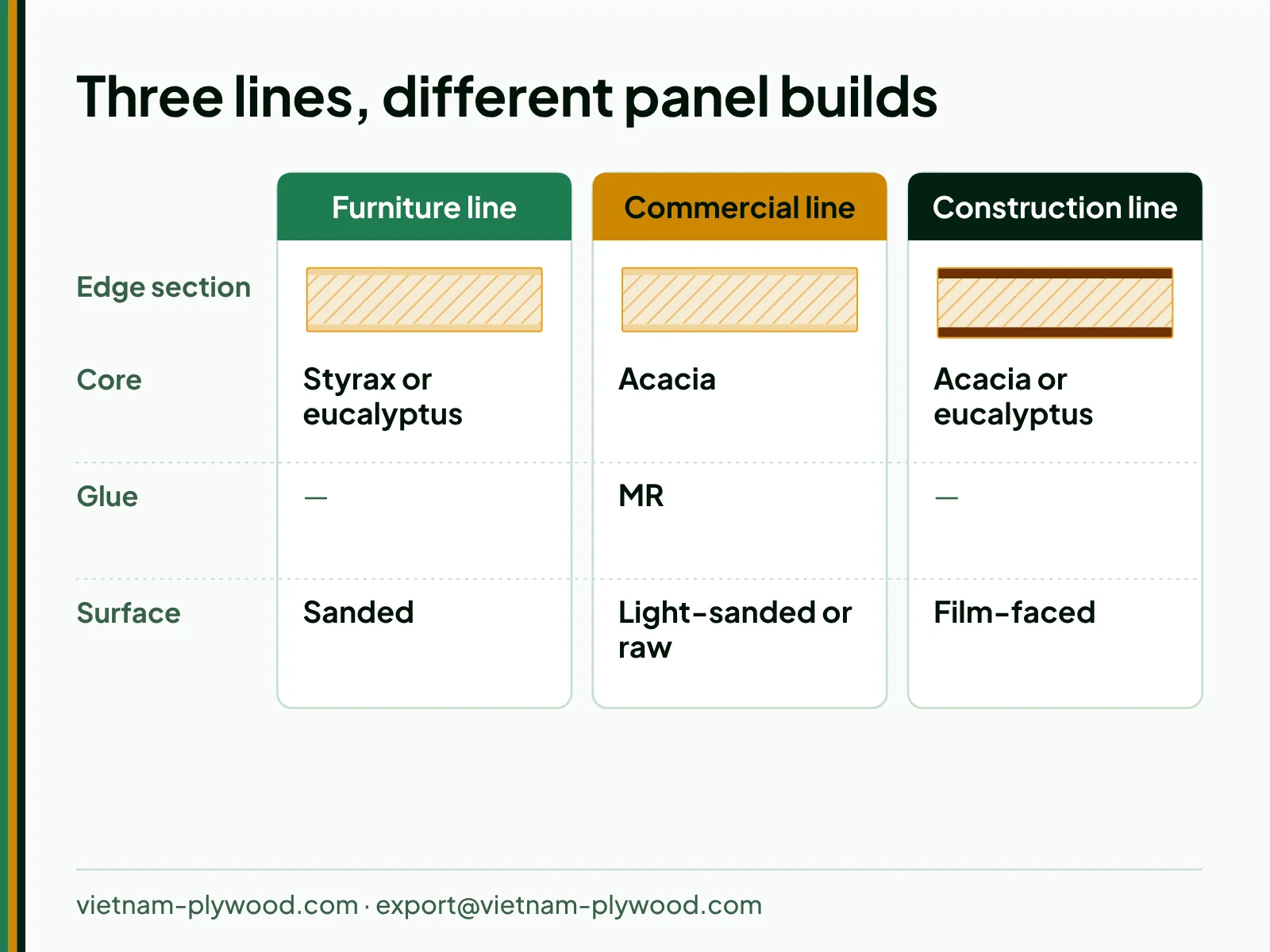
The construction line presses the film-faced sheet for this work. Our furniture line instead builds sanded, full-stitched styrax or eucalyptus-core panels with E0 or E1 emission classes. Our commercial and packing line builds unsanded or light-sanded acacia-core MR panels for commercial and packing applications. The same nominal thickness therefore describes three different purchasing decisions.
For repetitive work, write the pour exposure and target surface finish into the order before choosing glue. A contractor should also have the formwork designer approve spans, supports and loads; nominal sheet thickness alone is not a structural design.
Which is better, phenolic board or marine plywood?
Phenolic-film board is the better starting specification for concrete casting; a documented marine panel is the better starting specification for boats and permanently wet assemblies. “Phenolic” can refer to the surface film or the glue inside the panel, so an RFQ using that word alone is incomplete.
Our construction glue options are melamine MR, with a 12-hour boil specification, and phenolic WBP (weather and boil proof), with a 72-hour boil specification. Those figures describe the stated adhesive systems, not a marine certification. The film on the face is a separate field, and a heavy film does not upgrade a melamine bond to phenolic.
Where the project names BS 1088, use the named edition and a report covering the ordered build. The British Standards Institution’s 2018 BS 1088 scope describes marine craft and other waterway applications and addresses deterioration and bond durability. See the BSI standard scope.
What thickness and core should a formwork buyer specify?
Start with the formwork engineer’s panel schedule and choose the core, face and tolerance to match it. Construction sheets can be ordered in the stated overall thickness range of 3–40 mm, including common 12, 15, 18 and 21 mm sizes. Construction thickness tolerance is ±0.5 mm, with length and width tolerance ±2 mm.
Our construction line uses acacia at 580 kg/m³ or eucalyptus at 650 kg/m³. Density follows the core rather than the film color or veneer face. Available standard sizes include 1220×2440 and 1250×2500 mm; custom cutting is available. The thickness and sheet-size guide helps buyers align the panel schedule with packing.
At 18 mm, the core veneer construction typically has 11–13 plies. Core joints and internal gaps should be assessed on a representative cut edge, not inferred from a glossy face. Specify acceptance criteria for overlaps, voids and edge sealing in the written order.
What does a mixed formwork shipment change?
Mixed specifications can travel in one 40HC when the combined payload stays within 28.5 t. At 18 mm and 1220×2440 mm, the acacia-core lookup gives 31.08 kg per sheet and 880 sheets for a full acacia load, or 27.35 t. Eucalyptus-core sheets of the same dimensions weigh 34.83 kg, with a full eucalyptus load of 795 sheets or 27.69 t.
A mixed order therefore needs a pallet-by-pallet weight schedule rather than simply copying either full-load sheet count. If a buyer combines construction panels with furniture or packing panels, the different core densities and pallet arrangements must be recorded separately. For container planning, use the packing and load calculations and mixed-container order options.
What can an inspector witness at the producing factory?
An inspector can check the physical build against the signed specification before loading. At the producing factory, inspect the film surface and edges, measure thickness and dimensions, examine a representative cut edge for core gaps, and reconcile pallet labels with the packing list. Record the sample method and acceptance criteria before production.
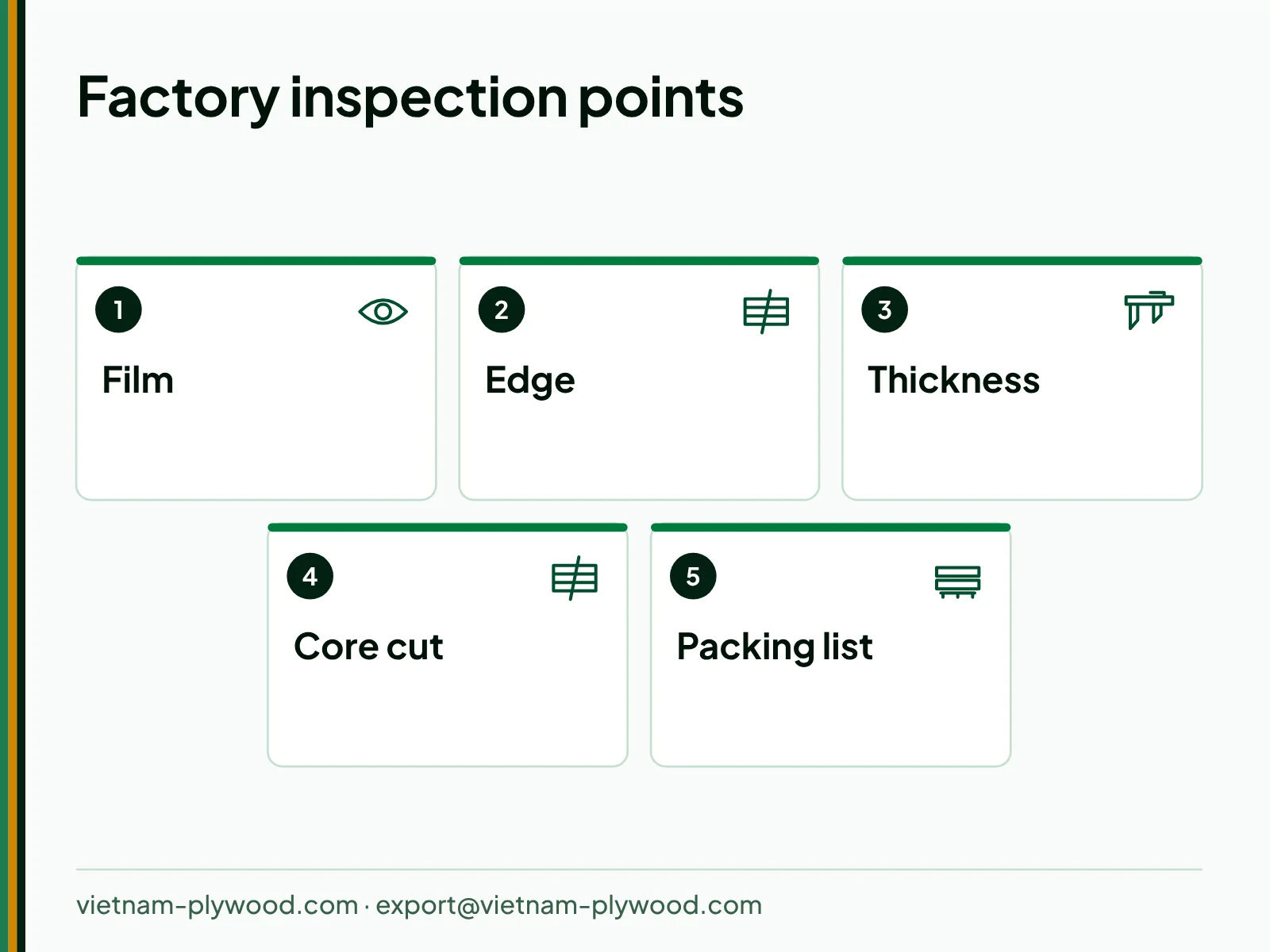
For a phenolic-board order, the inspection sheet should distinguish film weight from adhesive type. Visual inspection cannot establish a 72-hour boil result or a marine standard; use the agreed test report for those properties. An observed clean surface also cannot replace a structural assessment for formwork support spacing.
Buyers can visit the factory office and inspect goods at the producing factory. We handle specification, on-site QC, documentation and loading through shipment from the appropriate factory.
How should buyers compare phenolic board vs marine plywood price?
For repeat concrete pours, compare delivered panel cost per acceptable pour, including release agent, edge repair, cleaning and rejected surface work. Marine-grade construction commonly adds veneer selection and documentation costs that do not create a forming film. Film-faced cost instead responds to film weight, core species, glue system, thickness and quantity.
With proper handling, a release agent on every pour and sealed edges including cuts, melamine-glue film-faced panels give about 12–15 pours; phenolic-glue film-faced panels reach up to about 25 pours. Divide the quoted panel cost by a realistic accepted-pour count, then include site labor and replacement losses. Neither count is a promise for an untreated site.
There is no single useful phenolic board vs marine plywood price for every market or port. Send a written build and destination for a quotation; the film-faced versus commercial price comparison covers a different choice between two non-marine product families.
Is phenolic board or marine plywood better for flooring?
For flooring, the correct choice follows traction, moisture exposure, load design and the final surface system. A temporary industrial deck needing grip can call for anti-slip film; a boat deck or persistently wet marine assembly calls for a marine specification accepted by its designer. Smooth film should not be assumed slip resistant.
Our construction line offers 220 g/m² anti-slip film for the specified application. For flooring, request the required slip performance, substrate support schedule, edge treatment and any applicable project tests. A marine plywood designation by itself does not supply a finished slip rating or a complete flooring design.
For an interior floor that will receive another finish, compare the substrate and adhesive requirements with the actual floor assembly. The formwork surface advantage may add little value once covered, while a marine designation may be unnecessary in a dry assembly.
When is marine plywood still the right order?
Marine plywood remains the appropriate category when a boat, dock, waterway component or permanently wet assembly explicitly calls for marine-grade construction. The buyer should identify the relevant standard, grade, permitted core defects, bond tests and coating schedule. Where BS 1088 is requested, assess it against a test report the buyer accepts.
The 2018 BSI scope also warns that marine plywood can need additional requirements for a particular end use. This matters in structural floors, where the marine label alone cannot establish design capacity or code acceptance. A construction-film panel should not be substituted into a hull or dock merely because its face sheds water.
“Film faced marine plywood” is an ambiguous sales description. Separate the requested marine core standard from any optional film overlay and specify both explicitly. Our construction range is a film-faced formwork build; assess any marine-grade request against a test report the buyer accepts for that exact panel specification.
Which documents accompany the order?
The shipment document set identifies what was ordered and shipped, while the agreed product reports address technical properties. HCPLY prepares the commercial invoice, packing list, bill of lading, certificate of origin, phytosanitary and fumigation papers, plus insurance under CIF. EU lots include EUR.1 where applicable and the EUTR/EUDR file set.
Order-specific documents can include an FSC claim on sales documents, emission certificate and test reports for the agreed build. Member-factory certificates including FSC, CARB P2, ISO 9001 and CE are shown with factory details masked, on request. After loading, the draft shipping documents come to you for approval.
For a marine or structural claim, name the exact accepted report and panel construction in the order. A certificate for a different product or factory cannot establish the properties of the panels being inspected.
What should the buyer send for a trial container?
Send the application and measurable acceptance criteria first, then choose the appropriate production line and panel construction. A formwork yard should name the film, glue and expected pour conditions; a marine project should name its separate standard and report requirements. We can prepare a construction-panel quotation against that written specification.
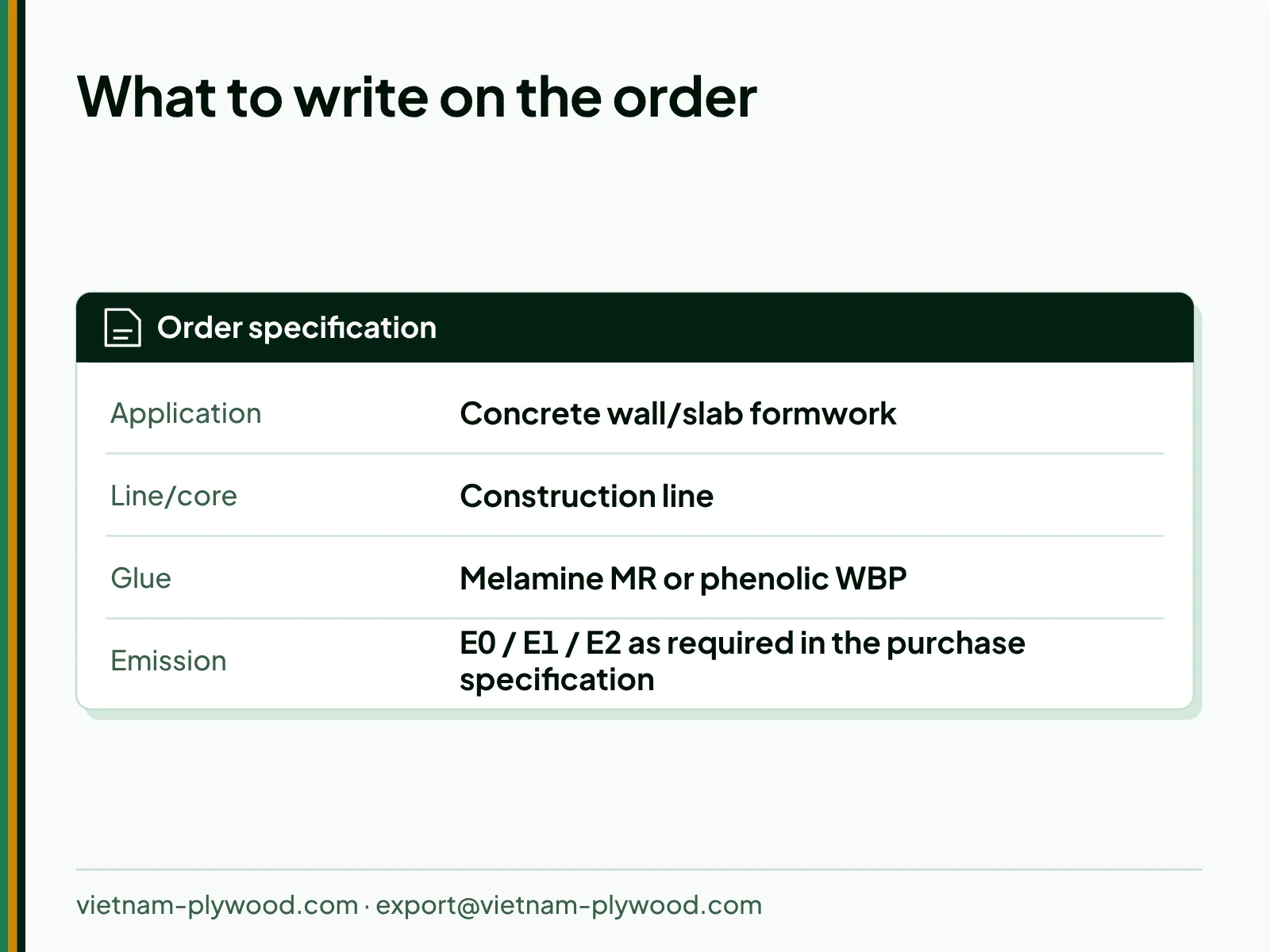
Application: concrete wall/slab formwork; pour exposure and finish: [specify]
Line/core: construction line; acacia or eucalyptus
Glue: melamine MR or phenolic WBP
Emission: E0 / E1 / E2 as required in the purchase specification
Face and grade: 120 g/m² standard / 135 g/m² premium film; anti-slip 220 g/m² if required
Thickness and tolerance: [mm]; ±0.5 mm
Size: 1220×2440 / 1250×2500 mm or specified cut size
Quantity: [sheets and pallets]; minimum one 40HC
Destination port: [port]; delivery term: FOB Hai Phong / CFR (CNF) / CIF
Plan a trial container with Lucy at contact or export@vietnam-plywood.com, using the agreed build and inspection criteria.